Notes for Monday – December 21, 2015

Today, we present another entry for Round 62 of the SurvivalBlog non-fiction writing contest. The nearly $12,000 worth of prizes for this round include:

First Prize:

  1. A Tactical Self-Contained 2-Series Solar Power Generator system from Always Empowered. This compact starter power system is packaged in a wheeled O.D. green EMP-shielded Pelican hard case (a $1,700 value),
  2. A Gunsite Academy Three Day Course Certificate that is good for any one, two, or three day course (a $1,195 value),
  3. A course certificate from onPoint Tactical for the prize winner’s choice of three-day civilian courses, excluding those restricted for military or government teams. Three day onPoint courses normally cost $795,
  4. DRD Tactical is providing a 5.56 NATO QD Billet upper with a hammer forged, chromlined barrel and a hard case to go with your own AR lower. It will allow any standard AR type rifle to have quick change barrel, which can be assembled in less than one minute without the use of any tools and a compact carry capability in a hard case or 3-day pack (an $1,100 value),
  5. Gun Mag Warehouse is providing 20 Magpul pmags 30-rd Magazines (a value of $300) and a Gun Mag Warehouse T-Shirt; (an equivalent prize will be awarded for residents in states with magazine restrictions),
  6. Two cases of Mountain House freeze dried assorted entrees in #10 cans, courtesy of Ready Made Resources (a $350 value),
  7. The Ark Institute is donating a non-GMO, non-hybrid vegetable seed package (enough for two families of four) plus seed storage materials, a CD-ROM of Geri Guidetti’s book “Build Your Ark! How to Prepare for Self Reliance in Uncertain Times”, and two bottles of Potassium Iodate (a $325 retail value),
  8. A $250 gift certificate from Sunflower Ammo,
  9. KellyKettleUSA.com is donating both an AquaBrick water filtration kit and a Stainless Medium Scout Kelly Kettle Complete Kit with a combined retail value of $304, and
  10. Two cases of meals, Ready to Eat (MREs), courtesy of CampingSurvival.com (a $180 value).

Second Prize:

  1. A Glock form factor SIRT laser training pistol and a SIRT AR-15/M4 Laser Training Bolt, courtesy of Next Level Training, which have a combined retail value of $589,
  2. A FloJak EarthStraw “Code Red” 100-foot well pump system (a $500 value), courtesy of FloJak.com,
  3. A transferable certificate for a two-day Ultimate Bug Out Course from Florida Firearms Training (a $400 value),
  4. A Model 175 Series Solar Generator provided by Quantum Harvest LLC (a $439 value),
  5. A Trekker IV™ Four-Person Emergency Kit from Emergency Essentials (a $250 value),
  6. A $200 gift certificate good towards any books published by PrepperPress.com,
  7. A pre-selected assortment of military surplus gear from CJL Enterprize (a $300 value),
  8. RepackBox is providing a $300 gift certificate to their site, and
  9. Safecastle is providing a package of 10 LifeStraws (a $200 value)

Third Prize:

  1. A Royal Berkey water filter, courtesy of Directive 21 (a $275 value),
  2. A $245 gift certificate from custom knifemaker Jon Kelly Designs, of Eureka, Montana,
  3. A large handmade clothes drying rack, a washboard, and a Homesteading for Beginners DVD, all courtesy of The Homestead Store, with a combined value of $206,
  4. Expanded sets of both washable feminine pads and liners, donated by Naturally Cozy (a $185 retail value),
  5. Two Super Survival Pack seed collections, a $150 value, courtesy of Seed for Security, LLC,
  6. Mayflower Trading is donating a $200 gift certificate for homesteading appliances,
  7. APEX Gun Parts is donating a $250 purchase credit,
  8. Montie Gear is donating a Precision Rest (a $249 value), and
  9. Two 1,000-foot spools of full mil-spec U.S.-made 750 paracord (in-stock colors only) from www.TOUGHGRID.com (a $240 value).

Round 62 ends on January 31st, so get busy writing and e-mail us your entry. Remember that there is a 1,500-word minimum, and that articles on practical “how to” skills for survival have an advantage in the judging.


CRKT BT-70, by Pat Cascio

I don’t remember where I first heard about custom knife maker Bob Terzuola, but I remember where I was and when it was. My family and I had just moved to Colorado Springs, Colorado, in June of 1984. During that summer I managed to get my hands on a brochure from Terzuola, and it was pretty plain. There were no pictures at all, just drawings of his fixed blade knives. However, I was impressed by what I saw and ordered one of his knives, which was my very first custom knife. I fell in love with custom knives after that and had quite a collection of custom knives. All have long since been sold, however.

A bit of history on Bob Terzuola is in order, because his life is more than a bit interesting, to say the least. Born in Brooklyn, NY in 1944, he went to Panama as a Peace Corps volunteer. After this, he was invited to become a Peace Corps trainer in Puerto Rico. He went on to work on several experimental education projects in Guatemala. During this time, Bob taught himself jade carving and became the general manager of a jade jewelry company. In 1980, Terzuola began making knives, and in 1981 he joined the Knifemaker’s Guild, on an endorsement from legendary knife maker Bob Loveless.

100_6407

As I recall, the first knives Terzuola made were fixed blade, combat knives that were held in favor by those in the military as well as others, like myself, who appreciated a serious fixed blade, combat knife. Over the years, Bob did some collaborations with other knife makers as well as knife companies, also lending his expertise on designs and manufacturing of knives.

The fixed blade I bought from Terzuola was his Model 30 (if I recall correctly), and it had a blade made out of D2 tool steel, which was something new to my mind, and black Micarta handle scales. The blade also had the Terzuola “dragon” logo embossed on the blade, which is his trademark. One thing about D2 tool steel is that, first of all, it is not one of the super stainless steels; it will rust. Also, if you don’t heat treat it properly and put just the right grind on the blade, it will take a lousy edge and hold it, seemingly forever. Terzuola knows how to do it right.

100_6408

Over the years, I most assuredly regretted selling my original Terzuola, fixed blade knife, as I understand they are commanding some big bucks these days, as all his knives do. He is still, at age 70, in demand, and he can’t possibly keep up with demand. Enter Columbia River Knife & Tool and their collaboration with Terzuola on this BT-70 model. BT stands for Bob Terzuola and the 70 for his 70th birthday. Cool!

To be sure, many consider Terzuola to be one of the founding fathers of tactical blades, if not the founding father of these types of combat blades. Bob makes his home in Albuquerque, NM and has been there since 1981. I was a police officer, for a time, in a little town called Questa, NM, and I wish I had taken the time to go and visit with Terzuola and picked his brain on knives and life in general. Hindsight is wonderful, isn’t it?

100_6414

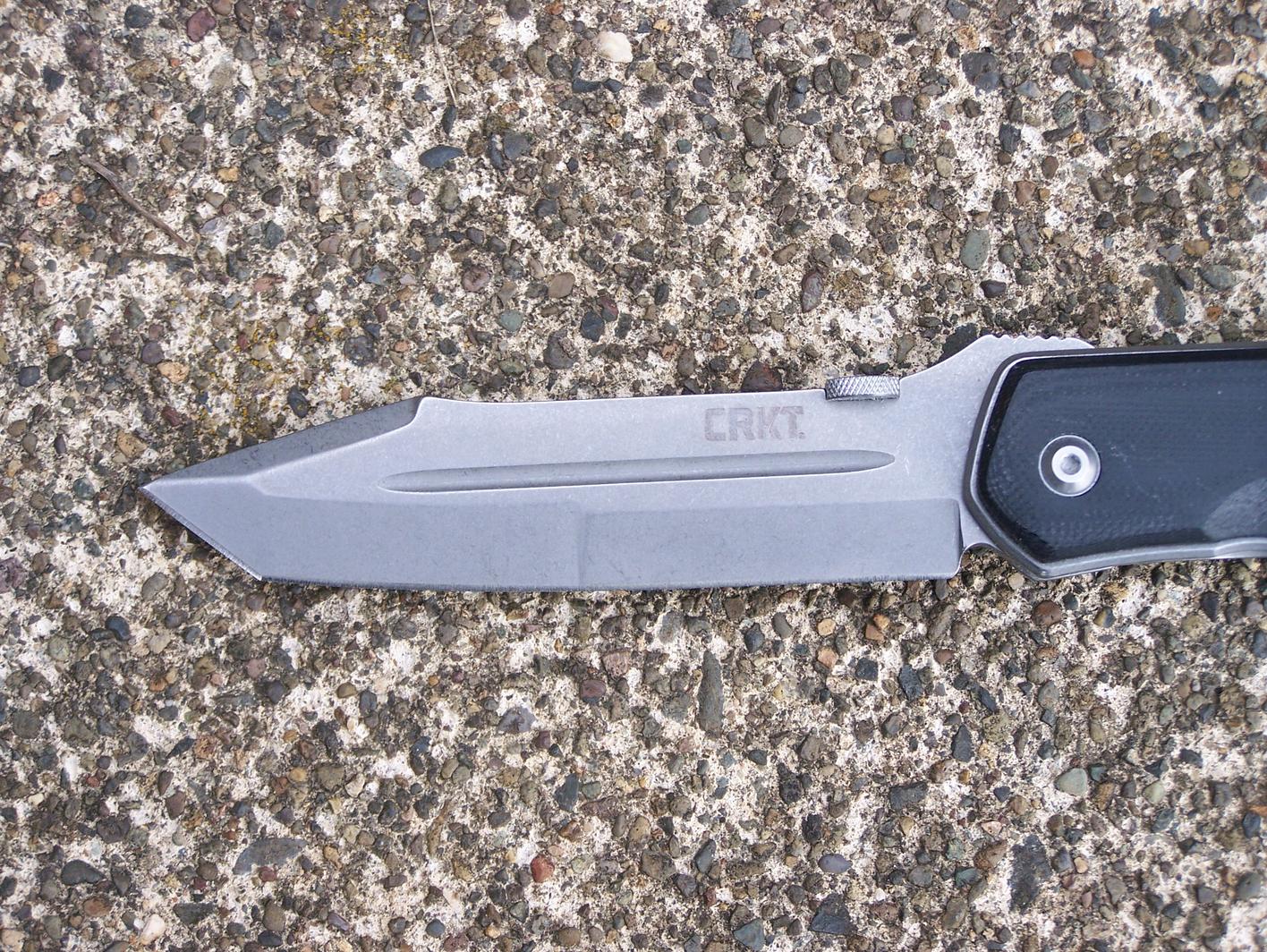
The CRKT BT-70 is worthy of celebrating Terzuola’s 70th birthday, and it’s a design that will stand the test of time. So, let’s take a closer look at the CRKT BT-70 and see what Bob has brought to us. The blade is 4.03 inches long and made out of AUS 8 stainless steel, which is one of my favorites stainless steels because it makes a knife more affordable, holds an edge a good long time, and is easy to re-sharpen, too. The blade is Rockwell’d at 57-59, and this is important; without the right heat treatment, a blade can be too brittle, too soft, or it won’t hold an edge. The overall length of this folder is 9.1 inches open and closed it is 5.15 inches. The knife weighs a hefty 7.6 ounces. The blade is stonewashed for a nice subdued look. The blade is a modified Tanto design with a dual grind, which is hard to do under any circumstances. The pics will show the dual grind on the blade; it is “stepped,” for lack of a better description. You can have the blade any way you want it, so long as it is a plain blade, no serrations. The handle material is dark brown/blade G10, which is some of the best material for serious use knives. The blade is a liner lock design and has a thumb disc on it for easy opening.

100_6410

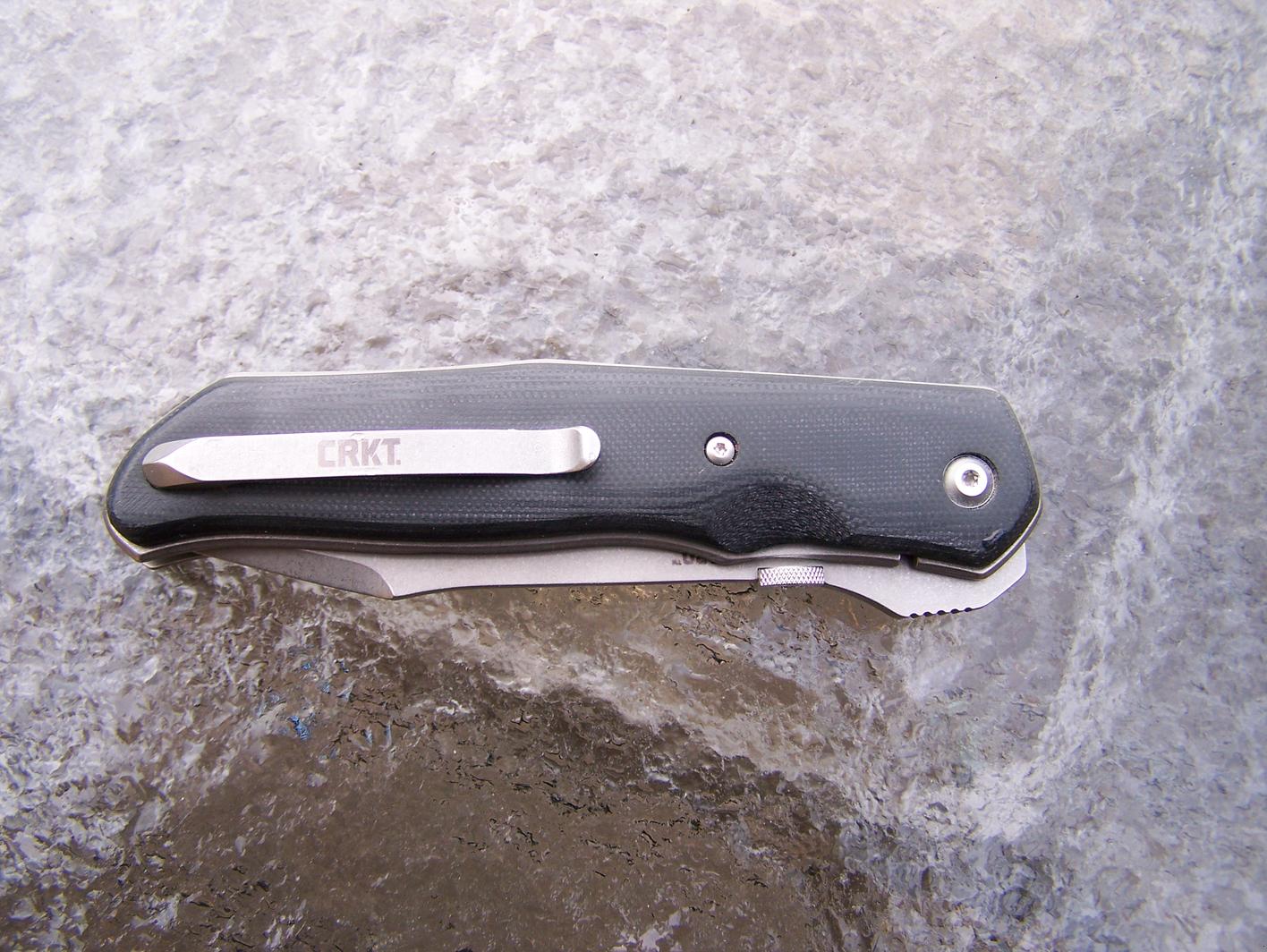
The pocket clip is worth noting in that it isn’t screwed onto the front of the handle scales and it is a one position clip; you can’t move it to the opposite of the handle. The clip is attached from under the G10 scales. No screws are visible on the clip at all, and I’m telling you that this clip isn’t moving on you like some pocket clips can do. (Those others loosen-up over time.) The clip is positioned “just right”, so the knife doesn’t ride too high or too low in the pocket; this is also a great touch. Some folding knives stick out of your pocket like a sore thumb, some ride so low in the pocket, they are hard to get out. The clip is also slim, not too wide and not too narrow. A lot of thought went into the design.

100_6425

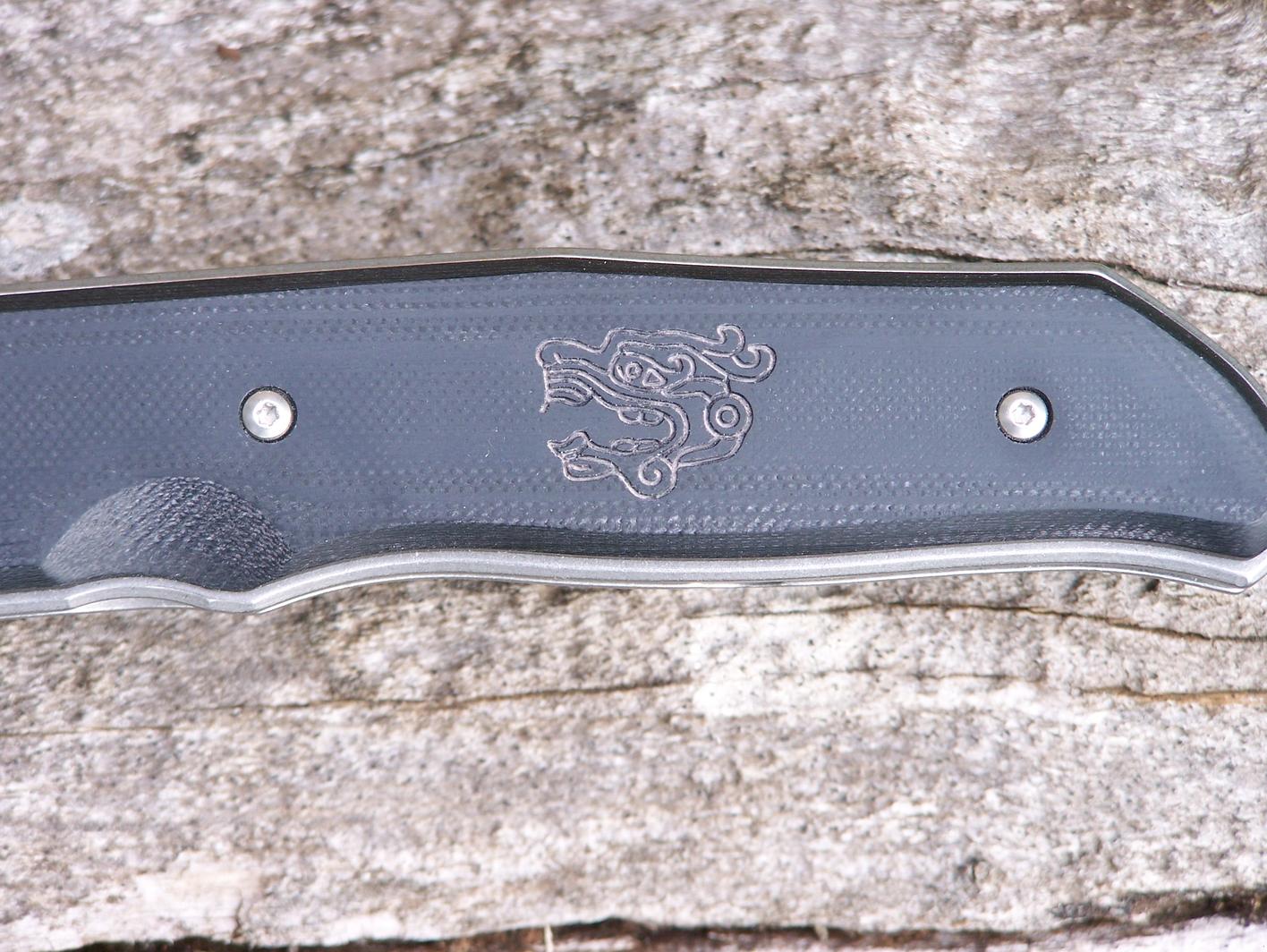
On the left side of the G10 handle is the Terzuola “dragon” logo, which really is a cool-looking design. The hand scales, liner, and locking liner are dished out in order to reach the thumb disc for easy opening. I had some problems, when I first got the knife, getting my thumb right on the disc in order to open the blade. It’s not a design fault, just a learning curve for my thumb muscle memory. In the end, I took my Dremel tool and lowered the dished out area on the liner a tiny bit, so my thumb could more easily find the disc.

100_6411

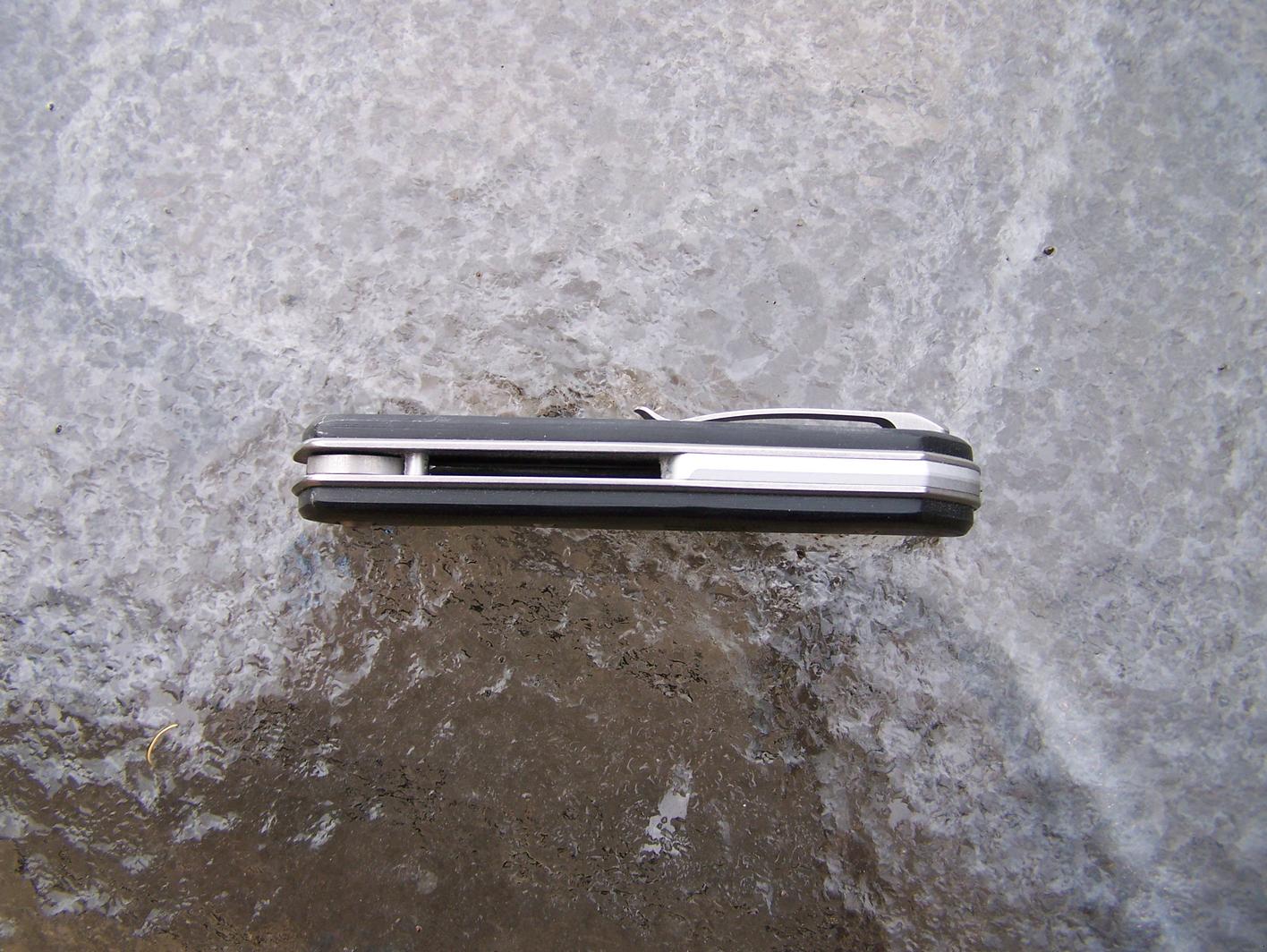
You will also note there is a blood groove on the blade; that’s a nice touch. The blade is .015-inches thick, bit it sure looks thicker than that. It is a hefty looking blade. The liner and liner lock are also a bit thicker than many knives in the CRKT line-up. We are talking one brute of a folder, and I think it is the new flagship in the CRKT tactical folding knife line-up, in my humble opinion. The spacer for the two halves of the knife is located in the rear of the handle scales, and it is about half the length of the handle scales. There is no butt wag in this knife at all.

My BT-70 sample came a bit tight, so I used a little bit of knife lube on the pivot point, rather than loosening the pivot screw, and I worked the lube into the pivot area by repeatedly moving the knife blade back and forth for a few minutes. Now the knife opens and closes super smoothly, without much effort at all, It may be one of the smoothest opening and closing CRKT folders I’ve run across. There is also a raised porting on the back top of the blade, with friction grooves for a sure thumb placement when using the fencing grip. Nice touch.

100_6412

Part of the weight of the BT-70 comes from the thick G10 handle scales. They are really thick, giving the hand a good grip on it, and with the added thickness of the liner and the heavy blade, we have one super tough folder that will give your years of service. Remember, CRKT provides a limited lifetime warranty on their products.

I’ve been carrying the BT-70 for more than a month now in my right front pocket and using it for all manner of chores around the homestead as well as doing my usual testing– cutting poly rope, slicing paper and cardboard, and, of course, slicing blackberry vines. You have to have a really sharp knife to cleanly slice a blackberry vine in one swift move; they are tough, to say the least. The BT-70 sailed through all my testing, and I only just touched up the edge of the blade the other day. It took all of a minute to do. As I mentioned at the start of this piece, I like AUS 8 stainless steel blades because they hold an edge and are easy to re-sharpen, when the time comes. I normally carry and test a folding knife for two weeks, which is a fair test. However, the BT-70 is still riding in my pocket and doing all I ask of it– lots of cutting!

100_6413

If you check around, you will see what some of the original, handmade Terzuola knives are selling for, and there really aren’t many to be found to start with. Bob, doesn’t lend his name and his design to just anything. He seeks out the best and makes sure that the knives are made to his specifications. The BT-70 is manufactured in Taiwan, in one of the plants that is owned by CRKT, and every couple of weeks someone from CRKT is there, checking on things to make sure knives are being made to their specifications.

This is your chance to lay claim to a Bob Terzuola collaboration, one from CRKT, and to be sure these knives won’t be around forever. This particular knife was announced in January 2015 in the new CRKT catalog, and it just now came out for us all to buy. Don’t wait! If you want a super tough folder, one that won’t let you down, and designed by one of the best tactical knife makers in the world, then jump on this one. It would make a great everyday carry folder and one that you can bet your life on, if the time comes to use it to defend yourself. Full retail on the BT-70 is $150; however, you can usually find CRKT products discounted at many locations. Get one, before they are gone, forever!


Recipe of the Week: Swiss Beef Birds

Ingredients:

  • 2 lbs round steak, 1/2 inch thick
  • 2 medium carrots
  • 1 large dill pickle
  • 2 Tbsp flour
  • 1 tsp salt
  • 1/4 tsp pepper
  • 1/8 tsp garlic salt
  • 2 Tbsp salad oil
  • 1 (8-oz) can tomato sauce
  • 1 small onion, chopped
  • 2 Tbsp minced parsley

Directions:

  1. With meat mallet, pound steak until 1/4 inch thick. Cut into 5 or 6 serving pieces.
  2. Cut each carrot into thin sticks and the pickle into 5 or 6 strips.
  3. Place several carrot sticks and one pickle stick on each piece of meat.
  4. Beginning at narrow end, roll up, securing with small skewers or toothpicks.
  5. Mix flour with salt, pepper, and garlic salt; coat rolls, reserving remaining mixture.
  6. In a large skillet or slow-cooking pot with browning unit, brown meat rolls in hot oil.
  7. Pour off excess fat.
  8. Place browned meat in slow-cooking pot.
  9. Mix tomato sauce with reserved flour; stir in onion and pour over meat.
  10. Cover and simmer on low for 7 to 9 hours, or until tender.
  11. Sprinkle with parsley.

Makes 5 or 6 servings.

o o o

Do you have a favorite recipe that would be of interest to SurvivalBlog readers? Please send it via e-mail. Thanks!


Two Letters Re: Water Works, by JSP

Hugh,

Reference “Water Works, by JSP”. Back in 1960’s Dad buried a 250-gallon steel fuel oil tank. The oil tank was buried in heavy clay soil. In the 1980’s Dad retired and since he no longer needed the fuel tank, he left the tank empty. After an unusual heavy rain fall, the oil tank had floated out of the ground about one foot. Since the author is burying plastic tanks, I feel it is very important to strap the tanks to a concrete base, if he wants to keep them buried. – R.L.

o o o

HJL,

In reference to JSP’s article on hot water heating in SHTF situations, I have a recommendation for a whole house hot water heater that has worked well for both myself and another off gridder that I recommended it to. We both have BOL’s that are over two hours from the nearest town and, needless to say, we do not have public power. I personally have a solar/generator/battery bank system, and it powers all my needs. We pump water from a stream to a cistern and then pressure pump it into a pressurized tank. We use an on demand Bosch Therm 330PN-LP (Liquid Propane) Tankless Water heater. It requires no electric power or batteries. We keep track of our propane consumption and with a gas stove, gas refrigerator, and the gas water heater, we use a one hundred pound LP cylinder about every 30-40 days under regular use (not trying to conserve power) for two people. We have found this tankless on demand water heater to be very efficient and we have used it now for three years. The price is reasonable as compared to the one recommended in the article (Navien), about $400. They also make a larger model for about $700 for larger families or more demand. I like the Bosch because it does not require electricity and because you can store tanks of LP gas indefinitely for a SHTF scenario. Hope this helps some of your readers looking for a reliable, efficient, and affordable method to heat water for your BOL or off grid home. – Mike Y.


Economics and Investing:

Obama Increases Deficit $1 Trillion a Year – B.B.

o o o

A recession is imminent: 5 charts signaling an oncoming recession. The market is overheated with debt and the public is anxious about the economy.

o o o

Items from Professor Preponomics:

U.S. News

Official Time: Practically Opaque in Every Way (Cato Institute) Little truth or transparency here… “The current scenario is ripe for abuse: there is no limit on the amount of official time, no mandated system for tracking the time, and no imperative for the agencies to publish the information.”

Obamas Treat Air Force One Like an Uber Ride: Spending Watchdog Says the President’s Christmas in Hawaii Trip Too Expensive to Justify (Daily Mail) The cost of fly-time alone was estimated at $3.5M, but the exact cost is difficult to know since not all the data is available. Since the American taxpayer if funding most of the bill, shouldn’t the American taxpayer know the cost? It’s another example of a lack of transparency.

Report: Price of Obama’s Getaways $70M and Counting (McClatchy DC)

International News

Hong Kong Watchdog Fines JP Morgan for Darkpool Control Failures (Reuters) Dark Pools are not a new financial phenomenon but remain important as they relate to both market transparency and to liquidity. “Critics of the platforms say they distort public markets and disadvantage traditional investors, while their proponents say they offer an important source of liquidity.”

What is ‘Mifid’ and Why Care About It’s Delay? (Financial Times) In response to the financial crisis of 2008, the EU has introduced Mifid II. It’s an ambitious effort to govern the trading of derivatives, to reduce risks associated with volatility, and to establish a framework for policing conflicts as those arise among financial advisors.

China Now Has So Much Bad Debt, It’s Selling Soured Loans on Alibaba (Zero Hedge) Hmmm. Little transparency here either… “Still, the official numbers on NPLs (shown above) look surprisingly low for an economy, which is supposedly careening towards a debt crisis. There’s a simple explanation for this apparent discrepancy: the numbers, like China’s official GDP prints, are fabricated.”

Personal Economics and Household Finance

Gallup Daily: US Consumer Spending (Gallup) An insight into the daily spending of an American consumer (and an interesting relative comparison to the spending of our government officials).


Odds ‘n Sods:

Link submitted by Avalanche Lily: Vote for my husband for president

o o o

Gift Suggestion for Christmas 2016 from Krayton Kerns, the Conservative Cow Doctor

o o o

From the Desk of Mike Williamson, SurvivalBlog’s Editor At Large: Propaganda Games: Sesame Credit – The True Danger of Gamification – Extra Credits

o o o

Sometimes, it is actually possible to win against the system: 5 Mothers are Victorious Against the New York City Flu Vaccine Mandate – D.S.

o o o

SurvivalBlog reader T.A. submitted this disturbing link: IS Jihadists Stole TENS of THOUSANDS of Passorts: Where are they now?


Notes for Sunday – December 20, 2015

Today, we present another entry for Round 62 of the SurvivalBlog non-fiction writing contest. The nearly $12,000 worth of prizes for this round include:

First Prize:

  1. A Tactical Self-Contained 2-Series Solar Power Generator system from Always Empowered. This compact starter power system is packaged in a wheeled O.D. green EMP-shielded Pelican hard case (a $1,700 value),
  2. A Gunsite Academy Three Day Course Certificate that is good for any one, two, or three day course (a $1,195 value),
  3. A course certificate from onPoint Tactical for the prize winner’s choice of three-day civilian courses, excluding those restricted for military or government teams. Three day onPoint courses normally cost $795,
  4. DRD Tactical is providing a 5.56 NATO QD Billet upper with a hammer forged, chromlined barrel and a hard case to go with your own AR lower. It will allow any standard AR type rifle to have quick change barrel, which can be assembled in less than one minute without the use of any tools and a compact carry capability in a hard case or 3-day pack (an $1,100 value),
  5. Gun Mag Warehouse is providing 20 Magpul pmags 30-rd Magazines (a value of $300) and a Gun Mag Warehouse T-Shirt; (an equivalent prize will be awarded for residents in states with magazine restrictions),
  6. Two cases of Mountain House freeze dried assorted entrees in #10 cans, courtesy of Ready Made Resources (a $350 value),
  7. The Ark Institute is donating a non-GMO, non-hybrid vegetable seed package (enough for two families of four) plus seed storage materials, a CD-ROM of Geri Guidetti’s book “Build Your Ark! How to Prepare for Self Reliance in Uncertain Times”, and two bottles of Potassium Iodate (a $325 retail value),
  8. A $250 gift certificate from Sunflower Ammo,
  9. KellyKettleUSA.com is donating both an AquaBrick water filtration kit and a Stainless Medium Scout Kelly Kettle Complete Kit with a combined retail value of $304, and
  10. Two cases of meals, Ready to Eat (MREs), courtesy of CampingSurvival.com (a $180 value).

Second Prize:

  1. A Glock form factor SIRT laser training pistol and a SIRT AR-15/M4 Laser Training Bolt, courtesy of Next Level Training, which have a combined retail value of $589,
  2. A FloJak EarthStraw “Code Red” 100-foot well pump system (a $500 value), courtesy of FloJak.com,
  3. A transferable certificate for a two-day Ultimate Bug Out Course from Florida Firearms Training (a $400 value),
  4. A Model 175 Series Solar Generator provided by Quantum Harvest LLC (a $439 value),
  5. A Trekker IV™ Four-Person Emergency Kit from Emergency Essentials (a $250 value),
  6. A $200 gift certificate good towards any books published by PrepperPress.com,
  7. A pre-selected assortment of military surplus gear from CJL Enterprize (a $300 value),
  8. RepackBox is providing a $300 gift certificate to their site, and
  9. Safecastle is providing a package of 10 LifeStraws (a $200 value)

Third Prize:

  1. A Royal Berkey water filter, courtesy of Directive 21 (a $275 value),
  2. A $245 gift certificate from custom knifemaker Jon Kelly Designs, of Eureka, Montana,
  3. A large handmade clothes drying rack, a washboard, and a Homesteading for Beginners DVD, all courtesy of The Homestead Store, with a combined value of $206,
  4. Expanded sets of both washable feminine pads and liners, donated by Naturally Cozy (a $185 retail value),
  5. Two Super Survival Pack seed collections, a $150 value, courtesy of Seed for Security, LLC,
  6. Mayflower Trading is donating a $200 gift certificate for homesteading appliances,
  7. APEX Gun Parts is donating a $250 purchase credit,
  8. Montie Gear is donating a Precision Rest (a $249 value), and
  9. Two 1,000-foot spools of full mil-spec U.S.-made 750 paracord (in-stock colors only) from www.TOUGHGRID.com (a $240 value).

Round 62 ends on January 31st, so get busy writing and e-mail us your entry. Remember that there is a 1,500-word minimum, and that articles on practical “how to” skills for survival have an advantage in the judging.


Water Works- Part 3, by JSP

Hot Water Grid Down or When the Schumer Hits The Fan

Let’s all agree that we can survive without hot water. Yet, as some have successfully argued on this blog that when it comes to food “variety is the spice of life”, I would ask why it is important, especially in a survival situation. “Morale” would be my answer. We could all survive on rice and beans, but it would be hard to keep group morale up if after a supper of rice and beans the group only could look forward to a breakfast of rice and beans.

My personal bias is certainly involved in this, as I can go without a lot of modern or “creature” comforts. I look forward to no cell phones, Internet, and television, and I can get by without a microwave. However, without an occasional hot water shower, I could get grumpy. Even more to the point, I want my team, my group, to never question that they are in the right place doing the right things and that we have thought about their sanitation and comfort. Additionally, I can use hot water showers as a reward for acts and work that is above and beyond the call of duty.

In this article, I am going to explain three ways to obtain flowing hot water without electricity or much electricity. The first two methods require some form of flowing water (like gravity feed for example). The third method is best with some water flow; it can function without it, but you won’t be taking showers in the traditional sense. If you look at non-electric communities, like the Amish, it is the third method that they use.

The methods are:

1) Single point, battery fired, on-demand, propane water heaters

2) Whole house, 110, fired on-demand, propane (or natural gas) water heaters

3) Wood fired range boilers

Let’s take them one at a time.

Single Point Propane Water Heater for Hot Water

The vast majority of on-demand water heaters take 110 volts to fire them and then a fuel source to heat the water, which is typically propane or natural gas. The only company that I am aware of that offers something different is the EZ Tankless people. They offer two water heaters which have an ignition source of two “D” batteries, so consequently they don’t have to be “plugged in” to anything. They have two different models that do this, and I have purchased six of their units. Two of them had problems, and in the end had nothing to do with the manufacturer. I once saw a “Camp Chef” (a brand I have respect for) version of one of these, but it looked to me like it was made by EZ Tankless and branded for them. In the next part of this article, I will highlight a few projects and identify how I have implemented these units. However, what I mean by single point is that they will heat plenty of water for one appliance, whether it is one shower head, one sink, et cetera.

Let’s talk about the problems I have had with these units. First, the usual application is to attach a water source and a fuel source, commonly a garden hose and then a 5-gallon propane tank. To do this you need a pressure regulator on the propane tank, and it turns out that most pressure regulators are now China garbage.

I typically have purchased the heaters directly from EZ Tankless and the pressure regulators online. I had problems with a heater, so my first thought was to switch out the regulator hose, but it still didn’t work. I switched out another one, and it still didn’t work. Long story short, I had three brand new propane regulator hose assemblies that were all defective, and one of them was purchased six months prior to the other ones from another supplier. The EZ Tankless people were very helpful working through this, even though it was annoying at times. When we finally figured out the problem, they suggested that I buy (online) a two-stage regulator.

The second problem I had was all my fault, as it was in a location that froze during winter, which I knew. I thought I drained it well, but I didn’t. (There’s more on that later).

Standard, Whole House Water Heater for Hot Water

Our standard hot water tank is an electric basic unit. I have always wanted a whole house on-demand unit, so I did some research and purchased a Navien. What I liked about them was their efficiency. For example, most whole house on-demand units require some type of metal exhaust pipe, and the Navien is so efficient you can use PVC for exhaust. Also, they don’t take that much flow to make them turn on or electricity to make them fire. They are not cheap though, and I am not sure how much use it will see in a Schumer situation, but it’s possible.

Just to back up for a second “on demand” just means that the units sense water movement and fire up to heat the water. If you turn on the hot water valve in the shower, water will flow past the on-demand unit, which will cause it to fire up and heat the water. So that means that as long as you don’t run out of water or fuel, you will never run out of hot water. Our whole house on-demand unit is probably best used grid up, when we have a house full of people taking showers and doing laundry, dishes, et cetera. It is a tool in our “kit bag” though, as it and other things are attached to a 1000-gallon, buried, propane tank, and a simple inverter and battery will fire it.

Wood-fired Range Boiler for Hot Water

We have two Range Boilers that I was skeptical about at first, but they really do work well. With the right configuration, the saying is totally true that with a good wood stove you can “heat your house, cook your food, and heat your water”.

Range Boilers work on the concept of “thermo siphon”. What that means is that just as hot air rises and cold air descends, so too does hot water rise and cold water descend.

A Range Boiler is typically a stone-lined steel tank designed to hold water, especially hot water. To work effectively you need a wood burning stove that has stainless steel coils inside the fire box. The fire heats the water in the coils and circulates it into and out of the Range Boiler Tank. We have had wood stoves that try to heat water using convection (without coils in the fire box), and frankly they are lame and don’t work.

I have seen a video online of a gentleman retrofitting an existing wood stove with stainless steel coils to heat water, so it is “doable”. However, it’s way easier to just order them as an add-on accessory when you order your stove. A review of stoves is beyond the scope of this article, but I will let the readers know what we are running. Our main stove that is in the house near the kitchen is a Flame View with a 80-gallon Range Boiler and 20-gallon water jacket. On the patio (there’s more on this later), we have an Ashland Delux (40-gallon Range Boiler), and then two Lopi stoves that are in the house and are wood burners only.

When you order products like those stoves and Range Boilers, they are typically made by Amish craftsman custom to order, so I hope you’re not in a hurry! The Amish make amazing products, but they don’t use computers so you’re not going to get much in the way of instructions or diagrams. The one page set of “instructions” we got with our Range Boiler was obviously typed on a manual typewriter and the diagrams were hand-drawn. They were helpful but certainly didn’t tell the whole story.

Range Boiler Installation

If you are serious about a long-term ability to heat your house, cook, and heat your water, then a wood stove with heating coils and a Range Boiler is the only way to go. Consequently, I want to spend a minute on the details of installation that is not found in the instructions we received. A Range Boiler typically has five threaded holes that are plugged when they arrive. There are two holes on the top, one on the bottom, and two on the side. The side holes are what comes and goes from the stove fire box coils. The side hole at the top is for hot water in from the stove (thermo siphon), and the bottom side hole is for cold water out of the tank to the stove. If you look closely at the back of your stove where the coils come out, you will notice that one threaded end is lower (cold in) than the other end (hot out).

When you are connecting your range boiler to your stove, it is absolutely imperative that you only use galvanized steel pipe. I am going to admit it is a first-class pain in the rear to get everything lined up and attached, especially in this day of products like copper compression fittings, PEX, copper and stainless flex hoses, and so on. Those products are just not going to hold up long term to the type of heat you’re going to be generating, and if you have a pipe failure while under pressure, the water can be so hot that things can get real ugly real fast. You can go to copper for water coming out of the boiler for domestic use but not between the stove and boiler. The last safety point is that one of the top holes on the boiler must be a pressure relief valve (just like you see on regular home water heaters) that is plumbed to a safe place outside. You can use PEX-type products for this.

The hole in the bottom of the tank is where the house water supply comes in, and the second hole at the top is where the hot water is taken off. Where does the hot water go? You plum that to your regular house hot water tank to the cold water “in” side of that tank. Yes, I said cold water in. We shut off the standard cold water in to the electric heater and everything that we will use for hot water first cycles through the Boiler and then into the house hot water tank.

The reasons we do it that way are as follows:

  1. If the water from the range boiler is sufficiently hot, then the home hot water heater doesn’t have to expend any energy to heat the water. It simply won’t kick on, thereby saving electricity and wear on your standard hot water tank.
  2. The home hot water heater is already plumbed to all your hot water fixtures in the home, so you don’t have to redo any of that. For example, say you’re going to take a shower and the range boiler has hot water. The stove is heating the water in the range boiler, which goes to your standard electric (or gas) hot water tank and then into the shower hot water faucet. Even grid down all that your standard hot water tank is doing is storing more hot water for you.
  3. Even if you’re not using your wood stove, you still route all hot water through the range boiler because, at that point it becomes what is called a “tempering tank”. What that means is that water is pulled from the well (or wherever), entering the house at 50 degrees and then sits in the Range Boiler inside the house that’s 70 degrees. While the water sits in the Range Boiler prior to going into the home hot water tank, it will rise in temperature possibly 20 degrees (tempering). That, then, is 20 degrees less that your home water heater has to raise the temperature of that water.

On paper this may sound complicated, but it really is just understanding the concept of Thermo-siphoning, which is using quality materials to put it together and some basic plumbing. You will be surprised how much hot water you can generate. Just like wood heat is unlike any other, wood heated water is like no other. When taking a shower, I can tell if it’s wood heated water, electric heated, or gas heated.

Our household size ranges from sometimes just two of us to at times a lot of us. Yesterday there were just two of us, and the main Range Boiler got sufficiently hot, so much so that I was concerned about the pressure valve opening to “let off some steam”. So I told my wife that I needed her to go take a long, hot shower… as long as she wanted! That’s a good problem to have.

In the next and final part of this series I will highlight some water-related projects we have done and try to answer a few questions that I imagine the reader might be wondering about.


Letter Re: How to Title Retreat Property

Hello:

The article on the importance of maintaining privacy with regard to ownership of property, and particularly retreat property, was very good. One other option, which was not addressed, is to use a trust under state law. Trusts are not generally registered with the state, but they will require use of an attorney in order to be sure it is properly formed, can receive and hold title, is enduring, and can eventually sell property if that becomes appropriate. A trustee may need to be named for the trust, as may beneficiaries, but again none of that is registered with any state anywhere. – Kass Andrada


Economics and Investing:

Items from Mr. Econocobas:

House Passes $1.15 Trillion Spending Bill: Here Is What’s In It

Peter Schiff- Mission Accomplished – A good article from Peter Schiff in regards to the Fed Rate hike this past week.

Items from Professor Preponomics:

U.S. News

The Other Three Rs: Risk Adjustment, Reinsurance and RISK CORRIDORS (Citizens Against Government Waste) Article Excerpt: “…ObamaCare’s risk corridors are designed in such an open-ended manner that the president’s action now exposes taxpayers to a bailout of the health-insurance industry if and when the law fails.”

How the Spending Deal’s Risk Corridor Provision Would Affect Obamacare Co-ops (The Daily Signal) Here it comes… “consumers are likely to see increased premiums in 2017 as insurers decide how to address losses and the potential for lower risk corridor payments.”

Nearly Half of Uninsured Went Without Coverage Because It Was Too Expensive (Washington Free Beacon) No surprise… “The failures of Obamacare continue to pile up: co-ops have failed across the country, tax penalties have increased, and last year’s extended open enrollment period was not renewed.”

International News

Greek Lessons for Puerto Rico (US News and World Report) Article Excerpt: “It is said that those who do not learn from history are doomed to repeat it. Sadly, this adage appears again about to be proved true by the way in which the United States Congress is dealing, or more correctly not dealing, with Puerto Rico’s financial and economic crisis.”

Congress’ Funding Package Offers No Debt Assistance to Puerto Rico (NPR) Spoiler Alert: “Puerto Rico’s economic woes run deep and have been building for a while…”

Personal Economics and Household Finance

Running Out of Other People’s Money (Cato Institute) When many American families cannot manage their individual household budgets, how in the world are they supposed to tackle this? ” Each American’s share of that debt is more than $56,750. And that’s the good news. America’s real debt is far, far worse.”


Odds ‘n Sods:

Sent in by T.P.: Flame Thrower Equipped Hobby Drone – Happy Holidays ! – You know you want one!

“The next best thing to having sharks with lasers” – JWR

o o o

Also sent in by T.P.: FAA Finally Admits Names And Home Addresses In Drone Registry Will Be Publicly Available

JWR’s Comment: Let me get this straight: I can buy or build, and personally fly an ultralight or a powered parachute with an empty weight of up to 253 pounds with no FAA paperwork or licensing whatsoever. Some ultralight owners have staged solo cross-country flights. (3,000 miles!) But starting in 2016, the same agency wants to register the owners of all drone (remotely piloted) aircraft weighting more than 240 GRAMS? (About 9 ounces.) That is highly illogical.

o o o

It has been reported that President Bolt Hold Open has started a lengthy vacation in Hawaii with his family, and that his raft of planned Executive Orders will be delayed until after his return. Let me be the first to suggest that BHO extend his vacation in Hawaii until late December of 2016. He could just mail the key to the White House to his successor. Our nation would be a much safer and more free place, because of it. – JWR

o o o

The DOOMSDAY plan if America’s power systems are wiped out by cyber attacks – Sent in by G.G.

o o o

Homeless Man Allegedly Lived In Army Barracks As Soldier For 8 Months – Not just any Army barracks but in a special forces barracks at Fort Bragg! – Sent in by G.P.


Hugh’s Quote of the Day:

“Jesus saith unto him, Rise, take up thy bed, and walk. And immediately the man was made whole, and took up his bed, and walked: and on the same day was the sabbath.” – John 5:8-9 (KJV)


Notes for Saturday – December 19, 2015

December 19th is the birthday of physicist Albert A. Michelson (born 1852, died May 9, 1931), who was the first American to be awarded a Nobel Prize in science, for measuring the speed of light.

o o o

Today, we present another entry for Round 62 of the SurvivalBlog non-fiction writing contest. The nearly $12,000 worth of prizes for this round include:

First Prize:

  1. A Tactical Self-Contained 2-Series Solar Power Generator system from Always Empowered. This compact starter power system is packaged in a wheeled O.D. green EMP-shielded Pelican hard case (a $1,700 value),
  2. A Gunsite Academy Three Day Course Certificate that is good for any one, two, or three day course (a $1,195 value),
  3. A course certificate from onPoint Tactical for the prize winner’s choice of three-day civilian courses, excluding those restricted for military or government teams. Three day onPoint courses normally cost $795,
  4. DRD Tactical is providing a 5.56 NATO QD Billet upper with a hammer forged, chromlined barrel and a hard case to go with your own AR lower. It will allow any standard AR type rifle to have quick change barrel, which can be assembled in less than one minute without the use of any tools and a compact carry capability in a hard case or 3-day pack (an $1,100 value),
  5. Gun Mag Warehouse is providing 20 Magpul pmags 30-rd Magazines (a value of $300) and a Gun Mag Warehouse T-Shirt; (an equivalent prize will be awarded for residents in states with magazine restrictions),
  6. Two cases of Mountain House freeze dried assorted entrees in #10 cans, courtesy of Ready Made Resources (a $350 value),
  7. The Ark Institute is donating a non-GMO, non-hybrid vegetable seed package (enough for two families of four) plus seed storage materials, a CD-ROM of Geri Guidetti’s book “Build Your Ark! How to Prepare for Self Reliance in Uncertain Times”, and two bottles of Potassium Iodate (a $325 retail value),
  8. A $250 gift certificate from Sunflower Ammo,
  9. KellyKettleUSA.com is donating both an AquaBrick water filtration kit and a Stainless Medium Scout Kelly Kettle Complete Kit with a combined retail value of $304, and
  10. Two cases of meals, Ready to Eat (MREs), courtesy of CampingSurvival.com (a $180 value).

Second Prize:

  1. A Glock form factor SIRT laser training pistol and a SIRT AR-15/M4 Laser Training Bolt, courtesy of Next Level Training, which have a combined retail value of $589,
  2. A FloJak EarthStraw “Code Red” 100-foot well pump system (a $500 value), courtesy of FloJak.com,
  3. A transferable certificate for a two-day Ultimate Bug Out Course from Florida Firearms Training (a $400 value),
  4. A Model 175 Series Solar Generator provided by Quantum Harvest LLC (a $439 value),
  5. A Trekker IV™ Four-Person Emergency Kit from Emergency Essentials (a $250 value),
  6. A $200 gift certificate good towards any books published by PrepperPress.com,
  7. A pre-selected assortment of military surplus gear from CJL Enterprize (a $300 value),
  8. RepackBox is providing a $300 gift certificate to their site, and
  9. Safecastle is providing a package of 10 LifeStraws (a $200 value)

Third Prize:

  1. A Royal Berkey water filter, courtesy of Directive 21 (a $275 value),
  2. A $245 gift certificate from custom knifemaker Jon Kelly Designs, of Eureka, Montana,
  3. A large handmade clothes drying rack, a washboard, and a Homesteading for Beginners DVD, all courtesy of The Homestead Store, with a combined value of $206,
  4. Expanded sets of both washable feminine pads and liners, donated by Naturally Cozy (a $185 retail value),
  5. Two Super Survival Pack seed collections, a $150 value, courtesy of Seed for Security, LLC,
  6. Mayflower Trading is donating a $200 gift certificate for homesteading appliances,
  7. APEX Gun Parts is donating a $250 purchase credit,
  8. Montie Gear is donating a Precision Rest (a $249 value), and
  9. Two 1,000-foot spools of full mil-spec U.S.-made 750 paracord (in-stock colors only) from www.TOUGHGRID.com (a $240 value).

Round 62 ends on January 31st, so get busy writing and e-mail us your entry. Remember that there is a 1,500-word minimum, and that articles on practical “how to” skills for survival have an advantage in the judging.


Water Works- Part 2, by JSP

In part 1, I explained several things we did to take our water preps to the next level, which felt good but was still lacking in some areas. So, let’s start by looking at the potential problems of that system.

Problems of Our Water System At This Point

First, at this point, the poly tanks are not “plumbed” to anything; they are simply static, stand-alone storage vessels. Make no mistake that is way better than having no water on hand but not ideal either. Secondly, the primary grid down backup plan is a gas generator. Many people would argue that the flaw in that has to do with running out of gas for the generator. Remember that the well output is 23 GPM, so simple math tells us that in ten minutes I can pump 230 gallons, in 100 minutes I can pump 2300 gallons, and so forth. The point is that we don’t need to run the generator for many hours at a time to get a lot of water, and our well is tapped into an aquifer so it will likely never run dry. However, it is true that no matter how much fuel you store, it will run out eventually. I would say the flaw to the generator plan short term is not fuel but the following:

  • noise, which affects OPSEC,
  • the risk of the well pump getting fried from an EMP or otherwise, and
  • the risk of the generator having a mechanical failure.

Also have you ever hand pumped a Simple Pump that is down to any depth? It’s fun at first, knowing you have a backup, but it grows old fast. Also, while we now have several sources of water, we do not have running water or flush toilets in the house. Furthermore, our well head and Simple Pump at this time are out in the open with no structure around them in a very vulnerable location security wise. Lastly, it’s 12 degrees outside our home right now with a couple of inches of snow on the ground, In this condition, who wants to go hand pump me 20 gallons of water while I keep the fire going?

Where We Go From Here

I want to interject a concept that I had to think about for a while. There was a standing joke among some people I knew that went “all you need to know about water is that if flows down hill.” Unfortunately, it’s not true, and there is a lot more to know about water than that. Actually, water flows to the path of least resistance, which might be down hill. For example, water will flow uphill, if there is more pressure behind it than the pressure above it from gravity.

What this means is that you need to stop looking at places that water comes “in” and water comes “out” as your only option. This is important, and we will go back to it several times in this article and the next.

For example, many well heads have a frost-free hydrant (spigot) near by to get water for the yard and so forth. Everybody knows that when the grid is up and everything is fine, you open the spigot and water does what? It comes out, of course. What happens if the power is out and the well is not running but the pressure tank(s) has water in it and you open the spigot? Water still comes out. However, what happens if the pump is not running and the pressure tank is empty and you open the spigot? Right, nothing comes out.

Simple Pump (or its competitors) basic application #1

Build yourself a short section of garden hose with a female garden hose fitting on each end just a bit longer than the distance between your well head pump and your nearest spigot. Attach one end to the pump and one end to the spigot. Open the spigot valve and start pumping. You are now pumping water into the house system and can fill your pressure tank to give you running water in the house. No, this is not the easiest thing to do physically, so hopefully you have some teenagers around to do this a few times a day, but it’s a whole lot better than hauling 5-gallon buckets into the house.

At this point I had visions of a more elaborate system, but I needed a place for it to all come together. So, I built a pump house around the well head and nearby spigot. In our county at the time, you could build structures up to 120 square feet without a permit (now it’s 200 sq ft), so that is exactly what I did. The pump house is 10′ x 12′, and we poured a cement slab floor. The front third of the building (10′ x 4′) is the pump house proper, and the back two-thirds is storage.

Reducing Risk to Pump of EMP or CME

Once the pump house was built, it was time to add a few enhancements. Because the high voltage well pump delivers so much more water than slow pumps, keeping it operational even grid down for as long as possible makes things much easier. One possible problem is what might happen if there is an EMP or CME that renders that pump toast. Years ago I read an article on Survival Blog where a gentleman posted plans of an electric shut off switch to protect your well pump from an EMP. As I understood it, when the pressure switch turns on the pump simultaneously this “switch” opened and when the pressure switch shut off it would close. I don’t know the technical definition of this switch, but we did have an electrician install one, and he referred to it as a “Mag Starter”.

The problem with this protection device is that if it is “open” at the time of a surge, EMP, CME, et cetera, it doesn’t matter because the pump will be toast anyway. This started me thinking that in addition to that, well pumps don’t wear out from running; they wear out from starting and stopping. This is often times referred to as “cycling”. So, to reduce the chance of the well pump running in the event of a surge and to reduce “cycling”, I added a second pressure tank to the system. Originally, we had an 80-gallon pressure tank inside the house, and then I added a 120-gallon pressure tank (the largest I could find to purchase) in the pump house. The pump house tank and the in-house tank are about 90 feet apart, and our well people advised against having two pressure tanks that far apart, as it might wreak havoc with your pressure switch, but we have had no problems at all. At this point the spigot now inside the pump house was removed and in its place a galvanized “T” was placed in its place and the Simple Pump comes in one side of the “T”, and the pressure tank to the other side.

This project accomplished several things:

1) Reduce the cycling of the pump so it will last longer, which could save thousands of dollars in the long run,

2) Reduce the chance that your well pump will die at the worst possible time (because it will last longer),

3) Increase the pressurized, stored water for the house so that if you do lose power it’s that much longer that you have to mitigate things until you run out of water. Also if you’re grid down and need to run a generator or hand pump to “charge” the house water systems, you don’t have to do it as frequently, and

4) The pump will be running less frequently, which may reduce its vulnerability to power surges, EMP, et cetera.

Motor for Simple Pump and Solar Equipment

The next phase of the project was to purchase a 15-volt motor to run the Simple Pump and add some very basic solar equipment to power it. I spent about $800 for the pump directly from a Simple Pump distributor, which is not cheap but, boy, is it a good way to go, if you can afford it. I placed one 135-watt solar panel on the roof of the pump house and an inexpensive charge controller and small battery bank that easily runs the pump motor. For fun we placed a second 135-watt solar panel on the roof, and those two together run the pump “PV Direct”, which is very cool.

Gravity-fed Water and Pump House

The next phase was to add gravity-fed water. At this point I purchased our first buriable poly cistern (1500 gallons) and an above ground poly “Guido” tank (2600 gallons). We have a hill behind the house, so a friend brought over his excavator and we hauled the two tanks up the hill and placed them. The buried tank is for year round use, and the above ground tank for summer, when we are watering gardens, the orchard, and when the animals drink more. Then we rented a trencher and ran a trench from the tanks on the hill to the pump house.

Prior to pouring the cement slab floor for the pump house, I purchased a simple irrigation valve box and placed that at grade in the floor of the pump house as I knew we would need to bring piping into the pump house from under ground. We ran a two-inch PVC pipe from the tanks on the hill to the pump house. At this point it’s important to know the elevation of things. The pump house, main house, and house tank are all at the same grade. Using a GPS, we determined that the gravity flow tanks on the hill are 72 feet in elevation above the pump house.

This may sound like it’s getting complicated at this point, but trust me it will come together in a minute.

Connecting It All Together

Another trench was dug from the pump house to the house water storage tank and then a third from that tank up the hill to the gravity tanks. One inch PEX pipe was installed to connect those points, and a manifold was built in the pump house to connect everything together. If you followed all that, you may be thinking why was only one pipe run from the gravity tanks to the pump house? Don’t you need one to fill the tanks, and one pipe to gravity feed back down the hill? No; one pipe does both. That is if your standard well pump is working, meaning that when you run the pump you push the water up the hill and it fills the tank because it has sufficient force to do so. Then when the pump is off, gravity takes over and the water will flow back down the same pipe that filled the tank.

Now, here’s the fun part. When our house is on gravity feed, we can hardly tell the difference from the well pump. We have running water at all of the sinks, can take a shower, flush toilets, et cetera with no electricity whatsoever.

What if you can’t run your high-voltage pump system and you need to go to the Simple Pump as a back up? Your pump dealer can do the calculations for you, but just because your low voltage or hand pump can bring water to the surface of your well top does not mean it has much more “umph” to do anything else. In our case because we are not maxing out the vertical lift ability of the hand pump, it has a little “umph” left when it gets to the surface, but there is no way it will pump water up the hill to the gravity tanks. So, now what do you do?

Basically you do the following. The Simple Pump can bring the water to the surface of the well and pump it over to the house tank, as they are at the same elevation. I then installed a Dankoff Solar slow pump and another basic solar system to run it at the house tank. This pump does have enough “umph” at this point to pump water from the house tank to the gravity tanks on the hill. Make no mistake, these systems don’t run a lot of water. Depending on the circumstances, you can expect from 1/2 GPM to 2 GPM, but a pump like the Dankoff can run 24/7 for a long, long time. At 1 GPM though, that is over 1400 gallons of water per day. (The only flaw to a Dankoff pump is that it absolutely, positively needs the water to be filtered well before it gets to the pump.)

I do not want to delve deeply into rain water collection in this article, as it has been covered sufficiently on the Internet. However, I will say that our rain water collection goes into the house tank, thereby reducing wear on our well system, and that our main roof surface area used to collect rain water is of a good size but not huge. Just 1.25 inches of rain will fill the 1500 gallon tank.

On paper, these projects may seem a little complex, but they really are not. Once you start down the path, taking it one step at a time, and bring things like this online, it will take on its own energy and excitement.

In the next part of this series, I will address methods to obtain and manage hot water in a grid down or survival scenario.