Pat Cascio’s Product Review: Zero Tolerance 0900 Folder

Anyone who has followed my knife articles for the past 23+ years will know that I’m just not a big fan of little folding knives. However, sometimes smaller is better for certain applications. Under other conditions, bigger knives are called for. I remember when I was 11 or 12 years old the local hardware store in my neighborhood had a shipment of pocket knives coming in. To be sure, back in those days, almost every kid carried some kind of pocket knife. Sadly, that’s not true today. If caught with a knife in school, it’s a one year suspension in most schools across the country and a possible criminal charge brought against a kid. What a shame!

Now, you have to understand how the “old” neighborhoods operate in the big cities. Everyone knows everyone else and all their kids. Back then, the hardware store was simply called Simon’s because that was the owner’s name. Simon knew all of the kids in the area and went to school with our parents, as did some of the employees who worked in Simon’s store. I don’t know if this corner hardware store still exists back in Chicago, but I would like to hope so. Many of us kids would oftentimes just spend hours in there, just “hanging” out or studying all the tools, and Simon never once chased any of us out of his store. Go ahead and try that today, if you’re a kid, in any of the big box hardware-type stores; security will be all over you.

Okay, where was I? Oh, yeah. Simon’s hardware store ordered in some pocket knives, and none of us, including Simon himself, knew what the knives even looked like other than knowing he had a good selection coming to choose from. Many of us kids pre-paid for our knives ahead of time, and like some of the other kids in the “hood” we would visit and hang out at the hardware almost daily while waiting for those knives to come in. What seemed like many weeks, was probably only a few days – maybe a week at most – before the knives came in. I spotted the one I wanted; it was the largest (longest blade) of the selection, and several other kids also picked this one. It had a genuine imitation pearl handle. The knife was long; the blade was probably four inches in length and very narrow. It wasn’t until later on that I learned it was called a “fruit knife” because it was used for cutting fruit off of trees. Still, to me, it was a monster of a folding knife and one that could be used to take on the world. It was great back then, letting our imaginations take us to wherever we wanted to go. To be child-like again…

So, since that time, my brain has been etched with wanting big folding knives, and to my way of thinking a perfect folding knife has a blade 3.5–4.0 inches in length. It’s perfect for many chores around the homestead, and the blade is long enough to inflict some damage if forced to use it for self-defense purposes. So, I readily admit to my bias for longer blades on folding knives. That’s just me, I guess.
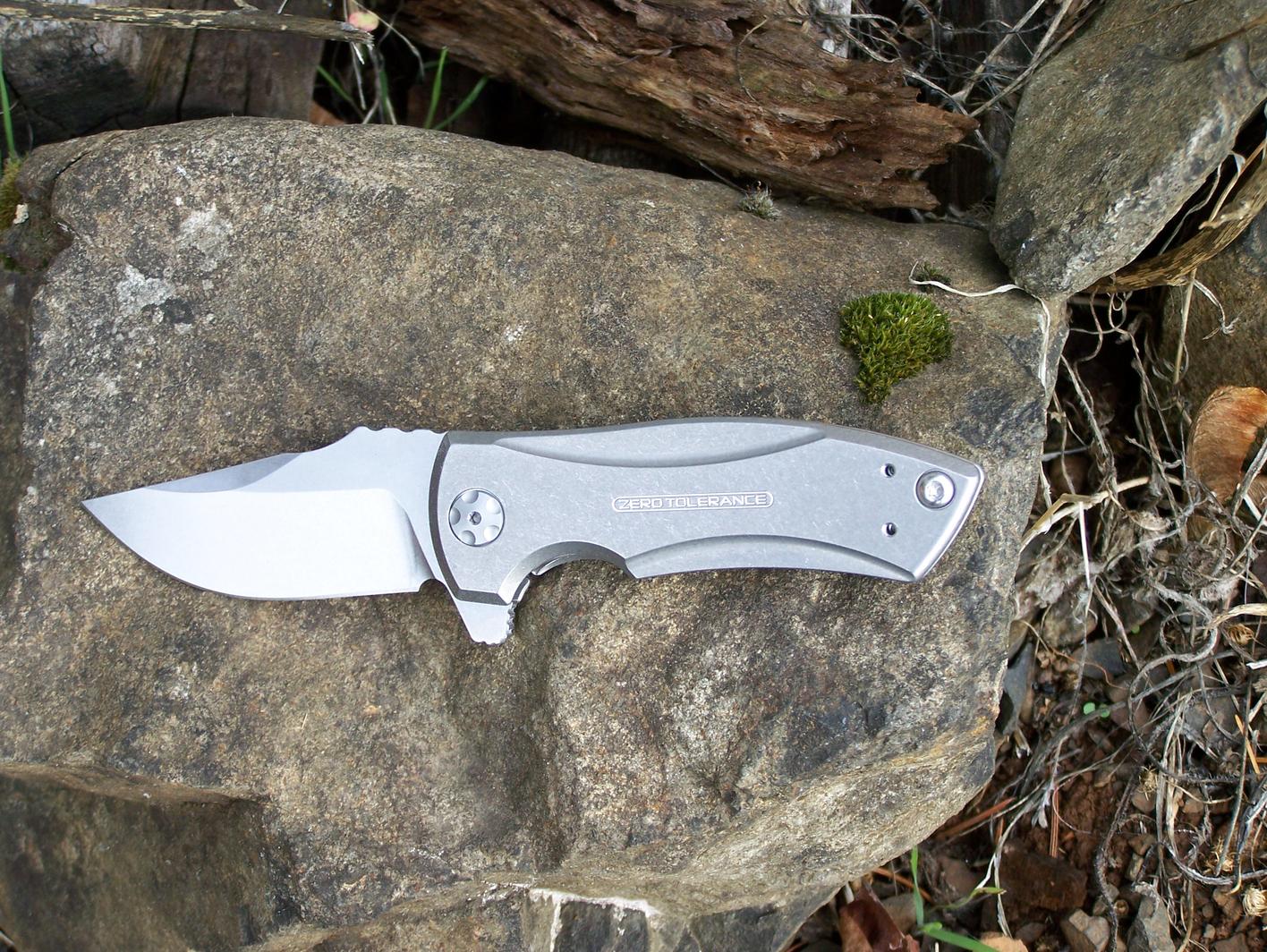
100_6416

I’m one of those people who doesn’t especially like surprises, unless Publisher’s Clearing House showed up at my front door with a check for ten million bucks. Those kinds of surprises, I like. However, most surprises aren’t my thing. Long time friend Thomas Welk, who does the PR/marketing for Kershaw Knives and their Zero Tolerance line of knives, sent me the new ZT 0900 folder. Wouldn’t you know it; it’s a small one. The blade is only 2.7 inches long and made out of S35VN steel– one of the newest super-stainless steels.

100_6417

I have to admit, I was a little disappointed when I opened the box. Well, I thought it was a big folder. It came in a big box, but a smallish folder fell out of the box. Then again, maybe this wasn’t such a “small” folder after all. This little 0900 from Zero Tolerance is one brute; we are talking tank tough. It has titanium handle scales, and this stuff is lighter and stronger than steel. The knife also has a frame lock with a hardened steel insert that helps keep the blade secured in the handle when not in use. It is a manual opening folder; however, it has a “flipper” on the blade, a nice large flipper, that is easy to hit with your index finger. And, to top it all off, it has the KVT ball-bearing system that makes the blade pivot like it’s in butter. We are talking super -smooth. It might be the smoothest opening folder I’ve handled, just might be!
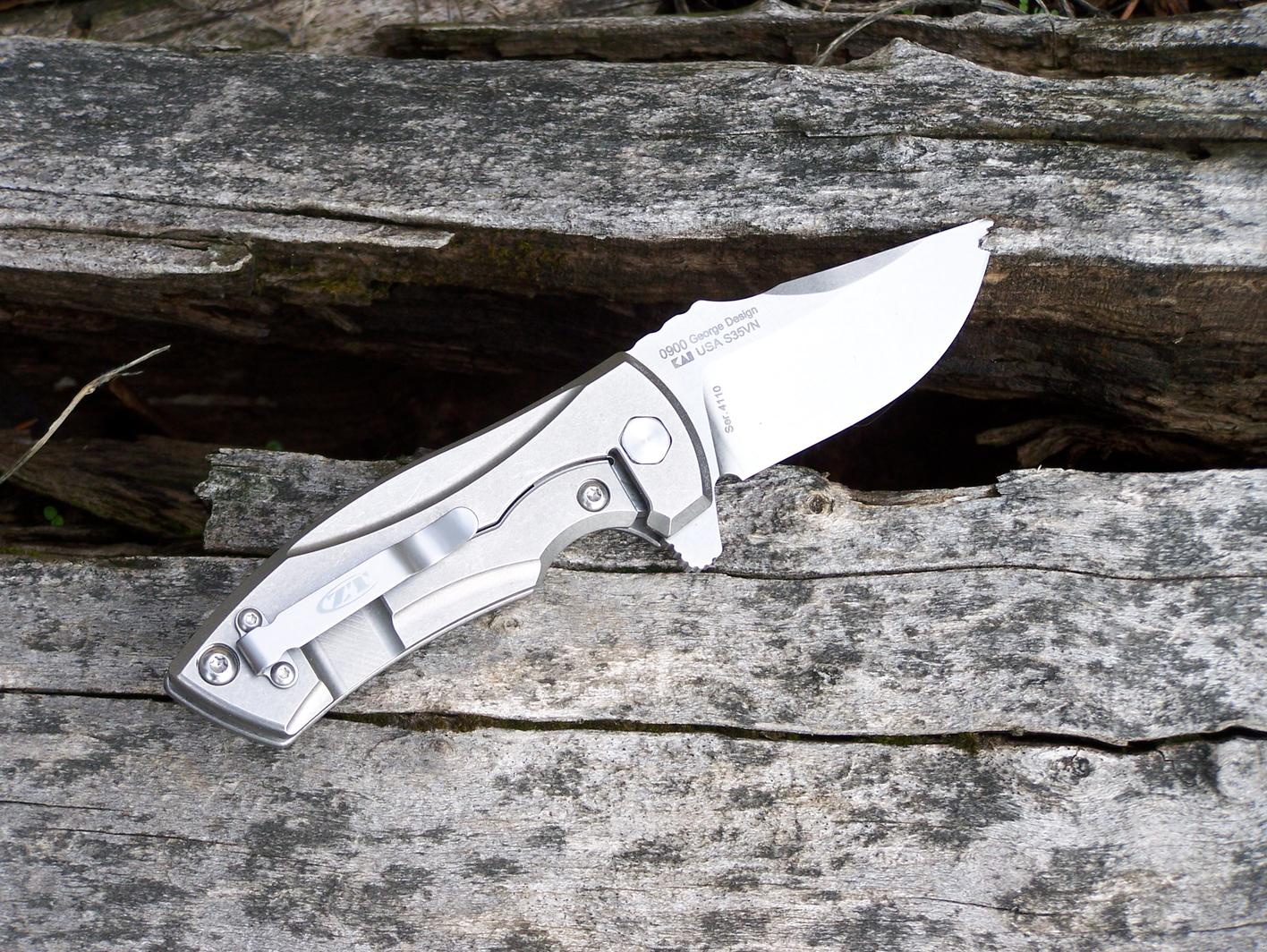
100_6418

There is also a reversible pocket clip for easy pocket carry, and the knife rides just perfectly in the pocket– not too low and not too high that it sticks out like a sore thumb. The blade is stonewashed for a nice subdued finish. Excellent! Its closed length is 3.9 inches, and opened the knife is 6.6 inches with a weight of 4.3 oz, which is a bit heavier than I thought it was. To be sure, it’s made in the USA!

Overall, the 0900 has a rather “boring” look to it. It’s nothing fancy. The titanium handle scales are dull looking, with a little sculpting to them. Then again, we are talking about a little knife that is build like a tank. It’s not meant to be a work of art for the eye but a work of art for the user to use under any extreme conditions.

100_6421

Zero Tolerance knives are designed especially for those in the military and law enforcement. They are designed and manufactured for hard use, simple as that. These aren’t knives meant to be held and admired for their beautiful looks. No! They are meant for folks who want hard-working knives that won’t let them down.

If you’ll notice in the pictures with this article, the 0900 isn’t a little folder, in the respect that many think of “little”. It is only “little” by the length of the blade, nothing more. This knife has a wide blade, and the handle actually fits my hand nicely. It surprised me, because it is a smallish folder. The 0900 was designed by custom knife maker Les George, who has worked with ZT on a few other of his designs.
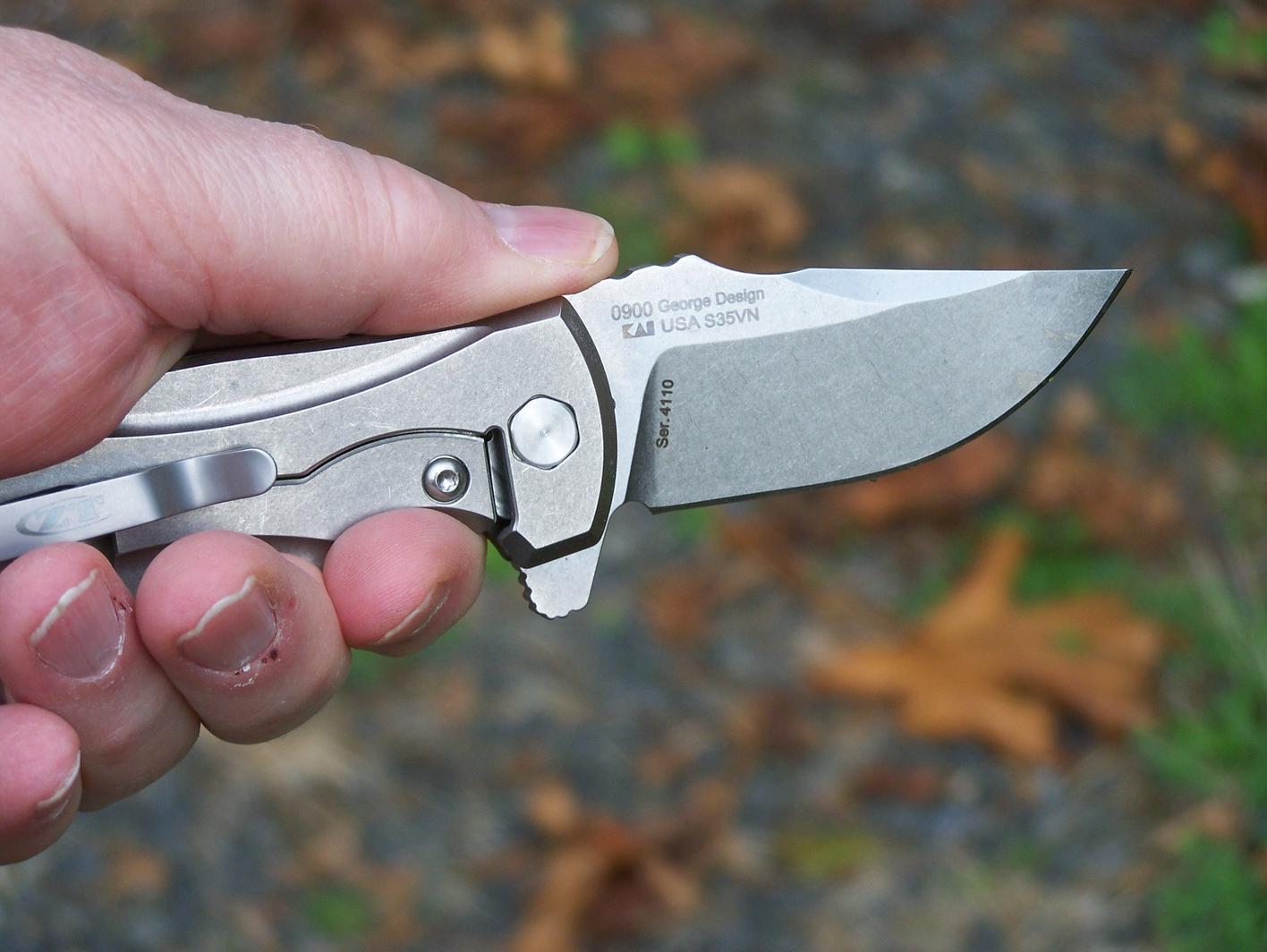
100_6423

I think what surprised me more than anything on the 0900 is the KVT ball-bearing system that the blade runs on. I actually thought that, when I used the flipper to open the blade, it was an assisted-opening folder. I had to try it several times to realize that this wasn’t an assisted-opening blade. It did take a little bit of effort to press down on the flipper; it’s actually on the bottom rear of the blade. However, when closed, the flipper is on the top rear of the blade, sorta! You simply press down on the flipper with your index finger and the blade just “flies” out of the handle scales. It’s just something you have to experience to really appreciate. It did have me fooled for a little while, thinking it was an assisted-opening folder, but it is NOT! When you push the frame lock out of the way, so you can close the blade, you’ll feel how smoothly the blade runs on those KVT ball-bearings.
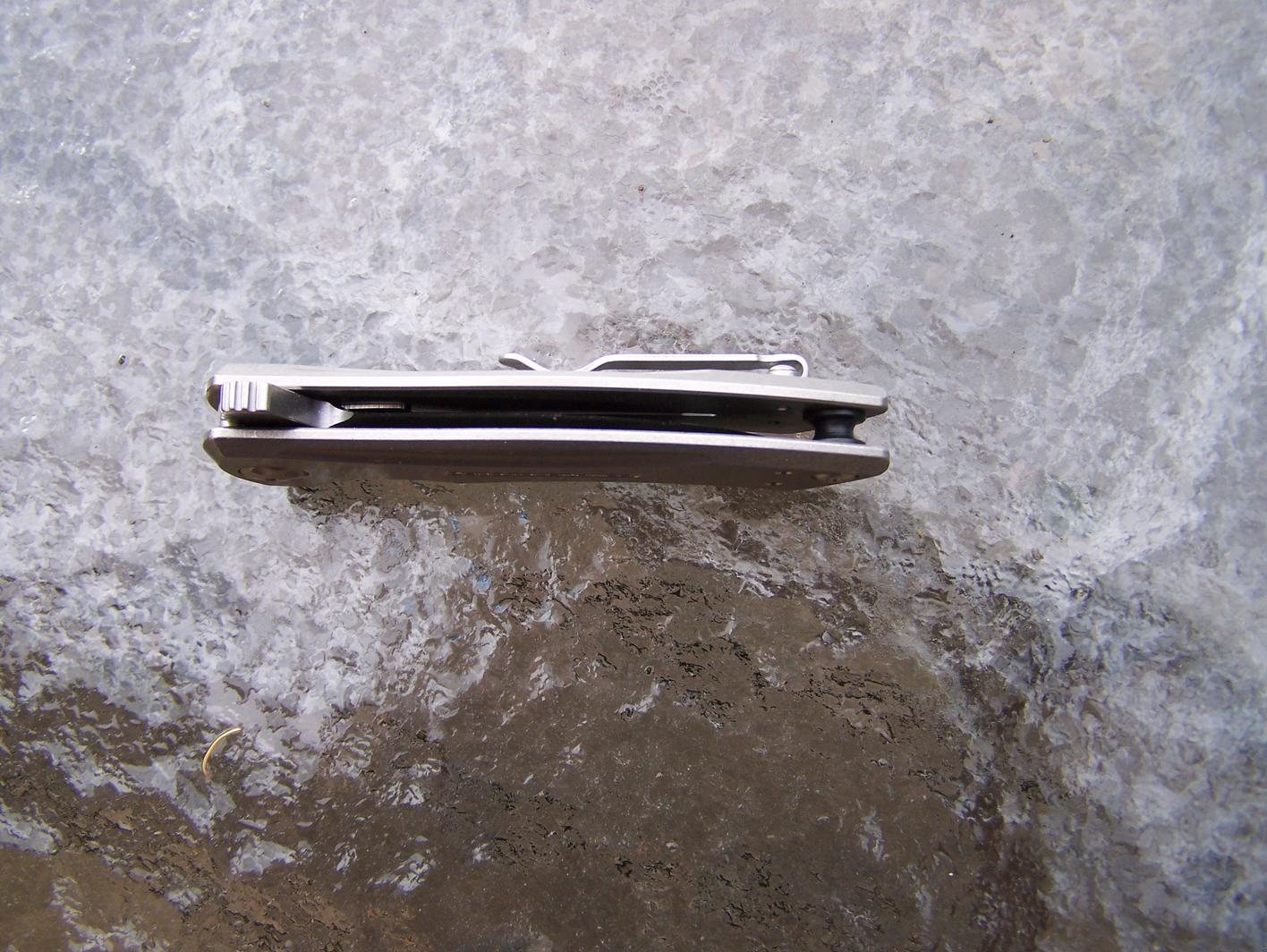
100_6424

The top rear of the blade has what I call “friction” grooves on it, for thumb placement, when holding the knife in the fencing position, which is one of the most common types of grips used for many cutting chores. When the blade is opened, the flipper acts as a guard, so your fingers can’t slip up onto the blade. There is also a groove in the handle scales, where my index finger just naturally laid in.

The ZT 0900 was put to the test around my digs cutting blackberry vines, and it easily sliced right through them, which is something many short blade folders can’t do. The blades are long enough to really slice easily; the 0900 had no problems. Cardboard was cut until I was bored. The same goes for cutting hemp rope, and I’m now out. I have to get a new supply. Poly rope, which is always a tough thing to easily slice through, was no match for the 0900. Some kitchen testing was done by my wife, who used the 0900 as something of a paring knife to slice veggies and the like. She liked it for the most part but thought it was a bit heavy for a paring knife. I reminded her that it wasn’t a paring knife!

100_6426

Many jurisdictions have restrictions on the length of a knife blade that you can carry in your pocket; many areas only allow you to carry a folding knife in your pocket with a blade three inches in length or shorter. The ZR 0900 fits the bill perfectly. However, you will believe the knife has a bigger blade than it does, because of the width of the blade and the overall appearance of the knife. It looks bigger than it is for the most part, and when you put it to work for your cutting chores you’ll believe you have a folder with a longer blade than it is.

With this “little” ZT 0900 folder, I’m starting to change my thinking on little folders with short blades. Thanks, Zero Tolerance. You are starting to rid me of my bias against folding knives with blades less than 3.5 inches, See, even an old dog can learn new tricks. Check out the 0900. I think you’ll like it. Full retail is $240, but you are getting custom quality knives from Zero Toleranace.

– Senior Product Review Editor, Pat Cascio



Recipe of the Week: Two Ingredient Biscuits, by C.P.

Ingredients:

Directions:

  1. Heat oven to 450 degrees.
  2. Mix flour and buttermilk together to form dough. If needed, add extra buttermilk. Do not over mix.
  3. Put a little flour on counter; dump dough on counter and knead four times.
  4. Turn dough over and pat to about an inch thick.
  5. Cut out biscuits with cutter or pinch off in small balls.
  6. Place in a cast iron skillet or baking pan that has been sprayed with cooking spray or coated with a light coat of bacon grease or shortening.
  7. Bake for 10-12 minutes, depending on how brown you like your biscuits.
  8. Serve with butter and jam/sorghum, etc. or gravy.

o o o

Useful Recipe and Cooking Links:

SurvivalBlog Reader J.C. sent in the link to this Video of making bread without kneading it: Bake A Sandwich Loaf With No Machine and Without Touching The Dough

Do you have a favorite recipe that would be of interest to SurvivalBlog readers? Please send it via e-mail. Thanks!


Letter Re: Bug-Out Boats Revisited

HJL,

Regarding bug-out boat power generation, I just wanted to add that there is a tow-behind unit that generates power while under sail from the water flow.

I’ve always thought a sailboat in warm waters would be a pretty nice escape, especially Cats with their low draw and excellent access, much more living space, and top speeds.

However, there are a couple concerns:

  1. If it’s a true EOTW scenario, establishing any “community” or tribe from such a mobile homebase would seem to be very difficult and going within sight of land could put you in danger of being easily run down by gangs in powerboats.
  2. How much firepower can a boat withstand without danger of sinking?

HJL: Anybody?


Economics and Investing:

Items from Mr. Econocobas:

Norway’s Biggest Bank Demands Cash Ban – This call for capital controls is not likely to go away; hedge yourself to the best of your ability.

The Markets Are Backing Central Bankers Into a Corner – As you are well aware, and plenty of folks have been saying for a long while, QE and other central bank interventions are a monetary roach motel. You can never check out.

Items from Professor Preponomics:

US News

Waste-O-Meter: GOP Lawmakers Create Meter to Target “Wasteful” Government Spending (The Providence Journal) In an attempt to tackle the problem of “out of sight, out of mind”, lawmakers are creating a constant visual reminder intended to keep the matter of wasteful government spending at the forefront of constituent thinking! Excerpt: “…we have constructed a visual reminder for citizens and for our policy makers. The Waste-O-Meter is a giant thermometer which will track the instances of waste in government. Every two weeks, we intend to add to the thermometer as we uncover more examples of wasteful spending….”

Government Spending is Out of Control (Rand Paul News) Excerpt: “What frustrates me the most about Washington’s penchant for spending $7 million a minute is that there is clearly hundreds of millions dollars worth of pork barrel spending that should be removed from our list of expenditures. For example, we recently spent taxpayer money on everything from a $104 million subsidy for millionaires to live in public housing to $850,000 on foreign made-for-T.V. cricket league in Afghanistan. I cannot imagine that anyone living outside the beltway would support such wasteful expenditures.”

International News

Desperate in Davos: Policymakers Struggle for Answers (Reuters) Excerpt: “Beneath the veneer of can-do optimism at the World Economic Forum, however, was a creeping concern that the politicians, diplomats and central bankers who flock each year to this gathering of the global elite are at the mercy of geopolitical and economic forces beyond their control.”

IMF Say… Brazil Recession Deepening with Three Lost Years (Bloomberg) Excerpt: “Brazil won’t return to growth until at least 2018 after two years of recession and one of stagnation, marking the first time in over a century that Latin America’s largest economy fails to expand for that long…”

Rising Debt in Emerging Markets Poses Global Threat(Wall Street Journal) Excerpt: “After years of powering the global economy, emerging markets are caught between fading growth and tighter lending conditions, squeezing their private sectors, which had borrowed heavily during an era of low rates.The fallout from any debt defaults can spread fast: Foreign banks have lent $3.6 trillion to companies in emerging markets, and foreign investors hold, on average, 25% of local debt in developing economies.” Note: The Wall Street Journal requires subscription access to some content.

Profit Warnings Hit Crisis Highs as Market Turmoil Wracks UK (The Telegraph) Excerpt: “Profit warnings have rocketed to their highest levels since the financial crisis amid growing market fears that the global economy is on the brink of a major new downturn.”

The Periodic Table of Commodity Returns (Visual Capitalist) Excerpt: “At the beginning of each year, U.S. Global Investors puts out a fantastic visualization called the Periodic Table of Commodity Returns. This year’s version has an interactive design that allows users to sort returns by various categories including returns, volatility, and other groupings. For those keeping score, 2015 was a historically bad year for commodities in almost every regard.”

Personal Economics and Household Finance

Keys to Preventing Tax Identity Theft (Clark Howard) Spoiler Alert: File early! Excerpt: “During the last few years, crooks have been stealing people’s Social Security numbers and then filing false returns as though they were those people. The crooks typically claim low income and high deductions and file electronically. Then when you go to legitimately file your return, it’s rejected by the IRS because somebody else already filed as you!”

o o o

SurvivalBlog and its editors are not paid investment counselors or advisers. Please see our Provisos page for details.


Odds ‘n Sods:

Zika virus, a wolf in sheep’s clothing A virus that has no vaccine and no specific treatment is on the rise and prevention appears to be the only real option. The mosquito-borne virus is actually a minor illness that resembles a light case of the flu except when it holds a nasty surprise. – D.S.

o o o

No idea what you’re going to do when TEOTWAWKI is here and there is no GPS? How about doing the same thing that Native Americans did for hundreds of years: Native American GPS – T.Z.

o o o

Flint Residents Told That Their Children Could Be Taken Away If They Don’t Pay For City’s Poison Water. Let me get this straight – The government is responsible for the quality of the water delivered, mandates that it be purchased and used, but it is unsafe to use. If you don’t pay your water bill for this substandard, poisoned water, the city threatens to foreclose on your home and take your children away? It’s time to move! – D.S.

o o o

From the Desk of Mike Williamson, SurvivalBlog’s Editor At Large: The NRA seems to be the only organization that has actually tested the Armatix iP1, the Not-So-Smart Gun.

o o o

The Sundance Film Festival Trains Its Sights on the Gun Debate – T.P.


Notes for Sunday – January 24, 2016

January 24 is the birthday of Tamara K., the editor of the View From The Porch blog. This is also the birthday of René Barjavel (born 1911, died November 24, 1985). This prescient French science fiction author wrote several books with survivalist themes, including Ravage, which was titled Ashes, Ashes in its English translation.

o o o

Today is the day we move to our new server! We expect a few hiccups along the way in the move but hope to be stable by tonight.

o o o

Don’t forget that we are nearing the end of Round 62 of the Writing Contest. There are many fantastic prizes with a total combined value of nearly $12,000. A $245 gift certificate from custom knife-maker Jon Kelly Designs is just one of them. Check them all out and get busy writing.


Bug Out Boats Revisited, by P.J.C.

As more and more prepper books and articles are written to address the issue of what one should do in order to have a viable bug out plan, most primarily focus on having a physical location, such as a cabin or small house in a remote area within reasonable driving distance of your present home. Somewhat surprisingly, far less attention has been given to the alternative idea of having a bug out boat to use for the same purpose. Once carefully examined, a “proper” boat will have certain advantages over a remote physical location, not the least of which is less cost and the ability to move on quickly to safer location if necessary.

A quick scan of related postings and articles suggest that others do give some credibility to the idea of a bug out boat but tend to offer examples that are relatively impractical. For example, one writer recommends a trailerable motorboat in a range of 20’ to 25’ in length. While this may provide a quick means of escape, it affords no suitable longer-term accommodation, at least for any more than a few days. That is, unless it provides the means of safer transit to a remote cabin by avoiding clogged or dangerous public roads. In another You Tube video, the serious owner of a 45’ luxury motor yacht extolls its virtues as the ideal bug out boat. It truly is a large, comfortable, well-equipped floating condo with every possible creature comfort. However, it is propelled by huge twin Caterpiller diesel engines, which literally guzzle fuel. It has substantial fuel tanks that would probably keep a family quite happy and comfortable for at least a few weeks, but then what do they do when diesel fuel in any quantity is no longer available. At that point, you have a huge, immobile floating barge that cannot readily move anywhere, plus you’ve also lost all systems dependent upon a diesel-fueled generator, such as lighting, air-conditioning (cooling and heating), refrigeration, running water, electric flush toilets, et cetera. That’s not a great choice if you have to escape a chaotic urban scene for more than a few weeks. I also suspect that a large, luxury yacht would make a highly visible and attractive target for any water-borne looters.

While these writers do make a fair case for bug out boats, none I have found actually describe what the “proper” bug out boat might actually look like. So, from personal experience as an owner of both, I will suggest two very viable options for consideration. In my opinion, the most ideal bug out boat will be a sailing catamaran, such as the popular Gemini 105MC– a 34-foot cruising cat with a 14-foot beam, capable of floating in 18” of water with a small, diesel auxiliary engine. It can go almost anywhere, including remote shallows where most other boats cannot. The Gemini has the advantage of both efficient sail power and economical diesel propulsion. However, when considering the prospect of longer-term occupancy, I believe its biggest advantage is the exceptional amount of living and storage space. It comfortably sleeps six persons in three separate staterooms and two more on its convertible settee. There is a private head with shower and a well-equipped galley. There’s an abundance of breathing room inside and lots of open, walkable deck space outside, essential to avoiding “cabin fever”. As a bug out boat, the Gemini can sail most anywhere, as long there’s at least six to seven knots of wind. Under power alone, with two built-in 18-gallon tanks, it burns about 1.5 gph at 6+ knots (7.2 mph), providing a range of 170 miles, which is easily increased to more than 300 miles by carrying an additional 30 gallons of diesel in its rear lazarettes. All of the lighting systems, instruments, VHF radio, and pressurized fresh water system run off a 12-volt battery bank, which is maintained daily by a 125 watt solar panel. The battery bank will also power computers and cell phones indefinitely, assuming service is available. A second solar panel can easily be added to double charging capacity. Two such solar panels will operate the 12-volt refrigerator/freezer. Another option is to carry a compact Honda EU2000i generator with a nominal supply of gasoline. The Gemini’s are equipped with a propane range and stove top. Two twenty-gallon propane tanks will last for five or six weeks, or even longer if used sparingly.

My second choice would be a smaller, semi-displacement trawler, such as the Nordic Tug 32, which I also presently own. These are economical, single diesel engine boats with a sizable fuel capacity affording significant cruising range. For example, the Nordic Tug has a 200-gallon fuel tank and room to carry an additional 50 gallons of diesel. At six to seven knots cruising speed, it uses about two gallons per hour and provides a cruising range of 700-800 miles. Since you may only travel 20-30 miles to your pre-selected anchorage hideaway, you will have a substantial reserve of fuel. The 5kw diesel generator can be run for two hours as needed to recharge the battery bank. This will consume less than two gallons per recharge. The Nordic Tug sleeps four persons comfortably and is of the highest quality construction. Other small trawlers in this same category are manufactured by Ranger Tug and American Tug, and there are several others in the 30-35’ range as well.

Lastly, there is a caveat I must address when recommending a bug out boat in lieu of a cozy cabin in the woods and that is cold weather, meaning long stretches of sub-freezing temperatures, heavy wind-driven snow, and frozen over lakes and rivers. It would be a challenge to live comfortably and warmly on either boat in such winter conditions. Both boats do have factory-option diesel heaters, and I’ve seen Nordic Tugs with small, coal or wood-burning fireplaces mounted in the salon area. If you live in a northern climate and if SHTF should occur in the winter, chances are that your boat would be dry-docked and bubble-wrapped in plastic. So, generally speaking, the cozy cabin retreat probably makes more sense in higher latitudes subject to extreme winter weather. Conversely, if SHTF happens in a more favorable season, just head south to warmer weather as winter approaches. I believe there is a strong case to be made for a bug out boat, if you do not reside in the frigid north.

Also, don’t forget that these boats are a whole lot of fun even if SHTF never happens.


Letter Re: Letter Re: Root Cellaring Potatoes

It is very possible to grow potatoes from true pollinated seeds. I have been doing it for years. Potato seeds store for a long time, if kept dry. Enough seed to plant a large garden can fit into a small seed packet. Something like 85% of commercial varieties are sterile and thus don’t produce seeds. On my farm I have chosen to only grow varieties of potatoes that routinely produce seeds, and I store the seeds from them even if I most commonly grow from clones.

Regards, J the farmer.


Economics and Investing:

Nearly $8 trillion wiped off world stocks in January, U.S. recession chances rising: BAML – B.B.

o o o

Items from Mr. Econocobas:

David Stockman- 700 Days In No Man’s Land – Why They Can’t Keep It Up

Venezuela Default Imminent

Items from Professor Preponomics:

US News

Moody’s Puts 175 Energy and Mining Companies on Downgrade Watch (Financial Times) Excerpt: “Several of the world’s biggest oil and gas groups— including Royal Dutch Shell, Total and Chesapeake Energy— are among 175 energy and mining companies at risk of rating downgrades following a collapse in crude and other commodities markets….”

Bonner: The Entire Recovery is One Giant Myth (Business Insider) Some analysts and commentators believe consumer driven activity will save the day and that the worst is over for the manufacturing sector; it seems reasonable, however, to question the underlying fundamentals and to consider whether or not (or to what degree) consumer support is sustainable. This article does just that… Excerpt: “We don’t know whether it will get uglier now… or further down the road. But sooner or later, markets will retest the myths that support today’s asset prices. They will begin by asking questions: Are stocks too expensive? Can investors repay their debt? Is the economy capable of real growth? Can a small bunch of PhD economists with no market or business experience really manage the entire world’s economy?”

International News

When Russia’s Money Runs Out, the “Real Trouble Starts” (CNBC) Excerpt: “I don’t think you can underestimate how bad the situation in Russia is right now, you’ve got oil below any measure where the budget can survive and you’ve got sanctions from the West. Russia is in what I’d call a real serious economic crisis….”

There’s a Worrisome Shift in the Way the Most Powerful People in the World are Talking about China (Business Insider) Excerpt: “China faces a falling currency that it is spending billions to keep stable, and massive companies in sectors that used to drive growth getting swallowed by debt and buried by overcapacity. The Chinese government has said it has plans to combat these problems, but the plans are yet to be made public.”

IMF: Venezuela Inflation to Surpass 700%(AP) Excerpt: “…Venezuela’s economic troubles are leading to widespread shortages and “exacting a tragic toll”. Zero Hedge is also reporting: This is What the Death of a Nation Looks Like Warning: ZH article commentary may contain bad language and/or inappropriate avatar images.

Brazil: Economy Shed 1.5M Jobs in 2015 (New York Times) Excerpt: “Earlier this week, the International Monetary Fund said the recession affecting Latin America’s biggest country will continue in 2016 with output contracting 3.5 percent.”

Davos Leaders Fear “Brexit” May Be Deathknell for EU (The Telegraph) Excerpt: “Europe’s leaders have issued a passionate plea for Britain to remain in the European Union, fearing that Brexit could set off a disastrous chain of events at a time of existential crisis for the EU project.”

Personal Economics and Household Finance

11 Ways to Save on Your Water Heating Bill (Frugal Living) Install a timer. Stop the leaks. Insulate your pipes…and more! This is a list of excellent reminders and ideas.

o o o

SurvivalBlog and its editors are not paid investment counselors or advisers. Please see our Provisos page for details.


Odds ‘n Sods:

I had to chuckle a bit, seeing the news reports from the east coast. You see, we get five to eight feet of snow most winters here in our part of the American Redoubt. And it is not unusual to get two feet of snow with just one two-day storm. When we do, we just throw another log on the fire, top off our livestock water tanks, and our kids have an excuse to slack off on their homeschooling to do some extra sledding. But we certainly don’t call it #SNOWMAGEDDON, and the local police chief doesn’t threaten to arrest people if they go out driving. This is not The End Of The World As We Know It! Stay safe and warm, folks. Keep those who don’t have backup heat and water systems in your prayers. – JWR

o o o

J.C. sent in this link to the vlogger Primitive Technology: Cord drill and Pump drill. It is truly amazing what can be accomplished with some of the most primitive tools and a little ingenuity.

o o o

Reader A.W. sent this Facebook link to pictures of the 3rd U.S. Infantry Regiment (The Old Guard). In spite of a record snow fall, the Old Guard is still on duty at Arlington National Cemetery honoring the memory of the Unknown Soldier. (You do not have to have a Facebook account to view the pictures.)

o o o

‘Seeds of Change’ Documents the Seed Saving Movement. Sent in by D.S., this article is about the PBS special documenting the rise of the patented seed, the decline of the heirloom seed, and the fight to save it.

o o o

More reason to home school: Former Pearson Exec Reveals Anti-American Agenda in Common Core – B.B.


Notes for Saturday – January 23, 2016

January 23rd is the birthday of John Moses Browning, born 1855. He was the brilliant designer of dozens of guns, including the M1911 pistol, Browning Automatic Rifle (BAR), and the venerable M2 .50 Caliber Machinegun. The latter is still in service in at least 95 countries, and I wouldn’t be surprised if it is still in service in 2075 or even 2100.

o o o

Today, we present another entry for Round 62 of the SurvivalBlog non-fiction writing contest. The nearly $12,000 worth of prizes for this round include:

First Prize:

  1. A Tactical Self-Contained 2-Series Solar Power Generator system from Always Empowered. This compact starter power system is packaged in a wheeled O.D. green EMP-shielded Pelican hard case (a $1,700 value),
  2. A Gunsite Academy Three Day Course Certificate that is good for any one, two, or three day course (a $1,195 value),
  3. A course certificate from onPoint Tactical for the prize winner’s choice of three-day civilian courses, excluding those restricted for military or government teams. Three day onPoint courses normally cost $795,
  4. DRD Tactical is providing a 5.56 NATO QD Billet upper with a hammer forged, chrome-lined barrel and a hard case to go with your own AR lower. It will allow any standard AR-type rifle to have a quick change barrel, which can be assembled in less than one minute without the use of any tools and a compact carry capability in a hard case or 3-day pack (an $1,100 value),
  5. Gun Mag Warehouse is providing 20 Magpul PMAG 30-rd Magazines (a value of $300) and a Gun Mag Warehouse T-Shirt; (an equivalent prize will be awarded for residents in states with magazine restrictions),
  6. Two cases of Mountain House freeze-dried assorted entrees in #10 cans, courtesy of Ready Made Resources (a $350 value),
  7. The Ark Institute is donating a non-GMO, non-hybrid vegetable seed package (enough for two families of four) plus seed storage materials, a CD-ROM of Geri Guidetti’s book “Build Your Ark! How to Prepare for Self Reliance in Uncertain Times”, and two bottles of Potassium Iodate (a $325 retail value),
  8. A $250 gift certificate good for any product from Sunflower Ammo,
  9. KellyKettleUSA.com is donating both an AquaBrick water filtration kit and a Stainless Medium Scout Kelly Kettle Complete Kit with a combined retail value of $304, and
  10. Two cases of meals, Ready to Eat (MREs), courtesy of CampingSurvival.com (a $180 value).

Second Prize:

  1. A Glock form factor SIRT laser training pistol and a SIRT AR-15/M4 Laser Training Bolt, courtesy of Next Level Training, which have a combined retail value of $589,
  2. A FloJak EarthStraw Code Red 100-foot well pump system (a $500 value), courtesy of FloJak.com,
  3. A transferable certificate for a two-day Ultimate Bug Out Course from Florida Firearms Training (a $400 value),
  4. A Model 175 Series Solar Generator provided by Quantum Harvest LLC (a $439 value),
  5. A Trekker IV™ Four-Person Emergency Kit from Emergency Essentials (a $250 value),
  6. A $200 gift certificate good towards any books published by PrepperPress.com,
  7. A pre-selected assortment of military surplus gear from CJL Enterprize (a $300 value),
  8. RepackBox is providing a $300 gift certificate to their site, and
  9. Safecastle is providing a package of 10 LifeStraws (a $200 value)

Third Prize:

  1. A Royal Berkey water filter, courtesy of Directive 21 (a $275 value),
  2. A $245 gift certificate from custom knife-maker Jon Kelly Designs, of Eureka, Montana,
  3. A large handmade clothes drying rack, a washboard, and a Homesteading for Beginners DVD, all courtesy of The Homestead Store, with a combined value of $206,
  4. Expanded sets of both washable feminine pads and liners, donated by Naturally Cozy (a $185 retail value),
  5. Two Super Survival Pack seed collections, a $150 value, courtesy of Seed for Security, LLC,
  6. Mayflower Trading is donating a $200 gift certificate for homesteading appliances,
  7. APEX Gun Parts is donating a $250 purchase credit,
  8. Montie Gear is donating a Precision Rest (a $249 value), and
  9. Two 1,000-foot spools of full mil-spec U.S.-made 750 paracord (in-stock colors only) from www.TOUGHGRID.com (a $240 value).

Round 62 ends on January 31st, so get busy writing and e-mail us your entry. Remember that there is a 1,500-word minimum, and that articles on practical “how to” skills for survival have an advantage in the judging.


Market Garden Tools, by J.B.

At the top of everyone’s prepping list is an abundant food supply. Gardening is an essential part of making that food supply as resilient as possible. Maintaining a garden does take a substantial amount of time and energy, both of which may be in short supply in a TEOTWAWKI situation. As a farmer running a market vegetable farm, there are a number of tools that I have come to rely on, many of which would be similarly helpful on a non-commercial scale as well, allowing you to spend less time maintaining the essential food source that is your garden.

The soil on which I farm, and accordingly on which I am familiar with these tools, is heavy clay loam. This means that I have a very dense soil that is sticky when wet and quite hard when dry, by contrast to sandier soils that would be looser and less prone to forming a hard, crusty surface when dry. Many of the tools that I will described will perform differently on different soils and in fact may be easier to use on a lighter, looser soil. Please note that I am not affiliated in any way with any of the retailers or producers of these products; I am just a retail customer.

Tillage & Bed Preparation

Tillage is the process of turning over, mixing, or otherwise mechanically preparing your soil for planting. There are a number of ways to do this, which I will describe in order of decreasing cost and scale.

Rotavator

A rotavator is a rotary tiller, or rototiller, powered and pulled by a tractor. If you already have a tractor and also have a very large garden, you may want to consider one of these. For most this is both prohibitively expensive and prohibitively large for a smaller space. However, rotavators are generally more capable of preparing your soil deeper, more thoroughly, and faster than any other method.

Walk-Behind Tractor

Walk-behind tractors are often referred to simply by the function of the implement that is attached to it, like a rototiller. Another common example would be a snow blower. Basically, this is a relatively small engine with a power-take-off (PTO) that runs an implement while you walk behind it. For a small to homestead sized garden a walk-behind rototiller should be everything you need to prepare you garden for planting. Rototillers are generally measured by the width or soil that they work, and range in size from 6” to 36” with sizes in the 16”-24” range being most common.

Prices range from $200-$500 for a used unit to over $5000 for a top of the line unit like a BCS or Grillo. Less expensive models are available from many outdoor equipment makers like Husqvarna, Troy-Bilt, and many others, and many of these will work great. It has been my experienced that older models (like pre-1985) are much more solidly built and if well maintained are less likely to have issues than more recent models. If you can afford it, I recommend BCS as a quality manufacturer with an outstanding reputation. With a BCS you also have the option of a number of other attachments aside from the rototiller, include mowers, snow blowers, and even a generator.

Hand Tillage Tools

Both tractor-mounted rotavators and walk-behind tillers make soil preparation much easier and faster than hand tools. However, both have a number of drawbacks in that they are major investments, require fuel to function, and are hard on the soil. If these options are outside of your budget or you would like a non-fuel powered backup, there are some hand tools that can be used in their place

The largest and most efficient is the broadfork. This allows you to lift and break up a relatively wider piece of soil than the other hand tools. Additionally, broadforks do a good job of aerating and deepening your soil due to the depth the tines reach. They can also serve as a harvest tools for digging root crops, like potatoes or carrots. One caveat of this tool is that it is breakable. In very dense soil, like the clay loam that I farm on, you can bend the tines just trying to work the soil up. And even in lighter soil, if you happen to catch a root or something, you can wind up with bent tines, and once they are bent they will never again be as sturdy as before bending. That said, folks working in lighter soil have told me that broadforks can be used effectively and efficiently.

Tillage can also be done with just a simple shovel or digging fork. This is obviously much slower and more labor intensive than any of the other options, but shovels are much easier to find and are far less expensive than any of the other tools mentioned.

Many seed and supply companies also sell a number of other soil preparation tools. These include things like tilthers, bed rollers, or hand tillers. In my experience there is rarely, if ever, a need to have your bed so finely prepped that those tools are merited.

Planting

Planting in a home garden is a relatively minor task and can generally by quickly and easily accomplished by hand simply by dropping the seeds into a prepared furrow. As you increase the size of your garden, hand-seeding can quickly become a tedious and time-intensive project. A push seeder can make this process much faster, more accurate, and more efficient in terms of seeds used by spacing them more evenly than you can easily do by hand. The Earthway seeder is a good, low cost push seeder. To use the Earthway, you fill the hopper with seed and as you push it down the row the front wheel turns a seed plate that picks up the seeds and drops them into the soil. Another option is a Jang seeder, which works much the same as the Earthway but uses rollers instead of plates to pick up the seeds. The Jang is substantially more expensive than the Earthway, plus has the additional cost of purchasing rollers for the various seed types. It is, however, a much higher quality product and is capable of being more precise, thus further reducing waste from over-seeding. One particular drawback of the Earthway is that it can’t be used to plant small, round seeds, as it will crush the seeds.

Cultivation & Weed Management

Controlling weeds can be one of the most challenging and time-consuming components of gardening. The preferred method of cultivation is killing the weeds pre-emergence or extremely shortly thereafter by mechanically stirring or scraping the top layer of soil with a hoe or similar tool. There are many, many tools available for this, which I will again list in order of decreasing scale and cost.

Tractor Cultivation

There are many, many tractor cultivation tools out there. They are nearly all beyond the scope of even a very large home garden, so I am not going to get into them here, but if you find yourself approaching a commercial scale operation keep in mind that they are an option.

Wheel Hoes

Wheel hoes, I think, are one of the most indispensable tools you can have for a garden. They are a bit of an investment but quickly pay off in time and effort saved even in a smaller home garden. There are a number of brands out there, of which the Glaser is my preferred model. A wheel hoe allows you to cultivate the space between your rows quickly and efficiently. Also, it allows you to do so while standing, thus saving strain on your back and knees, which generally take a lot of abuse with many other garden-related tasks. The major drawback of a wheel hoe is that they lack the precision to control weeds close to your plants, meaning that you need to come back with a more precise tool for those weeds.

There are a number of attachments available for wheel hoes. I almost exclusively use 8-inch or 12-inch stirrup hoes, but there are tine cultivators, hillers, and even a single row seeder like those described above available for your wheel hoe.

Long-Handled Hoes

There are a number of types of long-handled hoes. I personally prefer scuffle hoes, collinear hoes, and stirrup hoes, but any kind of hoe can accomplish the same task. Scuffle hoes are essentially sharpened wedges on the end of a long handle that you push in a sort of ‘scuffle’ along through your rows. A collinear hoe works in reserve of a scuffle hoe; the blade is set to the handle such that you pull it toward you rather than push it away from you, like with a scuffle hoe. Both of these have the advantage that they can easily be used from an upright standing position. A stirrup hoe has a stirrup-shaped loop of metal at the end of the handle, the bottom of which is sharpened. These are more aggressive hoes and may work better than scuffle or collinear hoes in hard, crusty soil. Stirrup hoes do, however, require more bending to use effectively than the other types, thus putting more strain on your back.

Hand Hoes

The long handles hoes just described are much more precise than wheel hoes, but even so are sometimes not precise enough for some tasks. In that case you may need a hand hoe. Hand hoes allow you to cultivate extremely close to your plants. However, this are a much more labor-intensive and time-consuming task than using any of the other hoes. Also, using a hand hoe requires being on your hands and knees, thus making it physically challenging work.

Bear in mind that any of these cultivating tools rapidly become less effective as your weeds move past their very early stages. You truly do want to be cultivating as soon as (or even before) the weeds emerge from the soil. Once the weeds grow past an inch or three tall, it becomes difficult to impossible to hoe effectively and you may wind up having to pull the weeds by hand to remove them.

Harvesting

Nearly everything that you would grow in your garden must be harvested by hand, due to the delicate nature of the produce, even on our ten-acre market farm. There are a few tools that can be helpful, the first of which is a good knife. We use these Victorinox serrated paring knives, as they come extremely sharp, cut well even after lots of use, and are inexpensive enough that I don’t mind when they get lost or broken. At this point we treat them as essentially disposable, which is something that would have to change in a TEOTWAWKI situation, but for now I can hand them out to my employees and not worry about what happens to them.

A hand pruner can also be a helpful tool for harvesting. I use these for harvesting things like peppers and eggplant, where cutting them with a knife increases the odds of both damaging the plant and cutting your hands. Also, a pruner or even a lopping shears can come in handy for cutting full stalks of Brussels sprouts before they go into the root-cellar.

Crops like carrots, garlic, or potatoes have to be dug up. I already talked about broadforks in the tillage section above so will not go into detail on those again, but they are a more efficient option than a regular shovel or digging fork. I prefer to use a shovel for digging root crops rather than a digging fork because I seem to damage more of the roots with a fork. The fork may be more effective in a looser soil than mine though, and they do come in handy for other tasks so are worth having around.

Once crops are harvested you need something to store and transport them in, and while any tote, bucket, or bag will work I highly recommend crates from Intercrate Container. I use the 6.7, 8.5, and 10.5 crates for transporting and storing nearly everything on the farm. Their major advantage over other types is their swing-bar stacking design. Basically there is a bar on either side of the top that you swing in, allowing the crates to be stacked without crushing the contents, and when the bars are swung out the crates nest inside each other, saving on storage space.

Season Extension

On a farm scale we use heated greenhouses, unheated hoophouses, and row cover to extend the season in which we can grow certain crops. The larger scale and greater cost of the greenhouses and hoophouses makes them impractical for a home garden setup, but row cover is something that can be fit to any scale. Row cover is a very lightweight non-woven fabric that is used to cover your crops, giving them a little bit of cover from cold and frost. It also traps heat like a greenhouse would, warming the soil faster, adding to the season-extending benefits. Additionally, row cover creates a physical barrier to insect pests and can be used in place of sprays for some crops. For many of the sturdier crops, such as broccoli or summer squash, I let the row cover simply lay on the plants directly. For more fragile crops like peppers, tomatoes, or sweet potatoes the row cover needs some support to keep it off of the plants. I generally use hoops of heavy wire (less expensiver in other places) or you could use bent electrical conduit or pvc. The edges of your row cover need to be buried slightly or thoroughly weighted down with something to keep it from blowing away.

Row cover is reusable, but it is also quite fragile and tears easily. It can make a big difference in crop health and can extend your growing season upwards of two weeks on either end. So, it is definitely worth using but may not be sustainable in a long-term TEOTWAWKI scenario.


Letter Re: Starting a Small Business, by T & BR

HJL:

I admire their enthusiasm. As an independent insurance agent I work with lots of successful businesses. Those successful business people have one thing in common and that is focus. If there is a second commonality, it is unequaled knowledge which would be a product of the first. Sure, those people are branched out in other endeavors with a goal of income diversification and asset preservation but only after significant success in the first. Rarely are the alternative investments as lucrative as the first, but they make up for that with security.

Knowledge of how to get a job done is not where you stop. Understanding costs and what jobs will and will not pay for the effort is key. Figuring out who you should do business with is at the heart of success. There are people that you just cannot work with and mutually win. You learn the noises they make and politely bow out.

Getting your fanny handed to you makes the success sweeter. Keep it up.