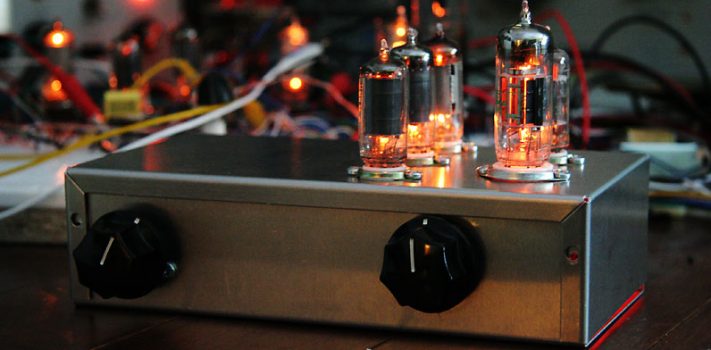
Using EMP-Hardened HF Ham Radio to Send/Receive E-Mail During Nationwide Outage- Part 1, by PrepperDoc

There are multiple possible scenarios that may result in a regional an/or national combined loss of Internet connectivity and cell/telephone service, during which you would probably wish to maintain communications to loved ones and others. EMP may destroy routers, cell towers, and power sources; solar coronal mass ejection (CME) may remove power from all communications systems; cyber warfare may have similar outcomes. Travel in some of these circumstances will be difficult, or dangerous to impossible.

Ham radio VHF/UHF repeaters may go down, due to power outages or EMP. Direct, point to point simplex VHF Ham radio will still work (even after an EMP, if hand-held radios were at all hardened or protected) over modest distances. Long range HF direct Ham radio communications will work (possibly after a delay of any EMP), presuming you had protection (if EMP) and have your own power. However, they will be of less usefulness if you haven’t established communications plans, frequencies, modes, and protocols with your loved ones. Without prior pre-arranged schedules, connecting directly with your intended recipient may take precious hours of transmissions, create immense interference to others, use precious power, and provide a very easy radio signature from your location.

It would be really nice to be able to reach people via asynchronous email, so that direct radio contact and simultaneous radio communications aren’t necessary. You’d prefer to connect to a server, digitally send your message, and have your intended recipient be able to do the same at times that are convenient to both of you. Such communications may allow you to set up direct communications (if desired), or pass crucial information or requests. If you are not familiar with Ham radio digital communications, this reference may help:[1].

The WINLINK system[2], which is available to all Ham radio operators, was designed over the last 20 years with this exact capability, and it currently serves ships at sea as well as anyone who has a communications need that requires radio contact. Their system is provided by volunteers and is free and reliable, though not without controversy, as some object to what they see as automated interference to their activities in the name of providing free email to “yachtsmen”. Critics do not recognize the catastrophic scenario benefit. WINLINK has the ability to do intelligent automated radio forwarding from server to server, completely independent of but similar to the Internet, and thus it provides a fairly comprehensive alternate communications system. Email attachments are allowed; in the event of national emergency, you might be able to attach encrypted material, which is not legal under current FCC regulations. This may not even be necessary, as the request/acknowledgment packet handshakes make it difficult for anyone but a very capable and well-funded foe to decipher your communications. Users specify to three “message pick up stations” (MPS) where their mail will be delivered and from which they can retrieve it. You might want to pick a couple within your geographic area and one that is totally out of your nation.

Robust

It is extremely likely that the WINLINK system will continue to operate in some form after most catastrophes. Their five central servers are distributed across multiple continents. Their volunteer RMS email-server high frequency Ham radio stations are located all over the world, and these stations function with different equipment of different vintages and manufacture. There is a very good chance that some of them will either be unaffected or have equipment that is impervious to the catastrophe, with some stations likely EMP-hardened. Since HF signals can easily span continents and oceans, you will have multiple options to make the necessary contacts. The flip side is that HF radio communications modems are relatively slow, compared to the broadband connections to which much of us are accustomed. Transfer speed is back to what you may remember from the old telephone modem days. However, for email, it works!

Getting Started

If you have (or can borrow for your initial learning curve) a newer, solid state HF Ham radio transceiver with digital frequency readout, you will have little trouble learning and using this system. After the initial setup of your equipment and software (follow the directions in the videos on the WINLINK site!), it will take you less than 30 minutes to have it all figured out. Many new solid-state Ham rigs include their own sound card that will work with RMS-EXPRESS and its embedded WINMOR software terminal node controller (TNC). However, If your rig doesn’t have a built-in sound card, you can a buy Signalink-USB, which works with any Windows computer that has a USB port. In either case, download the free RMS-EXPRESS software from their web site[3], carefully watch the videos on their web site to understand how to use the system and create a free account, and you should be good to go. You may want to do your configurations by going step-by-step through the videos, which lead you through the process. Note that you must USE your new account, via either TELNET or actual Ham radio contact, at least once every 400 days or it will lapse. You automatically get your own WINLINK email account, to which you can set size limitations so as not to overburden your downloading ability. The system resists spam wasting precious bandwidth by using “white lists” of email addresses allowed to send to you; until you send to THEM, they can’t send to you. Otherwise, it works just like any other email account and receives and sends regular Internet email.

Making It EMP-Hardened

Now let’s shift focus to the more important point of this article: getting older, EMP-resistant vacuum tube gear working well with the WINLINK system. The most vulnerable portion of your communications equipment is the part connected to long wires: the transceiver. It has an unavoidable connection to antennas, which may deliver thousands of volts and amperes for nanoseconds in the event of an EMP. Thus, we focus there primarily. The computer and other equipment is more easily protected. (We’ll discuss this later).

Although it is frequently claimed that you should not try digital Ham radio using an older vacuum tube transceiver, those are exactly the systems that will best survive the EMP scenario, and it turns out that once configured properly it really isn’t difficult at all to send and receive email via the WINLINK system using 40-50 year old vacuum tube single-sideband Ham radios. I use them routinely with 40+ year old Heathkit SB-102/101/100 and HW-101/100 style vacuum tube gear that is relatively immune to EMP with minor protection additions.[4] This article is designed to help you discover how to take advantage of these inexpensive, older and readily available Heathkit rigs, with their inherent hardening to EMP. Entire stations can often be obtained from eBay for $200-$300. The remainder of this article is predominately devoted to the review of each hurdle and how to overcome them.

Frequency Control

You must have a stable transmit/receive frequency. This can usually be achieved by letting your radio warm up for 20 minutes or so. You must be within 200 Hz of the correct frequency, and preferably within 100 Hz; otherwise, the automated RMS server station will not acknowledge your connection attempt. The “dial accuracy” of older vacuum tube gear cannot hope to meet that accuracy. There are at least three possible solutions to achieve this frequency accuracy:

  1. Easiest: Simply measure your transmit frequency using an accurate digital frequency counter. You can use FLDIGI or similar program to send a 1.5 kHz (upper side band) audio tone, and use a bit of wire as an antenna on your counter to measure your own transmit frequency, which should be adjusted to exactly the published “center frequency” of the RMS server you want to try to reach. You can even transmit into a dummy load for this purpose.
  2. Next easiest and quite slick: Purchase the DD-103 universal digital dial from Electronics Specialty Products.[5] Tap into the LMO output with a 15-20 picofarad capacitor to the cathode of V5A (first transmitter mixer), and route the signal to the DD-103 with some RG174 flexible coax. For EMP protection, I would recommend adding back-to-back signal diodes (1N914’s or anything similar) between center conductor and shield, to clip signals more than a volt or so. Use MOV protection as appropriate on the power supply voltages to the DD-103. Follow the instructions included with the product to accurately adjust its measurements.
  3. Least expensive but far more work: Build the Pacific Antenna DIGITAL DIAL from qrpkits.com[6] kit, and use it to give your vacuum tube rig a digital dial. Beware, this kit is surface component mounted. You may wish to grind your soldering tip to 0.025” or so and obtain rosin core solder of that or more slender size. A “third-hand-held-magnifying glass” helps a lot. As above, a 15 pF capacitor from the cathode of V5A (first transmitter mixer) will give you plenty of the 5.0-5.5 MHz VFO signal for your Digital Dial input; use coaxial RG174 cable to get the signal to the Digital Dial. Just as with the DD-103 above, protect the DIGITAL DIAL from EMP by adding back-to-back 1N914 diodes between its input RF signal and ground as input clippers, by providing it with metal-oxide-varistor 20V clipping on its 12V power input, and by mounting it in a metal case. After adjusting your Heathkit’s crystal calibrator by beating against WWV (using a 2nd receiver), you can tune to exactly the bottom of a frequency band (e.g, 3.5, 7, or 14 MHz), memorize the VFO frequency within the DIGITAL DIAL, then choose the third option to subtract, and the counter will read just like a digital dial. The Heathkit HW- and SB- series used a reverse direction VFO that was 5.5 MHz at the bottom of a band and 5.0 at the top; the Digital Dial kit allows to subtract the current measurement from the memorized VFO frequency, making the reading correct.

References


[1]https://survivalblog.com/digital-communications-capabilities-for-prepared-families-by-prairie-dweller/


[2]Winlink: http://www.winlink.org/


[3]RMS-EXPRESS client software for Windows: http://www.winlink.org/sites/default/files/downloads/rms_express_install_1-3-12-0.zip


[4]See for example, https://survivalblog.com/emp-hardened-ham-radio-communications-by-prepperdoc/ and https://survivalblog.com/protecting-both-tube-and-transistor-hf-communications-equipment-from-e1-emp-pulse-part-1-by-prepperdoc/


[5]Digital Dial, http://www.qrpkits.com/freqcounter.html


[6]Universal Digital Dial, http://www.electronicspecialtyproducts.com/dd103.html



Letter Re: Venezuela Eating Worse

Hugh,

I understand the situation. The people are desperate. Looking at those pictures it is easy to see they are subsisting on too many starches, which makes them appear well fed, though they are not. So I’m not meaning to criticize, but there is also in those pictures of their food something of note. There’s lots of foods there that can be reproduced. Seeds in the veggies can be planted, beans can be planted, coax seeds from the onions and carrots, plant a potato, etc. Are they doing that? Do they have a place to do that? Would it be stolen from them before they could harvest? I wish someone would address the peoples’ attempts to take care of themselves. We may learn a lot. The time may come when we too would need to be very resourceful to increase our food supply. – J.D.


Economics and Investing:

Frank Holmes: Gold Is Crushing It So Far this Year

o o o

Soaring Silver ETFs to Snap Up as Metals Shine

o o o

Items from Professor Preponomics:

US News

Free Markets Do Not Need Negative Interest Rates (Mises) Excerpt: “An almost line-by-line critique of this article would be necessary, for the arguments in it are so ill-conceived and fallacious that it is hard to ignore them.”

Freddie Mac Narrowly Avoids Tapping Treasury for Money (Washington Examiner) Excerpt: “Lawmakers and officials have been concerned that, as government stewardship of Fannie Mae and Freddie Mac stretches into an eighth year, the companies could require more Treasury funds, creating tumult among investors and members of Congress.”

Puerto Rico to Default Further on Debts (USA Today) Excerpt: “…faced with the inability to meet the demands of our creditors and the needs of our people, I had to make a choice.”

How Puerto Rico’s $70 Billion Crisis is About to Get Catastrophic (Bloomberg) Excerpt: “Puerto Rico missed a $400 million debt payment on Sunday, and bigger, more consequential defaults could follow.”

International News

Warnings Mount on World’s Corporate Debt, China Crisis (The Telegraph) Excerpt: “The body flagged a double threat: a five-fold rise in company debt to $25 trillion in emerging markets over the past decade; and record junk bond issuance in US and Europe, along with shockingly-irresponsible levels of US borrowing to buy back shares and pay dividends.”

Eurozone in Crisis: Greece Set to Default AGAIN and Italy Panics Over £270BN of Bad Loans (Express) Excerpt: “DEFIANT Greece has again turned down creditor demands, taking the country a step closer to another default crisis and subsequently crashing out of the eurozone.”

Tackling Bad Loans at Italian Banks Will Take Years – ECB Angeloni (Reuters) Excerpt: “”Legislation to accelerate insolvency procedures and the liquidation of collateral should be an important part of the solution,” he added.”

Personal Economics and Household Finance

How to Figure Out How Much Debt You Really Have (Clark Howard) Excerpt: “Between student loan payments, a monthly mortgage (or your rent), credit card bills and maybe even an old gym membership that somehow (whoops) went to collections, it can be all-too-easy to lose track of how much debt you actually have on the books.”

o o o

SurvivalBlog and its editors are not paid investment counselors or advisers. Please see our Provisos page for details.


Odds ‘n Sods:

Video: Nightmarish Dashcam Footage Shows Escape from Fort McMurray Fire – Sent in by RBS

o o o

The new EMP/Collapse/Martial Law movie AmeriGEDDON will be released on May 13th. Although the budget and production value look low, the theme will be of interest to most SurvivalBlog readers.

o o o

Ammon Bundy had intended refuge occupation to end up in civil court, lawyers say – Sent in by B.B.

o o o

An excellent review of “How London got its new Muslim mayor”: London’s new Muslim mayor confirms urban Britain’s cultural transformation. – M.B.

o o o

‘We could have been there’: Squadron member speaks out on stalled Benghazi response – B.B.


Hugh’s Quote of the Day:

“Socialism, like the ancient ideas from which it springs, confuses the distinction between government and society. As a result of this, every time we object to a thing being done by government, the socialists conclude that we object to its being done at all.” – Frederic Bastiat


Notes for Thursday – May 12, 2016

Camping Survival just started a factory authorized three day sale on the lifestraw products. It is flying out the door at $14.95. This sale expires on 5/13/16 and no coupon is necessary. You might also checkout their Boone brands canned foods while you are there as well.

o o o

I just noticed that Cold Steel has put the few remaining limited edition Rawles Voyager knives up for sale at Amazon.com, for less than $85 each. Order yours, before they sell out! – JWR

o o o

Today, we present another entry for Round 64 of the SurvivalBlog non-fiction writing contest. The nearly $12,000 worth of prizes for this round include:

First Prize:

  1. A Tactical Self-Contained 2-Series Solar Power Generator system from Always Empowered. This compact starter power system is packaged in a wheeled O.D. green EMP-shielded Pelican hard case (a $1,700 value),
  2. A Gunsite Academy Three Day Course Certificate that is good for any one, two, or three day course (a $1,195 value),
  3. A course certificate from onPoint Tactical for the prize winner’s choice of three-day civilian courses, excluding those restricted for military or government teams. Three day onPoint courses normally cost $795,
  4. DRD Tactical is providing a 5.56 NATO QD Billet upper with a hammer forged, chrome-lined barrel and a hard case to go with your own AR lower. It will allow any standard AR-type rifle to have a quick change barrel, which can be assembled in less than one minute without the use of any tools and a compact carry capability in a hard case or 3-day pack (an $1,100 value),
  5. Gun Mag Warehouse is providing 20 Magpul PMAG 30-rd Magazines (a value of $300) and a Gun Mag Warehouse T-Shirt; (an equivalent prize will be awarded for residents in states with magazine restrictions),
  6. Two cases of Mountain House freeze-dried assorted entrees in #10 cans, courtesy of Ready Made Resources (a $350 value),
  7. The Ark Institute is donating a non-GMO, non-hybrid vegetable seed package (enough for two families of four) plus seed storage materials, a CD-ROM of Geri Guidetti’s book “Build Your Ark! How to Prepare for Self Reliance in Uncertain Times”, and two bottles of Potassium Iodate (a $325 retail value),
  8. A $250 gift certificate good for any product from Sunflower Ammo,
  9. KellyKettleUSA.com is donating an AquaBrick water filtration kit with a retail value of $250, and
  10. Two cases of meals, Ready to Eat (MREs), courtesy of CampingSurvival.com (a $180 value).

Second Prize:

  1. A Glock form factor SIRT laser training pistol and a SIRT AR-15/M4 Laser Training Bolt, courtesy of Next Level Training, which have a combined retail value of $589,
  2. A transferable certificate for a two-day Ultimate Bug Out Course from Florida Firearms Training (a $400 value),
  3. A Model 175 Series Solar Generator provided by Quantum Harvest LLC (a $439 value),
  4. A Trekker IV™ Four-Person Emergency Kit from Emergency Essentials (a $250 value),
  5. A $200 gift certificate good towards any books published by PrepperPress.com,
  6. A pre-selected assortment of military surplus gear from CJL Enterprize (a $300 value),
  7. RepackBox is providing a $300 gift certificate to their site, and
  8. Safecastle is providing a package of 10 LifeStraws (a $200 value)
  9. American Gunsmithing Institute (AGI) is providing a $300 certificate good towards any of their DVD training courses.

Third Prize:

  1. A Royal Berkey water filter, courtesy of Directive 21 (a $275 value),
  2. A $245 gift certificate from custom knife-maker Jon Kelly Designs, of Eureka, Montana,
  3. A large handmade clothes drying rack, a washboard, and a Homesteading for Beginners DVD, all courtesy of The Homestead Store, with a combined value of $206,
  4. Expanded sets of both washable feminine pads and liners, donated by Naturally Cozy (a $185 retail value),
  5. Two Super Survival Pack seed collections, a $150 value, courtesy of Seed for Security, LLC,
  6. Mayflower Trading is donating a $200 gift certificate for homesteading appliances,
  7. Montie Gear is donating a Precision Rest (a $249 value), and
  8. Two 1,000-foot spools of full mil-spec U.S.-made 750 paracord (in-stock colors only) from www.TOUGHGRID.com (a $240 value).

Round 64 ends on May 31st, so get busy writing and e-mail us your entry. Remember that there is a 1,500-word minimum, and that articles on practical “how to” skills for survival have an advantage in the judging.


Notes from “The Lost Art of Reading Nature’s Signs”, by ShepherdFarmerGeek

Did you know that you can get an estimate of distances and elevations conveniently using nothing more than your eyes and your hands? It’s really quite amazing and useful; hikers, hunters, and preppers really need to learn these skills.

Ol’ Remus at the Woodpile Report (www.woodpilereport.com) recently recommended a book by Tristan Gooley entitled The Lost Art of Reading Nature’s Signs: outdoor clues to find your way, predict the weather, locate water, track animals and other forgotten skills.

It sounded downright intriguing, so I’ve been reading it on my Kindle and enjoying it quite a bit. The first Appendix had the following useful distance and angle approximations (not original with Gooley) that might turn out to be really useful for those of us who can’t afford a decent laser rangefinder (or whose “decent laser rangefinder” has become a “decent paperweight” for one reason or another).

DISTANCE

trianglulation1

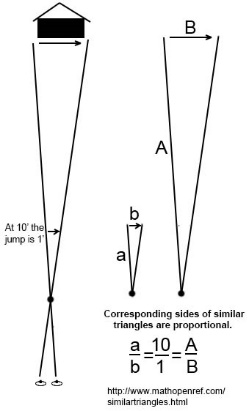
Before the invention of sub-nanosecond timing circuits and compact lasers, there were native tribes-people in Europe and the Americas who used body-proportion estimation to determine sizes and distances. They observed that the apparent distance our extended fingertip will “jump”, when viewed first with one eye and then the other against a background of an object or distance to be measured, is approximately one tenth the distance we are from the object in question. The further away you are, the more the apparent jump. This jumping is called “parallax” and is a consequence of having two eyes with a little distance between them.

Based on the geometric postulate that “corresponding sides of similar triangles are proportional” you can use parallax to calculate the distance between two distant objects, if you know how far away you are from them. (You are three miles from town and see two tall buildings; if your finger jumps exactly from one to the other building, they must be about 1,600’ apart: 3 miles divided by 10.)

Or, if you know the distance between two objects, you can work out how far you are from them. (You see a church that you know is 0.6 miles from the edge of a lake. If your finger jumps exactly from one to the other, then you must be approximately 6 miles away. Fractional or multiple jumps are fractional/multiples of the distance. In this example, if your finger jumped past the lake edge and the parallax jump was 1½ times the visible distance between church and lake, you would know you were nine miles away.)

This will also work if you know the approximate size of an object (the distance from one side to the other). How long is the barn you can see? How long is a typical pickup truck? How tall are the telephone poles in your area? Door heights are pretty standard, and how tall is a standard “floor” of a building? If you know A, you can calculate B and vice versa. This technique works vertically as well as horizontally; you just view the object with your head on its side (finger sideways too)!

If you want to refine this method, mark out a greater test distance of say 50 feet and have a friend with a tape measure determine your exact “jump”. (Eye separation and arm length vary.)

Here’s some more information that is not from the book: Another explanation of why this works can be found online. Also, see this reference.

Here’s a powerful example of the “corresponding sides of similar triangles are proportional” postulate. (I always wanted to use the word “postulate” in an SB article!). However, you’ll need some room to walk! This is an example of determining the width of a river, but you could use it to tell the distance to anything, really.

trianglulation

Find an object across the river (your target object, which in this illustration we will label as tree “T”), and stand facing it on the other bank. Mark point K with a pile of something or a red handkerchief or IR chemlight.

Now, squarely face the tree, hold your left arm (in this example) straight out to your side and pick a point M that is 90° from K-T that you can walk toward. (Want to make your measurements more accurate? Use your compass, like this nice one I’m recommending, to make sure you’ve made a 90° turn. Count your paces.

When you’re about halfway to M, stop and make another marker at L. (If you get to L and “shoot an azimuth” to T and it’s 45°, then K-L (the distance you just walked) is equal to K-T, and you can just stop there! Why don’t we use this property of 45° every time? Because if K-T is really far, you’ll have to walk that far as well.

Let’s say you walk 10 yards from K-L. Now keep walking to M, and count paces again. Let’s say L-M was five yards. Once at M, turn your back to the river and point your left arm again, so it points to both L and K, which you can see because you left nice markers there.

Now, when you walk forward you will be (roughly) walking at a 90° angle to K-L-M. Pick a point that’s directly in front of you, and walk towards it. Keep looking back toward the marker at L until it lines up with T (the tree) on the opposite bank. Keep track of your paces.

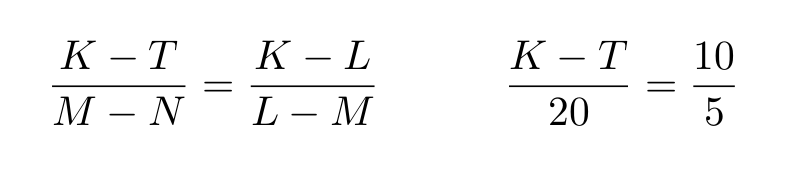
Let’s say M-N was 20 yards. The ratio of the distance between K and L and the distance between L and M is equal to the ratio of the distance from K to T and M to N. Gaaaa! That sounds so complicated, but it’s not! Don’t panic. Just write it out and do the simple math. (Here’s Mr. Barns, the nice math teacher, doing it for his students, beginning at the 8:14 mark: ) You just need three numbers and your “unknown” value K-T:

math

Cross-multiply, 10×20 and divide by 5 = 40. The river is 40 yards wide. (Remember when you were in high school and you thought to yourself, “I will never, ever need to use algebra or geometry for anything!” Well, looks like you were wrong.)

All you do is face the target, make two turns, drop three markers, and count your paces. It’s easy peasy. You can do this! You could have calculated the width of the river in the time it takes you to walk 35 paces. (There are several ways to do it, but I think this is the simplest.) You just need to know what to do. Doing it isn’t so hard!

Don’t like the idea of counting strides across the countryside in full view of your target? Pre-measure a length of paracord with high-visibility endpoints and midpoint and you can “measure” the baseline K-L-M at a crawl. Play out paracord for M-N and measure it later when you’re safely out of sight again. We didn’t even break out the trigonometric tables or a calculator!

Using a related principle, here are a couple of web pages that describe how to estimate distances based on angular width, with a known object height. Be sure to look at the business card you can print out and carry that will let you quickly estimate distances to objects of known size. It’s very cool!

ANGLES (covered by Gooley)

You can also use your body proportions to roughly determine angles. That might come in handy when describing the location of a hard-to-see object relative to a known object. (“He’s in the bushes 15° to the left of the biggest pine tree…”) Here’s how that’s done:

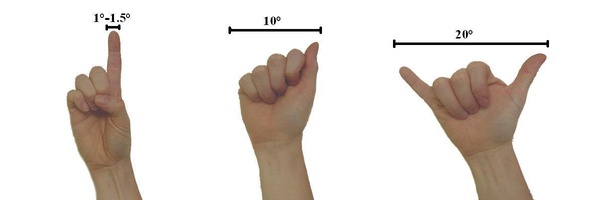
Holding your hand at arm’s length and closing one eye, the outer joint of your index finger is about one degree across. The width of your first three fingers (Boy Scout salute) = 5 degrees. The width of your fist (with thumb on top) is about 10 degrees across, and a wide open hand span is about 20 degrees (depending on how flexible your hand is!).

hands

You can use this rough approximation technique to gauge your latitude or to estimate how much longer until sunset, etc. Hint: It has been demonstrated and estimated that each finger-width between the sun and the horizon is about 15 minutes until sunset.

FOOTNOTE

In mid-March, G.P. sent SurvivalBlog the a brief article and video, which I think is worth mentioning here again. This is John McPhee’s method to estimate how far away a person is, using only your naked eyes. The article says, “100 meters – recognize a face, see what they look like. 200 meters – No face, cannot distinguish facial features. 300 meters – No hands, soldier can distinguish what the enemy is doing, but cannot make out individual fingers or the entire hand. 400 meters – The head cannot be distinguished, in fact it looks like they don’t have one at all. 500 meters – Cannot see individual legs, especially the light between their legs, an enemy is moving, but he is moving as a whole, without legs to the soldier’s eye. 600 meters – Humans look like little triangles in shape. He says, ‘A fat little triangle’.”

In the video, John is saying “yards”, but whoever summarized the article (cited above) wrote it as “meters”. The difference between the two doesn’t really become an issue until about 400 meters. (400 meters equals 437 yards, 500 meters equals 546 yards, and 600 meters equals 656 yards.) Really, given the large-ish margin for error inherent in this method, the 10% error of yards vs meters isn’t going to make a whole lot of difference. If you need precision, buy a laser rangefinder. Yes, there are other quick, effective, and convenient ways to measure distances and sizes (like measuring shadows), but this will get you started. There are quick rules for shooting up a mountainside or down into a valley. There are easy-to-calculate shortcuts to determining how fast the wind is blowing and how it will affect your bullet. Isn’t mathematics fun? And there’s so much more in The Lost Art, I hope you take the time to read it!

Now, I’m going to condense all this, print it really small, and paste it into my pocket-sized All-Weather Rite in the Rain fieldbook for future reference! (Note: either print it with a laserprinter or print it with your ink-jet printer and then photocopy it. Laser printed text won’t run and smear if it gets wet!)

Trust God. Be prepared. We can do both.


Letter: Observations on the Fires in Canada

Hugh,

I wanted to comment on the article about the folks fleeing the wildfires in Fort McMurray, Canada. I saw some classic SurvivalBlog themes in there:

  1. Keep your gas tanks full. The gas station owner noted that people were “fighting each other to get gas, growing more and more desperate as the afternoon wore on.”
  2. Keep your gas tanks full, (yes I’m repeating myself). Later on the writer notes people were abandoning their cars on the highway since they knew they wouldn’t have enough fuel to make it to their destination.
  3. Don’t be a refugee. The folks that went to the camps not only were now at the whim of the government, but the same government that sent them there now had to try and get them out of there since it was no longer safe.
  4. Keep your head about you and use common sense. The writer correctly observed that the fire would head north and therefore he headed south, out of harm’s way. Kudos to them.
  5. Don’t trust the government to give you good advice, particularly low level police officers. (I say this as a former 23-year low level police officer.) The cops in the gas station were telling people to go north then later changed it to south. Naturally, the fire could shift directions and I have no doubt the cops told the people whatever they were told to tell them, but it turned out to be bad advice at first. I mentioned low level police officers, because in my experience they’re the last to know the important information as it filters its way down the chain of command. – Spotlight


Economics and Investing:

This Amazing Silver Trend Will Make Short Term Price Movements Irrelevant

o o o

Of Course the US Government Will Default on Its Debt – Sent in by B.B.

o o o

90% Off Sale On Offshore Drilling Rigs? – The oil price bust has struck the offshore sector especially hard, leading to nothing less than a fire sale of oil and gas rigs.

o o o

Company plans to mothball Carlsbad potash plant – Note that this is a basic mineral used for fertilizer everywhere. Also ties in to reduced train loads, as it is normally shipped by rail. – I.K.

o o o

SurvivalBlog and its editors are not paid investment counselors or advisers. Please see our Provisos page for details.


Odds ‘n Sods:

Flameout: Bill Whittle’s Afterburner Finale – Once you’ve watched that, please DO go and visit BillWhittle.com

o o o

Trump vs. Hillary: What Are My Options? – Excerpt: “…I commit that I will be on my knees in the early morning praying for our nation–regardless of the outcome. For unless we are His children these elections just turn into modern day “towers of Babel” thinking ourselves so wise that we can outdo God.”

o o o

Combat Knife Instructor Ralph Thorn shows how to “no spin” throw a knife (or just about any similar sized metal object ) in two minutes. – Submitted by T.P.

o o o

Some good news for a change: Wyoming welder, facing $16M in fines, beats EPA in battle over stock pond – submitted by MtH


Notes for Wednesday – May 11, 2016

On May 11, 1949, Israel was admitted into the United Nations.

o o o

Today, we present another entry for Round 64 of the SurvivalBlog non-fiction writing contest. The nearly $12,000 worth of prizes for this round include:

First Prize:

  1. A Tactical Self-Contained 2-Series Solar Power Generator system from Always Empowered. This compact starter power system is packaged in a wheeled O.D. green EMP-shielded Pelican hard case (a $1,700 value),
  2. A Gunsite Academy Three Day Course Certificate that is good for any one, two, or three day course (a $1,195 value),
  3. A course certificate from onPoint Tactical for the prize winner’s choice of three-day civilian courses, excluding those restricted for military or government teams. Three day onPoint courses normally cost $795,
  4. DRD Tactical is providing a 5.56 NATO QD Billet upper with a hammer forged, chrome-lined barrel and a hard case to go with your own AR lower. It will allow any standard AR-type rifle to have a quick change barrel, which can be assembled in less than one minute without the use of any tools and a compact carry capability in a hard case or 3-day pack (an $1,100 value),
  5. Gun Mag Warehouse is providing 20 Magpul PMAG 30-rd Magazines (a value of $300) and a Gun Mag Warehouse T-Shirt; (an equivalent prize will be awarded for residents in states with magazine restrictions),
  6. Two cases of Mountain House freeze-dried assorted entrees in #10 cans, courtesy of Ready Made Resources (a $350 value),
  7. The Ark Institute is donating a non-GMO, non-hybrid vegetable seed package (enough for two families of four) plus seed storage materials, a CD-ROM of Geri Guidetti’s book “Build Your Ark! How to Prepare for Self Reliance in Uncertain Times”, and two bottles of Potassium Iodate (a $325 retail value),
  8. A $250 gift certificate good for any product from Sunflower Ammo,
  9. KellyKettleUSA.com is donating an AquaBrick water filtration kit with a retail value of $250, and
  10. Two cases of meals, Ready to Eat (MREs), courtesy of CampingSurvival.com (a $180 value).

Second Prize:

  1. A Glock form factor SIRT laser training pistol and a SIRT AR-15/M4 Laser Training Bolt, courtesy of Next Level Training, which have a combined retail value of $589,
  2. A transferable certificate for a two-day Ultimate Bug Out Course from Florida Firearms Training (a $400 value),
  3. A Model 175 Series Solar Generator provided by Quantum Harvest LLC (a $439 value),
  4. A Trekker IV™ Four-Person Emergency Kit from Emergency Essentials (a $250 value),
  5. A $200 gift certificate good towards any books published by PrepperPress.com,
  6. A pre-selected assortment of military surplus gear from CJL Enterprize (a $300 value),
  7. RepackBox is providing a $300 gift certificate to their site, and
  8. Safecastle is providing a package of 10 LifeStraws (a $200 value)
  9. American Gunsmithing Institute (AGI) is providing a $300 certificate good towards any of their DVD training courses.

Third Prize:

  1. A Royal Berkey water filter, courtesy of Directive 21 (a $275 value),
  2. A $245 gift certificate from custom knife-maker Jon Kelly Designs, of Eureka, Montana,
  3. A large handmade clothes drying rack, a washboard, and a Homesteading for Beginners DVD, all courtesy of The Homestead Store, with a combined value of $206,
  4. Expanded sets of both washable feminine pads and liners, donated by Naturally Cozy (a $185 retail value),
  5. Two Super Survival Pack seed collections, a $150 value, courtesy of Seed for Security, LLC,
  6. Mayflower Trading is donating a $200 gift certificate for homesteading appliances,
  7. Montie Gear is donating a Precision Rest (a $249 value), and
  8. Two 1,000-foot spools of full mil-spec U.S.-made 750 paracord (in-stock colors only) from www.TOUGHGRID.com (a $240 value).

Round 64 ends on May 31st, so get busy writing and e-mail us your entry. Remember that there is a 1,500-word minimum, and that articles on practical “how to” skills for survival have an advantage in the judging.


Readiness Mindset: Your Most Important Survival Tool- Part 2, by B.G.

Keep yourself from giving up.

Always stay positive. Negativity will kill you faster than the lack of nourishment, enemy combatants, or nature. It is an absolute guarantee that you will fail, if you give up. Staying calm and keeping a positive mindset will give you the mental endurance to continue on and make good decisions.

Find your mental trigger. This is what you will think about when you are on your last leg, ready to give up, or don’t think you can do what needs to be done. This will be your motivation to push that one more mile, to get up off the ground, fight through the pain, or even to eat something disgusting to stay alive. Your mental trigger can be anything from:

  • your children,
  • your spouse,
  • your parents,
  • your own selfish pride, or
  • your ultimate goals.

Now, this trigger is only to be used as a last-ditch emergency motivator. If you use it at every step and every minute you feel tired, it will start to lose its impact, so hold on to this one until you really need it; and when the time comes, pull the trigger. For smaller and more frequent motivations, come up with a simple phrase to push yourself. Personally, I use the phrase “harden up” whenever I need to force myself to do something. Sometimes I even find it helpful to imagine a specific person yelling this to me, such as a drill instructor or even a respected family member or role model.

Stay positive and motivated.

Set small, achievable goals. One way people often get frustrated is that they set these huge, unrealistic goals for themselves; and, having not stood any chance of realistically achieving them, they fail and become disparaged. Set for yourself small, short-term goals in addition to your main goal. While your main goal may be to make it to help from a plane crash hundreds of miles away from any cities, you cannot achieve this goal in a short amount of time. Instead, set smaller goals, such as:

  • make it over this hill today,
  • find a source of water,
  • find or build a shelter, or
  • start finding sources of food.

Even coming up with a concrete and complete plan is a necessary and achievable goal that will greatly increase your confidence.

One of the most important ways to avoid negative thinking is to keep your mind occupied. The more you are focusing on a specific task, the less free your mind will be to wander into self-defeating thoughts. Remember that anxiety and fear are typically irrational reactions to events that haven’t even happened yet. Too often people handicap themselves based on errant thoughts about potential circumstances that don’t even exist. Don’t dwell on thoughts about what could possibly go wrong. This will only prevent you from being able to think about how you can make things go right.

Plan for mental preparedness.

The best way to be mentally prepared is to plan ahead. People solve countless problems and complete a myriad of tasks on a daily basis. Most of these we never even think twice about. Why? Because we are mentally prepared to handle them. These range from things as simple as where to get dinner to what to do if a light bulb burns out. You can handle emergency scenarios just as adeptly as these seemingly mundane problems if you are mentally prepared for them.

The first and easiest way to be prepared for any situation is to visualize every conceivable possibility. Visualization is an extremely powerful tool. Our brains learn from experience. Our experiences are no more than memories imprinted by electrical signals in our brains. At an anatomical level there is nothing to distinguish a true memory from an imagined thought. The only difference is usually that a real memory will have other data associated with it, such as smells, feelings, and sounds. Nevertheless, these things can also be associated with visualization.

Have you ever had a dream that seemed so real while you were experiencing it? When you woke up, could you still remember the dream as if it had really happened? This is the same principal as training your brain through visualization. The trick is to visualize and think about the scenario in as much detail as you can. When visualizing a survival scenario, you want to be as thorough as possible. Imagine details of what would be going on around you, the different ways you could react, the cause and effects of your actions, and the potential reactions to your actions. Try to imagine all the sights, sounds, and feelings associated with the situation. This will help to further “burn” it into your memory.

[Additional note: It is best to be in a quiet place free from distraction while visualizing. The more absolute focus you can put into it, the more effective it will be. I recommend learning about meditation to help with visualizing. In addition, meditation is a great way to calm yourself, relax, think, and reduce stress.]

When planning how you will deal with an emergency situation, whether ahead of time or during the emergency, use the rule of three. Come up with three solutions to your problem and focus on each one in turn, deciding whether that particular option is achievable and how. Once you’ve come up with three options, pick the best one and focus on how you’re specifically going to accomplish it. The reason for the number three is because you will either:

  • not have enough time to explore a large number of options,
  • will spend more energy over-thinking the situation than is useful, or
  • will have trouble committing to one specific plan amidst a never ending list of possibilities.

Not all options, or any for that matter, may be perfect solutions to your particular situation. The important thing is that you do make a decision. In an emergency, you will most likely not have time to sit and think of every little detail. This is why you come up with three possible directions of action and pick one. You can always adapt your plan to fit whatever may arise later on. The key thing is that you take action in a timely manner.

Once you’ve decided on a course of action, remember to break it down into small achievable goals. Take it step by step in a logical and concise manner. Given that you have the time to do so, remember to take into account any unknown variables and contingencies, such as:

  • what if your planned route is blocked,
  • what if a piece of equipment fails, and
  • what to do if you encounter some form of active resistance to your plan at some point.

Every situation will differ in how much you may be able to plan ahead of time. This is why it is best to plan for things before they happen. Nevertheless, if you are on a boat and it catches fire, obviously you don’t have time to go over every conceivable detail; however, a few seconds to think before you act can make the difference in your survival.

Remain calm and aware during an emergency.

When you are actually in an emergency situation, the most important thing to remember is to remain calm. Everything else you do depends upon your ability to think clearly and make good decisions. Many factors, such as hunger, dehydration, fatigue, weather and injuries, can affect your mental strength and stability. Regardless of your situation, remain calm and think logically about the next priority that needs to be addressed. If you are stranded and have no water, don’t start stressing out about how far you may have to trek to get to help. Focus on finding yourself a source of drinkable water; then, move on to the next priority.

Throughout every step of any survival or emergency situation, you need to maintain your situational awareness. This means being observant and aware of what is going on around you, as well as the terrain, weather, your health (both physical and mental), your supplies, and any potential dangers. Before diving head first into any predicament, especially a potentially dangerous one, take a moment to assess your situation. If you need to take a knee to focus, do so. Take in your surroundings. Pay attention to details. This can be anything from:

  • seeing which way the land slopes,
  • which way clouds are moving,
  • figuring out what part of the day it is in relation to the sun, or
  • looking to see if a crashed vehicle is smoking,
  • if a pain under your jeans is actually a cut, or
  • if the people with you are becoming mentally unstable.

Don’t forget, one of the most important aspects of situational awareness is knowing what items you have at your disposal. These can include the items in your pockets, pack, vehicle, or house. It also includes anything in your environment around you that can be used to your advantage.

In closing, I hope I have given you some ways not only to help you prepare for emergencies and survival situations but also to help make you a stronger, more skilled and more confident person. These tools and lessons can be applied to anything in life, whether it be training for combat or simply getting back in shape. Just remember that the greatest weapon at your disposal is your own brain. It carries more memory and computing power than any device you can bring out into the field with you. Take advantage of it! And remember…toughen up!


Letter Re: Maintaining Your Household in the Post-SHTF World- Part 2

Hugh,

This was an excellent article from S.T. Sanitation and cleanliness will become a major concern post SHTF. In his writings, JWR has commented on the advantage of having spring water on your property, and we can attest to that. Here’s how it works for us.

Our spring is located up at the head of our holler up behind the house. It is piped into to a 500 gallon holding tank and that is piped down to the house. From there it feeds into a wood-fired water stove (hot water and baseboard heat) as well as all the faucets and toilets. As long as your spring is higher than the roof of your house, it will give you enough water pressure. Our spring flows 500 gallons a day, and you only need 50 gallon per day maximum per adult. So anybody considering land for a survival retreat might want to put a spring at the top of your list. In our part of Appalachia, homes have been running on “mountain water” for generations. Good luck to all – HWS