Economics and Investing:

Man With Full-Time Job in U.S. Earned Less in 2014 than 1973 – B.B.

o o o

OPEC Estimates Oil Output Will Fall Among Non-Member States “OPEC, in its latest monthly report, projects that oil production will decline in non-OPEC states, with estimates remaining unchanged from May”

o o o

Venezuela: It’s starting to look like scenes from the movie Soylent Green down there. How A Venezuela Food Protest Turned Into A Deadly Police Gunfight – J.E.

o o o

Say Goodbye to America

o o o

SurvivalBlog and its editors are not paid investment counselors or advisers. Please see our Provisos page for details.


Odds ‘n Sods:

An article from Mike Williamson, SurvivalBlog’s Editor at Large: It’s Time To Eliminate The Gun Control Laws: Yes, All Of Them

o o o

Some call him _resident Obama- ( ‘cuz they don’t give a ‘P,’ he just ‘lives’ in our White House?) I call him Pres__ent Obama (‘cuz he has no real ID). This writer takes him to task over his televised comment yesterday. Mr. President, You Disgust Me – D.S.

o o o

Orlando police are facing questions over why it took three hours for a SWAT team to storm the nightclub where ISIS fanatic Omar Mateen slaughtered 49 people. Police Chief John Mina has also admitted that some of the victims may have been hit by officers’ gun fire. – T.P.

HJL’s Note: To be fair, there was apparently some discussion of explosives (or the threat of…) at the scene contributing to the delay of SWAT and EMT’s. However, SWAT shooting the victims is inexcusable.

o o o

Reader G.G. sent in this link to A tour of the Svalbard Seed Vault

o o o

Facebook Deletes Pamela Geller’s ‘Stop Islamization Of America’ Page After Orlando Attack – W.C.


Jim’s Quote of the Day:

“When a people lose the courage to resist encroachment on their rights, then they can’t be saved by an outside force. Our belief is that people always have the kind of government they want and that individuals must bear the risks of freedom, even to the extent of giving their lives.” – A.E. Van Vogt, The Weapons Shops of Isher


Pat Cascio’s Product Review: Ruger GP100

Ancient. Obsolete. Dinosaur. Older than dirt. Old fashioned. These are a few of the terms, which have been used to describe…me! While I don’t believe they all apply, especially about being older than dirt, and just because I had a pet dinosaur when I was growing up doesn’t mean that I’m “that” old. I will readily admit though that I love the music from the mid to late 1960s, and when I do have the radio on in my pickup truck it is tuned to an oldies station. My favorite group from the 1960s was Peppermint Rainbow. Their song, “Will You be Staying After Sunday” is still my favorite song from that time period. (This is a poor quality video, but it’s the only known video of this group from the 1960s; they weren’t squat and fat.) I have a number of pictures on my office wall of many famous people that I know/knew, including the late Col. Rex Applegate, Roy Rogers, and Dale Evans, and many more. However, my autographed picture of Peppermint Rainbow sits on my desk, not on my wall. It is signed by Bonnie Lamdin, the lead singer of Peppermint Rainbow, and her sister, Pat Lamdin. Bonnie and I stay in touch with each other several times per year via e-mails. Without a doubt, I’m Peppermint Rainbow’s biggest fan. I even hear from the lead guitarist, Doug Lewis, now and then. He is still in the music game with his group, The New Monopoly.

DSCF0317

If I could go back in a time machine and was allowed to take a pill that would make me 18 years old again, I would jump on it and never look back (forward?) to the future. I admit to being somewhat old-fashioned in many things, and change comes hard for me, real hard. Yep, I miss the “old days”.

Now, while I might resemble some of the comments about my age, though I certainly hope that I’m not obsolete, I hope I still have a few years left in me, where I can make some contributions to society and to my life. All of this leads to the purpose of this article, and that is reviewing a revolver– the Ruger GP100 .357 Magnum revolver, to be exact. Many SurvivalBlog.com readers have contacted me and asked me to do some reviews on revolvers. I’m guessing these folks are my age or maybe older. Sadly, I turn 65 later this year. These readers may be like myself, in that they cut their teeth on revolvers back in the 1960s when it was “the” gun to have. The few semiauto handguns around, like the 1911 and the Browning Hi-Power, were some of the most reliable semi’s out there, but choices in ammo were mainly in FMJ, which were not the best for self defense. So, everyone gravitated to revolvers, with JHP ammo.

I carried revolvers while working as a private investigator and doing private security work back in Chicago, IL. Most of the time I carried a 4” Bbl S&W Model 586 or a Ruger Service six, both .357 Mag chambered. At times, I also carried a S&W Model 10 with a heavy barrel, and on my ankle was a backup revolver– either a S&W Model 36 or a Cold Detective Special. So, I’m well aware of the use and deployment of revolvers. Even during some time as a police officer, I still carried a revolver as a backup, again, in an ankle holster. To this day, I can still be “caught” carrying a little snubby revolver in an ankle holster from time-to-time!

DSCF0318

Many younger readers might poo-poo the use of revolvers in today’s busy world of semiauto handguns, thinking that the revolver is ancient, old fashioned, or even obsolete. If you believe that then your thinking might be obsolete, if you ask me. Sure, in some cases and perhaps many, a revolver isn’t the best choice for self defense. Then again, it depends on where you’re standing at the time. Working police officers are often outgunned on the mean streets of American these days, even when armed with a GLOCK that can carry 17-rds of JHP 9mm ammo. Fortunately, many police officers have access to backup by other officers, but some don’t! For them, I say carry a semiauto handgun with two to four spare magazines.

Enter the revolver today! I’ve often said that the best (if there is such a thing) handgun for survival, on the street or in the wilderness, is some kind of stainless steel, 4” Bbl .357 Magnum revolver, loaded with good JHP ammo. One of the benefits of having a revolver in .357 Mag is that you can also shoot lower-powered .38 Spl ammo and use it for plinking and target practice, instead of always burning up the most expensive .357 Mag ammo.

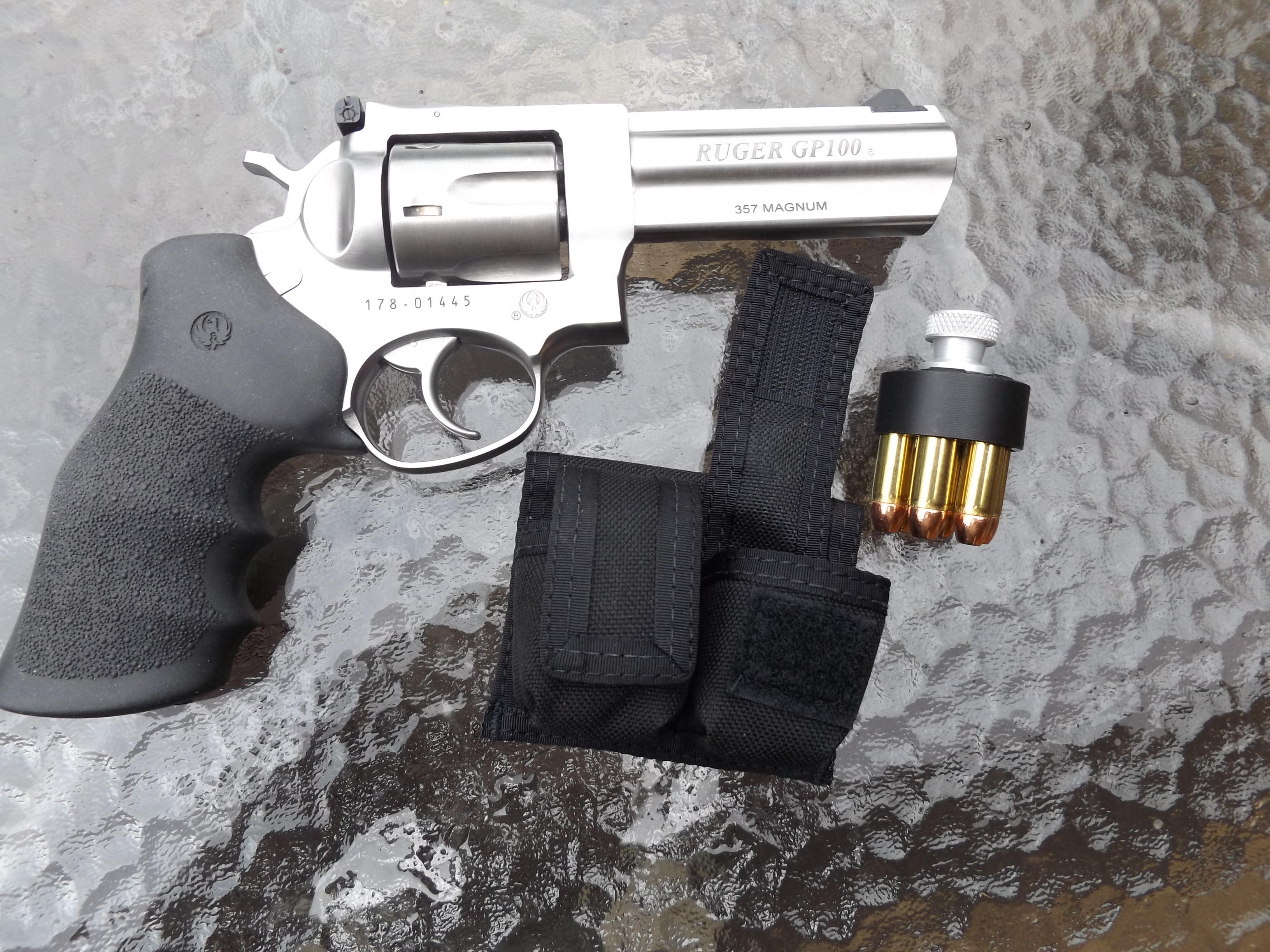
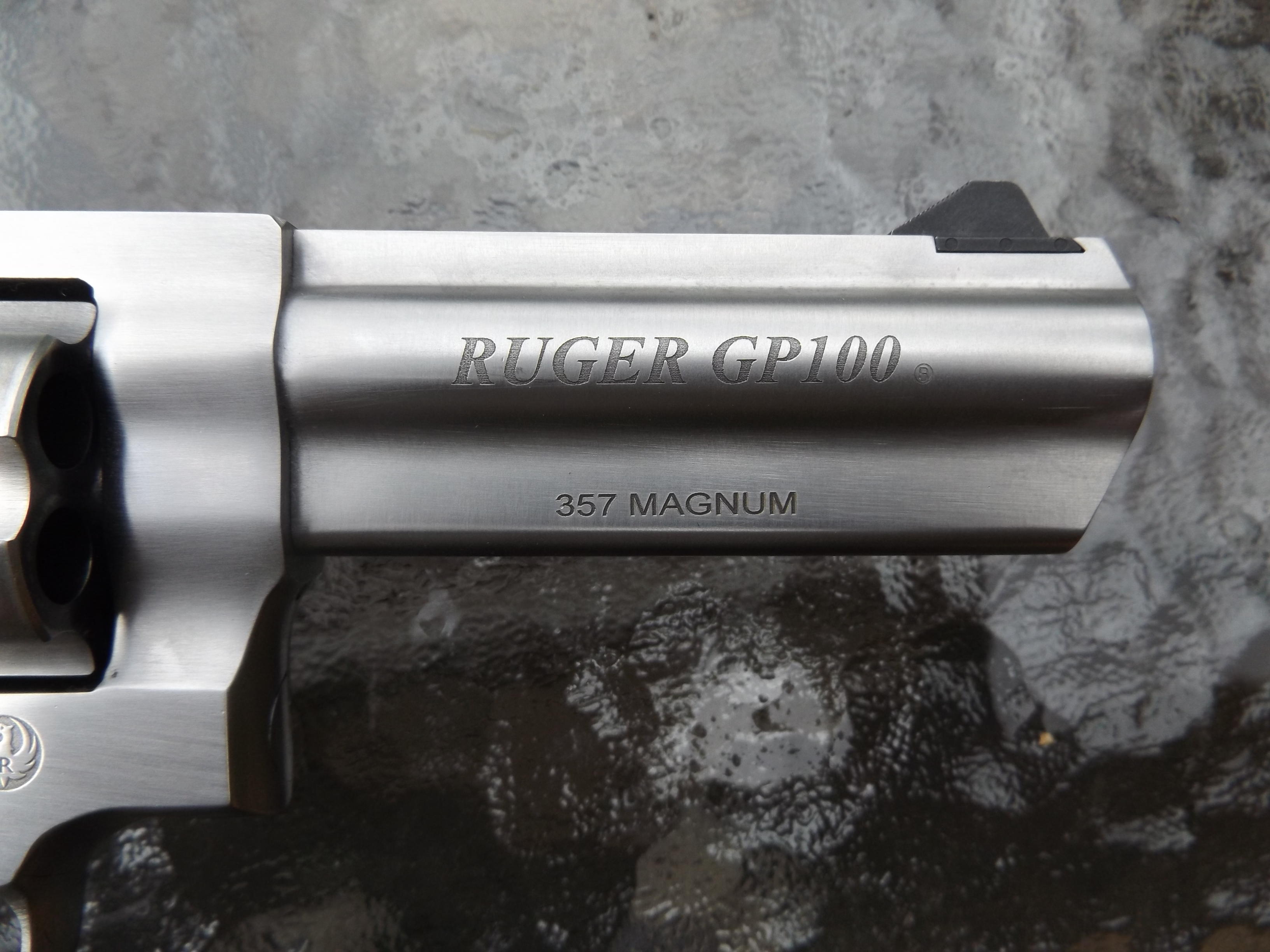
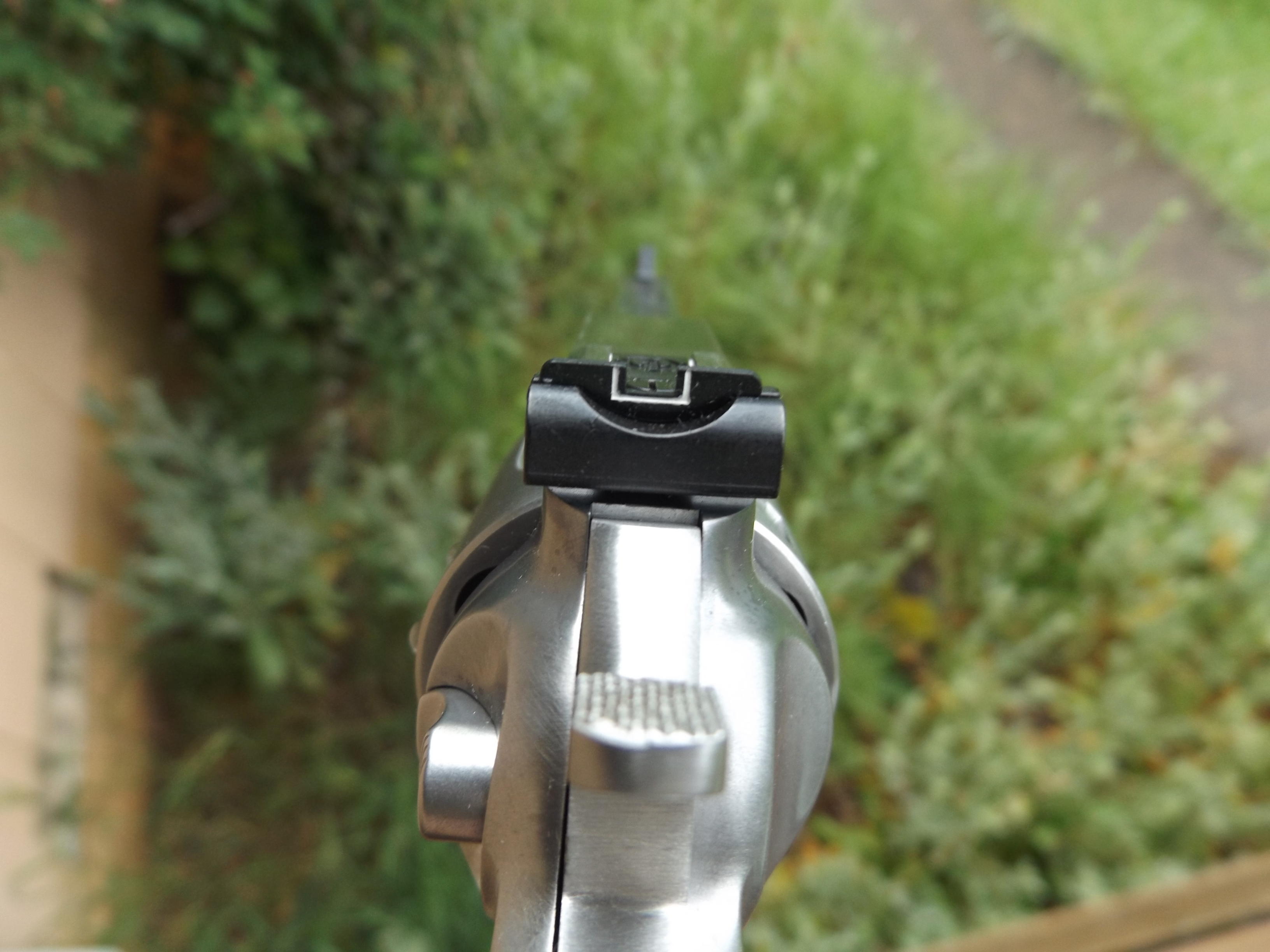
The Ruger GP100 is a .357 Mag revolver that perfectly fits my criteria for the above handgun for survival. We have a 4.20-inch barrel, lugged with a fully adjustable rear sight, elevation and windage, in stainless steel finish with a brushed satin for a low-glare to it, but it still will fight off the elements. The gun is heavy. It weighs in at 40 oz. Compared to many semiauto handguns made with polymer frames, many will think the GP100 is too heavy. It’s not, especially when shooting full-power .357 Mag loads. .38 Spl loads are a real pussycat to fire in this massive gun. The current GP100 comes with a Hogue Monogrip; earlier models had a combination of wood and rubber grips that many didn’t like. I love the Hogue Monogrip with the finger grooves. The front sight on the GP100 is all black; however, it is easily changed out to one of several different colors. I’m awaiting a front sight with a red insert in it that is easier for my aged eyes to pick up.
DSCF0319

The GP100 has a triple locking cylinder that is locked to the frame at the front, rear, and bottom. We are talking super-strong lock-up, for more reliable functioning, shot after shot. Like previous double-action revolvers from Ruger, the takedown is integrated into several sub-assemblies and requires no special tools to completely disassemble the gun for major cleaning and/or parts repair.

Quite often, when I’m haunting my local FFL, Fast Cash in Lebanon, OR, they get swamped with customers, and I step behind the counter to help them out. Many customers, especially “ancient” ones like myself, ask me about the “best” .357 Mag revolver that they can own. I always steer them to a Ruger GP100, if there is one in the display case. I get the same thing from many who reply, “Oh, you’re only saying that, because you work here.” I inform them that I do not work there and am just helping out. I have no vested interest in Ruger firearms, nor do I make a commission on the guns I help sell at the shop.

Yes, there are many other great 4” Bbl .357 Mag revolvers out there, and I have no problem with someone choosing a S&W or a Dan Wesson, or any other quality revolver. However, in my humble opinion, the GP100 just might be the strongest .357 Mag revolver being made; if it’s not the strongest, then it is in the top two or three. And, the sheer simplicity of the sub-assemblies, which consists of the inner workings of the GP100, well, there just isn’t much to go wrong with this gun. Spare parts? I don’t keep any on hand for this gun, other than the different front sight I ordered for my gun.

One of the nice advantages of a good double/single action revolver is the fact that you can fire it double-action for self-defense, or you can cock the hammer and fire it single-action, if need be, when attempting to take game with it. I previous reported, in another article, where I took a good-sized black bear with a 4” Bbl .357 Mag revolver. I also took a badger with the same gun, and he was hard to kill,even with 125-JHP loads. It took six shots to finally anchor him. They are tough for their size. However, taking game like deer, at reasonable distances with good shot placement, isn’t a problem. The deer in my area are rather small black tail and go down with one to the boiler room. Again, I’d use a JHP, probably a heavier 158-gr load or even go with a 180-gr Hard Cast load.

I had an outstanding assortment of .38 Spl and .357 Mag ammo to run through my GP100. From my friends at Black Hills Ammunition, I had their .38 Spl. 125-gr JHP +P and their 148-gr Match HBWC and .357 Mag. I had their 125-gr JHP, 158-gr JHP and their Cowboy load that is a sedate 158-gr CNL load moving at 800-FPS. From the nice folks at Buffalo Bore Ammunition, I had their .38 Spl 158-gr Hard Cast +P Outdoorsman load, 125-gr LV JHP +P, 110-gr Barnes, all-copper hollow point standard pressure load, and the same in +P, in .357 Mag. I had their 180-gr Hard Cast Outdoorsman load, 158-gr JHC, 125-gr JHC, 125-gr Barnes XPB all-copper hollow point, and lastly their 140 Barnes XPB all-copper hollow point. From the folks at Double Tap, I had .38 Spl 148-gr full wadcutter Match load, 110-gr DT Lead Free, and 110-gr Controlled Expansion load, and in .357-Mag I had their 110-gr DR. Lead Free, and 180-gr Hard Cast solid load.

DSCF0320

I don’t know when I’ve had such a variety of different brands and types of ammo to run through a gun for an article. The Ruger GP100 was up to the task though. I did have a box of 158-gr SWC .357 Mag ammo that was given to me by the gun shop I haunt, and they don’t know who loaded it or anything, but I knew that no matter what, the GP100 could handle it. Needless to say, my shooting session with the GP100 covered many days, over several weeks, and I did have some volunteers helping me. There is never a lack of volunteers when the ammo is free and gun is provided!

The GP100 sample I received from Ruger had the rear sight completely as high as it would go, when I first fired it. All rounds were close to a foot above the target at 25 yards. It took some cranking to get the rear sight down for a 25-yard zero, with 158-gr loads. The windage was dead-on though, so that was the good news. I don’t like to shoot a lot of .38 Spl ammo through a revolver chambered in .357 Mag, for the simple reason that if you fire a lot of the shorter .38 Spl ammo in a .357 Mag gun, it tends to make extraction of the longer .357 Mag brass a little harder. It doesn’t matter how much you scrub the chambers; if you fire a lot of the shorter .38 Spl brass in the gun, this happens, so I limit any .38 Spl ammo in any .357 Mag I shoot. As a rule, this isn’t a problem. However, it can be, so be advised.

DSCF0321

The 158-gr lead SWC reloads that were given to me were pretty hot, and they simply wouldn’t group. No matter how hard I tried, they just were making holes all over the target, and it did lead-up the barrel. It took a lot of scrubbing to get the lead out of the barrel, but the GP100 handled this hot load just the same. As mentioned, the GP100 is a super-stout .357 Mag revolver, perhaps the strongest on the market.

At 25 yards, there isn’t a lot of difference in the point of aim or point of impact between the 125-gr bullets and the 158-gr bullets from any of the makers. The impact point with the heavier 180-gr Hard Cast loads was shooting about an inch or so higher than the rest of the loads, and the 110-gr loads were easily an inch lower than the 125 and 158 grain bullets. Still, that’s not that big of a deal. In all my years using a handgun for hunting, any kind of hunting– small or big game– I’ve never taken a shot beyond 50 yards, and most were closer than that. The sights on a revolver determines how well you can hit a target at longer distances; smaller bead front sights allow for a much better sight picture for longer ranger shooting. The sights on the GP100 are pretty much standard in size, and at 100 yards it pretty much covers the entire body of a small deer, so you don’t have a precise aiming point.

Now, with the above said, I used to vacation in Colorado Springs, CO many years ago when I would hike and camp out in the mountains of the area. I usually packed either a .357 Mag revolver or a .44 Mag revolver during these treks. I could take either of the above guns, sit on one mountain, shoot across to a big boulder on another mountain that was roughly 600 yards away, and consistently hit the rock, once I got on my game. However, shooting at any game at that kind of distance is stupid!

DSCF0322

My accuracy testing was all conducted at 25 yards with me resting the GP100 on a sleeping bag across the hood of my pickup, and all shots were in the single-action mode to wring out the most accuracy possible. Every thing I shot, outside of those unknown reloads, gave me groups around two inches, if I did my part. Some groups were a little bigger, some a little smaller. The winner in the accuracy department was the Black Hills Cowboy load. Those conical lead 158-gr bullets moving along at 800-FPS would give me groups of about an inch and a half, if I did my part. I was surprised! I thought one of the other loads would have done better. I like the 125-gr JHP loads for self defense against critters with two legs. For 4-legged critters, the 158-gr or 180-gr Hard Cast loads are the way to go. Still, I wasn’t disappointed in the performance of the GP100 and any of the loads. I liked the Black Hills 148-gr HBWC and the Double Tap 148 WC loads; they were both hot on the heels of the Black Hills 158-gr Cowboy load.

Now, picking one load for hunting or on the hiking trail is a tough one! I think it is a toss-up between the Buffalo Bore 180-gr Hard Cast load and the Double Tap Hardcast Solid. Both give the penetration you will need on dangerous game. I know some hunters who have used the Buffalo Bore 180-gr Hard Cast load on elk. Yes, elk! And, they reported that it shot completely through an elk standing broadside, and I have no reason to doubt their claims. There is an over abundance of black bears in Oregon, so that is the load I’d use on them if I were hunting them with a .357 Mag revolver. For thin-skinned game, any of the .357 Mag JHP loads in the 158-gr bullet weight would do the job on the likes of mountain lions.

I don’t carry the GP100 concealed, nor do I currently have a holster that will conceal this gun. It is large, but it is concealable with the right clothing and holster. I simply use an Uncle Mike’s size 2 ballistic Nylon holster for open carry in the boonies, and I have two speed loaders in a double speed loader case for fast reloads, not that I’ve ever had to speed load any revolver, ever!

DSCF0323

BTW, the double-action trigger pull is super, super smooth. There’s not a hitch of glitch anywhere along the entire trigger pull. It broke at about 11 lbs and is smooth, smooth, smooth.

Is the revolver design “old”? You bet. Is it “ancient”? Maybe just a little bit. Is it “old fashioned”? Well, that depends on who you talk to. Is it a “dinosaur”? Well, I don’t think so, and some of the bigger calibers we have today could probably bring down some of the smaller dinosaurs. Now, the big question is, is the revolver “obsolete”? I don’t think so; not in the least. If forced into some kind of survival situation, be it city or wilderness, the GP100 in .357 Mag would do quite nicely for self defense against two-legged and four-legged threats, with the right ammo. It will also bring home something for the pot for your dinner, again with the right loads.
DSCF0324

I don’t believe that I’m quite “obsolete” just yet. I think I have a few more years left, and I can contribute something to society in some way, shape, or form, and I don’t believe for one second that a good .357 Mag revolver with a 4” Bbl is obsolete. It still has a lot to offer a person. Especially if they can only own one handgun, this may be the way to go, in my humble opinion.

– Senior Product Review Editor, Pat Cascio



Recipe of the Week: Taco Pizza, by L.H.

The garden is doing well so far this year, and we are right now awash in romaine lettuce. Ten little lettuce seeds at planting time doesn’t seem like much, until the stuff is ready to harvest all at once. There are only so many salads a person can consume. Anyway, taco pizza is one of our favorite ways to use up our fresh lettuce when we tire of salads. It’s terrific!

Ingredients:

  • 1 lb. ground beef
  • 1 packet (1.0/1.25 oz.) taco seasoning
  • 1 pizza crust of choice (I prefer the box of Jiffy or packet of Great Value; they are both thrifty and quick and easy to prepare.)
  • ½ of 1 (14.5 oz.) can refried beans
  • 1 c. (4 oz.) shredded mozzarella cheese
  • 2-3 c. shredded lettuce
  • 1 c. (4 oz.) shredded cheddar cheese
  • 2 tomatoes, diced (optional, we only use fresh tomatoes when they are in season out of our garden)
  • A handful of chopped red onions, optional
  • Your favorite salsa

Directions:

  1. In a skillet, brown and crumble ground beef until done.
  2. Drain grease, stir in taco seasoning, remove from heat, and set aside.
  3. Prepare pizza crust on a standard pizza pan according to package directions and prick all over with a fork to reduce air pockets.
  4. Bake crust in preheated 450 degree oven 5 minutes.
  5. Remove crust from oven and spread the half-can of refried beans over it. (You can season up the other half for a bowl of bean dip, or just freeze it to use for your next taco pizza.)
  6. Sprinkle the taco meat over the beans and then the mozzarella.
  7. Return to oven for 10 minutes, or until crust is done. When done, go ahead and cut the pizza into slices.
  8. Sprinkle all over with the lettuce and then the cheddar, and the tomatoes and onions, if using.
  9. Serve immediately with salsa for topping the slices. Makes 8 slices of pizza.

Helpful Hint:

The best way to preserve fresh lettuce in the fridge is to:

  1. Wash it well.
  2. Dry it very well. Get it as dry as you possibly can.
  3. Stuff it in a gallon ziploc bag along with a paper towel.
  4. Squeeze out the excess air, seal, and store in the fridge crisper.
  5. Replace the damp paper towel with a fresh dry one every time you get into the lettuce.

I have been able to keep lettuce crisp and usable for 8-10 days using this method.

o o o

Do you have a favorite recipe that would be of interest to SurvivalBlog readers? Please send it via e-mail. Thanks!


Letter Re: Sanitation Considerations

HJL:

It’s an interesting topic. I have designed a solution (bad pun), acquired most of the materials but have not gotten to the installation. My plan includes collecting from the gutter down spout barrels that have a tap about two thirds of the way down and on the bottom. A tiny pinch of alum goes in before you drain to the holding tank. Crud goes out the bottom tap. The holding tank from NORESCO has roughly the dimensions of a cabinet, so you can hide it under a work bench. A cap full of bleach goes in the holding tank. I have a 12-volt pump intended for an RV and a pressure tank intended to save your battery. All this works fine on a 20-watt panel with your battery. The innovative part of the plan is to drill a second 7/8ths hole in the water closet tank bottom and install a second fill valve that is hooked to the line from the pump. My intention is to just turn off the city water and use the rain water instead with obvious advantages if there is no city water. My idea pivots on the notion that the fill valve is an acceptable separation between potable water and the waste system. The health department gets touchy when you hook an auxiliary system to their system directly. My contention would be that this would not constitute a direct connection, as there is no pressure in the water closet tank. Additionally elevation to between six and eight feet above your use point barely gets you any water pressure to run the fill valve. Lastly, removal of the connection and the capping of the fill valve inlet would never be noticed. – RV


Economics and Investing:

This video explains the characteristics of gold’s baby bull and how the adolescent phase just beginning will likely be different, for gold, miners, and also for silver.

o o o

Economic Collapse Will Serve One Purpose: “Global Governance And The Enslavement Of Mankind” – B.B.

o o o

Fed’S Rate Normalization Will Be Far From Normal

o o o

There Is A Deepening Shortage Of Physical Gold

o o o

SurvivalBlog and its editors are not paid investment counselors or advisers. Please see our Provisos page for details.


Odds ‘n Sods:

Orlando Terrorist Attack Gunman Named – T.P.
Orlando Night Club Attack by Known Wolf Terrorist Had Been Previously Investigated by the FBI – W.C.
“ACT OF HATE”: Obama BLAMES HOMOPHOBIC GUNS in Nightclub Shooting Speech, CENSORS “ALLAHU AKBAR” SHOUTS – B.B.

o o o

And more are coming! Afghanistan Migration Surging into America; 99% Support Sharia Law – B.B.

o o o

Members of ‘Leavenworth 10’ languish in military prison, while Gitmo detainees freed – B.L.

o o o

How Can We Lose? – Excerpt: “There is no America, it has been fractionalized into powerful minorities tugging at every corner of the national fabric until it comes apart. This has been instigated by those at the highest levels of government. This is the consequence of hiring a professional fire-starter as a president and CEO. The scraps of America are being fought over by a conman and a criminal.”


Notes for Sunday – June 12, 2016

On June 12, 1987, during a visit to the divided German city of Berlin, President Ronald Reagan publicly challenged Soviet leader Mikhail S. Gorbachev to ”tear down this wall.”

o o o

The Colossal Security Pack, from Seed for Security, LLC is 15% off right now. This pack is a total of seven pounds of vegetable, grain, and herb seeds. All are open-pollinated and non GMO. Included are their three most popular collections: The Super Survival Pack, the 4 Grain Collection, and the Heirloom Herb Collection. This offer is for a limited time.


Nutritious Homemade Dog Treats and Food Using Mainly Scraps, by Sarah Latimer

In this day when everything seems to cost so much more than it did twenty or even five years ago and we all work harder than ever to make ends meet, I just can’t stand waste. Beyond that, I think I was born with a love for efficiency and resourcefulness. These are traits I highly esteem in individuals and strive to accomplish myself, and I know Hugh appreciates that I am able to stretch our dollars further than many others know how to do. So, let me share how I apply this to our beloved and useful dogs.

While I know there are some who see little to no benefit in having dogs, I do not agree. Obviously, people who feel this way have not been attacked by a wild animal, pack of unruly domesticated dogs, or a human and the had their dog(s) jump between them and the attacker(s) or at least help you fend off the attack. While this situation may not be common, I have personally experienced this situation twice with two different dogs of different breeds. My dogs serve as early warning of any visitors or stranger on the property. Those who are walking on the perimeter of our property with no obvious reason to be there are well warned to walk on the other side of the road, and they do! Friends are sometimes a bit nervous but learn that those who our family welcome are received with enthusiasm rather than hostility. That’s not the case with those of ill intent, and I am most grateful for this. My dogs deserve my loyalty and care, because I need theirs.

However, it is costly to feed and care for our canine friends and to give them the very best at the same time without some clever intervention and may seem impossible in a TEOTWAWKI situation, but I don’t believe it is. This clever intervention is what I have learned from others and want to share with you. I have stored purchased dog food away, but the dogs always prefer fresh and find the homemade treats and food I make to be special “treats”. These “treats” are very nutritious as well as good motivations and supplements to the purchased food that will help purchased foods last longer or may become their sole diet, as our farm increases. One of the benefits of our homemade food is that it has no preservatives and is grown organically. I know what is going into my dog, and it is basically (or close to) the same thing that is going into me. At least it is from the same plants and animals, even if it consists of different parts of these plants and animals.

I am a gardener and a livestock raiser, and I highly encourage all of you to begin practicing these skills also. Even, if you just begin with a few planters on an apartment patio, you should consider beginning to the skills right away. I truly hope that most of you are working gardens to not only provide most of your family’s fruits and vegetables right now but are producing enough to put some away for the future. If you are gardening and raising even small animals, such as poultry or rabbits, you can have a sustainable source for most of what you need to begin making nutritious dog treats by using mainly scraps from your “products”.

As I’m preparing foods, I have scraps or leftovers or, most often, rejects that get popped into freezer bags until I’m ready to grind everything up for tasty treats. (It’s just easier to make it in large batches, so that’s my preferred way to do it, but it isn’t necessary.) In a TEOTWAWKI situation where there is no freezer available, I imagine I’ll find myself chopping things up and feeding them as the items are available or at least grinding what’s on hand every day or two.

There are some key components to my dog treats:

  • Protein and gelatins
  • Fruits, vegetables, and herbs
  • Starches and Grains
  • Healthy oils

Protein

When processing chicken, we don’t eat the organs, so those get set aside for the dogs. There is cartledge and skin (gelatin) and some meat that just isn’t pretty with blood spots and so forth that I may cut away; that gets set aside for the dogs. When I cook a chicken, I often boil the chicken carcass to get more of the meat and make broth. Invariably, there is some meat and cartilage that is not particularly appetizing to my family that the dogs love. Even if you buy your chicken breasts at the store, there is usually some cartilage and fat left on them that has to be cut away (along with a little muscle (meat). This is the part that goes to the dogs.

When we have beef butchered, we get the liver for the dogs. I like eating it, but I don’t like cooking it and I’m the only member of my family who’ll eat it, so it goes to the dogs too (but in small amounts as in large amounts I understand it can cause Vitamin A toxicity.) We also get the bones cut up for the dogs to eat on; there’s a surprising amount of meat left on some of them and the marrow is so very good for them as well as the calcium for their bones and teeth. (Never feed poultry bones to dogs though, as they can splinter into needle-like pieces that puncture their digestive system.)

Rabbit, squirrel, venison, fish, and other “varmit” can be used for feeding dogs also in a TEOTWAWKI situation. Any meat, cartilage, and even thin skins can be cut and ground up to provide protein and gelatin for their muscle, skin, teeth, and joints. You can also use canned meats, such as tuna, or peanut butter. Just be sure you get canned products that are absent or low salt/sodium and sugar.

Fruits, Vegetables, and Herbs

The two fruits that my dogs like best are pumpkin and apples. Homemade pumpkin puree gets used in almost all of my dog foods and treats. It’s a wonderful and healthful ingredient for dog food and treats. In puppies, it is helpful in dealing with diarrhea and nausea when they don’t want to eat anything at all. I just mix a little pumpkin puree (2-3 Tbsp ) with some cooked rice (about 1/3 cup) and add some chicken broth (about 1/2 cup) and the puppies slurp it up; diarrhea is gone and puppy’s strength is regained. Chopped apples or applesauce are also great. Chop the peels if you want, after you’ve made an apple pie and pop them in the freezer until you’re ready to bake some dog treats. Then, pull them out to be ground up with the dog treat ingredients.

Dogs need vitamins A, C, and B, as well as minerals, so they need some orange and green vegetables. I most frequently use carrots and peas. When I bring in carrots form the garden, I scrub them well and peel them. the peels and tops go to the chickens, but the ends get set aside for the dogs, along with any carrots or pieces that are deformed shapes or require trimming. I throw good peas in, because I don’t ever have bad ones, but the pods can also be finely chopped up, too.

Don’t forget to add some parsley from your garden into your treat mix. It aids in their breath and digestion, just like it does ours and provides a little more green and minerals. Other vegetables can be added, but not onions or peppers and most won’t have much to do with broccoli and leafy greens.

Starches and Grains

Starches are necessary to hold it all together and they can help provide fiber and nutrients, too. I have used a combination of rice and potato flakes or leftover mashed potatoes. I’ve also used some freshly ground whole wheat, flax, oatmeal, and cornmeal when I have ground just a bit more than I needed in my recipes. (I like to use it freshly ground rather than storing cracked grains and flours; if I do store them, I do so in the freezer and only for short periods.)

Healthy Oils

I almost always use coconut oil, because it is so healthy and is good for their digestive system, teeth, and breath, but I would imagine you could use just about any other vegetable oil that is available. (I use coconut oil with some tumeric mixed in as toothpaste for my house dog, and she has beautiful teeth and gums.)

My General Recipe for Treats

Ingredients:

  • 12 cups of raw meat, ground
  • 1- 1 1/2 cup of vegetables, ground or finely chopped (usually carrots and peas)
  • 1/2 cup of ground or pureed fruit (usually apples and/or pumpkin)
  • 2+ cups of starch (usually potato flakes, cooked rice, or mashed potatoes)
  • 3 Tbsp vegetable oil (preferably coconut oil)
  • 1-2 Tbsp dried parsley

Directions:

  1. Preheat oven to 325 degrees Fahrenheit.
  2. Blend all ground ingredients together with a mixer.
  3. If not a thick paste, add more potato flakes. If too dry to blend together, add more fruit, broth, or water.
  4. Place parchment paper on a cookie sheet.
  5. Drop a spoon full of the treat mixture onto the parchment paper and mash down util about 1/4” thick. Spoon another, leaving space between them.
  6. Bake about 30-40 minutes, or until they begin to lightly brown on the edges.
  7. Let cool and place in airtight container or ziploc bag.
  8. They will store several days in cool temperatures, or can be stored for several weeks in the refrigerator.

Toxic Ingredients and Those to Avoid

  • Chocolate. It is seriously dangerous for dogs and can cause vomiting, diarrhea, tremors, abnormal heart rate, and death. Don’t use it!
  • Onion. In large doses it can cause anemia
  • Green part of potatoes. They are toxic to all animals. Only use the white, red, or yellow parts of potatoes and cut off any green on them; toss the green part, as it isn’t useful.
  • Raisins and grapes. These are toxic to dogs for an unknown reason. Avoid them altogether in dog treats/food!
  • Walnuts and macadamia nuts. There can be serious consequences, such as tremors.
  • Salt. It’s not necessary for their taste, nor is it helpful to their health.
  • Sugar. Like salt, it’s not necessary or helpful.
  • Liver, in large quantities. Cooked liver can become toxic, so keep it to small servings and not as a daily main ingredient.
  • Dairy. Like humans, some dogs have issues with dairy products, so be cautious using it and watch closely for any reactions; almond milk can be substituted.

While I have made up my own recipes, I have heard there are some great dog treat and biscuit recipe books out there. One that I have seen recommended and highly reviewed is the Organic Dog Biscuit Cookbook by Bubba Rose.


Letter Re: Pantry Building Basics

HJL,

This was an excellent article to which I would add home freeze drying (fd). Canning fresh foods is a lot of work, but you know what went into those canning jars. Freeze drying at home is almost no work and is fun, in addition to you having the knowledge of what went into those jars. A home freeze dryer costs less than $3,000; that’s less than a one year’s supply of commercial fd food for one person. You can fd almost any food at home. Imagine ice cream sandwiches after the SHTF! Those cans of commercial foods that are in your preparedness pantry and about to reach their expiration date can be easily fd. Freeze-dried food has a shelf life of up to 25 years. Re-hydrating fd foods is done by simply adding water. Scramble raw eggs, freeze dry them, and then when they are needed in recipes simply add equal parts fd egg and water (1 1/2 T fd egg + 1 1/2 T water= 1 egg). We store all of our fd foods in canning jars that we vacuum seal with our “Food Saver”. Once opened, a jar can be re-sealed with a new lid, unlike a #10 can. Just like canned foods, fd foods do not require any refrigeration. Freeze drying a batch (four trays) of food takes between 20 and 36 hours depending on the moisture content in the food. We raise our own beef, so we know what goes into a pound of our hamburger. We cook one pound of hamburger at a time on our “George Forman Grill”, which drains away the unwanted grease. The fd trays hold 1 1/4 pounds of hamburger each, so we fd five pounds of hamburger per batch, which yields 6 pints of fd hamburger and takes about 24 hours. The hardest part about fd is waiting to see what the product looks like at the end of the cycle. It reconstitutes back to its original taste and texture without losing its nutritional value and you know what’s in it. – M.C.


Odds ‘n Sods:

Petraeus, McChrystal Join Dozens of Former Military Leaders to Create New Gun Control Group – It’s disturbing to see prior military come out against the Second Amendment like this. – DSV

o o o

DEA Wants Inside Your Medical Records to Fight the War on Drugs

o o o

Man who built gun drone, flamethrower drone, argues FAA can’t regulate him – T.P.

o o o

This Is How You Disarm America (But Only the Law-Abiding Part)

o o o

Propaganda Bill In Congress Could Give America Its Very Own Ministry Of “Truth”