Jim’s Quote of the Day:

“For the vision is yet for an appointed time, but at the end it will surely come, it will not tarry.
Behold, his soul which is lifted up is not upright in him: but the just shall live by his faith.” – Habakkuk 2:3-4 (KJV)


Notes for Friday – June 24, 2016

June 24th is the birthday of rifle-toting abolitionist pastor Henry Ward Beecher (born 1813, died March 8, 1887). He and his adherents from his church smuggled so many Sharps rifles to Bleeding Kansas that the Sharps rifles picked up the nickname Beecher’s Bibles. Wikipedia states: Several of his brothers and sisters became well-known educators and activists, most notably Harriet Beecher Stowe, who achieved worldwide fame with her abolitionist novel Uncle Tom’s Cabin.

o o o

Today, we present another entry for Round 65 of the SurvivalBlog non-fiction writing contest. The nearly $12,000 worth of prizes for this round include:

First Prize:

  1. A Tactical Self-Contained 2-Series Solar Power Generator system from Always Empowered. This compact starter power system is packaged in a wheeled O.D. green EMP-shielded Pelican hard case (a $1,700 value),
  2. A Gunsite Academy Three Day Course Certificate that is good for any one, two, or three day course (a $1,195 value),
  3. A course certificate from onPoint Tactical for the prize winner’s choice of three-day civilian courses, excluding those restricted for military or government teams. Three day onPoint courses normally cost $795,
  4. DRD Tactical is providing a 5.56 NATO QD Billet upper with a hammer forged, chrome-lined barrel and a hard case to go with your own AR lower. It will allow any standard AR-type rifle to have a quick change barrel, which can be assembled in less than one minute without the use of any tools and a compact carry capability in a hard case or 3-day pack (an $1,100 value),
  5. Gun Mag Warehouse is providing 20 Magpul PMAG 30-rd Magazines (a value of $300) and a Gun Mag Warehouse T-Shirt; (an equivalent prize will be awarded for residents in states with magazine restrictions),
  6. Two cases of Mountain House freeze-dried assorted entrees in #10 cans, courtesy of Ready Made Resources (a $350 value),
  7. The Ark Institute is donating a non-GMO, non-hybrid vegetable seed package (enough for two families of four) plus seed storage materials, a CD-ROM of Geri Guidetti’s book “Build Your Ark! How to Prepare for Self Reliance in Uncertain Times”, and two bottles of Potassium Iodate (a $325 retail value),
  8. A $250 gift certificate good for any product from Sunflower Ammo,
  9. KellyKettleUSA.com is donating an AquaBrick water filtration kit with a retail value of $250, and
  10. Two cases of meals, Ready to Eat (MREs), courtesy of CampingSurvival.com (a $180 value).

Second Prize:

  1. A Glock form factor SIRT laser training pistol and a SIRT AR-15/M4 Laser Training Bolt, courtesy of Next Level Training, which have a combined retail value of $589,
  2. A transferable certificate for a two-day Ultimate Bug Out Course from Florida Firearms Training (a $400 value),
  3. A Model 175 Series Solar Generator provided by Quantum Harvest LLC (a $439 value),
  4. A Trekker IV™ Four-Person Emergency Kit from Emergency Essentials (a $250 value),
  5. A $200 gift certificate good towards any books published by PrepperPress.com,
  6. A pre-selected assortment of military surplus gear from CJL Enterprize (a $300 value),
  7. RepackBox is providing a $300 gift certificate to their site, and
  8. American Gunsmithing Institute (AGI) is providing a $300 certificate good towards any of their DVD training courses.

Third Prize:

  1. A Royal Berkey water filter, courtesy of Directive 21 (a $275 value),
  2. A $245 gift certificate from custom knife-maker Jon Kelly Designs, of Eureka, Montana,
  3. A large handmade clothes drying rack, a washboard, and a Homesteading for Beginners DVD, all courtesy of The Homestead Store, with a combined value of $206,
  4. Expanded sets of both washable feminine pads and liners, donated by Naturally Cozy (a $185 retail value),
  5. Two Super Survival Pack seed collections, a $150 value, courtesy of Seed for Security, LLC,
  6. Mayflower Trading is donating a $200 gift certificate for homesteading appliances,
  7. Montie Gear is donating a Precision Rest (a $249 value), and
  8. Two 1,000-foot spools of full mil-spec U.S.-made 750 paracord (in-stock colors only) from www.TOUGHGRID.com (a $240 value).

Round 65 ends on July 31st, so get busy writing and e-mail us your entry. Remember that there is a 1,500-word minimum, and that articles on practical “how to” skills for survival have an advantage in the judging.


Rebalancing Your Gun Collection for the Uncertain Days Ahead

With the upcoming presidential election, American gun owners are facing a time of great uncertainty. If Hitlery Clinton is elected, it is anticipated that she will not only issue a large number of anti-gun executive orders but during her term in office she will also appoint several ultra-liberal Supreme Court justices. That would dramatically alter the balance of the court. These frightening prospects have prompted many gun owners to increase the size of their collections and readjust their composition. As recent gun sales statistics attest, people are definitely stocking up. This news is not evidence of paranoia. It is simply rational self-interest.

By way of conversations at gun shows and with my consulting clients, I am now witnessing some deliberate “rebalancing” of gun collections. Here in The American Redoubt, the rebalancing that I’ve heard described is summarized as follows:

  1. Buying guns “off paper” (using cash, without a paper trail).
  2. Selling off some non-family heirloom guns in obsolete or oddball calibers.
  3. The addition of a few rifles in the most popular civilian hunting calibers, such as .243 Winchester, .270 Winchester, and 6.5 Creedmoor.
  4. Double or treble redundancy in “group standard” calibers.
  5. Selling some previously “papered” guns to Federally licensed dealers, in order to extinguish their paper trail to you.
  6. Buying “Sleeper” bolt action rifles. (I have more on that later.)
  7. Buying some complete guns or dedicated uppers that are compatible with suppressors, with corresponding muzzle adapters.
  8. Buying AR lower receivers (or 80% complete unserialized lower receivers) and parts sets.
  9. Stocking up on handloading components.
  10. Purchasing guns of particular action types and calibers that are legal in the host countries of clients’ offshore retreats.
  11. Buying full-capacity magazines in quantity.
  12. Acquiring caching tubes and desiccants.
  13. Stacking ammunition, deep.
  14. Diversifying ammunition reserves by adding small quantities of some exotic loadings, such as tracer, incendiary, AP, API, APIT, and Raufoss.
  15. Buying limited numbers of Federally exempt pre-1899 “antique” cartridge guns.
  16. Adding night vision equipment and weapons-mounted optics that are specifically compatible with night vision gear.

Planning Multigenerationally

Even if you don’t plan to shift the basic composition of your family firearms battery, then you should at least stock up in quantity with more guns to match what you already have. This is with the best interest of your children and grandchildren in mind. But remember: A gun just by itself is not sufficient. For each gun, you will need: ammunition, magazines, a set of web gear (to carry magazines), a spare optic, and a few spare parts.

Hedging Into Sleepers

In the automotive world, the term “Sleeper” or “Q Car” refers to a car that has high performance but with an unassuming exterior appearance. In the context of firearms, a Sleeper is a rifle that is highly capable of a counter-sniper role in modern combat, yet it has the outward appearance of a humble “hunting rifle”. Having Sleeper rifles may prove to be important in the years to come. So, I strongly recommend that you buy at least one bolt action rifle that is chambered in .308 Winchester, and:

Note: For muzzle threading a .30 caliber rifle, I prefer to use 5/8×24 right hand (RH) threads, which have become semi-standardized for AR-10 rifles. Hence, there are a large variety of flash hiders and muzzle brakes available to use without any need for modification. And by the way, I DO NOT recommend using 1/2×28 threads on a .30 caliber rifle, since there is not enough steel remaining to safely contain the pressure– rifling deformation, distorted threads, or worse might result. 1/2×28 threads are fine for a .223 caliber rifle but not for a .30 caliber rifle!

Needless to say, spend plenty of time practicing with that rifle. Once it is zeroed, be sure to research and confirm a drop table out to 800 yards for your primary match grade loading. (Bullet drop data is available free at the web sites of major ammunition companies, such as Hornady.com. But you need to confirm that data with testing on the range.) You should attach the confirmed chart to the rifle’s stock, for quick reference.

Some good candidate .308 Sleeper Rifles include:

  • Remington Model 700 (make sure that it is “post-recall”)
  • Winchester Model 70 (get one with a large tab Mauser-style extractor)
  • Ruger Model 77 Mark II
  • Ruger Scout Rifle
  • Savage Scout Rifle
  • Savage Model 10 or 110

I generally prefer to buy stainless steel rifles for their rust-resistant longevity. But if you opt for stainless steel, then be sure to either have it camouflage dipped by a hydrographics shop, or lay in a large supply of removable camouflaging tape.

Hedging Into Lower Receivers

For the past 15 years, the American semi-auto rifle market has been dominated by Stoner Armalite Rifle (AR) pattern rifles. They are popular in part because of their modularity and versatility. An amazing variety of AR parts and accessories are available. Because of their clever “automatic headspacing” design, they can also be assembled at home with a minimum number of tools, even by folks with rudimentary mechanical skills. Both the 5.56mm NATO (AR-15 pattern) and 7.62mm NATO (AR-10 pattern) are now incredibly popular. It is estimated that more than 4 million additional AR pattern rifles have been built during the two terms of the Obama Administration. Dozens of manufacturers are presently cranking out millions of these rifles, of varying quality. One peculiarity of both the AR family design and of U.S. gun laws is that it is the so-called “lower receiver” (trigger group), which that is the serialized part, that constitutes the “firearm”. All of the other requisite parts for building an AR can be purchased by mail order. (This is not the case in most European countries.)

With many new gun restrictions on the horizon, prescient American shooters are stocking up on AR lower receivers for later builds. Although there might eventually be sales restrictions placed on barrels and upper receivers, at least for now buying stripped lowers represents a great window of opportunity to buy “firearms” for less than $70 each. Buy plenty of them. Someday you may be very glad that you did. (Once Clinton gets the Democratic nomination, the price of lowers is expected to jump up to $200+.)

By the way, if you are a member of a retreat group or a circle of friends that intends to buy a sizable number of 80% complete AR-15 lower receivers, then I recommend splitting the cost of a Ghost Gunner 2 automated milling machine. A full review of these amazing little machines will be posted in SurvivalBlog sometime in the next few weeks.

Hedging Into Antiques

As I’ve written several times over the years in SurvivalBlog, one often overlooked category of guns are Pre-1899 Federally “Antique” rifles, revolvers, and shotguns. My current favorites are the Model 1893, 1894, 1895, and 1896 Mauser bolt action rifles. These can be re-barreled or re-chambered to handle many modern loads. They can also be restocked and equipped with modern telescopic sights and have their muzzles threaded, all without affecting their “exempt” status. For more details on pre-1899 antique guns, see the free FAQ that I authored.

Hedging Into PVC

Lastly, consider buying caching supplies, just in case you need to make some guns, ammunition, magazines, and accessories disappear. – JWR


Letter Re: Food Preservation

Good afternoon, Hugh,

Recently SurvivalBlog has presented several articles on food preservation, including extremely informative ones from your wife, Sarah.

I’ve become curious about a few things: Is there a minimum vacuum level necessary for food preservation? (This assumes other factors, such as the lack of heat-based canning procedures are not necessary for preservation.) Are there advantages to purging air from a food container with nitrogen? If so, is there a recommended procedure for that? Does vacuum sealing after nitrogen purging offer additional advantages? You have tested and reported on a commercially available home freeze dryer; how much preservation time is gained, or how great an advantage is there, by high vacuum storage (>20mg Hg) of home freeze dried food? – N.K.

HJL Comments: For food storage that contains moisture, there are only two real methods of safe storage– heat-based canning and freezing. Freezing works by slowing the process of decomposition and bacterial growth down to a negligible level, and heat-based canning works by raising the temperature to the point that bacteria is destroyed. Freezing is the preferred method for short-term storage because the texture of the food is the least changed. Canning is better for long-term storage, but the texture of the food is often changed and many do not like it.

Food that has a low to very low moisture content cannot support the growth of bacteria, so those methods are not necessary. What does matter is the removal of oxygen. The oxygen oxidizes the food, destroying the flavor and nutrients over time. There are a variety of ways to remove the oxygen. Placing oxygen absorbers in the storage containers and replacing the air with nitrogen or carbon dioxide are a few. Pulling a strong vacuum is also an effective method, but this requires a container with some strength or the food will be crushed (though in some foods, like wheat, this really doesn’t matter).

The strength of the vacuum is relatively unimportant though. A strong vacuum will remove more air (and thus more oxygen), but even a medium vacuum will remove enough air to have a significant impact on the storage life. If you are rotating your stocks and eating what you store, you only really need at most a 5 or 6 year shelf life, even if you have a very deep larder. To answer your question though, freeze-dried foods have a storage life in the realm of 5-20 years, depending on the oil content of the food (oils can become rancid) and the oxygen they are exposed to.


Economics and Investing:

Spending it all on rent: 11 million Americans spend half their income on rent. Another 21 million spend over 30 percent of their income on rent, a record high.

o o o

COMEX Registered Silver Now More Leveraged Than Gold

o o o

Potash Price Surge Could Lead To Higher Food Costs For Billions – “As global population surges and arable land decreases, efficiency is the name of the game. And in this environment, the little known commodity potash comes into its own”

o o o

The Stock Crash Of 2016: Stocks Have Already Crashed In 6 Of The World’s 8 Largest Economies

o o o

SurvivalBlog and its editors are not paid investment counselors or advisers. Please see our Provisos page for details.


Odds ‘n Sods:

Some pointed commentary about the black letter law and due process by Andrew P. Napolitano, over at Lew Rockwell’s site: ‘No Fly, No Buy’ Means No Freedom

o o o

DIY Barrel Rifling Tool 2.0 – Sent in by G.P.

o o o

An interesting take on What To Do About Islam – Sent in by B.B.

o o o

Reader P.S wrote in to suggest this addition to your go bag. Bandaid Friction Block – Just rub in on the body parts where you think you’re going to get a blister and presto– no blisters.

o o o

The traitor lets us know her real feelings: Dianne Feinstein says Americans must prove their innocence if they’re on a watch list – B.B.


Notes for Thursday – June 23, 2016

On July 23, 1942, the Nazis continued their reprehensible and criminal behavior by making the first selections for the gas chamber at Auschwitz on a train of Jews from Paris.

o o o

homedefense-300x200

Our writing contest now has over $12,000 in prizes. Today, the featured Writing Contest prize is the Three Day Course Certificate from Gunsite Academy. Gunsite was founded in 1976 by Lt. Jeff Cooper and covers 4.5 square miles with modern facilities, large classrooms and a fully stocked Pro Shop with a full-service gunsmith operation. They currently offer more than 45 different classes in Pistol, Rifle and Shotgun covering everything from basic defensive pistol to long range rifles.ccw-300x200 The certificate is good for any one, two or three day course that they offer with a value of up to $1,195 depending upon the course that you choose to attend. These are well respected certifications within the industry. You can find which classes will work with the certificate and see what works with your schedule by taking a look at their calendar. Do you need to learn how to defend your own castle? Or perhaps you just need to brush up on your range skills by spending a day at the range with an instructor. Take a look at their courses and see if this is for you!

o o o

Today, we present another entry for Round 65 of the SurvivalBlog non-fiction writing contest. The nearly $12,000 worth of prizes for this round include:

First Prize:

  1. A Tactical Self-Contained 2-Series Solar Power Generator system from Always Empowered. This compact starter power system is packaged in a wheeled O.D. green EMP-shielded Pelican hard case (a $1,700 value),
  2. A Gunsite Academy Three Day Course Certificate that is good for any one, two, or three day course (a $1,195 value),
  3. A course certificate from onPoint Tactical for the prize winner’s choice of three-day civilian courses, excluding those restricted for military or government teams. Three day onPoint courses normally cost $795,
  4. DRD Tactical is providing a 5.56 NATO QD Billet upper with a hammer forged, chrome-lined barrel and a hard case to go with your own AR lower. It will allow any standard AR-type rifle to have a quick change barrel, which can be assembled in less than one minute without the use of any tools and a compact carry capability in a hard case or 3-day pack (an $1,100 value),
  5. Gun Mag Warehouse is providing 20 Magpul PMAG 30-rd Magazines (a value of $300) and a Gun Mag Warehouse T-Shirt; (an equivalent prize will be awarded for residents in states with magazine restrictions),
  6. Two cases of Mountain House freeze-dried assorted entrees in #10 cans, courtesy of Ready Made Resources (a $350 value),
  7. The Ark Institute is donating a non-GMO, non-hybrid vegetable seed package (enough for two families of four) plus seed storage materials, a CD-ROM of Geri Guidetti’s book “Build Your Ark! How to Prepare for Self Reliance in Uncertain Times”, and two bottles of Potassium Iodate (a $325 retail value),
  8. A $250 gift certificate good for any product from Sunflower Ammo,
  9. KellyKettleUSA.com is donating an AquaBrick water filtration kit with a retail value of $250, and
  10. Two cases of meals, Ready to Eat (MREs), courtesy of CampingSurvival.com (a $180 value).

Second Prize:

  1. A Glock form factor SIRT laser training pistol and a SIRT AR-15/M4 Laser Training Bolt, courtesy of Next Level Training, which have a combined retail value of $589,
  2. A transferable certificate for a two-day Ultimate Bug Out Course from Florida Firearms Training (a $400 value),
  3. A Model 175 Series Solar Generator provided by Quantum Harvest LLC (a $439 value),
  4. A Trekker IV™ Four-Person Emergency Kit from Emergency Essentials (a $250 value),
  5. A $200 gift certificate good towards any books published by PrepperPress.com,
  6. A pre-selected assortment of military surplus gear from CJL Enterprize (a $300 value),
  7. RepackBox is providing a $300 gift certificate to their site, and
  8. American Gunsmithing Institute (AGI) is providing a $300 certificate good towards any of their DVD training courses.

Third Prize:

  1. A Royal Berkey water filter, courtesy of Directive 21 (a $275 value),
  2. A $245 gift certificate from custom knife-maker Jon Kelly Designs, of Eureka, Montana,
  3. A large handmade clothes drying rack, a washboard, and a Homesteading for Beginners DVD, all courtesy of The Homestead Store, with a combined value of $206,
  4. Expanded sets of both washable feminine pads and liners, donated by Naturally Cozy (a $185 retail value),
  5. Two Super Survival Pack seed collections, a $150 value, courtesy of Seed for Security, LLC,
  6. Mayflower Trading is donating a $200 gift certificate for homesteading appliances,
  7. Montie Gear is donating a Precision Rest (a $249 value), and
  8. Two 1,000-foot spools of full mil-spec U.S.-made 750 paracord (in-stock colors only) from www.TOUGHGRID.com (a $240 value).

Round 65 ends on July 31st, so get busy writing and e-mail us your entry. Remember that there is a 1,500-word minimum, and that articles on practical “how to” skills for survival have an advantage in the judging.


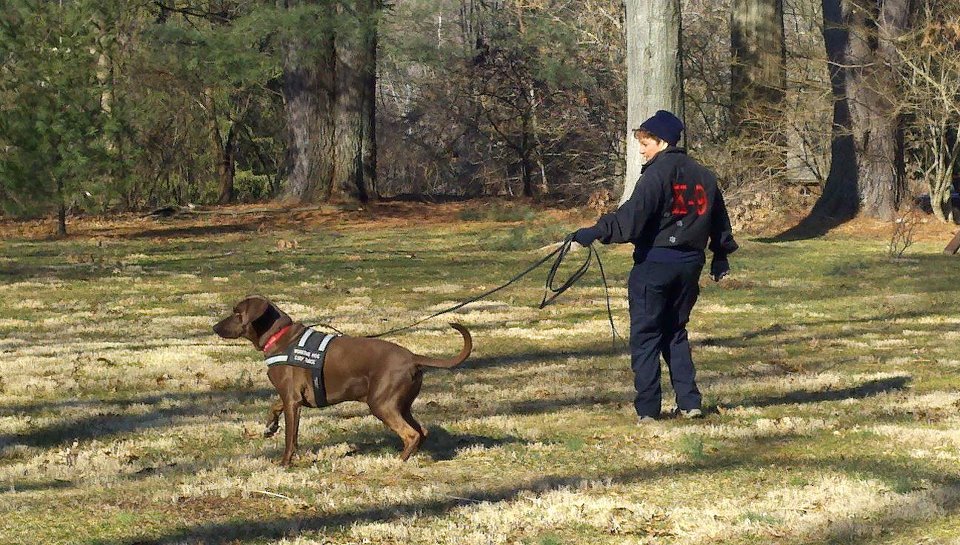
Tracking Dogs- Part 3, by D.D.

As you can see, the dogs are the least of your worries. They are just one of the tools that are used to accomplish the overall goal of catching you. They are used for direction and tracking, and they supply information to the other searchers. A K9 may also be used to grab you, just as they would anywhere else they are used.

Even if you could somehow trick or neutralize the dog, you are still going to have to deal with quite a bit of other things. To get into range of doing harm to the dog or handler is to get very close to the people who are trying to find you, and help is only a radio call away. You will never encounter just the handler and the dog by themselves. The handler is armed, and behind them is a few more people who are armed and focused on support.

They don’t have to run you down. They just have to follow until someone else corners you or you give up. They will be constantly resupplied with water and rotated out for rest. They know your chances of that are slim. Many give a good long chase only to walk out and give up, because they are dying of thirst.

Understanding The Handlers

These guys are usually professionals. They have schools, certifications, experience, and decades of methods behind the art and science of using dogs. They will have learned from people who spent their lives doing this very thing. Many are dedicated to the cause and are driven to succeed for one reason or another. To them, the dog is a tool. The handler learns to read the dog like an instrument. He knows a great many things by observation, such as how hard the dog pulls and how eager he is. He can watch the dog lift its nose at a tree or lean in a direction. He can read confusion or if the dog is unsure. When he does read these things, he knows how to bring the dog back to a point it was sure or canvass another area. They can hold position and let the escorts fan out. Handlers will read maps and approach trails from angles they think will give them the best track. They will report a wealth of information to the other chasers. If they don’t catch you themselves, there is a good chance they had something to do with it.

Some departments don’t have their own tracking teams. They may have K9 units that consist of bomb or drug dogs but no actual trackers. A department like this will usually call on another department or hire a third-party civilian dog company. These civilian companies are usually made up of former military or police K9 handlers. They, in my experience, are more knowledgeable. They are the ones who chose to pursue a career in K9 services after leaving the military or police force. Their K9 companies do not deal with anything other than dogs. The don’t have to take classes on domestic violence or writing tickets, for example. The handlers are also people, which is to be kept in mind when trying to avoid being tracked.

How To “Win”

It is not the dog you have to beat; it is the handler. What you want is a morale win. You want the handler to give up. As I said before, the handler is a person. He or she has bad days and good days. They may have been called in off vacation or a day off to work on finding you. They get tired or are out of shape. They may be sick or have just been passed up for promotion. These things are not something you’ll likely be able control, but keep them in mind if you’re attempting a morale win. Every little bit counts.

Remember previously my notes on attacking the handler or the dog. Doing either of these things can harden the will of those looking for you. They will push through a lot more discomfort, if they have some payback in mind. They may let the bite dog chew on you for a little while longer before calling it off.

I have seen a handler show up at the start of a track wearing jeans and a t-shirt. He got out of his van took about 30 seconds to look an area over and then declare the dog couldn’t find anything. The dog never got out of the van. He didn’t feel like working that day. He didn’t feel like slogging through a wet jungle. This worked because he was the professional making the call on the dog’s ability. It also worked because tracking dogs were only one small part of a search.

Tracking dogs are usually on a leash. Sometimes, depending on the area, those leashes are thirty feet long. The dog tracks ahead, and the handler follows. I’ve seen more than one handler give up and declare a lost trail after they spent an hour unwrapping the dog from being twisted around tree after tree. It was almost as if the runner was doing it on purpose. Doing something like this takes a lot of time and will seriously hamper your forward progress.

Anywhere you go the tracker has to go and he has to take the dog with him. More often than not, the dog is leading him and may get into a situation or area that will take the handler more time to negotiate. A four of five foot climb or drop will cause them to lower or lift the dog up, or go around. The handler might have to crawl through very thick saw grass or briars. This can get annoying when it happens over and over again.

Some handlers don’t want to get wet. They will call a lost trail to avoid doing so. The handler on the government dime is getting paid whether they find you or not. That handler may be wearing body armor and/or weapons. This can add significantly to his ability and will to keep chasing you. They get hot and tired, as well.

Terrain dangerous enough to cause the handler concern is another deterrent. He’s got a dog pulling on a leash and walking close to perilous cliffs can cause him to back off. He may be afraid of heights or drowning. Knowledge that you’ve booby trapped the area can cause them to give up (the tracking portion).

Additional Notes

Some of the most successful people that avoided our teams, causing us to give up, were the ones that picked an easy and fast route and headed away in pretty much a straight line. They didn’t make any attempts to fool us and didn’t even try to cover their tracks. Speed and distance were their only concern. As we slowly followed them in full armor at the pace the dogs set, they kept increasing their distance. No one wanted to sleep in the jungle at night. By the end of the second day, they were far enough forward that the trail was getting weaker. Rain on the second day was almost a guarantee that the handlers would call it off. The further we had to go in, the further our resupply lines were stretched. We also knew that walking for days forward meant walking for days back. It just wasn’t worth it for what we were chasing them for. Even when the handlers wanted to go forward, the escort teams in full armor were getting tired and suggesting that he “got away”. If the person we were pursuing made it to any kind of civilization (even a small village), the tracking portion was over as far as dogs were concerned.

Remember what they are chasing you for. If there is a full-blown state-wide man-hunt in progress, you’ve probably done something (or they think you have) that is going to keep them looking for you for a long, long time. If they’ve decided to chase you for some lesser reason, you may be able to avoid capture by making it not worth the trouble, expense, or time it would take to catch you. Just stay away or ahead of them long enough and they’ll give up.

Helicopters can cost thousands of dollars an hour to keep in the air. If the searchers have this asset available, it will have specific areas to search and most likely be on stand-by to be called in when they need an overhead look at an area. Overtime, funds for third-party contractors, supplies, gas, et cetera are factors. Someone is keeping track of how much all of this is going to cost.

Get to an area with a lot of people, such as a city. This won’t stop the search and will bring its own problems, but it will pretty much stop the dogs from tracking you in the classic sense.

You can make things worse by trying. If for instance you stole a car, got involved in a high-speed chase, and then ran into the woods, they might look for you for hours before giving up. They got the car back. The rest is standard police work. Set up a booby trap that kills an officer and you’ll have major media reporting it and several departments and counties in on the search. They will NEVER EVER give up on you.

Dogs can be commanded to bark in attempt to flush you. Many people, upon hearing the dog is closer, make a panicked run for it. I’ve seen handlers, when they think they are close, yell something like “We see you! Come out with your hands up”. This actually works. A few people have come out and done just that.



Letter Re: Vacuum Sealing Jars and Feed Store Grain

Good morning, Hugh,

I enjoyed and learned a little more from Sarah Latimer’s post. I’m interested in the method used to create a vacuum in the canning jars when dry canning. We have arrived at the same place you have– to use glass jars. We have canned many jars of dehydrated apples and other items by heating the jars in an oven to 300 degrees and sterilizing the lids, filling the jars with the contents, and tightening the lids quickly. This has worked well 95% of the time. We have heard of various devices to place a vacuum on jars, but it only does one jar. What method are you using?

When buying grain from feed stores to be used for human consumption, I have used the following method to greatly reduce bug issues:

  1. Buy freshly harvested and bagged grain. From the farmer I spoke with, he would cycle his grain from the bottom of his grain bin back to the top. This is done using a powerful blower using air. This keeps the bugs down and blows out eggs. This is why you don’t want bags that have been “sitting” for a while.
  2. IMMEDIATELY, when you arrive home with the newly purchased grain, you need to winnow it again. You do this with a fan set on the highest speed. Get outdoors, because there will be a mess. I like to use a 5- or 6-gallon white buckets, so I can see the “bugs” that might be present. I use a small scoop or coffee can and slowly pour the grain into the bucket in the air flow in front of the fan. It will take a little practice to get this right. I let the contents fall about three feet from the scoop to the bottom of the bucket. As the grain passes through the air flow, some of the bugs will be blown away and land on the floor. The ones that hang on tight will let go when they “bounce” off the bottom of the bucket. (Imagine being in a car that was dropped 10 feet. You would get out also.) Watch the inside of the bucket to see if any bugs are crawling up the inside. If there are, repeat the process. If the grain is fresh, there should be very few bugs. (I bought some wheat from a feed store in December that I know was harvested the previous July. There well over 1,000 bugs in a 50 pound bag.)
  3. Immediately package and seal the grain in the storage container of your choice. We have used plastic buckets and diatomaceous earth, and we have placed the grain in mylar bags with oxygen absorbers and heat sealed. The point of doing this is there will still be some eggs remaining that will hatch and re-infest the grain over time. – M.E.R.

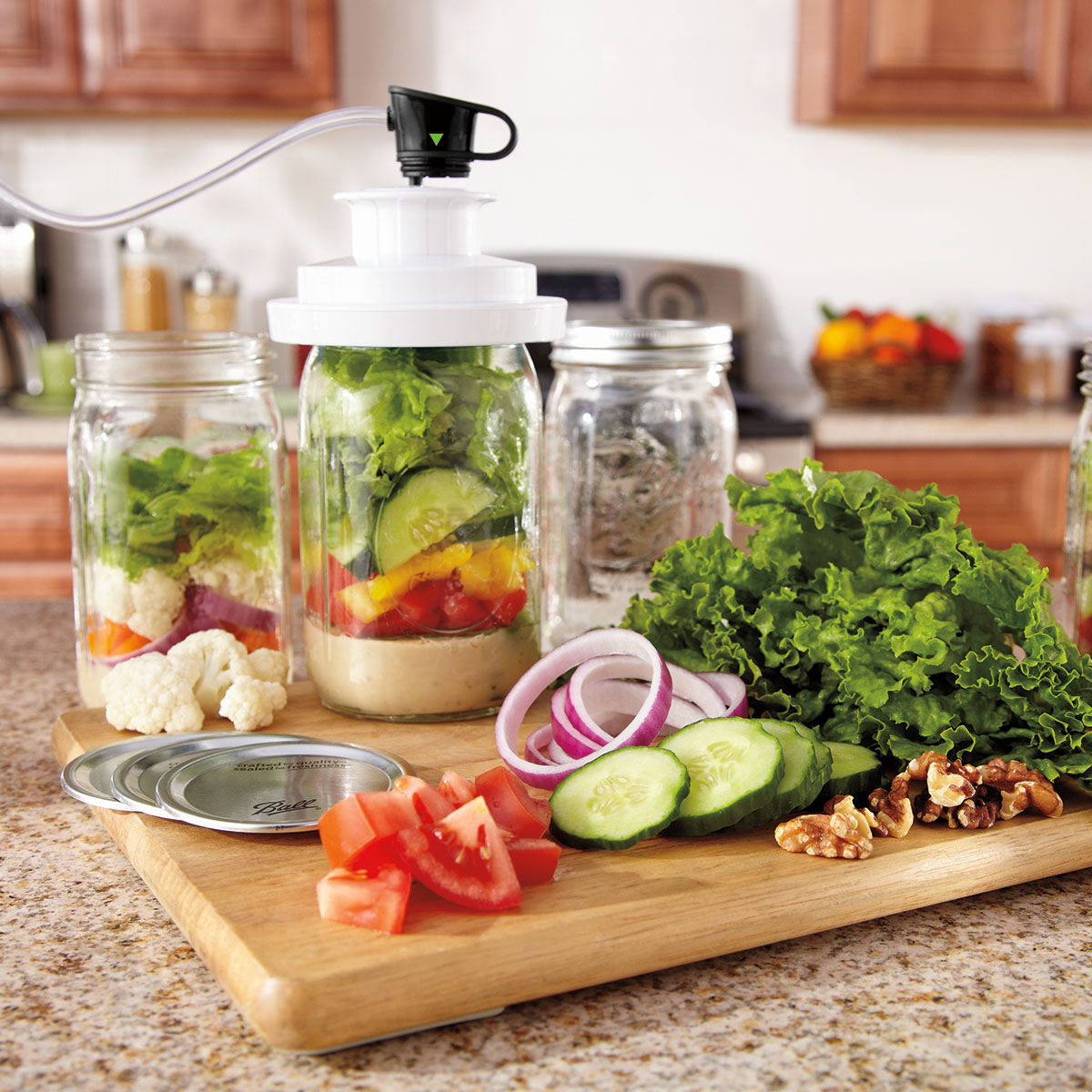
Hugh’s Comments: The vacuum sealer that we use is not original to me. I’ve asked the SurvivalBlog reader whom I obtained the idea from to write an article on it for us, and he has agreed to do that. Hopefully that will be coming soon. In the mean time, we simply use a Tilla FoodSaver Wide-Mouth Jar Sealer with an industrial vacuum pump. The pump is located in the laundry room (near the kitchen) and the vacuum line runs into the attic and then down into the kitchen near a set of cabinets. There is a remote power switch and a valve mounted underneath the upper cabinet. When it’s time to seal jars, the pump is turned on and the vacuum controlled with the line valve. We hook up a jar, turn the valve on, and wait about 30 seconds while the air is evacuated. The valve is then turned off and the jar removed and replaced with another, if necessary. Only dry bulk food is stored this way. All wet processed foods go through the normal canning process.

When canning dehydrated, freeze dried, and dry bulk foods, there is no moisture to support the growth of bacteria, so the shelf life is determined by the quality of the food. Oxygen is the killer in this case, and creating at least 20 inches of Hg vacuum removes the greatest portion of that oxygen, thereby keeping the food fresh longer. The Tilla FoodSaver itself will pull about 24.2 inches Hg and was the best commonly available vacuum pump we used. Unfortunately, it wasn’t very fast or durable. It eventually died under the heavy use we put it through. I purchased a laboratory grade, dual diaphragm vacuum pump off of E-bay (used) that was rated for a 100% duty cycle and will pull a vacuum of better than 28.9 inches Hg, and I have been happy ever since (especially since it is mounted out of sight). We also keep a Pump-n-Seal handy, if we have to draw a vacuum by hand. It will connect to the same Jar Sealer or you can use its own system. The Pump-n-Seal is a bit of work though, if you have alot of jars.

Caution: You cannot use this method to store foods that have moisture in them. Clostridium Botulinum prefers a low oxygen environment and thus may thrive in a vacuum sealed jar. The heat from the normal canning process is what safeguards this food. Only dry food items can be safely stored with a vacuum system.


Odds ‘n Sods:

So much for the “Gray Man” approach to blending in! Tam over at the View From The Porch blog reports on an OTT vehicle OPSEC issue, in transiting New Jersey: You’re Not Helping, Part MCXII…

o o o

OPSEC impaired gun owner leaves several high end guns on SUV seats in plain view. – Sent in by T.P.

o o o

Bill Whittle’s Firewall: Guns, Islam and Orlando – B.B.

o o o

Air Force Veteran Assaulted for Speaking About God – T.Z.

o o o

The Supreme Court Just Created a Full-Blown Police State – The End of the USA Cannot Be Far Behind – D.P.


Jim’s Quote of the Day:

“If survival calls for the bearing of arms, bear them you must. But the most important part of the challenge is for you to find another means that does not come with the killing of your fellow man.” – Rod Serling, (creator of The Twilight Zone) in a speech at Binghamton Community High School (1968)


Notes for Wednesday – June 22, 2016

During World War II, the U.S. 10th Army overcame the last major pockets of Japanese resistance on Okinawa Island on June 22nd, 1945, ending one of the bloodiest battles of World War II. The same day, Japanese Lieutenant General Mitsuru Ushijima, the commander of Okinawa’s defense, committed suicide with a number of Japanese officers and troops rather than surrender.

o o o

Don’t forget that from June 25th and 26th (beginning at 1800 UTC Saturday and running through 2059 UTC Sunday) is Ham radio FIELD DAY. Most clubs will be setting up in a local park to operate in field conditions, using temporary antennas and alternate power. There is no better time to find your local club and go see what it’s all about. They’ll have many different things going on for you to peruse. They may even feed you!

o o o

Safecastle made a pricing mistake on Mountain House multi-case listings. Apparently a new employee used the wrong numbers to set the prices. They’ve since corrected the price and refunded customers who were affected, but the bottom line is that the prices are much lower than they were. You might want to take a peek, if you need to stock up.

o o o

Today, we present another entry for Round 65 of the SurvivalBlog non-fiction writing contest. The nearly $12,000 worth of prizes for this round include:

First Prize:

  1. A Tactical Self-Contained 2-Series Solar Power Generator system from Always Empowered. This compact starter power system is packaged in a wheeled O.D. green EMP-shielded Pelican hard case (a $1,700 value),
  2. A Gunsite Academy Three Day Course Certificate that is good for any one, two, or three day course (a $1,195 value),
  3. A course certificate from onPoint Tactical for the prize winner’s choice of three-day civilian courses, excluding those restricted for military or government teams. Three day onPoint courses normally cost $795,
  4. DRD Tactical is providing a 5.56 NATO QD Billet upper with a hammer forged, chrome-lined barrel and a hard case to go with your own AR lower. It will allow any standard AR-type rifle to have a quick change barrel, which can be assembled in less than one minute without the use of any tools and a compact carry capability in a hard case or 3-day pack (an $1,100 value),
  5. Gun Mag Warehouse is providing 20 Magpul PMAG 30-rd Magazines (a value of $300) and a Gun Mag Warehouse T-Shirt; (an equivalent prize will be awarded for residents in states with magazine restrictions),
  6. Two cases of Mountain House freeze-dried assorted entrees in #10 cans, courtesy of Ready Made Resources (a $350 value),
  7. The Ark Institute is donating a non-GMO, non-hybrid vegetable seed package (enough for two families of four) plus seed storage materials, a CD-ROM of Geri Guidetti’s book “Build Your Ark! How to Prepare for Self Reliance in Uncertain Times”, and two bottles of Potassium Iodate (a $325 retail value),
  8. A $250 gift certificate good for any product from Sunflower Ammo,
  9. KellyKettleUSA.com is donating an AquaBrick water filtration kit with a retail value of $250, and
  10. Two cases of meals, Ready to Eat (MREs), courtesy of CampingSurvival.com (a $180 value).

Second Prize:

  1. A Glock form factor SIRT laser training pistol and a SIRT AR-15/M4 Laser Training Bolt, courtesy of Next Level Training, which have a combined retail value of $589,
  2. A transferable certificate for a two-day Ultimate Bug Out Course from Florida Firearms Training (a $400 value),
  3. A Model 175 Series Solar Generator provided by Quantum Harvest LLC (a $439 value),
  4. A Trekker IV™ Four-Person Emergency Kit from Emergency Essentials (a $250 value),
  5. A $200 gift certificate good towards any books published by PrepperPress.com,
  6. A pre-selected assortment of military surplus gear from CJL Enterprize (a $300 value),
  7. RepackBox is providing a $300 gift certificate to their site, and
  8. American Gunsmithing Institute (AGI) is providing a $300 certificate good towards any of their DVD training courses.

Third Prize:

  1. A Royal Berkey water filter, courtesy of Directive 21 (a $275 value),
  2. A $245 gift certificate from custom knife-maker Jon Kelly Designs, of Eureka, Montana,
  3. A large handmade clothes drying rack, a washboard, and a Homesteading for Beginners DVD, all courtesy of The Homestead Store, with a combined value of $206,
  4. Expanded sets of both washable feminine pads and liners, donated by Naturally Cozy (a $185 retail value),
  5. Two Super Survival Pack seed collections, a $150 value, courtesy of Seed for Security, LLC,
  6. Mayflower Trading is donating a $200 gift certificate for homesteading appliances,
  7. Montie Gear is donating a Precision Rest (a $249 value), and
  8. Two 1,000-foot spools of full mil-spec U.S.-made 750 paracord (in-stock colors only) from www.TOUGHGRID.com (a $240 value).

Round 65 ends on July 31st, so get busy writing and e-mail us your entry. Remember that there is a 1,500-word minimum, and that articles on practical “how to” skills for survival have an advantage in the judging.