Mindset of Financial Preparedness: The Color Code, by L.F. in Texas

We live in a world where almost everything happens rapidly and often by remote. Books and movies are downloaded from the Internet for instant entertainment. We travel freely and quickly around the world. Things like automatic dishwashers and laundry machines aren’t even remarkable anymore. And everywhere we go, in person or online, we are enticed to spend money freely, without thought of tomorrow. Being a prepper, however, means that we are thinking ahead to what might happen tomorrow, or next month or year, and getting ready for those possibilities. How does that affect our financial strategies?

Colonel Jeff Cooper was a Marine officer and a great tactical thinker, and founder of the Gunsite Academy, which is still a premier firearms training institute. He developed the color code to teach tactical awareness. The colors of the code are white, yellow, orange, and red. In condition white, you are relaxed and unable to respond quickly. A good example would be someone walking down a busy street, looking at their iPhone with headphones in place. That person is a perfect target for a robbery. In condition yellow, you are paying attention to your surroundings and are prepared to respond if anything unusual occurs. Col. Cooper often pointed out that there is almost never a time when it is safe to drop from yellow to white, even in your own home. In condition orange, you have spotted a potential threat and are thinking of options to respond. Your response time will be much lower if something happens when you are in condition orange than condition yellow. For example, think abut walking down that same street in condition yellow when you see a group of young men approaching wearing gang colors. You move to orange, cross the street, and place your hand on your concealed weapon. Finally, in condition red, you are actually under attack. You have made the decision to fight back and are responding to the threat. Going from condition white straight to red is difficult and makes an effective response unlikely.

The color code is a good way to visualize the mindset necessary to be ready to respond to a physical threat. But how can it help us financially? Our society encourages us to live in a financial white condition, so we need to understand why we should be living in yellow and preparing for orange and red.

The financial world has changed substantially in the last 30 years. In the 1980s, interest rates on savings were 6-12 percent. There was a reason to keep money in the bank, simply because it made more money. Currently, interest rates are being maintained at very low rates by the Federal Reserve, so those savings accounts make around 0.01% to 0.06%. So, if you put $10,000 in the bank for a year in 1984 at 10%, you would have $11,000 at the end of the year. That’s a good payoff. If you put the same $10,000 away now for a year at 0.1% (rounding up, assuming you found a great rate), you would have $10,010 at the end of the year. That’s enough extra to buy dinner at a fast food restaurant for one person. It is much less incentive to save. Meanwhile, negative interest rates are now a reality in Japan, Switzerland, Sweden, and Europe. If you put 10,000 into two-year Swiss bonds, for example, you would lose approximately 1.2% a year ($120). That’s crazy! Surely people will pull out their cash and put it under their mattresses? Apparently not. But people certainly are saving less than they used to.

So if we plan to prepare financially by saving cash in the bank, we need to realize that is not going to be a good long-term strategy. Not only will we be losing to inflation, but with negative interest that cash will continue to lose value. Saving via the stock market is a topic for another article, but suffice to say that in a situation in which preparedness strategies will be necessary, the stock market will be in a downturn also.

If we want to get out of condition white financially, we need first to become aware of the current financial situation, both in our own homes and in the country as a whole. The federal debt, of course, is almost beyond understanding, as it approaches 20 trillion dollars. Federal debt was set up by Alexander Hamilton in the 1790s to pay the expenses of the Revolutionary War, but that debt was actually paid off over time. In fact, paying off the Federal debt was actually accomplished twice, in the 1830s when the initial Revolutionary War debt was paid off and then a second time after debt was again accrued in the Civil War and paid off by the end of the 1800s. After the depression of 1929, however, the U.S. began accruing debt that would never be paid. Financial experts estimate that when interest payments reach about 12% of gross domestic product, the government will default. If interest rates remain near zero, we are a long way from that default. But if interest rates rise, we will get close to default very quickly. Now we know why the Federal Reserve is keeping interest rates low. So let’s plan for that to continue!

One of the prime movers in both our national and our personal financial situations is spending. If we spend more than we make, we will be in debt. Nationally, we may not be able to influence the problem. However, personally, there are decisions we can make every day to put us in a condition of financial readiness. Let’s take a look at possible differences between a person in financial condition white and someone else in condition yellow.

Mr. White is a manager for a large company and makes $58,000 per year. He lives in the suburbs in a four bedroom, four bath home, which cost $285,000 with his wife and three children. They all have cell phones. He drives to work in his 2015 Escalade. He plans to get a new car next year. He always stops on his drive in at Starbucks, where he gets a Grande black and white latte and usually also a bite to eat. He eats lunch at one of the many restaurants around the office. Today at lunch, he was telling one of his coworkers about the trip to Florida he is planning for next month. His family can’t decide between Disney and Universal Studios, so they plan to stop at both. Mr. White is also interested in preparedness and often watches Doomsday Preppers with his wife on their very large bedroom TV, which gets all possible channels of cable and also wifi for $220 per month. The kids don’t like the show, so they watch TV in their own bedrooms. Mr. White has an AR and a couple of pistols, but he hasn’t put aside any food or other supplies because he just hasn’t got money to spare for that.

Mr. Yellow also works as a manager in the same company and makes the same $58,000 per year. He lives farther away from work than Mr. White, but he drives his 2012 pickup truck to the train station every morning and takes the train to work. Mr. Yellow and his wife live on a small farm, in a three bedroom, two bath home, which cost $185,000. Two of their three kids share a bedroom. Mr. Yellow brings coffee from home on the train and also uses the time to write a blog on self-sufficient living. Advertisers on the blog pay to promote products, adding an extra $200 per month to his income. Mr. Yellow also brings his own lunch, often composed of products from his garden and farm. He doesn’t have cable, but his family has a wifi Internet system, which is $50 per month and provides limited data. They have one TV in the living room, but they usually play board games or read instead of watching it. Only one of Mr. Yellow’s kids has his own phone, and he pays for it himself by mowing lawns for the neighbors. The Yellows are planning a camping trip to Yellowstone this year and will practice survival scenarios as they see the sights there. The Yellows have a year of freeze-dried and home-canned food stored, and everyone in the family over age seven is trained and able to use firearms and has equipment appropriate for their age.

I know what you are thinking. Not everyone wants to move to the country and quit spending money on expensive coffee. Your lifestyle changes don’t have to be that extreme to move to condition yellow. But do you really want to remain in financial ignorance? Probably not. Let’s look at some concrete and realistic steps to get out of white condition.

First, control your discretionary spending. If you eat out all the time, that’s a huge area of potential savings. If you are going to Florida to visit a theme park on vacation, pick one park and get the multi-day discount tickets. You don’t have to see everything at once. Evaluate any monthly recurring bills. Cutting or at least downsizing cable will help. Look at your phone bills. I had AT&T for years with unlimited data grandfathered. I finally decided to make a change when the bills hit $150 per month. Now I pay $45 per month for more data than I use, my phone cost $39 and the battery lasts all day. (It’s an android). Yes, I missed my iPhone for a while, but I got over it. Also, my service is just as good as it was on AT&T, but when I call the company they actually answer! Who knew?

Second, control your monthly spending that isn’t completely discretionary. For example, if you can live in a somewhat smaller house and save $200 per month on your mortgage, that will add up to $2400 per year or $24000 over 10 years. That’s tax free income, by the way. Even better, if you can live in a small house and pay off your mortgage, your lifestyle will improve dramatically. Calculate how much interest you are paying monthly and you will convince yourself. Check out your healthcare bills. Even if you have company insurance, you may not be using that vision plan, and if you are buying insurance in the “marketplace”, you certainly need to shop yearly.

Finally, get out of debt and stay out. If you are in debt, you can’t walk away from your job if things go bad. You can’t move easily to another area of the country. You don’t have a cushion in the case of illness or injury in the family. There are many resources to help with planning to reduce debt. Dave Ramsey and Crown Financial both offer courses that are helpful. The tips in the paragraphs above are the first step– cut spending.

Why do we want to be in financial condition yellow? If we are aware of our surroundings, we know that unexpected events may happen and we are ready for them. So if we lose our job to layoffs, have a family member with a serious illness, or just need a new air conditioner in our vehicle, we can respond quickly and without panic. In condition yellow, we are spending less than we are making. We have savings in cash to cover several months of living expenses, and we are prepared with food storage and supplies that can be used in a financial emergency, just like in any other emergency. We know that something may happen, and we are ready.

What happens in financial condition orange? Condition orange means that we have become aware of a potential threat. If you find out your company is in financial difficulty, you might move to condition orange. Cut all unnecessary spending and save every possible dime, check your food storage, and calculate how long you can go without an income to prepare for potential layoffs. If you have been living in yellow, you may be prepared to live for six months or a year even without further spending cuts. If you have been living in white, you may want to get your resume ready quickly.

And finally, what is condition red? If one of your children is severely injured in a car accident and you have to take time off work to be with the child in the hospital and then months of rehab, can you still pay your mortgage? We hope it won’t happen, but we live in yellow so that if a financial disaster happens, we can still remain ready. Another example of condition red is what may happen if the global financial markets become unstable. If you have not been following events in Venezuela, you should read up on the current problems there. Financial mismanagement has left the entire country short of food and basic supplies. Venezuelans are in condition red with no end in sight. Unfortunately, many of them went from condition white straight to red. Living in condition yellow, hopefully you would see the early signs of financial collapse and increase your stockpiles of food, spending cash savings that would shortly evaporate anyway with rampant inflation. Making the transition gradually from yellow to orange to red is far less painful than the jump from white to red.

So what about savings, in this era of negative interest rates and bank bail-ins (in which failing banks seize depositor’s money)? It is still helpful to have cash in the bank to cover expenses for a few months. However, saving more cash in the bank or cash instruments, like CDs or money market funds, is no longer a safe and effective investment. Gold and silver are relatively easy to store, but they are also somewhat risky as prices fluctuate and you may have to pay a premium to sell them. Stocks are always risky. As my mom, who lived through the Great Depression, used to say, “Never invest money in the stock market that you can’t afford to lose.” That’s still true today. Food is bulky to store and may have a limited shelf life, but it has certainly appreciated in value considerably in the last 30 years, if you have been following prices at the grocery store. Guns similarly have consistently appreciated in value, though they may become illegal to own eventually (topic for another article!). Land or single family homes may still be good investments, though they are not easily liquidated. Diversification is probably the best investment preparation at this point. Spending money to learn new skills may also be a safe and effective investment. For example, cheese making, crafting furniture, working as a gunsmith, training police dogs, or other skills and crafts might become profitable hobbies and potentially life-saving sources of income in an economic collapse.

If you have been living like most Americans in financial condition white, accruing debt and consistently spending more than you earn, simply reversing that equation and paying down debt will put you into condition yellow. Paying attention to your financial condition is the first step to effective financial preparedness. If you have already eliminated credit card and vehicle debt, then began preparing for potential financial threats, and consider paying off your mortgage as well. Finally, be aware and informed of financial events in the United States and the world, and consider the implications for yourself and your family. Living in financial condition yellow may mean a few lifestyle changes and some extra time spent following world events, but the ability to respond to financial threats without surprise or stress is a good trade for that iPhone or grande latte.

Three Letters Re: Canning Jars

HJL,

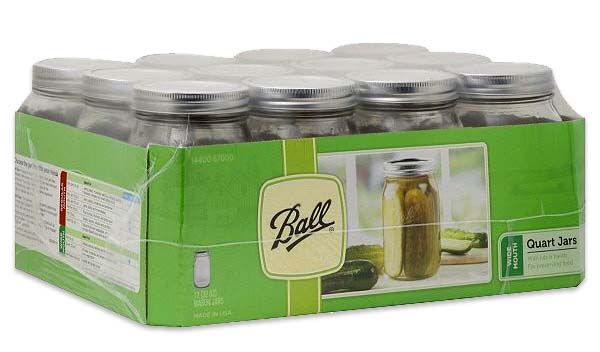
I just wanted to let the readers know that Uline has a wide selection of jars, from 1/2 pint up through 1/2 gallon, with lids and rings. – C.S.

o o o

Hugh,

Here is an interesting way to store mason jars in your pantry: Bug-Out Pantry – R.T.

o o o

Hi Hugh,

Thanks for the info on food preservation. In this latest round, you mentioned pressure canning only lean meats. Why is that? Fat is an essential nutrient. – J.J.

HJL comments: The fat complicates the canning process and can cause less than desirable results. Because the meat is a non-acid product, long processing times in a pressure canner are the norm. The fat tends to liquefy at these temperatures and can interfere with jar sealing and because of the processing times, you can’t just run the jar through another heat cycle if it doesn’t seal. In other words, the failure rate of canning high-fat meat tends to be higher. That’s not to say that it can’t be done; it just complicates the matter.


Economics and Investing:

The Disastrous Dollar Standard

o o o

Big Banks Can Restrict Public Access to Gold. But It’s a Card They Could Only Play Once – and a major Swedish bank might have just tried to play that card. – G.G.

o o o

Oil products fill storage tanks and cast doubt over crude demand

o o o

What Happens When The DOW Index Drops And The DOW/Gold Ratio Climbs

o o o

SurvivalBlog and its editors are not paid investment counselors or advisers. Please see our Provisos page for details.


Odds ‘n Sods:

Send in the Terminator: Are Police Allowed to Robot-Bomb Suspects? JWR’s Comment: This event in Dallas deserves some serious consideration and both public and legislative debate. Ditto for the use of a U.S. military drone (possibly an armed drone) in the recent lethal roadblock event in rural Oregon, where Lavoy Finicum was killed. It should also be remembered that it a was two police bombs that were used to end the leftist MOVE organization’s squatting and standoff in Philadelphia, back in 1985. There, police officers in a helicopter dropped two bombs on the roof of the row house in the middle of Osage Avenue. These were each 1-pound water gel explosives euphemistically called “entry devices”, using explosives provided to the Philadelphia police by the FBI. This killed 11 MOVE members, including their leader John Africa and five children. Firefighters were ordered to stay back and “let the house burn.” The resulting fire destroyed 65 houses.

o o o

House Committee OKs Bill Letting The FBI Use Rapid DNA Profiling – C.F.

o o o

Twitter Takes No Action As Calls For Cop-Killing Sweep Platform – P.M.

o o o

All-Natural Homemade Bug Spray Recipe That Works! (More Effective Than Deet) – H.L.

o o o

The FBI published a notice that GLOCK has been awarded as the contractor for their new 9mm pistols and parts. Expect to see a lot of used .40 S&W pistols on the market. – W.W.


Hugh’s Quote of the Day:

“Moreover as for me, God forbid that I should sin against the Lord in ceasing to pray for you: but I will teach you the good and the right way: 24 only fear the Lord, and serve him in truth with all your heart: for consider how great things he hath done for you. 25 But if ye shall still do wickedly, ye shall be consumed, both ye and your king.” 1 Samuel 12:23-25 (KJV)


Buying and Selling Rural Land: Considering The Basics

Much of my work as a consultant revolves around selecting retreat properties. For more than 15 years I have assisted my clients in their quest for the most suitable and practical properties available, to assure their families the best possible chance of surviving anything from a short-term localized disaster to a long-term societal collapse. Over the past 10 years of editing SurvivalBlog, I have included many insights about the retreat property selection process, interspersed in articles and replies to letters on related topics. But in this article, I’d like to distill a lot of that experience into just one concise description.

Keep in mind that most of my experience has been with properties in the inland western United States, so your circumstances and constraints may vary, in other regions.

Due Diligence

Purchasing property in a rural area in many ways requires much deeper due diligence than that for buying a house on a city lot.  This is not just because of the larger scale of country properties, but also because country properties are typically more independent of utilities, namely:

  1. Your water system is usually spring or well water, rather than from a civic supply (commonly called “City water”).
  2. Your septic system is probably independent of city sewer systems. Typically this consists of a septic tank and a perforated pipe leach field.
  3. Your power system may be independent (aka “off grid”).  Typically this employs either a photovoltaic (solar), micro-hydro, or wind power system with a battery bank and inverter, supplemented by a backup generator that is fueled with diesel, propane, or gasoline.
  4. Your Internet service and possibly also your phone service might be independent of both phone lines and cellular connectivity. Living beyond pavement can mean living beyond phone lines. (The most remote homes can be served only by satellite services, such as dishNet, Hughesnet, and WildBlue.)

There are also many other considerations for buying a rural property. Just a few of these include:

  • Climate zone
  • Work commute distances
  • Distance to nearest commercial airport
  • Distance to the nearest hospital
  • Annual property taxes
  • State laws vis-à-vis firearms, income tax, homeshooling, home birth, vaccination, et cetera
  • Available solar exposure
  • Prevailing winds
  • Precipitation
  • Snow depth in a typical winter
  • County road maintenance and snow plowing
  • Livestock fences and fence corners (type and condition)
  • Survey records
  • Locating property corners
  • Soil type and quality
  • Water rights
  • Mineral rights
  • Timber rights
  • Mix of tree varieties in your woodlot
  • Forest age and health
  • Pasture grass varieties
  • Invasive weeds
  • Presence of deer ticks, chiggers, fire ants, etc.
  • Cattle grazing leases
  • Easements
  • Rights-of-way
  • Livestock fencing/gates type and condition
  • Hay storage
  • Hunting and fishing potential and applicable local laws
  • Local wild edibles
  • Firewood storage
  • Zoning and building permits
  • Homeowners Associations and relevant CC&Rs
  • Defendable ground
  • Water sources.
  • Water quality tests
  • Water well draw-down tests
  • School bus routes or availability of local homeschool groups
  • Shared road maintenance expenses.
  • Local established churches or home churches
  • Condition and suitability of house and outbuildings
  • Insurability and likelihood of approval for a mortgage
  • Condition and suitability of wood or coal-fired stoves
  • Condition and suitability of any machinery included with property sale
  • Local crime rates and drug culture
  • Regional radon risk
  • Local wildfire risk (proximity to trees or other fuel loads.)
  • Regional existential threats (such as: earthquake risk, dams, prisons, high-traffic railroads, proximity to population centers, national borders, nuclear plants, et cetera)
  • Diversity and resiliency of the local economy
  • Terrain and your visibility from natural lines of drift
  • Depth of water table
  • Ambient soil temperature at basement depth.

Again, that was not a complete list. With those in mind, you can see that there are a lot of things that require thorough study to avoid the many pitfalls. In this article I’m just emphasizing two of them, for particular consideration:

Water

A plentiful supply of domestic and agricultural water is crucial and deserves special mention. Finding a property with gravity-fed spring water is ideal. But a shallow well in conjunction with an independent power system can still be viable to carry you through a protracted disaster.

The All-Important Aspect: The Neighbors 

Another aspect of selecting a rural property deserves special mention: The residents of contiguous and nearby properties. A wise rural property buyer will spend as much time talking with the owners of the neighboring properties as he does in examining the house and land, before he buys. Having trustworthy neighbors is very important. Not only will you need to keep an eye on each other’s properties, but you will also have to depend on each other for things like availability for jumpstarts, extra drivers for vehicle shuttling, swapping the use of heavy equipment, and combined shopping trips. (When the nearest store is 40 miles away, even non-preppers see the wisdom of buying in quantity.)

Where to Find a Suitable Retreat

My standing recommendations for good retreat regions can be found in this SurvivalBlog static page: Recommended Retreat Areas. Repeating any of that in this article would be redundant. Please take the time to read through that static page.

Back in 2007, when SurvivalBlog was less than two years old, my #1 Son launched a spin-off website devoted to bringing together the sellers and buyers of retreat-worthy rural properties. It is called SurvivalRealty.com. I may be biased, but I highly recommend it. Very detailed ads with copious illustrations are available for just $25 per month, and no sales commissions are charged. Be sure to check out the more than 250 currently featured properties. (Most of them are in the United States.) Presently, the listings range from western waterfront ranches to a converted missile silo and a property with a 220-foot long horizontal gold mine tunnel.

For greater detail on evaluating rural land and houses, I recommend the book How to Find Your Ideal Country Home: A Comprehensive Guide, by Gene GeRue.

In closing, I recommend that you complete the purchase of any rural property only after you’ve done your homework and after some fervent prayer. Trust in God to lead you to the right piece of land! – JWR


Letter: Food Storage Question on Mason Jars

Hello, Hugh,

I’ve been following Sarah’s articles on food storage with interest,and learning a great deal from them.

My question is this: Has your family performed any food storage involving vacuum-sealing “wet” food in mason jars and freezing them? I’m wondering if putting hamburger and chicken in mason jars, vacuum-packing them, and freezing them is a reasonable long-term storage solution (assuming electricity exists to maintain storage temperatures at 0F or below).

If such a procedure is feasible, are there any cautions I should be aware of? I would guess that, since water expands as it freezes, the jars should not be packed tightly, allowing some room for that expansion. Any tricks you’ve discovered that would be useful? – N.K.

HJL and Sarah Comments: Some mason jars can be used for freezer storage. As you surmised, the issue is the expansion of water as it freezes. This limits you to using wide mouth pint and 1/2 pint jars, because the opening is as wide as the jar with a gentle outward taper. Any jar that has a shoulder on it will probably break, if you try to freeze water in it. If all you are doing is freezing the food, you might want to just look at the vacuum bags, since they work really well in the freezer. The only problem we have ever had with these heavy food bags is that they freeze in whatever shape you place them in in the freezer. This often means when you move them arround, it’s like playing a game of tetris to keep them from avalanching out the door of a standing freezer when opened. You can, however, place a far greater quantity of bags in your freezer than you can jars, just for that fact. For storing hamburger and chicken in mason jars, we have (as have other prepping friends) successfully pressure canned these lean meats as well as broths and meat dishes in jars and stored them at room temperature for multiple years without any spoilage. It is just very important that you use a pressure canner (not a water bath canner) and follow guidelines for canning meats a long time. Every year we use our All American pressure canner to put up some tomato meat sauce in jars to have ready to heat and eat, if we have nothing but a rocket stove to boil some pasta and then pour sauce over the top and heat thoroughly for a one pot meal. Lean ground beef, venison, or chicken that is mostly cooked, drained, rinsed with hot water to remove excess fat and grease, put into quart jars, and covered with fresh hot water to not quite fill the jars can be pressure canned just fine. The partially cooked meat finish cooking during the hour and a half or so that it processes in the pressure canner. This method does not require any electricity or a freezer for storage. Hope these suggestions help.


Economics and Investing:

Video: British Pound Collapse Vs Silver & Gold Post Brexit – Mike Maloney

JWR Adds: A similar overnight revaluation could happen to any currency that is not redeemable “on demand” for specie!

o o o

Massive One-Day Record Surge Of Mainstream Gold Investment Demand

o o o

Gold Bull Market Confirmed; $1450 The Ultimate Test

o o o

Morgan Stanley Warns That Rising Rig Count Could Undo The Rally

o o o

SurvivalBlog and its editors are not paid investment counselors or advisers. Please see our Provisos page for details.


Odds ‘n Sods:

Four officers killed during ‘Black Lives Matter’ protest in Dallas – Something wicked this way comes. The big cities are ready to explode! Heads up people – A.S.

o o o

Anti-Gun Professor Calls for Shooting Up NRA Headquarters and Washington Lobbyists “And make sure there are no survivors.” The NAZIs had a similar program, which I suppose should make this one less surprising. After all, a National Socialist is a National Socialist is a National Socialist – GJM

o o o

If Benghazi doesn’t matter, what does? – Sent in by B.B.

o o o

FBI Resignations: Where Are They? – Integrity and resignation. – D.S.

o o o

YouTube Suspends Reid Henrichs’ Valor Ridge Channel – T.J.


Jim’s Quote of the Day:

“Reports of widespread hunger in collapsing Venezuela confirms my opinion: food stands alone as the indispensable preparation for survival. Why? All else can be managed as needed, they’re answerable with non-perishable inventory, often with as-found inventory. By “all else” I mean the other two of “cold-wet-hungry”. You can be any two of these and survive, but not all three. You may be cold or wet on a given day, but you will be hungry every day. No gaps. Therefore: solve food first.” – Ol’ Remus, in his Yer Ol’ Woodpile Report


Notes for Thursday – July 07, 2016

July 7th, 1907 was the birthday of novelist Robert A. Heinlein.

o o o

Today, we present another entry for Round 65 of the SurvivalBlog non-fiction writing contest. The nearly $12,000 worth of prizes for this round include:

First Prize:

  1. A Tactical Self-Contained 2-Series Solar Power Generator system from Always Empowered. This compact starter power system is packaged in a wheeled O.D. green EMP-shielded Pelican hard case (a $1,700 value),
  2. A Gunsite Academy Three Day Course Certificate that is good for any one, two, or three day course (a $1,195 value),
  3. A course certificate from onPoint Tactical for the prize winner’s choice of three-day civilian courses, excluding those restricted for military or government teams. Three day onPoint courses normally cost $795,
  4. DRD Tactical is providing a 5.56 NATO QD Billet upper with a hammer forged, chrome-lined barrel and a hard case to go with your own AR lower. It will allow any standard AR-type rifle to have a quick change barrel, which can be assembled in less than one minute without the use of any tools and a compact carry capability in a hard case or 3-day pack (an $1,100 value),
  5. Gun Mag Warehouse is providing 20 Magpul PMAG 30-rd Magazines (a value of $300) and a Gun Mag Warehouse T-Shirt; (an equivalent prize will be awarded for residents in states with magazine restrictions),
  6. Two cases of Mountain House freeze-dried assorted entrees in #10 cans, courtesy of Ready Made Resources (a $350 value),
  7. The Ark Institute is donating a non-GMO, non-hybrid vegetable seed package (enough for two families of four) plus seed storage materials, a CD-ROM of Geri Guidetti’s book “Build Your Ark! How to Prepare for Self Reliance in Uncertain Times”, and two bottles of Potassium Iodate (a $325 retail value),
  8. A $250 gift certificate good for any product from Sunflower Ammo,
  9. KellyKettleUSA.com is donating an AquaBrick water filtration kit with a retail value of $250, and
  10. Two cases of meals, Ready to Eat (MREs), courtesy of CampingSurvival.com (a $180 value).

Second Prize:

  1. A Glock form factor SIRT laser training pistol and a SIRT AR-15/M4 Laser Training Bolt, courtesy of Next Level Training, which have a combined retail value of $589,
  2. A transferable certificate for a two-day Ultimate Bug Out Course from Florida Firearms Training (a $400 value),
  3. A Model 175 Series Solar Generator provided by Quantum Harvest LLC (a $439 value),
  4. A Trekker IV™ Four-Person Emergency Kit from Emergency Essentials (a $250 value),
  5. A $200 gift certificate good towards any books published by PrepperPress.com,
  6. A pre-selected assortment of military surplus gear from CJL Enterprize (a $300 value),
  7. RepackBox is providing a $300 gift certificate to their site, and
  8. American Gunsmithing Institute (AGI) is providing a $300 certificate good towards any of their DVD training courses.

Third Prize:

  1. A Royal Berkey water filter, courtesy of Directive 21 (a $275 value),
  2. A $245 gift certificate from custom knife-maker Jon Kelly Designs, of Eureka, Montana,
  3. A large handmade clothes drying rack, a washboard, and a Homesteading for Beginners DVD, all courtesy of The Homestead Store, with a combined value of $206,
  4. Expanded sets of both washable feminine pads and liners, donated by Naturally Cozy (a $185 retail value),
  5. Two Super Survival Pack seed collections, a $150 value, courtesy of Seed for Security, LLC,
  6. Mayflower Trading is donating a $200 gift certificate for homesteading appliances,
  7. Montie Gear is donating a Precision Rest (a $249 value), and
  8. Two 1,000-foot spools of full mil-spec U.S.-made 750 paracord (in-stock colors only) from www.TOUGHGRID.com (a $240 value).

Round 65 ends on July 31st, so get busy writing and e-mail us your entry. Remember that there is a 1,500-word minimum, and that articles on practical “how to” skills for survival have an advantage in the judging.


Prepping and Moving, by S.F.

As many of you probably did, we started prepping before we really thought about moving. In the process we procured a lot of provisions that we felt would serve us well in some sort of catastrophe. It’s certainly true that skills are important but so too are food, medical supplies, guns, and a myriad of other necessities– necessities that take up space and are heavy, if not individually then certainly in aggregate.

A number of years back I came to the conclusion that God was leading me to serve as a pastor. A couple years passed before I was in a place to actively start pursuing this, and in January of 2013 I started seminary. By the following year, through a series of experiences, we decided it was time to start looking for a place to serve. Without any specific direction we concluded that if possible, we would look for a church to serve at in Alaska. We were honest with ourselves and understood that the move from a larger suburb in Colorado to a small town on the road network in Alaska would be about the biggest move we could make successfully. Our family was not prepared to move to an off the grid bush community. In the summer of 2014 we were invited to preach and subsequently offered a position at a small church in Alaska. And then the fun started.

We had two primary considerations or restraints that needed to be resolved in order to effect our move. First, we had to sell our home, and second we had to figure out the work situation. The second dragged out for almost nine months, but God intervened at the right moment to provide the kind of work I needed. The first went more rapidly, but this was not necessarily a good thing. After we listed our home, it took about two months to actually sign a deal to sell the home; the challenge with this was that the new owners wanted to move in within six weeks during half of which time my wife and kids would be gone on a family visit. While we had purged a lot of our stuff in this short period of time (particularly books), we could have done a lot better in paring down our things and only taking what was necessary if we had had more time. As a result we ended up having to rent two storage units for about seven months, while we waited for the job to align. Relationally, it also put a lot of stress on the family, which we really didn’t need. If at all possible when moving, give yourself time to think through the various aspects of the move and start purging before you are ready to actually move.

As alluded to above, we moved in phases. After we sold our house, it was another seven months before we actually left Colorado for Alaska. When it was finally time to leave, we were confronted with the issue of how to move our remaining goods. We had sold most of our furniture, so what remained was pretty concentrated. While we were given a generous allowance from the church, it was not nearly enough to cover the normal costs of a commercial move, which would have been around $15k to $20k, so we opted for a two pronged approach. We would load as much as we could in a you-pack ABF trailer (PODS are not available for a move to Alaska but would be a great way to go in the lower 48) and packed the rest of our stuff in a 12-foot, enclosed trailer to be pulled behind our Suburban. We bought the trailer in part because we would be able to sell it in AK for at least as much as we paid for it or could keep it to use later on.

ABF trailers rent/sell space by the linear foot with a minimum length (I think 13 feet at the time), which we knew we would fill (based on how much stuff was in our storage units). We then had to decided what was going ABF and what would go on the pull behind trailer. Our first two considerations were externally imposed. There were certain items, like firearms, ammunition, and liquids, that ABF would not move, and items like our handguns that we could not bring into Canada without a lot of red tape. We ended up having to ship our handguns but because we had less than 5,000 rounds of ammo, we could bring that on the pull behind trailer along with our long guns (no assault/black rifles). As for the rest, if we didn’t need it right away in Alaska and if it was heavy, it went on the ABF to ensure that the pull behind trailer was not too weighted down. On ABF packing day, we were blessed with a relative who had worked in the moving industry for a while and maximized the use of the ABF, leaving us with a pull behind trailer that was full but not overloaded.

The drive itself at the end of March was by in large uneventful. God blessed us with perfect weather and no breakdowns. We were prepared with extra tires and gas, but certainly if we had had a catastrophic failure on the AlCan we would have been in trouble at that time of year. We planned out our route to ensure that we always had a place to stay, never overreaching in a day’s drive, and broke the drive up a bit for our four kids. It was long but otherwise uneventful. For us, the border crossing in Montana was also uneventful. We arrived mid-afternoon and checked in on the U.S. side before heading to Canada. I had all my paperwork in order, particularly with regards to my long guns, and laid it all out for the agents. This facilitated our crossing on the Canadian side, which took about 10 minutes with only a cursory review of our documentation. But, while waiting on the U.S. side, there was a guy trying to cross who seemed to have a less than honest story he was trying to feed the agent. I’m not sure they ever let him cross.

When we arrived in Alaska one thing we had not procured was a place to stay. Ultimately, we had to live in vacation and other rental places for about a month until we found a permanent place. If at all possible, I would recommend having some sort of lodging in place before arriving at your new location. This caused a lot of stress for the family, again, was not what was needed. But here as well, God provided when we needed it with a great place to live.

Lessons Learned:

  1. Use a move as an opportunity to purge and update. Moving is a great time to take stock of what you have and what you need. This obviously is relevant to your preps but also to other things as well, particularly if your move is self-funded or partially self-funded and you don’t have tens of thousands of dollars to spend.
    1. Food stocks and other semi-perishables: If you’ve been prepping for a long time and have not been rotating, moving might be the time to get rid of old stocks and if possible re-buy on the other side (make sure of availability) so as not to incur the shipping cost.
    2. Tools and other equipment: Assuming you have access to tools and other accessories on the other side, it might make sense to leave or sell outdated or worn out tools at the place you are leaving and buy new at your final destination. My tools were by far the heaviest items.
    3. Home school and other resources: When we moved we had been home schooling for about eight years. This was a great opportunity (and excuse) to give rid of mountains of papers and other completed work that we no longer needed. As stated above, we also got rid of a lot of our furniture. In our case, we didn’t have anything that was worth moving and having cash in hand was a better way to go. Overall, look at everything you have and determine if it is really worth moving or even if an item will survive a move.
    4. What we could not sell on Craigslist we donated to Good Will with the added bonus of a little more in the donations column of our tax returns the following year.
  2. Calculate the costs. If you choose to sell an item and repurchase it later, is that really better than paying the moving costs? We determined that it was not worth trying to move a lot of old furniture, and we were able to sell most of our stuff and repurchase comparable items in Alaska. But, while Craigslist is a great place to buy and sell, most people are looking for killer deals. If you have nice/valuable stuff, you may not be able to sell it for what it’s worth and repurchase it for a similar price on the other end. You really need to think though if the cost of moving might be the more cost effective way to go with any particular item that you can’t do without long term.
  3. Unless you know the area you are moving to, renting may be the best option to give you time to look for the right place to live. When we arrived there were almost no homes for purchase, and those that were for sale did not meet our criteria. Renting, while not the most cost effective way to go, has worked out well for us and has given us time to think. It has also opened up the possibility of building, which means we could end up with a place that (within reason) meets our needs exactly. One of the true blessings is a land lord whom we have established a good relationship with. I’m sure a bad land lord could be a nightmare. Also, don’t forget insurance if you are moving out of a home you owned and trading it for a rental. (The same is true for covering your possessions during the move; a conversation with your insurance agent may be in order.)
  4. Books are heavy. If you are moving with multiple modes, maximize your allocation of goods between modes. As stated, we packed all the heavy stuff in the ABF to minimize the wear and tear on our pull behind trailer. Once you have reduced your load to exactly what you need, then parse it out between modes (assuming you are moving with multiple modes) as effectively as possible. Since ABF charged by the volume (linear foot), it got all the heavy stuff, which included most of our preps. We did not, however, ship any valuables, just in case there was an issue with security.
  5. If you have to cross the border (at least Canada) don’t mess with border guards; play it open and honest. I had read up on the regulations and understood exactly what I could and could not cross the border with. I had all my ammunition counted (to the round and caliber) and passports were up to date. We also had the vet’s clean bill of health for the dog. It is possible to cross the border with handguns and more than 5,000 rounds of ammunition so long as you have the right paperwork (at least this was the case a year ago), but I would not even try it as it would start to raise questions. We did find that the Canadian guards in Montana were pretty understanding while professional. I had called one of the eastern border stations previously and they told me not to even bring my guns through Canada! I would recommend that if you are moving to Alaska cross over in one of the Redoubt states.
  6. Understand the differences between where you are moving from and where you are moving to.
    1. Types of heating and other utilities: In our case we moved from a place with full city utilities to a home that is supplied with a well, firewood, and backup oil heat. It has been an adjustment, but it was something I was prepared for. Part of our earnings from selling a lot of our stuff was specifically allocated to buying a new chain saw. For all those moving from some suburban or urban place to a rural place, be prepared to be more self sufficient, even for the little things. Obviously this extends to all aspects of living.
    2. Food and other sundry costs and availability: Our food budget has definitely taken a major hit in our move to Alaska. As a result, and because of the lack of availability of items like fresh fruits and vegetables, we have had to adjust how we eat. Obviously there will be regional differences on a myriad of these types of issues, but embrace this change. For us, we miss having salads every night, but we have traded it for salmon, halibut, moose, bear, and half a dozen other species secured locally.
    3. Home school, firearms, and other legal considerations: For most, your move will hopefully relocate you to a place with more constitutionally minded laws and law makers. This has been our experience in moving to Alaska. But this might not always be the case, and I would advise that in areas like firearms, home schooling, and even vehicle registration, that you make sure you understand the laws of where you are going to live and plan accordingly.

Overall, our experience moving to Alaska has been a positive one. There has definitely been some culture shock, and we have had to make adjustments along the way. We have had to make changes to our lives and in some cases compromise on trivial values while sticking to our core principles. Moving is definitely not something to take lightly and prepping adds a number of considerations, which have to be taken into account. Overall, I believe the best policy is to address every situation your move presents with honesty and wisdom.


Letter Re: Sanitation Issues

Good morning, Hugh,

Many homes are equipped with septic tanks to perform as a holding tank for waste, allowing waste decomposition to occur. Reduction of solid waste through bacterial action works, but is a slow process and often incomplete. Additionally, a large number of chemicals we regularly introduce into our septic tanks, such as common soap, dishwashingj and clothes detergents, bleach, commercial toilet cleaning solutions, et cetera, are toxic to the bacteria performing the job of decomposition.

Septic tanks are one part of the equation; the other being the leach field. Leach fields are the fluid distribution pipes running from the septic tank into the ground and are intended to operate with “clear” liquids only; “clear” liquids does not refer to their color but means “no solid materials”. Solids will fill the spaces between dirt particles and eventually form a sufficient barrier to liquid absorption to cause the leach field to fail. The only fix for this is dig a new leach field in dirt that has not been contaminated by particles, or replace the dirt in the existing field. Either solution will be expensive and quite inconvenient.

Other things that wind up in the septic tank can render the leach field useless, specifically, greases and oils, including those created during cooking. Washing a grease-encrusted broiler pan sends thick animal fats down the drain; these fats will float on the liquid in the septic tank and be the first to be carried out of the tank into the leach field. It’s better to wipe out greasy cookware with paper towels to be disposed of as trash before sink washing, to minimize the amount of grease and oils entering the septic tank.

Harsh chemicals should be avoided in houses with septic systems. Soap and detergent use cannot be avoided, but things such as commercially-available toilet cleaning chemicals can be replaced with scrubbing with small quantities of isopropyl alcohol, which can be carefully burned off in the toilet bowl.

Since waste decomposition is slow and usually incomplete, all septic tanks will need to be pumped out periodically to remove the solids. Depending on how many people are in the family and the size of the tank, that period may be as short as three years or as long as seven. Most residential tanks are 1,000 gallons, but they are commonly available in sizes from about 500 to 3,000 gallon. I’ve seen a series of three 55-gallon blue plastic barrels used successfully as a septic tank where the quantity of waste is small or the need is temporary. (I doubt those can be pumped out with regular equipment, so they must be replaced periodically.)

Most septic tank pumping trucks have 2,000 gallon tanks, so there’s a disadvantage to having a septic tank larger than that; one pumping session won’t completely empty the tank, necessitating a second trip, always at additional expense to the homeowner.

Regardless of how often it’s necessary, more frequent septic tank pumping is recommended. I have my tank pumped every three years, even though I could probably go another two years, or perhaps three, without a problem. Should economic and social conditions deteriorate sufficiently, it may be impossible to get a tank pumped at all. When it’s completely full, solids will start entering the leach field, eventually killing it, and could back up into the supply pipe coming from the house preventing use of any of the house’s plumbing fixtures. Knowing that I have a recently pumped tank that could go as long as six years without attention provides a reasonable operational cushion.

If one has the land and money resources, a dual septic system can be a good investment. One tank is connected only to the toilets and becomes the sanitary system; the other handles all other waste water, from sinks, showers, washing machines, et cetera. This keeps chemicals that are toxic to bacteria out of the sanitary tank, allowing it to perform its decomposition job unaffected. This will extend the required pumping intervals, and the non-sanitary tank should probably never need pumping. Leach field killers, such as grease, oils et cetera, should still be avoided in the non-sanitary system.

Equipping toilets, or at least one toilet, with its own independent water supply (most easily accomplished during construction or major remodel) provides an advantage. In SHTF times, family use shifts to the single toilet equipped with an independent water supply; disconnecting that toilet’s water piping from the whole house system and attaching it to an independent water source allows use of that toilet without using the entire house’s water system. Additionally, non-potable but uncontaminated water can be used for toilet flushing since that independent water delivery system for the one toilet gets disconnected and is separate from the house’s potable water system. Rainwater collected from roofs, after the first 10 minutes of rain cleans the roof, is one good source of toilet-flushing water, and will not require any expensive purification to use in a toilet. “He who flushes also pumps” becomes the order of the day.

If usage is confined to one toilet, the water traps in the others will eventually dry out from evaporation allowing sewer gases and insects into the house. (The same applies to sinks, tubs, and showers not in regular use.) Evaporation losses can be reduced by covering the toilet bowl with plastic wrap, but since the DWV (drain-waste-vent) system is connected to vents, those are the pipes extending above your house’s roof that allow the plumbing system to drain properly, the water in a toilet bowl is still exposed to atmosphere and will eventually evaporate from that. Periodic inspection of unused toilets is necessary, as will be the occasional refilling of the toilet bowls to maintain water seal in the trap. – N.K.


Economics and Investing:

What Is Causing The Surge In The Price Of Silver?

o o o

Those not in the labor force grew by 25,000,000 people from 2000 to 2016: During this same period those employed grew by 15 million and those unemployed grew by 6 million.

o o o

Life after Brexit: What’s Next for the UK?

o o o

Will Iran Scare Away Big Oil Once Again? – Big oil faces a serious setback as one of Iran’s most influential oil executives has called for a comeback of the old buyback contract

o o o

SurvivalBlog and its editors are not paid investment counselors or advisers. Please see our Provisos page for details.