
“O Zion, that bringest good tidings, get thee up into the high mountain; O Jerusalem, that bringest good tidings, lift up thy voice with strength; lift it up, be not afraid; say unto the cities of Judah, Behold your God! Behold, the Lord God will come with strong hand, and his arm shall rule for him: behold, his reward is with him, and his work before him.” Isaiah 40:9-10 (KJV)
- Ad LifeSaver 20K JerryCan Water PurifierThe best water jerrycan you can buy on the market! Mention Survivalblog for a Free Filter ($130 Value)
- Ad California Legal Rifles & Pistols!WBT makes all popular rifles compliant for your restrictive state. Choose from a wide range of top brands made compliant for your state.
Notes for Friday – August 19, 2016
Today is the birthday of Philo Farnsworth, the father of electronic television. Additionally, he invented the nuclear fusor and held over 300 U.S. and foreign patents with his inventions contributing to the development of radar, infra-red night vision devices, the electron microscope, the baby incubator, the gastroscope and the astronomical telescope.
- Ad USA Berkey Water Filters - Start Drinking Purified Water Today!#1 Trusted Gravity Water Purification System! Start Drinking Purified Water now with a Berkey water filtration system. Find systems, replacement filters, parts and more here.
- Ad Click Here --> Civil Defense ManualNOW BACK IN STOCK How to protect, you, your family, friends and neighborhood in coming times of civil unrest… and much more!
The Development and Maintenance of the First Weapon- Part 2, by B.C.
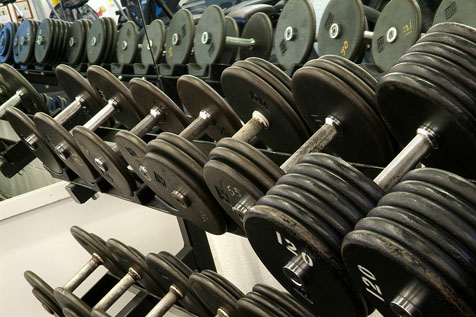
Strength-Building Option 2: Alternative Training
Your second option is much less expensive and is easier, but it’s less lucrative in its payoff. You’ll need three handled water containers (I would use the inexpensive pre-filled 2.5gal ones you can buy at the grocery store), a pair of grippy work gloves, and a large filled and twist tie sealed sandbag. You’ll leave them filled as is for now, but will eventually fill the containers with sand or dirt as you get stronger.
Fill the sandbag to a weight that allows you to take it from the ground to your shoulder 5x with some effort, but where you can do so safely. Always err on the side of too light!
The workout is as follows:
- Jog or fast walk for five minutes to warm up; do two minutes of mobility work.
- Sandbag Squats 5×5 (five sets of five reps)- Hold sand bag in arms across chest, and squat to below parallel. Then, return to standing position with tight abs and a flat back. Don’t force your ROM; stay in a good position and keep working your mobility until you get it right. Rest 90 seconds between each set.
- Sandbag Press 4×5. Hold bag at shoulder level with palms facing up. Set your shoulder blades down and squeezed in. Press the bag overhead to a locked out elbow position by your ears. Lower it back down the chest. If the lower back is unsteady or working too hard, stagger your stance with once foot forward eight inches. Rest 90 seconds after each set.
- Water Jug Carry (Farmers Walk) 10x50ft. The easier and hardest way to improve spinal posture, core, and grip strength. Pick up the jugs by the handles, walk heel toe with perfect posture and an active grip (squeeze, don’t slack). Complete the distance and rest 30 seconds. You can weekly and incrementally fill with rocks and sand to make them heavier. Just make sure they don’t break. Five-gallon buckets work too.
- Sandbag Row 3-4×10. Hold bag at waist height and hinge at knees and hip. Keep back flat, slide the bag to just below your knees. Gripping with palms facing each other, squeeze your shoulder blades together and row the bag to your sternum. Pause and lower with control. You can do this with a pair of bags stacked to increase the load or elevate your feet and use the water jugs!
These four exercises completed two or three times per week will make a big difference in your physical strength. Always leave a bit in the tank on your workouts, increase loads carefully, and leave the ego out. If you have any orthopaedic issues, get a good trainer to help you get started. You’re looking for a CSCS qualified coach and hopefully one with at least five years in the field.
Endurance
This one is easy. I don’t have a great deal of love for jogging. It’s boring and not great in it’s ROI. However, you need to be able to do it pain free for at least three miles. Linear progression is here to save the day again.
- Start by walking 1-3 miles 3-4 times per week and stretching after.
- Once you’ve hit three months of strength work and walking, ramp up by jogging the last mile 1-3 times a week.
- Then lengthen out the jogging by a quarter to half mile each week. Take it slow and take care of your calves and feet using the mobility tricks you’ve learned from Kelly Starrett.
- Once you can jog three miles, you can add a small pack and incrementally load it. It needs to have a chest and waist strap. Being able to jog three miles with a 20lb pack is pretty impressive for most folks. Don’t worry if it takes you a year or two to achieve.
- If jogging is out of the question, go for hikes and use the same linear progression, but add the pack sooner! Your endurance work can be done.
Speed/Agility
This is the most likely situation in which you will hurt yourself when the SHTF. Lifting can be shared or made lighter to avoid injury. Endurance comes quickly to humans, simply by walking or running more. Speed and the ability to use it (agility) needs to be practiced. Imagine that right now you had to sprint down the stairs, out the door, and down the street carrying your CQB rifle or shotgun. You would need to achieve top speed quickly, change direction, and decelerate safely. It’s much harder than it seems. If you haven’t hit a dead sprint in awhile, you’re at a high risk of an ankle or knee injury that won’t heal quickly. You need to work on the motor and suspension! The fact is, some people simply aren’t fast. It’s largely genetic. Some are more fast twitch, some are largely slow twitch, and some are a compromise. You can train speed though!
Start by doing some light jogging to warm up, roll the ankles around, stretch the calves, and do some high knees and butt kicks for 20-30 yards to prepare the joints.
The Workout
- Run 100 yards at 80% effort. If it’s pain free, you can proceed. (Lungs burning is fine!)
- Walk back to starting position, and repeat 5-10 times, depending on your fitness level. You can time all your runs and chart them if you’d like. Your second or third one should be the fastest. Do speed work 1-2 times per week, preferably after a strength workout! Here are several easy to remember formats. They are in meters, as tracks are set up for that. Work through them in rotation, using one format per workout.
- 12x40m, walk back rest
- 10x100m (quarter lap), 1 minute rest or walk back
- 6x200m (half lap), 90 second rest
- 4x400m (1 lap) 2-minute rest
- 3×800 (2 laps) 3-minute rest
Agility (Turns/Stops)
(I’ll shoot, you move!) We will have you use this in your warmups or cool downs. You are looking to hit the following movements:
- Forward sprint start and stop/backpedal/stop
- Sprint and turn 90° and sprint/stop
- Backpedal/stop/forward sprint
- Backpedal/turn 90° and sprint/stop
Go at 50% speed to start, and work on keeping your feet underneath you and having crisp, balanced turns/stops that you can transition out of easily and smoothly. Youtube has some easy to find resources for Change of Direction work (COD). Practice in boots you plan to survive in!
Nutrition
I’ll keep this simple!¨You need to eat a small meal 1-2 hours before a workout and a meal (no mater the time of day!) within 30 minutes to heal up and grow. Post workout should be protein-rich foods (20-40g) with minimal fat. Carbohydrate intake post workout will be dependent on your goals. If you are trying to pack on some armour, you need a 2:1 ratio of Carbs to Protein (40-80g). If you are trying to lose some body fat, go with protein alone or a 1:1 or 1:2 carbs to protein. Earn your carbs, and store calories in buckets, not on your waistline!
This brief article should now have you ready to start developing your first weapon. Be smart about it and start slow. Be consistent and forthright in your efforts, and things will improve. Print and keep a copy of this should you need to coach an out of shape group at your bug out location. The mobility work will be the most crucial part to staying on your feet and keeping safe in uncertain times.
“Strong people are harder to kill than weak people and more useful in general.” – Mark Rippetoe
- Ad STRATEGIC RELOCATION REALTYFOR SALE: Self-sustaining Rural Property situated meticulously in serene locales distant from densely populated sanctuary cities. Remember…HISTORY Favors the PREPARED!
- Ad Civil Defense ManualClick Here --> The Civil Defense Manual... The A to Z of survival. Looks what's in it... https://civildefensemanual.com/whats-in-the-civil-defense-manual/
Letter Re: Dehydrating Food
Hugh,
Thanks to the author for a very informative article on food dehydrating. Dehydrating frozen vegetables from the grocery store is a very easy way for the beginner to start; however, as these small particles of food shrink they will fall between the openings of the trays. Don’t use cheesecloth unless you want to spend an hour with tweezers picking them free. Try to find a fiber-free porous inert material and then let me know what that is.
A pulverized mixture of various dried vegetables makes a great soup additive or a table seasoning. I’ve made dried soup mixes from dried and pulverized vegetables, beef jerky, and lentils. Add your homemade bone broth, miso, salt, and you have a hearty soup.
I agree with the author on choosing a dehydrator, however, I would like to point out that dehydrators can catch on fire. I had one that did due to a faulty heat control mechanism, and if you do an Internet search you will find that it can happen to any brand at any price level. If you have a fan and a heating element, you have a potential for fire. For this reason I would avoid buying second-hand and always place it on a non-combustible surface. – RT
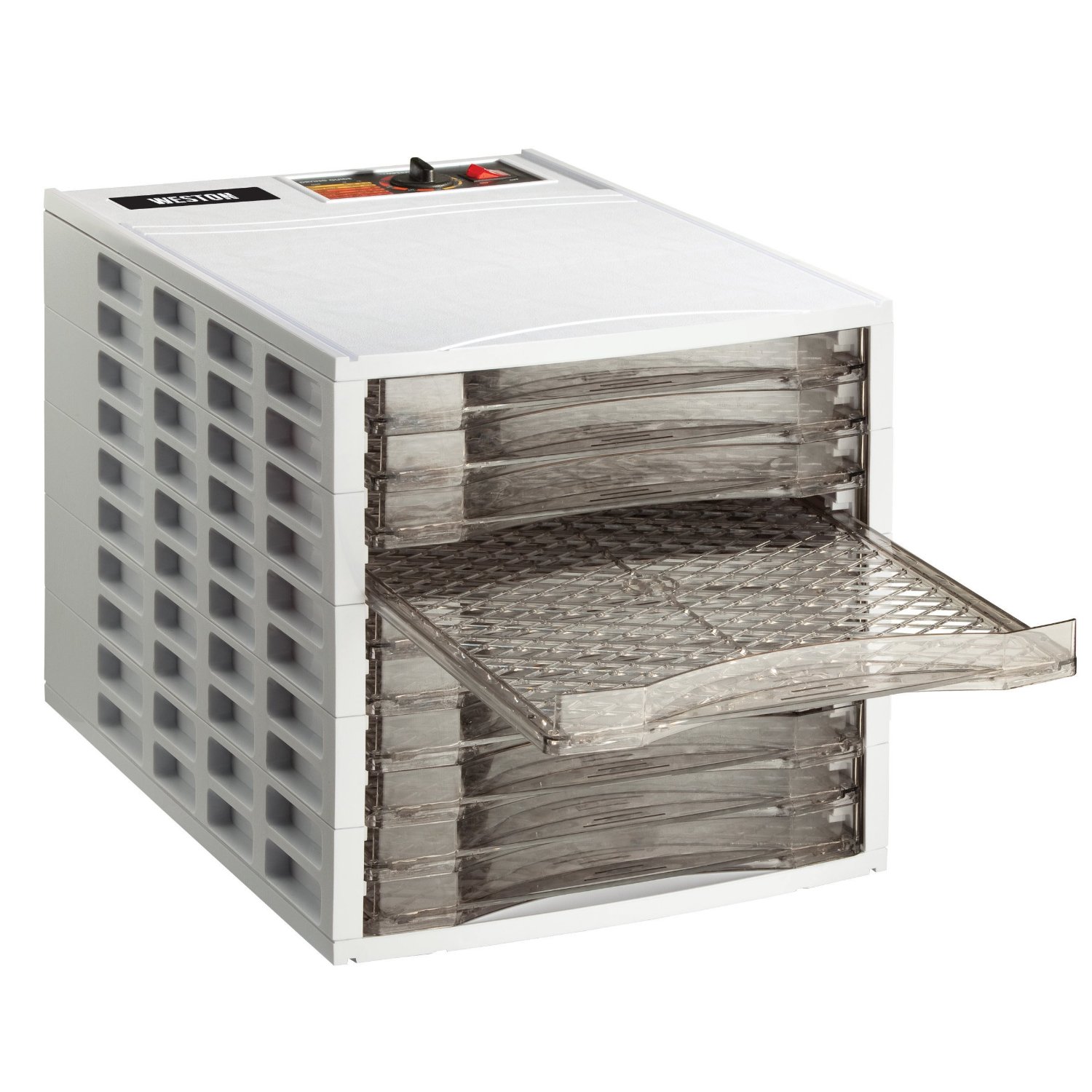
HJL Comments: My personal preference for a dehydrator is the Weston Stainless Steel Food Dehydrator, which I purchased at Ready Made Resources. (It’s on sale right now for $299.)
To answer your question on liners though, I’ve tried quite a few. I’ve had good results with the baking parchment paper (from Walmart or Costco) and also with bamboo liners. The bamboo is good, but it is expensive and I’ve not found a good source for it yet. Mrs. Latimer tells me that her favorite is a set of Non-stick Dehydrator sheets she purchased off of Amazon. She used these this last summer and had very good results with them. Nothing falls through and nothing sticks to them. In order to use them, you need a dehydrator that moves the air horizontally across the food tray though. Dehydrators that move the air vertically through the trays will not work with these sheets.
- Ad Ready Made Resources, Trijicon Hunter Mk2$2000 off MSRP, Brand New in the case
- Ad Survival RealtyFind your secure and sustainable home. The leading marketplace for rural, remote, and off-grid properties worldwide. Affordable ads. No commissions are charged!

Economics and Investing:
Maloney Calls It: Recession Here Now
o o o
Oil Prices Continue To Rise On Hollow Saudi Comments. Saudi rhetoric has been an integral part of the move in oil prices over the last days, but most of this has been panic buying with total disregard to fundamentals
o o o
World stock markets climb on labor data, oil gains
o o o
Inflation: It’s a Wealth Redistribution Scheme
o o o
SurvivalBlog and its editors are not paid investment counselors or advisers. Please see our Provisos page for details.
- Ad Don't wait - get the ultimate US-made ultra-high performance US-made SIEGE Stoves and stunning hand-crafted SIEGE belts for Christmas. For stocking-stuffers see our amazing fire-starters. Gifts that can save lives. Big Sale!Every bespoke SIEGE buckle goes through an hours-long artisanal process resulting in a belt unlike anything else, with blazing fast performance and looks and comfort to match.
- Ad Trekker Water Station 1Gal Per MinuteCall us if you have Questions 800-627-3809
Odds ‘n Sods:
Free Private Cities: The Future Of Governance Is Private
o o o
MassPrivateI: Snapchat, Big Brother, credit card companies etc., are using facial recognition
o o o
Inmates made defective combat helmets for U.S. troops — and no one was prosecuted. You might want to check your helmet to see if it is from the affected lots. – V.H.
o o o
Venezuela crushes 2,000 guns in public, plans registry of bullets – DSV
o o o
- Ad USA Berkey Water Filters - Start Drinking Purified Water Today!#1 Trusted Gravity Water Purification System! Start Drinking Purified Water now with a Berkey water filtration system. Find systems, replacement filters, parts and more here.
- Add Your Link Here
Jim’s Quote of the Day:
“In my opinion, any adult human – and most children past a certain degree of maturity – ought to carry a knife. Otherwise you’re just a chimp with a haircut.” – Tamara K. in a comment to a post in The Adventures of Roberta X. blog
Notes for Thursday – August 18, 2016
The 18th of September is Chilean Independence Day. On this day, in 1810, Chile declared independence from Spain.
o o o
Today, we present another entry for Round 66 of the SurvivalBlog non-fiction writing contest. The nearly $12,000 worth of prizes for this round include:
First Prize:
- A Tactical Self-Contained 2-Series Solar Power Generator system from Always Empowered. This compact starter power system is packaged in a wheeled O.D. green EMP-shielded Pelican hard case (a $1,700 value),
- A Gunsite Academy Three Day Course Certificate that is good for any one, two, or three day course (a $1,195 value),
- A course certificate from onPoint Tactical for the prize winner’s choice of three-day civilian courses, excluding those restricted for military or government teams. Three day onPoint courses normally cost $795,
- DRD Tactical is providing a 5.56 NATO QD Billet upper with a hammer forged, chrome-lined barrel and a hard case to go with your own AR lower. It will allow any standard AR-type rifle to have a quick change barrel, which can be assembled in less than one minute without the use of any tools and a compact carry capability in a hard case or 3-day pack (an $1,100 value),
- Gun Mag Warehouse is providing 20 Magpul PMAG 30-rd Magazines (a value of $300) and a Gun Mag Warehouse T-Shirt; (an equivalent prize will be awarded for residents in states with magazine restrictions),
- Two cases of Mountain House freeze-dried assorted entrees in #10 cans, courtesy of Ready Made Resources (a $350 value),
- The Ark Institute is donating a non-GMO, non-hybrid vegetable seed package (enough for two families of four) plus seed storage materials, a CD-ROM of Geri Guidetti’s book “Build Your Ark! How to Prepare for Self Reliance in Uncertain Times”, and two bottles of Potassium Iodate (a $325 retail value),
- A $250 gift certificate good for any product from Sunflower Ammo,
- KellyKettleUSA.com is donating an AquaBrick water filtration kit with a retail value of $250, and
- Two cases of meals, Ready to Eat (MREs), courtesy of CampingSurvival.com (a $180 value).
Second Prize:
- A Glock form factor SIRT laser training pistol and a SIRT AR-15/M4 Laser Training Bolt, courtesy of Next Level Training, which have a combined retail value of $589,
- A transferable certificate for a two-day Ultimate Bug Out Course from Florida Firearms Training (a $400 value),
- A Model 175 Series Solar Generator provided by Quantum Harvest LLC (a $439 value),
- A Trekker IV™ Four-Person Emergency Kit from Emergency Essentials (a $250 value),
- A $200 gift certificate good towards any books published by PrepperPress.com,
- A pre-selected assortment of military surplus gear from CJL Enterprize (a $300 value),
- RepackBox is providing a $300 gift certificate to their site, and
- American Gunsmithing Institute (AGI) is providing a $300 certificate good towards any of their DVD training courses.
Third Prize:
- A Royal Berkey water filter, courtesy of Directive 21 (a $275 value),
- A $245 gift certificate from custom knife-maker Jon Kelly Designs, of Eureka, Montana,
- A large handmade clothes drying rack, a washboard, and a Homesteading for Beginners DVD, all courtesy of The Homestead Store, with a combined value of $206,
- Expanded sets of both washable feminine pads and liners, donated by Naturally Cozy (a $185 retail value),
- Two Super Survival Pack seed collections, a $150 value, courtesy of Seed for Security, LLC,
- Mayflower Trading is donating a $200 gift certificate for homesteading appliances,
- Montie Gear is donating a Precision Rest (a $249 value), and
- Two 1,000-foot spools of full mil-spec U.S.-made 750 paracord (in-stock colors only) from www.TOUGHGRID.com (a $240 value).
Round 66 ends on September 31st, so get busy writing and e-mail us your entry. Remember that there is a 1,500-word minimum, and that articles on practical “how to” skills for survival have an advantage in the judging.
The Development and Maintenance of the First Weapon- Part 1, by B.C.
“You can’t make people smarter. You can expose them to information, but your responsibility stops there.” -Mark Rippetoe, Strength Coach and Texan
Two-thirds, one-third, and one-tenth. Those are the stats on how many Americans are overweight, obese, and have diabetes, respectively. Let that sink in for a minute. One in ten Americans would be dead within weeks, should their insulin supply be cut short by any kind of major incident. (Insulin is only guaranteed to be good for 28 days.) There would be roughly 30 million bodies in the first two or three months. The remaining folks who are obese would have some serious issues with their calories being cut short. Those too unfit to defend themselves, forage, hunt effectively, or get some gardening going would snuff out quickly as well. There is no denying it; your health is the most important prep you can make, and it’s also the least expensive one.
Last year I spent a day helping a friend haul gravel and wood around his yard. I’m in good shape; he’s not. I went mountain biking and did yard work the next day. He went to the doctor for his back and was out of commission for three weeks. Imagine if his ability to get work done or get around the next day was a matter of life and death. What would happen to him?
For those with rural properties, farms, or authentic manual labor jobs, some of this will be much easier for you. For the average city folk or suburbanite, you could go weeks or months without sprinting or carrying a heavy object. You need to be better prepared for things. I’m here to help. (Note: Some city folk walk four or five times the amount that suburb dwellers do! Last time I was in NYC, I walked six miles per day getting around.)
I’ve been a personal trainer for eight years. I’ve had hundreds of clients and business isn’t slowing down. My business comes down to two things– knowledge and discipline. My clients lack one or both. The first is easily excusable, as a good trainer is worth the money. The time it takes to become really great as a coach is immense, and even the most disciplined person can still see solid benefit from an expert. Those who lack in the latter are less excusable. Nobody is perfect, but sloth is a great sin and the waste of an amazing gift. I’m not talking about six pack abs and massive arms. I’m concerned with the ability to put in work and come out alive and unscathed and to be able to face uncertain times with strength, mobility, and endurance. Plenty of people underestimate the impact that sudden physical exertion can place on the body and mind. Unless you’ve had a hardship, a manual labor job, or attempted a 4-day canoe trip having not walked more than two miles in a day for months (as one client of mine), you don’t fully comprehend what lays in store. Things can get nasty very quickly. A pulled groin will lay you up for weeks. A back muscle in spasm will relegate you to the nearest hard, flat surface for days. A sprained shoulder makes shooting near impossible. Your ability to put in good long hours day after day is your first and most important line of defense.
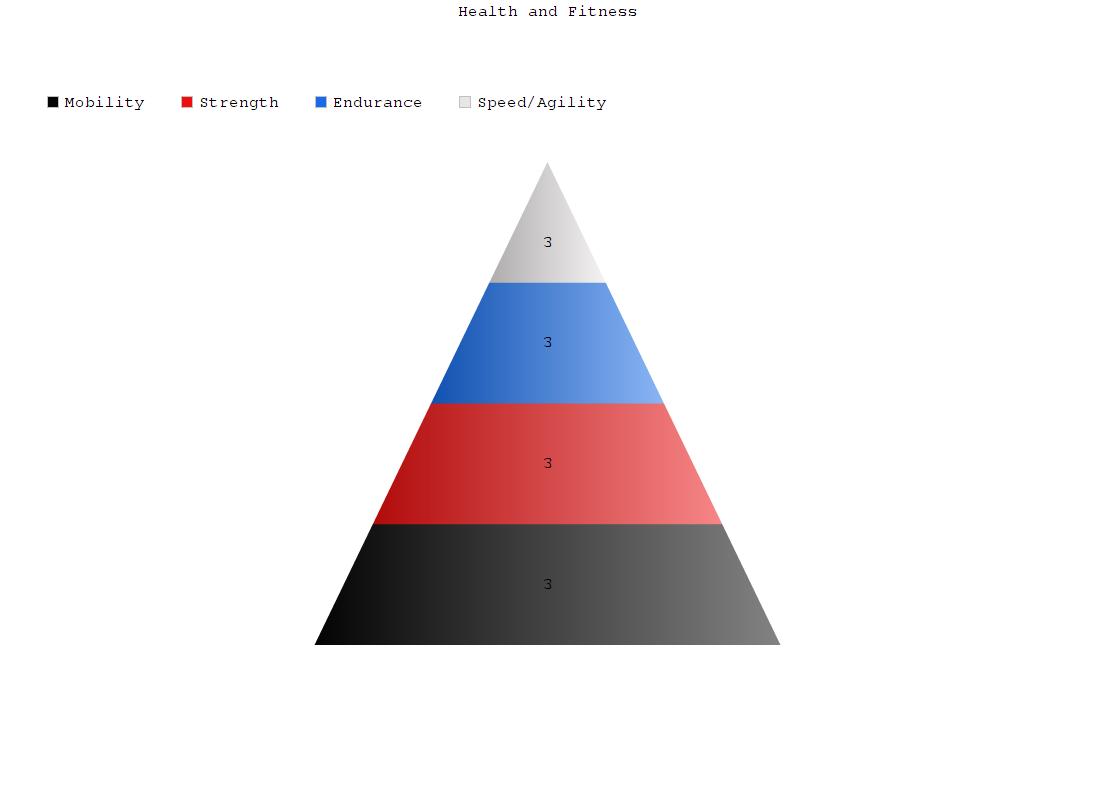
Health has come to mean the absence of acute illness, which is a sad state of affairs indeed. True health is thriving, being energetic, and relishing physical activities and challenges. It has a pyramid, like most things.
Mobility
Mobility is the true base of health. If you can move well with full, pain-free range of motion (ROM) in your joints, you are way ahead of the curve. Good mobility means you can jump in and things will much easier. There is a simple test that tells a trained eye where problems lie– The Overhead Squat.
The Overhead Squat Test
Start by standing with your feet outside your hips and your arms extended overhead. Most people can’t get into an overhead position that shows full ROM. Your bicep should be behind your ear and the arms should be at 90° to the shoulder. Then sit back into a deep squat while maintaining the overhead position. Most peoples arms will come quite far forward, knees will cave, the lower back will round and they will end up on their toes. If you’re unsure about your ability, try it with your toes against a wall. That is your first challenge. Take a video of your movement for retesting two weeks from now.
The Fix
The fix for any problems is two fold. Start doing Yoga stretches. YouTube is full of free videos, and five minutes a day will pay massive dividends. I like my stretching time to be a period of reflective thought, prayer, and deep breathing. I’ve become a fan of Kelly Starrett. He’s a physiotherapist from San Francisco and has book called The Supple Leopard. You’ll learn how to use inexpensive items to help prep the body for movement, work on painful spots, and clean up years of poor posture and movement. You are going to get hurt at some point. Be prepared to rehab it yourself. I use his methods everyday in my gym and was lucky enough to attend a seminar in 2011 that changed my practice forever. I can’t say enough about his work. Try my above advice for two weeks, and then retest your overhead squat. Things will improve quickly.
Strength
Many equate strength with size, and the correlation bears some mentioning. While a larger muscle has the propensity to become stronger, it doesn’t necessarily equate to more strength. Strength is quantified as the absolute heaviest repetition one can complete in any given lift.
Deadlifting
The king of all lifts is the deadlift. Humans are capable of lifts well in excess of 500lbs without the use of anabolic steroids. My own personal best was a 455lb deadlift at a body weight of 190lbs, using no straps, belt, or drugs. That required three years of dedicated lifting, five days a week. I’m not naturally strong and had to work hard for it. I was also in my early 30’s, and age is big factor in how easy the gains come. I would propose that all men should be able to deadlift 1.5 times their own body weight to be considered physically fit. A solid women weight would be around 1-1.25, depending on their age. My wife pulled 225lbs for one rep at a bodyweight of 135, and she was quite lean at the time. She has her father’s genes, who at 71 can do 20 pushups, three pull-ups, and competes in Dragonboating weekly. Health is ageless. The big question is: How do you get strong enough to be useful in uncertain times and be bulletproof enough to not break in half when you need to use that strength?
How to Get Stronger
There are two choices. The first is that you can join a real gym, where people lift real weight. Look for powerlifting gyms or Crossfit locations; avoid large chain gym locations. These large chains gyms will stick you on machines and waste your time and money! Your second choice is to go the inexpensive and self-disciplined route– go for it at home. For under $450 you can buy a squat rack, a barbell and 300+lbs of steel plates. This will require a space to use it, some research, and some ego checking. Here is the simple strength plan. It uses the principle of linear progression, or what we call the Milo and the Calf Method. Linear Progression works off the human body’s desire to maintain homeostasis. An exercise induced stressor can cause the body to adapt to it, through a process called Super Compensation. When you lift weights or run for a long duration or high intensity, you damage the muscle fibers and stress the respiratory and nervous system. The body responds by building things up stronger and/or bigger so that the specific stressor you put to it will no longer be a problem. If applied with incremental progression, you can add between 80-100lbs to your strength numbers in 18-24 weeks.
Strength-Building Option 1: Barbell/Weight Training
Using the barbell can be simple for some with the right body type and mobility. Should you be concerned with your ability to get started, I suggest the Mark Rippetoe book Starting Strength. He has a no Bravo Sierra way of presenting things and is very thorough in the necessary details. His language can be a bit spicy at times. (You’ve been warned.)
- Start on Day 1 by testing your squat, deadlift, and standing shoulder press. You want to find a weight that challenges you for five reps while maintaining decent bar speed and your form should be near perfect. That’s your 5-rep weight. Write it down. Complete two more sets of five with 90-180 second rest between each set. Then, rest 3-5 minutes, and then do the same testing with the deadlift. Once you find your deadlift 5RM, you’re done with that lift. Deads are very taxing on the nervous system, and 3×5 is too much for most folks. Rest 3-5 minutes, and then finish up with your testing and 3×5 of the press.
- You will perform this workout three times every 7-8 days with a minimum of one days rest.
- During the first week you may find you can increase the weight you use each workout by as much as 10-15lbs (total on bar). This is your body making better use of its abilities.
- After that, make 5lb increases on each lift every workout.
- After three weeks, you can add some supplementary work for the upper body. Do 3×10-15 chinups or supine rows on your first workout of the week and 3×15 pushups or bench press on the third workout of the week. This extremely simple plan should yield massive results for the time and effort put in.
Everyday tasks will become easier, you will lose body fat and gain muscle, and you’ll be much better prepared for TEOTWAWKI.
The second option for strength training will be continued in Part 2 of this article.

Two Letters Re: Urban Trash
Hugh,
This article is a good start to a problem solving dilemma. It definitely requires a mindset change, but that’s achievable for everyone. The best book I ever read, back in the late 80s, on this subject is Re/Uses: 2133 Ways to Recycle and Reuse the Things You Ordinarily Throw Away by Carolyn Jabs, published in 1985. – T.S.
o o o
Hugh,
When I have plenty of scraps, I do just as the author suggests (and as Julia Child had suggested in her book!) and make soup stock with them, canning them for later use. It makes for wonderful, flavorful soup stock! A lot of times, before I have filtered the scraps out, my husband eats the soup as is–and he has never complained. I gave up trying to tell him those were the junk ends and were supposed to be thrown out. Apparently, they still taste good, and he often has several bowls of this soup. After the scraps are filtered out, they go to the chickens for their third life. 🙂
As an example, right after Christmas, frozen turkeys were marked down to 49 cents a pound. I canned the meat from two of them and then took the carcasses and all of my freezer scraps and made stock. I canned 17 quarts of really flavorful stock that I am still enjoying!
As one more suggestion, there is a lot of talk these days about the health benefits of bone broth. With larger bones, you can cook them in a pressure cooker until the bones are easily breakable (or leave them in longer for the bones to dissolve) to get at the marrow, which can also flavor your soups and stocks. – L.B.
Economics and Investing:
World seeing ‘greatest monetary policy experiment in history’. Excerpt: “The six months under review have seen central bankers continuing what is surely the greatest experiment in monetary policy in the history of the world. We are therefore in uncharted waters and it is impossible to predict the unintended consequences of very low interest rates, with some 30 percent of global government debt at negative yields, combined with quantitative easing on a massive scale,” – Link sent in by P.S.
o o o
Silver Takes A Dip On Hawkish Fed Meeting Minutes
o o o
Is The Oil Production Efficiency Boom Coming To An End? Oil rigs have gotten much more productive since the start of the oil bust, sometimes even producing 1000 bpd, but how much more efficient can these wells get?
o o o
Tech Wreck – 100+K Jobs Gone and More Cuts Coming
o o o
SurvivalBlog and its editors are not paid investment counselors or advisers. Please see our Provisos page for details.
Odds ‘n Sods:
Claire Wolfe recommended this insightful essay by Vin Suprynowicz:
‘Tolerance’ sounds great. But is there no limit to what we can wisely ‘tolerate’?
o o o
Authorities believe frat boy found eating victim’s face may have been on “zombie” drug. Are you prepared for more of this as society crumbles around you?
o o o
SurvivalBlog Reader RBS wrote in about yesterday’s Top Note: I have heard it said that in the Klondike Rush an egg was worth its weight in gold. One can only imagine that transaction taking place. Here is an interesting side note to history that is rarely if ever ever spoken of in standardized history texts. Opportunity is where you find it. When “things are re-organized” by factors beyond anyone’s control, new opportunities will avail themselves too.
o o o
America to hand off Internet in under two months. They wouldn’t stifle dissent, would they? Nah. No more “badthink/badspeech”! Rainbows and unicorns for all. – C.S.
o o o
Col. Ralph Peters talks legacy after Gitmo: ‘Lincoln freed the slaves, Obama freed the terrorists’ – B.B.
Hugh’s Quote of the Day:
“A society that puts equality … ahead of freedom will end up with neither equality nor freedom.” – Milton Friedman
Notes for Wednesday – August 17, 2016
While salmon fishing near the Klondike River in Canada’s Yukon Territory on August 17th, 1896, George Carmack reportedly spotted nuggets of gold in a creek bed. His lucky discovery sparked the last great gold rush in the American West. His two companions later agreed that Skookum, Jim–Carmack’s brother-in-law, actually made the discovery.
o o o
Today, we present another entry for Round 66 of the SurvivalBlog non-fiction writing contest. The nearly $12,000 worth of prizes for this round include:
First Prize:
- A Tactical Self-Contained 2-Series Solar Power Generator system from Always Empowered. This compact starter power system is packaged in a wheeled O.D. green EMP-shielded Pelican hard case (a $1,700 value),
- A Gunsite Academy Three Day Course Certificate that is good for any one, two, or three day course (a $1,195 value),
- A course certificate from onPoint Tactical for the prize winner’s choice of three-day civilian courses, excluding those restricted for military or government teams. Three day onPoint courses normally cost $795,
- DRD Tactical is providing a 5.56 NATO QD Billet upper with a hammer forged, chrome-lined barrel and a hard case to go with your own AR lower. It will allow any standard AR-type rifle to have a quick change barrel, which can be assembled in less than one minute without the use of any tools and a compact carry capability in a hard case or 3-day pack (an $1,100 value),
- Gun Mag Warehouse is providing 20 Magpul PMAG 30-rd Magazines (a value of $300) and a Gun Mag Warehouse T-Shirt; (an equivalent prize will be awarded for residents in states with magazine restrictions),
- Two cases of Mountain House freeze-dried assorted entrees in #10 cans, courtesy of Ready Made Resources (a $350 value),
- The Ark Institute is donating a non-GMO, non-hybrid vegetable seed package (enough for two families of four) plus seed storage materials, a CD-ROM of Geri Guidetti’s book “Build Your Ark! How to Prepare for Self Reliance in Uncertain Times”, and two bottles of Potassium Iodate (a $325 retail value),
- A $250 gift certificate good for any product from Sunflower Ammo,
- KellyKettleUSA.com is donating an AquaBrick water filtration kit with a retail value of $250, and
- Two cases of meals, Ready to Eat (MREs), courtesy of CampingSurvival.com (a $180 value).
Second Prize:
- A Glock form factor SIRT laser training pistol and a SIRT AR-15/M4 Laser Training Bolt, courtesy of Next Level Training, which have a combined retail value of $589,
- A transferable certificate for a two-day Ultimate Bug Out Course from Florida Firearms Training (a $400 value),
- A Model 175 Series Solar Generator provided by Quantum Harvest LLC (a $439 value),
- A Trekker IV™ Four-Person Emergency Kit from Emergency Essentials (a $250 value),
- A $200 gift certificate good towards any books published by PrepperPress.com,
- A pre-selected assortment of military surplus gear from CJL Enterprize (a $300 value),
- RepackBox is providing a $300 gift certificate to their site, and
- American Gunsmithing Institute (AGI) is providing a $300 certificate good towards any of their DVD training courses.
Third Prize:
- A Royal Berkey water filter, courtesy of Directive 21 (a $275 value),
- A $245 gift certificate from custom knife-maker Jon Kelly Designs, of Eureka, Montana,
- A large handmade clothes drying rack, a washboard, and a Homesteading for Beginners DVD, all courtesy of The Homestead Store, with a combined value of $206,
- Expanded sets of both washable feminine pads and liners, donated by Naturally Cozy (a $185 retail value),
- Two Super Survival Pack seed collections, a $150 value, courtesy of Seed for Security, LLC,
- Mayflower Trading is donating a $200 gift certificate for homesteading appliances,
- Montie Gear is donating a Precision Rest (a $249 value), and
- Two 1,000-foot spools of full mil-spec U.S.-made 750 paracord (in-stock colors only) from www.TOUGHGRID.com (a $240 value).
Round 66 ends on September 31st, so get busy writing and e-mail us your entry. Remember that there is a 1,500-word minimum, and that articles on practical “how to” skills for survival have an advantage in the judging.
Urban Trash: Why and How to Minimize Your Garbage- Part 2, by K.S.
3. Compost/Animal Food
Technically you could differentiate between these two, as some items that you can compost you shouldn’t feed to certain animals. So scrounge two plastic buckets of a size you’ll actually use, carry, and empty, and make sure they have well-sealing lids since you’ll probably keep these in the kitchen. Then, label one Compost and the other Chicken Food (or whatever). Keep them under the sink or somewhere where you’ll actually use them. I’ve heard that compost “rules” have changed and you might be able to compost meat and dairy products now. I probably wouldn’t feed old meat or cheese to the chickens, but maybe you do, so just do what works for you and your animals.
You can probably re-eat a lot of the stuff you’d normally put right in the compost, so consider doing that first. Save old fruit peels for making fruit vinegars, but then compost them later. Apple cores and cuttings can be juiced into a rough sort of apple cider and then composted. Make some soup stock out of the onion skins and carrot ends before composting them. You get the idea.
4. Scrap Metal
You can still do this even if you’re in the city, though you may need to get creative about storing your stash. I don’t know of any metal that can’t be taken to your local scrap yard (readers may be able to chime in, though). Just make sure you sort by type beforehand. If you just put everything in one bin, you’ll lose out on high-dollar metals, like copper and brass, because as far as I’ve experienced you’ll get the dollar value of the lowest-value metal in your container. So, sort out the brass and copper! Also, don’t recycle your food cans, if you do decide to have a scrap pile, but do recycle bottle-deposit cans (see #7).
Post-garage sale free piles can be great sources for scrap. Look for bed frames, old flatware, kitchen items you don’t need (trays/bowls), broken appliances (for the copper coils in the motor), and especially house hardware. (I’ve scored pounds of brass doorknobs and fixtures this way.)
Make sure your scrap containers are solid, not slatted. Then you can toss in small metal bits like bent nails, soda can tabs, and bottle caps. Seem extreme? Yup, but every piece can count.
Wait until you have probably a hundred pounds or more of sorted scrap, and then take your first run to the scrap yard. You’ll get a feel for how much you need to bring in to make a certain amount of money. They should give you an itemized receipt with the weights of your sorted metals and the dollar value per unit (in pounds or tons, probably). Then you’ll be able to gauge how often you want to do a scrap run and how much stuff you should bring to make it worth your while. I think we used to go every six months or so. Follow the rules, be polite, don’t horse around, and don’t try to pull a fast one by hiding low-value metals in your high-value bins!
5. Burn
If you have any sort of backyard or back driveway, rustle up some concrete blocks, a big old stock pot, or a circle of rocks, and start a burn area. Also, start a paper “Burn Bag” in your kitchen. You’ll see major reductions in your landfill trash this way. Plus, you can get rid of personally identifying documents without needing to buy a shredder. I’d suggest diverting items like old bank paperwork to the burn bag, plus stuff you can’t necessarily recycle or compost, like greasy paper towels, dryer lint, old toothpicks and popsicle sticks, tin can labels, used matches, short bits of string, butter wrappers, paper food containers, and pizza boxes. Want to take it to the extreme? You can dispose of some bathroom trash this way (used kleenex, cotton swabs, and cardboard toilet paper rolls, for example). It’d probably be more sustainable, though, to sew some handkerchiefs out of found fabric.
If you want to maintain a little more OPSEC in the summer, just use your burn bag as kindling before a nice hot dog roast or barbecue. That way, if neighbors are curious about the smoke, you have a real reason to tell them, instead of letting on that you’re burning sensitive documents.
6. Free Pile/Donate
Can’t reuse, re-eat, compost, scrap, or burn it? Try donating it to a thrift store. There are none close by? If you’re in a moderate to high traffic area, and this fits with your neighborhood ethos (stay Grey Man), try a free box. The town we live in has a thriving “freeboxing” community, if you know where to look and what guidelines to follow. I’ll have more about how to maximize free stuff in my next article, but for now if you’re looking to give stuff away for free (so that you don’t have to pay to throw it away) here’s what to remember. First of all, your goal is to get rid of something, right? You need to make it easy and appealing for someone to take. Put your clearly labeled “free box” (cardboard is just fine) out on your curb or median grass strip. Don’t keep it on your porch or lawn or you might end up with folks taking your lawn furniture or items on your porch. Keep your free box clean and neat! It’s a big turn-off to find a free box that looks like it’s full of kitchen trash. If you want to get rid of items that thrift stores won’t take, like old plastic and glass food containers, wash them first! Stack them neatly and include lids. You’ll likely have more takers than if you treat your free box as a dumping ground. If you’re giving away clothes or fabric material, wash and fold them, then put them in the box. Keep an eye on your free box; if stuff gets tossed outside of it, take a minute to tidy it up. Put the box away in your garage or otherwise out of sight after a few days, so folks don’t start tossing their trash in it. You may or may not need to advertise (on Craigslist, etc) that you have a free box at your curb. If you feel ambitious, you can use scrap lumber to build a nice “free box” stand with a roof and clothes hanger bar, as some in our city have done.
7. Recycle
If you maximize “trash” flow to strategy streams 0 through 6, you may not need to pay for recycling service. See if you can swing that. Otherwise, if you end up with a lot of nonburnable, non-scrappable, inedible items (like glossy paper ads and some styrofoam materials), recycling may be for you. Though, before you shell out your cash on service, check out three other options. First, see if you can trade with a neighbor to utilize their recycling bin. Maybe if you take it to the curb and back in every week, they’ll let you toss in your stuff, especially if it’s not much. Second, ask your coworkers or your boss if you can bring your recycling to work. (Clearly, this option depends on your personal work circumstances.) Third, see if your town has any kids’ clubs, churches, or craft centers that need donations of art materials. Styrofoam meat trays, plastic yogurt cups, glossy ads, and foil wrappers (all clean!) could be a great help to that group.
Also, don’t scrap or send through recycling services anything that has a deposit! Look at the label or top on drink bottles and cans, and see if it lists your state abbreviation (i.e. “CA”) and then says something like “DEPOSIT” or “5 cents”. Save those items and take them to a bottle-deposit facility, grocery store, or mini-mart. If you take them to a person (as opposed to an automated machine), pre-count your items, politely let the clerk know how many you have (stay under daily limits), and then graciously recount them out in front of the clerk when requested. Don’t ever try to sneak in non-deposit items; or, if you’re new to this and accidentally put in a non-deposit can, be honest and apologize. Over time, the clerk will start to trust you and your count. Build that trust and don’t abuse it, and it’ll pay off in the long term. They often deal with a tough crowd, and your politeness and honesty will put you on their good side.
8. Trash
This should ideally be a last resort, but there are some things that you can’t do much else with. Feel free to offer your reuse ideas for empty ketchup packets, used dental floss, and broken light bulbs! By now, though, your landfill-bound trash bag should be pretty small, as you’ve successfully learned how to divert the majority of the waste you generate to other streams.
Your trash at this point contains one last thing of value though. You now have an opportunity to analyze what you’re still tossing in order to determine how you can find, make, reuse, or trade for that item, instead of buying it and then throwing it away.
For example, maybe you’re still throwing away tea bags. Could you eliminate those from your trash? I think so. First, you’d have to decide whether or not you wanted to keep buying tea (#0). Maybe that’s a “Yes” for you, which is fine. Next, consider if you could reuse/re-eat this item (#1 and #2). Can you make one more cup of tea out of it before tossing the teabag? Then, if it’s really at the end of its lifespan, look at composting the organic matter (#3). Maybe your tea bags have that little staple, string, and tag. Feeling extreme? How about scrapping the staple (#4) and burning the string and tag (#5)? No more tea bags in the garbage!
And what if you’re throwing away juice boxes? Maybe you’re ready to stop buying those (#0). Have you saved and juiced some apple cuttings (#2)? Great! Now you can put your homemade juice in reused plastic or glass containers (#1) and feed the juiced-out apple bits to the chickens (#3).
So, you get the picture. While cutting down your trash might seem like a big endeavor, it will ultimately help you save money for the things that are much harder to get, while building a creative, out-of-the-box mindset in you that positions you for resourceful survival. To be honest, though, while we’ve done every single item on this list, it’s not always easy. You can cut yourself a break on that one late night when hand-washing a sandwich bag might send you over the edge. We’re all human, but don’t give up! Find another creative way to cut down your trash. I think you can do it. I know we did.