Hugh,
A great read. Here is a simplified version – OPSEC for Dummies:
- Keep your mouth shut. Trust no one or very few.
- Remember that anything you say may be used against you.
- Don’t advertise it. Be the grey man. – P.S.

Hugh,
A great read. Here is a simplified version – OPSEC for Dummies:
WARNING: The Coming Collapse Of U.S Net Worth Will Wipe Out Millions Of Americans –
o o o
From: Wells Fargo, Re: Closing The Accounts We Secretly Opened For You – DSV
o o o
Items from Mr. Econocobas:
Backlash to World Economic Order Clouds Outlook at IMF Talks – Here is Globalism on the defensive. The world’s economy has been destroyed by globalist policies and now they want to blame the impending recession/depression on others who are rejecting globalism.
Video Interview : Is Canada’s Economy on the Verge of a Financial Crisis? – This is a very good interview on Bloomberg.
o o o
SurvivalBlog and its editors are not paid investment counselors or advisers. Please see our Provisos page for details.
Storey’s Basic Country Skills: A Practical Guide to Self-Reliance by John & Martha Storey
Good-Bye April 15Th! by Boston T. Party
Lone Survivor (Warning: Has many violent war scenes.)
Unbroken (Warning: Has many violent war and POW camp scenes.)
Combat Shotgun (Lou Awerbuck)
Interesting Coincidence – U.S. Internet Disruption Maps During WikiLeaks Presser. – C.S.
o o o
Video: Trey Gowdy Took Only Three Minutes To Silence The Media – B.B.
o o o
On The Precipice Of World War III: Russia Prepares For War On Multiple Fronts – B.B.
o o o
In the news, I notice that Russians are participating in large nuclear preparedness drills. While it seems based on Russian sources (and all that implies, based on Sun Tzu), I would certainly say that a pre-emptive strike is in their arsenal of options and should be considered when evaluating our own state of preparedness. 40 Million Russians To Take Part In “Nuclear Disaster” Drill, Days After US General Warns Of War With Moscow – EJR
o o o
“Cowardice asks the question, “Is it safe?” Expediency asks the question, “Is it politic?” Vanity asks the question, “Is it popular?” But, conscience asks the question, “Is it right?” And there comes a time when one must take a position that is neither safe, nor politic, nor popular, but one must take it because one’s conscience tells one that it is right.” – Martin Luther King
October 4, 1923 is the birthday of the late Charlton Heston, who was born John Charles Carter. He died April 5, 2008. He is often remembered for movies like Ben Hur, The Ten Commandments, Soylent Green, The Planet of the Apes, and the survivalist classic The Omega Man.
o o o
SurvivalBlog would like to welcome Max Velocity Tactical as a new sponsor in our writing contest. They will be donating a gift certificate good for any two or three day class of training. Stop by their website today and see what they offer.
We are also welcoming back SafeCastle as a contest sponsor. They will be donating a package of 15 Life Straws. If you are a regular purchaser of survival/prepping materials (and who among us isn’t?), you owe it to yourself to check their website out.
o o o
Today, we present another entry for Round 66 of the SurvivalBlog non-fiction writing contest. The nearly $12,000 worth of prizes for this round include:
First Prize:
Second Prize:
Third Prize:
Round 66 ends on September 31st, so get busy writing and e-mail us your entry. Remember that there is a 1,500-word minimum, and that articles on practical “how to” skills for survival have an advantage in the judging.
If it ever really comes down to it, you can easily find food in your backyard. I remember reading a survival book when I was younger that mentioned how absolutely ludicrous it is to die of starvation in the wild. The book mentioned the sheer number of times that starved lost hikers’ bodies are found lying in a patch of edible plant life.
After reading that, I agreed with the author and set out to educate myself on the edible plants I walk by every day. The end result is that I can now take a hike through the woods and readily identify plant after plant that I can eat along the way. If I’m ever on a dayhike and find my food is running low and I’m hungry, I know which plants I can munch on that’ll allow me to enjoy my hike much longer. It’s pretty fun.
I think plants are pretty neat. The tiny little red clover lives in its own little world, while the massive oak will fill you with a sense of awe.
With a little bit of training, those plants can fill your belly with food as well!
Here are seven very common and very easy to identify edible plants that you most likely have in your backyard already.
This is your typical three leaf clover, just with red-ish flowers. If you live in an area with rabbits, sooner or later you’ll see them munching on red clover flowers. The cool thing is that those red flowers are edible for you as well.
The central stalk can be kind of tough, but if you have the time and desire to strip all of the little red florets off of the main stalk, then you’ll be in for a real treat. You can eat the little flowers raw or use the dried florets to make tea.
I’m a big fan of this pretty little blue/purple flower. The leaves make an excellent addition to salads, and you’ve probably eaten them before without ever really realizing it. They’re a very popular addition to mixed green salad bags that you can buy at the grocery store.
You can actually buy seeds for these little guys at your local hardware store as well, which I find funny since I consider it a weed. However, this weed is incredibly tasty and versatile. When harvesting, try to pick the younger leaves, as they’ll be less bitter.
The taproot can be used as well. If you dry, roast, and grind them, you can use them as a coffee substitute, just like you’ll find in New Orleans.
You know these little guys as the notorious blobs that end up all over your sidewalk every fall. Well, give them a piece of your mind this year by fighting back with your stomach. That’s right, you can eat these little fruits as well. I’ll give you fair warning though, they’re extremely tart.
Personally, I’ve never been a big fan of Granny Smith apples. However, if you do like Granny Smiths, there’s a good chance that you’ll like these as well. They have roughly the same taste and probably a bit more of the tartness. You can cook with them, just like you would a Granny Smith though, and they make pretty good applesauce.
Here’s another little green that I’m a pretty big fan of because of how great of an addition it makes to salads. The leaves get more bitter as they grow larger (read: extremely bitter), but if you can get them while they’re young they’re fantastic.
I find eating dandelion leaves is very similar to drinking coffee. Nobody drinks straight up black coffee and likes it the first time. It’s an acquired taste. The same can be said of dandelion as well. Once you develop a taste for the bitterness, you won’t be able to get enough.
Like chicory, you can use the roots of dandelions for a coffee substitute as well. Dry, roast, and grind the roots, and you’ll be on your way to a beverage that’s at the midway point between a coffee and a tea.
The only way I’ve ever eaten these are as nuts, but you can use them to make flour like the Indians used to as well. The key to making acorns edible is to get rid of all of the tannins inside of them.
Tannins make the acorn incredibly bitter. The key to removing tannins is water, and lots of it. By boiling acorns in several changes of water, until the acorns taste decent, you will safely dispose of the tannins. When you boil them, make sure to remove the outer shells first too. Otherwise, you end up with a mess. After you boil them, you end up with a pretty pleasant nut meat that can easily fill some bellies.
If you use cold water to leach out the tannins, THEN you can use acorns as a source of flour to make breads and such. Tying up your acorns in a bag with holes in it, and placing them in a flowing stream will leach out the tannins over a period of time (potentially three days). Then, you’ll want to dry the acorns out, and peel off the thin little papery skin around each one before grinding them down to use as a source of flour.
These are very easy to identify little boogers that you’ll see popping up all over your yard from spring to fall. We always called them wild onions growing up, but wild garlic is the proper name. They send up long, green, tube-ish stalks that are hollow inside and tend to tower over the surrounding grasses.
You can use the green part chopped up like chives. The teeny little onion at the base you can use, well, like an onion. I think they taste pretty good too. Some people say that the taste is too powerful though, so be wary of that before you substitute them in recipes in the same proportions as regular onions.
If you live in the South, you’ll find these things all over the place. Dogwoods are incredibly popular down here, and the Kousa variety is just as common. Kousa dogwoods are recognized by their pinkish-red globular fruits. They kind of look like bumpy soccer balls.
What most people don’t know about this tree is that those little soccer balls are edible. Personally, I find them kind of mealy, but if you’re truly hungry you probably won’t mind. The fruits ripen in late summer, and turn from yellow to pink-red when they are fully ripe. The skin is pretty bitter, so they’re gonna taste better if you can avoid that part.
Should something crazy ever happen, such as a loss of power, flooding of your community, or storms that leave roads impassable, you may find yourself marooned at your house for a period of time. I don’t consider my current residence out in the boondocks by any means, yet we’re faced with at least one of those problems every year.
Should such an event come to your doorstep, the ability to forage food out of your own backyard will make your life much less miserable. Think about the peace of mind that comes from knowing that there are plants out in your lawn that you know your kids can safely eat should your food stores run out.
It’s a good feeling knowing that you can do that.
If you want to know more about foraging for your own food, there are a couple of resources out there that I rely on and have found to be a great source of information.
This is the most comprehensive book on edible plants as far as I’m concerned. I carry this book with me everywhere. Not only does book do an excellent job of telling you what part of the plant to eat, but it also shows you poisonous look-alikes. The only negative is that most of the pictures are hand drawn.
Another great foraging book that goes in depth into the wild edibles growing in your own backyard. The pictures are fantastic, it tells you what parts to harvest, and tells you how to prepare the food to eat as well.
I use this book mainly for verification issues. If I’m not 100% positive about what I’m about to eat, I pull out this book as a last resort just to make sure. It’s got a number of lesser-known wild edibles within it, and I like the extra perspective regarding how to eat different plants.
If you’ve ever watched Fat Guys in the Woods, then you know who Creek Stewart is. This is the website of his survival business that he runs out in Indiana. His blog has some great posts on lesser known edible plants.
Good Afternoon Hugh,
This is a response to the Letter regarding Alaska as a Survival Location. I am sure you are getting piles of letters from people in Alaska who claim many things. We have owned our property in Alaska for eight years. Here are some pointers for being successful in Alaska, which people down in the States don’t seem to understand.
If you are committed to coming to Alaska the recommendations are the following:
o o o
Winners Of The Oil Bust: How Much Oil Did China Store? New satellite images suggest that China might be able to store much more crude oil than previously thought
o o o
Three reasons why the banking system is rigged against you – DSV
o o o
Deutsche Bank Received a U.S. Bailout Twice as Big as Lehman Brothers – P.M.
o o o
SurvivalBlog and its editors are not paid investment counselors or advisers. Please see our Provisos page for details.
Today NOAA Adds Solar Storms to the Weather Forecast – G.G.
o o o
Several readers sent this link in: Gun-Show Customers’ License Plates Come Under Scrutiny. Well worth reading, though you may have to sign in to get it. You can get a summary of the article at Bearing Arms.
o o o
Gun sales hit 17th straight monthly record, up 27 percent – G.G.
o o o
‘We run the streets’: Video shows angry mob attacking CHP patrol car with officer still inside – W.C.
o o o
A bit of humor for your Tuesday morning – Music Video: Liar Liar Pants On Fire Hillary Song
“Those who make peaceful change impossible will make violent revolution inevitable.” John F. Kennedy
October, 3, is the anniversary of the Mogadishu, Somalia raid. The 18 Americans killed were: MSG Gary Gordon, 1st SFOD-D SFC Randy Shughart, 1st SFOD-D SSG Daniel Busch, 1st SFOD-D SFC Earl Fillmore, 1st SFOD-D MSG Timothy Martin, 1st SFOD-D CPL Jamie Smith, 3/75 Ranger SPC James Cavaco, 3/75 Ranger SGT Casey Joyce, 3/75 Ranger PFC Richard Kowaleski, 3/75 Ranger SGT Dominic Pilla, 3/75 Ranger SGT Lorenzo Ruis, 3/75 Ranger SSG William Cleveland, Jr. 160th SOAR SSG Thomas Field, 160th SOAR CW4 Raymond Frank, 160th SOARD CW3 Clifton Wolcott, 160th SOAR CW2 Donovan Briley, 160th SOAR SGT Cornell Houston, 10th MTN DIV PFC James Martin, 10th MTN DIV
The Somalis killed were unnamed and un-numbered, but estimates range from 315 and 2,000 KIAs.
The events of October 3, 1993 were memorialized in the movie Black Hawk Down.
The 1911 handgun has been around since, well, 1911, so the design is more than a hundred years old. For an old work horse, the design shows no signs of slowing down. As a matter of fact, there are probably at least 50 companies producing the 1911 in one form or another. We can have a 1911 in the basic mil-spec version or a fully decked out custom gun with more bells and whistles than we could ever use. We can find 1911s imported from The Philippines for well under $500 or acquire custom guns that easily cost tens of thousands of dollars. We can have a full-sized 1911 or a sub-compact version and everything in between those sizes.

One of the major players in the 1911 field is Springfield Armory in Geneseo, IL. They have some 1911s produced in Brazil, and many are made in-house. You can choose anything from a mil-spec version, which are very nice guns, to one from their Custom Shop and once again everything in between. Also, Springfield Armory has one of the best warranties in the business, too.
I rarely, and I mean rarely, do a side-by-side test of any firearms. For good reason, no matter how fair one wants to be, we will always favor one gun over another, for whatever reason. This doesn’t mean that one gun is necessarily better than the other gun. It’s just our preferences and personal tastes. We can take two identical guns from the same manufacturer, and we will most likely favor one over the other. Go figure.
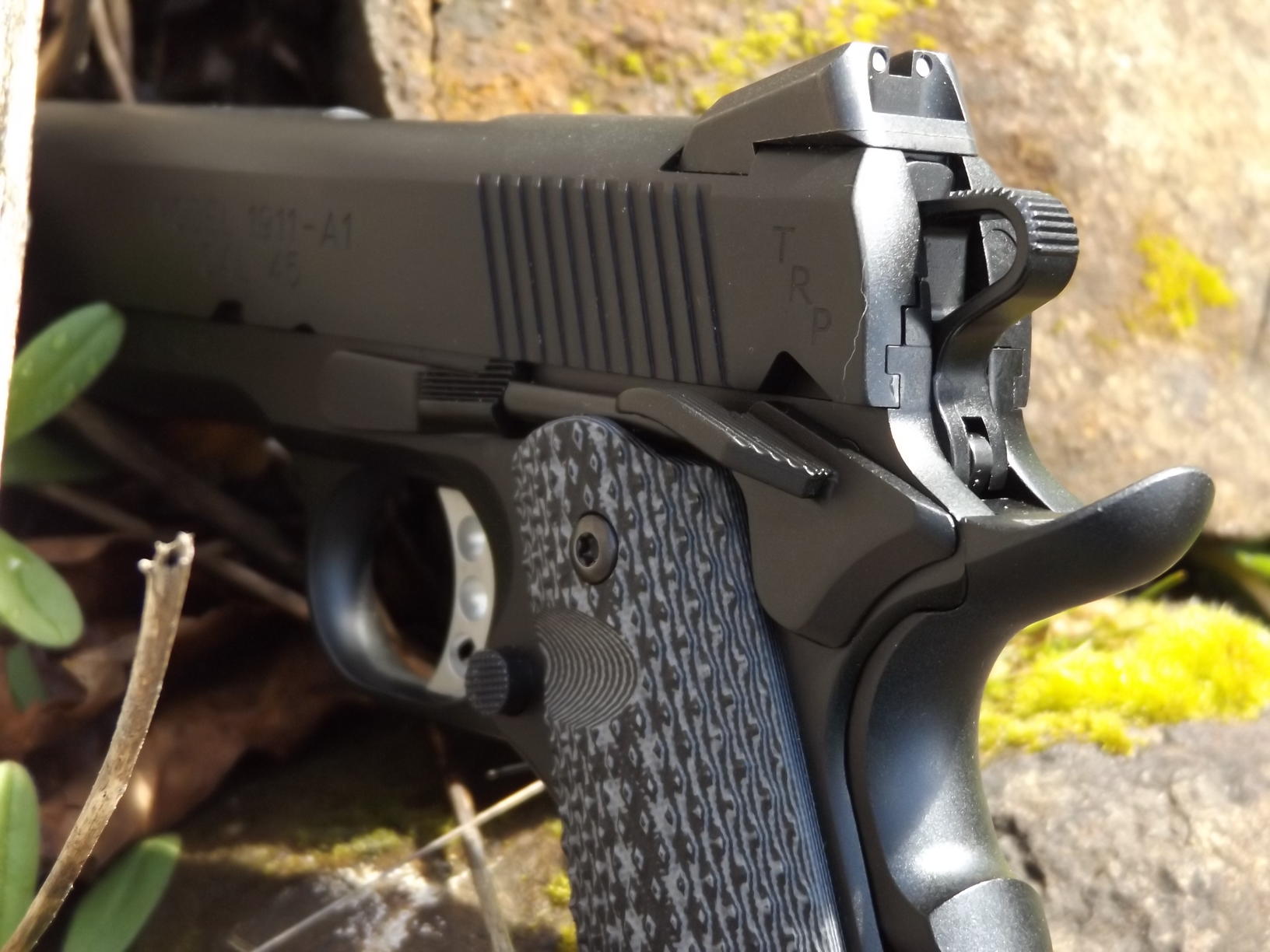
With the above in mind, I thought it would be interesting to test the Springfield Armory TRP 1911 against the TRP Operator 1911 to see how they compared. The TRP has a 2-piece guide rod, while the TRP Operator has a 1–piece guide rod. Both guns have Tritium night sights. The TRP has fixed Novak combat sights, and the TRP Operator has a full adjustable rear sight. Both come with two 7-rd stainless steel mags with slam pads, both have their frames made out of forged steel, and ditto goes for the slides. Both have identical grey G-10 gips, and both have 5-inch match grade stainless steel barrels. Both have the outstanding Armory Kote on the slides and frames that really resists the elements. The TRP weighs 42 oz, while the TRP Operator weighs 45 oz, due to the Picatinny rail on the frame for lasers and lights. Actually, there are very few differences at all between the two guns.
If you like adjustable sights, the TRP Operator is the way to go. If you like fixed sights, the standard TRP is the right choice. If you want that Picatinny rail for mounting lights and lasers, then the TRP Operator is your choice. Other than that, the guns are pretty much the same in all the areas that count.
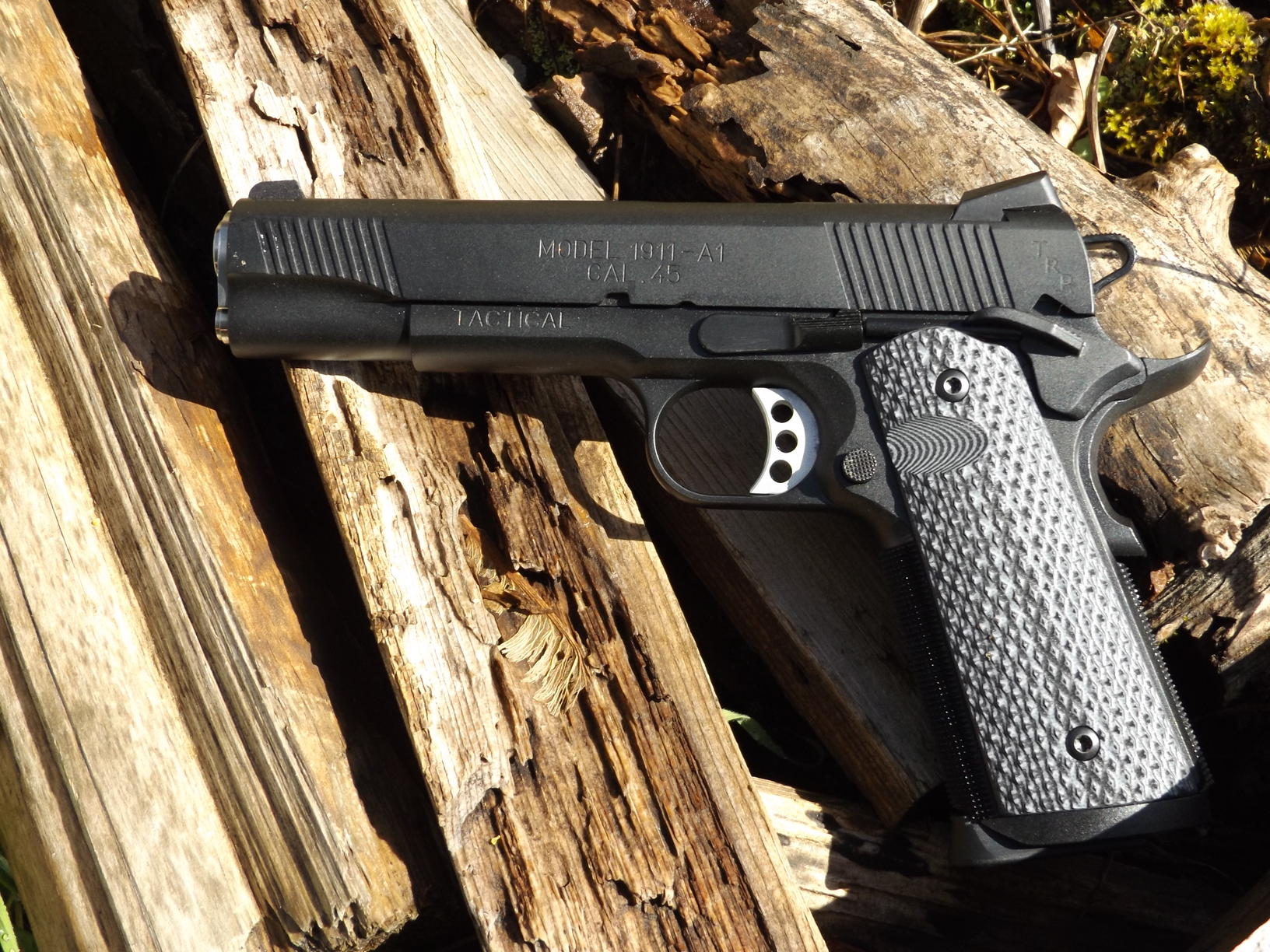
Springfield Armory has a limited edition of only 1,500 TRP Operator 1911 available that are set up the way famed Navy SEAL Chris Kyle had his that he carried in Iraq. The gun with serial #1 was sold at auction, and if I recall it went for over $22,000. However, if you can find any of the other serial numbers, the retail price is $2495, however I suspect they will all sell for even more than that.
Both of the TRPs come from Springfield Armory in a very nice polymer carrying case that includes the two magazines, a double magazine pouch, a paddle holster, full instructions, and a cleaning brush. The two magazines have slam pads for a reason; there is an extended magazine well “funnel” on the gun for faster reloads, and mags without the slam pads would be difficult to insert. The slam pads are the way to go. The trigger pull on both of my samples came in right at 4½ lbs, and I didn’t see any need to adjust it lighter than that; this is a good trigger pull for a self-defense handgun. The TRP had a slightly, every so slightly, crisper trigger pull. Both guns also have the extended beaver tail grip safety that were timed perfectly. Both guns had ambidextrous thumb safeties as well. They snicked on/off with authority; there’s no slop! The barrel on the TRP Operator is a heavier bull barrel, as opposed to the standard diameter barrel on the TRP.
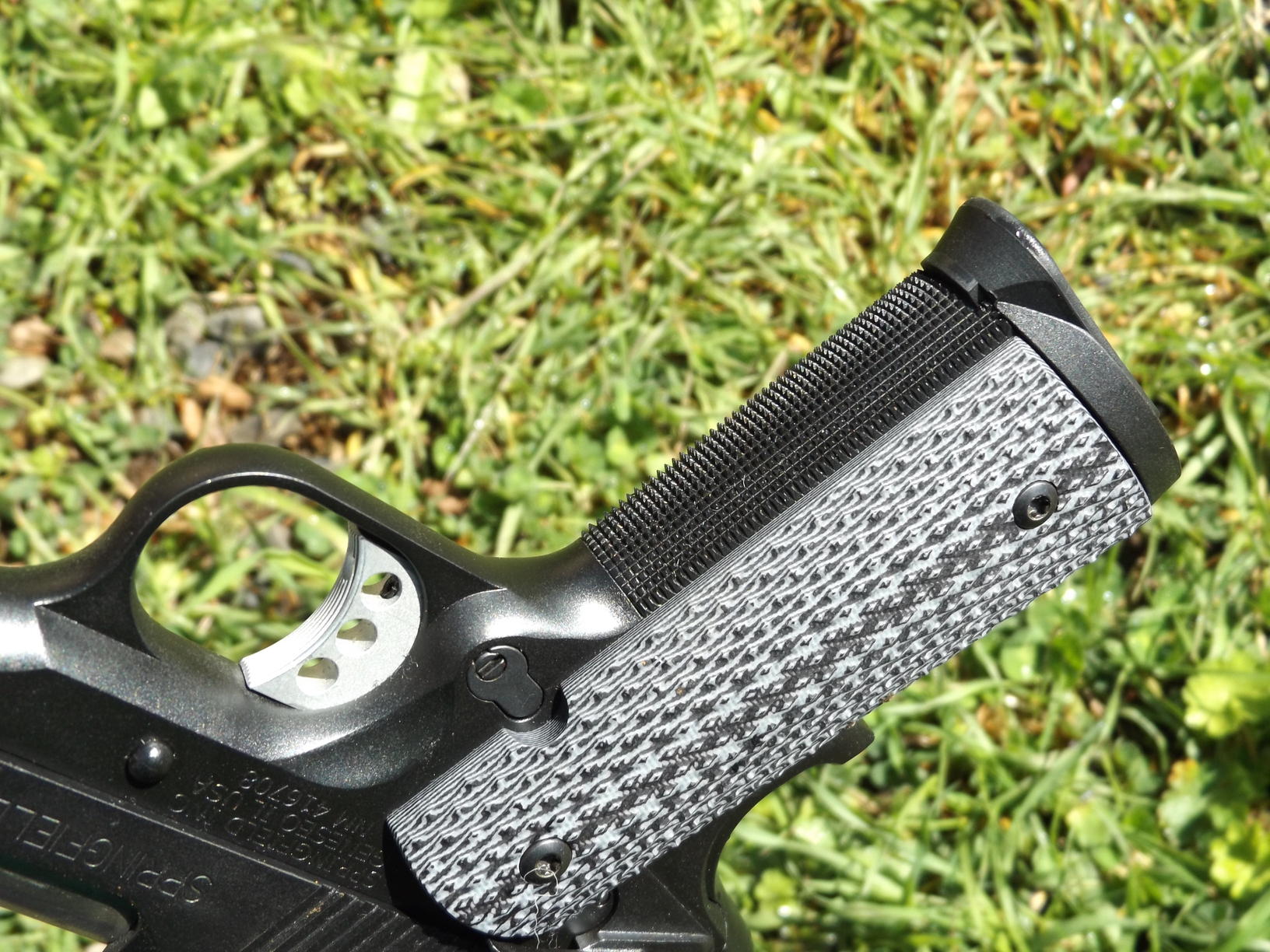
Both of the TRPs fit nicely in a Blackhawk Products tactical thigh holster and their SERPA hip holsters. I was a little concerned that the Operator with the Picatinny rail wasn’t going to fit in those holsters; it fit nicely. However, the Operator needs a specially molder leather holster that will have room for the Picatinny rail. The TRP fit in every 1911 holster I tried it in.
Many years ago, I co-authored a book called SWAT Battle Tactics with my friend John McSweeney, who passed away about a dozen years ago. McSweeney was the founder of the American Kenpo Karate Association, and he is credited with introducing Kenpo Karate in Ireland. He was also well-known for his handgun skills, especially when it came to Point Shooting. He and I used different methods, but they were compatible with one another, as demonstrated in our DVD “Tactical Point Shooting” that is sold by Paladin Press. I used to teach SWAT tactics many, many years ago, and my SWAT book is in need of a serious update when I can find the time, or perhaps I need to write a completely new book.
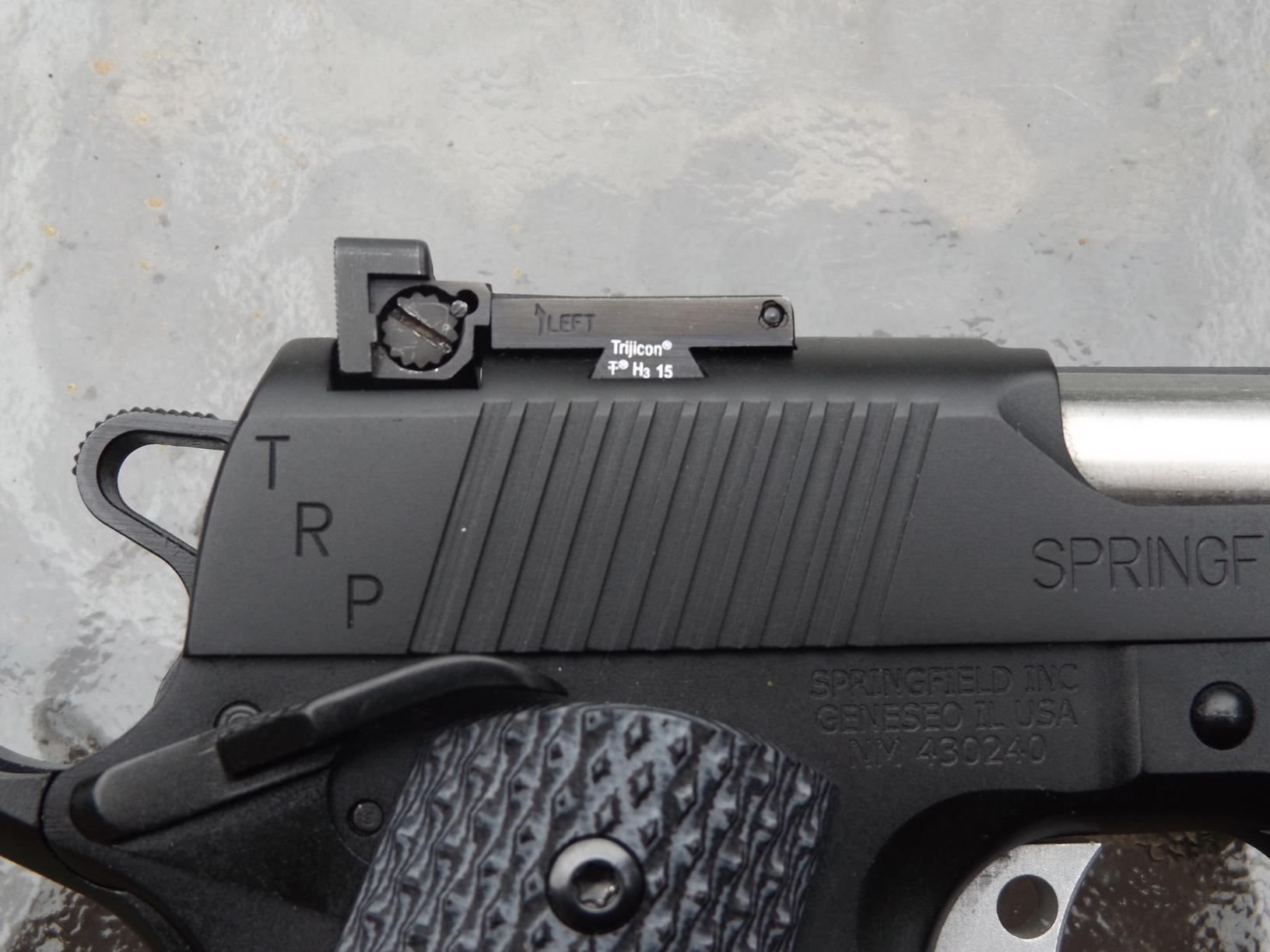
I’ve stated before that if I had to go into an active shooter situation and I could only have one handgun, the 1911 would be that firearm, with plenty of spare magazines. The .45 ACP puts the bad guns down faster, in my humble opinion, and the TRP 1911s are both chambered in .45 ACP. When I taught SWAT tactics to police officers, it became apparent that they had difficulty moving through the hallways and small rooms with a shotgun or an AR-15. I suggested that they try house clearing with a handgun instead of a long gun, and it worked better. That’s not to say that a shotgun or an AR-15 shouldn’t be used. Take it for what it’s worth and save the hate mail. Use what you use best if you’re a SWAT officer. If I knew I was going up against several armed suspects who were armed with AK-47s or AR-15, my choice would be an AR-15 WITH a 1911 on my hip. It just depends on the situation. Choose the tools you’ll use carefully, and train with them. I have every confidence in the world, if only armed with a good 1911, the right ammo, and plenty of spare magazines, going into many dangerous situations.
Highly trained SWAT teams, like the world-famous Los Angeles PD, issue 1911s to their officers. Each officer is actually issued two 1911s– one has a rail for a light, and one without a rail. They choose accordingly when going into a dangerous scenario. Many other SWAT teams around the country, even around the world, pick the 1911 as their sidearm. Take it for what it’s worth.

Many of my long-time readers will know that I just can’t help but change something on my 1911s or tinker with them to make things more to my liking. The only changes I did on both the TRP and the TRP Operator were to replace the standard 16-lb recoil spring with an 18.5-lb heavier recoil spring. I shoot a lot of +P ammo through my 1911s, and I think the heavier recoil spring just makes sense. It protects the frame from getting battered by the hotter rounds. Other than that, I made no changes to either gun.
Black Hills Ammunition and Buffalo Bore Ammunition kindly supplied me with a great assortment of .45 ACP ammo for my testing, and I did a lot of shooting for this article. From Buffalo Bore, I had their 160-gr Barnes TAC XP low recoil, standard pressure, all-copper hollow point round, their 255-gr Outdoorsman Hard Cast +P load, 230-gr FMJ FN +P, 185-gr JHP +P, 200-gr JHP +P, and their 185-gr Barnes TAC XP all-copper hollow point +P. From Black Hills, I had their 200-gr Match SWC, 230-gr FMJ, 185-gr JHP, 230-GR JHP, 230-gr JHP +P, and their 185-gr Barnes TAC XP all-copper hollow point +P.

I fired more than 500 rounds through each gun over my testing period of a couple months, and there were zero, none, nada malfunctions of any type. The TRP Operator needed to have the fully adjustable rear sight adjusted a bit. It was shooting too high and to the left a bit. The fixed sight TRP was dead-on at 25 yards.
Accuracy testing was done at 25 yards with the TRPs resting over a sleeping bag over the hood of my pickup truck– my usual routine. Both guns would easily shoot under three inches with all of the ammo. Some rounds gave me groups of 2½ inches, if I did my part. One ammo gave me a 2-inch group, if I did my part, and that was the Black Hills 230-gr JHP, with the Buffalo Bore 200-gr JHP +P load right on its heels. I also allowed several friends to shoot both guns, and none of them could decide which one they liked better. I believe, on a good day, when I’m really on my game, I can get groups down below two inches.
So, what did I learn from the TRP vs TRP Operator testing? Well, I thought the heavy bull barrel TRP Operator would give me smaller groups. It didn’t. There really wasn’t any measurable differences between the two TRPs. This surprised me, because a heavier bull barrel has given me better accuracy in the past on 1911s. It just show that Springfield did an outstanding job fitting the barrels on both guns for the most accuracy.
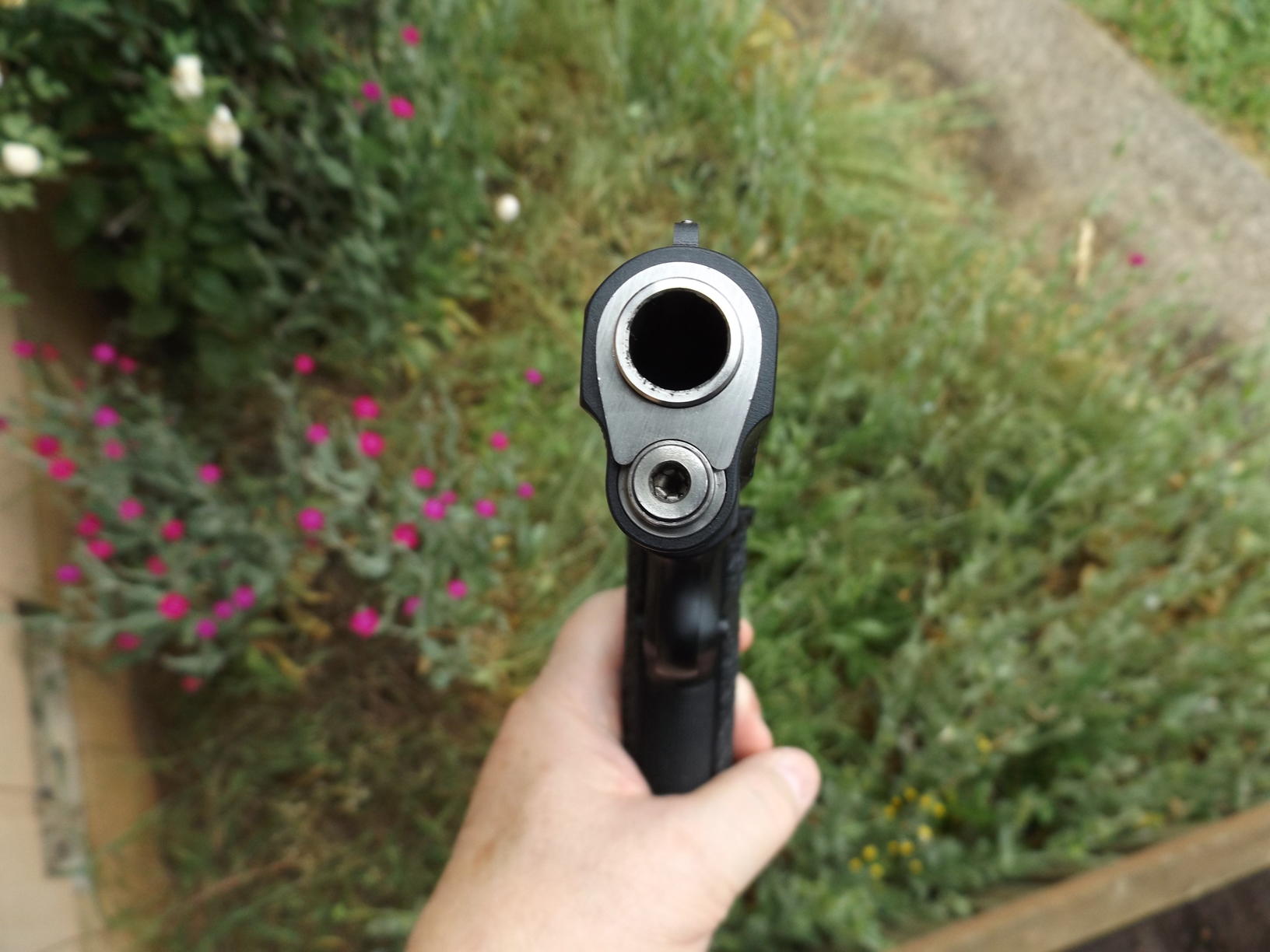
Did I have a preference at the end of my testing? Yep, I liked the TRP a little bit better than the TRP Operator, for concealed carry! It just seemed to balance a little better in my hand than the TRP Operator did with the rail on it. Now, going into a dark building at night not knowing what was hiding and waiting for me, it would be a complete toss up as to which TRP I grabbed. If using a rail mounted light, the TRP Operator would win. So, when it comes down to it, I wouldn’t feel the least bit undergunned or outgunned with I had the TRP or the TRP Operator in my hands. There was no loser here. Both guns are winners in my book. The Operator retails for a little bit more than the standard TRP does, and I’m not listing prices here. I checked all over the Internet, and prices are all over the place. So shop around on the ‘net or at your local gun shops, and see who has the best prices. However, don’t be surprised if your local gun shop doesn’t even have either TRP in-stock; they are hard to come by, and Springfield works overtime to try and meet demand. The guns are very popular. You can’t go wrong with either one.
– Senior Product Review Editor, Pat Cascio
Makes 5 servings. This goes especially well with hot rice.
o o o
Do you have a favorite recipe that would be of interest to SurvivalBlog readers? Please send it via e-mail. Thanks!