Economics and Investing:

China must wean itself off debt addiction if it is to avoid financial calamity, warns IMF chief

o o o

Hubert Moolman: Silver Price Forecast: Higher Silver Prices For Many Years To Come

o o o

Bank of England investigating dramatic overnight fall in pound

o o o

Gold bounces back from biggest weekly drop this year

o o o

SurvivalBlog and its editors are not paid investment counselors or advisers. Please see our Provisos page for details.


Odds ‘n Sods:

I recently had the opportunity to tour Michigan’s Upper Peninsula (commonly called “The U.P.” or “Upper Michigan”) for the first time. It is a large, mostly forested expanse with a fairly light population density. The region measures 16,377 square miles–nearly twice the size of New Jersey. It is known for mosquitoes in the summer months and brutal cold and deep snow in the winter months. The folks there seem friendly and predominantly conservative. The only disappointments were seeing the scarcity of home vegetable gardens (and greenhouses), the scarcity of livestock, and seeing not nearly as much commercial row crop agriculture as I had expected. Together, these factors make the region less suitable for self-sufficiency in the event of a grid-down collapse. – JWR

o o o

Patrice Lewis:  Why we garden in tires.

o o o

10 DIY Home Hacks Every 30-Something Should Know

o o o

Reader Peter S. alerted us to yet another concealed carry self defense success story:  Man shot, killed after robbing 2 at gunpoint in Tacoma

o o o

This gives new meaning to the phrase “conflict of interest”: Hillary In Leaked Email: Saudi Arabia And Qatar Are Funding ISIS. (Thanks to DSV for the link.)


JWR’s Quote of the Day:

“There are two basic ways in which people can interact: by mutual agreement, or by one person using threats or violence to force his will upon another. The first can be labeled ‘consent’– both sides willingly and voluntarily agreeing to what is to be done. The second can be labeled ‘governing’ – one person controlling another. Since these two – consent and governing – are opposites, the concept of ‘consent of the governed’ is a contradiction. If there is mutual consent, it is not ‘government’; if there is governing, there is no consent. Some will claim that a majority; or the people as a whole, have given their consent to be ruled, even if many individuals have not. But such an argument turns the concept of consent on its head. No one, individually or as a group, can give consent for something to be done to someone else. That is simply not what ‘consent’ means. It defies logic to say, ‘I give my consent for you to be robbed.’ Yet that is the basis of the cult of ‘democracy’: the notion that a majority can give consent on behalf of a minority, That is not ‘consent of the governed’; it is forcible control of the governed, with the ‘consent’ of a third party.” – Larken Rose,Most Dangerous Superstition


Guest Article: Being (Part 4 in Intelligence for Preparedness), by Samuel Culper

This is the fourth and last article in a series about using intelligence for preparedness. I’m starting from square zero in order to introduce a new crop of Americans to the concept of using intelligence, to prove that there’s a need for intelligence, and to get readers quickly up to speed on how to incorporate it into their security planning. For a better foundation, be sure to read Part One, Part Two, and Part Three. (And check out the Ultimate ACE Startup Guide, too.)

Brief recap: In the first article, we established that prepared communities need intelligence because they’re going to have blind spots during an emergency or disaster. I recommended writing out a list called Intelligence Requirements. Before we build a house, we need to be organized with the right tools and materials. The same is true of intelligence, and our requirements prepare for us the path ahead. In the second article, I talked about shopping at the hardware store for our materials list. Once we have our requirements, we need to start satisfying them through intelligence gathering. I wanted to stress that we have to automate collection as much as possible now, and I offered some strategies on how to accomplish that. Collect information now while it’s cheap, easy, and readily available. Tomorrow it comes at a premium. The third article is about what we need to do immediately following an SHTF scenario. Consider it the “man your battle stations” article.

Our goals during an SHTF scenario should be producing early warning and threat intelligence. Phase Four of the Intelligence Cycle is production, which is the form our intelligence takes. For instance, we identify some gang members in the area, or we identify the location of a police roadblock, or maybe we’re tipped off about a threat in the area. We’ve received the information, it’s been vetted, and we assess that the information is accurate. Before we alert members of the group, we need to figure out how we’re going to spread the message. This is not a particularly difficult step, because we’re so limited in our options during an SHTF scenario.

I would recommend using what’s called a BOLO, or Be On the Look Out. This is simple and straightforward, and it quickly allows us to push out threat intelligence. What should people do with a BOLO alert? Be on the look out. Everyone can understand that, so there needs to be a phone number or radio call sign and frequency, or some other information about means of contact to report a sighting. For dissemination, the BOLO can be delivered over an hourly or daily local radio address, it can be printed out on a sheet of paper (image below), and/or briefed at a daily community meeting.

Now comes the most important part – how do we spread awareness and get community involvement? In a worst-case SHTF scenario, I envision something like this for my community…

I go door to door around my neighborhood and check on my neighbors, all of whom I already know. I explain that I’ve set up a listening post and am monitoring the emergency situation. I ask for help in keeping their eyes peeled. If they are very responsive, then I get them signed up for a proactive community watch (think A Failure of Civility), where they will help me monitor who’s coming in and out of the neighborhood, as well as what’s going on just outside that line of sight. For everyone else, I will explain that we’ll be working 24/7 to alert the neighborhood about what’s going on. Doing this, or having someone go around door to door for me, will allow us to gauge the neighborhood’s attitudes and opinions about what’s going on (not to mention, identifying who’s home and who’s not). We call this ‘atmospherics’ and, as an intelligence analyst, it’s vital for me to understand the mood of the community.

Now here comes the difficult part. In a grid-down or any other SHTF situation, how do I do push out intelligence to the community? Grid-down: by courier and word of mouth, most likely. Here are a number of ways that we can disseminate the early warning and/or threat intelligence to community members of like-mind who agree to help provide security for the area. What follows are merely some suggestions…

  1. Town Hall Meetings – As long as we have incoming information, one of my first steps for my neighborhood is to establish a daily town hall where community members are briefed on the day’s new information. At least for my area, being proactive and building a sense of cooperation is part of my plan to ensure that we all stay as calm as possible. The other part of this town hall includes eliciting feedback about those who will be in need. It’s a great way for me to update my neighbors on what’s going on, and in turn continue to gather information about developing situations in the community. Additionally, this provides me a great deal of legitimacy that I can use to ensure that we make good security decisions. The last thing I want is for the neighborhood to descend into a Mad-Max-esque sequel where poor decisions can exploit a sense of panic or unrest. That begins with building cooperation on a neighbor-to-neighbor basis.
  2. Radio Nets – We should already be linking up with ham radio operators in the area (and becoming ham radio operators ourselves – I recommend the Gordon West books on Technician Class and General Class ham licenses). This is not only going to be key in expanding my access to information, but this is also going to allow me to disseminate intelligence to my own area. Outside of high frequency ham radio, we have some other options, especially concerning low-power transmissions that would just cover the bubble of our immediate area. Transmitting on a predetermined VHF/UHF frequency would allow the neighborhood access to our scheduled updates. Another option is FM radio. By the letter of the law, I believe one must obtain a license to transmit on low-power AM/FM. Transmitting on a local FM frequency would be a great way to provide scheduled updates to the area, too. The time is now to link up with local radio operators who are like-minded, and begin identifying solutions for your area. Get your local radio expert to weigh in on what’s best for your area.
  3. Micro-Newspapers – The Appalachian Messenger is a great example of a micro-newspaper. It was started to compete with their local liberal paper, and is enjoying great circulation for their area. This may not be a great solution for the average community, but as long as we have the means, then we can churn out a one-pager each week containing the weekly roll-up of information – an intelligence summary, if you will.
  4. Phone Calls – Yeah, I know – it puts you “on the grid”, but there’s no more efficient way of getting into contact with folks as long as cell towers are working. My first preference is to meet with community members face to face; however, I’d also like to attempt to call neighbors who aren’t home and find out where they are. As one caveat: remember to never transmit sensitive information electronically, including via email or phone.

As we round out this SHTF Intelligence: Getting Started series, I just want to encourage everyone again to consider information as a part of preparedness. We don’t need to be James Bond or begin complex espionage operations; but we do need access to timely, relevant, accurate, specific, actionable, and predictive information. Having all the food, water, guns, and medical supplies in the world does you little good if you suffer what we call ‘strategic shock’, or being exploited by a threat that you didn’t know existed. Please learn about active and potential threats in your area. Intelligence reduces uncertainty, and I want to give my family and community every operational advantage over area threats. That includes domain awareness – the informational advantage over those threats. If we can remain better informed than they are, then we have a significant advantage.

If you enjoyed this series, then be sure to check out my book, SHTF Intelligence: An Intelligence Analyst’s Guide to Community Security. At around 200 pages, it’s a thorough read, but contains everything you need to know, step by step, in order to set up an area intelligence section. Every community needs a way to gather and analyze information, and this book is a great way to build that capability. Just follow the instructions. Intelligence may not be something that you’re particularly interested in, however, I’d recommend having the book on your shelf for when you find that special someone who wants to pick up the mantle for your group or community.


Letter: Using Military Ammo Cans for Faraday Shielding

Dear JWR:
The use of military surplus ammo boxes as Faraday shields was recently mentioned again in SurvivalBlog.  But readers should be reminded that these cans will not work in the configuration where they are normally purchased.  This is because the boxes have a rubber gasket to seal the lid from water and that makes the lid not in [electrical] contact with the body of the can, thereby losing the [EMP] shield effect.  Regards, – Dave X.

JWR Replies:  You are correct.  As mentioned previously in SurvivalBlog, the best approach is to remove the rubber gasket,  rough up the metal on both the top edge of the can lip and in the gasket groove (with sandpaper, a wire brush wheel, or a Dremel tool rotary stone) and replace the thickness of the gasket with stainless steel wool which is tacked in place with small globs of epoxy at two inch intervals.  (NOT a continuous seam of epoxy!)


Economics and Investing:

Simon Black’s Sovereign Man e-letter reports: “It’s official. The United States government closed out the 2016 fiscal year that ended a few days ago on Friday September 30th with a debt level of $19,573,444,713,936. ??That’s an increase of $1,422,827,047,452 over last year’s fiscal year close. ??Incredible. By the way, that debt growth amounts to roughly 7.5% of the entire US economy.”

JWR’s Comment: Or look at it this way: The $1.4 Trillion in new debt surpasses all of the debt that the Federal government accumulated inclusively from 1787 to 1979—yes, and all in just one year. In all, in his eight years in office BHO has accumulated $9 trillion in debt. Our elected officials are burdening the future generations of Americans with a level of public debt that is almost mathematically impossible to ever repay. The handwriting is on the wall, folks. So be wise and invest accordingly. The U.S. Dollar is doomed, so hedge into tangibles—most notably: productive farm land, silver, guns, and ammunition!

o o o

Over at Investopedia:  Why should you invest in tangible assets?

o o o

Why Toyota is leaving electric cars to Tesla and GM

o o o

Banks ponder the meaning of life as Deutsche agonizes.  JWR’s Comment: Be prepared for another global credit crisis, folks.  This could result in bail-ins–which are levies on Bank deposits.

o o o

SurvivalBlog and its editors are not paid investment counselors or advisers. Please see our Provisos page for details.


Odds ‘n Sods:

Over at the deservedly-popular Yer Ol’ Woodpile Report blog, the Editor “Ol’ Remus” comments wittily: “He who panics first, panics best” –  This of course is regarding the urgency of escaping the death traps of the big cities in the midst of crises.

o o o

I recently purchased a state-of-the-art FLIR countermeasure field camouflage shelter, produced by SnakebiteTactical.com.I was quite impressed with the quality of construction. These shelters—about the same size and slightly heavier than a poncho liner–are handmade in Montana. They render the user nearly invisible to even the most sensitive FLIRs and cameras with similar technology. Thanks to the generosity of Snakebite Tactical, one of these shelters will soon be added as a prize in he upcoming rounds of our bi-monthly Nonfiction Writing Contest. As time permits, I plan to publish a review of these shelters including some field tests, using my own FLIR weapons sight, in a variety of weather conditions. Be sure to visit SnakebiteTactical.com’s web site to check out their counter-FLIR ThermTac Ghost Suit ghillies and their shelters! – JWR

o o o

The folks from Makezine and Maker Faire have a lot of new project plans available–and some of those projects have prepping applicability.

o o o

Reader D.S.V. was the first of several to send us this news link: Pope Says Not Right to Identify Islam with ViolenceJWR’s Comment: What will be his next pronouncement?  Perhaps that it is not right to identify sunlight with warmth.


Jim’s Quote of the Day:

“My take on socialism is this: Socialism only seems to work when you don’t fully implement it, when you keep enough capitalism around to pay socialism’s bills, at least for a time. It’s the difference between milking the cow and killing it. Socialism has no theory of wealth creation; it’s just a destructive, envy-driven fantasy about redistributing it after something else (and somebody else) creates it first.” – Lawrence W. Reed


Notes for Monday – October 10, 2016

Today’s lead article by our Senior Product Review Editor, Pat Cascio, is near and dear to my heart.  This is because I and all of the adult members of my immediate family carry either Glock 30 or Glock 30S pistols regularly. I personally recommend the .45 ACP  Glock 30 pistol for all but the most frail shooters.

But please heed this advice: Learn how to maintain it,  buy a practical holster for it (I prefer the BladeTech Kydex holsters), buy plenty of spare magazines for it (and half of those should be the larger Glock 21 magazines that hold 13 rounds), buy several magazine pouches for it,  and get the very best training that you can afford, at a top notch school like GunsiteYour life, or the life of your loved ones may depend on it, sooner than you think! – JWR


Pat Cascio’s Product Review: Glock 30 Pistol

There seems to be some kind of stigma with the term “step-child”, for some reason. I should know. I had a step-father and was, therefore, a step-child. I can’t say that I was always treated the same as my half-sisters, but that’s another story. How many times have you heard the phrase “I’ll beat you like a red-headed step child” in your life? I know I’ve heard it thousands of times over the years and probably used it myself for some reason. There are some firearms that are considered a step-child for some reason, and I don’t quite understand why.

Just because a particular firearm doesn’t fall into a certain category, or it isn’t as popular as one of its siblings, is no reason to reject it or treat it any differently than any other member of the family. I’m sure I’m guilty of this myself. Some firearms just don’t ring my bells, or it isn’t a very hot seller for a gun company. However, that doesn’t automatically mean that a particular firearm isn’t as useful as its siblings, not in my book!

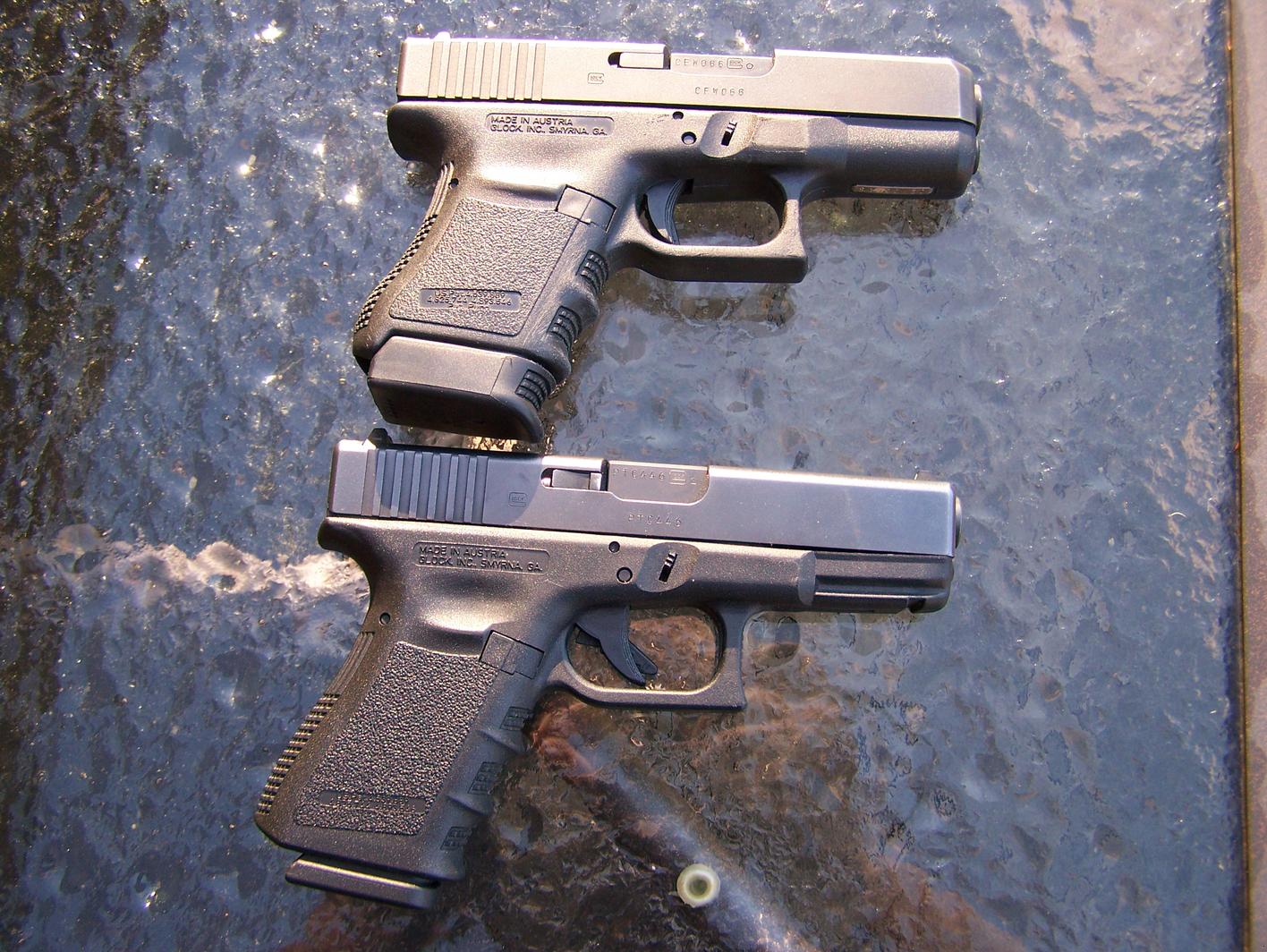
The Glock 30 is something of a step-child in the Glock line-up, and I don’t understand why. Yeah, the Glock 30 is a little bit chunkier than some of its siblings, but do we reject our siblings, spouses, children, or any family member simply because they are a little chunkier than us? I think not! The Glock 30 is 1.28 inches thick, depending on who you believe, whereas the very popular Glock 19 is 1.18 inches thick. That’s not really all that much difference between the two, when it comes down to it. However, the Glock 19 is a 9mm, and the Glock 30 is a .45 ACP.

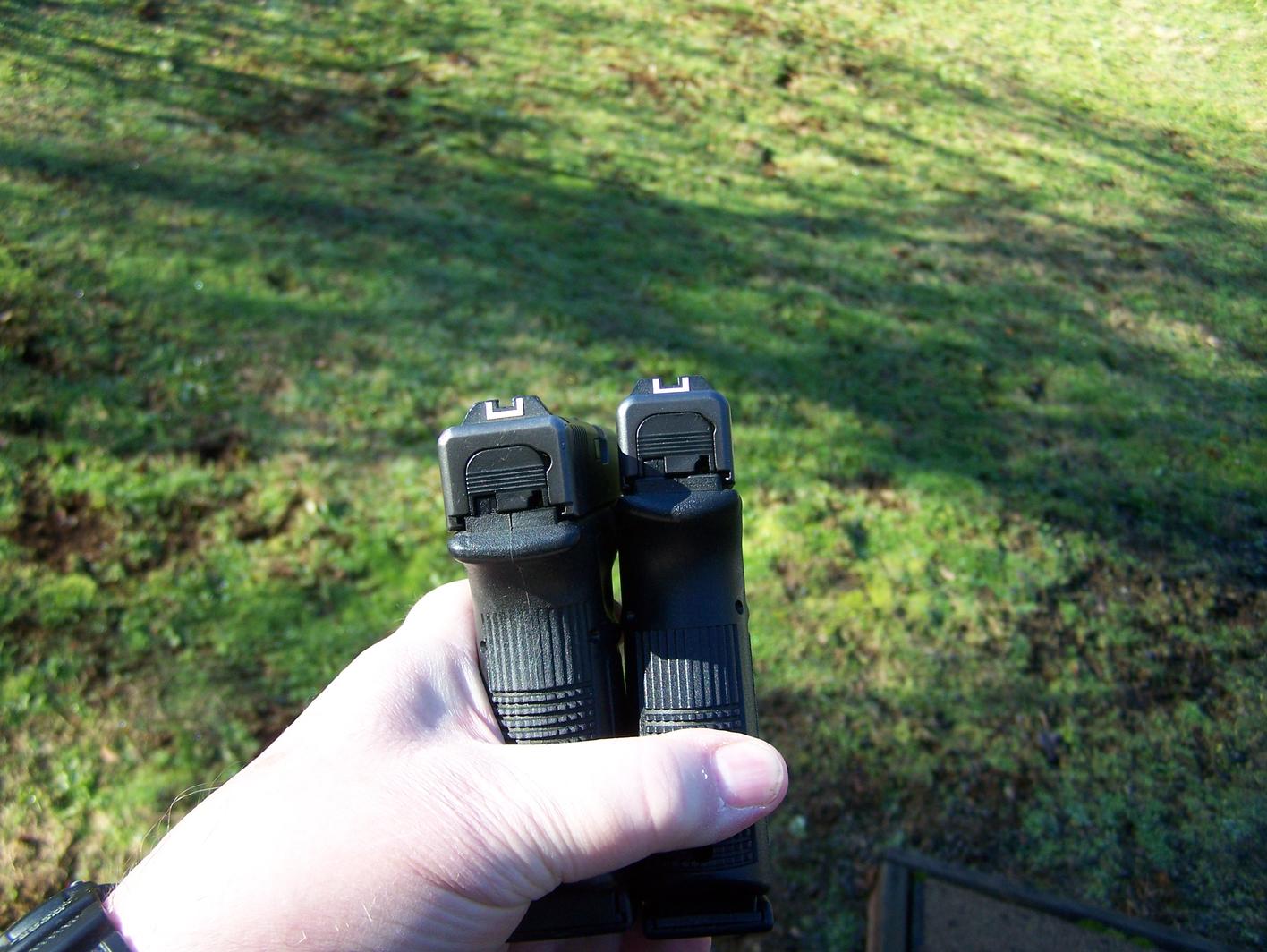
Where we find some differences is when we grip the two guns side-by-side. The Glock 19 is much thinner in the grip, front to back, making it feel a little thinner than the Glock 30. To many people, the difference is too much for their hands. I have large but not overly large hands, and both the 19 and 30 feel good in my hand. The 19 holds 15 rounds of 9mm, whereas the 30 only holds 10 rounds. When you place the two guns side-by-side, there really isn’t much visual difference. The difference lies in the way they feel. I’m a huge fan of the 1911 in .45 ACP and can shoot them extremely well and fast. The Glock 30, with the slightly wider and thicker grip area, really absorbs the recoil, even with the hottest loads. So, I can shoot it extremely fast and accurately, too.

The reason I’m comparing the Glock 19 and 30 to one another is because they really are similar in size. They just “feel” a little different in the hand. The overall dimensions are very close to one another in most respects though. The barrel length on the 30 is 3.78 inches. The 19 has a slightly longer barrel, ever so slightly. So, when it comes to concealing either gun, there isn’t that much difference, at least not to me. As an experiment, I had my wife slide the guns on my belt,using a Glock combat holster without my looking to see which gun she was putting on my belt. I honestly couldn’t tell the difference between the two guns on my belt. The 19 weighs 23.65 ounces empty, and the 30 weighs 26.98 ounces empty.100_6549
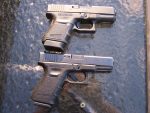
Now, there is a slight difference in the dimensions between the Glock 30 and the newer Glock 30S, and you can feel it in the hand if you have the guns side-by-side and repeatedly hold one and then the other. However, the difference isn’t that great, if you ask me. Iit just depends on how it feels to you. My wife is very big on how a gun feels in her hand. If it doesn’t feel just right, she isn’t interested in it. A gun that feels really good in her hand will be one that she shoots much better than one that doesn’t feel as good to her.

Of course, the Glock line-up of handguns all have polymer frames and a steel slide. The trigger pull is about the same, around 5.5 lbs for a standard model and slightly lighter on some target models. It is fairly easy to make the trigger pull lighter on a Glock, too. Everyone believes that Glock came out with the first polymer framed handgun, and that’s not true. It was H&K. Most Glocks have polymer sights, front and rear, with the front being a white dot and the rear has a white outline. They are fast to pick-up, not the best for target work, but more than good enough for combat work!100_6548
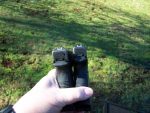
Anytime my local FFL dealer gets in a used Glock 30, they try to sell it fast by marking the price down, hoping someone will snap it up. Many people just don’t like the “chunky” feel to the gun. I’m not one of them, not when you hold it next to some of the other Glocks. The difference just isn’t all that much. And, as I stated, the 30 feels good in my hand. Also, being a little thicker side-to-side and front-to-back in the grip, the gun absorbs the recoil of the .45 ACP very well, thank you. Even the hottest P+ loads aren’t a problem for the Glock 30.

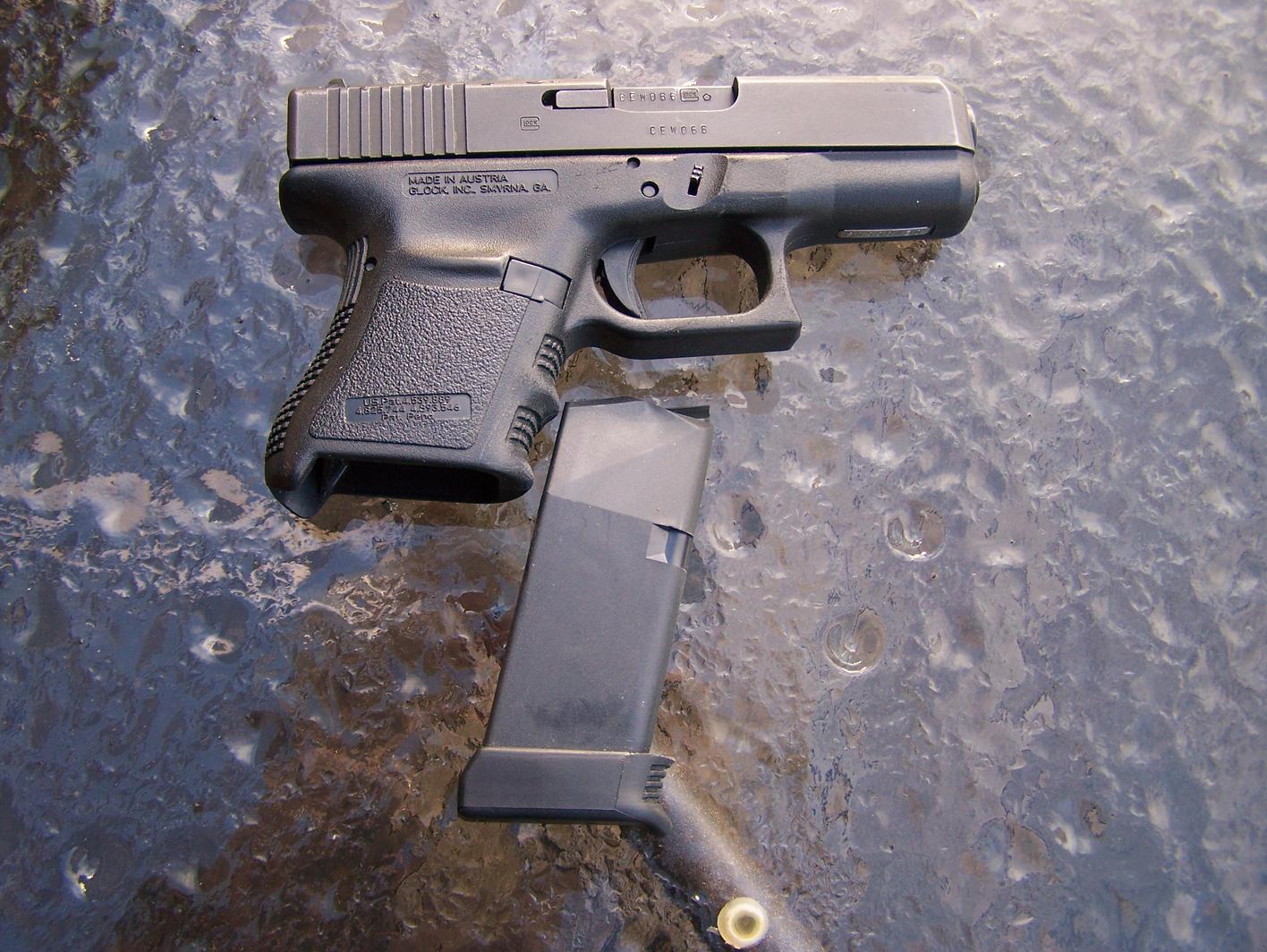
My Glock 30 was purchased used, and it had ejection problems. Someone played around with the ejector. I’m assuming that they wanted their empty brass to fall into one direction or one area and they bent the dickens out of the ejector. I was able to get it back to spec, but I ordered a new replacement. It took all of five minutes to replace it. The gun had been around the block with some scratches on the slide. It was probably dropped more than once. However, the gun was only $375. I know a deal when I see one, so a few scratches here and there weren’t of any concern.100_6545
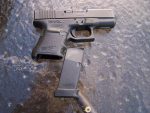
I’m not going to get into a debate over which caliber is “better”– the 9mm, .40 S&W, or .45ACP– and those are the main calibers most of us use for self defense. With today’s advances in JHP and bullet designs, all three calibers are good stoppers if the rounds are placed where they are supposed to go. I can often be caught carrying my Glock 26, because I like the compact size, and with the Glock +2 floor plates on the magazine that gives 12+1 rounds of 9mm on hand with a spare mag on my belt. Now, if pushed, in my own mind I know that the .45ACP is a better stopper. It just puts the bad guys down faster than the other two calibers do. How much faster? I’m not sure anyone has done a study on it. I just know in my mind that the .45 ACP puts the bad guys down faster, end of debate!

If I were tasked with going into a building that had armed terrorists in it and I could only carry a handgun, my first choice would be a 1911 in .45ACP. That’s how confident I am of the .45 ACP round to get the job done!

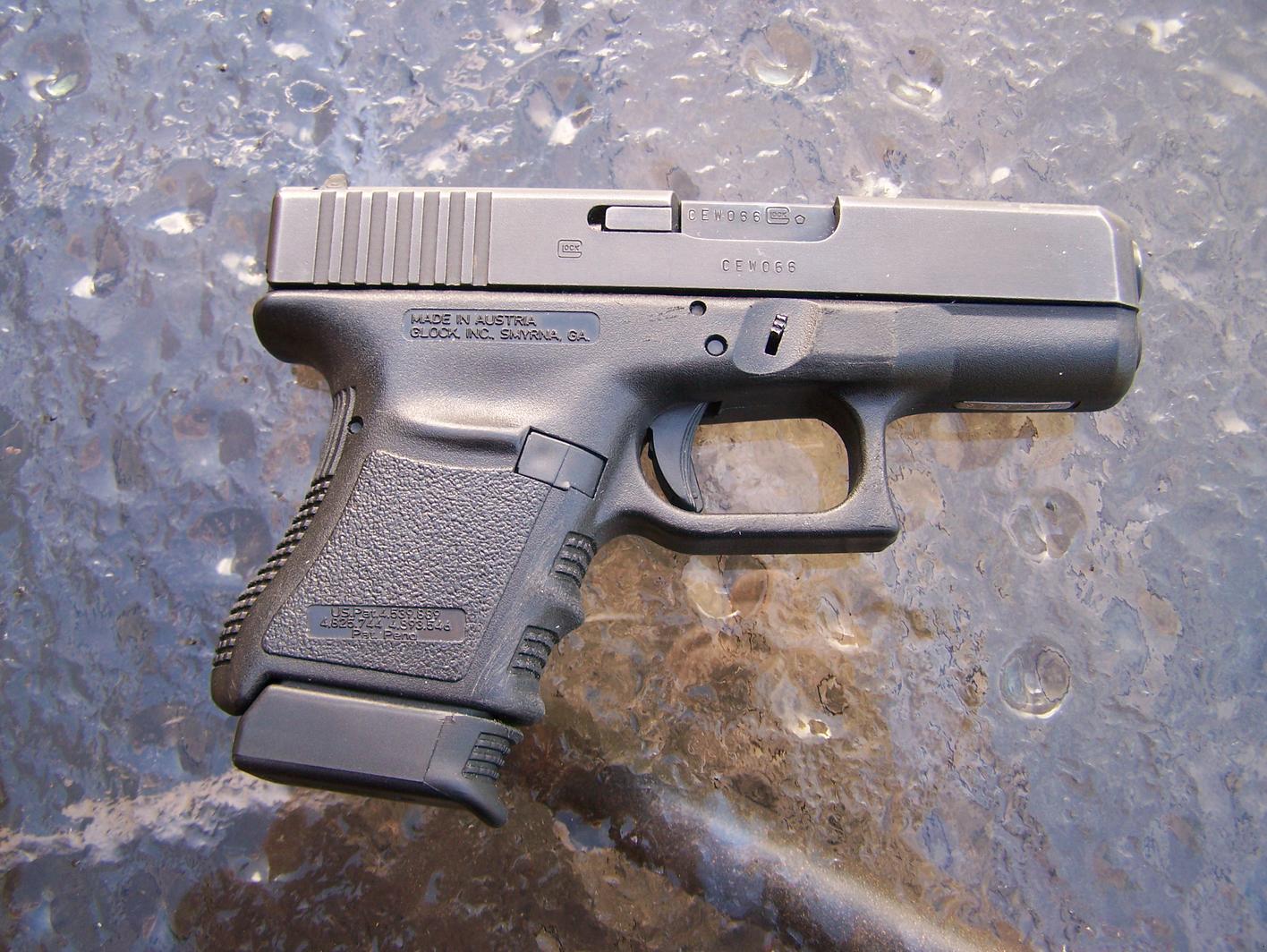
The Glock 30 has a magazine floor plate on it that is already “extended”, but I preferred the ones from Pearce Grip, which is a has a bit more of a “lip” on it for really holding my pinky finger on to it a little better. I also carry my Glock 30 in a Glock combat holster made of polymer, of course. It’s just hard to beat these skinny and super-thin holsters for concealed carry. To be sure, the combat holster for the Glock 30 is slightly larger than that of the other Glock combat holsters. The 30 won’t fit in the smaller holsters. It’s close, but there’s no cigar! How can you beat a holster that holds the gun tight and close to your body, will last for years, and only costs $12.95? 100_6540
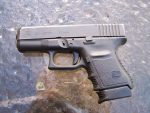
After replacing the ejector on my Glock 30, I had no ejection problems of any kind. I only had a few with the defective ejector. I had an outstanding assortment of .45 ACP on-hand, for testing, too. From Black Hills Ammunition, I had their 230-gr FMJ, 185-gr JHP, 230-gr JHP, 230- JHP +P, and their 185-gr Barnes TAC XP all-copper hollow point +P load. From Buffalo Bore Ammunition, I had their 255-gr Hard Cast Outdoorsman +P load, 230-gr FMJ FN +P, 185-gr JHP +P, 160-gr Barnes TAC XP all-copper hollow point +P, 185-gr Barnes TAC XP all-copper hollow point +P, 200-gr JHP +P, and their 160-gr Barnes TAC XP all-copper hollow point low recoil load.

Accuracy testing was done at 25 yards, resting the Glock 30 over a shooting bag on top of a rock. The short 3.78-inch barrel really performed. No groups were over four inches, and most groups were 3½ inches, and two groups were in a dead heat for best of day, at three inches, so long as I did my part. All shooting was done over a couple weeks, so some days I was on my game and other days my groups weren’t where they should have been. Tied for first place is the Black Hills 230-gr FMJ and the Buffalo Bore 230-gr FMJ FN +P loads. The Glock didn’t mind the hotter +P loads in the least, and the low recoil, standard velocity 160-gr Barnes TAC XP load from Buffalo Bore functioned 100%. I was a little worried about this one since the recoil spring on the Glock is a bit stout, but this load functioned perfectly. It’s a good load if you are a little recoil sensitive. 100_6539
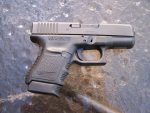
I looked around on the ‘net, and it looks like the Glock 30 is selling for around $500 new, and a little bit more for the 30S. If I were buying a brand new Glock 30, I guess I would opt for the 30S with the slightly thinner feel to it, front to back, in the grip area. However, there is nothing wrong at all with the 30. It may be a step-child in the Glock family, but it will hold its own against any of its siblings, if you ask me. If you want a compact .45 ACP handgun, though “compact” means different things to different people, then check out the Glock 30.

– Senior Product Review Editor, Pat Cascio



Recipe of the Week: Pan Roasted Chicken Thighs, by M.C.A.

Ingredients

  • 6 skin-on, bone-in chicken thighs (about 2.25 pounds)
  • Salt and pepper
  • 1 tbs vegetable oil

Directions:

  1. Preheat oven to 475°F.
  2. Season chicken with salt and pepper.
  3. Heat oil in a 12″ cast-iron or heavy nonstick skillet over high heat until hot but not smoking.
  4. Nestle chicken in skillet, skin side down, and cook 2 minutes. Reduce heat to medium-high; continue cooking
    skin side down, occasionally rearranging chicken thighs and rotating pan to evenly distribute heat, until fat renders and
    skin is golden brown, about 12 minutes.
  5. Transfer skillet to oven and cook 13 more minutes.
  6. Flip chicken; continue cooking until skin
    crisps and meat is cooked through, about 5 minutes longer.
  7. Transfer to a plate; let rest 5 minutes before
    serving

o o o

Useful Recipe and Cooking Links:

Recipe: Chicken and Wild Rice Bake

Swiss Cheese Chicken: A Must-Have Meal for Your Freezer & Food Storage!

Do you have a favorite recipe that would be of interest to SurvivalBlog readers? Please send it via e-mail. Thanks!


Letter: SurvivalBlog’s 185.8.177.142 Dotted Quad Backup Address

Greetings, Mr. Editor:
I just tried to log on to your new “backup” dotted quad address: 185.8.177.142 and my Firefox browser reported: “Your connection is not secure.”  Is it safe for me to ignore this message?  Thanks, Michael S.

JWR Replies: Yes, it is perfectly safe to set a permanent security exception for SurvivalBlog’s main site and for our dotted quad direct server address (185.8.177.142)  Please be sure to jot down this dotted quad address and carry it in your wallet or bugout bag, but please continue to use “survivalblog.com” URL for your bookmark that you use to check SurvivalBlog daily.  (This will help us keep aggregate visit statistics–and those are important for our advertisers to know what our traffic is and thus justify their continued advertising on SurvivalBlog.)


Economics and Investing:

Some quite bad news has come from an oft-cited “tax free” offshore haven: Vanuatu to impose their first ever payroll and income taxes—without any public comment. The plan is for a payroll tax, beginning in 2017, and then an income tax, beginning in 2018. Vanuatuan officials claim that the offsetting revenue generated by these new taxes will allow them to do away with the current rent tax and also to “reduce” import duties. They say that they also “hope” to eventually reduce the hated Value Added Tax (VAT), but they are making no promises. In sum, these new taxes make Vanuatu far less desirable as an offshore haven. (Up until this was announced, many Australians, Britons and Americans were willing to put up with Vanuatu’s fairly sucky gun laws, a hot and rainy climate, and frequent natural disasters, in exchange to live their lives tax free. But now, not so much.)

o o o

Bank of America Says We’re Experiencing ‘Peak’ Everything and a Major Market Change is Coming

o o o

We observe that the U.S. stock market is again approaching stratospheric heights: Shiller P/E – A Better Measurement of Market Valuation.  What goes up must come down.  In my estimation this is a good time to get out of most of your stock holdings, regardless of the outcome of the upcoming election!

o o o

SurvivalBlog and its editors are not paid investment counselors or advisers. Please see our Provisos page for details.