
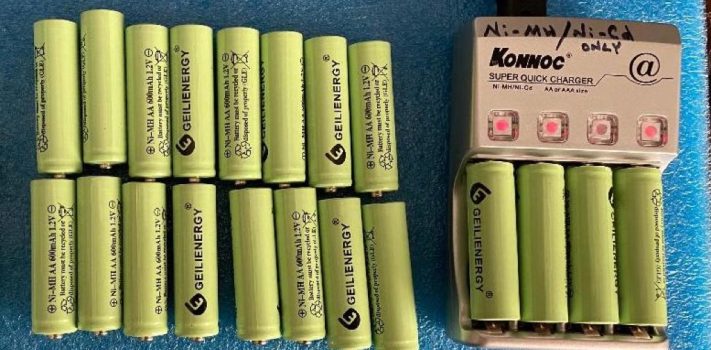


There have been many articles by myself and others on SurvivalBlog that discuss the use of mobile electronic devices such as radios, flashlights, cell phones, red dot sights, drones, cameras, etc. for emergency preparedness and disaster scenarios. The one thing all such devices have in common is that they require power of some sort, usually in the form of a battery, and without power those devices are about as useful as a paper weight (I guess you could use them as projectiles). Understanding how batteries work and how to best manage them can help ensure you get a long and useful life out of those critical devices.
A battery is basically a way to store electricity using chemicals and typically consists of three components – an anode, a cathode, and an electrolyte chemical that the anode and cathode are immersed in. The anode releases electrons, which flow through whatever device the battery is connected to and back to the cathode, creating an electric current. Simultaneously, ions move through the electrolyte from the cathode to the anode, which is a substance that allows ions to flow but not electrons, to balance the charge. This process continues until the chemicals within the battery are depleted, at which point the battery is considered “dead” and needs to either be disposed of or recharged.
Battery Capacity
When using mobile electronics you want to be able to operate them as long as possible without having to change batteries or recharge them – that’s where battery capacity comes in. Battery capacity is a measure of the total amount of electrical energy a battery can store and deliver – the higher the capacity the longer the battery can power your device. Capacity is typically measured in Amp-hours (Ah) or, for mobile devices, milliamp hours (mAh, which is one one-thousandth of an Amp-hour).
1000mAh battery can deliver 1000 milliamps to a device for 1 hour, 500 milliamps, for 2 hours, and so forth. It’s also possible to express a battery’s capacity using Watt-hours (Wh) or milliwatt hours (mWh), which is nothing more than the Ah or mAh value multiplied by the battery’s voltage. For example, a 300mAh AA battery delivering 1.5V has a value of 450mWh (300 x 1.5 = 450). Note that some manufacturers like to play a game of advertising milliwatt hours for their batteries instead of amp-hours because it’s a bigger number. So, when shopping for batteries make sure you’re comparing apples to apples.
To understand how long a given battery will run your device you need to know how many amps the device consumes while running. Most devices tend to vary their power consumption level while operating, depending on what functions they’re performing; for example, turning on the IR illuminator on an infrared night vision device would cause it to consume more power. A few manufacturers provide ‘average’ power consumption numbers in the specifications, which allows you to very roughly estimate how long a given battery would run your device. For example, if a manufacturer claims their device consumes 100mA, a 1000mAh battery could theoretically last 10 hours, but reality is never that neat.
I know this may come as a shock, but many manufacturers (especially those from a certain Asian country) exaggerate their battery capacity by using theoretical calculations or testing under ideal lab conditions that they control, while others just make numbers of out of thin air. This is a common problem with 18650 batteries – manufacturer specs range from 2000mAh to over 9000mAh, but they’re all the same size and use similar chemistries, so you should take the 9000mAh claim with a grain of salt. A realistic maximum range for an 18650 battery using current technology is around 2500–4000mAh.
Note that it is possible to measure the actual storage capacity of a battery fairly accurately, which involves connecting a fully charged battery to a battery capacity measurement device that simulates a device load on the battery and measures how long it takes to run down. If you’re going to be working with a lot of rechargeable batteries I highly recommend you get something like the DL24 battery capacity tester (and an add-on battery holder) and learn how to use it. I always test at least one rechargeable battery from each group I buy to understand it is actual capacity and see how close it is to what’s advertised. Note that you can also test single-use batteries, but that’s obviously going to make the one you test useless afterwards. If you buy a package of off-brand single-use batteries I recommend you test one sample battery to see what you’re actually getting.
You may be thinking ‘if testing battery capacity is so complex, then how do all of those electronic gadgets know which red/yellow/green LED to light to show me how much battery is left?’. It’s simple – they only check the voltage level. Most batteries have a fairly flat discharge rate, meaning the voltage drops fairly slowly as it’s used until it’s nearly discharged, then the voltage drops quickly. Most electronic devices can operate on a range of voltages – for example, a device the uses a ‘nominal’ 1.5V AA Alkaline battery can usually operate on any voltage from 1.65V down to 1.15V, depending on the specific device. Small circuits inside the device manipulate the voltage coming off of the battery to the voltage level the device requires. Devices with some kind of battery level display are usually measuring the voltage to determine how much power the battery has remaining. Below is a table showing the typical nominal and 100%-50%-10% voltage levels for some common battery types (more on type later).
Battery Voltages
| Type | Nominal | 100% | 50% | <10% |
| Alkaline | 1.5V | 1.60-1.65V | 1.35 – 1.39V | 1.15 – 1.19V |
| NiCd | 1.2V | 1.4V | 1.22V | 1.08V |
| NiMh | 1.2V | 1.4V | 1.2V | 0.9V |
| Li-ion (generic) | 3.7V | >3.8V | 3.26V | <3.0V |
| LiNiCoMnO2/LiPo4/LiCoO2 | 3.7V | 4.2V | 3.35V | <2.5V |
If you’re not comfortable with the complexity of a full-blown battery capacity tester, then I recommend you at least get a decent battery voltage tester like the ANENG DL-168 Pro so that you can estimate the remaining power in your cylindrical batteries using the table above.
Types of Batteries
There are two broad categories of batteries – primary (aka single-use) and rechargeable ones. Primary batteries are assembled in a charged state, and the most common types are cylindrical (e.g. AAA, AA, C, D, etc.) and provide 1.5V per battery, with the exception of 9V rectangular batteries. Chemistries for primary batteries include alkaline, lithium primary, zinc-carbon, and nickel oxyhydroxide, with alkaline being by far the most common (e.g. Duracell, standard Energizer, etc.) Note that lithium primary batteries are available that typically use a Lithium Manganese Dioxide (Li-MnO₂) chemistry and are not rechargeable. Alkaline primary batteries have historically suffered from leakage over time as the hydrogen gas produced by the internal chemical reaction builds up pressure, causing the battery casing to rupture, but newer materials allow for alkaline batteries that can be stored for 10-15 years with minimal loss of power and no leaking. Companies like Energizer produce 1.5V Lithium AA and AAA primary batteries that claim a 25-year shelf life with no leakage. The most common form factor for removable mobile electronic primary batteries is cylindrical, although small disc-shaped ones, commonly called ‘button cells’ are also used sometimes.
Like cylindrical primary batteries, button cells also come in a number of different sizes and chemistries. Common sizes include CR1220, CR1254, CR1620, CR2025, CR2032 and CR2045, with the first two digits referring to the diameter in millimeters and the second two referring to the thickness – a CR2032 battery is 20mm in diameter and 3.2mm thick. Common button cell chemistries include:
- Alkaline: Typically used in low-drain devices, such as watches and calculators. They have a voltage range of 1.5 to 1.6 Volts and a capacity range of 50 to 150 milliampere-hours (mAh).
- Lithium: Commonly used in high-drain devices, such as digital cameras and electronic toys. They have a voltage range of 3 to 3.6 Volts and a capacity range of 40 to 240mAh. Note that some companies do make 1.5V lithium primary button cell batteries.
- Silver oxide: Commonly used in medical devices, such as hearing aids and pacemakers. They have a voltage range of 1.5 to 1.6 Volts and a capacity range of 20 to 100mAh.
- Zinc-air: Commonly used in hearing aids. They have a voltage range of 1.4 to 1.45 Volts and a capacity range of 50 to 130 mAh.
(To be continued tomorrow, in Part 2.)