


(Continued from Part 1. This concludes the article.)
I decided to try raised garden beds, and I’m three years into it! When people purchase and store seeds for their apocalypse garden should they need it one day, I laugh. You could starve before you ever get a good garden going. Unless, you happen to be sitting on perfect and fertile soil.
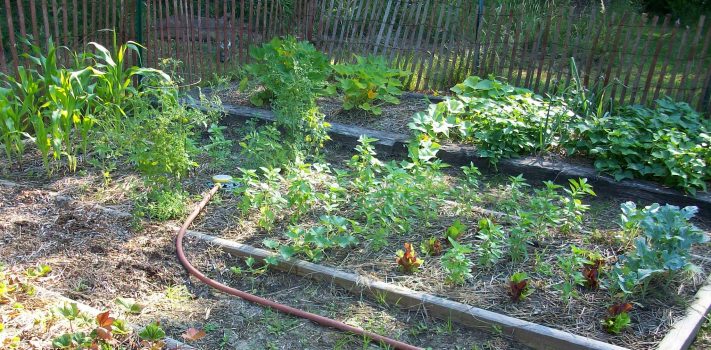
Raised garden beds
In my case, I had to hire the help to build all the beds, transport barn compost from another area of the farm to the beds, and pay for composted “top soil” to be delivered. Some of the beds were filled part way with old wood to fill up the space; some were filled with old hay, but most of them were filled with barn compost. If I had the ability to do that work myself, I could have saved a considerable amount of money. However, the barn compost was sitting on the other side of the farm and had to be moved up a hill and across pasture to the garden. A tractor, which I do not own, was needed.
My reasoning for spending all that money is that it would enable me to maintain the garden by myself for a long time, as I aged, and grow a lot of food… I hoped… if I could just get it right. It seemed like a good investment.
I hated putting that much money into the garden year after year and then fail at gardening. I hoped that raised bed gardening would change the dynamics for me. I am gettin’ old y’all! For example, bending down is painful, and getting down on my knees is very awkward, as is trying to get back up. And oh, my knees! Gardening had become like an Old Folks Comedy Show. Conversely, weeding the raised beds takes 10 minutes in the morning by quickly walking through the garden and pulling the weeds. No raking, hoeing, shoveling, or bending over. Blessed relief. It has made gardening possible for me, as my body struggles to do what it once did.
With everything finally in place, I planted, and planted, and planted.
One thing I noted early on was that the soil/compost in some of the beds was very high in nitrogen causing plants to grow tall and full, but not much going into “fruit” production. In some of the beds where I planted potatoes of various types, the plants were several feet tall and full, but the potatoes were small. In some other beds, the soil composition must have been close to perfect because I harvested a couple hundred pounds of potatoes. The radish plants did the same. By the looks of the plants, the radish and potato harvest would be bountiful. The radish plants grew tall and full with tiny little, skinny, radishes attached. I ended up feeding most of the radish plants to the chickens, but kept the small potatoes. You can’t feed potato plant leaves to animals because it is toxic.
The fix for high nitrogen is to add carbon to the soil, so on the next go round I will mix in to the soil pine chips, sawdust, or mulch. The other option is to grow “nitrogen binding” plants in the soil, such as squash, corn, cabbage, or broccoli. Those plants may not produce well, but they will help suck up the excess nitrogen (note to self). I’m still learning and trying to figure this out. For Spring 2026, I topped all the garden beds with a soil and mushroom compost mixture. I also mulched the beds with “carbon” in the form of hay and pine chips. That seems to be working. So far, everything I’ve planted is growing!
Garden Experiences – some good, some bad
I did not spend the time to properly mix the soil and compost that I put in the garden beds. It was just a free-for-all, let’s get those beds filled as soon as possible! As a result, some beds were very high in Nitrogen and others were not. The good news is that as the raised bed soil/compost “settles”, I can add properly balanced soil/compost to the top, and keep going. No harm, no foul.
I was very excited when things started to grow. I enjoyed various lettuces, radishes, strawberries, blueberries, zucchini, squash, potatoes, and then the bugs moved in…. The squash bugs decimated all of the cantaloupe, winter squash, pumpkins, what remained of the summer squash, but for some reason the squash bugs didn’t bother the watermelons. And I also planted Virginia peanuts as an experiment, and they did very well.
I tried numerous methods for killing the squash bugs and I was not successful. At one point I used at least 10 pounds of diatomaceous earth, covering the plants and soil. The squash bugs seemed impervious, like little armored vehicles. They came in like the plague, too numerous to deal with, and devastated bed after bed of vegetables. I have researched more and feel that I might be able to conquer them in 2026 using a combination of methods. One such method is to plant late in the season for plants that are subject to squash bugs. Let those bugs come and go, then plant. Our season is long enough to do that fortunately.
Another problem in the garden was that there was not enough watering going on to combat our hot summer months. I had not constructed a watering system, and was just using a long garden hose. In 2025, the hot weather started here in May after an extremely wet Spring. And it continued through September. It remains to be seen what kind of weather the summer of 2026 will bring.
A downside of raised beds is that the soil drains much quicker than if it were on the ground. Things like tender tomato plants, cucumbers, carrots, peppers, etc., could die in a day, and they did. We had months of 90-100 degree, and 90-99% humidity, weather. If you’ve ever done farm chores in that kind of weather, you know how miserable it is. I tried to get outside earlier and earlier each day. As soon as the sun starting peeking over the hills, I was out doing chores, and then again right before dark.
After feeding animals, milking cows, and doing regular chores, I was dripping head to toe in sweat, and became quickly overheated. The previous summer I had experienced heat exhaustion, and one time was very close to heat stroke, so I monitor myself more closely. I had to get out of that heat and into the air conditioned house to cool down after morning chores. A drip system could have helped with the watering problem, but I haven’t quite figured out how to do that with curious dogs who like to chew on things and drag them around. If I close up the garden to keep the dogs out, there is no vermin control. Hmmmm… I still have not solved that problem.
Utilizing the space
Half of the garden is raised beds with wide paths in between. Ostensibly to get a mower or wheelbarrow through the rows. Currently, there is vinyl ground covering under all the beds, but this Spring I pulled up all the remaining vinyl in the pathways, and seeded the bare ground with a cover crop that can be easily mowed. The original plan, was to cover the vinyl with either gravel or wood chips for a nice, neat, effect. But, all it takes is for a break or tear in the vinyl for the native plants to come up and things get messy fast. Leaving that vinyl down for an entire year effectively killed off the native plants and their root systems. The new growth, neatly mowed, is more effective and looks nice.
In one section of the garden, I planted numerous young fruit and nut trees, 6ft apart, for an intensive orchard. I chose Cherry, Apple, Pear, Plum, Pecan, and Fig. It gets too cold here for Peaches, which are my favorite. I selected 2-3 year old trees, and this Spring the cherry trees are loaded with fruit, and the fig trees look dead. Between the orchard and the raised beds, I planted a long row of thornless blackberries and raspberries, with plenty of room to mow around everything.
Plants that take up a lot of space, such as pumpkins, winter squash, various melons including watermelon, do well in raised beds, but they vine out so profusely that they spill over the raised beds and travel along the pathways. I really thought I had the space figured out, but what I lacked in knowledge was how various plants grow and their space needs, along with what pests they are subject to. I haven’t quite figured that out yet.
What I’ve learned so far
Maybe one large garden is not the answer. Maybe numerous smaller gardens in various locations would be better. But, this is what I have, so this is what I’ll work with. I realized that planning out a farm takes some flexibility, as well as long term thought.
I never thought I would start with one dairy cow and end up with 7 cows, 2 designated for beef, and 5 for dairy. Five cows will calve annually, quickly bringing the numbers up, and so on. The cows are my priority because they provide the most protein in the form of all things dairy and beef. When the calves come, I sell the heifer calves, and raise the bull calves for beef, so there are ever changing numbers of cows at any given time. They need space, not just for grazing, but for times when they need to be separated.
Semi-related to the garden, is the fact that the main barn was built by the previous owners at the bottom of a field. It floods every Spring, although it has been remediated, so we’ll see what happens this year. The compost pile from barn clean outs, sits off to one side, but it is a long distance from the garden. It is still more cost effective for me to hire a neighbor to move the compost than to buy a tractor, so that’s what I plan on continuing. That compost will feed the garden beds for a long time, even if the beds need to be topped off periodically with purchased organic compost.
I absolutely love the convenience that the raised beds have afforded me. There is no hoeing, bending over, or getting down on my knees. I need to do better with soil composition and remediation. I need to figure out a better watering system. And of course, how to combat the squash and potato bugs before they get out of control.
On a positive note, the new garden brought in a lot of pollinators. There is no shortage of honey bees and butterflies. I was able to harvest enough potatoes for the year, plenty of summer squash and lettuces for fresh eating, some berries, onions, pumpkins, peanuts, etc.
I do not regret the move to or expense of raised beds. But, I still have a lot to learn on a number of fronts. I am slightly jealous of people who can just plant right into the ground. It is a common custom here to hire a neighbor to come plow a “plot” for gardening season. That obviously didn’t work for me. It could be that because of where I live, on the top of a rocky hill, the surrounding woodlands, and the fact that there was not an existing garden to work with, that this is just how it goes when converting raw land into a garden. It is also true that my refusal to use herbicides or pesticides makes planting at this location exceptionally difficult. I’m actually excited to grow food this Spring. It seems like the hard work and mistakes are paying off. I will keep going, solving problems, remediating, and growing food.