


“As the twilight drew on, [the dog’s] eager yearning for the fire mastered it, and with a great lifting and shifting of forefeet, it whined softly, then flattened its ears down in anticipation of being chidden by the man. But the man remained silent. . . . [The dog] caught the scent of death.” (Jack London, “To Build a Fire”).
Fire is important. It is so important that I recommend carrying at least three different tools for starting a fire while in the field. I recommend that one of these tools be a ferrocerium (ferro) rod.
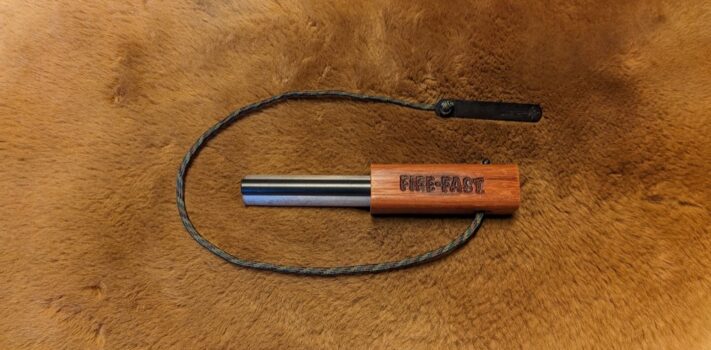
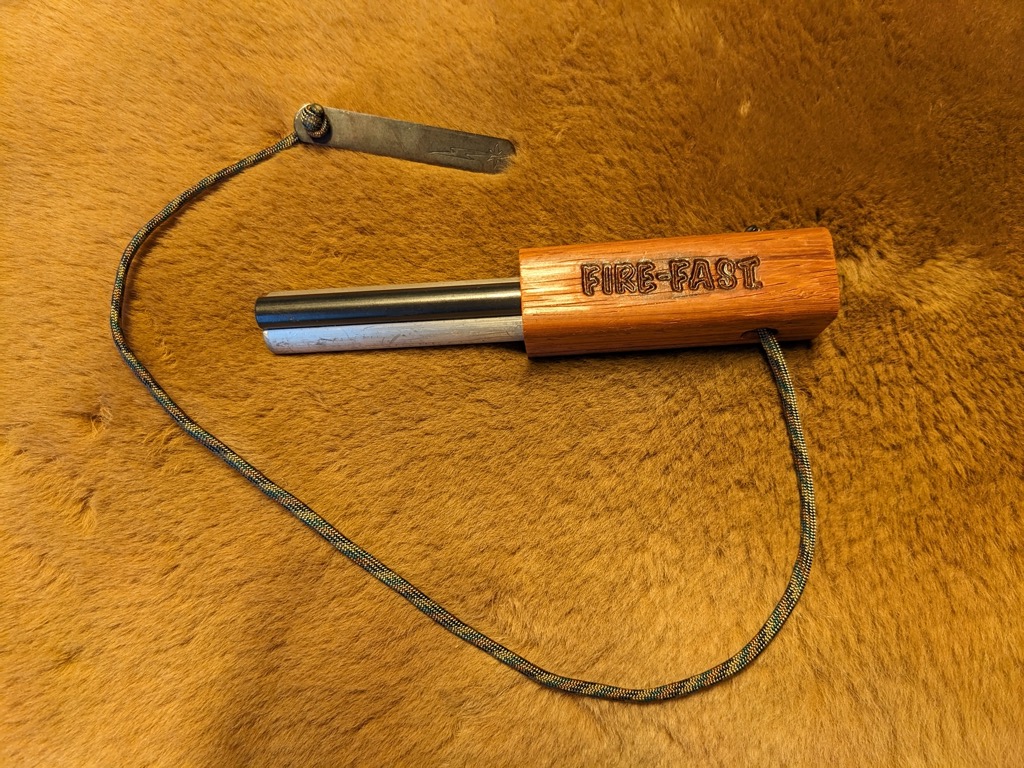 The Fire-Fast Trekker Fire Starter elevates the basic ferro rod concept to a new level. The Austrian-made ferro rod provides a heavier shower of sparks than the typical Chinese-made rod. The ferro rod component of the Trekker is three inches long and 0.38 inches thick. The ferro rod is integrated with a magnesium rod in order to provide tinder if necessary. The magnesium rod component is three inches long and 0.5 inches thick.
The padauk wood handle provides still another potential source of tinder. It will ignite even after being immersed in water. The handle component is 3.38 inches long and between 1 and 1.25 inches thick.
I found the Trekker to be an extremely effective fire starter in my testing. I highly recommend it.
Warning: Even the best equipment may not be able to overcome poor fire-starting technique. It is important to practice with the Trekker under a wide variety of conditions so that you are proficient in its use when you need it.
Full Disclosure: Siege Stoves and Siege Belts is an advertiser on SurvivalBlog.com.
At the time of this writing, the Trekker cost $38.95 at SiegeStoves.com. Full Disclosure: Siege Stoves and Siege Belts is an advertiser on SurvivalBlog.com.
The medium-sized Kamper cost $33.95 . The compact FireFly cost $28.95. I recommend that you just go ahead and get the Trekker, since it is the best value for the money.
Background
Fire is warmth and light and a hot meal. It is a wonderful servant and a terrible adversary. As mentioned above, while in the field it is wise to carry at least three different tools for starting a fire. These tools may include matches (waterproof, strike anywhere, strike on box), lighters (butane, Zippo, plasma, permanent metal match), flares, Fresnel lens, battery and steel wool, flint and steel, bow drill, fire piston, etc. I recommend that at least one of these tools be a ferro rod. Ferro rods are weather resistant, have a great shelf life, are durable, and are reliable.
One potential drawback of ferro rods is that they produce sparks rather than open flame. They require a source of reliable tinder in order to convert sparks into flame. Unless one is in an area rich in natural tinder like birchbark, it is advisable to carry a supply of water-resistant tinder in addition to the ferro rod.
The magnesium rod and padauk handle of the Fire-Fast Trekker Fire Starter provide a supply of water-resistant tinder. By doing so, they greatly enhance the effectiveness of the ferro rod component of the Trekker.
In the past I have found both Siege Stoves and Siege Belts to be effective pieces of gear. So when I found out that Siege Stoves and Siege Belts was sending me a Fire-Fast Trekker Fire Starter to review, I eagerly looked forward to its arrival. Before long a 9.5 x 5.5 inch black plastic envelope arrived in my mailbox via USPS Ground Advantage from Siege Belts, 1922 Tire Valley Blvd., Unit 2021, Walnut Creek, CA 94595-5002.
First Impressions
Inside some protective paperboard padding, the envelope contained two items: a SiegeBelts.com/Siegestoves.com decal and a resealable plastic bag containing the Trekker.
The plastic bag with the Trekker also contained a paperboard backer with some helpful information printed on it:
–The Trekker is made in the USA.
–There is a QR code to demo videos on Fire-Fast’s YouTube page.
The paperboard backer also contains a set of instructions:
1. To light tinder: Place the striker at the top of the flint at a 45-degree angle (downward). Put pressure on the striker and grind it down the length of the flint. Angle the shower of sparks directly into the material you are going to ignite.
2. Shavings from the magnesium rod can be used as tinder. For emergency use, the handle can be scraped for dry tinder.
Goldenrod Heads
I had previously discovered that dried goldenrod heads provide an outstanding source of tinder in the autumn. The fluff catches the spark and produces the initial flame. The dried stalks then catch and provide an excellent intermediate tinder between the fluff the fine kindling provided by small dry twigs.
I was now wondering if goldenrod heads that had stood through the snows of winter and the rains of spring would be equally effective. So I collected a half dozen or so wizened goldenrod heads from the marshland that abuts the edges of our driveway. I brought the material into the pole barn for testing.
I wore a bug jacket because the mosquito season was in full bloom. A persistent buzz provided the background music for my experimentation.
I placed a couple of ceramic tiles on my work bench and then covered them with an old cookie sheet.
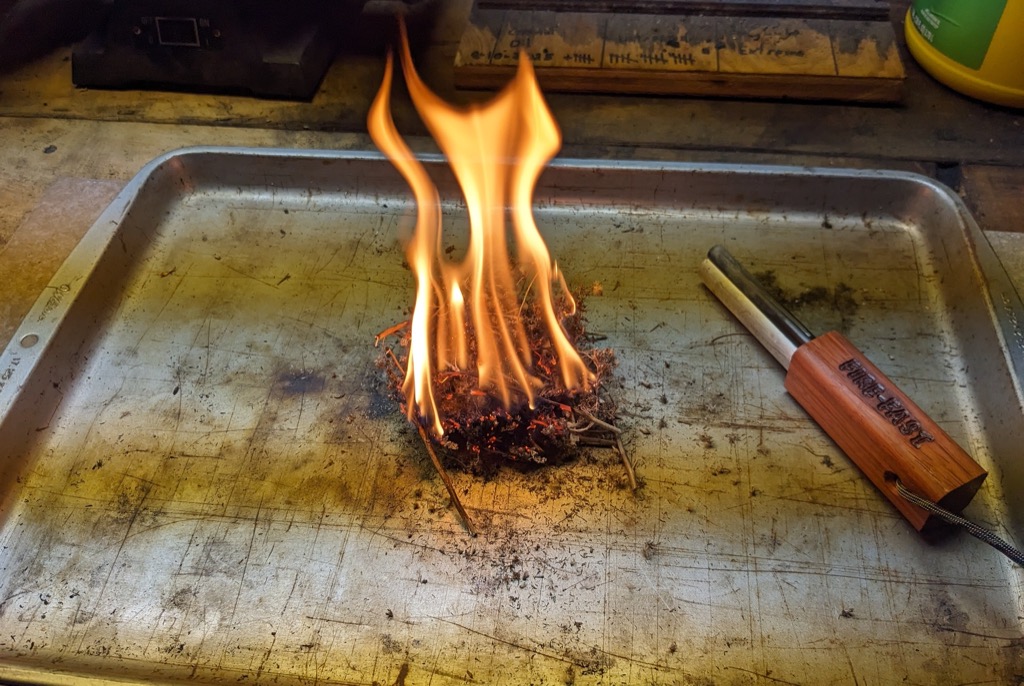 I then took a couple of goldenrod heads, rolled them into a ball, and placed them in the middle of the cookie sheet. I then put the end of the Trekker near the ball of material and scraped the ferro rod component with the striker. A generous shower of sparks erupted from the ferro rod onto the goldenrod ball, causing it to ignite. The goldenrod ball then burned steadily for several minutes.
I was more than satisfied with dried goldenrod heads as tinder. It is now ranks up near birchbark in my estimation as a favored source of natural tinder.
Dandelion Fluff and Dried Grass
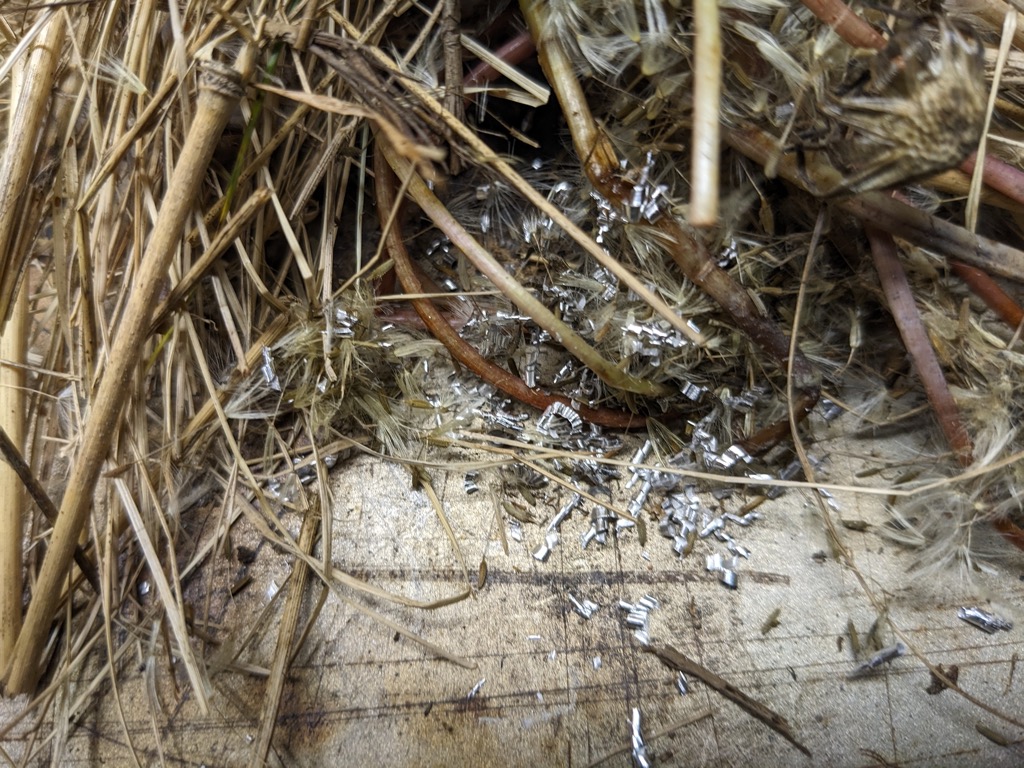 I collected a dozen or so fluffy dandelion heads from the lawn. I also collected some dry grass to provide an intermediate tinder between the dandelion fluff and small dry twigs. Grass that has dried on the root is reputed to burn effectively, while grass that has dried after cutting is reputed to not burn effectively. I collected grass that had dried on the root.
 I took the dandelion heads and dried grass to the pole barn, made them into a ball, and placed them in the center of the cookie sheet. I was unable to ignite the combination in spite of the excellent shower of sparks provided by the ferro rod. I added some magnesium shavings. The magnesium shavings caught, but not the dandelion fluff or the dried grass. I added more magnesium shavings and tried again. I failed once again. I decided that I was not impressed with dandelion fluff and dried grass as tinder.
Damp Wild Cherry Shavings and Twigs
I grabbed a small wild cherry stick. It was damp from heavy rains earlier in the day.
I carved some shavings from the stick with my EDC knife. Sparks from the ferro rod were not sufficient to ignite the shavings.
I added some magnesium shavings. It almost worked, but not quite. I tried again. Strike two. I gave it one more try. Strike three.
I added some shavings from the padauk-wood handle. This was more promising, but it just could not sustain a flame in the damp cherry wood. I cut more shavings from the handle with my EDC knife. I split larger cherry twigs with my EDC knife to expose the less damp interior. I used a ball of goldenrod, which burned well. But there was just not enough heat to cause the damp cherry twigs to catch.
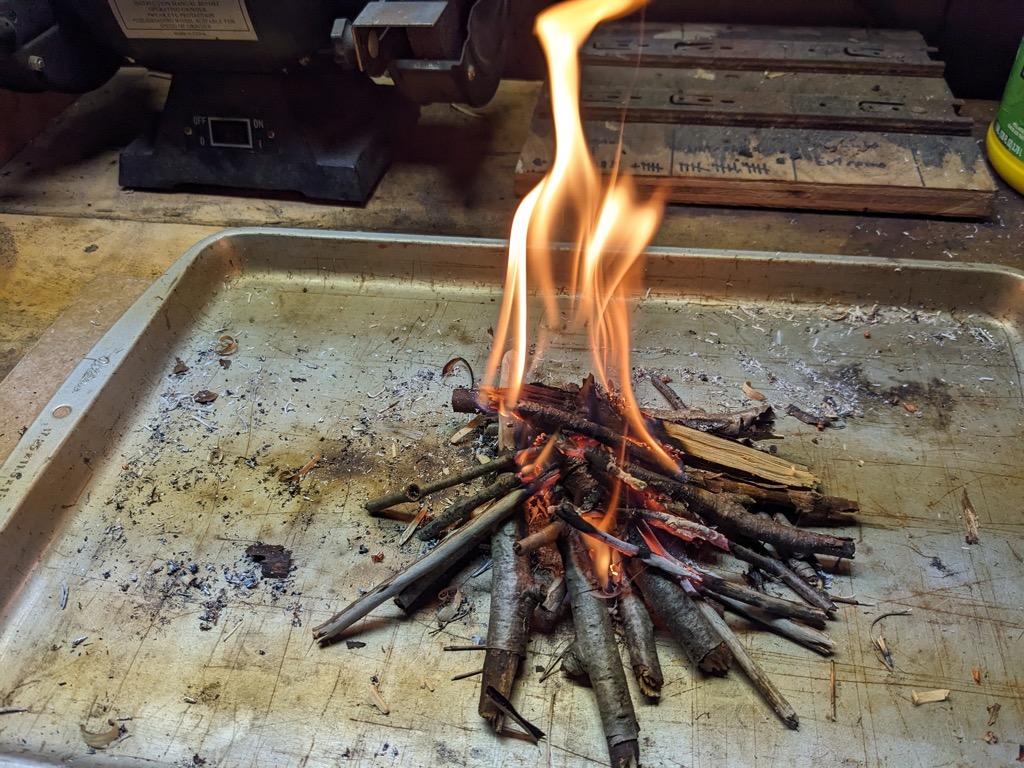
I then pulled out one of my home-made, water-resistant fire starters. It was easy to ignite that with the ferro rod of the Trekker. It burned long enough and hot enough to get the damp twigs burning. Soon I had a cheery little fire going.
I concluded that even good gear cannot always compensate for poor technique.
Dry Pine
Next I tried a block of dry pine. I cut shavings from the edges, and then split some pieces off with my EDC knife. Sparks from the ferro rod alone were not sufficient to ignite the shavings, but they caught easily with the help of some shavings from the magnesium rod. Soon I had a dandy fire going.
Camping
I want on a camping trip with my wife, “Kari”, our daughters “Ella” and “Rivka”, Ella’s husband “Samwise Gamgee”, and their children “Cicero”, “Earnest”, and “Ginger.”
During the trip I kindled campfires to cook our supper on several occasions. I also kindled fires to make s’mores and to warm us up on a cold morning. Ella and Sam used coals from one of the fires to bake a birthday cake for Rivka in a Dutch oven. I kindled all of the fires using the Trekker. It worked great, providing a powerful shower of sparks every time.
Conclusions
The Trekker is an excellent tool, but wood selection is also vitally important. Pine catches more easily than most hardwood, and dry wood is infinitely easier to ignite than damp wood. Even an outstanding fire starter cannot overcome poor technique.
If I ever find myself cold and hungry in a hardwood forest in a rainstorm without much natural tinder, I am probably in trouble. But my odds are much better with a Fire-Fast Trekker Fire Starter than with a standard ferro rod. My odds are even better if I also have some home-made, water-resistant tinder on hand for just such an emergency.
Disclaimer
Siege Stoves and Siege Belts provided me with a sample of the Fire-Fast Trekker Fire Starter for testing and evaluation. They had previously provided me with sample of a Siege Stove and several Siege Belts for earlier reviews. I tried not to allow their kindness to interfere with the objectivity of this review, and I believe that I have succeeded. I did not receive any other financial or other inducement to mention any vendor, product, or service in this article.