Update: Critical Capabilities for Retreat Defense: “Move, Shoot, and Communicate”

JWR’s Introductory Note: This is an update to an article that I wrote for SurvivalBlog in December, 2005. It is part of a series of SurvivalBlog 20th Anniversary update re-posts, in recognition of the fact that the majority of readers did not join us until recent years. — As an Army officer, I learned that in order to be effective, any army must have three key abilities: To move, shoot, and communicate. Take away any one of them, and you are ineffective. But if you get all three right, and you can absolutely devastate an opponent–even one that has superior …


Rebuilding an Old Vehicle as a Daily Driver – Part 3, by Lodge Pole

(Continued from Part 1. This concludes the article.) Electrical I keep a variety of spare fuses on hand in the glovebox. Fuses are cheap and do not go bad if kept dry. I also keep a voltmeter in the glove box. Ensure the cigarette lighter works. Replacing a cigarette lighter plug is simple. Having an operable lighter plug can mean the difference of not only being able to pump up a flat tire, but also preventing hypothermia. If you are stuck in the backcountry, a cigarette lighter can be used to start a fire. The factory battery cables mounted to …


Rebuilding an Old Vehicle as a Daily Driver – Part 2, by Lodge Pole

(Continued from Part 1.) Transmission The truck has a three-speed automatic transmission with a manual 4×4 transfer case. As much as I love driving a standard, manual transmission, the ease and comfort of an automatic is preferred for the places we go, and how we use the truck. Standard vs. automatic transmission is completely personal preference. Both have advantages and disadvantages. Use what works best for you and your lifestyle. I keep a quart of Automatic Transmission Fluid (ATF) in the truck box at all times. Dump bed and Greaseable Fittings All of the hydraulic lines are original from when …


Rebuilding an Old Vehicle as a Daily Driver – Part 1, by Lodge Pole

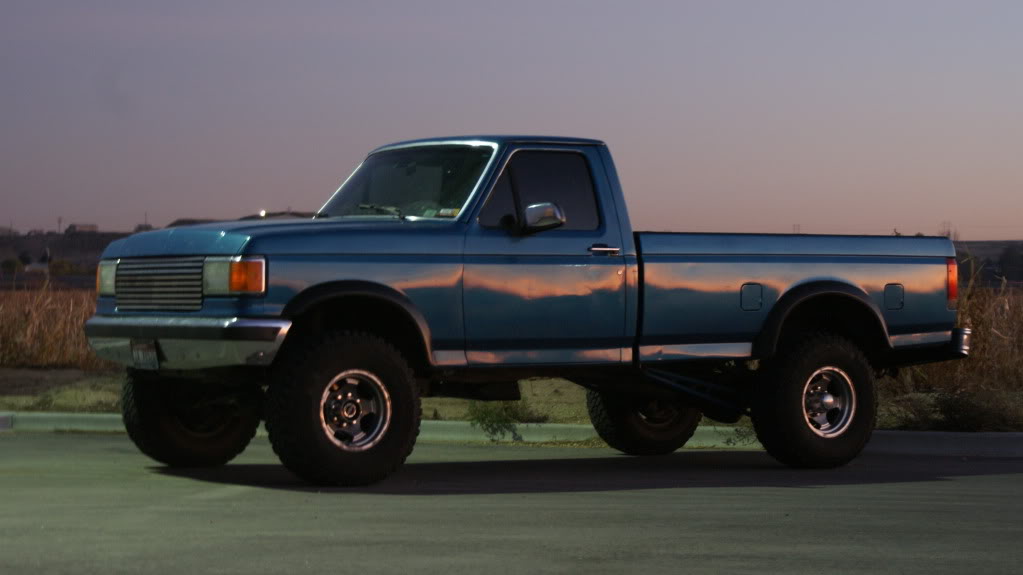
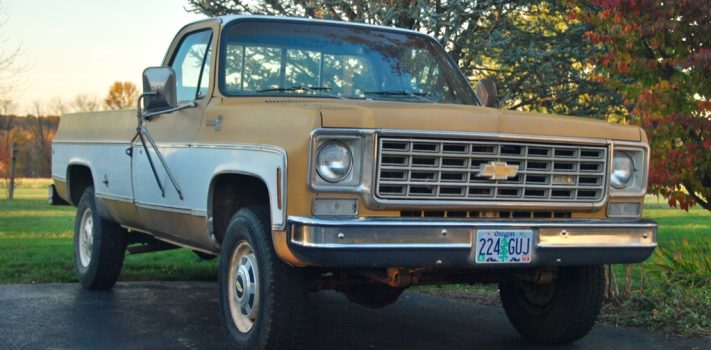
In 1975, for the first time in his life, my grandfather, who was a Great Depression era child, splurged and ordered a brand-new vehicle from the factory. It was a 1976 Chevrolet Silverado K20 4×4. (Aside from the color, it looks a lot like the one pictured above.) This piece of machinery was his pride and joy until the day he passed away. Shortly after he picked it up from the dealership, he had a dump bed installed. He wanted it to look stock, and still have the usefulness and functionality of a standard bed, so he hired a fabricator …


The “Come as You Are” Collapse–Have the Right Tools and Skills

Introductory Note From JWR: This article is an update and small expansion to a succinct post that I made back in February, 2008. When the Second World War broke out in September, 1939, the United States had nearly two full years to ramp up military training and production before decisively confronting the Axis powers. In the mid-1970s, looking at the recent experience of the 1973 Arab-Israeli War, the Pentagon’s strategic planners came to the realization that the next major war that the US military would wage would not be like the Second World War. There would not be the luxury …


SurvivalBlog Readers’ & Editors’ Snippets

Our weekly Snippets column is a collection of short items: responses to posted articles, practical self-sufficiency items, how-tos, lessons learned, tips and tricks, and news items — both from readers and from SurvivalBlog’s editors. Note that we may select some long e-mails for posting as separate letters. — SurvivalBlog reader Tim J. suggested this video: The Insane Number of Humvees in US Inventory. JWR’s Comments:  Once all those thousands of HMMWVs (“Humvees”) are inexpensively released as surplus over the next decade, for preppers, it will seem like manna falling from heaven. The key question is: Will any of the up-armored …


Commonality Across Your Preps, by A.C.

Let’s face it, the world we live in is defined by the staggering variety of choices we have. A that is why the simple concept of standardization (the deliberate choice to use common platforms and equipment) might seem like a limitation. However, as large government organizations and individual preppers alike have learned a strategic commitment to commonality offers immeasurable benefits in efficiency, cost, and safety. By examining the lessons from military programs I have been personally involved with and applying them to our own lives, we can see how thinking about standardization is a powerful way to enhance our readiness, …


Preventing Bicycle Tire Flats: A DIY Kevlar Method, by B.C.

I’ve been trying to get a puncture in my bicycle tires for over two years now. So far, I’ve failed miserably. Background History I’ve been a bicycle rider since I was a kid, but I didn’t get serious until I got a job in a midsized town at the ripe old age of 21. Work was not within walking distance. I didn’t want to buy a car to commute to work and I held off buying one until I was in my mid-twenties. That really helped my bank account, and I got lots of exercise. The local weather was generally …


Preparedness Primer for an Uncertain Future – Part 2, by Single Farmer

(Continued from Part 1.) Sometimes, when you are lost, often the best course of action if you can is to go back to a known starting point. Trying to figure out where we are on a historical timeline if we could be going into a Third World War, you first need to know how we became embroiled in the First and Second World Wars. Without the First, you would not have the Second. Nation-states need to have certain preconditions to have a world war. The First World War — known back then as the “Great War” — was a conflict …


A Goldilocks Tale of Three Lake Docks, by Mrs. Alaska

When we bought our undeveloped land on a lake in Alaska, the first thing built was a little dock on the lake, so that boats and float planes could deliver workers and supplies. What type of dock is best in a cold climate where lakes and rivers freeze and thaw? In general, I found that Americans writing from states like Minnesota favored light metal docks that you could pull out of the water at the end of the season.  We saw that approach frequently used in Wisconsin.  From friends there, we have heard that it is something of a seasonal …


The Final Countdown: Last-Minute Readiness Checks – Part 2, by Michael X.

(Continued from Part 1. This concludes the article.) Water List This is an item for the first three days. This is super important and needs to be one of the first items confirmed. Check locations and condition of water sources: Bottled Water/Stored water containers Well water (power dependent) Lake water – are there containers to carry and larger containers to store lake water? Is there a rainwater collection option available? Is the Berkey/Filtered water system ready? Can the tub be successfully filled with water from the system before the power goes out or the line pressure is gone? Can I …


The Final Countdown: Last-Minute Readiness Checks – Part 1, by Michael X.

Hypothetically, (of course), assume for a moment that the proverbial fan has been hit. Now you have three days….or two weeks….or two months…until the consequences of the event hit where you are. Good luck guessing how long it takes to hit you. Are you as ready as you can be? Are you sure? How do you know? How and when it hits you, whatever it may be, may be based on three key things: the type/cause of disaster, your proximity to the disaster or populated areas, and the stability of your systems (electricity, water, fuel, and human support systems). THE …


Building a Utility Trailer – Part 2, by Lodge Pole

(Continued from Part 1.  This concludes the article.) What to store in the trailer truck box? Because of the current mindset of theft with little to no penalty in many states, I do not have a truck box attached to my personal truck any longer. Since I do not take my trailer out, except for outdoor activities where I am typically within eyesight of it, I feel comfortable having a toolbox permanently attached to the trailer frame. The following is a list of what I carry in my toolbox and why. This is an extremely personal list suited to what …


Building a Utility Trailer – Part 1, by Lodge Pole

On a family camping trip earlier this year, I realized how little room, rather how much “stuff” we take with us when we go anywhere. As much exercise as I get from climbing in and out of the back of our tall truck, I wanted something that could carry all our camping gear, that was easy to unhitch and move by hand, and was easy to load and unload. After talking over some ideas with my wife, I decided it was time to get a utility trailer that we could use not only to carry our camping and exploration gear, …


Unexpected Homelessness: An AAR, by A Grateful Mechanic

Editor’s Introductory Note: This article is an After-Action Report (AAR).  At more than 6,400 words, it was long enough to serialize into three parts. But because it is in narrative form, I thought it was best to present it all in one piece. — In late 2019 into early 2020 I experienced a several month unexpected period of homelessness. This was during the incipient stages of the COVID-19 pandemic situation where there was significant “fog of war.” The severity of the situation was unclear. This was an exceptional learning opportunity that yielded significant operating experience that I am sharing here. …