Regional and Seasonal Camouflage Clothing and Gear

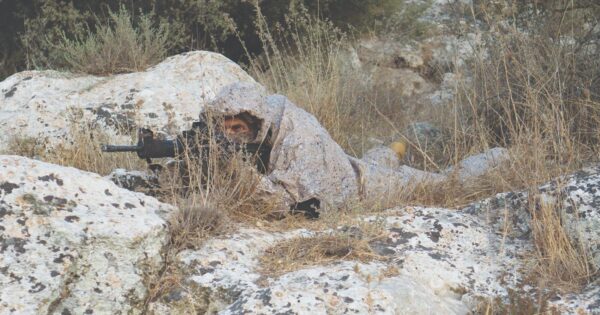
As 2025 draws to a close, I’d like to revisit a topic that often comes up in SurvivalBlog: camouflage clothing and equipment. Note: To see examples and variants of the camouflage patterns that I’ll mention in this article, see the comprehensive Camopedia.org website. They are to be commended for maintaining a great reference site. I will begin with some history: Camouflage uniforms were not standard issue for all but a handful of the world’s armies until the mid-1960s.  Experimentation with modern printed camouflage fabric as we now know it began with the German Wehrmacht and Waffen SS, circa 1942-1945.  They …


Prelude to World War – Part 3, by 3AD Scout

(Continued from Part 2. This concludes the article.) Timelines Given As we listen to all the chatter, day in and day out about a widening war in Europe and war with China, we can see some recurring messages in the reporting.  How many times have you heard that NATO needs to be ready for a war with Russian in 3-5 years or that China will likely invade Taiwan by 2030.  There are a few variations of the dates but regardless of the actual dates we need to ask why NATO and our Asia-Pacific Allies need to be ready by those …


A Systematic Framework for Identifying Real-World Threats, by Danield MacLeod

Many preppers have their priorities out of alignment. From my experience, many focus almost entirely on the how of preparedness—what supplies to stockpile, what gear to buy, or what skills to learn. Much of this is driven by one-size-fits-all recommendations that may not fit their specific situation. At the same time, attention is often focused on dramatic, low-probability events such as economic collapse, EMPs, or pandemics, while far more likely threats are overlooked. Now, I’m not saying that supplies, gear, skills, and major threats aren’t important—they are all extremely important for preparedness. Food, water, medical capability, tools, and training are …


Update: Budget Preparedness–Survival Isn’t About Stuff, It is About Skills

JWR’s Introductory Note: This is an update to an article that I wrote for SurvivalBlog back in June, 2008. It includes an adenda from my first wife Linda (“The Memsahib”), who passed away in 2009. It is part of a series of SurvivalBlog 20th Anniversary update re-posts, in recognition of the fact that the majority of readers did not join us until recent years. — I often stress that a key to survival is not what you have, but rather what you know. (See my Precepts of Rawlesian Survivalist Philosophy web page.) In part, I wrote: Skills Beat Gadgets and …


Practical Preparedness Suggestions – Part 2, by R.J.

(Continued from Part 1. This concludes the article.) 5. Self Defense This segment references reading, training and situational awareness that will be difficult for some people. Use what you can. Learn how to profile people and your surroundings. It happens in many forms, constantly. There are predators who don’t care about how nice you are. (Jeremiah 17:9 “The heart is deceitful above all things, and desperately wicked: who can know it?”) They will take advantage of the graces and courtesies that we usually employ to soften or de-escalate a problem. Learn what and how those predators think. Trust me, you …


Practical Preparedness Suggestions – Part 1, by R.J.

This article is a compilation of practical preparedness tips, insights, and lessons learned. It starts with what I call inner resources, or mindset and moves toward the hard, practical items. I offer a rather broad field of experience, including military/industrial electrical work, Christian hospitality in organized retreat settings, hospice/end of life care, and some alternative power experience. I’ll close the article with a Christian exhortation as we head into this Christmas season. Mindset You can break the preparedness mindset down into: homesteading, military, social, domestic categories, etc; or synthesize it into one grand holistic prepster/survivalist perspective. Just don’t flunk the …


Update: Coping With Inflation–Strategies for Investing, Bartering, Dickering, and Survival

JWR’s Introductory Note: This is an update to an article that I wrote for SurvivalBlog back in December, 2007. It is part of a series of SurvivalBlog 20th Anniversary update re-posts, in recognition of the fact that the majority of readers did not join us until recent years. — As of September, 2025, statistics released by the Federal government claim that the current inflation rate is 3.0 percent. That is utter hogwash. Their statistics cunningly omit “volatile” food and energy prices. It is apparent that something is seriously out of whack. Meanwhile, the buying power of the US Dollar has …


Update: Charity, Civility, Community, and Hope

JWR’s Introductory Note: This is an update to an article that I wrote for SurvivalBlog in December, 2005. It is part of a series of SurvivalBlog 20th Anniversary update re-posts, in recognition of the fact that the majority of readers did not join us until recent years. — Whilst pondering the various possibilities for the future, it is easy to get caught up in the minutiae of radio frequencies, milligram dosages, microns of filtration, calibers, and calories per ounce. (You’ll read plenty of those details in SurvivalBlog. But in doing so. we can easily lose sight of bigger, far more …


Kanban: America’s Ubiquitous “Just in Time” Inventory System: A Fragile House of Cards

JWR’s Introductory Note: This is an update to an article that I wrote for SurvivalBlog in February, 2007. It is part of a series of SurvivalBlog 20th Anniversary update re-posts, in recognition of the fact that the majority of readers did not join us until recent years. — When I give lectures or do radio interviews, I’m often asked for examples when I mention that “we live in a fragile society.” Here is one prime example: kanban. The kanban or “just in time” inventory control system was developed in Japan, and became popular in America starting in the 1970s. It …


Update: On Spring Water, Well Water, and Water Treatment Basics

This article is an update and expansion to a brief but important piece that I wrote for SurvivalBlog back in 2007. –  JWR Plentiful fresh drinking water for drinking, cooking, washing, and gardening is the most critical resource for all societies. The vast majority of the residents of First World countries are dependent on grid power to supply their water. When the grid goes down for more than a few days, water towers will soon be drained and huge numbers of people will be forced to draw water from open sources. Thankfully, there are streams, rivers, lakes, and ponds in …


From Unprepared to Prepped – A Beginner’s Guide – Part 2, by Mr. Wobbet

(Continued from part 1. This concludes the article.) As I wandered through my house trying to find the best place to create a second pantry I realized “I have way too much stuff.” I have been astounded at how much my life has improved by starting to declutter my house. I still have a way to go to get to where I want to be, but even the first step of acknowledging “Yes, there is such a thing as too many spare computers and spare monitors and spare cables” lifts a burden off of me. Opening up space in my …


Loaves, Fishes, Tree Bark, Seeds, and Knowledge – Part 8, by The Chemical Engineer

(Continued from Part 7. This concludes the article.) 4 – How Much Food Can We Afford To Share With Others? Now, let’s consider the controversial topic of sharing our limited food resources with a neighborhood group. Think of this option like investing money in start-up companies, high risk for the chance at high rewards but in this case the money is our food and the companies are people that need some of our food to have the strength to work on survival projects with us. I will do my best to outline facts and calculations that will help us to …


Loaves, Fishes, Tree Bark, Seeds, and Knowledge – Part 4, by The Chemical Engineer

(Continued from Part 3.) 2.5 – Options For Using Local Cambium Resources If we have prepared beforehand to harvest tree cambium and a Type 2 Emergency (T2E) happens, we will have three main choices to consider in my view. I encourage you to make this decision prayerfully and with your group’s best judgment. Every choice in a disaster is a set of trade-offs with no perfect solutions. If we actively try and help our neighbors early there is no doubt that this will reduce early suffering for some and could lead to ongoing beneficial cooperation. If more people are pulling …


Loaves, Fishes, Tree Bark, Seeds, and Knowledge – Part 2, by The Chemical Engineer

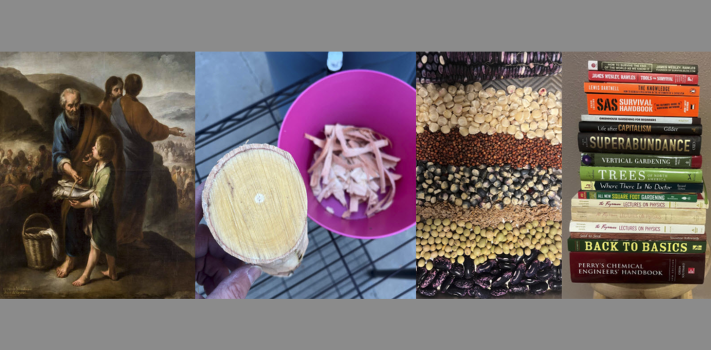
(Continued from Part 1,) Fifth, I believe that people are the most valuable creation on the planet for religious and practical reasons. The more people we have, the more knowledge they generate and can apply. I believe the growth of knowledge, personal freedom, and rule of law are the significant causes of mankind rising out of historical poverty. Great books like The Ultimate Resource 2, by Julian Simon, and Superabundance, by Gale Pooley and Marian L. Tupy, hammer home the fact that increased populations have increased prosperity. This is very counter to conventional wisdom because Malthusian thinking has warped much …


Loaves, Fishes, Tree Bark, Seeds, and Knowledge – Part 1, by The Chemical Engineer

JWR’s Introductory Note:  At just over 20,000 words, this is perhaps the longest single-topic contributed article ever serialized in SurvivalBlog. I consider it an important piece to ponder.  Please read all eight parts before sending your comments. I will post most of them in the Snippets column on October 29th. — I want to start with a brief but sincere thank you to all the article writers I have learned from here at SurvivalBlog.com. Your efforts have made a difference for me and many others. I hope my contribution can have a similar benefit to others. Thank you. Let me …