Preparedness Notes for Friday — February 20, 2026

On February 20, 1472, the Orkney and Shetland Islands were ceded by Norway to Scotland as part of a dowry payment. (Pictured are some of the Shetland Islands.)

February 20, 1824: The first description of a dinosaur: ‘Megalosaurus or Great Fossil Lizard of Stonesfield’ was pesented to the Geological Society of London by William Buckland, beginning dinosaur mania

SurvivalBlog Writing Contest

Today we present another entry for Round 123 of the SurvivalBlog non-fiction writing contest. The prizes for this round include:

First Prize:

  1. A Gunsite Academy Three-Day Course Certificate. This can be used for any of their one, two, or three-day course (a $1,095 value),
  2. American Gunsmithing Institute (AGI) is providing a $300 certificate good towards any of their DVD training courses. Their course catalog now includes their latest Survival Gunsmithing course.
  3. HSM Ammunition in Montana is providing a $350 gift certificate. The certificate can be used for any of their products.
  4. Harvest Guard is providing a 200-Piece Bulk Mix Pack of their Regular and Wide-Mouth Reusable Canning Jar Lids & Gaskets. This is a $161 + shipping value.

Second Prize:

  1. A SIRT STIC AR-15/M4 Laser Training Package, courtesy of Next Level Training, that has a combined retail value of $679
  2. Two 1,000-foot spools of full mil-spec U.S.-made 750 paracord (in-stock colors only) from TOUGHGRID.com (a $287 value).
  3. Preparedness author Jennifer Rader is providing a $200 purchase credit for any of her eight published food storage and medical preparedness books, including the Good Eats at the TEOTWAWKI Café series, the Armageddon Pharmacy series, and the Medicine Surrounds Us series.
  4. A transferable $150 FRN purchase credit from Elk Creek Company, toward the purchase of any pre-1899 antique gun. There is no paperwork required for delivery of pre-1899 guns into most states, making them the last bastion of gun purchasing privacy!

Third Prize:

  1. A Berkey Light water filter, courtesy of USA Berkey Filters (a $305 value),
  2. Two sets of The Civil Defense Manual, (in two volumes) — a $193 value — kindly donated by the author, Jack Lawson.
  3. A $200 credit from Military Surplus LLC that can be applied to purchase and/or shipping costs for any of their in-stock merchandise, including full mil-spec ammo cans, Rothco clothing and field gear, backpacks, optics, compact solar panels, first aid kits, and more.
  4. A transferable $150 FRN purchase credit from Elk Creek Company, toward the purchase of any pre-1899 antique gun.

More than $981,000 worth of prizes have been awarded since we started running this contest.  Round 123 ends on March 31st, so get busy writing and e-mail us your entry. Remember that there is a 1,500-word minimum, and that articles on practical “how-to” skills for survival have an advantage in the judging. In 2023, we polled blog readers, asking for suggested article topics. Please refer to that poll if you haven’t yet chosen an article topic.



Mobile Device Battery Management – Part 2, by J.M.

(Continued from Part 1.)

Rechargables

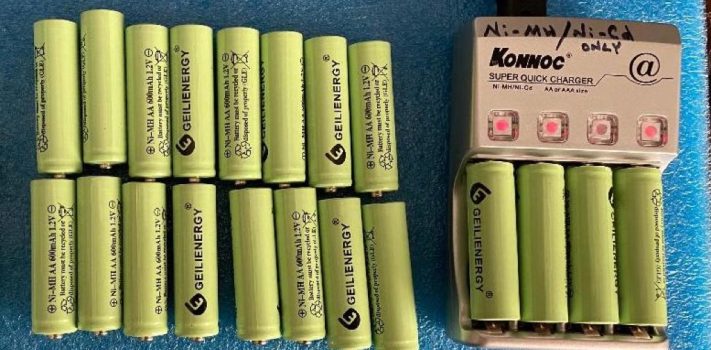
Rechargeable batteries come in a much wider variety of chemistries than primary ones, including nickel–cadmium (NiCd), nickel–metal hydride (NiMH) and various lithium-ion (Li-ion) and Lithium Polymer (LiPo) chemistries. It’s important to understand the ‘Li-ion’ and ‘LiPo’ aren’t specific chemistries, they’re categories of chemistries that use Lithium as one of the components of the electrolyte. Li-ion batteries use a liquid electrolyte, are usually cylindrical, and common chemistries include:

  • Lithium Cobalt Oxide (LiCoO2, LCO): Known for high energy density and used in portable electronics like smartphones, tablets, and laptops. It has a nominal voltage of 3.60V with a moderate number of recharges (500–1000 cycles), and a thermal runaway temperature of 150°C.
  • Lithium Manganese Oxide (LiMn2O4, LMO): Offers high power and improved safety compared to LCO, often used in power tools and medical devices. It has a nominal voltage of 3.70V (3.80V), and a recharge cycle life of 300–700 cycles. These are frequently referred to as ‘IMR’ batteries.
  • Lithium Nickel Manganese Cobalt Oxide (LiNiMnCoO2, NMC): Balances high capacity and power, with a nominal voltage of 3.70V. It is widely used in electric vehicles (EVs), e-bikes, and industrial applications, with a recharge cycle life of 1000–2000 cycles.
  • Lithium Iron Phosphate (LiFePO4, LFP): Known for safety, long recharge cycle life (1000–2000 cycles), and a flat discharge voltage, and a nominal voltage (3.20–3.30V). It is used in stationary energy storage and high-current applications.
  • Lithium Nickel Cobalt Aluminum Oxide (LiNiCoAlO2, NCA): Used in high-performance EVs, with a nominal voltage of 3.60V and a recharge cycle life of 500 cycles.
  • Lithium Titanate Oxide (Li2TiO3, LTO): Features exceptional recharge cycle life (3,000–7,000 cycles), fast charging (up to 5C), and wide temperature range, but it’s currently the most expensive. It is used in UPS systems, EVs, and solar street lighting

Continue reading“Mobile Device Battery Management – Part 2, by J.M.”


Economics & Investing Media of the Week

In Economics & Investing Media of the Week we feature photos, charts, graphs, maps, video links, and news items of interest to preppers. This week, another look at the penny shortage.

The thumbnail below is click-expandable.


Economics & Investing Links of Interest

Economics & Investing Media Tips:

Please send your economics and investing links to JWR. (Either via e-mail or via our Contact form.) Thanks!


The Editors’ Quote Of The Day:

“A system of capitalism presumes sound money, not fiat money manipulated by a central bank. Capitalism cherishes voluntary contracts and interest rates that are determined by savings, not credit creation by a central bank.” – Ron Paul


Preparedness Notes for Thursday — February 19, 2026

On February 19, 2008, Fidel Castro finally stepped down as Cuba’s president. He was then 81 years old and had been in power for 49 years. His successor was his younger brother Raul, who was also a stiff-necked communist.  He held power until 2021. The nation is still mired in communist bureaucracy and central planning.

And on February 19, 1910, Typhoid Mary (Mary Mallon) was  freed from her first periods of forced isolation and went on to cause several further outbreaks of typhoid in the New York area.

SurvivalBlog Writing Contest

Today we present another entry for Round 123 of the SurvivalBlog non-fiction writing contest. The prizes for this round include:

First Prize:

  1. A Gunsite Academy Three-Day Course Certificate. This can be used for any of their one, two, or three-day course (a $1,095 value),
  2. American Gunsmithing Institute (AGI) is providing a $300 certificate good towards any of their DVD training courses. Their course catalog now includes their latest Survival Gunsmithing course.
  3. HSM Ammunition in Montana is providing a $350 gift certificate. The certificate can be used for any of their products.
  4. Harvest Guard is providing a 200-Piece Bulk Mix Pack of their Regular and Wide-Mouth Reusable Canning Jar Lids & Gaskets. This is a $161 + shipping value.

Second Prize:

  1. A SIRT STIC AR-15/M4 Laser Training Package, courtesy of Next Level Training, that has a combined retail value of $679
  2. Two 1,000-foot spools of full mil-spec U.S.-made 750 paracord (in-stock colors only) from TOUGHGRID.com (a $287 value).
  3. Preparedness author Jennifer Rader is providing a $200 purchase credit for any of her eight published food storage and medical preparedness books, including the Good Eats at the TEOTWAWKI Café series, the Armageddon Pharmacy series, and the Medicine Surrounds Us series.
  4. A transferable $150 FRN purchase credit from Elk Creek Company, toward the purchase of any pre-1899 antique gun. There is no paperwork required for delivery of pre-1899 guns into most states, making them the last bastion of gun purchasing privacy!

Third Prize:

  1. A Berkey Light water filter, courtesy of USA Berkey Filters (a $305 value),
  2. Two sets of The Civil Defense Manual, (in two volumes) — a $193 value — kindly donated by the author, Jack Lawson.
  3. A $200 credit from Military Surplus LLC that can be applied to purchase and/or shipping costs for any of their in-stock merchandise, including full mil-spec ammo cans, Rothco clothing and field gear, backpacks, optics, compact solar panels, first aid kits, and more.
  4. A transferable $150 FRN purchase credit from Elk Creek Company, toward the purchase of any pre-1899 antique gun.

More than $981,000 worth of prizes have been awarded since we started running this contest.  Round 123 ends on March 31st, so get busy writing and e-mail us your entry. Remember that there is a 1,500-word minimum, and that articles on practical “how-to” skills for survival have an advantage in the judging. In 2023, we polled blog readers, asking for suggested article topics. Please refer to that poll if you haven’t yet chosen an article topic.




Mobile Device Battery Management – Part 1, by J.M.

There have been many articles by myself and others on SurvivalBlog that discuss the use of mobile electronic devices such as radios, flashlights, cell phones, red dot sights, drones, cameras, etc. for emergency preparedness and disaster scenarios. The one thing all such devices have in common is that they require power of some sort, usually in the form of a battery, and without power those devices are about as useful as a paper weight (I guess you could use them as projectiles). Understanding how batteries work and how to best manage them can help ensure you get a long and useful life out of those critical devices.

A battery is basically a way to store electricity using chemicals and typically consists of three components – an anode, a cathode, and an electrolyte chemical that the anode and cathode are immersed in. The anode releases electrons, which flow through whatever device the battery is connected to and back to the cathode, creating an electric current. Simultaneously, ions move through the electrolyte from the cathode to the anode, which is a substance that allows ions to flow but not electrons, to balance the charge. This process continues until the chemicals within the battery are depleted, at which point the battery is considered “dead” and needs to either be disposed of or recharged.Continue reading“Mobile Device Battery Management – Part 1, by J.M.”


The Survivalist’s Odds ‘n Sods

SurvivalBlog presents another edition of The Survivalist’s Odds ‘n Sods. This column is a collection of news bits and pieces that are relevant to the modern survivalist and prepper from JWR. Our goal is to educate our readers, to help them to recognize emerging threats, and to be better prepared for both disasters and negative societal trends. You can’t mitigate a risk if you haven’t first identified a risk. In today’s column, more on the rise of robot technology.

The Robot Revolution Is Nigh

Survivalog staff writer Tom Christianson was the first of several folks to suggest this American Spectator article link: The Robot Revolution Is Nigh.  An excerpt:

“Since 2022, Tesla has been developing Optimus, a humanoid robot built using many of the same technologies that power Tesla’s vehicles. More recently, Musk claimed Tesla has solved the core challenges that have long held humanoid robotics back.

Speaking at the 2025 All-In Summit, Musk said Tesla was finalizing the design of Optimus version three, calling it a ‘remarkable robot.’ According to Musk, Optimus three will feature human-level manual dexterity, an AI system capable of understanding and navigating the physical world, and mass production at scale. Those three elements, he argued, are what other robotics companies lack.”

More About A.I.’s “Transformation”

Reader C.B. was the first of more than a half-dozen blog readers to suggest this article about the leapfrogging advances in A.I.: Something Big Is Happening.

AI ‘Arms Race’ Risks Human Extinction

And over at Barron’s: AI ‘Arms Race’ Risks Human Extinction, Warns Top Computing Expert.Continue reading“The Survivalist’s Odds ‘n Sods”


The Editors’ Quote Of The Day:

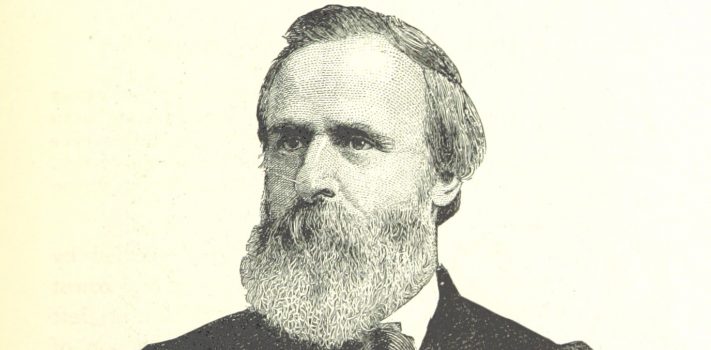
“Let every man, every corporation, and especially let every village, town, and city, every county and State, get out of debt and keep out of debt. It is the debtor that is ruined by hard times.” – Rutherford B. Hayes


Preparedness Notes for Wednesday — February 18, 2026

February 18, 1678: John Bunyan‘s Christian novel “The Pilgrim’s Progress” was published in London by Nathaniel Ponder.  Pictured is John Bunyan’s Tomb, at Bunhill Field, London.

Today is also the birthday of astronaut Theodore Cordy “Ted” Freeman (February 18, 1930 – October 31, 1964.) Ted Freeman and his wife Faith were friends of my mother and father.  Both my father and Ted Freeman were stationed at Bryan Air Force base in the early 1950s, and they rented houses three blocks apart, in College Station, Texas. (My father was a T-33 instructor pilot.) About ten years later, while training as an astronaut in the Gemini space program, Ted was killed in a birdstrike flying accident, while flying a T-38 Talon jet trainer. He was the first casualty of NASA’s manned space program. – JWR

Today’s feature post is by SurvivalBlog’s founder, JWR.

We need more entries for Round 123 of the SurvivalBlog non-fiction writing contest. More than $981,000 worth of prizes have been awarded since we started running this contest.  Round 123 ends on March 31st, so get busy writing and e-mail us your entry. Remember that there is a 1,500-word minimum, and that articles on practical “how-to” skills for survival have an advantage in the judging. In 2023, we polled blog readers, asking for suggested article topics. Please refer to that poll if you haven’t yet chosen an article topic.



More Inflation Ahead: At Best, Plan on Semi-Retirement

Imagine that you were a weakling who kept his cash under his mattress, and you lived in a bad neighborhood that was dominated by the Mafia.  Every year or two, Mafia thugs would come by and threaten to beat you to death, and demand: “Half for us and half for you.”  That is a bit like what it is like to live in an era of mass inflation. But with inflation, the cash extractions are gradual, and almost invisible. No thugs. Just melting purchasing power. Perhaps I chose a poor analogy, but bear with me, while I explain:

As a preface to reading this essay, I’d suggest taking the time to read these four recent news articles:

Yes, without some major changes, the Social Security Trust Fund will probably be insolvent by 2032.  Restoring the Trust Fund’s solvency would require either a 29-percent payroll tax increase or a 22-percent across-the-board benefit cut, today.  And if Federal legislators wait until 2032, it would require a 33.5-percent payroll tax increase or a 25.6 percent across-the-board benefit cut. The political backlash to either of those solutions would be tremendous. I predict that the elected politicians in the Federal government will dawdle until 2030 and then print their way out of that problem. When they need trillions of dollars, they will simply create trillions of dollars out of thin air. Any “austerity” alternative would be political suicide, at least for the party in power. This explains why this decision keeps getting delayed.

If the funds required are simply created out of this air, it would be largest quantitative easing in history. It would prove to be very inflationary.   But even without the Social Security funding crisis, with the U.S. government’s ongoing deficit spending, a resurgence of high consumer price inflation is almost inevitable.Continue reading“More Inflation Ahead: At Best, Plan on Semi-Retirement”


SurvivalBlog Readers’ & Editors’ Snippets

Our weekly Snippets column is a collection of short items: responses to posted articles, practical self-sufficiency items, how-tos, lessons learned, tips and tricks, and news items — both from readers and from SurvivalBlog’s editors. Note that we may select some long e-mails for posting as separate letters.

SurvivalBlog reader Tim J. sent us this: The Culture of Raising Barns.

o  o  o

“Everyone’s Grandma Is Selling the Silver Chandelier, Forks, Knives” as Scrap Volumes Overwhelm Refiners.

o  o  o

J.T. in Florida sent this television news link: Civilians in Florida are training like soldiers: ‘Best prevention to war’JWR’s Comment: The reporter, predictably, went to get pearl-clutching comments from Brandon Frin, a socialist anti-religious university professor, to make the prepper movement look unhinged.

o  o  o

An interesting podcast hosted by a left-of-center urbanite: Urgent Futures with Jesse Damiani. One recent episode: From ‘Prepper’ to ‘Resilient Citizen’ – Chris Ellis — #62.

o  o  o

SaraSue sent us this snippet:

“The snow is gone and we have temperatures in the 60s, but here in Tennessee, this is called a “False Spring”.  As much as I want to get the garden started, I know better.  The Big Freeze was brutal for cattle here that are not used to sub-zero temperatures.  I know a couple of people who lost a calf despite their rescue attempts.  Which is why I will not have winter calvings here.  Even if that means missing an opportune breeding window.  The gestation period for most cattle is approximately 283 days, which means you wait a long time for that calf, and to lose it at birth is devastating.

I had sent one cow I could not get bred back via A.I. (Artificial Insemination) to stay with a neighbor’s registered Angus bull for two cycles.  She is home now and she was bred, so now I wait to see if she will hold the pregnancy.  Her calf would be born in October, well before our winter weather.  I expect 4 calves this year with calving starting in April and ending in October.  I’ve enjoyed the break from milking cows!  I realized though, that the late breedings means I am going to be milking through next winter, so I’m hoping to make some adjustments to the milking area before then, and/or hoping she is capable of just raising a calf without being milked.  That’s not always possible for dairy breeds due to their large volume of milk.  We shall see.

I decided to keep a Jersey/Angus cross heifer for breeding purposes rather than send her to freezer camp in the Fall with a steer I’m raising.  It seems, that with the national cattle numbers being very low, it would be a shame to send a heifer off.  A healthy cow can raise a calf every year for many, many years so I would hate to lose that opportunity.  As well, several family members contacted me about when I would have freezer beef available again, so I could definitely use 2 for the freezer this year.  We shall see how large the steer turns out.  Otherwise, they will have to wait until the following Fall.

Raising beef has been a learning curve for me since I have focused on dairy breeds and dairy products.  Getting the timing right with breeding, calving, raising for the freezer has been a steep learning curve as well.  My goal in raising beef for my family is not conventional.  The cows are grass fed and receive no antibiotics or vaccines.  There is the rare exception when a cow needs antibiotics, and I will not deny that help.  But, otherwise, I raise them as holistically as possible.  I have much to learn about the “flavor profile” of grass fed beef.  So far, I have put 2 beef in the freezer and the meat was fantastic.

I have a like minded farming friend who offered to trade calves with me to “even things out”.  In other words, if I end up with a heifer I don’t need, she will trade me a steer calf that she doesn’t need, and vice versa.  I learned how to bottle feed calves last year, so I’m not adverse to that idea.  (The reason for bottle feeding is that a cow may not accept another cow’s calf to nurse.  In fact, she may kick it away from her.  So it’s important to be prepared to milk that cow, then give the calf a bottle of her milk.)  My friend’s practices are similar to mine and her cattle are also disease tested and very healthy.  Our arrangement may be beneficial to both our families.

The large garden was cleaned up and all the garden beds, except the ones growing onions, garlic, and strawberries, were refreshed with mushroom compost.  A dozen thornless blackberry plants, from a neighbor’s overgrown patch, were planted.  I finished some large painting projects in the house with help from a friend.  The barns and hen house were cleaned out, and general fence and farm maintenance accomplished.  I am ready for Spring (I think).  Last year was a really tough year due to my health problems, but I’m feeling much better now and hope to sail through this year without issues.  LOL.”

o  o  o

Dyeing UCP Surplus With Rit DyeMore Synthetic — Results & Outdoor Test.

o  o  o

The Perfect Colors to Dye UCP Gear.

o  o  o

Fabric Spray Paint? Problem Solved(ish)!

o  o  o

I recently heard an odd tidbit:  Most folks are familiar with the acting experience of James Earl Jones, but what most Americans have never heard is that he had a very large, eclectic gun collection that he developed over several decades. He was fascinated by gun designs and their mechanical precision.  Most of the collection is now being gradually sold off by Checkpoint Charlie’s.

o  o  o

Reported in late 2024: The Rural Migration Trend: What to Make of It, Why It’s Happening and Where It’s Headed.

Continue reading“SurvivalBlog Readers’ & Editors’ Snippets”


Preparedness Notes for Tuesday — February 17, 2026

On February 17, 1940, the Altmark Incident: The crew of the British destroyer Cossack (pictured) boarded the German tanker Altmark in Jøssingfjord, Norway, releasing 299 British prisoners after hand-to-hand fighting with bayonets and the last recorded Royal Naval action with cutlasses.

I just heard that actor Robert Duvall passed away at age 95.  May he rest in peace. – JWR

Using a 13-inch (33-cm) telescope at the Lowell Observatory in Flagstaff, Arizona, Clyde W. Tombaugh, a 24-year-old American with no formal training in astronomy, discovered the dwarf planet Pluto this day in 1930.

We are nearly done with deliveries of the 2005-2025 waterproof SurvivalBlog archive USB sticks. Here is the status of the few orders that are not yet at their destinations:

  • 2 packages going to Canada – one is still with Customs Canada, and the other made it through.
  • 2 packages are being held by post offices for pickup per customer request at their post offices.
  • 1 package delayed due to bad weather but still being tracked to an Ohio address.
  • 4 orders are still on hold, awaiting payment via check or cash. (Two of those were ordered on Feb 6, one of them ordered on Jan 25, and one of them ordered on Dec 31. A note to just those four folks: You have until February 23rd to get a check to us before your orders will be cancelled.

For everyone else: The archive USB sticks all sold out within a month. We won’t be taking any new orders until the next edition of the stick is produced in January of 2027.  Please mark your calendars for January 10th, 2027, so that you don’t miss out.

Today’s feature article is by SurvivalBlog Field Gear Editor Tom Christianson.


Cold Steel Recon 1 XL Folding Knife, by Thomas Christianson

“That’s not a knife. This is a knife!” (Paul Hogan as Mick Dundee, in Crocodile Dundee, 1986).

When I took the Cold Steel Recon 1 XL out of its box for the first time and deployed the blade, the attempted mugging scene from Crocodile Dundee immediately came to mind. The Recon 1 XL is bigger than the average everyday carry (EDC) knife: a lot bigger. It has a 5.5-inch blade that is 0.15 inches thick and 1.63 inches wide. It is 12.25 inches long when the blade is deployed. And it weighs 8 ounces.

The knife is 6.75 inches long, when folded. I thought that might be too long to fit in my left front pants pocket, but I was wrong. It made it a little more challenging to stick my hand in that pocket to retrieve the ink pen, Swiss Army SD Classic knife, or plasma lighter that I store there. But after a few days I got used to it, and forgot the knife was there unless I happened to need it.

The blade is made of CPM XHP stainless steel. The handle is made of G-10. (G-10, aka Garolite is a high-pressure fiberglass laminate.) The blade deploys using dual thumb studs, and is held open by Cold Steel’s famous Tri-Ad Lock.Continue reading“Cold Steel Recon 1 XL Folding Knife, by Thomas Christianson”


SurvivalBlog’s American Redoubt Media of the Week

This weekly column features media from around the American Redoubt region. (Idaho, Montana, eastern Oregon, eastern Washington, and Wyoming.) Much of the region is also more commonly known as The Inland Northwest.  This week: Some more backcountry flying videos.

Send Your Media Links

Please send your links to media from the American Redoubt region to JWR. Any photos that are posted or re-posted must be uncopyrighted. You can do so either via e-mail or via our Contact form.