


(Continued from Part 1. This concludes the article.)
How did we get here?
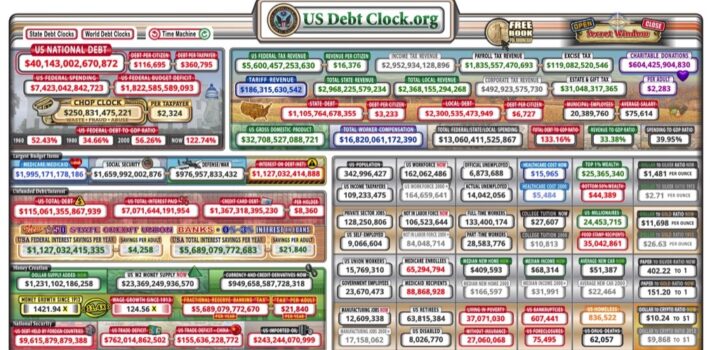
We are more than 40 trillion dollars in debt. Our streets are not lined with gold and other precious metals, but our nation is decaying around us. We are being invaded. Our military instead of repelling invaders and rounding them up is engaged in foreign adventures around the world contrary to what George Washington said about foreign adventurism and alliances. You can read my 14,000 word essay “Fall of the American Republic” for a detailed look into our likely fall in Parts One and Part Two. I have been adding up how much has been spent and how our nation got here.
In addition to the 40 trillion around another 180 trillion has been collected in tax revenue and spent. This is over Five Hundred Thousand dollars spent for every man, woman, and child in the United States with about half of it spent in the last 25 years. Some people have monumentally wet their beak in government coffers while others received nothing but the inflation that all of this money printing has caused. When the government handed out the checks to some people during the crisis over a cold back in 2020 and 2021, it was only a small amount that people received compared to how much was borrowed. The average American received up to 3200 dollars with children receiving up to 2500 dollars. In reality, about five times the total sum of all these checks was actually spent. To restate this: The average American only received a check for about 20 percent with 80 percent going elsewhere and 100 percent of the money was borrowed, with the national debt increasing like an out-of-control taxi meter, and the bill has not yet come due.
Someday, economic historians will look back on this time and wonder how the people did not do anything about it to reverse course on this journey. It was predictable, expected, and happened many times before in the history of the world. One thing you need to remember is that people in our time are no different than ancient Romans. Western countries did not even begin to match the Romans until the 19th Century across almost any field from health to sanitation to transportation. The Romans had running water and sewage disposal for centuries when Kings of Europe such as Louis XIV at Versailles had a palace with hundreds of rooms and no bathrooms. You may think our transportation system in the form of highways is so advanced, but the interstate highway system which was developed in the 1950s currently has less than 50,000 miles where the Romans achieved 50,000 miles of usable roads throughout their empire more than 15 centuries earlier when the United States did not even have one continuous paved road crossing the country until 1935.
The Roman Army was much more physically fit than our current army and pound for pound an ordinary legionary probably had the physical endurance of a member of one of our advanced special forces units. Consider a Roman legionary had to routinely march 20 miles in 5 to 6 hours with about 60 to 90 pounds of gear and then construct a fortified camp after this march on a diet of wheat, salted meat, vegetables, cheese, and drank usually dirty water mixed in a drink called posca (which was wine vinegar and water when combined have a degree of antibacterial properties). Currently, a United States infantryman receives an “expert infantryman badge” if he successfully passes some timed evaluations on proficiency and can march 12 miles in 3 hours with a minimum 35 pound load while likely imbibing copious amounts of microbiologically clear fluids. Only about 14 to 15 percent of United States soldiers can pass even at that level. To say the average United States citizen is soft is an understatement. Describing the United States as “Rome with wifi” is an apt description of where we find ourselves as a late stage Republic dying and overburdened with obligations all around the world much like the Romans with their far-flung empire. While an article on the uncanny resemblance of Rome to the United States would be interesting, but I will leave that for some possible future time.
To say that we are in debt up to our eyeballs is not an exaggeration, but most likely a gigantic understatement of our national financial position. We are a dying empire full of hubris that is lashing out against the world. There is a monumental difference between Rome in the 1st Century and in the 4th Century. If history is a guide, we are in our last days where the sun is setting on our Empire and our economy. Other countries are better credit risks evidenced by their lower interest rates. The market is usually an impartial referee unless it is actively manipulated, but even then manipulation has its own costs by usually reducing the time frame to economic collapse. If someone gave you a million dollars and told you that you had to invest it in a country’s bonds for the next 30 years for the purpose of similar purchasing power at the end of 30 years, but could only choose one country would you choose Switzerland or the United States?
As an “answer” to rising yields in long term debt, the United States Treasury is currently trying to hold back long term rates through refinancing debt with a monetary increase in the size of this operation announced on August 19, 2026. Refinancing debt in this instance means the treasury is taking on new short term debt in order to try to influence long term rates by issuing new short term debt to pay for higher long term debt. This short term debt will need to be paid back in less time than the long term debt because of the maturity difference of years instead of decades. If this is difficult to make a rational argument, you are probably correct because this does not make good economic sense trading longer term debt with a known price for something that needs to be paid back sooner and that may need to be then refinanced at an even higher price. This actually makes the economic situation more precarious as the government would need to then pay back treasury bills with usually more debt being issued which usually causes inflation.
There have been some complaints and anger of why the United States should have to pay more to borrow than some other countries. The truth is that we are not a good credit risk. In 2025, the United States lost the highest tier credit rating by the last of the three well known rating agencies. The first agency downgraded us in August 2011 which could be thought of as a warning shot across the bow. Few people paid attention. Nothing has changed since then. It took all the way to August 2023 to lose the highest credit rating with another agency and in May of 2025 the United States lost its last high credit rating.
A few months before his death, George Washington was corresponding with a man known to history as James Welch who was attempting to lease/purchase some of Washington’s land and had not made any payments. In the correspondence, one of Washington’s nuggets of wisdom shines over 225 years later when Washington refused to lend Welch any more credit: “To contract new debts is not the way to pay old ones.” Our government is currently doing the exact thing we were warned about by George Washington.
Now is not the time to cry over the spilled milk of lost opportunities of how many times we could have done better with the resources our country was given. It was all squandered and wasted in 40 trillion different ways with lots of fraud, waste, and generalized stupidity. Some people remember the promising “DOGE” (Department of Government Efficiency) idea, but that was only a long line in people trying to make the inefficient efficient going back to the 19th Century. Before “DOGE,” there was Simpson-Bowles, the Grace Commission, the Hoover Commission, the Keep Commission and going back to the House Committee on Retrenchment which tried to cut federal spending back in the 1840s.
So many people tried to solve it, but all governments — no matter how well meaning — are extremely inefficient compared to the private sector. Whenever there is a disconnection between money, responsibility, and the actual people who are affected, fraud and waste often occur whether it is a local, state, or federal project or even something very local such as a church or charity. There is no one who knows you and your family better than you. If you are a father or grandfather reading this, you are not likely taking from your family budget to pay for bloated public works projects in foreign countries, but anything not on a family level is often some combination of actual legitimate spending with sometimes doses of skimming, fraud, waste, overcharges, and fear based spending. Words such as defalcation, peculation, malversation often refer to such defrauding schemes.
Since the beginning of our Republic about 180 trillion dollars has been brought in revenue from the pockets of the taxpayers and another 40 trillion is currently owed with another maybe 80 trillion dollars of potential unfunded federal liabilities that is usually reported on a currently constantly increasing future timeline. Did we really get anything worthwhile for our money and blood expended in foreign wars? That is a value judgment I will leave for you to decide, but I can take you on a quick tour of some the human consequences to our foreign military adventures.
An Out of Control Train of Spending
For our billions and trillions spent, we created a lot of misery in foreign countries by destroying buildings and people with our bombs still being found in foreign cities as unexploded ordnance during construction projects, landmines are still crippling kids, and veterans are still having nightmares even decades later. Our bright young boys lost their innocence on foreign battlefields and in camps and towns surrounding our bases. I can still remember a First World War widow who used to talk about the anticipation of the homecoming and how things were different “when the boys came back” as something had changed in her husband and brother.
The last First World War veteran died in 2011, but I can still remember how I felt hearing about the insanity of trench warfare from the raspy voice of an elderly veteran. We learned inhumanity and brutality on an unimaginable scale in the Second World War especially inflicted upon civilian populations. We learned futility in Korea by retaking the same hills over and over again often with no strategic importance except that families receiving telegrams often remembered forever what they were doing right before that doorbell rang. By Vietnam after the Battle of Ia Drang, death notifications began to be handled a little more personally instead of with a telegram, but by having two trained people tell you that your husband, son, or brother died still does not change what happened. We learned the meaning of irony in Vietnam: “It became necessary to destroy the town in order to save it” which later became what is now remembered as the equally ironic saying of “We had to destroy the village in order to save it.”
Some of the ways in which we lost all of that money were during wartime with people who see opportunities and make money exploiting the often chaotic nature of war, allocation of resources, and the requisitioning process. Famous cases of the 19th Century include cardboard shoes, rotten meat, and shoddily constructed arms. The term “shoddy” became even more famous during the time period known as the “Civil War” when uniforms would fall apart in the rain as some of the soldiers’ uniform material was glued rather than spun. A famous case during this period is of the “Hall Carbine Affair” where the United States government sold obsolete rifles as surplus and then offered to buy them back at over six times the price after they had an inexpensive modification done to them.
While it would be instructive to point out a hundred more cases of on our road to bankruptcy for future generations to someday learn about our folly, let us fast forward a hundred years starting in the 1970s. Interest in trying to stop the bleeding of our national fortune is sometimes bipartisan. Starting in the 1970s, Democrat Senator William Proxmire handed out the “Golden Fleece Award” for those who fleeced (squandered) public money in the most egregious ways. One interesting example was when the government paid nearly 58,000 dollars to measure 432 stewardesses (the former name for female flight attendants) which is about 134 dollars per woman. Back then, even a well paid tailor could do this for less than 3 dollars per woman.
Another interesting example of what was called wasteful spending back in the 1970s included spending over 200,000 dollars to teach college students how to watch television. Decades later Republican Senator Tom Coburn produced a “Wastebook” detailing billions of dollars of spending from 2010 to 2014 in five editions with each having 100 projects that he considered to be wasteful. One example of the bloated nature of many of these programs was the 297 million dollar spent on the mega-blimp known as the Long Endurance Multi-Intelligence Vehicle (LEMV) project which made one flight. An earlier example which at the time was considered by people back then a “wasteful project” would be the “Spruce Goose” flying boat project from the 1940s which also made one flight and the over 20 million dollars spent in 1940s is comparable to the blimp projects of the early 2000s.
When will it collapse?
My family and I have accurately predicted many different national and international events including a World War to even what entertainment shows will become popular. We have a much better accuracy than a statistically random average, but sometimes we were way too early in our predictions, but were right in the end. Sometimes we were too conservative as I recently was about the national debt not crossing the 40 trillion dollar barrier until later August or even early September. There is a useful quote to our discussion here: “The market can stay irrational longer than you can stay solvent” which has been attributed to many individuals.
At what point does the US dollar’s house of cards collapse? That answer could be worth a few dollars to trillions of dollars depending on who is asking such as an individual deciding whether to exchange some dollars for canned goods or governments deciding that our long term financial outlook is bleak. We just don’t know exactly and being wrong can have catastrophic consequences. Years ago, many farmers thought that buying more land and bringing more land under cultivation would automatically be successful as it was for generations. For most of United States history this was true, however it hit a brick wall back in 1980s with the massive farm crisis which was exacerbated by high interest rates, overproduction with lowered commodity prices, and collapsing land values.
Barring an unlikely return to fiscal sanity, a financial crisis will occur at some point. Government spending is out of control and its likely return to sanity will have to probably wait until the system collapses. It is not just the large expenses, but the small expenses that add up to real money: “A billion here, a billion there, and pretty soon you’re talking real money” is another quote where the original author of the concept is unknown. Perhaps someone in ancient Rome could have be thinking something such as “A few denarii (Roman silver coins) here, a few more aurei (Roman gold coins) there, and pretty soon you’re talking real pecunia (money).”
The doubling effect is not widely understood, so I will explain further. The doubling effect is really great for individuals, but bad for governments. If an individual saves money, he can often double his money in a certain amount of time because of the time value of money when invested demonstrated through such ideas as the “Rule of 72” where the interest rate is divided by 72 to show when money approximately doubles. If money is invested at a higher rate, then it doubles faster than at a lower rate. It is the same for governments except it often makes situations worse with financially irresponsible governments where debt is doubled instead of investments. We are now drowning in 40 trillion in red ink. Arriving at 80 trillion could be less than 10 years away. We currently spend over a trillion dollars a year in interest. If interest rates adjust to a historically normal level of around 5 percent, this could be 2 trillion and counting worth of interest every year in addition to about a trillion dollars in deficits. Some say it could be a 800 billion deficit without interest, but given our nation’s predilection to find things to spend money including all our current wars and wanted wars, let us just call it a trillion dollars, so that is three trillion dollars a year. In ten years, you are already at 30 trillion dollars extra or 70 trillion total in this scenario that is without any “crisis” occurring which could easily get us past 80 trillion.
Interest Rates and Inflation
A lot of this assumes that interest rates will stay in a reasonable range such as at 5 percent or less. Interest rates can quickly consume all of tax revenue quickly if they increase to “junk rate” status. Currently, paying the interest on the national debt costs approximately 40 percent of all individual income tax revenue (income taxes from people) and this is expected to increase dramatically if increase rates increase. I know to most people this number means absolutely nothing, so I will restate it in plain terms. This is like you are bringing home 3000 dollars a month and you are paying 1200 dollars in interest each month leaving you with only 1800 to pay everything else. You are not receiving anything for the interest as it is just paying for past purchases and not even paying anything toward the principal of the money you owe. The money spent on interest is not going to pay rent or mortgage, food, entertainment or anything. It is like a leech sucking blood out of your body.
The term “junk” is a technical term, not a derogatory one usually referring to corporate or government bonds that are not high quality as they carry a higher rate of default risk, so the interest rate is higher. The interest rates for junk bonds could go to six to nearly 10 percent with about 9 percent being historically normal at this level, but during the 2008 crisis interest rates on junk status debt went up to about 25 percent. The sky is the potential ceiling on government interest rates in the real world. In Weimar Germany in 1923, interest rates were 30 percent per day as people were having to use wheelbarrows full of paper money to purchase groceries. Prices were increasing so fast that even that interest rate was probably not enough to compensate for the risk exchanging tangible goods for paper. Another time I plan to cover surviving hyperinflation, so that comment will have to be sufficient for now.
Nothing goes perfectly with economies especially those with large deficits: it seems that we have been leaping from crisis to crisis over the last 25 years and the world is not getting any better. Consider over the last 25 years we have had the 2001 crisis, 2008 financial crisis, and 2020 crisis all of which necessitated extra spending. We could easily have another crisis and it could be simple enough of even more people developing the conclusion that maybe America is not such a good credit risk and our interest rate goes higher as people want a premium for what they see as more risk.
All of the national debt from the founding of the republic until 1981 was 1 trillion dollars and that year 30 year treasury bonds topped out in the 15 percent range because the Federal Reserve was trying to raise interest rates to stop the 1970s inflation caused by government borrowing and spending for the Vietnam conflict and “The Great Society” government programs. Think about the fact that the national debt was only one single trillion dollars back then. Today we are at over 40 times that level and have promised even more in future obligations. Back in 2020, we added an extra trillion dollars in less than one month.
We are currently doubling the national debt at a rate of every nine years. If spending continues at current rates with interest rates remaining stable, we could see 80 trillion in 2035 if the interest rates drift a little higher (they are already trending higher and there is ongoing financial interventions to try to reduce interest rates) and if the government is just a little more generous in their spending or maybe another crisis could send us to 80 trillion in that time frame. Because of how great we were at overspending and finding new ways to finance foolishness, we were able to do our last doubling from 20 trillion to 40 trillion in less than 9 years from September 8, 2017 to August 19, 2026. From 10 trillion to 20 trillion was also less than nine years from late September 2008 to September 8, 2017.
Because I want to emphasize this point, let me rephrase it for you. We did not add just 10 trillion in 9 years like we did between 2008 and 2017, but added 20 trillion in the same time period. This is why doubling can be very bad when you owe money. Adding another 40 trillion in less than a decade is a definite possibility.
The United States government currently has a tsunami of Treasury debt of about 20 trillion dollars of debt that needs to be rolled over within the next five years with some estimates going even higher amounts of debt that needs to be refinanced! This debt was financed at ultra low rates of usually about 1 to 2 percent in the short term and now will need to be financed at likely new much higher rates. This is similar to what can happen to some college students with a credit card with an introductory rate or families who are financing higher prices of buying necessities of living like food on the credit card and then hit a wall when they can’t even afford to make the minimum payment. A college student often can dig himself out by getting a better job after graduation and he is likely young having many years of productive work ahead of him. Sometimes there is a way out for a family such as by growing their income and cutting back on spending in order to dig themselves out of debt. With government, it is a very different situation. Uncle Sam has borrowed 40 trillion dollars mortgaging both our future and that of unborn generations. The government has already reached into generations of our pockets through taxes that are often seen such as income and payroll taxes and largely unseen such as taxes on gasoline.
There is often the “growth” fantasy within economic circles thinking that “growth” will somehow be the answer to overspending by trillions of dollars a year. At one time, we were a growing country, but now we are a country that is in decline with its original productive native population in decline. A possible path is one many nations have suffered throughout history having to undergo the pain of high inflation, potential hyperinflation, diminished economic prospects, increased crime, despair, and maybe a side of anarchy with economic collapse.
On top of the trillions of dollars of debt that needs to be refinanced in the next five years, around another 2 trillion could need to be borrowed every year for the foreseeable future. There is nothing improving on the economic horizon. There are no Wunderwaffe (wonder weapons) to use an analogy from the Second World War that can defeat the ancient scourge of too much spending and debt.
Other great civilizations collapsed and we will likely join the graveyard of once great empires. It is always amazing and predictable how quickly spending gets out of control in the end stages of an economic collapse. It used to be 1 trillion dollars of deficit spending during an extraordinary crisis year, but that was “the good old days” of the 2008 financial crisis. The first 3 trillion dollar deficit started with the 2020 spending event and all of those “stimmy checks” where a little was given and so much was borrowed. Wait until we have regular 3 trillion dollar deficits. It only gets worse from there as we are not paying down anything, but adding to what we owe.
Our nation should be rich with trillions of dollars of surpluses, but instead it is broke — owning trillions even though it has collected hundreds of trillions of dollars of taxes and fees from you, your parents, your grandparents, and your great-grandparents. We should have a sovereign wealth fund which could lend to young people for them to start businesses and pay back interest in which to make the fund even more stable for future generations. Tuition should be free at public colleges and universities paid for by our national wealth that should be there, but it has never been more expensive.
I find it laughable whenever I see reports that in 30 years the national debt is going to be 160 to 180 or more trillion dollars. This is like doing a linear projection on a fever of 103 degrees saying if it continues it will be 165 degrees in so many hours. The patient will be in organ failure and likely cooling off in the morgue long before a fever registers in the 110 degree range and standard clinical thermometers don’t even register that high often with maximums in the 110 range as you are not trying to cook a turkey!
The highest recorded temperature of anyone who survived that I can find was 115.7 Fahrenheit and that was from a heatstroke, not an illness. We might make it to the 180 trillion dollars in national debt or it could collapse trillions short of that financially irresponsible achievement. Two distinct paths on the march to collapse could likely occur: either fiscal sanity will return with deep and painful cuts to get us back to a sustainable path or knowing past history it is more popular to print and deny the problem until it collapses everything. Even 180 trillion is not some “line in the sand” number as we could somehow double again on the march to a quadrillion: it is always possible that it could be another “safe” doubling just like food poisoning at the picnic where some people are a little more “resistant” than others, but are not likely to approach buzzard levels of resistance. Because this problem is not going away, this will unfortunately need to be revisited again another time with some more information on the current landscape on the road to economic collapse. The bill for all of this spending will come due. It is my hope that these articles are getting people thinking and talking about surviving the future.
What can you do?
You can do nothing about the overall spending and waste on a national level. The majority of the spending is on an automatic mandatory spending escalator with automatic spending increases tied to inflation. When DOGE tried to cut anything, we heard more wailing and gnashing of teeth than out of a low budget horror film. Everyone was going to die if foreign aid was cut. The children were going to starve, television was not going to be funded, and society was going to break down if cuts were made. With the level of hysteria, you would think that I would now be sharing candle making tips communicating with tin cans and string as we were going to be living in the dark without the few billions they were attempting to cut. DOGE gets an “A” for effort as I believe the people were sincerely trying to save the country, but overall there is not much that can be realistically cut other than some items which were identified and each cut was a dramatic exercise in futility as somebody somewhere who was previously “cashing” the check and screaming about the cut amplified through the megaphone of the mass media. There were rescissions, but a few billion out of trillions of annual deficits is not much to stop the tsunami of destructive red ink.
It is possible to do something on a personal level. Remember all of this is a Gedankenexperiment or thought experiment. None of this is advice, so don’t tell your wife that “Single Farmer” says sell and move to a farm in the country. I do not know you and your situation. I know myself and my situation. I live on a farm by choice. I could live in the city if I really wanted to be an observer of the collapse on a daily basis instead of occasionally seeing the slow collapse of civilization when I travel into cities.
Basic Steps to Survival
Most of survival in this type of scenario depends on three factors: money, people, and time.
Most people are not doing well in the United States and the idea of purchasing supplies to be used in the future instead of the present is really difficult to be able to afford financially. After much prayer, I was inspired to begin offering money for success in my quest for a spouse. Even with high prices the up to 50,000 dollars that I offer after marriage and children is still a significant amount of money. I could in some parts of the country purchase a small amount of land, build a shelter and purchase supplies with that amount of money if I were extremely careful in spending and did the labor myself. My quest also involves in finding more people and I do hope that there are others out there who want to help. If you want to help, please read through the links included at the bottom of this message including for my email address.
Here are some basic steps to potentially survive an economic collapse:
1. Purchase Supplies to protect yourself from potential inflation locking in the most likely lower prices of today from the probably higher prices of tomorrow. Prices rarely decline for most manufactured goods except for electronics. Look at the prices in firearms over time even surplus firearms. The prices of surplus quality Lugers back in the 1960s were about 40 to 60 dollars and now these sometimes sell for 3000 dollars and beyond depending on variant type.
Right now there is an opportunity to buy items as almost everything is available. You are only usually limited by your capability to store and use before expiration or deterioration, if you can purchase the item in your state, and your financial abilities.
Every time I leave my family farm traveling into larger cities I purchase items for the future. Almost every time I arrive home, I have a filled the entire truck bed with supplies. I am thankful that I can afford to do this. I realize most people have a limited budget and are not a third generation prepper living on a farm. Every little bit actually helps. When I was a child, my family would purchase one or two extra items each time we went into town, not fill a vehicle with extra supplies.
2. Develop a Group of people who are interested in having conversations and actually preparing who actually have real world useful skills such as in medicine or farming. Video game development is not as useful as knowing electrical and plumbing. These people will likely form the core of your group as you navigate the world of the economic collapse. It is so much easier out in the country to find people with skills and who are concerned about the future. Surviving alone is very difficult. I live in a food producing community with friends who are food producers. I live on a farm in the middle of other farms which could be quickly transitioned into a self-sufficient island, but most of us produce and sell at wholesale quantities into a market.
3. It is unknown of how much time we have left in order to prepare. The crisis could begin in the morning after this article drops or it could be years down the road. It is possible economic historians could someday say that the 40 trillion dollars of debt was actually the point of no return where paying it back was impossible given political considerations and collapse was inevitable. You may need time in order to move to a safer area, to build infrastructure including a house, and to purchase supplies. I live on a working farm in a safe area and in my storage areas have a large amount of supplies, but I lack a spouse and children. I do pray that there is time for me get married and have children. Everything will be so much more difficult after the collapse. Use every minute that you have available to get yourself ready because after the collapse is the time to calmly put your plan into action, not be trying to make a plan and purchase supplies.
—
About The Author: Single Farmer is a third generation prepper who lives on his family’s farm in Kansas.
—
Editor’s Note: This young man is prayerfully seeking a wife. He is from a very quality family. For those who are interested, he is offering an after-marriage gift of up to $50,000 to whoever introduces him to his bride with $18,000 after their marriage and another $16,000 to the individual who provided the introduction after the first two births of healthy children born to him and his wife, for a total potential gift of $50,000. For further details and a way to contact “Single Farmer,” see this link to his article posted on July 13th, 2025: My Quest for a Wife: I’m Willing to Move and in his February 24, 2026 article on rural migration starting at the bold section on “Continuing My Quest For a Wife”. He can be contacted at his family’s email of smartsimplepeopleATprotonmail.com (put the @ sign to replace AT).