


(Continued from Part 2.)
TRAVEL LIGHT
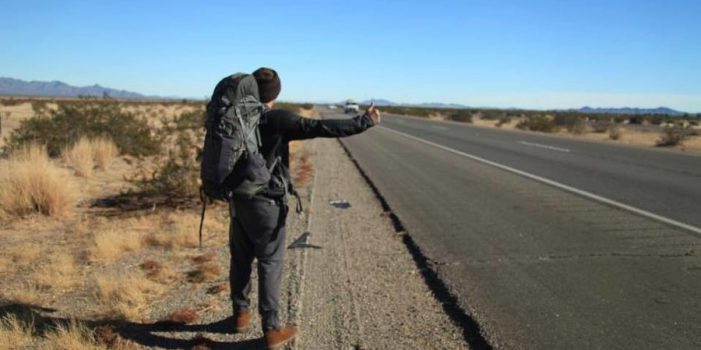
The more belongings you have, the less the chances are that you’ll catch a ride in a timely manner. A single backpack will be more appealing than a bunch of gear.
One important thing to keep in mind when you get picked up is to never put your gear in the trunk of a car, if at all possible. The chance of anyone driving off with your gear is minimal but as with all things, probabilities have to be weighed against consequences. Bugging out after losing all your gear would be a huge challenge, not only during your trip, but also when you get to your bug-out location without some of the things you considered essential for survival. A driver picking you up who already knows the feces have hit the fan, will perhaps have no supplies of his own and will be tempted to take what you have.
Many have learned about the downsides of car trunks the hard way when riding in a taxi in a Third World country. The scam is to get the tourist to put their baggage in the trunk of the taxi, quote the riders in the local currency, then at the destination tell them they said dollars, not the local currency. (Or vice versa.) Since they’re holding your luggage hostage in the trunk until you cough up the money, it doesn’t leave you with too many options. It only happened to me once, but since our backpacks weren’t in the trunk and we were already holding them as we walked into the hostel, he had no leverage. We paid him in the local currency and when he threatened to call the police, I told him he knew where to find us. The exchange rate was four of their units per dollar so the ride would have cost us four times as much money in dollars than what he quoted us.
Again, though the chance is small your gear will be held for ransom, avoid putting anything in the trunk. If lost during a bug out, the consequences could be catastrophic. The risk will increase, and the more tempting your gear will look, as more people find out they’re unprepared for what’s happening. This is another situation where you have to trust your gut as well as your common sense.
If your backpack or gear is in the back seat, when you exit the vehicle leave your door open after you get out. Next, open the back door to retrieve your gear, then with your gear in hand, shut the passenger side door as you thank the driver.
GENDER AND NUMBER OF HITCHHIKERS
Most of the hitchhikers you see are men. For the ladies, hitchhiking is far easier. While conventional thinking says you’ll probably be raped before you can even get your seat belt buckled, it’s highly unlikely and shouldn’t be a worry if you’re carrying a weapon. Some drivers will pick you up just because they always pick up hitchhikers. The majority, including people who never pick up hitchhikers, will pick you up because they’re concerned for your safety. Take advantage of that.</span>
<span style=”font-size: medium;”>The best group size is one. It should be obvious that the more people there are in your group, even if it’s just two, the less chance you’ll get picked up. The driver starts to be concerned for his own safety if there’s more than one rider. Depending on how many bug-out supplies you have with you, the other major thought in the driver’s mind is, “How am I going to fit all that gear into my vehicle?”</span>
I’ve only hitchhiked twice accompanied by another person. Both times they were my teenage sons. With the first one, we had to abandon our original travel plans after some unexpected occurrences. We were pressed for time and had to get home before my unsuspecting wife discovered we weren’t really working on the backpacking merit badge. Nobody was picking up hitchhikers that day. Finally, for humor’s sake, my son made a simple sign: WWJD? We finally got a ride. Three lessons were learned. First, it takes a lot longer for two people to get a ride than one. Second, some may pick you up if they see a little humor. Third, sometimes Christians just need a little encouragement. When we got home, my Christian wife didn’t need any encouragement keelhauling me when she discovered my son and I hadn’t really been backpacking. It was worth it though, after all these years. It is still a fond memory my son and I share. Not the tongue-lashing, the hitchhiking.
We’ve all seen people hitchhiking with dogs, another good way to decrease your chances. The majority of people who regularly pick up hitchhikers will generally pass someone up who has a dog. If I had a dog, I wouldn’t consider in a million years leaving him behind if I were bugging out, but keep in mind it will be longer between rides so work that into your plans. It can’t be stressed enough to have enough foresight to get out of Dodge before the masses realize what’s about to hit.</span>
CARRY A PHYSICAL MAP
When I mentioned in the opening paragraphs about taking a 3,200 mile cross-country trip when I was 18, a few readers probably wondered how it was possible to do that many miles on a continent that’s only 3,000 miles wide. The answer is: the shortest distance between two points isn’t hitchhiking. But a map can help to keep the distance as short as possible. On that trip all I had was a gas-station freebie map of the United States, but even lacking details it worked well enough.
Whether your GPS cell-phone app is working or not during a slo-mo SHTF event, you’ll still want to be carrying an old-fashioned paper map for the eventuality of the phone networks crashing, or your phone battery dying. You should already have a bug-out location and know how to get there, but are you prepared to take alternate routes? And if you discover that your alternate route is also crawling with low-lifes, do you know a secondary alternate route? Tertiary? Your final trip route may end up looking like the last bird’s nest in your fishing reel after that embarrassing cast, so you’ll need a map to keep finding your shortest way around the undesirables.
Another reason for the map is to be able to avoid large cities. While this is generally a good idea when hitchhiking in normal times, during a SHTF event it’ll be even more important to avoid population centers. If you have a guaranteed ride through a big city and out the other side with the person you’re currently riding with, no problem. If your ride is only going as far as a big city, you should ask to be let out at a smaller city or town before then, or even at a rest or truck stop.
Big cities have so many highways in and out that it is easy to get disoriented, or more likely, just stuck somewhere. Most people in cities are only going a short distance so they won’t pick you up.
Trying to hitchhike out of a city can often involve a lot of walking at a time when every hour counts getting to your retreat. Two of my worst hitchhiking days ever were trying to get out of Minneapolis, and Albuquerque. I spent a lot of time walking, trying to get to a better place to hitchhike. Some cities are better laid out and navigating through them is more intuitive. Hitchhiking from the Calgary airport to Montana was fairly simple, even without a map. A sure recipe for high stress is bugging out of one big city only to get caught in another.
With any luck, you’ll be hitchhiking a route you’re already familiar with and you’ll be at least somewhat familiar with the cities along the way.
Don’t be afraid to go off your intended route if it’s what it takes to get a ride, or if it can benefit you by traveling a much greater distance even if it’s slightly off course.
The most extreme version of going off course in my experiences was after the above-mentioned homosexual driver dumped me off in a place so remote I wasn’t sure why there was even an exit there. I was headed west and there was almost no traffic where I’d been dropped off. I don’t recall how many hours I was there trying to get elsewhere but it was far more than I wanted. Finally, fearing I was going to die by the roadside and be eaten by coyotes, I stuck my thumb out in whichever direction the occasional vehicle was traveling. I finally caught a ride heading due east, totally opposite of where I was trying to get to, but it got me out of there so I could try again from somewhere less remote. Lesson learned: don’t get fixated on having to travel certain roads or directions. The odds of getting a ride straight to your location on a long trip are slim to none before the SHTF, and probably less than that after the Schumer starts flying.
(To be continued tomorrow, in Part 4.)