
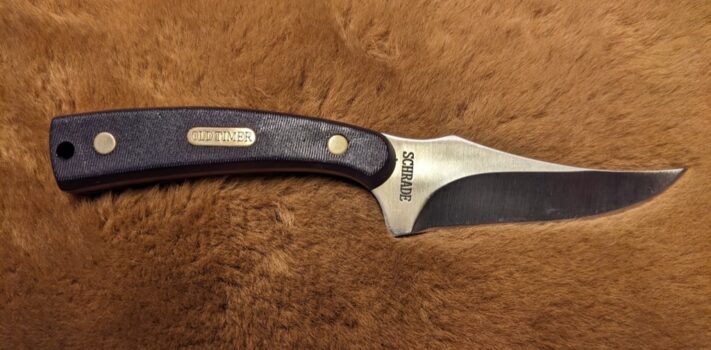


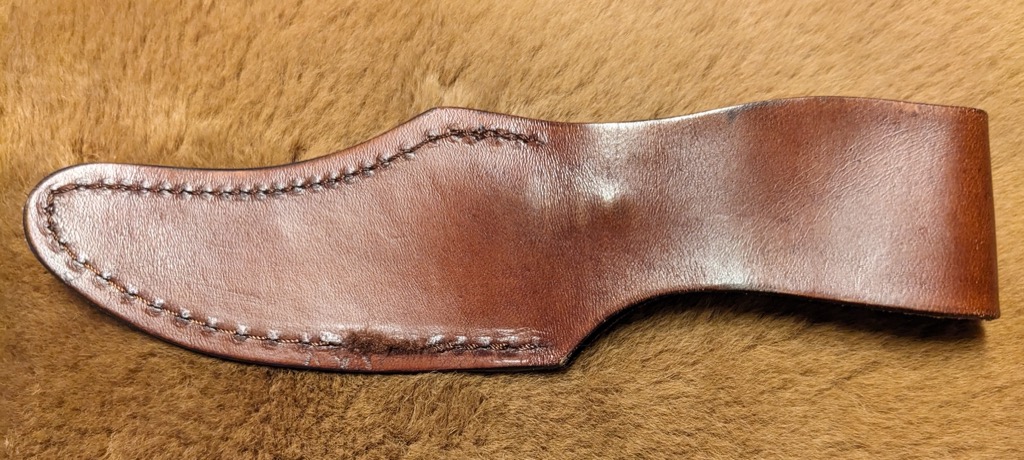
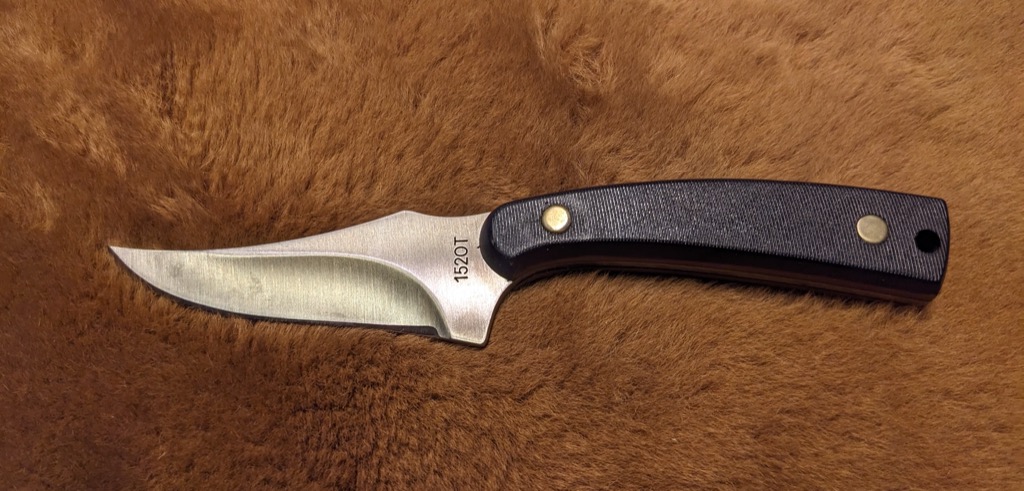
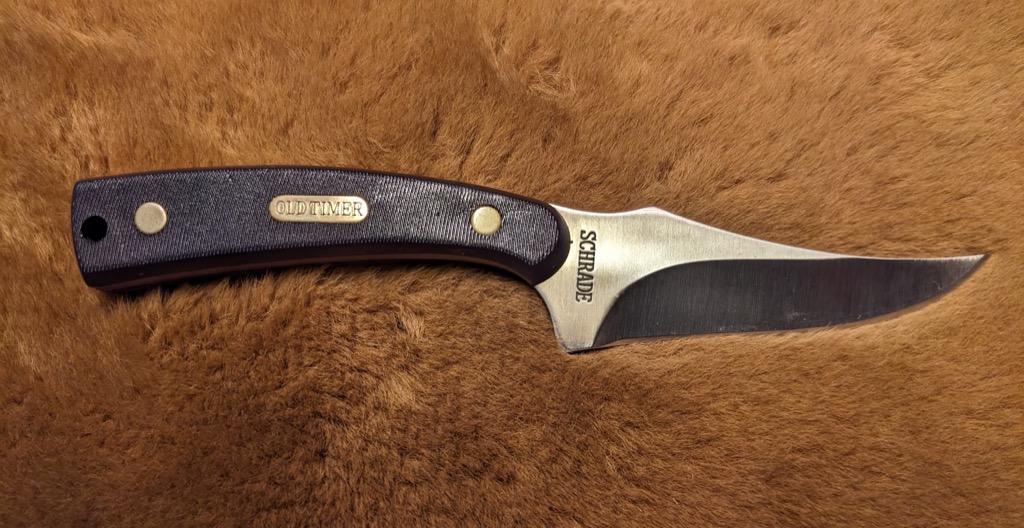
The Schrade Sharpfinger is an iconic American sheath knife design. The version that I tested has a 3.25-inch, hollow-ground blade. The tang of the trailing-point blade is 0.19 inches thick. The knife has an overall length of 7 inches. The handle is 0.75 inches thick and made of Delrin. The sheath is made of good-quality leather, is well-stitched, and has an effecitve retention strap around the handle that is secured with a snap closure.
Introduced in 1974, the Sharpfinger was continuously produced in the United States for 30 years until Schrade went bankrupt in 2004. The design was then acquired by Taylor Brands, LLC, who began producing the knife in China. Taylor Brands also licensed the design to Old Timer, who produces an American-made version.
For almost a year now, I have been carrying a Sharpfinger on the belt of my work pants. The version that I have been carrying was made in China under Schrade’s supervision during the early transition to Chinese production. I have found the knife to be sharp, durable, and unobtrusive.
At the time of this writing, a Taylor Brands version of the Sharpfinger was available at theoldtimer.com for $37.99 . It comes with a black or camo Delrin handle, a black or polished steel blade, and a brown or black sheath. There is also a large version of the knife with a 3.99 inch blade and a brown leather belt sheath. It cost $45.99 . A similar knife is the still larger Deerslayer, with a 5.6 inch blade and a brown leather sheath. The American-made version of the Sharpfinger was available for $104.99 . It has a 3.5 inch blade made of 1095HC, a bone handle, and also comes with a brown leather sheath.
If you would like a better-than-average, basic sheath knife, any model of the Sharpfinger would be an excellent choice.
Background
I have been an admirer of the Sharpfinger design ever since it was first introduced back in the 1970’s. Soon after I became Field Gear Editor for SurvivalBlog, I contacted Old Timer to see if I could review their American-made Sharpfinger for an article on SurvivalBlog. Old Timer did not choose to provide me with a sample for testing and evaluation at that time. I was bitterly disappointed.
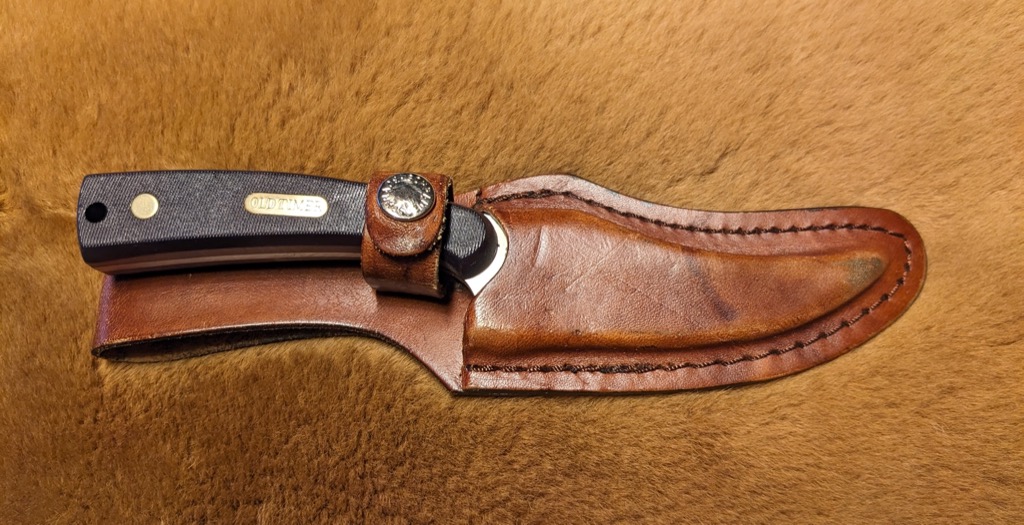
 Several years later, SurvivalBlog Senior Editor James Wesley, Rawles (JWR) sent me a box. Among a number of other wonderful items in the box, I found a Schrade Sharpfinger from the inventory of Elk Creek Company. I was very excited to finally have a chance to test the knife. As I mentioned above, the particular version that I received was made under Schrade’s supervision during the transition to Chinese production. As such, it is a somewhat rare collector’s item.
I was a little hesitant to subject a somewhat rare collector’s item to the hazards of the Thomas Christianson review process. I am afraid that I can be somewhat hard on tools and equipment. But I am a knife user rather than a knife collector, so I attached the knife to the belt of my work pants and began carrying it on a regular basis.
As I also mentioned above, over the course of almost a year of testing, I found the knife to be sharp, durable, and unobtrusive.
It Is Indeed Sharp
The Sharpfinger is well-named. It came out of the box shaving-sharp, and it remains shaving-sharp to this day.
I believe that the blade is made out of 7Cr17 steel. That is roughly equivalent to 440A stainless, which is in one of my favorite families of knife steels. I find steels in the 440 family easy for me to sharpen.
In any case, the Sharpfinger is sharp, it seems to stay sharp, and it is easy to resharpen if the edge becomes dulled. Those are all qualities that I highly value in a knife.
Durable
 As I mentioned above, I can be somewhat hard on equipment. I am not exactly careless, but I am a little clumsy at times. I sometimes walk just a little too close to the edge of a door frame when I am passing through. Sometimes I tighten a screw just a little too much. Sometimes (often?) I pry with a tool that is not really intended for prying. As a result, my equipment tends to look “well broken in” a little more quickly than I could wish.
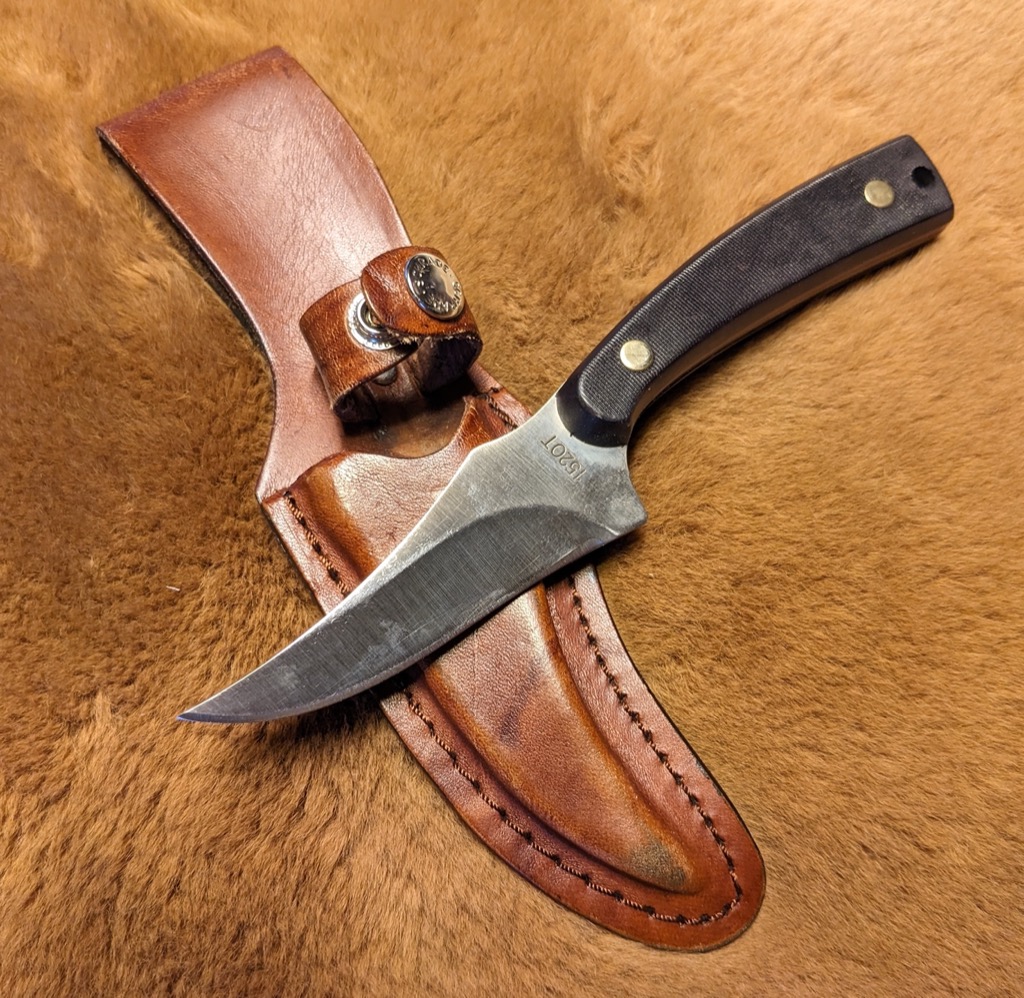
But after a year of regular use, the Sharpfinger still looks almost pristine. The metal still shines, the handle is unscratched, and the sheath is unstained. I am not 100% sure why, but the Sharpfinger is holding up to regular carry better than any other sheath knife that I have tested, but I am happy about it.
Unobtrusive
 The Sharpfinger does a wonderful job of not getting in my way while I am carrying it on my belt. I can lay on top of it while changing the oil in my truck without noticing that it is there. It doesn’t catch on anything while I am climbing into or out of the driver’s seat of a vehicle. It doesn’t get in the way when I am putting on a pair of insulated coveralls or taking them off.
Such unobtrusiveness carries it own set of risks. I can imagine myself as the main character in an action movie. I am sneaking up on the bad guys’ hideout. I accidentally trigger one of the booby traps that protect their camp. A net falls from a tree and entangles me in its meshes. Hours later, a bad guy patrol discovers me still trying to get loose. They ask, “Why didn’t you just cut yourself free with your knife?” I look down. There is the knife, still on my belt. It is so unobtrusive that I have forgotten that it is even there.
The Sharpfinger is so unobtrusive that I often forget that I am wearing it. I will be out working on the property, and suddenly notice that I need a knife. I forget all about the Sharpfinger, and instinctively reach for my EDC knife instead. That is great for EDC knife testing, but less helpful for Sharpfinger testing.
Testing
I did not completely forget the Sharpfinger every single time. I used it for cutting wild rose branches that were hanging over the driveway. I used it to cut branches that I had missed with the chainsaw from rounds that I was preparing to split. I used it for some other tasks as well. The knife worked great every time I used it. But for every time that I remembered to use to Sharpfinger, there were at least ten times that I completely forgot that it was there and used my EDC pocket knife instead.
George Schrade
The “Schrade” portion of the name of the Imperial Schrade Corp. comes from George Shrade, who was born in Williamsport, Pennsylvania on February 13, 1860. One of George Schrade’s chief claims to fame was that he patented one of the first practical switchblade designs on March 8, 1892.
Genius does not always bring unbridled success. After unsatisfying collaborations with various American knife makers, George moved to Germany and set up a factory in Solingen in 1913 to make his knives. Not long afterward, all of his equipment was confiscated by the German government at the beginning of World War I.
George returned to the United States in 1916. He began working for Challenge Cutlery in Bridgeport, Connecticut in 1919. Over the course of the next decade, he patented several more knife designs.
In 1929, Challenge Cutlery went out of business. George acquired their equipment in lieu of payment for royalties for their use of some of his designs.
In 1940, George died. His family carried on the business.
Or it might be more accurate to say that the family carried on the businesses. Evidently George owned two companies. One was sold in 1946 and the other in 1956. The one sold in 1946 eventually became a part of Imperial Schrade. The one sold in 1956 ceased operations in 1958 when congress outlawed the sale of switchblades across state lines. That second company had been the primary supplier of switchblades in the United States from 1907 to 1958.
So the German government ruined one of George Schrade’s businesses, and the American government ruined another. The third became a part of Imperial Schrade and survived until 2004.
George Schrade is most famous for his various folding knife designs, but the company that bore his name was probably best known for one of its fixed blade designs, the Sharpfinger.
Conclusions
The Sharpfinger is an iconic American design. It comes razor sharp. It is easy to maintain its edge. It holds up well under rough use. It is good at staying out of the way when you don’t need it (and sometimes, even when you do need it).
If you need a better-than-average, basic sheath knife, I highly recommend the Sharpfinger.
Disclaimer
SurvivalBlog’s Senior Editor James Wesley, Rawles (JWR) provided me with a Schrade 152OT Sharpfinger from the inventory of the Elk Creek Company. I tried not to let his kindness interfere with the objectivity of this review, and I believe that I have succeeded. I did not receive any other financial or other inducement to mention any vendor, product, or service in this article.