


Time to start the garden and not spend time watching world news. I can’t change a thing that is happening, but I can grow food and pray. I must stay focused on the farm and move forward rather than spend time fretting and scanning “the news”. Fear can be paralyzing. Growing food and praying are the most important things I can do, at this time, in this place.
Unless we get a surprise Spring cold snap, which is likely, the weather should be fairly mild temperature wise, from here on out for my location in Tennessee. Our long range weather forecast looks mild (in the 60’s and 70’s Fahrenheit during the day, and above freezing at night), so it’s time to begin gardening no matter what date it is. Last year, I waited until our forecasted “last frost date”, and quickly learned that I planted too late in the year. It got hot early in the year, and then the garden pests moved in, and while the garden looked great for a few months, it was all downhill after that. I’m trying to pay attention to the actual weather rather than typical planting dates for my zone (zone 7). I could be completely wrong since the weather never asks my permission to do what it does. But, here we go.
Fruits and Vegetables
I have used various garden planning calendars, taken copious notes, even created spreadsheets! Now that I have a few years of success and failures under my belt, I honestly don’t need any of those tools. It boils down to “what do I want to grow/eat?”, and “when can that be planted?” I turned myself into pretzels trying to get the companion planting, pest control, rotational planting, etc., all figured out. It’s not worth the time, to me, to do that much planning. The bottom line is that some plants can tolerate cold, and some plants like it to be warm. That’s it, plus a little knowledge about the “nightshade” categories (tomatoes, potatoes, eggplants, and peppers) and pest control. I have 19 raised beds now that are full of dirt and compost, ready to go.
In February, I had a large amount of mushroom compost mixed with top soil brought in, cleared the garden of dead weeds and debris, and topped off the garden beds. I ripped up the vinyl sheeting that was used as ground cover, and seeded the ground with clover and grass seeds. I was shocked at how much seeds costed, but used about 150lbs. My plan is to just mow between the beds, and around the trees and bushes, after trying out various ground coverings and strategies to keep the weeds at bay. A reminder that the garden is approximately 8,000-10,000 square feet, and contains the raised beds, a small orchard, flower garden, and berry patch. It is double fenced where the deer want to come in, and the livestock guardian dogs have access to keep the rabbits, cats, and voles out. I have found the dogs to be more effective than any other method. My current pack of dogs are not diggers, although they occasionally jump up into a garden bed to take a nap.
My gardening focus this year is to grow “staples”: onions, garlic, potatoes, carrots, winter squash, tomatoes. I will also grow the usual plants for fresh eating (squash, lettuces, peas, beans, watermelons, etc.). I talked to a neighbor who does an amazing job of growing tomatoes and asked if they wouldn’t mind growing extra that I could purchase from them. I only asked because they told me that they threw tomatoes away last year because they had so many. Horrors! I decided to not grow corn and purchase sweet corn from them since they sell their delicious corn. I am looking for ~60-100lbs of paste tomatoes for canning. I am also going to start my own paste tomato plants in the house for transplanting, and between the two families we will hopefully have plenty. I have not had great success with finding and purchasing good tasting tomatoes locally. The tasteless tomatoes in the stores should be ashamed of themselves. I’ve had a terrible time trying to grow them myself, yet I keep trying. And the one farm I depended upon who did grow great tomatoes closed down this past year due to health issues. Tomatoes are important because they are the base ingredient for so many things, such as ketchup, BBQ sauce, marinara sauce, pizza sauce, tomato juice, and as a base for soups and stews. In my opinion, you can’t have too many tomatoes. During tomato harvest season, I throw them in plastic bags, whole, and put them right into one of the large freezers so I can process them at my leisure.
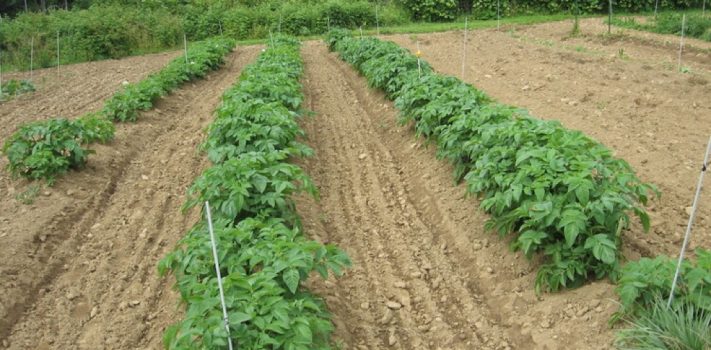
This past week I pulled out all the old potatoes from last year (4 varieties, half white, half red) from the storage room, inspected them, trimmed off some of the long roots, and planted them. I ended up with about 30lbs of “seed potatoes”. I think I guesstimated that I had grown 150+ pounds of potatoes last year and had shared them with family. This year I hope to increase that yield, but I’m using my own seed potatoes rather than purchasing new seed potatoes. If it goes well, I can expect about 3-5lbs of potatoes for every pound of seed potatoes planted. I don’t know how successful that will be, but I’m sure that’s how our ancestors did it. I want to at least try. If I am not successful, there are a lot of sources near me for potatoes I can purchase in bulk (we have a large Amish community nearby). Or if the early summer crop is dismal, there is still time to plant for a Fall crop of potatoes with new seed potatoes.
I have two sweet potatoes placed in quart jars, sitting on a window sill, half full of water (half the potato above the water, half the potato in the water). They are growing roots in the water, and should sprout “slips” above the water. A “slip”, in case you don’t know, looks like a small plant growing out of the potato. Once the slips have grown a few inches long, I pick them off the potato and put them in a jar of water wherein they grow long roots. When the soil is warm enough (around 75F degrees), I plant the slips in the soil. I also ordered slips in case my slips fail. Now is the time to start growing slips.
I planted carrot and lettuce seeds in raised beds, seeded and mulched heavily in case we get a good frost. There are a few beds that were planted in garlic and onions in the late Fall, mulched well, and a large strawberry bed that I mulched before winter. I planted some thornless blackberry bushes in the ground as a continuing line to the raspberry bushes. A neighbor was cleaning out their blackberry patch, and was willing to share with me. Last year I planted some blueberry bushes, but I am not sure they made it through the Big Freeze. I’m slowly trying to increase the number and kind of berries here. Fortunately, elderberry grows wild here. I did not prune the small orchard trees, preferring to see if they have survived the Big Freeze. The trees didn’t look so good in the Fall, and I’m not sure if they had a disease or if the Cicadas attacked them. A reminder that this is the second orchard I have planted, and chose a different area. I must not be very good at tending to young trees. I selected apple, cherry, pear, pecan, and fig trees – about 20 trees. I have a lot to learn.
This week my goal is to plant brassicas, collards, spinach, snap peas, radishes, and lots of Nasturtium seeds. The Nasturtium blooms will bring in lots of early pollinators and give the garden some color. I like to plant them in every garden bed. All of the above can be planted a month before the last frost date, which for us is in April this year. I have been delighted to see a large row of sunflowers that I planted years ago, come back year after year. Each Fall, I throw some more seeds on the ground to increase the number of sunflowers, and the sunflowers themselves drop their seeds in the Fall.
I have a large compost pile in the garden that is not really a compost pile. It’s a garden clean up pile and has everything in it from dead weeds to soil. It’s a fairly large mound. I am going to use it to plant the pumpkins and watermelon seeds in. If it works, it’s brilliant because rather than the vines spreading out and taking over the garden pathways, the vines can work their way down the mound. I found that planting vining plants in raised beds is silly since they take up so much room they outgrow the garden beds quickly. This will, at least, protect some space.
Last year, one of my experiments was to plant Virginia peanuts, and those plants did very well! What I quickly realized though, is it takes a lot of peanuts to make peanut butter, and I’m not sure I want to give up the space just because I think organic peanut butter costs too much. Decisions, decisions.
Another failure was the winter squash and melons. I planted them too late in the year and by the time they should have been ripe for picking, the pests had moved in. The squash bugs are a force and they quickly devastated all the squash, melon, and pumpkin beds and I lost a lot of produce. I tried every organic method I could think of, and am armed with Neem oil, etc., but I think the biggest problem is the weather. Squash bugs love the heat. So, I either plant early before the bugs get going, or late in the season.
All that to say, gardening has started in earnest. Tomorrow, I will share about the protein plan for this year.
(To be concluded tomorrow, in Part 2.)