


The following is an overview on the installation of a new gun part known as the Hoffman Tactical Super Safety. It is a do-it-yourself open-source forced reset mechanism characterized as an “active reset trigger system.” It makes your AR go fast. If you do not approve of guns going fast, then please don’t read this article. You can desist from clutching your pearls and return with alacrity to the closest available nursing home, the banned books section of Barnes and Noble, or the United Methodist Church. Your cat misses you. Everything discussed in this article is currently legal at the Federal level and in my current state of Arizona. Nothing discussed herein is legal advice. Consult ATF rulings, a lawyer in your state, and your state’s laws, since some states do ban this kind of device, and others. I am not your lawyer, your doctor, your priest, or your real dad. Nobody paid me to write this and I am not personally acquainted with any third party mentioned herein.
Practical Background, Overview, and How-To
First: What is an FRT? An FRT is a “Forced Reset Trigger.” It functions by using a firearm’s cycling action to push the trigger forward to force the trigger to reset. This greatly increases the rate of fire by making it quicker for you to pull the trigger, consecutively. It is not a machine gun, under the laws of this country, as written, and for now these are not being treated as machine guns AT THE FEDERAL LEVEL. Machine guns are defined mechanically, as we’re all mostly likely aware, as any “firearm which shoots, is designed to shoot, or can be readily restored to shoot, automatically more than one shot, without manual reloading, by a single function of the trigger.”
The verbiage of “single function of the trigger” means that a mechanical contrivance under which you hold down the trigger and a bunch of bullets are fired, would be illegal for most of us to own. However, counterintuitively, a device which is essentially a helpful little mechanical buddy that lives inside your gun and helps you quickly re-pull the trigger a bunch of times, really fast, is another type of device entirely. Again, a FRT is perfectly legal at the Federal level, regardless of actual achieved rates of fire. Thus, as of this writing, it appears that FRTs are legal, though I will add that from my understanding only one specific brand is named in official rulings as legal, and the creators of that design are aggressively suing any company that makes another even vaguely similar design, with the ATF’s support. This is even the case for the Hoffman Tactical Super Safety, which is completely mechanically divorced from anything remotely resembling this certain company’s (admittedly very good and reliable) design.
The Hoffman Tactical Super Safety Overview
The Hoffman Tactical Super Safety entirely differs from the Rare Breed trigger (RBT). It is an open-source, 3D-printable, CNC-machinable, and widely compatible Forced Reset Safety. It gives you three selectable positions in its most common form; Safe, Semi-auto, and “Super Safe”. The latter is the active trigger/forced reset mode. It is compatible with both mil-spec and Geisselle triggers. It takes the form of two base components, along with two standard AR-15 fire control group parts that are modified a little bit. The base Super Safety consists of a cam, a little round cylindrical piece that is going to be your push-button style external safety, and a lever, which slides into a dovetail inside the cam once inside your lower. While these are best made in some kind of durable tool steel (mine are D2 steel, but S7 and 4140 are also common) they can be made in other materials such as nylons with reduced long-term usefulness.
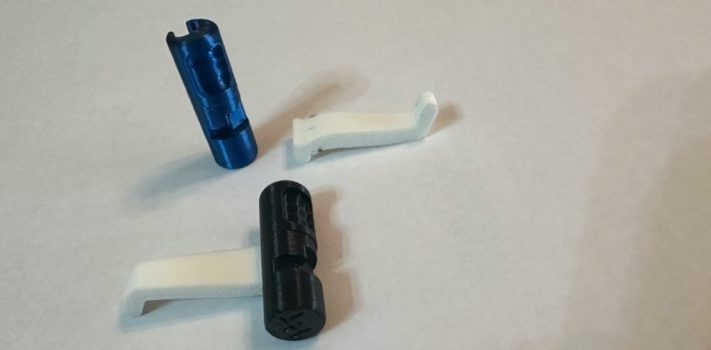
The photo at the top of this article shows some demonstration models I printed in regular old PLA plastic. They would shatter if actually installed. The lever is shown in white, and the cams are two different colors. The lever slides into the dovetail, and there are little ridged channels on the underside of the cam to provide your safety positions. In the middle sending, there is an angular shelf on the cam. This is what pushes against the trigger to force the reset when in the middle position. Once parts of requisite hardness are properly installed, you will have a durable and reliable forced reset mechanism, at the admittedly irksome cost of now having a push-button safety on your AR, much like those found on a Ruger 10/22 or a Remington 870. I’m still practicing with this and have gotten okay dry-fire times but it is definitely enough of a learning curve that those of you with lots of invested time and muscle memory on the AR-15 will most likely be drawn to the traditional style selector switch offered by Rare Breed or other manufacturers. So why did I pick the Super Safety? My basic bullet points follow:
- Cost: This is the biggest one. As a result of Hoffman releasing the original files to the DIY gun/3D2A community, there are dozens of manufacturers all making these in a variety of materials, which has introduced some significant competitive pricing. (DO NOT buy the $40 garage-made specials via Facebook, because frequently those guys aren’t heat-treating parts properly). My D2 steel models I’ve purchased to install on myself and some associates’ rifles all ran about $75 apiece for just the cam and lever. That’s a significant saving compared to the other designs. Also, I was actually able to buy these in cash from a buddy from my old police department job who has a CNC setup, which provides some nice anonymity since these by nature exist in a bit of a hazy future with regard to legality. Other vendors besides my friend offer very similar prices. Hoffman also briefly sold them himself after a couple of years of only distributing the files for free, and I was going to suggest in this article that they be purchased from him, but as of this writing he was forced to postpone sales due to a restraining order caused by an ongoing ridiculous patent infringement lawsuit. Fortunately for you, there are other manufacturers. But once he opens back up, he deserves the business, as he’s done more to get forced reset devices into common use than anyone else. Or, make it yourself, if you have the know-how. Open-source technology is fun like that.
- Open-Source Nature: This means that the barrier to entry is much lower, and there is a fairly well-documented community in various corners of the internet that has put a lot of time and effort into troubleshooting these things, including on Hoffman’s own forum, Odysee (a LBRY-derived video platform), YouTube, and Reddit (RIP r/FOSSCAD). This has also resulted in them being adapted for other platforms, including MP5 clones, AR-10s, and there are a couple of gents currently working on prototypes for the M249S as well as some maniac attempting one for the semi-auto M240. (As a side note, there has been a pronounced increase of interest in belt-fed AR-15 systems lately, very much related to the Super Safety’s popularity, but those are still out of my tight budget).
- Strength and Simplicity: I never got bumpstocks or hellfire triggers or any of those dumb things because I do not like having doohickeys in my gun. Some of you might consider an FRT or Super Safety a doohickey and I understand that but a Super Safety is actually simpler in some ways than several of the illegal ways to make your gun shoot fast, such as drilling the third hole and installing a FA trigger pack or making a drop-in austosear (DIAS). The RBT is, according to this review (language warning) quite durable, but again at a much greater cost, and is a little more internally complicated, with several new springs and small machined parts. The Super Safety has two stout pieces of heat-treated tool steel (they can also be produced in 3D-printed PA12CF nylon and last several hundred rounds or be cast in bronze with unknown and untested longevity) and I find that to be fairly reassuring as far as long-term mechanical reliability. As a caveat, I will say that most “reviews” on these things are designed to generate revenue for one of several maker’s particular businesses and are pretty cursory; some dweeb shows one installed, mag-dumps into trash, then says it’s solid and tells you where he got it. There are a few long-term reliability reviews on the RBT as linked above. The YouTube channel BrassFacts is really the only guy I’m aware of who has conducted significant durability testing on a stainless steel Super Safety, testing one (he says his is aluminum in the video but this is a flub as those don’t exist) using it for over 3,000 rounds in both a regular AR-15 and a Fightlite MCR belt-fed with good results. That video can be seen here. (Severe language warning!)
- Privacy: As mentioned before, these can be homemade by an individual or purchased with cash.
- Compatibility with Nice Triggers: The RareBreed Trigger style is, as the FRT name implies, itself a trigger. With the Super Safety, you can use a Geisselle trigger with only a slight modification which is a really nice upgrade option to have.
This ends my overview of the Super Safety and why it was chosen. Next, we will move on to installation and function checking. This will cover the modifications to install a Super Safety on only a standard 5.56mm AR-15. The MP5 and AR9 models are very popular but do require extra parts as well as some other considerations. A successful 5.56 install will help you get used to what you’re dealing with as it is by far the most straightforward.
(To be concluded tomorrow, in Part 2.)