
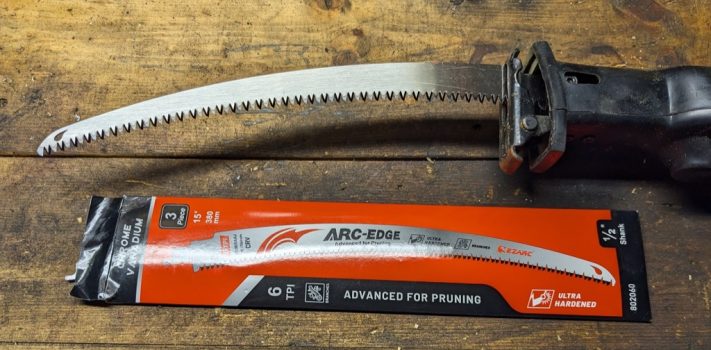


The EZARC ARC-Edge Reciprocating Pruning Blade is designed to make a Sawzall or similar reciprocating-blade-saw into a pruning tool.
The 15-inch, chrome-vanadium-steel blade has an aggressive tooth design optimized for pruning with five teeth per inch. A shorter 12-inch version is also available.
I tested the 15-inch version. Based on my testing, I would suspect that the shorter 12-inch version would work better than the 15-inch version. The extra length of blade that extends beyond the object being cut tends to whip violently to the left and right as the blade moves backward and forward. This creates extra friction, vibration, and blade fatigue without contributing anything to the cutting process.
At the time of this writing, a pack of three blades of either length cost $29.97 at ezarctools.com . The blades are made in Mainland China.
During my testing, I found the EZARC blades to be more effective than the pruning blades that I had previously used on my reciprocating saw. Unfortunately, those other blades worked so poorly that “more effective” still does not constitute “highly effective.” I would recommend looking for some other tool for pruning rather than a standard reciprocating saw.
Background
I ran across an online ad for a “Japanese Teeth Reciprocating Saw Blade.” I had recently tested a Japanese-made handsaw and had been very impressed with how well it cut. I thought that the tooth design that made that handsaw so effective for pruning might also make a reciprocating saw effective at that task.
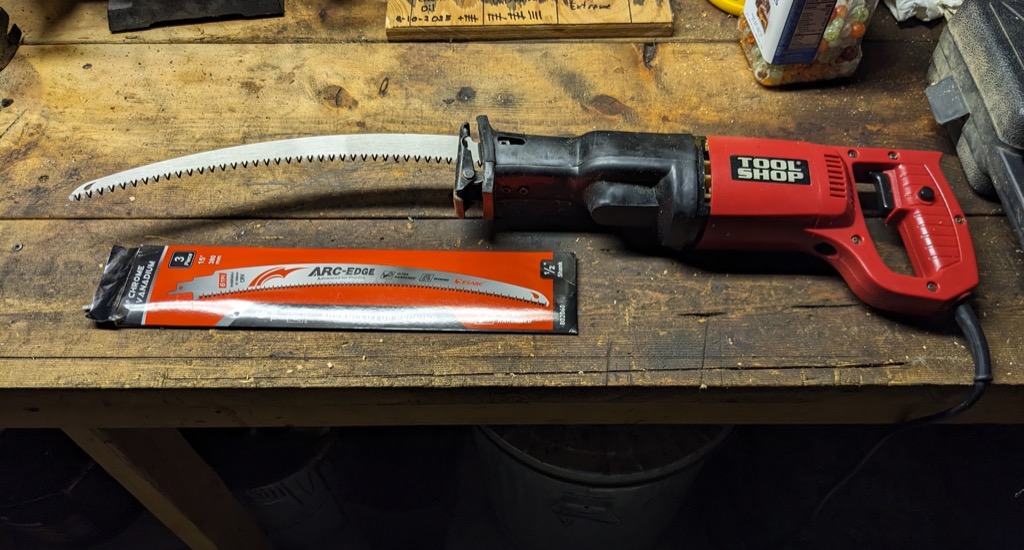 I contacted EZARC Tools to request a sample for testing and evaluation. They were kind enough to agree. Not long afterward, a 15 x 13.75 inch padded envelope arrived at my home. I was not home when the package was delivered, and the shipping label did not identify a carrier or a return address. The shipment just mysteriously appeared on my porch.
The padded envelope contained a packing list and a paperboard sleeve containing three pruning blades for a reciprocating saw. The sleeve measures 14.75 x 3.25 inches. Much useful information is imprinted on the sleeve.
Each blade is 15 inches long if measured along the curve of the blade. It is slightly shorter than 15 inches if measured straight from the end of the shank to the tip of the blade. The actual cutting edge is about 13 inches long.
The shank is ½ inch. There are roughly five or six teeth per inch (metric measurements don’t always convert into round numbers of inches). The blade is made of chrome vanadium steel.
The real shocker was that the words “Made in China” were imprinted on the sleeve. I had been distracted by the words “Japanese Teeth” in the ad. Those words led me to believe that the blades are made in Japan. Instead, the blades have Japanese-style-teeth but are made in China.
I was reminded of a passage in “Shooting the Chick-a-nout Narrows” which is a short story by Patrick F. McManus’ which is included in the collection A Fine and Pleasant Misery. The passage relates to one of McManus’ experiences at an army surplus store that he had frequented in his childhood:
“I was glad to see that he [the proprietor] hadn’t changed over the years, and was reminded of the longstanding business arrangement we had worked out between ourselves when I had frequented his store as a kid: Grogan would try to sell me every worthless, rotten, rusty piece of junk he couldn’t peddle to anyone else. I would buy it…
Now, of course, I was no longer a kid still wet behind the ears. I chuckled to myself at the thought the old codger might even now try to pull a fast one on me.”
McManus goes on to describe his purchase of a surplus rubber life raft from Grogan:
“I was so elated at having found a raft that I had it home and half inflated before it occurred to me to feel behind my ears. Sure enough, definite signs of moisture.”
I diligently try to avoid requesting Mainland Chinese-made products for review. Every once in a while, I go for several months without requesting an item that I subsequently discover to have been made in Mainland China. Whenever I manage to pull that off, I begin to think that I am finally getting clever. Then something interesting catches my fancy, and I think I know where it comes from. Before I know it, I see a “Made in China” label and feel behind my ears. Sure enough, definite signs of moisture.
By the way, I highly recommend all of Patrick F. McManus’ books. A Fine and Pleasant Misery was the first McManus book I ever read, but it was definitely not the last. I received it as a Christmas or birthday gift from my parents back many decades ago when I was a teen. The ragged dust cover has been ripped and repaired with tape. Pages are loose and ready to fall out where the binding is broken. I have enjoyed reading the book many times over, and hope to enjoy reading it many more times in the future.
Cool Hand Luke’s Test
I gave one of the blades to my friend, “Cool Hand Luke.” He regularly uses a Sawzall for various tasks. I was eager to hear his impressions of the blade.
Luke used the blade to cut out some good-sized roots from a pine tree that he had taken down. Cutting roots is just about the toughest job that a blade can undertake. The grit on the roots wears down the teeth rather quickly.
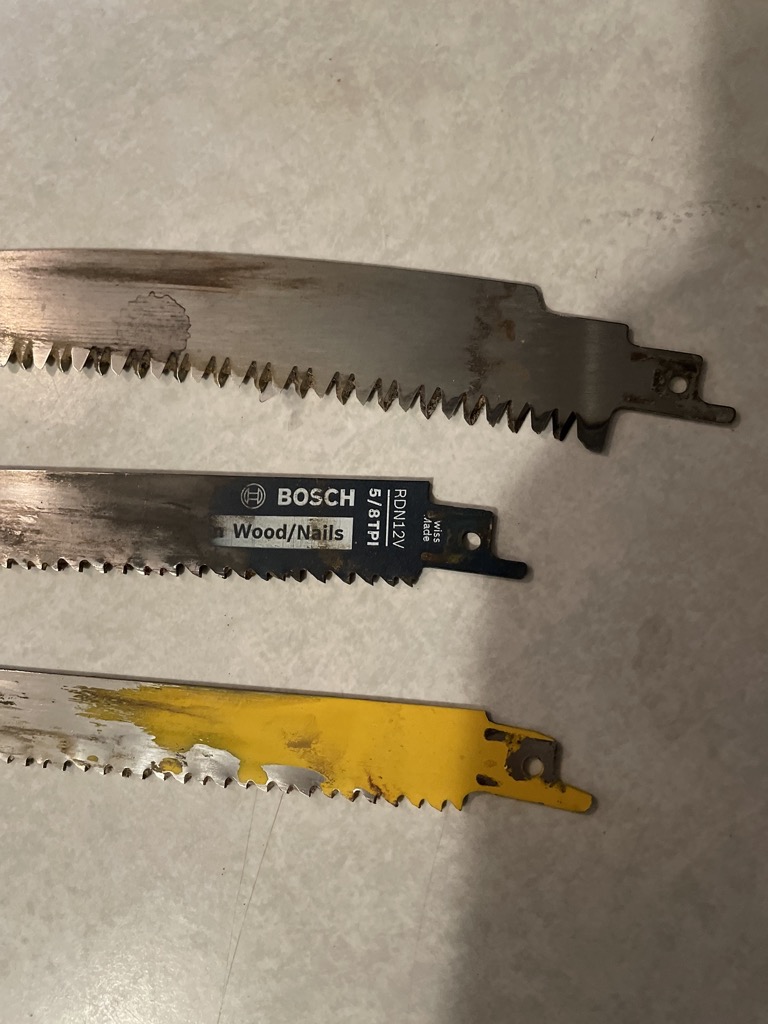
 Luke tested three blades on the job. A DeWalt blade wore out after cutting only three roots. The EZARC blade lasted long enough to cut five roots, largely because it was so long. After the teeth in each section of the blade wore out, he could cut with a different section of the blade. Luke got the best results with a Bosch Demolition Blade. He was able to cut 10 roots with the Bosch blade.
My Testing
I first attempted to use the saw to shorten a couple of wheelbarrow loads of cordwood into shorter lengths. I had sawn the rounds from which the cordwood was split into longer lengths to fit in our outside wood boiler. Then I needed some 16 inch long cordwood to fill the wood box for the wood stove in the living room. I needed to cut about three to five inches from the end of each piece of cordwood so that it would fit well in the wood stove.
I set a piece of cordwood on a stump, and tried to cut it using the EZARC blade in my reciprocating saw. The task did not go well. It seemed to take forever to get halfway through the first piece of cordwood. At that point, the kerf bound the blade so tightly that it pulled the tang right out of the saw in spite of the fact that it had been tightly seated. I put the reciprocating saw away, and elected to use my corded electric chainsaw to finish the task.
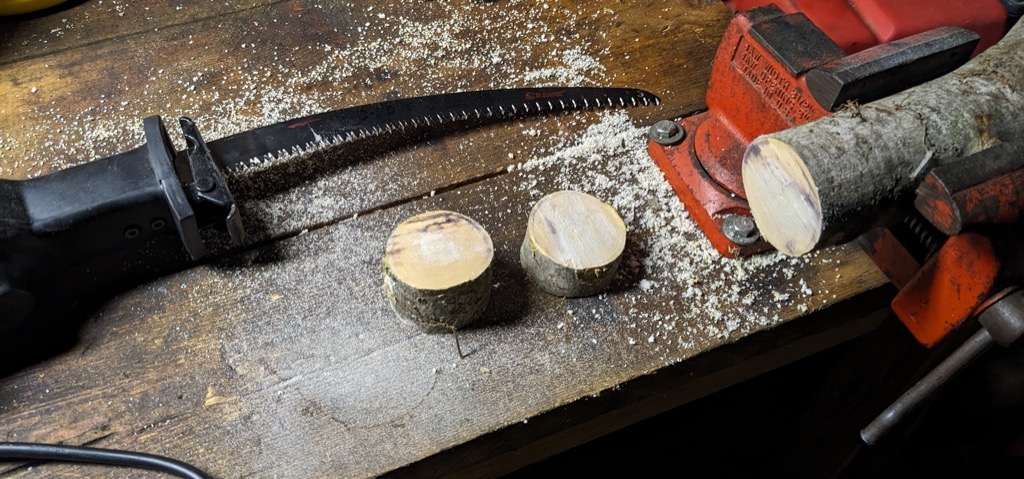 Later, I took a section of a 2.5 inch thick branch into the pole barn and secured it in the vise on my workbench. I then cut it using the EZARC blade in the reciprocating saw. The process took 21 seconds. Next, I fasted a Skil “The Ugly” pruning blade into the saw. This is the blade that I had always previously used for pruning with the reciprocating saw. Cutting through the 2.5 inch section of branch took 33 seconds with the Skil blade.
Finally, I cut through the branch using a Silky Katanaboy 700 handsaw. That process only took 11 seconds.
So the EZARC blade worked better than the Skil blade, but it was still easily outperformed by a handsaw.
I wondered if Luke’s DeWalt brand saw was more effective for pruning than my inexpensive Tool Shop brand saw. I borrowed Luke’s saw and tested it with the EZARC blade on a 2.5 inch branch. Luke’s DeWalt did not perform any better than my Tool Shop brand saw.
A standard reciprocating saw does not seem to be an effective pruning solution. It is possible that a Milwaukee Tool Super Sawzall would be more effective. The longer stroke length and the option of selecting the orbital action mode may make the Super Sawzall better at pruning than a standard reciprocating saw. If any SurvivalBlog readers have any insights regarding the Super Sawzall or any other blade or technique suggestions that would make a reciprocating saw an effective tool for pruning, I would welcome their comments. Please submit such comments to JWR for the weekly Snippets column, or send me a message at ThomasKChristianson at gmail dot com.
Conclusions
An EZARC pruning blade does not seem sufficient to transform a reciprocating saw into an effective tool for pruning. It works better than any other pruning blade that I have used in a reciprocating saw, but that is not saying much.
I would instead recommend a small chainsaw or one of the various sized curved-blade Silky hand saws. They are each more effective than a standard reciprocating saw, even when that reciprocating saw is equipped with a purpose-built blade like the EZARC pruning blade.
Disclaimer
EZARC provided me with a sample of their reciprocating pruning blades for testing and evaluation. Silky had provided me with a sample of their KatanaBoy 700 saw for a previous review. I tried not to allow the kindness of these vendors to interfere with my objectivity in this review, and I believe that I have succeeded. I did not receive any other financial or other inducement to mention any vendor, product, or service in this article.