
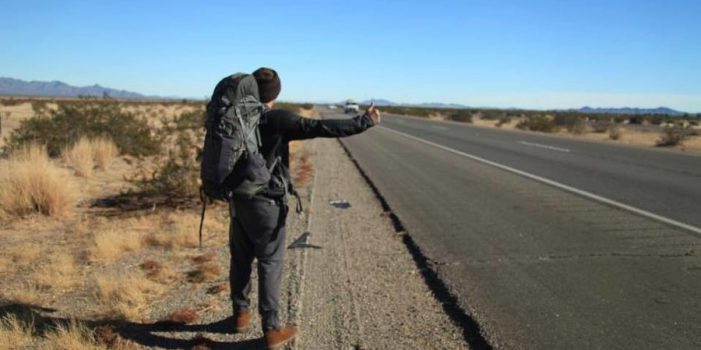


In case the Powers That Be ask our opinions about how the world as we know it should end, I’m going to recommend the slow-motion kind that takes a few weeks, rather than an instantaneous welcome-to-Teotwawkiville atomic explosion or EMP. That will give die-hard preppers time to top off their supplies and buy that extra pallet of Thin Mints, but more importantly, give those with a bug-out retreat time to get there before the final SHTF events usher us into TEOTWAWKI.
For those who find themselves up Schumer Creek with no reliable means of travel to their bug-out location; for those college kids who don’t own a vehicle and need to get home as the Schumer is beginning to fly; for those who are standing in the driveway cussing the old jalopy because the starter just couldn’t handle one more start; for those broken down on the side of the road because microchip #27 of the 166 chips in your vehicle gave up the ghost; for those who find the battery in your EV ran out of power during the most critical voyage of its life; and for all the rest whose transportation for a million other reasons won’t be taking them to their retreat, hitchhiking can a viable means of travel.
One of the more important things to consider when making bug-out plans is that time will be of the essence, literally every hour will count. The closer the days get to the actual SHTF final event, and the more the masses are beginning to realize what’s coming, the truer this will be. Foresight will be imperative. Many who are bugging out will wait until the last possible moment, afraid that maybe it’s just a false alarm. Better to leave early and have to call in sick or take some vacation days if it really was a false alarm, than to find yourself up Schumer Creek worrying about trying to get out of Dodge after the mayhem begins.
Once things get into full swing and the general population starts panicking, the more dangerous hitchhiking will become. At some point, those preppers who procrastinated too long before beginning their bug-out may have to face the decision of risking losing some or all of their bug-out supplies, or not getting to their retreat at all. Hopefully, the majority of their survival food and equipment will already be at their retreat or shelter-in-place location.
This article is written based on my experiences hitchhiking in the US and abroad, and my experiences picking up hitchhikers over the years. I hitchhiked home as recently as last year when my farm truck had a problem that wasn’t DIY fixable. I was standing on the side of the road with my thumb in the air as the tow truck disappeared over the horizon. It wasn’t long before a guy picked me up, drove me the 10 miles home, and even went out of his way to drop me right at my front gate.
SOME SCENARIOS WHERE FEW OPTIONS EXIST
The most common situation I can think of where hitchhiking would be necessary as the Schumer is in its early stages would be for a college kid trying to get home. For me, at one university I attended the distance to hitchhike home would have been 675 miles, and most likely a minimum two-day trip.
One actual event, had it happened to me as the feces were hitting the fan, would have required me to eventually abandon my vehicle and hitchhike the last 160 miles.
While driving 250 miles home, my pickup lost power and I coasted to the side of the road. Cell phones hadn’t been invented yet. My dad and I had rebuilt the engine so I was pretty familiar with everything under the hood. After trying every conceivable thing, I finally pulled the distributor and discovered it was toast and had to be replaced. Meanwhile, several hours had passed so by the time a good Samaritan towed me into town, the parts store was closed. On Saturday morning they said they could have a new distributor to me by Monday around noon.
Now, imagine my stress level had this been a real SHTF situation and I’m trying to get home to my wife and kids. I was sleeping in my pickup and imagining what’s happening back home, and wondering if the distributor will even show up on Monday as the world is falling apart. Sitting there, twiddling my thumbs and worrying myself sick over my family, would have left me no realistic options other than to abandon my vehicle and hitchhike home. As soon as the guy at the parts store told me I’d be waiting until Monday at noon, and thinking about the time to install it, plus the three-hour drive home, in a real SHTF scenario I’d have been out of there with my thumb in the air in no time flat, hoping the SHTF signals were all a false alarm and I’d be able to come back later for my vehicle.
Earlier this year I stopped to help an older couple whose later-model pickup was DOA on the side of the road. They were in a similar situation: he’d been working on it for hours, three hours from home, and 15 miles from the nearest backlogged mechanic. Had the Schumer started flying, what would their options have been to get back home or to their retreat?
So, the reality exists that situations could arise where hitchhiking might be a reasonable option to consider in order to get to wherever it is we’re going as the S is hitting the fan.
HITCHHIKING CONVENTIONAL WISDOM
Hitchhiking is another item on the long list of conventional wisdoms which are conventional but not containing as much wisdom as people generally believe. We hear all the scary stories which, for most part, exist only in the imaginations of those who’ve never done any hitchhiking. Many of these stereotypes are created in Hollywood for entertainment’s sake, but aren’t very common in real-life situations. In my own travels, I’ve had more positive experiences than I can remember with those who’ve given me rides, and with those I’ve given rides to. For me, the unexpected kindness of strangers is always a heart-warming experience.
With somewhere in the neighborhood of 7,500+ miles on my thumb, I thought I’d share some thoughts on bugging out via hitchhiking when, for whatever reasons, all other options have been exhausted.
My longest journey was a 3,200-mile cross-country trip when I was a young lad of 18 who had no other viable means to get home. I didn’t own a vehicle or have money for bus fare, I wasn’t about to ask Dad for a loan, and I’d always wanted to do a long-distance thumbing trip anyway. After that experience and others, I know that for some, bugging out by means of a SHTF road trip could be just the ticket.
HOW I GOT STARTED
I discovered hitchhiking in junior high school. One of my teachers would hold us for detention just until the buses had left, then let us go. I couldn’t call my mother to come and pick me up, she would have yelled something about paying the piper, laughed maniacally, and then hung up on me. That was back before child abuse was given much publicity.
One option for getting home was to walk the five miles through rural woods and cow pastures on a narrow road with no shoulders, the first quarter mile of which was up a steep hill. The logical option was to hitchhike. I was a teenager, the high school was the only thing in the area, school had just let out, and I was on foot so those who stopped to pick me up felt certain I was just a student who’d missed the bus. Walter Cronkite hadn’t mentioned any 14-year old serial killers on the loose so the drivers probably felt safe giving me a lift.
When I graduated from high school, my dad told me I didn’t need a car just yet and I’d save a lot of money if I waited until it was absolutely necessary. Heading off to college, I took his advice with no regrets, other than an occasional inconvenience.
When it came to Thanksgiving and Christmas, and the occasional weekend back home to visit friends and relatives, I was on my own to get there if I couldn’t find a ride. As a sophomore, my high-school girlfriend was attending a university 260 miles away so I got my share of 520-mile round-trip hitchhiking trips that year.
With that, let’s learn some rules about hitchin’ a ride.
(To be continued tomorrow, in Part 2.)