
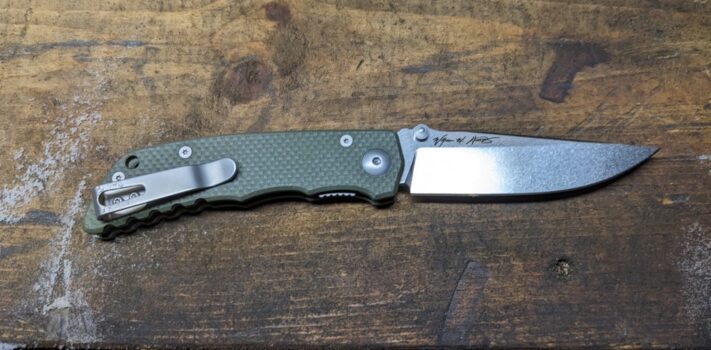


Spartan Blades makes some really nice knives. Unfortunately, most of them are a little pricey for plebeians like me. But beginning in 2019, Spartan Blades was purchased by KA-BAR and expanded their product line to include the more affordable Field Grade models. Spartan Elite and Pro models are manufactured in the USA, but their Field Grade line is made in Taiwan. The intent is “to provide a dependable knife or tool for anyone regardless of budget.”
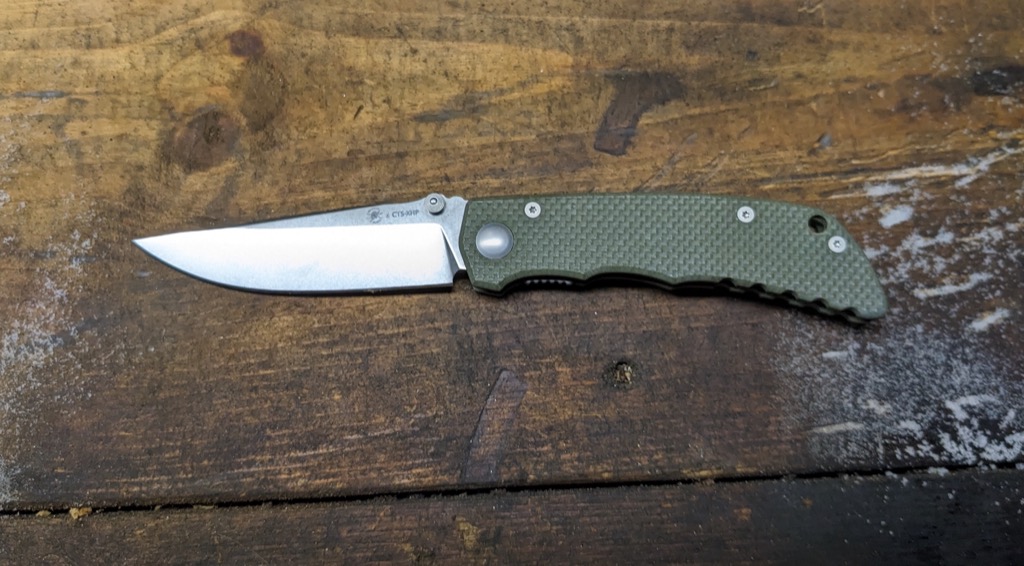
The Talos Folding Knife is a good example of the Field Grade line. It has a 3.12 inch long, 0.12 inch thick, straight back blade with just a hint of drop point. The blade is flat ground with a hint of saber grind. It has a very practical tumbled finish that does an excellent job of hiding signs of wear, and is made of CTS-XHP steel. It deploys with dual thumb studs around an oil infused bronze bushing system.
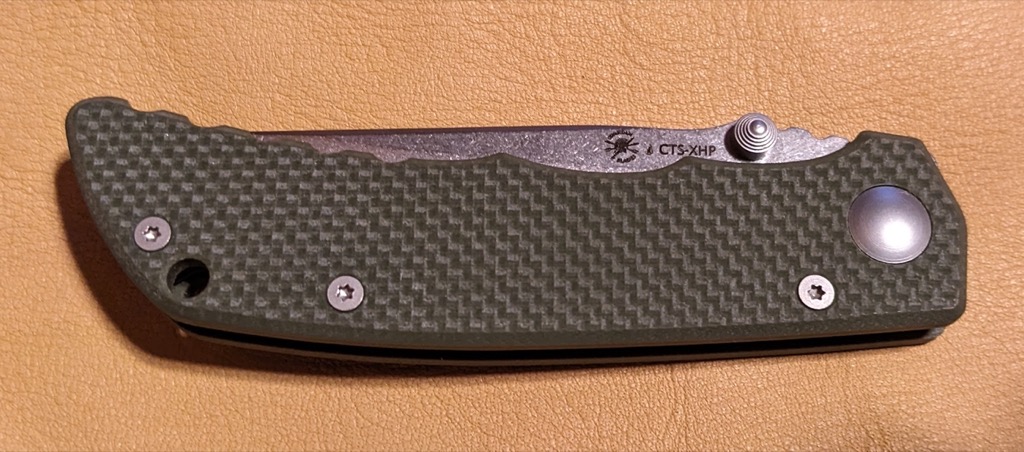
The frame is composed solely of G10 except for the liner lock. The texture on the scales resembles canvas Micarta. The handle on the version that I tested is green. It is also available in black.
The knife is designed by William W. Harsey Jr., and cost $115 at spartanbladesusa.com at the time of this writing. It would be a good choice for everyday carry (EDC).
Background
I was doing some research on knives made in Taiwan (free China). The advantage of Taiwanese-made knives is that many of them feature well-conceived designs at reasonable prices.
One of the most interesting Taiwanese-made blades that I ran across was the Spartan Blades Talos. I liked the size, the blade shape and finish, and the handle color and texture. I contacted Spartan Blades to see if they could provide me with a sample of the Talos for testing and evaluation. They were kind enough to agree. In spite of the fact that I made the request during the busy holiday season between Christmas and New Year’s, a package appeared in my mailbox within a week.
First Impressions
The 8.5 x 5.38 x 1.75 inch USPS Priority Mail package came from Spartan Blades, 625 SE Service Rd., Southern Pines, NC 28387-6062.
The shipping box contained a Spartan Blades product catalog, a Spartan Blades decal, and a 4.25 x 1.38 x 0.88 product box.
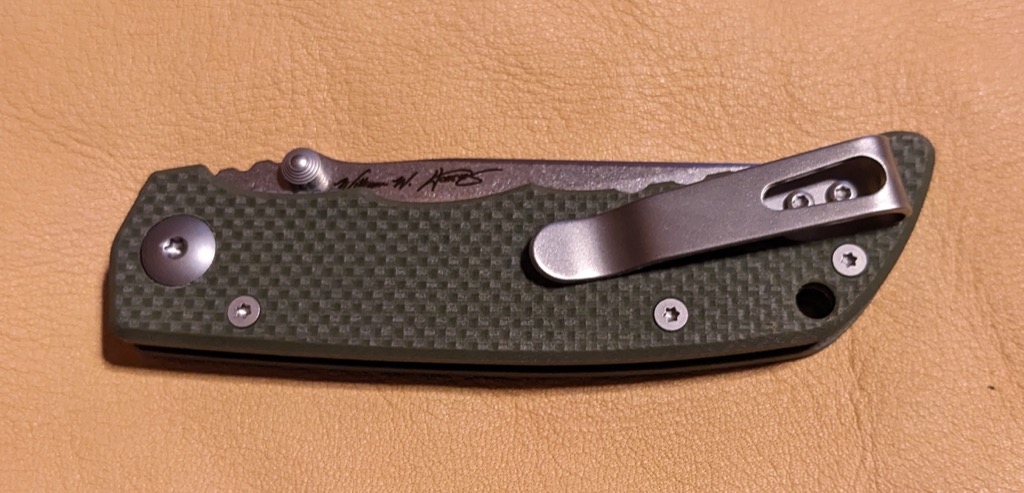
 The product box was imprinted with the Spartan Blades web address (partanbladesusa.com), motto (“Knives With Intent”), and information about its founders (“Spartan Blades was formed by two U.S. Army Special Forces NCOs . . . to design and make finely crafted knives . . . .”). It also provided information about their Field Grade knife line, included the ubiquitous California P65 warning, and made reference to the fact that Spartan Blades is a division of Pineland Cutlery, Inc.
JWR Adds: As a side note, I should mention that the culmination of the US Army Special Forces candidate qualification (the “Q Course”) is a large-scale field training exercise called Robin Sage, where the Green Beret candidates operate as insurgency trainers in the fictional country dubbed “Pineland”. Given the SF background of the company’s management, I assume that this is where Pineland Cutlery got its name.
Pineland Cutlery is the legal name of the corporation which is doing business as Spartan Blades. The CEO of Pineland Cutlery is John Stitt, who is also CEO of KA-BAR. I could be wrong about the precise legal terminology, but I think it would be correct to say that Spartan Blades is now owned (or partly-owned) by KA-BAR.
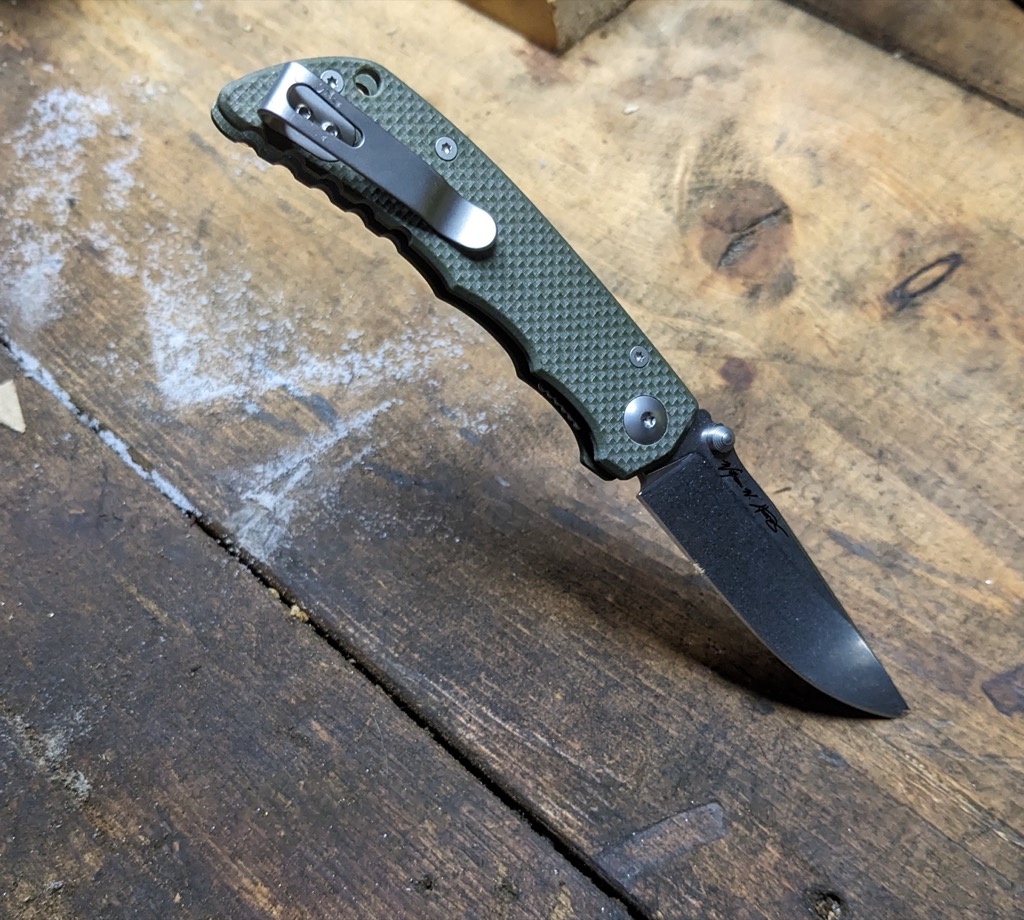 When I took the Talos out of the box, the three features that I liked the best were the texture on the scales, the finish on the blade, and the smoothness of the ambidextrous blade deployment. The faux-canvas-Micarta texture of the handle provided an excellent grip surface under a wide variety of conditions. The tumbled finish of the blade is not easily marred by marks of use. And it is always nice when a blade deploys well.
One of the features of the Talos that I did not like as well was the jimping. About half of the jimping on the base of the spine of the blade is recessed within the frame when the blade is deployed. This renders that portion of the jimping inaccessible and non-functional during normal use. I would like to see the jimping farther up the spine of the blade where it would be useful for providing better control during delicate cuts.
The blade came out of the box just barely shaving sharp. That would not be a problem with a blade steel like 440C that is easy to sharpen. CTS-XHP demands a little more effort to hone, so it would be helpful for it to come from the factory with a little better edge.
I enjoyed the catalog almost as much as I enjoyed the knife. Spartan Blades has an impressive product line. The Spartan KA-BAR in particular caught my eye. The original Marine “Knife, Fighting Utility” of World War II is a great design for a field knife in my opinion. The CPM MagnaCut blade and Krayton handle of the Spartan KA-BAR update of that classic knife are definitely improvements to the original design. I hope to someday test those improvements in practical use.
Testing
I clipped the Talos into the left front pocket of my pants, and began to carry it on a daily basis. Over the course of the following weeks, I was able to use the knife for a host of the mundane tasks of everyday life (mundane tasks are why I carry an EDC knife in the first place):
–opening the wrapper on a can of herring fillets so that I could then open the can and enjoy the fillets as a part of my lunch.
–opening a package of large print Our Daily Bread devotionals so that they could be distributed in the church foyer.
–removing labels from a box so that I could repurpose the box to return a poncho that I had been testing to the vendor.
–opening mail.
–opening a box containing a pellet gun for testing.
–cutting a piece of string in order to make an improvised plumb line. I used the line to hang a surge protector plumb in the internet closet at the church building.
–I had used a socket as the plumb bob on the improvised plumb line. I used the knife to cut the socket from the line when my work with the line was finished.
–opening a box of minibooks for distribution in the church foyer.
–removing a staple so that I could open the package containing a tamperproof bit set. I then used one of the bits to remove screws from the battery compartment cover on the key pad on one of the doors of the church building.
–prying the battery compartment cover from the key pad so that I could install new batteries. I then placed the cover back on the key pad and reinstalled the screws.
–opening a case of printer paper so that I could replenish the paper tray on one of the printers in the church office.
–my oldest daughter, “Ella” used the knife to open her birthday presents.
–on several occasions I used the Talos as a table knife while eating leftover chicken teriyaki (I washed the knife prior to using it for eating).
–cutting cardboard to use as a target for patterning a shotgun.
The Men Behind the Knife
 William W. Harsey, Jr. designed the Talos. Bill was born in 1955 to a logging family in Oregon. He worked his way through college by his labors in the logging industry. After graduating from the University of Oregon in 1979, Bill set up his own knife-making shop. He has made many custom knives over the years, and also collaborates with prominent knife manufacturers by providing designs.
Curtis Iovito is one of the co-founder of Spartan Blades. He retired after more than 20 years in the United States military after serving as a Marine, as an Army Ranger, and in Special Forces. He is originally from Bolingbrook, Illinois, and now resides in Aberdeen, North Carolina — near Fort Bragg.
Mark Carey is the other co-founder of Spartan Blades. He also retired from the United States military after more than 20 years of service. He served as an Infantryman, a Special Forces Medic, and a Special Forces Operations (Team) Sergeant. He is originally from San Diego, California. Like Mr. Iovito, Mr. Carey currently resides in Aberdeen, North Carolina.
Who Was Talos?
For scholars of classical antiquity, this may seem like a silly question. But I must admit that I had completely forgotten the myth of Talos prior to being reminded of it in connection with the testing of this knife.
In Greek mythology, Talos was a man made out of bronze who guarded the Island of Crete. He prevented Jason and the Argonauts from passing Crete on their homeward journey until the sorceress, Medea, caused him to graze his vulnerable ankle, thus draining his life force and causing his death.
Conclusions
The Spartan Blades Talos is a nicely designed folding knife for EDC. It has a usefully shaped blade made out of high quality steel with a practical finish. The handle is easy to grip. The blade deploys smoothly.
Disclaimer
Spartan Blades was kind enough to provide me with a sample of their Talos Folding Knife for testing and evaluation. I tried not to allow their kindness to interfere with my objectivity in this review, and I believe that I have succeeded. I did not receive any other financial or other inducement to mention any vendor, product, or service in this article.