Editor’s Note: The following recipe for Survival Cookies is from fellow preparedness blogger Patrice Lewis. It was first published with many photos in her Rural Revolution blog. We highly recommend bookmarking her blog. – JWR
When I put up the recent post on making strawberry preserves, a reader asked why I canned it up in quart jars instead of pints.
Short answer: Just about the only thing we use strawberry preserves for is as a filling for so-called “survival cookies.”
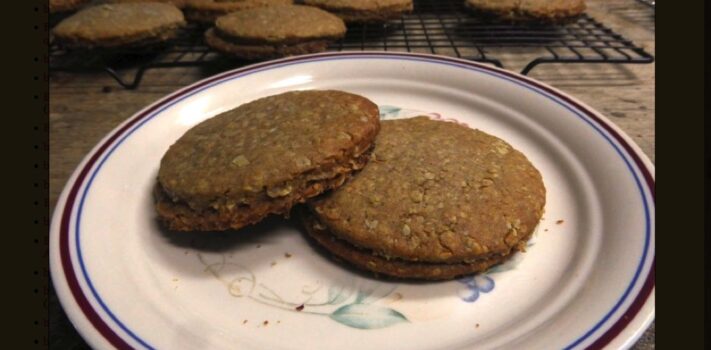
Back in our old home, these incredibly delicious filled oatmeal sandwich cookies made the rounds among our group of homeschooling moms. They became dubbed “survival cookies” because they require no fresh ingredients and can be made completely with dried or preserved ingredients.
Because I tend to make survival cookies in large (quadruple) batches at a time, using a quart of strawberry preserves is not unusual.
I thought I’d walk you through my latest batch of survival cookies. Here’s the recipe:
Ingredients
• 1 1/2 cup shortening, lard, or butter (I prefer shortening)
• 1 1/2 cup brown sugar (or half brown, half white sugar)
• 1 1/2 teaspoon vanilla
• 1 1/2 teaspoon baking soda mixed with 6 tablespoons hot water
• 3 cups oatmeal (thick or thin cut)
• 3 cups flour (may use white or whole wheat – I use half-and-half)
• 1/4 teaspoon nutmeg
• 1 1/2 teaspoon salt
• Filling (we use strawberry preserves, but use whatever your family enjoys)
Directions
Preheat oven to 350F. Blend shortening, sugar, and vanilla. Add baking soda (in water), nutmeg, and salt. Mix in the flour. Using a stout spoon, stir in the oatmeal by hand (do NOT try to use a mixer for this step, as the dough is too stiff). Stir the dough until it’s thoroughly mixed.
Flour a large breadboard or other surface. Roll the dough thin. Cut with a round cookie or biscuit cutter (I use a clean tuna can). Stack the round cutouts aside until the dough is used up.
Lay the rounds on a cookie sheet and place one teaspoon of the desired filling in the center (dollop it, don’t spread it). Lay another cutout over the top to make a “sandwich.” It is not necessary to seal the edges.
Bake at 350F for 10 to 15 minutes (depending on your oven) until lightly brown. Do not overbake.
Prep Tips
• The cookies do not expand while baking, so they can be (reasonably) crowded on the baking sheet.
• The dough is sticky during the rolling and cutting process. Be very liberal with the use of flour on the breadboard, rolling pin, and dough surface.
• Use a spatula to lift the raw dough cutouts so they won’t tear.
• Because rolling and cutting the cookie dough can be labor intensive, I usually quadruple the recipe and make an enormous batch at once. The recipe multiplies well and surplus cookies freeze beautifully.
• If you’re feeling extra fancy, drizzle a little frosting (powdered sugar + milk) over the baked cookies.
—
Do you have a well-tested recipe that would be of interest to SurvivalBlog readers? In this recipe column, we place emphasis on recipes that use long-term storage foods, recipes for wild game, dutch oven recipes, slow cooker recipes, and any recipes that use home garden produce. If you have any favorite recipes, then please send them via e-mail. Thanks!