
Strategic Relocation in Australia, by The Former South Aussteyralian

I’ve had great difficulty figuring out how to approach writing this submission. Initial versions came out a bit prideful and preachy. In the end it’s usually best just to stick to the facts. So here’s the good, the bad, and the ugly. I’ll let you interpret it yourself.

Please note that this submission comes to you from Australia, so (as y’all say) “your own mileage may vary”. Furthermore, I understand that this is not a survival “silver bullet”. It is intended as a temporary solution for those of us doing the best we can with what we’ve got.

Roughly 36 weeks ago my family and I were living in the suburbs of a city housing over a million people. Our landlord wanted even more money than the already ridiculous amount we were paying. We’d suffered through the worst summer in memory (which barely edged out the last one and the one before that). We had water restrictions, power grid failures, and the buffoon in charge of it all was bragging that by 2020 our population would be up by another half a million. In short, we decided that the time to Get Out of Dodge (G.O.O.D.) was now. But how? We couldn’t afford to buy a retreat property outright. In fact, we weren’t even in a financial position to acquire a mortgage.

We looked at our options. Staying in our home state was out of the question. It ticked just about zero boxes for TEOTWAWKI survival. We considered dozens of factors, and from the short list went with the one that felt right for us. Tasmania. (I know there’s a big empty spot in the middle of our country, but it’s empty for a reason. Trust me!)

We talked to our family and friends about it. The consensus was uniform. We were crazy. Regardless, many were still supportive and this was a major factor in our successful relocation.

Problem one was getting jobs. We needed employment from the time we arrived or no house rental agency would give us the time of day. Fortunately nurses were in strong demand and my wife had recently attained her nursing degree. She was offered a job with a large hospital and we began applying for rental properties.

Well… being that we were so far away, most of them still didn’t want to touch us with a ten foot pole. In the end we had to find the cheapest places available and offer to pay three months rent in advance. That made the agents sit up and take notice! We got two offers immediately (both very rural) and in hindsight we chose the wrong one. This brings me to my first piece of advice. Beware of false economy. We chose the cheaper house but since it was an extra 15 miles out of town we ended up paying much more in petrol than we saved in rent. Expect a lot of trips to and from town in your first six months!

Back to the planning. We had a place to go to, but now we had to get there. We’d already moved out of our old house and were staying with my wife’s parents. We’d also gotten rid of a good 50% of our stuff and were selling or donating anything that wouldn’t fit into two cars and a trailer. Easier said than done! We planned the trip in great detail, but nothing ever goes quite according to plan. We lost a half day of packing prior to lift-off because when we went to pick up our hire trailer the clerk had every trailer connection imaginable except for the one that we needed. The frustrating part was that our tow car was only five years old and had the most common of connectors. It was many a pensive hour before the trailer maintenance man arrived with a “spare” connector, however, this was just an appetiser for that evening. We packed, repacked and by 9 pm (T-minus 7 hours) had crammed everything except ourselves into what space we had available. We were about to settle in for a stressful nights sleep before the 4 am start when a voice inside my head said to me “you really should make sure you know where all the car keys are… just in case”. Sometimes you get that voice in your head that sounds different than your normal inner monologue, and whatever it has to say is usually important, so naturally I froze in terror. Lo and behold, the hatchback key was missing. What’s more, it was blocking the exit and the column lock was engaged. It was going nowhere. The house was turned inside out. The cars were ransacked. Meanwhile I called every after hours locksmith I could find in the yellow pages. The three responses I got was “not available”, “can’t be done in the dark”, and “it’ll cost you $900”. After we’d partially disassembled the steering column in a fit of desperation we got a call back from a fourth locksmith who promptly arrived and cut us a key on the spot for $200. It was a costly reminder to always have another key handy. By the time we repacked the cars it was midnight and we were too stressed to sleep anyway.

Our lack of sleep made the following 14 hour drive very unpleasant. We thought we’d given ourselves plenty of time to get to the Bass Strait ferry in Port Melbourne but we somehow arrived there with only a half hour to spare. The GPS had a hand in this. I should have updated it or (better yet) bought current maps. We realised the next day that a single flat tire would have seen us miss the ferry and lose our non-refundable tickets (and before anyone says “I can change a tire in less than half an hour, remember, we’d have to unpack the car to get to the spare and repack it afterward). Another piece of advice. If you’re ever covering a trailer with a tarpaulin in windy/rainy conditions, invest in a cargo net to hold down the tarp. Our tarp resembled a bunch of knotted blue ribbons by the time we arrived, and because it poured with rain our belongings were thusly soaked.

The ferry trip was rough but I slept like a baby. My wife and her father were another story. By the time we’d exited the ferry and driven another two hours they both looked like zombies. Amusing in hindsight, but imagine traveling to your retreat after the SHTF and having to scan constantly for ambushes, road blocks etc. Under those conditions a mere hour of driving would be utterly exhausting. Preparing S.O.P.s for driver rotation if you have to travel post TEOTWAWKI is prudent.

Miraculously we made it to the rental agent’s office with thirty minutes to spare, despite the GPS and the weather. Remember, your GPS probably doesn’t have settings for “it’s raining, I’m tired, and I have a trailer weight that exceeded my braking capacity as soon as the road got wet.”. My GPS tried to take me down some pretty steep goat tracks, and one narrow road that had recently (read: since I bought the GPS) been turned into a dead end street. An annoyance now, but a death trap during Schumeresque times. Seriously… Get maps!

Twenty more miles later we arrived. It was a cheap little cottage/shack on a large block in a town of 200. The local river was a stones throw away if your arm was any good, and on the other side was woodland. To say it was modest would be putting it mildly, but to us it was a mansion. #(As a side note: we now refer to this trip as “the pilgrimage”, and it’s given us a newfound respect for the men and women who struck out into the unknown when there were no maps, roads, or really much of anything to assist their journey. They were truly made of sterner stuff.)

We bought some overpriced wood at the local store and gleefully put our wood fire heater to use (what a novelty)! It didn’t take us long to realise how much wood you can go through, especially when your house is poorly designed and insulated. Remember that other house I told you about? It was far more modern than this one and would have been much easier/cheaper to heat. Another false economy! At any rate, we got settled in and my wife began doing her 3 hour round trips to work while I looked for work in the area. The first month was a real eye opener. We expected to learn as we went along, but… well what can I say. As country living goes, we were greener than grass. We ran out of things constantly. Not for want of money but for want of foresight. It was a one hour round trip to the nearest supermarket which wasn’t exactly open 24 hours a day. It meant that if we forgot to buy milk, then our cornflakes were eaten dry and our coffee was served black (the horror)! It was a crash course in stocking up and a valuable one at that. Travel time was another oversight. It just adds up and up and up, along with your petrol bill. It can wear you down quickly when you’re not used to it. The local school was not far from that supermarket I mentioned earlier. That means our boy’s schooling equated to two hours of driving per day Monday to Friday (home schooling was looking better and better).

By the end of the first month I’d secured part time work. The pay rate was very low and it was shovel and barrow work but it’s key importance was that it provided a foot in the door to get some local references. The first week revealed just how soft I really was (though thankfully not as soft as most of the other workers). Previously I’d done plenty of hands-on work in my spare time but labouring all day was a different matter. If you’re planning on becoming a post TEOTWAWKI farmer then I hope you’re in very good shape. I gained 5 kilos in as many months (not of fat either) and every meal seemed to gravitate toward meat, meat and more meat. It also demonstrated to me the worth of good tools. On my work site we’ve replaced so many cheap tools that we’d have been financially better off buying good ones from the start, to say nothing of the time and work efficiency lost. Post TEOTWAWKI you wont have the option of buying another cheap shovel or pick. How many flat screen televisions would you have to trade for a Fiskars brand splitter or axe? I digress.

At the end of the first month we were blessed with the news that our second child was on the way. The previous nine months were fruitless in this regard, yet perhaps if we’d been successful before the move we might never have undertaken it in the first place. What came next was less fortunate. A mystery blood condition caused my wife to suffer a massive clot in her brain. Doctors were slow to diagnose it, and by the time they did it required urgent and lengthy hospitalisation. It was so large she was considered lucky to have survived it.

We were all emotional wrecks. My daily routine consisted of getting our boy to school, going to work, picking up our boy from school, visiting my wife for as long as I could and getting home to clean up and prepare for the next day. Nine hours of work (home-making included) and four of driving wasn’t the exhausting part. Living with the fact that every day might have been the last day I would hug my wife simply crippled me like nothing I’d previously experienced, and as I write this I understand how survival scenarios can break someone down, even if they have the beans, bullets and band-aids they need to survive.

Thankfully, our family arrived like the proverbial cavalry to help with basic day to day tasks. We also found out what financial hardship was really like. We went to the wall and only got by with more help from our family. The lessons for us were; If you can retreat to an area where you have family then it would be a wise choice. You just cannot predict life’s ups and downs. Family are like the shock absorbers of life. In fact, one of the main reasons we left the city was so they could turn to US in times of great need. We ate humble pie on that one but hopefully in time we can repay them. Lesson two was a double dose of a previous lesson. Travel time is a burden not to be underestimated. Moving an hour out of town to start with would be much wiser than an hour and a half. It can make a huge difference by the end of the week. Lesson three? Hope for the best but plan for the worst. The last thing we anticipated was losing our primary source of income. It was a mix of equal parts diligence and dumb luck that I even had a job by that stage (jobs here are scarce and getting scarcer). I wont tell you to get rid of your debts because it’s far easier said than done. Downgrading your car for something more affordable? That’s realistic. Do you really, really need that huge flat screen television? Sell it! Suddenly you have a monetary buffer for bad times. Keep it secure, or better yet, pay out expenses like food (storable food) and firewood in advance once you’re there. It’s better than money in the bank.

During that five months we struggled greatly yet, surrounded by trees, wildlife and good people, we never regretted our decision. Even our family members who shared our burden agreed that we’d done the right thing. They’re a stubborn lot but I sense that even they are beginning to smell the economic smoke. After our 6 month lease was up we applied to rent a place a little closer to the city (but not much closer). We’re now in a much nicer house that costs more to rent, but it’s proximity to my job, our boy’s school, doctors clinic, chemist and supermarket (if needed) combined with its superior build (heat retention, solar hot water etc.) more than make up for the difference. We’re still an hour away from the nearest city (which is really more like an overgrown suburb) but we’re still in a far better position than we were nine months ago living in a suburban sprawl. Having read this you may be thinking “the heck with that” but I’ll list some of the benefits we’ve gained while struggling with the hardships:

• The tap water tastes “proper”. i.e. Not like watered down chemicals.

• The air is fresh. In fact, I can barely tolerate city air anymore.

• My boy can ride his bike down the street without us worrying.

• There are no gangs or dealers. They wouldn’t last five minutes 😉

• Nobody here jumps out of their skin at the sight of a gun, law enforcement included.

• Locals sell fresh grown fruit and vegetables at lower than store prices. The taste (and nutrition I’d wager) is also superior.

• The local butcher sells meat that’s actually fresh.

• Growing food in your back yard is perfectly commonplace.

• Imagine putting aside your Bugout Bag to focus on your Get Home Bag.

• Good picnic, camping, hunting and fishing sites are not far at all.

• There are tons of people that can teach almost any survival skill you want to know.

• Television reception is terrible. • The local work is likely more in line with what you’ll be doing post Schumer.

• Saving money is easier when the nearest fast food outlet is a two hour round trip away.

• Farm auctions and country garage sales are prepper heaven.

• You wont feel out of place driving a beat up, old (read: EMP resistant) pickup/ute.

• When you have the means to pick out a retreat property it’ll be easier to scout for a good one.

• No incessant background noise means you can actually hear yourself think. It makes planning and focusing your thoughts a lot easier.

• You’re not being constantly bombarded with advertising telling you to buy things you don’t need.

Most importantly, you’ll be integrating yourself into a group of people that will be able to support each other when times get bad. Am I squared away? Heck no. In fact, I’m barely more equipped (logistically) than I was before the move. Yet I rate my survivability as an order of magnitude higher than it was when I lived in the periphery of a large(ish) city.

Now, here’s some stuff that I learned (some of it the hard way):

• Check whether your mobile phone service provider has coverage for the area you’re moving to, and check your phone has a strong enough signal for that matter. A new phone or provider will be easier to arrange before the move.

• Ditto for internet service providers, assuming you still want to read SurvivalBlog. Personally I’m still catching up on the August to December archives by way of the local online centre (not OPSEC Optimal, I know.)

• Budget for firewood as applicable. I recommend you steer clear of the idea that bringing a chainsaw and a block splitter will allow you to slip seamlessly into “mountain man mode”. Unless you really know what you’re doing your wood supply will deplete faster than you can replace it. When I arrived there was an article in the paper about a life long forester who’d just killed himself felling a dying tree that threatened nearby power poles. He was a professional and reportedly one of the best. Doubt you can kill or injure yourself, even cutting up fallen timber? Watch the television series “Axe Men”. It will give you respect for the factors involved.

• Be realistic about the place you rent. Out here the rent on a 600 square yard block and a 20 acre hobby farm is not much different, but you’re not bringing a ride on mower or a flock of sheep with you, right? 20 Acres might seem great, but check with the owner/agent where your maintenance responsibilities end and theirs begin.

• Play friendly with your landlord, even if it means biting your tongue once in a while. There are only two rental agencies where we are so if you burn your bridges then your future options will be severely limited.

• You will be asked why on earth you moved to the boring old country (it’s a trick question). There’s no need to start quoting Mel Tappan. Just tell the inquirer that you want a safe, clean place for your kids to grow up. They will smile, nod, and leave it at that.

• Mind your manners, especially on the road. My car is common in the city, but out here it’s unique within a 40 mile radius. You will be recognised and remembered by your conduct so it must be spotless 24/7.

• Buy those maps! If you need directions the gas station attendant won’t go near your GPS, and you don’t want to mess about with all that “take a left, then a right” nonsense. What would you do if the main road washes out in a flood? Many of the roads out here are not on any database. Likewise, some of the roads that are on the database are actually privately owned (my GPS didn’t understand the concept of “trespassing”) so get maps, and be prepared to alter them accordingly.

• Ditch your fancy “sort of 4WD” before you move to the country. If you can find an old 4X4 pickup in the city where nobody wants one then you’ll probably get it cheaper. Country folk seem to drive their vehicles ’till they’ve pretty much returned to the earth. Not many used vehicles for sale out here at all… Of course, be mindful of any potential registration pitfalls. Here in Australia, for a car to be re-registered in a new state it typically has to pass a roadworthiness inspection.

• You might find yourself falling in with other recent city leavers looking for that “tree change”. Don’t! If you hear someone say “I’ve never gotten along with the people here” or something to that effect then politely excuse yourself and avoid them as a rule.

• Attend the local firing range (or similar) even if you don’t have a gun yet. Despite the average 20 year age difference between me and the locals there they really spoke my (our) language and offered plenty of advice and assistance. This is especially important in states/countries with vague and confusing firearms legislation. Also, these are the guys that will be heading up the “neighbourhood watch on steroids” post Schumer, and they’ll be more than a little wary of a relative stranger turning up to the party heavily armed and outfitted.

• Join the local church if applicable. If the bomb drops tomorrow and you’re not squared away then you’ll be on the soup line with everyone else. I’d rather be the guy spooning out the soup than the guy at the end of the line. Also, churches are often the nexus of the local underground economy. Just mention that you need work, or firewood, or a cheap sofa and the word will go out on your behalf. Of course it’s expected that you pass on these charitable efforts to the next person in need, but that’s like me telling you that water is wet.

So how can I sum it up. a) If you desire a retreat property in your current state then keep your city job and move as far in the direction of your imaginary retreat as your finances and time considerations will allow you to commute. or b) If your state is likely to become a meat grinder after TSHTF then act now! Apply for jobs in another state, remembering the three D’s. Dirty, Dangerous or Dull. Take the pay cut if you have to. Maybe you can apply for jobs with a large store chain that will be willing to shuffle you to another store location as soon as you can make up a believable excuse for your move. In either case, once you’re an hour or so out of the nearest city (make it as small a city as possible) you can look for work locally. Then, once you’ve got that local work then you can move even farther out. BTW, just to be clear, “an hour out of the city” means an hour of travel beyond where the houses have given way to trees or pasture.

“But nobody out in the country will employ me”, I hear you say. That depends entirely on your outlook. As times get tougher out here in the country a lot of people are doing the opposite of what the average SurvivalBlog reader is trying to do. They’re moving to the city where they can find higher paying jobs! They don’t want to downsize their living arrangements so they’re going where the money is. That’s why half my weekends are spent at garage sales. There are jobs to be had out here but there’s a proviso: You have to want it more than the next guy! I got a job, partly by luck in coming across the advertisement just in time, but also because when I turned up for the interview they could tell just by looking at me that I was dead serious about my application. I wanted the job, and what’s more, I would work hard to keep it. Six months later my references now speak for themselves and in a place where everyone knows everyone else, references are everything. I’m no superman, so if I did it, then you can too! You just have to want it bad enough.

So clearly I’m not that guy with a hundred acres of farmland and a concrete bunker with a bunch of armour piercing rifles and heat seeking bullets (kidding). A year ago I found SurvivalBlog and I felt like I’d arrived at the party too late. Then I remembered the old saying; “You don’t have to outrun the lion. You just have to run faster than the other guy!” If you really pulled out the stops. If you quit letting excuses hold you back. If you stop waiting to win the lottery and start making some hard decisions, how long would it take for “home” to be at least an hours drive away from Schumer ground zero? When I lived in the city I always felt like my preps were completely inadequate, and always would be. Like I was using a shot glass to bail water out of a sinking boat. In my new location my prepping is beginning to move under it’s own momentum because out here preppers fit in rather than stand out. I don’t feel out of place buying 20 cans of corn when it’s on special because the person in line behind me is doing exactly the same thing. How can I put it other than to say that I am becoming one with my inner survivalist and more importantly my family is too. So promise your wife a massive flower garden (or you husband a workshop). Promise your daughter a pony and your son a quad. Do whatever you have to in order to get them on board and G.O.O.D. so that in nine months time you can write a submission telling the new batch of survival stragglers that they can do it too! Through all the hard times (it seems we’ve had our fair share thus far and them some) we’re becoming hardier people and a tougher family unit. Surviving TEOTWAWKI requires nothing less.

So get cracking. You wont regret it. Despite all that’s happened we’ve never regretted our choice. And don’t worry about TEOTWAWKI coming tomorrow. After all, It’s already tomorrow in Australia!

Musings From a Novice Gardener, by Mike in Western Pennsylvania

Last year I planted my first home garden in my adult life. I am 46 years old and grew up most of my years in suburban America so I had little experience with the nuts and bolts of a family garden but I did spend twenty years in the Marine Corps so I do have a level of self-sufficiency that I garnered over the past 20 years during my service in the Marines.

I will also add that my Dad did a little family gardening in the 1960s and 1970s but by the 1980s we were a complete suburban family relying on the modern food chain supply of commercial America. My Dad’s grandfather definitely was a master gardener as he had 12 children (my Dad was the oldest), and did not make a lot of money so he had what I would consider a huge family garden. I helped both my father and grandfather during my youth so I had a small amount of ability but almost 40 years of gardening regression made me pretty much a novice once more.

That did not stop me one bit. When I retired, I announced to my wife that I was “cutting” a garden in the backyard last year as soon as the snow melted. She thought I was crazy as I used a motorized sod cutter to cut a 40’ x 30’ garden in the backyard. She said I had bitten off more than I could chew. Well, I just took that as a challenge and went at it with some gusto. My production was varied and I had some winners and I had some losers (more losers I would say) but what I learned last season was invaluable and I am eagerly awaiting this season to apply hose lessons.

Lesson #1: There is no substitute for good soil. If you have crummy soil (like I did), augment it with some kind of compost. At the end of the season, after my less than bountiful harvest, I had a local soil company dump four tons of mushroom manure on top of my garden and I tilled it in. I live in western Pennsylvania where there are more rocks in the soil than there are stars in the universe and it is hard to get a good garden started with just a thin layer of substandard soil. Again, get some augment and build up your garden height so your seeds and plants have a fighting chance.

Lesson #2: Check with the local agro stores and find out what kind of soil you have. Take a few samples and have them analyze it. If you buy from them, they probably won’t charge you for the service either. Most veggies like a particular soil PH so find out what it is and add the proper augments to your soil to get it to a particular acidity or non-acidity.

Lesson #3: In my regular crummy dirt garden, I planted everything I could find, tomatoes, cucumbers, lettuce, peppers of all kinds, squash, corn, onions, garlic, potatoes, carrots, beans, and some spices.  Some did ok, others were pitiful. Again, soil is everything if all else remains the same. On a couple of smaller circular plots, I planted some tomatoes according to a group of bio-dynamic gardeners in Bradford, Pennsylvania. They have a web site (just search for biodynamic tomatoes and it will take you to their web site) which I found and I did exactly as they told me to do in my little circular garden and wouldn’t you know, I had cherry tomatoes growing out of my ears. I started from seeds they sent me and planted three small plants in my little mound and I had mutant tomato plants by mid-summer. They got to a height of 9’ (that’s not a typo) before they fell over from the weight of the tomatoes. I harvested around 2,000 cherries from the plants; it was simply amazing. The secret is in how you prepare the hole in the ground. 3’ wide by 2’ deep and start filling it with table scraps during the winter and spring and add equal parts of manure and dirt until you get a 2-3’ high mound of dirt that has 4-5’ of depth due to the original hole. The plants “feasted” on the garbage through the season and the results were amazing. I’m not advertising for these guys but the process can be applied to pretty much any plants you want to use.  Remember, you don’t have to compost the garbage, just dump it in the hole, cover with dirt and manure and repeat until it is a big round mound, plant your desired crop on top and watch the miracle happen. I had small rows in my crummy garden last year but I am going to do more mounds in it this year and do the same thing with my other plants and see what I can produce. I had tomatoes in the crummy garden as well as they super plot and the ones on the crummy side did crummy so I know it was soil and compost that was the catalyst for the mutant yield in the “super” plot. As I said, I am excited.

Lesson #4: Potatoes! I had a great start to my spuds and then did something very stupid. I got attacked by Colorado Potato Beetles and used some insecticide on them. The first dose took care of 50% but when I did it again, it pretty much wilted the plants and they never recovered. I still managed to harvest decent size reds and whites mid-summer and even replanted some more seed potatoes and got a second smaller harvest in October. Bottom line, don’t use store bought chemicals to deal with your bugs. Find out what natural solutions work and use them. I have read that planting different plants next to each other is symbiotically beneficial and I plan to do more of that this season.

Lesson #5: We get pretty good rainfall here in western Pennsylvania but I am going to add a few rain barrels, dig a small trench for some PVC piping and run it from the barrels to the upper side of the garden with soaker hoses attached at the intervals I have my garden rows set. Since my barrels are above the level of the topside of my garden, gravity will do the trick for water distribution.

Lesson #6: Save every bit of food scraps from your table and start composting today. The feeling that my wife and I get from knowing that everything we do not eat will make it back into the garden makes us feel so much better than throwing it out in the garbage. In a spiritual sense, I think this is what God intended us to do from the beginning so we don’t need to add fertilizers or any other miracle growth stuff since our soil will be rich with organic nutrients year round. We saved one of the plastic containers that the kitty litter comes in and since it is made to keep the smell in, our little compost bucket in the garage never emanates any odor; until of course I bring it out to the garden, did my little hole, and dump it in. I realize that there are tons of folks that have composting down to a science but garbage is garbage and it will decompose under the soil, trust me. On those occasions where I have dug up a small part of a prior load of garbage, it has been quite odiferous.  If you want to compost, have at it. If you want to do it the simple method, it works too. Just give it enough time to decompose in the soil before you start tilling for the spring plant. I try to have a ready-to-go hole into which I can dump refuse during the season so it will be ready for the next year.

Lesson #7: As low key as you can, get your neighbors involved in starting their own garden as well. Invite them over when you are out and share with them what you have produced. You will be amazed at the communal feelings that start to develop over the sharing of food. My neighbor and I started doing this at the same time, and although he has no idea of my prepping beliefs, he is “in training” whether he knows it or not! We share our veggies and have a lot more in common now than just golf! My other neighbors are getting into it as well. I let them borrow some of my tools to get them started and then the eventual list of questions start getting asked. “How big should I make my garden? What should I grow?” This is really all it takes to get your neighborhood on the road to self-sufficiency.

These lessons learned are by no means a complete or comprehensive list of “how to’s” but I hope that by sharing what I learned as an evolving home gardener will help you in your gardening adventures down the line.


Precious Metals–When to Begin Reducing Your Holdings

I often get e-mails and letters from readers about precious metals, and most of them are wrong. Many of them were about silver:

  • In 2001, when I formally called the bottom, for silver, I got taunting letters. Those naysayers claimed that silver was heading down further, perhaps to $3 per ounce.
  • In 2005, I started getting whining “I missed the boat” letters. That was when the silver bull was still just a calf. People have continued whining, ever since.
  • In 2008, when silver was $9.80 per ounce, I got my first “this is the top for silver” letter. I’m still getting letters like that.
  • In 2010, the “silver is soon heading to $200 per ounce” letters began to arrive.
  • In early 2011, I started getting “silver crash alert” and “silver bubble is about to pop” letters.
  • Today, (with spot silver now around $37.32 per ounce) I got a letter claiming that silver was about to crash, and that it would bottom at around $4 per ounce.

I need to clarify a few things. First, silver is not a reliable investment vehicle. Stop thinking of it as an “investment.” The silver market is too thin and volatile for that. Owning silver is more properly a hedge on inflation and insurance against a Dollar collapse. To illustrate:

  • In 1964, $1,000 face value in silver coins could be had for $1,000 in FRNs. (Still “face value.”)
  • In 1979: $1,000 face value in pre-1965 silver coins briefly spiked to $25,000 in FRNs
  • In 2001, $1,000 face value in pre-1965 silver coins hit a low of $3,600 in FRNs. (3.6 times face value.)
  • In March, 2011: $1,000 face value in pre-1965 silver coins costs $26,680 in FRNs. (26.6 times face value.)

Next, I must mention that 1979 (when silver briefly spiked to $48.70 per ounce) was an aberration. This aberration was created when the Texas billionaire Hunt brothers and their Saudi buddies attempted to corner the silver market. They were stopped when the COMEX regulators brutally enacted Silver Rule 7 which effectively raised the margin requirement for silver futures contracts for big buyers to 100%. That move destroyed the futures market. It forced the Hunt Brothers to cover their positions and divest their holdings into a falling market.

Just for the sake of argument, let’s surmise that the current run-up in the price of silver is indeed a “bubble”.  Even if the COMEX committee again artificially hammers the market, the subsequent bottom for silver would have to be at least $10 per ounce.  Why? Because the underlying stair steps in currency inflation don’t ever go away. The Dollar will never have the same purchasing power of a decade ago.

But I don’t think that silver is yet in a speculative bubble. The true value of silver and gold haven’t changed substantially. Rather, it is paper money that is losing value. I believe that the value of the U.S. Dollar and the world’s other fiat currencies are simply diving into a chasm, following an orgy of government over-spending. The current bull markets in silver and gold are just reflections of the ongoing destruction of the Dollar and the world’s other pager currencies. For this reason, even if there is a major correction in silver, I doubt that the bottom will be any lower than $20 per ounce. The silver market fundamentals support my outlook. Silver is scarce and become more scarce with every passing year. (Which, by the way, is one of the reasons why I recommended that my readers ratio trade out of physical gold, and into physical silver.)

Will a gallon of premium gasoline ever sell for $1.00 per gallon again?  Will silver ever be $4 per ounce again? No, not unless they knock a zero off the Dollar. Inflation is unrelenting.

Take Some Profit and Put it in Tangibles
I must reiterate that silver is not a reliable investment vehicle.  But it is a reliable hedge on inflation and provides protection from a currency collapse. Don’t be a greedy silver bull. Market manipulations are impossible to predict. When they do come, they will likely be draconian, and they will get the silver longs screaming for mercy. If the future delivery price of silver again approaches $50 per ounce, it is very likely that the COMEX regulators will artificially raise the margin requirements or otherwise change the trading rules in an attempt to crash the market. If there is a price spike, short squeeze and shortage of physical silver, I wouldn’t be surprised to see the COMEX dictate that only industrial users (like Kodak, Fujifilm–both manufacturers of medical x-ray film) would be allowed to take delivery of physical silver when settling futures contracts.

When To Sell Some Gold
Gold bottomed in April, 2001 at $255 per ounce. As I’m writing this, spot gold is at $1,430 per ounce. That is a 5.6x gain! There are few other investments that have done so well. At this juncture, I think that it would be wise for anyone who purchased their gold at $715/oz. or less, to sell one-third of their gold, NOW. (Well, wait for the next day where there is a spike upward.)

Immediately parlay the cash proceeds into additional practical tangibles (such as guns, common caliber ammunition, and productive farmland), and perhaps some silver, if you don’t already have some silver coins set aside for barter. If and when gold doubles again (to $2,860 per ounce), then it will probably time to think about selling another fraction of your holdings.

When To Sell Some Silver
I’m setting an interim target of $41.90 per ounce for silver. That is ten times the 2001 bottom price and almost 30 times face value, for pre-1965 coins.That is a good threshold for preparedness-minded people to sell one-third of their silver holdings. Don’t be greedy and try to “call the top”. If you attempt this, odds are that you will be wrong.

My advice: Start cashing out when silver touches $41.90 per ounce. But don’t sell all of your silver into the rising market. Always maintain a core holding of silver for barter. Here in the United States, pre-1965 silver quarters (25 cent pieces) are the ideal coins for barter.

Whenever you liquidate any of your precious metals DO NOT leave the proceeds in perishable Dollars. Again, parlay the profit into additional practical tangibles.

If you follow my advice, you will have a balanced asset preservation strategy that will leave your family well-prepared. By diversifying into other tangibles, you will sleep better at night.


Economics and Investing:

Do you remember my warnings about “creative” ways that legislators might find to solve budget crises? Brace yourselves. CBO: Taxing mileage a ‘practical option’ for revenue enhancement. (A hat tip to J.H.B. for the link.)

My cousin in England sent this: Proof That Gold Is Not a Bubble

Gonzalo Lira: How Likely is QE-Three? (Lira thinks either that there will soon be be either more monetization or seizure of IRAs and 401(k)s.

G.G. flagged this: Morning Note: Gold Replacing Dollar as World’s Reserve Currency?

Also from G.G.: Buffett Warns: The Dollar Will Decline

Items from The Economatrix:

Stocks Falter Despite Improving Economic Reports  

Oil Slides as Rebels Take Libyan Ports  

More People Signed Contracts to Buy Homes in February  

How to Detect Fake Silver  

US Closes Small Bank Bringing 2011 Total to 26  


Odds ‘n Sods:

Free city lots offered for modern-day homesteaders in the Midwest.

   o o o

K.A.F. flagged this: Nine Best Canned Foods. For what its worth, JWR‘s favorite, canned salmon, tops their list.

   o o o

Wow! I just noticed that the 1950s novel “Atlas Shrugged” just jumped to #130 in Amazon’s sales rankings. No doubt renewed interest (above and beyond its perennial following), is due to the upcoming release of the feature motion picture. (Appropriately, the release date is April 15th.)

   o o o

Shortages of scarce natural resources coming, warn chemists. (Thanks to C.D.V. for the link.)


Move to the Mountain States–The American Redoubt

(Note: This essay launched The American Redoubt movement. It was first posted in 2011. It was last updated on May 17, 2017)

To begin, I recognize the fact that “all politics are local”. I also recognize the international readership of SurvivalBlog.  Therefore I de-emphasize politics in my blog. However, an article got my blood boiling: Motorists illegally detained at Florida tolls – for using large bills! So, not only are Federal Reserve Notes not redeemable “on demand” for specie, but effectively they are now no longer “…legal tender for all debts public and private.” It is often hard to pinpoint a breaking point–the proverbial “straw that broke the camel’s back”–as impetus for a paradigm shift. But reading that news article was that last straw for me.

Consider my paradigm fully shifted. I’m now urging that folks Get Out of Dodge for political reasons–not just for the family preparedness issues that I’ve previously documented. There comes a time, after a chain of abuses when good men must take action. We’ve reached that point, folks!

Voting With Our Feet

I concur that Pastor Chuck Baldwin was right when he “voted with his feet” and moved his family from Florida to Montana. Like Chuck Baldwin I believe that is time for freedom-loving Christians to relocate to something analogous to “Galt’s Gulch” on a grand scale.

In March 2011, Ol’ Remus of the weekly  Yer Ol’ Woodpile Report blog quoted an essay by economist Giordano Bruno, titled The Return Of Precious Metals And Sound Money. In it, Bruno stated: “If there is anything good to come out of our present predicament, it is that Americans, from average citizens to elected officials, are beginning to understand the reality of coming collapse and are preempting it with measures designed to insulate their communities from the inevitable firestorm. Eventually, as this movement escalates, certain states will come out ahead of the pack, gaining a kind of “safe haven” status, and attracting liberty minded people from around the country to the protective shelter of their borders.”

Some Experts

Sociologist Albert O. Hirschman in his book Exit, Voice, and Loyalty, identifies the growing libertarian trend of “Exit” strategies, all the way from the individual level up to the level of nation states.

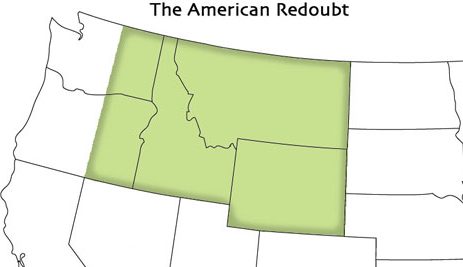
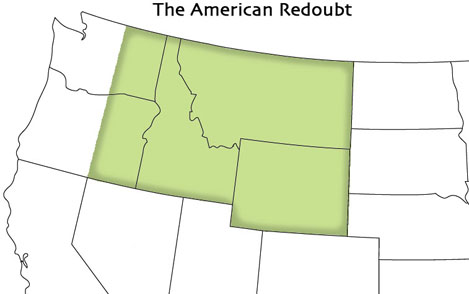
Giordano Bruno identified a trend that has been developing informally for many years: A conscious retrenchment into safe haven states. I strongly recommend this amalgamation, and that it be formalized. I’m calling it The American Redoubt. I further recommend Idaho, Montana, Wyoming, eastern Oregon, and eastern Washington for the réduit.

Some might call it a conglomeration, but I like to call it an amalgamation, since that evokes silver. And it will be a Biblically sound and Constitutionally sound silver local currency that will give it unity.

redoubt

(For re-use of this image, see the copyright notice, below.)

I anticipate that this nascent movement, and the gulch itself will be a lot bigger than most other pundits anticipate. It could very well be a multi-state amalgamation like The American Redoubt, that I’ve advocated.

Why Exclude Some Adjoining States?

I’m sure that I’ll get e-mail from folks, suggesting expanding the Redoubt concept to include Utah, the Dakotas, and Colorado. Let me preemptively state the following: Utah is a conservative state, but its desert climate makes it unsuitable to feed its current population, much less one swelled by in-migration. North and South Dakota have some promise, but I have my doubts about how defendable they would be if ever came down to fight. Plains and steppes are tanker country. It is no coincidence that the armies of the world usually choose plains for their maneuver areas, for large scale war games.

Why Include Eastern Oregon and Eastern Washington?

Next, some might argue that I shouldn’t have included eastern Oregon and eastern Washington. The population densities are suitably low, and the populace is overwhelmingly conservative. But the folks there are still at mercy of the more populous regions west of the Cascades. That is who dictate their state politics. However, who is to say that their eastern counties won’t someday partition to form new states, like West Virginia? This same factor is just as pronounced in rural Colorado. Just a few large cities call the political shots, and they have been overwhelmed by ex-Californians. For this reason I reluctantly took Colorado off the list.

Take a few minutes to look at a map that shows unpopulated regions in the United States. As you can see, a lot of that is in The American Redoubt.

To Clarify: Religious, Not Racial Lines

I’m sure that this brief essay will generate plenty of hate mail, and people will brand me as a religious separatist. So be it. I am a separatist, but on religious lines, not racial ones. I have made it abundantly clear throughout the course of my writings that I am an anti-racist. Christians of all races are welcome to be my neighbors. I also welcome Orthodox Jews and Messianic Jews, because we share the same moral framework.

In calamitous times, with a few exceptions, it will only be the God fearing that will continue to be law abiding. Choose your locale wisely. I can also forthrightly state that I have more in common with Orthodox Jews and Messianic Jews than I do with atheist Libertarians. I’m a white guy. But I have much more in common with black Baptists or Chinese Lutherans than I do with white Buddhists or white New Age crystal channelers.

Emulating Switzerland, Not Germany

I also expect that my use of the term Redoubt will inspire someone to accuse me of some sort of neo-Nazism. Sorry, but I use the term in honor of Switzerland. When I chose the name I was thinking of the Schweizer Alpenfestung (aka Réduit Suisse), rather than any reference to the Nazi’s “National Redoubt” scheme at the end of World War II. I am strongly anti-totalitarian, and that includes all of its forms, including Nazism and Communism.

I’m inviting people with the same outlook to move to the Redoubt States, to effect a demographic solidification. We’re already a majority here. I’d just like to see an even stronger majority.

Non-Exclusivity

One important point: I do not, nor have I ever advocated asking anyone already living here to leave, nor would I deny anyone’s right to move here, regardless of their faith, (or lack thereof).

Closing ranks with people of the same faith has been done for centuries. It is often called cloistering. While imperfect, cloistering got some Catholics in Ireland through the Dark Ages with both their skins intact and some precious manuscripts intact. (It is noteworthy that other copies of the same manuscripts were burned, elsewhere in Europe.) Designating some States as a Redoubt is nothing more than a logical defensive reaction to an approaching threat.

Are You With Us?

Most of all, you should read my Precepts page. If you aren’t in agreement with most of those precepts, then I don’t recommend that you relocate to the Redoubt–you probably won’t fit in.

Your Checklist

I suggest that you follow these guidelines, as you prepare and then move to the American Redoubt:

Prioritize

  • Research geography, climate, and micro-climates very carefully.
  • Bring your guns.
  • Sell your sports car and buy a reliable crew cab pickup.
  • Keep the practical items but sell your junk and impractical items at a garage sale.
  • After you’ve set aside cash for your land, convert the rest of your Dollar-denominated wealth into practical tangibles.
  • Develop a home-based business.

Lighten The Load

  • Sell your television.
  • Sell your jewelry and fancy wristwatch. Buy a Stihl chainsaw instead.
  • Switch to a practical wardrobe and “sensible shoes”.
  • Sell your bric-a-brac and collectibles. What is more important? A large collection of Hummel figurines, or having a lot of good hand tools and Mason jars?
  • Donate any older bulky furniture to the local charity store before you move.

Prepare Your Mind

  • Leave your Big City expectations behind. There probably won’t be cell phone coverage, high speed Internet, or Pilates.
  • Expect a long driving distances for work and shopping.
  • Begin homeschooling your children.
  • Encourage your kids to XBox and Wii less and read more.

Strengthen Your Faith

  • Choose your new church home wisely, seeking sound doctrine, not “programs.”
  • Expect persecution and hardship. You will be despised for being true to your faith. (Just read 2 Timothy 3:1-12. and Matthew 5:10-14, and John 15:18-19.)

Buy That Land

  • Buy land that will maximize your self-sufficiency.
  • Make a clean break by selling your house and any rental properties. You aren’t coming back.
  • If you buy an existing house, get one with an extra bedroom or two. Some relatives may be joining you, unexpectedly.

Then, after you move, consider:

Privacy

  • Be active, politically, but use a pseudonym in letters to the editor an internet posts.
  • Use VPN tunneling, RSA encryption, firewalls, and anonymous remailers.
  • Conduct as much business as possible via barter or with precious metals rather than credit cards.
  • Choose your fights wisely. Don’t tilt at windmills, but when you feel convicted, don’t back down.

Community

  • Respect the property rights and the traditions of your neighbors.
  • Don’t try to change things to be like the suburb that you left behind. You are escaping all that!
  • Pitch in by joining the local Volunteer Fire Department (VFD), Ski Patrol, Sheriff’s Posse, or EMT team.
  • Be a good neighbor.
  • Do your banking locally, preferably with a credit union and/or a farm credit union.
  • Encourage like-minded family and friends to join you.

Education

  • Be active in local home school co-ops and service organizations.
  • Gradually acquire a home library that includes self-sufficiency books and classic books–history, biographies, and novels.
  • Join the local ham radio club. (Affiliated with the ARRL.)

Stocking Up

  • Build a Deep Pantry of storage foods for lengthy power failures, or worse.
  • Patronize the local farmer’s market and craft shows.
  • Support local businesses, and companies that are headquartered inside the Redoubt, not Wal-Mart.
  • Attend gun shows in your state. (This keeps money circulating in the state and keeps you legal, for private gun purchases.)
  • Find and visit your local second-hand stores. Watch for useful, practical items that don’t need electricity.
  • Get accustomed to eating venison, elk, moose, antelope, trout, and salmon.
  • Visit some farm auctions in your region to gather a good collection of useful hand tools and a treadle sewing machine.

Faith

In conclusion, I am hopeful that it is in God’s providential will to extend his covenantal blessings to the American Redoubt. And even if God has withdrawn his blessings from our nation as a whole, he will continue to provide for and to protect His remnant. Pray and meditate on Psalm 91, daily!

Addenda (April, 2011): 33 Ways to Encourage Atlas to Shrug

Ayn Rand’s 1957 novel “Atlas Shrugged” is enjoying renewed popularity following the release of the new Atlas Shrugged movie. Rand’s story describes a group of American industrialists that lose patience with onerous regulation and taxation. They decide to “shrug”–to disappear from their normal lives and secretly relocate to a hidden valley called Galt’s Gulch. While this tale is fictional, it has some strong parallels to modern-day America. Granted,  Ayn Rand was an atheist and favored legalized abortion. But she was a good judge of both character and the inevitable tendencies of elected governments.

Rand’s Prescience

I was born in 1960. I shudder when I consider the regulatory and tax burdens that have been added in my lifetime. Ayn Rand had amazing prescience in predicting those changes. It is most noteworthy  that we no longer live in a free market capitalist nation. At best, it could called a “mixed” economy with statist tendencies, and verging on socialism.

To continue, reading the news headlines in recent months has led me to believe that the Galt’s Gulch concept has a lot of merit. If The Powers That Be wanted to encourage the Atlases of the world to shrug, they couldn’t have done a better job. So, what is the best way to get the most productive Citizens of our nation to go on strike? How to make us  retreat to “gulches”? Consider the following “to do” lists for those whom Ayn Rand called “The Destroyers”

Spend Liberally

  1. Continue to increase the size of the government (and its debts). The Federal debt increases are looking inexorable.
  2. Provide free education to illegal immigrants.

Increase Old Taxes

  1. Remove the homeowner’s mortgage interest tax deduction. Yes, they’re pushing for it.
  2. Raise import tariffs. Each new tariff causes problems. Didn’t they ever hear Ben Stein’s high school Economics lecture on the Hawley-Smoot Tariff Act? (OBTW, Ben Stein is now warning about an economic collapse.)
  3. Increase taxes for unemployment-insurance funds. This is already in progress.
  4. Increase the tax paperwork burden by requiring “1099-MISC” reporting of all cash transactions over $600. (Attempted, but thankfully set aside for the time being.)
  5. Raise sales taxes. Several states have increased sales taxes since 2009.
  6. Increase property taxes, even if home values decline. Many counties have hiked their tax rates.
  7. Increase license, permit, and vehicle registration fees. In progress. Meanwhile, institute “temporary” tax increases. These surtaxes on income, sales, or real property are described as “temporary.”
  8. Inflate the currency to rob those who save money–a hidden form of taxation. Standard practice for 40 years.

Invent New Taxes

  1. Create a European-style Value Added Tax (VAT). Yes, they’re still pushing for it.
  2. Nationalize IRAs and 401(k)s. Yes, its under discussion.
  3. Mandate payment of state sales taxes on out-of-state purchases for Internet and mail orders. Yes, they’re still pushing for these taxes, and for regulation of the entire Internet.

Regulate Everything

  1. Drag out approval of new mining operations with endless Environmental Impact studies. They’re already doing it.
  2. Drag out approval of newly-developed medicines. Now the status quo.
  3. Make it illegal for owners to protect their livestock from predators.
  4. Increase the cost of doing business through mandatory insurance. (The “labor burden” for an employee with a nominal salary of $17 per hour ($35,360 gross, annually) is an additional $20,029 per year.) Workman’s compensation, in particular, is getting painfully expensive.
  5. Over-regulate small firms out of business. Dry cleaners are a prime example.
  6. Implement carbon taxes and credits. Still in early stages of implementation.
  7. Remove the salary cap on Social Security tax “contributions”. The liberal think tanks are pushing for it.

Punish Everyone

  1. Fine farmers and ranchers for using traditional practices.
  2. Sue the makers of guns that actually work just as they were designed. (At least a partial law shield law was enacted, in 2005.)
  3. Reinstate the Federal estate tax and pre-Bush Administration income tax levels. They want to impose the old tax rates on anyone with an income of $250,000. Oh, and the CBO’s budget predictions are all using the assumption that the 2001 tax cuts are reverted. Is this wishful thinking (to make the increases in the Federal debt not look quite so bad), or a fait accompli?
  4. Push up the rates for “sin” taxes on tobacco, alcohol, and other items. Already implemented in 2010.
  5. Levy taxes on home schooling families for services that they don’t use.

Burden Business Owners

  1. Lobby for mandating that companies pay for three weeks of paid vacation per year for all employees.
  2. Legislate expansion of company-paid health insurance to cover pre-existing conditions and everything from same sex “domestic partners” and autism to sex change operations.
  3. Institute dozens of unfunded mandates from the Federal level, that must be compensated for with higher state, county, and local taxes.
  4. Increase the Minimum Wage. Several states have done so, but even worse yet, some unions are pushing for more socialist “Living Wage” laws
  5. Push for increased mandatory employer-paid benefits for company employees like mandatory health insurance for part-time employees and European-style long term parental leave. Also, push toward excluding companies from government contracts unless they have expanded health care coverage.

Socially Engineer Us

  1. Create a pervasive Nanny State mentality. For example: penalize companies and consumers for high trans-fat foods, and alcoholic beverages that taste too good.
  2. Encourage a litigious society where huge lawsuits are filed over trifles, and where the makers of products can be sued even if product buyers intentionally misuse products.
  3. Use taxpayer funds to destroy classic cars that are in running condition, while subsidizing hybrid cars that use batteries that will pollute landfills for centuries.
  4. And lastly, the big one: Implement socialized medicine. Despite a strong public outcry, this is now Federal law. But thankfully there is a push to rescind part or all of it.

In response, the shrugging and gulching has already begun:

In conclusion, many folks are now ready to vote with their feet. Atlas is starting to shrug.

Addenda (May, 2011, with several updates between 2012 and 2017):

Finding a Prepper-Friendly Church

First of all, many SurvivalBlog readers are Christians. For us, the search for a desirable “vote with your feet” relocation locale includes a very important criteria: finding a good church home. I am of the opinion that finding a good church home is our Christian duty, and that it honors God.

Furthermore, it is also an important factor in finding acceptance in a new community. By joining a church congregation that shares your world view, you can very quickly become part of a community, rather than being perceived as just “that new guy”. Therfore, in many locales this shortens the time required for a high level of acceptance and inclusion as a part of “the we”, by years.

Why Reformed?

In my experience in the western United States, Reformed churches tend to have a very high percentage of families that are both preppers and homeschoolers.

It is most noteworthy that when I put forth my American Redoubt plan, a key aspect was that it would be primarily geared toward fellow Christians, Messianic Jews, and conservative Jews.

My Criteria

Here are lists of my own criteria, for you to consider. (Note: I come from a Reformed Baptist background, so your criteria may differ):

Looking Upward

  • An edifying church that gives glory to God. (Most noteworthy.)
  • Reliance upon and belief in the literal truth of the 66 books of the Old and New Testament as the Inspired Word of God.
  • Sound doctrine, with Christ as the cornerstone, and preferably in accord with the Five Solas and the Five Points of Calvinism. (Or at least four of them. This is especially relevant.)
  • A strong emphasis on the Gospel of Christ.
  • Expository preaching. (A systematic exposition of scripture.)
  • An emphasis on teaching and memorizing God’s word with exhortation rather than “programs”.

Looking Outward

  • Biblical evangelism–the pastor, elders, and congregation all take The Great Commission literally. (Avoid churches with any racism or anti-Semitism.)
  • A commitment to Christian Charity.
  • An “…in the World but not of the World” outlook.

Looking Homeward

  • A congregation where a substantial portion of the body home schools their children. (Not a necessity, but a nice plus.)
  • Some interest in family preparedness. (Not a necessity, but a nice plus.)
  • Congregants that focus on their home life rather than their social life.
  • Congregants with a conservative outlook, modest dress, humble attitudes, and avoidance of worldly trappings.

Addenda: Reformed Churches in The American Redoubt States

My initial list had just 25 churches that I’ve either visited or that have been recommended to me.  This list has gradually grown to almost 50 churches.

Southern Idaho

Central Idaho

Northern Idaho

Northwest Montana

Elsewhere in Montana

Eastern Oregon

Eastern Washington

Wyoming

Orthodox Jewish Synagogues and Congregations in The American Redoubt States:

Try to find a truly conservative congregation. The word “conservative” (shamrani) has different meanings to different Jewish people! (Political conservatism is not always synonymous with religious conservatism and a traditional moral code.)

SurvivalBlog reader Yorrie in Pennsylvania sent some notes via e-mail. He recommended:

“…Torah knowledgeable and observant = Orthodox religiously or similar. Which usually overlaps with conservative politically. The more traditional end of the Conservative Jewish movement did not accept the liberal swing [that began in the 1950s] and is called Traditional, Conservadox (Halfway between Conservative and Orthodox), or sometimes Masorti (Hebrew for Traditional).

There are Orthodox and Traditional Jews in Flathead County, Montana, and more formal congregations of the Chabad movement (a Torah Judaism movement with roots over 300 or more appropriately over 3,000 years).

Chabad congregations in the Redoubt area are in Bozeman, Montana [The Shul of Bozeman], Jackson, Wyoming, [Chabad-Lubavitch] and elsewhere in most major cities around the world.”


Messianic Jewish Congregations in The American Redoubt States:

Many of these congregations tend to be small “home churches”. So make inquiries, locally.

Here is just one example of what you will find. It is in eastern Washington:

Kehilat HaMashiach
13506 E. Broadway Ave
Spokane Valley , Washington 99216
509-465-9523 (Phone) / 509-465-0451 (FAX)
Rabbi David D’Auria

Conclusion:

Due to the controversial nature of any discussion of religion, I’m sure that this will  inspire a lot of correspondence. I don’t have plans to create a nationwide directory of prepper-friendly churches and congregations. (That would go beyond the scope of my project.) But I would appreciate your feedback on any of the churches and congregations listed.

Also, I would also appreciate recommendations on specific Jewish and Messianic Jewish congregations inside of the Redoubt region.

Addenda (June, 2011):

The Yellowstone “Super Volcano”

I’m often asked by readers about the Yellowstone supervolcano caldera. There have been plenty of sensationalist news reports that have exaggerated the risk. More realistically, volcanologists tell us: “It could still be tens of thousands of years before the next eruption”. And, also the “rapid uplift” that was widely reported in 2004 in 2005 has slowed, significantly.

Because of the prevailing winds, the anticipated volcanic ash fall is probably more of threat to eastern Montana, eastern Wyoming, the Dakotas and the Plains states than it its to anywhere west of Yellowstone. If you consider it a threat in the next few generations, then simply buy property that is at least 100 miles UPWIND of Yellowstone. If there ever is an eruption, anyone in northern Idaho or Northwestern Montana will only get ash fall that first circles the globe. It it will be people the Plains states that would get buried by several feet of ash.

The Nuclear Bonus

Next as a bonus, locating UPWIND of Yellowstone will also put you upwind of Montana’s missile fields. It is noteworthy that Malmstrom AFB (which BTW is a locale in the second sequel to my novel “Patriots“) has dozens of strategic nuclear targets. If we are ever engaged in “nuclear combat toe to toe with the Rooskies”, each silo could be targeted for a nuclear ground burst. (It is ground bursts rather than air bursts that create significant fallout.) Again, I wouldn’t want to live downwind.

Also, as a further bonus, the climate is also much more livable west of the Great Divide. East of the Great Divide, the winters can be bitterly cold, but west of the Great Divide it is more mild.

Finally, also consider: U.S. Game Changing Renewable – Geothermal Power. Note that the preponderance of the nation’s geothermal potential is in the Rocky Mountain States and the Intermountain West. The Redoubt just keeps looking better…

About the Author

James Wesley, Rawles is a former U.S. Army Intelligence officer and a noted author and lecturer on survival and preparedness topics. He is the author of the best-selling nonfiction book “How to Survive the End of the World as We Know It”. He also wrote the novel “Patriots: A Novel of Survival in the Coming Collapse” He is also the editor of SurvivalBlog.com–the popular daily web journal for prepared individuals living in uncertain times.


Copyright 2011-2017. All Rights Reserved by James Wesley, Rawles – survivalblog.com

Note: The map image on this web page is my own creation and I personally hold the copyright. This image with resolution no greater than 36 DPI and a width no greater than 250 pixels is licensed under the Creative Commons Attribution-ShareAlike 3.0 License. The intended use is on Wikipedia and similar reference web sites, for use in newspaper and magazine articles, in book reviews, and in book catalogs. The rights to any larger or higher resolution image is reserved and are granted only upon request.


Pat’s Product Review: The Saiga 12 Shotgun

Awesome! That’s the best word I can come up with, to describe the Saiga 12, 12 gauge shotgun. Most people believe that only full-auto assault rifles, machine guns or submachine guns can offer-up “fire-power.” Well, I’m here to tell you that the Saiga 12 shotgun, can hold its own against many full auto guns – at least, given the limited range of a shotgun.

Right now, the Saiga 12, is one of the hottest selling firearms across the country. There are several reasons for this, first of all is that, this is one fantastic shotgun for self-defense. Secondly, the BATFE, or more rightly so, the US Justice Department, is trying to ban imported shotguns that have certain “features” that they deem evil. Third, there is a rumor going around, that the Justice Department refuses to give any more import permits for the Saiga 12. If that’s true, this is a de facto ban that is already in place. Lastly, there is a strong possibility, that the Saiga 12 and some other shotguns will be permanently banned from future importation after May of this year.

I have watched the price on Saiga 12 shotguns soar the past couple of months. My local gun shop was selling the Saiga 12 for around $450 just a few short months ago – when they were able to still get ’em. I routinely check gun prices on Gun Broker and the few Saiga 12s on there, the Plain Jane versions, box-stock, are going for between $800 and $900 these days and I expect prices to continue to rise.

The Saiga 12 was made in Russia, in the (now closed) Izhmash factory – where many of the best AK-47s and AK-74s were being made. The Saiga 12s action is based on the AK-47 – just enlarged, and certain changes were made, in order to make this shotgun importable under US import and firearms laws. The Saiga 12 comes in several barrel lengths, with the 19″ barrel being the hands down favorite. As already mentioned, the Saiga 12 is a semi-auto loader. It comes with a chrome-lined barrel and is cylinder bored. However, you can purchase other bore setting choke sleeves and change them in seconds. As the Saiga comes from Russia, it has a 5-round detachable box magazine – which is the maximum allowed by law for imported shotguns. Why? I have no idea – just another stupid law. The Saiga 12 can handle 2 3/4″ and 3″ magnum rounds, too. There is an adjustable gas plug on the Saiga 12, however it only has two settings. (I’ll discuss this more later in this article.)

For plain ol’ fun shooting, I like to use some of the cheapest 12 gauge birdshot I can find – usually around $5.99 per box of 25-rounds of #8 birdshot. My Saiga, and most others,simply won’t function properly with the factory gas plug (regulator) on setting #1 or #2, even though the instructions say the gun should function on setting #2 with lighter recoiling birdshot. The simple solution was to replace the screw-on gas plug with one from MD Arms – that has five different settings. For 3″ magnum loads, the plug should be set on #1, for 00 buckshot loads, the setting should be on #2 or #3, for low-recoiling 00 buckshot loads, setting #4 should work. For light-recoiling birdshot, setting #5 works great. Again, this is a drop-in part – no gunsmithing required. The price on the MD Arms 5-position gas plug (regulator) is only $25. I made no other other changes to my Saiga 12. However, at some point, when funds permit, I plan on buying a conversion kit, so I can add a pistol grip and a side-folding stock – they run around $150, and if you have any gunsmithing skills, you can install this conversion yourself.

I purchased several full capacity mags for the Saiga 12. The best of the bunch, in my humble opinion is the MD Arms, 20-round drum magazine. This drum magazine is easy to load – no tools required, and you can load it up in a minute or so. I will say, that it was a little difficult loading the first few times I used it, after that, it was a piece of cake. I also purchased a ProMag 12-round drum magazine (they also make a 20-round drum mag), and it too, was easy to load, and it too was a little difficult to load the first few times, after that – no problems at all…many magazine are difficult to load the first few times you use ’em, so this isn’t a rare problem. Lastly, I bought several ProMag 10-round “stick” magazines. There are several other brands of hi-cap mags for the Saiga 12, with some stick mags holding 12 or 13 rounds, and I think they just stick out off the Saiga 12 too far and they make the gun unwieldy if you ask me. There is also an 8-round stick mag available, too.   [JWR Adds: In my experience, the AGP Arms 10 round magazines (made in Arizona) work best. BTW, they have reinforcing ribs on their sides that can also hold the floorplate–allowing you to shorten these magazines to several different lengths, with a hacksaw.]

When it comes to inserting the magazines in the Saiga 12, it can prove a little tricky. And, the instructions with all the mags I purchased said you might have to fit them to the gun because of different tolerances in different guns. Remember, the Saiga 12, is based on an AK-47 action and there are generous tolerances. All the mags I purchased had to be fitted to my gun. It only took a few minutes with a file to get the mags to fit perfectly – anyone can do it – just remove a little material at a time – don’t go crazy or you’ll remove too much material, and the mags won’t work properly.

I’m happy to say, I had no functioning problems with any of the magazines I purchased for my Saiga 12 – all fed without any problems at all. For sheer fire-power, you will find the MD Arms 20-round drum magazine hard to beat. We’re talking loading up with 20-rounds of 00 buckshot – and I can empty the 20-round drum mag in about three seconds…we’re laying down a massive amount of firepower. No one comes through your front door if you don’t want them to. My only minor complaint with the MD Arms 20-round drum mag is, it is a bit bulky – but that comes with having a mag that will hold 20-rounds of 12 gauge shotgun shells. For carrying comfort, I found the ProMag 12 round drum to be the best of the bunch, followed by the ProMag 10-round mags.

The Saiga 12 comes with a bolt hold-open device in front of the trigger guard. You have to lock the bolt up before inserting a fully loaded magazine into the gun. It only takes a second to draw the bolt back and lock it up, insert your magazine and pull the bolt back, chambering a round. You can then put the safety on and you’re ready to go. Oh, the side safety – being an AK-47 type gun, it is a little difficult to put on safe and off safe – but if you’ve been around AKs you already know this. There are aftermarket safeties being made for AK-47s, that would probably work on the Saiga – that makes it easier to manipulate the safety to the on or off positions. Personally, I don’t find it all that much trouble to put the gun on safe or take it off of safe for firing.   The front and rear sights on the Saiga 12 are small – then again, we are talking about a shotgun – that will be used for CQB  of no more than 50-yards with 00 Buckshot – which is about the maximum range for any 12 gauge shotgun loaded with 00 Buckshot. Now, please don’t e-mail me and tell me that you can kill a deer at 60 or even 100 yards with your shotgun loaded with 00 Buckshot – maybe you can, but I can’t. You can load the Saiga 12 with slugs, which will extend your range out to about 100 yards.

I mentioned that the Saiga will shoot 2-3/4″ and 3″ magnum shells – that’s true, using the factory 5-round magazine. However, if you plan on using the drum mags or the extended 10+ round mags, they only hold 2-3/4″ shells. Personally, I find that the 2-3/4″ shells work just fine – I don’t like the added expense of 3″ magnum shells, or the added recoil.

If you load the Saiga 12, with a 20-round drum magazine, fully loaded with 00 buckshot – and most of those contain nine .33 cal. pellets, we are talking about having some very serious firepower on-hand. We’re talking about laying down 180 .33 caliber pellets down range in a few seconds – that’s more lead than most machine guns can throw in a few seconds. And, remember, we are talking about shooting 9 .33 caliber pellets with each pull of the trigger. Like I said, no one comes through your front door of you don’t want them to.

I see the Saiga 12 as having great utility as a home defense shotgun, with 00 buckshot, in one of the hi-cap mags I mentioned above. It’s a great survival weapon for all sorts of situations. You can use it for hunting anything from big game, down to rabbits or quail, if you have the right shells loaded.

Is the Saiga 12 affordable? Well, right now, I think they are about as inexpensive as they are going to be – pending the import legislation that is coming down the pike. Is the Saiga 12 worth $800 or $900? Only you can answer that one. However, I can’t think of anything else on the market, that is capable of laying down such a vast amount of firepower, in such a short amount of time. Personally, if I had the money in-hand right now, I’d purchase another Saiga 12 without blinking an eye – I think the gun is that good! And, I don’t think they are gonna get any less expensive, given that there probably won’t be any more imported into the USA.


Four Letters Re: The Struggle for Meat After TEOTWAWKI

Dear Mr. Rawles,
The picture provided by N.N.R. just doesn’t seem sustainable. He or she does realise that most Americans get whatever they want whenever they want it, and that this is a problem, but seems unwilling to do anything about it in his or her own family as a means of preparedness. Most of us – as preppers – should understand that our lifestyles are going to change in the scenarios we all talk about. As a society, we are far too focused on dietary meat as a right and necessity. We don’t need meat for every meal, every day, every week or even every month, for that matter. It simply isn’t required. I’d like to share some alternative thought on surviving with – and enjoying – the food you can grow yourselves.

In June of 2008, as a result of a medically supervised 18-day health program my wife attended, she and I made the commitment to continue eating the vegan – or plant based – diet she learned in the program “for at least a year”.  That same month, we moved on to 24 acres of bare land in the hills, and proceeded to establish a new off-grid homestead from scratch.  Here it is, almost 3 years passed, and we are still eating essentially the same diet.  And doing just fine. 

Since the plant based diet we eat was chosen for health reasons, we weren’t ethically bound to it.  We have never been what we would call strict or “militant” vegans. However, we both did notice a sense of spiritual relief at not “having” to eat animals. We each grew up on farms and have raised and slaughtered our own meat animals (beef, sheep, pigs, rabbits, and poultry), both as kids and as adults, so we know what is involved.  But, (surprise! surprise!) as a middle aged couple building a homestead, it has been no trouble at all to stay well fed by sticking to a plant based diet at least 95 percent of the time (maybe 5% occasional baked goods containing a little egg or dairy we chose to eat rather than avoid).  We only in the last month or two started to add an occasional whole egg back in to our regular diet, a bit of butter, and or putting a little milk in some of our tea as well.  Most of us eat what we want merely from habit, not what we need nutritionally.  No, I don’t mean “if it tastes good, spit it out”.  Food from the garden and orchard tastes great and with a little care will provide most if not all of the protein we need.  This is from personal experience, not hearsay.

We entered this project accompanied by several horses and a small mob of wethered goats for brush clearing, and have been diligently working on plans for how to provide enough feed for them from our own land, knowing it may become necessary in the near future.  But an early realization was that – in time – we could grow everything we needed for our own diets on our property, without having to worry about how to also feed, house and protect meat animals, either now or in a TEOTWAWKI situation. The raising and subsequent processing of meat livestock takes a lot of human energy, resources and time that we now can instead use on growing most of the fruits, nuts, vegetables and seeds that have made up our diets since June of ’08. We will also be a less obvious target for the “Golden Horde”, should they come our way.

We Americans also need far less energy than we consume.  If you live an unsustainable lifestyle, all the preparation you can muster will not be enough. Make the changes gradually now, not all at once and you will be much better off.  I urge everyone to get into the garden and off the grid as best you can.  Even if it’s a little at a time, it’s a means to an end and well worth the journey. – Dan the Mountain Man

Jim:
“The Struggle for Meat After TEOTWAWKI” was an excellent article and the author highlights a serious security issue of protecting your livestock after a crisis. I believe one answer was developed by the Spanish Missions built in early California. They designed their mission around very large courtyards with high adobe walls and buildings protecting this central area. One surviving mission in central California is called Saint Antonio de Paula and has a central water well and a courtyard approaching a full acre.

They planted their orchards and gardens in the courtyard and still had the room for pens to protect their livestock at night. This required having shepherds to move the stock to pasture each day. Small stock such as chickens and turkeys were allowed to scratch amongst the orchard trees for weeds and bugs. Outside the walls they grew pastures, field crops, and harvested nuts and firewood. When necessary they sent  large armed parties into the surrounding hills and valleys, but they protected their vital herds, gardens, and stores of food within their walls.

Since I am interested in building a Mission style homestead in a high precipitation area, adobe is not a viable material. Instead I will string high tensile woven fencing between 10 ft high posts made from used drill stem pipes. The bottom of the fence will be secured by a foot or so of concrete. CONEX shipping containers and a large pole barn facing the central area will provide storage and serve as the end walls. I calling this simply a farm yard, since I don’t want to make it look like an armed compound. I would encourage folks to design it big enough to support multiple family groups, perhaps 2-3 acres of yard and surround it with several 4-5 acre pasture areas.  – Connie H.


Sir:
Just a brief anonymous note about storing eggs. Blue Water sailors have stored eggs in their original carton for three to six months simply by keeping them dry and coating each egg with cooking oil. Coconut oil has worked for me in the tropics, but I probably would not try it in cooler climates. The eggs should not be broken together. Break each egg into a small glass and observe and smell it before adding to a batch. I have heard shelf life can be increased to nine months by flipping each egg over biweekly with oil on your fingers to redistribute the coating. It sounded tricky to me so I never tried it. – Southsider

James,
In regards to to the poultry, I’d like to set a few things straight about  chicken eggs. They don’t need to be refrigerated or pickled. If you don’t wash the eggs, they have a shelf life of 30+ days. Maybe more. I’m not against pickled eggs. But eggs have a natural coating, that preservers them if not washed. There are several sites to look at. A great key word to help is “don’t wash those eggs” Many of my chicken friends across the pond, have told me they never wash eggs, and go 90+ days with no problem.

We incubate eggs as well, I’ve waited as long at 20 days, without washing, and have had success rate in the 95 percent range.

From experience, the right breed of chicken will go broody. What breed that is? That’s every chicken lovers dream question.

I’m putting my money on Silkie Bantams this year. – K.F.

JWR Replies: Thanks for those tips. OBTW, I’ve had several recent letters from readers recommending waterglass for preserving eggs. However, the folks at The Mother Earth News did some extensive tests a few years back and found that there is no good substitute for refrigeration for long term storage. Waterglass only provides a five month storage life. That is a lot of work for an extra 45 to 60 days of storage life (above an beyond a simple vegetable oil or vaseline coat.

Inverting eggs once evey week or so does extend their shelf life. To avoid cracking eggs, this is best done by storing them in cartons, rather than in open trays. Gently flip the entire carton.

From a practical standpoint, the best options for continuous egg availability in “grid-down” situations seem to be: 1.) Refrigeration (via a propane refrigerator, an efficient electric refrigerator powered by photovoltaics or micro hydro, or a deep-dug root cellar in northern latitudes), 2.) Dehydrating eggs, or 3.) Mastering the art of wintering over your hens and keeping a few broody hens for flock replenishment. Of course to keep hens laying through the winter, you will need artificial lighting. And storing their feed is also an issue.


Letter Re: Sailboats as Alternative Bugout Vehicles

Sir:
In response to Richard O., he may not need to build his own boat for a bugout vehicle, although more power to him if he does. He could instead convert a work boat into a sailboat. Having grown up along the Carolina coast, I am familiar with a type of boat we just call a “shrimper” or trawler. The basic design should be familiar to anyone who saw the movie Forrest Gump. Older ones can easily found for relatively low cost, in the range of 54 to72 feet long. The forward wheel house models usually already having a galley, head and bunks aboard for small crews heading offshore for days at a time. Also, since they are basically one big storage hold, usually a refrigerated/freezer compartment (although some older ones sport what amounts to a very large circulated water “live well”) they present a lot of space available below-decks for conversion to storage of survival goods or as a dry hold for cargo goods for trade to other locales, or a combination of both. Also the rear deck can be used for cargo or through the use of a canvas awning, outdoor living space in good weather. The steel hulls are strong and long lasting and the general look of them does not scream “wealth”, thus helping to avoid piracy in some areas. While maintenance on any boat is a near constant job, even without routine painting the hull won’t rust through for decades if you can keep the zinc anodes replaced. Also, I’ve seen these boats pulled onto pilings at high tide, allowing for hull work, patching or painting underneath during low tide and then easily floated off again at the next high tide.

While it is true that most of these boats operate on large marine diesel engines with terrible knots per gallon fuel ratios, a conversion to sail can be performed turning them into a single mast gaff cutter, of sorts. The hull is already built to handle the stresses of sails because of the rigging in place to trawl the nets behind the ship. You’ll need a long boom and a tall mast to allow for a decent sail area to displacement ratio for the mainsail and a lateen type sail rigged from the bow to the mast over the wheel house. The mast can’t be too tall though, since you sport a short keel, but that’s not a large problem. You’ll also need to look into whether you will need a manual rudder installed, based on the design of steering present in the boat when you purchase it.

Even after a full conversion to sail you likely wont be going anywhere quickly, as you’ll only reach top speed (sub 10 knots) with a stiff wind directly behind you. However, the small keel will allow you to head up many medium to large size river mouths to find shelter from storms and to pull into “civilized” ports of call upriver. Plus you’ll have the benefits of avoiding roads, traveling quietly and without need of fuel. The boats are large enough for a family to actually live on fairly comfortably and the wide hull provides a smoother ride than many narrow bodied sail boats, when at anchor. While your boat will have access to most ports and harbors around the globe, I’m not sure I would classify them as ‘blue-water’ boats so don’t think you’ll be doing trans-oceanic voyages.

Instead of removing the engine and props altogether, if you do have access to fuel you can swap out the large marine diesel below-ships for a smaller diesel (or natural gas/propane conversion). The smaller horsepower engine will suffice since your converted boat should be pushing tens of tons less weight without a hold full of shrimp/water and giant nets dragging behind the ship. You could also swap in an electric motor, powered by a solar/battery array if you lived below certain latitudes and had dependable high intensity sunshine. If you do remove the engine and drive system entirely, be sure to plan on adding back some semi-permanent ballast to ensure the boat rides appropriately. In addition to solar cells, marine wind powered electric generators are also an option, although less so for powering propulsion. They are handy on a sail boat for powering the galley, lights, radar, bilge pumps, etc and the all important sea water desalination system you would want to employ to provide plenty of fresh water on board.

I’ve seen accounts online of at least a dozen successful conversions to sail that I would emulate; google is your friend if you want more information. My extended family owns three of these boats; actively using them as working boats, but if push comes to shove you can bet I have the majority of the gear needed for a conversion squirreled away in a safe place and would get started converting one of them to an aquatic retreat for my family if the need arises. On a different tack, if you can find one, the Mossberg 500 12 gauge pump-action shotgun in the stainless steel Mariner finish, especially in one of their sealed Just-In-Case (JIC) kits, makes a great addition to any boat at sea. Its always nice to have a shotgun around for defense, launching signal flares or even doing a little impromptu seashore hunting for wetlands game birds. FYI, just remember that you can only fire marine signal flares out of a shotgun that does not have a choke (the 500 Mariner [is “cylinder bore”– it] has no choke). Lit flares stuck inside a barrel are a bad thing.

While a converted shrimper-sailor is not perfect for the job of sailboat, especially since the hulls weren’t designed for slicing through the waves under wind power, a converted ‘shrimper-sailor’ in my humble opinion would provide lots of enjoyment and utility whether as a retirement vacation toy, or as a full time working boat for those who are trying to deal with new economic realities. God’s speed and may the wind always be at your back. – Ohio Shawn


Economics and Investing:

G.G. sent this: End of the Dollar?

Some severe gloomage, over at Zero Hedge: The Dollar Will Collapse Within 3-4 Months

Dr. R. highlighted this item: Connecting the Dots … Grain Shortages & Food Inflation Quietly Accelerating Due to Perfect Storm

Greg C. flagged this: Fears rise that Japan could sell off U.S. debt

Items from The Economatrix:

Of particular interest to SurvivalBlog readers in the hinterboonies: Postal Service to Cut 7,500 Jobs, Close Offices  

Asian Shares Higher After Wall Street Closes  

US Experiencing Uneven Job Growth Across States  

Oil Hits Highest Levels Since Recession  

Private Corporation Official Admits Impending US Bankruptcy  

US Consumer Confidence In US Falls More Than Forecast On Rising Fuel Prices  

When Silver Investors Finally Wise Up


Odds ‘n Sods:

Steve S. liked this piece by Patrice Lewis: Tangible investments … that lick your hand

   o o o

F.G. sent this: The emergency internet bunkers. “Nik Rawlinson investigates the impregnable underground bunkers that will keep the net running during wartime…”

   o o o

Dave B. write to mention that Texas is one step closer to legal open carry.

   o o o

Chad S. pointed me to a great site written from a Christian perspective: StockingUp.net


Jim’s Quote of the Day:

"The house of every one is to him as his castle and fortress, as well for his defence against injury and violence, as for his repose." – Sir Edward Coke, English Jurist


Note from JWR:

Today we present another three entries for Round 33 of the SurvivalBlog non-fiction writing contest. The prizes for this round include:

First Prize: A.) A course certificate from onPoint Tactical. This certificate will be for the prize winner’s choice of three-day civilian courses. (Excluding those restricted for military or government teams.) Three day onPoint courses normally cost $795, and B.) Two cases of Alpine Aire freeze dried assorted entrees in #10 cans, courtesy of Ready Made Resources. (A $400 value.) C.) A 9-Tray Excalibur Food Dehydrator from Safecastle.com (a $275 value), D.) A 250 round case of 12 Gauge Hornady TAP FPD 2-3/4″ OO buckshot ammo, courtesy of Sunflower Ammo (a $240 value), and E.) An M17 medical kit from JRH Enterprises (a $179.95 value).

Second Prize: A.) A Glock form factor SIRT laser training pistol. It is a $439 value courtesy of Next Level Training. B.) A “grab bag” of preparedness gear and books from Jim’s Amazing Secret Bunker of Redundant Redundancy (JASBORR) with a retail value of at least $300, C.) A $250 gift card from Emergency Essentials, and D.) two cases of Meals, Ready to Eat (MREs), courtesy of CampingSurvival.com (a $180 value).

Third Prize: A.) A Royal Berkey water filter, courtesy of Directive 21. (This filter system is a $275 value.) , and B.) Expanded sets of both washable feminine pads and liners, donated by Naturally Cozy. This is a $185 retail value.

Round 33 ends on March 31st, so get busy writing and e-mail us your entry. Remember that articles that relate practical “how to” skills for survival have an advantage in the judging.


The Struggle for Meat After TEOTWAWKI, by N.N.R.

Every day most of us in the U.S. have access to whatever we desire to eat whenever we want to eat it. We eat eggs for breakfast, chicken at any meal, and beef or pork as our dinner, nightly. There is no work or sacrifice in ordering a burger or chicken fingers. It would be very different after TEOTWAWKI.

One of the hardest things to do in a homesteading situation will be getting enough protein. We live in a meat eating society. Do the math on your daily intake of meat.  We eat two eggs and bacon or ham for breakfast, a grilled chicken breast for lunch, hamburger steak for dinner. Now multiply that for six months (180 days). How are you going to get 360 eggs, 180 chicken breasts, and 180 beef patties? It is daunting to consider. The logistics of raising different livestock would be a full time job. How to process and preserve them? How to feed and protect them? Between this and the time needed to garden, every daylight hour would be spent working.

On my small homestead are a variety of livestock.  I raise Dexter cattle, hair sheep, rabbits, ducks, chickens, honey bees and catfish. Of the 29 acres I have about seven acres fenced.  I have a small orchard of 63 apple and pear trees, and being in the Deep South, a pecan orchard. I have been working hard on my place for 10 years. It takes time to build a homestead and lots of work and money. Do not think otherwise, it is not easy.

I am trying to be self sufficient. I supply my own beef and eggs from home. I also butcher 2-3 sheep a year. I have had no luck with getting anyone to agree to eat rabbit or duck, but keep them around because of their reproductive prowess and quick growth. The catfish are not my favorite fish (I like tuna in a can). The fish are a last resort for me. I think it would take all of the above to come close to the level of protein we get from our modern diet.

The modern chicken is an amazing creature. A hen will produce 250 eggs a year if kept laying. This is an amazing feat and lot of food. Four to six hens laying will give you a thousand eggs a season. That is 1,000 eggs x 90 calories each. (90,000 calories) Every day will be an egg day. You will have to use these eggs quickly with no electricity for refrigeration WTSHTF.  The only way I know to preserve eggs without refrigeration is to pickle them. Yuck! Salt and vinegar are going to be used a lot in preserving everything if the SHTF, so stock up now!   Vinegar is easy to get now at any grocery store. I recently got an 80 lb bag of non-iodized salt from a restaurant supply for $11.50. These hens will also raise your replacement stock. You’ll need roosters for chicks. You don’t want all the hens to go broody and quit laying, so you may have to separate one and let her set on a clutch of eggs. All the incubators will be useless without electricity. The hens will last about two years laying, and then be eaten. 

You could raise your own birds for meat. I have never raised commercial broilers that mature in six weeks and if TSHTF they won’t be available anyway. It will take a lot of effort to raise replacement hens and have birds to butcher. It’s would be hard to store enough layer mash for the chickens. One may have to get a few hundred pounds of feed corn and crack it in a grain mill. Even then, I would only use it sparingly.  I think chickens will have to be allowed to fend for themselves WTSHTF. They are perfectly capable of feeding themselves. I have seen my birds eat everything under the sun.  Maybe they could be let out in the morning and coaxed back in the evening with a little cracked corn.  One person may have to be with the chickens when out to deter predators. I have lost chickens to owls hawks and dogs (domestic and wild).It’s the only plausible solution I can come up with. If you were to eat a chicken only once a week, think 52 birds, at least 24 weeks old including incubation time.  That’s six months to grow one chicken dinner. I have figured and charted and drawn diagrams trying to figure what I would need to supply this one chicken a week if TSHTF. I am still  skeptical of my ability to produce 52 chicken dinners a year without pre collapse resources available to me. (Resources such as grower crumbles, layer pellets, incubator, hatcheries that send chicks through the mail) I think the best use of my resources is to produce eggs in abundance and  replacement birds. Maybe a few chicken dinners, but the eggs would give you the most bang for buck. This is not meant to be skeptical, but to be realistic. I am not giving up on raising them for meat, but my experience tells me it would be very difficult.

The Dexter cattle are one of the most pleasurable additions I have made to the homestead. They are a naturally small (750-1,000 pound) and a docile breed. They produce good beef and small amounts of milk. I keep 2 cows and 1 bull. With the bull (Justice) left in permanently with the cows, (Hannah and Hershey) they have calves about every 18 months. When calves are born one of the previous born 18 months ago is butchered. There’s always one growing out and two pregnant. I keep the number of cows down because I want to balance the grass and the animals.  This is closer to sustainable. They eat grass eight months of the year and are easy keepers. A salt and mineral block is kept in with them. Besides that they just graze. During December, January, February and March I have to feed hay. This would be a hard problem to fix in a collapse. I think I would have to stockpile round bale hay to make it. Eight to 10 bales would get the cows and the sheep through a winter. These need to be kept at all times. We just don’t know when the SHTF.  If there was no fuel available to power the tractor I would have to hand feed them several times a day. The problem with this is the distance and amount of hay that can be moved by hand.  The rest of the next year I would have to scythe and haystack everything I could find outside the pasture. It would be very tough. I think they would be worth the trouble though.

I get a couple hundred pounds of meat from each cow butchered. In TEOWAWKI I would have to butcher the animal in winter myself. The meat would have to be preserved immediately. No electricity or refrigeration would mean the meat had to be cubed, cooked and canned. This is something that needs to be practiced ahead of time. The jars, lids, salt and spices need to be stockpiled. Two hundred plus pounds of cubed beef in quart jars would take at least 75 to 100 jars. That could be a good number of meals for a three person household. I would try to get at least a meal per pound, for my three person family group. A pound of lean beef has 1,000 calories. That’s 200,000 calories in meat.  

The Dexter cows are a dual purpose breed that also can be milked. I originally planned to milk Hannah, but haven’t done so yet.  She’s a good and friendly cow but I can’t seem to pull the trigger on milking. I don’t think she would give allot of milk. If she gave only a quart a day to us that would be close to 2 gallons a week. That’s nothing to sneeze at. Milk has around 150 calories and 8 grams of protein per cup. There’s 16 cups per gallon. That is 2400 calories and 128 grams of protein per gallons x 2 is 4800 calories a week. I think If TSHTF me and Hannah will have to come to terms on the milking. We will need the 650+ calories a day from her milk. Butter made by shaking a jar would be a luxury.

The sheep that I raise are hair sheep. There is no shearing of wool. They were developed to live in warmer climates but thrive anywhere. They are a meat breed. They are kept in the same pastures as the cows. Sometimes together, sometimes in rotation behind the cows. The thing about the sheep that would be beneficial in a collapse is there size and reproduction rate. The average size of an adult is 80 to 100 lbs for a ewe and 100 to 150 for a ram. Khatadhin sheep have the short gestation rate of five months. They produce twins most of the time and these lambs are 60 to 80 lbs in 5 months. They breed anytime of the year. Three ewes and a ram will produce a lot of meat. The best thing in a SHTF situation would be that you could butcher one at a time. They would be grazing till needed. Their size is more manageable, but still yields a lot of meat.  I have 3 in the freezer now. You will get about 35 lbs of meat from a 70 lb sheep. At approximately 650 calories per pound that is another 22,750 calories per lamb. You could have 3 to 6 animals to butcher a year with 3 ewes and a ram. That’s a lot of meat. One problem with sheep is parasites. It would be wise to stock up on at least 2 kinds of wormer. I have fewer problems with worms at my place since adding the cows and geese to my rotational grazing. This must have changed the parasite-host dynamic. I still worm occasionally, but not as much. I advise that when you do have to worm, don’t skimp on the amount of wormer used. You need to kill the parasite not promote resistance. Use the full amount and then a little extra. I also like to worm three successive times at seven day intervals.

Since I haven’t eaten any of my rabbits or ducks I have no info on their ability to supply meat on your homestead. I do know that you can be overrun with rabbits pretty quickly. A rabbits gestation period is very short (31 Days!) and the litter size is from 4 to 9. You can scrounge up grass and greenery year round to feed them. Six litters a year is a lot of rabbits. The ducks I have had are Khaki Campbells. They are a medium sized bird that lays as well as a chicken. They can easily lay 200 eggs a year. They can be imprinted very easily and will think you’re the mother duck if you feed and handle them when small. This would be helpful in getting them in at night. The thing I liked about these ducks is that they mature faster than chicks. This could be a lot of meat and eggs if managed well. If things were really grim, I would eat the catfish.

One of the most important things in a collapse would be the safety and security of your livestock. I was awakened at 4 a.m. last week to the sound of my last goose raising an alarm. I ran out to the pasture and found 6 wild dogs in the paddocks with my sheep and cows. They had run all of the sheep until they had collapsed then killed two ewes that were due to lamb. All alive sheep were being bitten while down. The sheep were covered with blood and my prize ram had one ear nearly tore off. These sheep represent 10 years of breeding and culling and cannot be easily replaced. They killed my last goose (geese are wonderful alarms). They were harassing the cows and scattered when I shone the truck lights on them. Thankfully I don’t have any baby cows now or it could have been worse. I got one with the rifle and have been working to get the rest. If I had to rely on these animals as the only source of meat for me it would have been disastrous. Predators are a big problem. If TSHTF I will likely have to shelter my animals every night for protection. The thing that would be difficult about this is getting the animals to respond without sweet feed as an encouragement. I think to make it with the livestock I would have to stock up on feed corn. I would probably need 5 or 6-50 gallon drums full. I have stored it in drums by the pasture before for the animals. It could be fed cracked or un-cracked to the chickens, cows, and sheep. This is the one thing that all livestock respond to. It would simplify raising the chickens. It would allow me to coax the cows and sheep where I needed them. I have gotten it at the grain elevator many times and it is not expensive by the bushel. You would also need to have your winter hay stockpiled. If things go bad it would be ready. You don’t want to chance your cows going hungry. A hungry cow is hard to contain. They will walk right through a fence. I have started using a solar powered fence charger. It will contain them.

Putting meat on the table will be difficult in the future but I think it is doable. If you gain the experience now you will be well ahead of the game. There will have to be multiple sources to supply you with enough protein. I believe raising chickens for the eggs will be the most efficient use of feed and bird. The larger livestock will produce stockpiles of meat for you if you learn how to preserve it by canning, drying, pickling, curing or smoking. The stockpiled corn for the animals will give you the ability to move the animals as needed for their protection. The hay will be your insurance for winter. The resources we position in preparation will allow us the time to grow the corn, wheat, or oats that will make the livestock sustainable. This along with our food storage program will give us a chance if TSHTF.