
Founders Sample Chapter — In The Footsteps of Josephus

Author’s Notes: Founders is scheduled to be released in September, 2012. Please wait until the release date (“Book Bomb Day”) to order your copy. That same day, there will be simultaneous releases of the e-book and audio book editions.

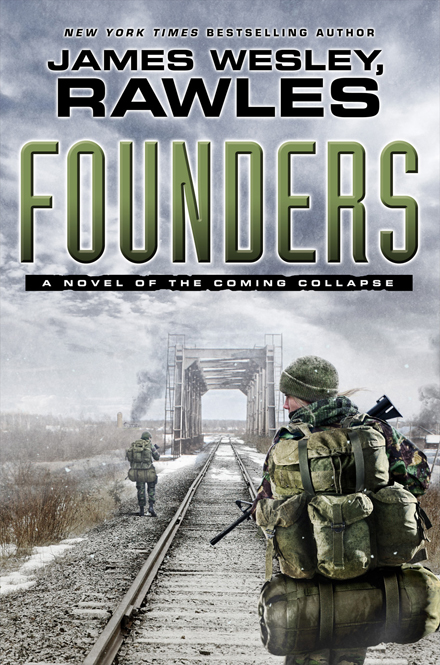
The cover art was created by Tony Mauro, Jr., who also created the cover for “Survivors.” The Founders cover depicts Ken and Terry Layton on their cross-country journey.

Spoiler Alert: This chapter includes passages of the novel that you may not want to know about before reading the book from beginning to end. So skip reading this sample chapter if you are the sort that dislikes spoilers.


“There are certain principles that are inherent in man, that belong to man, and that were enunciated in an early day, before the United States government was formed, and they are principles that rightfully belong to all men everywhere. They are described in the Declaration of Independence as inalienable rights, one of which is that men have a right to live; another is that they have a right to pursue happiness; and another is that they have a right to be free and no man has authority to deprive them of those God-given rights, and none but tyrants would do it. “These principles, I say, are inalienable in man; they belong to him; they existed before any constitutions were framed or any laws made. Men have in various ages striven to strip their fellow-men of these rights, and dispossess them of them. And hence the wars, the bloodshed and carnage that have spread over the earth. We, therefore, are not indebted to the United States for these rights; we were free as men born into the world, having the right to do as we please, to act as we please, as long as we do not transgress constitutional law nor violate the rights of others… “Another thing God expects us to do, and that is to maintain the principle of human rights… We owe it to all liberty-loving men, to stand up for human rights and to protect human freedom, and in the name of God we will do it, and let the congregation say Amen.” – John Taylor, 1882, Journal of Discourses, Volume 23, p. 263.

Muddy Pond, Tennessee – July, The Second Year

            Life in Overton County was just starting to get back to normal when the first Provisional Government units passed though. Since the town was within the four-hour drive-time local security radius of Fort Knox, Muddy Pond was in one of the first areas to be pacified by the ProvGov.  The new administration at first seemed well intentioned and benevolent, but people soon saw its sinister side.
             The nationalization programs and the Controls began gradually.  At first, the ProvGov seized only key industries and utilities.  But later, smaller companies were taken over, some seemingly on a whim. People wondered why would a padlock manufacturing company be nationalized?  And why would a silver refinery have to be nationalized?
             Likewise, the wage, price, currency, and credit controls started small, but gradually grew to gargantuan proportions.  Just a month after the ProvGov troops arrived, there was a dusk-to-dawn curfew, with shoot-on-sight orders for violators.  But even daylight hours weren’t safe, as Ben Fielding discovered.
            Early one afternoon, all of Ben’s family except Joseph was at home listening to some Messianic music on Rebecca’s iPod dock. They often gathered in the living room to do so, on the days that the power was on. The children liked to hear the music played loudly, and they sang along, and danced.  Their fun was interrupted when they heard some long bursts of automatic weapons fire, close by their house. They looked out their living room window and saw a convoy of UNPROFOR coalition vehicles strung out for a quarter mile on the county road.  The trucks and APCs had stopped and turned out onto either side of the road in a herringbone pattern.  The wild firing continued for thirty seconds. They heard a few shots hit the roof of their house. The firing finally stopped when the convoy commander in the lead Marder APC repeatedly honked his horn.
             Ben and his family fearfully watched as men ran back and forth between the vehicles.  They expected more trouble, so Ben took the precaution of running all the pages of his address book through his crosscut paper shredder.
            Five minutes later, a UNPROFOR patrol approached the front door. A German soldier shouted with a heavy accent, “Man of the house, come out!”
            Ben walked out with his hands on top of his head, and said, “The only others here are my wife and children.  Please leave them alone.”
            The patrol leader unslung a rifle from his shoulder and held it out.  Ben recognized it as his son’s .22, now missing its bolt.  The soldat asked, “Your gun, is this?”
            “Yes, I believe that is my rifle, but I’m not certain.  If that is mine, then it is registered in my name, in full accordance with the law.  Where did you find it?”
            “It was being carried by a young, err, man, now dead.”
            Rebecca began wailing.
             “Have you any other guns in the house?”
            “No.”
             The soldiers spent an hour noisily ransacking the house, while others held Ben and his terrified family at gunpoint, outside.  Their youngest daughter, just recently out of diapers, wet herself as they waited.  One team searched the house, while another searched the barn and outbuildings.  Ben alternated between intense feelings of fear and anger at the situation. They watched helplessly as the soldiers carried off Rebecca’s jewelry box, her iPod and dock, and many other small possessions.  This included nearly 200 rounds of .22 hollowpoints that were taken as “evidence.”
            Finding nothing actionable, the soldiers left without explanation or apology.
            Ben and Rebecca went inside to find the house was a shambles.  Several stretches of sheetrock in the hall and master bedroom had been kicked in and the upholstery on their couches and two of the mattresses had been slashed open. Two cabinets had been pried completely off the walls, and were left dumped on the floor, coated in sheetrock dust.  There were shattered dishes and plates littering the kitchen and dining room floors.  A broken pipe was spraying the front bathroom cabinet with water.  Ben soon turned off the well pump and shut the valve for the service line to the house. That stopped the water from further flooding the bathroom and hall.
             After a pair of honks, the UNPROFOR convoy left in a cloud of dust and diesel smoke.
             Ben and Rebecca walked out to the north end of their property, to look for Joseph.  After ten minutes of searching, they found his body 80 yards from the county road, and about 300 yards from the house.  He had been shot six times in the back and buttocks. Two gutted quail were still in his game bag. His white t-shirt was entirely stained red with blood, and his blue jeans were stained red down to the knees.
            For a half hour, Ben sat cradling the lifeless form of his eldest son, crying and rocking. Tears ran down his face. Nearby, Rebecca and their three surviving children sat hugging each other in a huddle, crying, moaning, and praying aloud.  Finally Ben stood up.  He looked down at his son’s corpse and said, “You wait here, I’m going to get a shovel, a sheet, some water, towels, and olive oil.”
            He was back a few minutes later and almost immediately began to dig.  As Ben dug just a few feet from his son’s body, he said forthrightly, “We’ll find no remedy or recourse in the courts, Rebecca.  These are tyrants, tyrants. I need to fight them.”
            He then continued working quietly, digging into the soil and small rocks with fervor. He didn’t stop until the grave was head-height deep.  Blisters were forming on his palms, but he hardly noticed.  As Ben dug the grave, Rebecca washed her son’s body, and rubbed olive oil onto his skin.
             They gently lowered Joseph’s body into the grave and Ben folded the boy’s arms across his chest.  They shrouded the body with a sheet. Rebecca helped Ben back up out of the grave. After saying prayers, each member of the family poured in a shovelful of earth. Rebecca then did most of the shoveling as they re-filled the grave, weeping yet again.
             After the grave was re-filled and mounded, each family member selected a stone to mark the site. Ben found one beside Joseph’s favorite fishing hole.
            They recited the Kaddish, a mourning ritual in Judaism, found in the Siddur, the Jewish liturgy book read in Jewish temples on the Sabbath and High Holy Days.
            Yitgaddal veyitqaddash shmeh rabba. Be’alma di vra khir’uteh veyamlikh malkhuteh veyatzma purqaneh viqarev qetz meshiheh behayekhon uvyomekhon uvhaye dekhol bet yisrael be’agala uvizman qariv ve’imru amen. Yehe shmeh rabba mevarakh le’alam ul’alme ‘almaya Yitbarakh veyishtabbah veyitpaar veyitromam veyitnasse veyithaddar veyit?alleh veyithallal shmeh dequdsha, brikh hu. Le’ella lella mikkol min kol birkhata veshirata tushbehata venehemata daamiran be’alma ve’imru amen.
            (May His great name be exalted and sanctified is God’s great name in the world, which He created according to His will! May He establish His kingdom and may His salvation blossom and His anointed be near. During your lifetime and during your days and during the lifetimes of all the House of Israel, speedily and very soon! And say, Amen. May His great name be blessed forever, and to all eternity! Blessed and praised, glorified and exalted, extolled and honored, adored and lauded be the name of the Holy One, blessed be He, above and beyond all the blessings, hymns, praises and consolations that are uttered in the world! And say, Amen.)
As they walked away from the grave and back toward the house, Rebecca carried the shovel. With both sadness and anger, she spat, “Yes, go.  Fight them! You have my blessing. Don’t worry about us.  We will be safe and waiting here. The Lord will protect all of us, and provide for all of us.”
            That evening, with aching hands, Ben dug up the length of 8” diameter PVC pipe buried beneath their pair of grated trash-burning barrels.  The PVC cache tube contained Ben’s heavily-greased guns: a Galil .308 rifle, a Browning A-5 semi-auto 12 gauge shotgun, and a HK USP .45 Compact pistol. All three guns were considered contraband, so they hadn’t been registered under the recent edicts. Packed along with guns there were seven Galil magazines, three 200-round battle packs of Portuguese 7.62mm ball ammunition, and seven boxes of shotgun shells, each wrapped in separate Ziploc bags.  After he had cleaned and loaded the guns, Ben organized his backpacking gear. He put the Galil and magazines in a guitar case, padded by extra clothes.
            As Ben organized and packed his gear, Rebecca served the children some leftovers. They had to eat sitting on the couch, because the kitchen was still littered with broken glass. After they had eaten, Ben gave each of his children lengthy hugs. He told them to be brave and reverent, and to obey their mother.  He tucked them in bed and said prayers with each of them.
             Back in the living room, Ben spoke with Rebecca, who was busy sweeping up glass. “The chances that they’ll return our .22 rifle are about .001 percent, so I’ll leave you silver that you can use to buy another .22 rifle, for small game. And I’ll be leaving you the 12 gauge, for anything bigger, man or beast.  I think under the old chest freezer would be a good hiding place for it.  Did you notice that the soldiers didn’t touch that?  You can ask some of the neighbor men to help you patch up the house.”
            She set down the dustpan and came into the living room with Ben.  As he continued packing, he said, “I need to be on my way, tonight. It is easier to fight from outside of barbed wire, than from inside it. We’re lucky that I didn’t get arrested today.  I don’t want to give them another chance.  Now listen carefully: I want you to tell people that I was arrested and taken away tonight.  Otherwise, they’ll ask questions when they see that I’ve gone.  In addition to the Army, there are at least three agencies of the ProvGov and four security contracting companies that are independently arresting people and hauling them off to camps, or I suppose for immediate liquidation.  The right hand doesn’t know what the left hand is doing.  So by blaming them for my disappearance, you’ll put yourself in the clear.”
            “And also make the Hutchings government look even worse,” Rebecca added.
            Ben nodded and said, “That’s right. It’s a ‘win-win.’ They use psychological warfare on us, so it’s only fair that we return the favor.”
He let out a breath and went on, “Now I’ll be going to Nashville, to see some old friends.  Its safer for both of us if I don’t tell you exactly who.”
             “Okay.”
            Ben finished strapping his sleeping bag onto his pack. “I’m leaving you most of our silver.  I can’t be sure, but I’ll do my best to send you money from time to time.  Whenever I enclose a letter, you have to promise me that you’ll burn it, right after you read it.”
            “I promise.”
            Then he shouldered his pack and gave his wife a two-minute hug, and a kiss. Ben touched the Mezuzah on his way out the door.  On the porch he snapped closed his backpack’s bellyband clasp, and picked up his guitar case. He turned to face his wife again in the doorway.  “Trust in Adonai and May His Ruach HaKodesh (Holy Spirit) comfort you during the days you sit Shivah for Joseph.  I will remember Joseph with you and will pray the Kaddish for him every day.  I will pray every day for peace, safety and that you would be comforted by the Lord, despite my absence from your side.  Remember that Joseph is ‘asleep’. He loved the Lord Yeshua and is with Him, at this very moment.  Ani meohev otach yoter Midai!”
            “I love you without measure, as well,’ she said, as he turned, and walked out into the darkness.


Guest Article: The Best Free Medical References for Preppers, by Greg Ellifritz

It could evolve as systems are stressed after a natural disaster.  It could be caused by a terrorist attack.  It could even be the result of a societal or economic collapse.  Have you ever thought about what might happen if our current health care system (EMS, Doctors, Hospitals, and Pharmacies) ceased to function normally?

What would you do if you couldn’t go to your doctor, all of the hospitals were shut down, all of the pharmacies closed, and no one answered the phone when you called 911?  You would be on your own.  You would have to take care of yourself and your family members with the knowledge and supplies you currently have.  Could you do it?

Many people have been forced to care for themselves due to partial or full system collapses in recent history.  Think about these events:
– Hurricane Katrina in 2005
– The 2006 Tsunami in Thailand
– The 2010 Haitian Earthquake
– The 2011Earthquake, Tsunami, and Fukushima Nuclear Disaster in Japan

Those were just the big ones.  There have been countless other natural disasters on a slightly smaller scale.  Besides the natural events, think about what happened in New York City when the Twin Towers were brought down.  Think about the economic collapse that affected Argentina for several years.  Think about the societal collapse in the Balkans in the early 1990s.

In each of these events, medical care was limited or non-existent.  All of the residents affected had to take care of themselves.  I ask again: could you do it?

In order to be successful, you have to have knowledge.  With the right medical knowledge, you can acquire, create, or improvise many of the supplies you may need.  Fortunately in this digital age, there is a lot of knowledge freely available on the Internet.  The difficulty lies in sorting through all the rubbish and trying to discern good information from bad.

Well, I’ve done the work for you.  Below are links to the best available free videos and publications on the internet.  These resources are designed primarily for the person who is not a medical professional.  Most speak in relatively clear language without too much technical jargon.  With a little work, anyone reading these books should be able to understand the concepts.  Almost all of these references address the issue of austere medical care…what to do when you have relatively untrained practitioners, limited equipment, and no one coming to help.  These are the facts and skills you will need to learn if you want to take care of yourself in a system-collapse medical emergency.

Where There is No Doctor
The most widely-used health care manual for health workers, educators, and others involved in primary health care delivery and health promotion programs around the world.  While you are visiting this site, make sure you also download “Where There is No Dentist”, “Where Women Have No Doctor” and “A Book For Midwives”.  All are excellent resources. Print versions are also available as well. 

These books are a great introduction to primary care in an austere environment, offering useful information for handling everyday medical problems by unskilled caregivers with minimal access to resources. but the advice often ends with “and transport patient to definitive medical care”.  That may not be enough when there is no definitive care available.

US Army Tactical Combat Casualty Care (TCCC) Correspondence Course
“When you have casualties on the battlefield, you must determine the sequence in which the casualties are to be treated and how to treat their injuries. This subcourse discusses the procedures for performing tactical combat casualty care; treating injuries to the extremities, chest, abdominal, and head; and controlling shock.”
This course was developed by the United States Army, but the lessons contained within are the battlefield medical protocols utilized by all branches of the US Military.  These are the absolute best practices for handling traumatic injuries without professional medical intervention.

Combat Lifesaver Home Study Course
This is the “advanced” version of the basic TCCC protocols course above.  It is a self- guided home study course that is academically equivalent to the class that many soldiers going into combat receive.

Special Operations Forces Medical Handbook (2001)  
This book is a little more complex than the other ones above, but it is still a very valuable reference.  There are more current print versions available, but the latest books don’t vary greatly from the free version found at the link.

Survival and Austere Medicine, An Introduction (2nd edition)

This is simply one of the best wilderness and primitive medical books available anywhere!  It covers every conceivable topic including drugs, kits, herbal remedies, disease treatment, trauma, and dentistry.  It also has a very comprehensive list of reference material to look at for additional study.

Ship Captain’s Medical Guide

Although primarily concerned with emergencies at sea, this book is an excellent medical guide for a variety of conditions written so that the lay reader can diagnose, understand, and treat most common medical conditions in the absence of more definitive care.  It contains good basic coverage of hygiene, nursing and medical care with limited on-hand resources.  Like “Where There is No Doctor”, the treatment sections often end with somewhat impractical advice for a grid-down scenario.  “Access medical counsel via ship radio” may not be appropriate for your situation.
  
Operational Medicine Videos
For those of you who prefer to learn skills by watching video rather than reading, this is your site!  It is a treasure trove of archived military medical videos on almost every topic available.

Medical Drugs and Equipment for the Team Physician
A great listing of equipment and drugs for treating all types of injuries in athletes.  In a survival situation, everyone will have to become an athlete.  This is a great overall list of gear (and drugs) to have if you plan on taking care of a large group of people or you have a larger family.

Journal of Special Operations Medicine
An archive of more than 10 years’ worth of journals for continuing education of military medics.  Check out each year’s “Training Supplement” for the latest guidance about how to treat virtually any common medical conditions in the field with minimal equipment.  If I had only one resource to download, this “Training Supplement” would be it.

Before you dig in and get started, I have a couple of caveats….
  
Reading these books and stockpiling some supplies is not the same as attending medical school!  If the healthcare system is functioning properly, use it!  Save the knowledge in these books for when you really need it.
  
Also, there is no substitute for experience.  If you have a greater interest in these subjects, classes are available.  You will learn much more in a hands-on classroom environment than you will by just reading alone.  Medical classes for non-medical personnel are sprouting up nationwide.  You can find classes in every subject from Tactical Medicine to Third-World Medicine to Wilderness/Backcountry Medical skills.  I’ve taken many of these kinds of classes and even teach some.  They are all valuable.  The first time that you place a tourniquet should be in class, not on the battlefield!
  
I have one more tip for you….

If you anticipate needing these kinds of skills, think about the environment in which you will be practicing.  Don’t just save these to your computer.  If there are power outages or if there is an EMP event, your computer won’t likely work.  Print them out or order the books in hard copy form.  There’s nothing like having a real book when the lights go out!

If you want to learn more and buy some actual hard copy books for reference material, it would be a good investment.  I recommend the following:

Be safe and learn these skills before you need them!

About the Author: Greg Ellifritz is a 16-year veteran police officer. He is currently assigned as the full-time training officer for a suburban police department, responsible for developing and instructing all of his agency’s in-service training. With a passion for adventure travel, Greg spends an average of six weeks a year exploring Third World countries.  Recognizing that his travels often take him far away from established medical care, he has taken numerous wilderness, tactical and military medical care classes since 2003 and is a certified Tactical First Aid Instructor and Emergency Trauma Management Instructor.   Having provided medical care for both himself and his traveling companions in austere conditions on five continents, he now teaches medical courses for police officers, corporations and individuals through his company, Active Response Training


Economics and Investing:

The Start Of An Economic Collapse In Europe, But It Will Deeply Affect The Entire Globe

C.D.V. sent this: Germany Has A Generous Proposal To The Broke PIIGS: “Cash For Gold”

Also from C.D.V. : Cramer: Europe Has Become a Black Box

More monetization ahead: Early Fed Move Will Boost Gold

Spain faces ‘total emergency’ as fear grips markets

Money flies out of Spain, regions pressured

Items from The Economatrix:

When The Derivatives Market Crashes (And It Will) US Taxpayers Will Be On The Hook

Consumer Confidence in the Economy Plunged in May

A No-Confidence Vote For Obamanomics

May Jobs Report:  More Weak Hiring Expected


Odds ‘n Sods:

The book NOLS Wilderness Medicine is available free, for today only, from Amazon.com.

   o o o

I heard about a good article on bug-out RVs and camping trailers.

   o o o

Lee M. suggested: 51 Free Tools to Stay Informed and Invisible on the Internet

   o o o

Now approaching 100 active listings! There are some great retreat properties available at our spin-off site, SurvivalRealty.com. For example, one of the most recent ones is a 212-acre ranch property in Montana that would be ideal for a group or extended family retreat. In addition to the main house, it has a commercial kitchen, four cabins, two bunkhouses, and a yurt. Full length ads at SurvivalRealty are just $30 per month, and there are no commissions charged.

   o o o

F.G. sent us this sign of the times: Alabama National Guard Closing Many Armories

   o o o

More Bloomberg Nanny State Nuttery: New York City proposes ban on sale of oversized sodas. Perhaps next on Bloomberg’s agenda will be a banning “high capacity” triple-scoop ice cream cones and giant Toblerone bars. (The latter would be import banned and classified as Weapons of Mass Ingestion. The pre-ban chocolate bars would only be available after a background check, fingerprinting, and a $200 transfer tax.) And what about those 24-packs of Krispy Kreme donuts? Clearly, only trained law enforcement professionals should be trusted with those.

Jim’s Quote of the Day:

“In the brief span of my lifetime, we have gone from a nation where kids could order a .22 [caliber rifle] in the mail (with their parents’ permission) and go to Sears and buy a kit for casting their own lead toy soldiers to a nation where they are protected from ‘dangerous clothing’ [with drawstrings] and would be expelled from school for drawing a picture of a toy soldier.” – Tamara, Editor of the View From The Porch blog


Jim’s Quote of the Day:

“In the brief span of my lifetime, we have gone from a nation where kids could order a .22 [caliber rifle] in the mail (with their parents’ permission) and go to Sears and buy a kit for casting their own lead toy soldiers to a nation where they are protected from ‘dangerous clothing’ [with drawstrings] and would be expelled from school for drawing a picture of a toy soldier.” – Tamara, Editor of the View From The Porch blog


Note from JWR:

Today is the last day to order the SurvivalBlog Archive CD-ROM during our mid-year 25%-off sale. The latest six-year compilation includes as a bonus my book “Rawles on Retreats and Relocation” in digital format. Having an offline archive is the only sure way of knowing that you will have access to SurvivalBlog’s content, regardless of what happens to the Internet. At the sale price, the CD-ROM is $11.25 and the Digital Download is just $7.50. Be sure to order your copy before midnight, May 31, 2012.

Today we present the last two entries for Round 40 of the SurvivalBlog non-fiction writing contest. The other articles still in the queue will “roll over” into the judging for Round 41. The prizes for this round include:

First Prize: A.) A gift certificate worth $1,000, courtesy of Spec Ops Brand, B.) A course certificate from onPoint Tactical. This certificate will be for the prize winner’s choice of three-day civilian courses. (Excluding those restricted for military or government teams.) Three day onPoint courses normally cost $795, and C.) Two cases of Mountain House freeze dried assorted entrees in #10 cans, courtesy of Ready Made Resources. (A $350 value.) D.) a $300 gift certificate from CJL Enterprize, for any of their military surplus gear, E.) A 9-Tray Excalibur Food Dehydrator from Safecastle.com (a $300 value), and F.) A $250 gift certificate from Sunflower Ammo.

Second Prize: A.) A Glock form factor SIRT laser training pistol. It is a $439 value courtesy of Next Level Training. B.) A FloJak FP-50 stainless steel hand well pump (a $600 value), courtesy of FloJak.com. C.) A “grab bag” of preparedness gear and books from Jim’s Amazing Secret Bunker of Redundant Redundancy (JASBORR) with a retail value of at least $300, D.) A $250 gift card from Emergency Essentials, and E.) two cases of Meals, Ready to Eat (MREs), courtesy of CampingSurvival.com (a $180 value) and F.) A Tactical Trauma Bag #3 from JRH Enterprises (a $200 value).

Third Prize: A.) A Royal Berkey water filter, courtesy of Directive 21. (This filter system is a $275 value.), B.) A large handmade clothes drying rack, a washboard and a Homesteading for Beginners DVD, all courtesy of The Homestead Store, with a combined value of $206, C.) Expanded sets of both washable feminine pads and liners, donated by Naturally Cozy. This is a $185 retail value, D.) A Commence Fire! emergency stove with three tinder refill kits. (A $160 value.), and E.) Two Super Survival Pack seed collections, a $150 value, courtesy of Seed for Security.

Round 40 ends today, but you can write and e-mail us your entry for Round 41. (At this point, with the queue full, any entries that have not yet been posted will run after June 1st and be part of the Round 41 judging.) Remember that there is a 1,500-word minimum, and articles that relate practical “how to” skills for survival have an advantage in the judging.


Buying a Used Wood Stove by Sid S.

Near the top of the List of Essentials is is keeping warm. One surefire way to do that is with a wood-burning heat stove. Wood stoves are reliable as a main source of heat or as backup but can cost between $1,000 and $2,000 new, so buying used is a practical way to go. Before you buy however, there are a few things you should know.

First of all, you need a good, certified wood stove. Why certified? Because they use less than half the wood that the previous generation of wood stoves used, don’t exhaust clouds of unburned soot into the air, and have close clearances to combustibles, some as close as 4?. Also because certified wood stoves are mandated by the EPA in all fifty states.

Virtually all certified stoves have a ceramic window that looks like glass but is impervious to heat, through which you can enjoy the fire and keep up with the need  to adjust the wood or to feed in more.  I don’t recommend getting a stove with a catalytic combustor as they are more expensive and have a declining efficiency. The efficiency of a non-combustor-equipped stove never changes and newer standards have been met without combustors since 1990, when the current EPA standards were established.

The fire chamber in certified stoves is engineered to burn wood efficiently without smoldering, even when shut down all the way. This gives you more heat from each piece of wood while exhausting cleaner and hotter, thus almost completely eliminating creosote buildup in the chimney. By the way, never connect a 6?-exhausting certified stove into a 8? chimney. Because of the engineered burn, all certified stoves are designed for a 6? flue which has a stronger draft than an 8?. Be sure to use listed stovepipe and adhere to the clearances on the pipe and the stove for a safe installation. Your insurance company can deny a fire claim caused by a stove that is improperly installed or is not safety listed. Also, I recommend a wind-directional rotating cap on all wood stove installations. They are the solution to back drafting, caused by a high wind forcing itself down your chimney and filling your house with smoke. You will want one after the first time the smoke alarms wake you up in the middle of the night!

Here are some things to look for on a used wood stove :
• All legal wood stoves must have an EPA sticker on the back. This sticker shows the production date, efficiency, grams per hour (gph) of emissions, as well as the clearances to combustibles for various applications.
• The production date should be July 1, 1990 or later.
• Inside the firebox and above the secondary air tubes is the baffle plate. Look for warped baffle plates from overheating the stove. This is more common in a smaller stove used to heat a larger area. The steel plates are removable and can be replaced for about $50.
• A cracked glass can be replaced for about $75. This is usually Robax ceramic and is impervious to heat although it breaks like glass. The prevention is to make sure the log fits inside the stove before closing the door on it.
• If the stove needs a paint job, use Forrest Stove Bright paint. After wire-wheeling off the rust and loose paint and cleaning with lacquer thinner, fog on the first coat. Follow with a slightly heavier second coat, and finish with a normal third coat. This paint fully cures under heat so a small fire must be built initially, followed by a hotter fire until out-gassing is completed. When the smell goes away the paint is cured. Open the windows during the curing process.
• The braided gasket around the door can be replaced for around $20 and will need to be glued in place. The special glue is around $10.
• Firebricks can be purchased at your local wood stove store. They are around $4 each.

Once installed, a wood stove should give you a lifetime of trouble-free service. There is however some maintenance involved. The ash will need to be removed from time to time and the window cleaned daily. The inside of the stovepipe will need to be cleaned annually with a wire brush but don’t be surprised if you don’t find much creosote. The newer stoves burn clean, remember? They accomplish this by burning hotter inside the firebox and exhausting hotter (and cleaner) into the flue pipe. The newer flue pipes are packed with ceramic wool and rated to 2100 degrees. The unburned creosote that used to build up in the old triple-walled air-cooled flue pipes is sparse and, with annual maintenance, so are flue fires. The newer insulated pipes get hotter quicker and stay hot longer, thus increasing the draft and practically eliminating creosote buildup.

Keep your eyes peeled on Craigslist for a good deal on a used stove. Just last week I called on a newer Lopi for $400 but someone offered them $450 and they took it. That was a $1,800 stove when  old new four years ago and it was barely used. Once in a while I will find a certified stove in good shape for around $200. I am always on the lookout for used stoves for friends and sometimes I’ll turn one over for a profit.

If you buy a used stove manufactured after July 1, 1990, it will comply with the Phase II standards which are 7.5 gph of particulates. Washington  is the only state to have it’s own standards which are 4.5 gph. Most new stoves and some used ones will meet this standard and some are as low as 1-2 gph. Check “EPA Certified Stoves” online if you find a used stove you are considering. This site lists most of the stoves which have been certified but not all of them. Some stoves presently being manufactured in other countries are missing from the list.

Inside the house, I keep a weeks worth of firewood near the stove in brick bins built for that purpose. The raised hearth is 3 1/2? thick concrete and full of rebar, allowing me to split kindling right on the hearth. Under the hearth is a large kindling drawer where I also keep paper. Implements are hanging on hooks nearby. I use a coal hod to carry out the ash and to carry in more kindling.

My favorite wood stove is a Brass Flame. They are certified of course, and are built like a Sherman Tank. They have a double-air opening for quick-starting the fire, they look good and burn efficiently. I have found used ones for several friends and relatives. I am a little prejudiced in this department; my brother developed the Brass Flame and it was the first stove to pass the emission standards without a catalytic combustor. All certified stoves on the market now copy his combustion process, the big secret being lots of secondary and tertiary air. He made 10,000 of them before selling to Earth Stove, who made them for a few years and then sold to a bigger company, who dropped the line. If you can find one, you won’t be disappointed! Other brands I look for are QuadraFire, Lopi, and Avalon but I will consider others, especially if they are in good shape.

When heating with wood, it is a good idea to keep a pot of water on the stove to replace the moisture removed by the dry heat. An old cast-iron kettle serves well for this purpose. Another addition that is very helpful is a ceiling fan, positioned close to the stove and used to move the heat away from the stove. Without a fan, the heat takes a longer time to fill the house. Since heat seeks cold, it does eventually warm the place up, but in the dead of winter, who wants to wait? This small addition makes a big difference!

One more thing that makes a big difference in helping to heat your home more efficiently is bringing in outside air directly to the stove. This is required in mobile homes and all new homes, but is a good idea in any home. If you have a crawlspace under your home, a 3?-4? pipe into the crawlspace is adequate for this purpose. In my case, I  put in a 4?  pipe to open air before the slab was poured.  Pedestal stoves are designed for outside air while stoves with legs will need to be adapted. Special outside-air adapters can be ordered or made for any stove.

When buying a wood stove, look for one with a flat top on which you can cook your food in a pinch. All newer stoves have a baffle plate around which the exhaust must go and in the process the stove top heats up nicely. Stoves with a stepped-top lack the space for a frying pan. During power outages, your stove can do double duty, heating the home and cooking your supper!

To clean the ceramic glass in the morning when the stove is cold, I simply get a piece of newspaper wet with water and emulsify the creosote, scraping it off with a razor. Even the best stoves get buildup on the window.

It is comforting to have my three cords of oak firewood put up for the winter, knowing that if a storm or blizzard should blow through or the power should go out (sometimes for days) my family and I will be warm and able to cook on our trusty wood stove. Our kids remember those times as special, with all of us in the same room not far from the stove while outside the snow is piling up and the wind blowing. There is nothing like the steady warmth of wood heat to soothe the soul and warm the body. It is primal. To me, it seems the way God meant it to be!


Beyond The Four Pillars, by Adam H.

Obviously it’s fun talking about boom sticks and charging in to save the day. But here are some other items for your consideration for the other 23 hours in the day when the castle is not under siege:

FOOD & WATER – Your body can last 30 days without food, and only 3 days without water. What are you doing to secure a minimum of a gallon/day for each member of your family. Remember, in a grid down scenario, it will NOT take long for industrious groups to recognize that water will be more valuable than gold. Plan on making a hike to a nearby stream each day with your bucket? How long do you think it would take a gang to recognize the power of strategically placing sniper or blockades to/from accessible watering holes? You’re going to need a Plan B – plastic water cans (5 gal) that can be carried, 55 gallon drums, 250 gallon rain capture systems. These will be life savers. One final word on water – consider a well hand pump like this one from Flojak. JUST BECAUSE YOU HAVE A WELL DOESN’T MEAN YOU HAVE WATER! Without electricity, how do you plan to get that water up to you?

Figuring out food is easy. What did you eat today? Now buy 30 of that, with your goal to build up to 6-12 months of food for your family. Eggs/milk? Yeah, they have the powdered stuff. Remember that you will want to maintain as much of a normalized, familiar diet as possible so you don’t shock your body.  Don’t forget to throw in some sweets (Hershey Kisses, candy bars, etc.)  When everything seems like it’s off its hinge, you’ll appreciate having something sweet.

CLOTHING – What are you lacking right now that is either missing or in need of repair/stitching? Comfortable, water proof hiking boots should be priority. Poncho. Waterproof cold weather gear. Hats, gloves, sunglasses. Do you have extra batteries for your watch?  Also – 2 categories to prep: Everyday “civvies” /work uniform (khakis and polos, etc), and then your “playtime/hunting” gear. there is a time and place for both. Simple is best. And remember that “two is one, and one is none”.

SHELTER – This is more than do you have a roof. Consider what happens when the power goes down. Do you have light/candles/flashlights/phone service? What about backup heat? Here’s food for thought: In a grid down scenario, how long do you think you can “hold up” without operational sewage? Do you have an emergency 5 gallon bucket with lid and extra baggies? Hint: some extra kitty litter? Not a bad idea. Also – inventory any possible weak spots: Ground floor doors and windows. You may also consider pre-cutting plywood to act as reinforcement in the case of a hurricane (or other man-made threats).  Now is also a good time to begin contingency plans.  Where will you go in the event of some emergency and your house is no longer safe, or has been destroyed or damaged?  Have you considered forming alliances with people in your neighborhood or church where if you are homeless you can stay with them (for a pre-determined period of time), and vice versa.

TRANSPORTATION – Lets step back for a second. Before you go shopping for a diesel Bug-out vehicle, do you have the basics? Jumper cables? Gas can? Spare tire? Reliable jack? Extra quarts of oil and coolant? These cost $50 and can be the difference between a 10 minute ride home, or being stuck in the woods overnight. Also – were you aware that you can purchase a 14 gallon gas tank with wheels to store at the house? Think about it…if the pumps go dry, you have an extra 300-400 miles of mobility that can be bartered or utilized to get to your safe house.

Going Beyond The Four Pillars

Beyond the “4-Pillars” of Food, Clothing, Shelter, and Transportation, there are other vital tactics that you will need to sustain you and your family over the next 6-12+ months: They are Communications, Defense, Medical, and Community.

COMMUNICATIONS: – As the Ghostbusters would ask, “Who ya gonna call?” Do you have a local list of 5 to 10 reliable people that you would trust if you come home to a burning house, or you find yourself surrounded by a roving band of ne’er-do-wells trying to beat down your front door and windows? After the phone tree, given the phone dead zone in New York City on 9/11, you should probably consider getting your ham radio license. When disaster hits, this is the Internet, phone system, and postal service all wrapped up in one little box. In the field of battle, when you control communication, you also control movement of the enemy, and can cut off any vital supplies and shipments.

DEFENSE: This seems to be where us guys like to go first. There’s a reason this is further down the list. If you don’t have these other items squared away first, then what are you going to do? Well, you become one of “them”, the looter crowd that just thinks they are going to take whatever they need by force. The habit of planning the use of non-lethal force will avoid major unnecessary engagements that cost valuable resources, and cost lives. Still, you need to be able to defend yourself, your family, your home, and be prepared to come to the aid of your friends and community. It’s your duty as a man, in my humble opinion.

You don’t need to spend $1,500 on the fanciest AR and a drawer full of Glocks in every caliber. It means you need the basics – 1) Knowledge/Awareness, 2) Hand to Hand/Self Defense training, 3) Concealed carry, 4) Something to defend your home against multiple aggressors for 20 to 30 minutes until help can arrive (see Communications, above). At its core you can equip yourself with a highly-concealable Taurus TCP .380 for only $200, and reliable 12 ga Shotgun for $209.

Guess what? That leaves enough funds to pick up a Mosin Nagant rifle for less than $120 that will take down any large game you may need to put on the table for your family (or even two-legged predators). Now I’m no math major, but for $529 (+FFL fees), you can purchase all the home defense that you really need. But here’s the rub: These will do you no good unless you practice, practice, practice. Get involved with USPSA. Find other like-minded folks in your area who are interested in running various drills, shooting matches, and get the practice and experience you need. Losers practice so they don’t miss. Winners practice until they can’t miss. Chew on that for a minute.

MEDICAL – Preventive maintenance is most critical. Get off your duff and move for 20-30 minutes day. Walk, hike, hit up p90x or Insanity. Heck, go online and find some sort of fitness that you find fun. I have a 20 minute circuit of sit-ups, pushups, pull-ups, handstands, rev pull-ups, dips, burpees, curl/shrugs, weighted jump rope and deep squats/sprints that I knock out in the time it takes most people to watch television commercials. Beyond preventative, you will obviously need some basics: Supplements, pain meds, insulin, Neosporin, Band-aids, rubbing alcohol, etc. Don’t over think it. Just put together what you need as you need it in a water-tight tool box, or Rubbermaid tote container. Then find some place to get CPR certified.

COMMUNITY – No man is an island, and you aren’t going to be able to do this alone. We’re not wire up that way. Got a bug out retreat in the boonies that’s 50 miles from the nearest town? Awesome. Then what. Why not organize with people in your community. Find a common thread, and decide that if TSHTF that you, your family, your neighbors, and people within your community are going to be proactive in setting up all the items listed above.  Since before the formation of our nation, churches have played a vital role in our communities, both for spiritual guidance, as well as for community. We need each other.  As a former athlete I cannot tell you how many times I was reminded of the acronym “TEAM – Together Everyone Achieves More!”.  It became a running joke, but today those words ring truer than ever.  There are people you know who can build shelter, run plumbing, electricity, fix cars and engines, set up and orchestrate civil communications and defense, bake, can, and coordinate anything you can imagine. But apart from community, those talents and strengths all go to waste.  But when combined, we all become a part of something much greater than the sum of our individual parts.

The media seems to enjoy casting “preppers” as outer fringe nut jobs, yet the federal government has underground bunkers and contingency plans for every conceivable disaster known to man. Did you know they even have contingency plans in the event an asteroid slams into the planet and wipes 90% of the population off the face of the earth? Yet you’re told that you’re nuts to set aside 30 days of food and water… well, to me that is nuts not to think about these things and set plans in motion. And above all else, find things that you enjoy doing and share them! Movies, plays, art, music, backpacking, dancing…and my favorite, eating! There is so much worth living and fighting for.

So why not start today with an open discussion with the people in your life? The journey of a thousand miles begins with a single step. Start by picking up that extra 25lb block of rice at Sam’s Club. Then look to add 1 new thing each day or week. Remember, the days are evil, and each passing day is a lost opportunity to do good, not only for yourself, but for the lives of those around you who are beginning to wake up.  And see this time as a tremendous opportunity to become more as a person, and to minister to the needs of others.  Imagine the impact and good you can do when a family member or friend comes to you panicked by the reality that the world that they’ve always know is about to change.  Nature abhors a vacuum, and when a void is created, Edmund Burke once said that “All that is necessary for evil to prevail is for good men to do nothing”.  Well, now is your chance to do something good.


Letter Re: Commercial Scale Organic Farming and Ranching

Hi Jim,
I wanted to let you know about an interesting visit I had last week.  Part of my job is to evaluate start-up companies for potential early-stage investments.    Ran across an interesting one last week.  Located in the Willamette Valley of Oregon, they have embarked on a totally sustainable commercial scale organic farming/ranching enterprise.  They have about 1,000 acres in Oregon and another 1,000 acres in California in the Central Valley.  Here’s their process to convert regular farmland to sustainable organic agriculture and ranching:

1.  First, they acquire standard farmland, usually tilled.
2.  They convert it to pasture ensuring that there is irrigation and planting it with a robust mixture of grasses, clover, grains, hairy vetch, and other sturdy broadleaf plants.  It takes 3 years to be certified as organic so from this point on, they do not apply pesticides [herbicides,] or non-organic approved fertilizers.
3.  They then run sheep on the pasture land, moving them from segment to segment every 3-5 days. They sell the lambs yearly and keep the breeding ewes for about 5-7 years when they are also sold. They also harvest hay to feed the ewes over the winter.  Volunteer weeds are favorites of the sheep and very little land maintenance is required beyond irrigation.
4.  Sheep are alternated with very large chicken tractors that move on winches about 1 foot/hour.  Eggs and meat are harvested.
5.  Cows are run on the land occasionally.
6.  After three years of this production, the pasture foliage has filled in and is very dense.  The biomass has also been completely re-established in the ground.  The ground has rebuilt its nitrogen content and is now ready for crops.
7.  After several additional years of production (optional), pigs are allowed on the pasture.  The pigs rip up the soil and add natural fertilizer.
8.  After a partial season of pig use, the land is tilled and organic crops are grown for two years.
9.  After cropping, the land is re-planted in pasture and the process repeats.

As you can see, this requires substantial farm land in order to rotate the different utilizations at the proper time.  What is interesting is the financial dynamics of this process.  Typical farmland produces about a 4% return on investment (ROI) annually.  Margins have decreased since ethanol production and other factors have driven up the cost of fertilizers, additives and animal feed.  With their process, they are getting 8% ROI and it is indefinitely sustainable.  Plus, the meat, eggs, and crops are all organic commanding premium prices for the farmers.  I should note that their business model is to be simply owners/managers of the land.  They lease out the land to other commercial enterprise who raise sheep, cows, chickens, pigs and crops and sell them into the organic marketplace.  They lease the land on the schedule noted above.

I thought that this may have some value to homesteaders and people setting up their retreat.  Perhaps this could work on a smaller scale; say five acres or so with small numbers of sheep, pigs and chickens.  You would need ongoing access to grass seed to re-seed pastures if you chose to grow crops. – Sid L.


Letter Re: FTX Games for Developing Recon and Perimeter Security Skills

JWR,

Thought I’d pass on some field training exercise (FTX) grunt games that we used to use for training. It’s an excellent way to evaluate your rural home or retreat security, and develop reconnaissance skills.

I don’t know if the military still encourages this kind of training, but during the Cold War, there was a game we used to play to try and keep sharp. If I remember right, both my army reserve unit and later, my regular army mechanized infantry units both practiced this. It costs about nothing, but hones critical skills.

The premise is simple:

To send a team out to gather as much information on the opposing team as possible, and report back without being caught. To make things a little more interesting, each aggressor team member would have a deck of cards, and place them on items of value that they could have stolen or destroyed inside the defenders camp. And if one of the aggressors were caught, they were usually held inside the camp, and made to do something embarrassing (singing a nursery rhyme, clucking like a chicken, or whatever the officer or NCO felt like at that time).

The defensive team would, of course, try and create a defense where no one could sneak through, send out patrols to try and spot/capture recon-patrols, and set traps within their parameter to secure valuable/sensitive items.

Teams:

When training within the platoon, one group (usually a team to squad size – 4 to 13 people) are marked as the aggressor, the remaining play the defensive role. Sometimes this would even be one company against another company where both had aggressor and defensive components.

This was never official, and usually the losers had to pay for some beer when it was over, but you would be surprised how effective it was.

Training Goals:

Learn where your training is weakest – both in personal training and the tactical abilities of your team/platoon/company.
The best way to learn where your parameter is weakest is to try and get around it.
The best way to learn how to defend against small recon size patrols or individuals is to defend against them.
Not knowing the exact location of the defenders was critical. We would get a general location of where they might be, but beyond that we had to track down the defenders by search grids, and their lack of noise and light discipline.
Most of this was done at night. We had night vision, but the technology is not as effective as you might think in woodland terrain. Plus when the goggles are cranked up to full power, they send out a light beam that gives you away when the opposing team has the goggles too.

Sometimes the NCO on patrol would declare himself “injured”, and he would alternate putting E4s in charge during the remaining mission. It always caused a little confusion, but dealing with confusion was part of the exercise.

To avoid the ‘I saw you’ excuses, we would plan out the recon, mark times at different points, and if possible leave cards where you could have stolen or destroyed materials. In addition, there was on occasion a hidden case of beer. If you could get it out of the defensive parameter without being caught it was yours, if you could identify where it was you split it with whoever else spotted it. We mixed up the rewards all of the time, but you get the point.

One last note: we often did this over the course of a planned field exercise, and in-between normal training. If you only do this for one night, then the opposing force will be ready and have most of their people awake as possible. If they don’t know if you are coming tonight, tomorrow night, or early next week, then they have to use a normal schedule for security. It also meant that if we were to infiltrate when they were the most tiered from their daily training, we would be infiltrating under the same conditions, and with the added strain of the patrol. – Robert B.


Economics and Investing:

Pierre M. sent this: Debt crisis: a $46 trillion problem comes sweeping in

Pierre also suggested this by John Rubino: Welcome to the Currency War, Part 1: Iceland and the Tragedy of the Commons

Insight: European firms plan for Greek unrest and euro exit. (Thanks to Sue C. for the link.)

Ex-employees punish JPMorgan via CDS derivatives trades

Food stamp Usage Remains at All Time High, Record Number uf Households Receive $277 in Poverty Assistance Monthly

Items from The Economatrix:

Home Prices in US Fell at Slower Pace in Y/E March

Consumer Confidence in US Fell in May to Four-month Low

Oil Advances for Third Day on Outlook for US Economic Growth


Odds ‘n Sods:

A reminder that the ongoing Radio Free Redoubt podcast series is now available on iTunes.

   o o o

Simon Black brings us news of the latest absurdity from Nanny State Britannia: Trust me, this is good news. (OBTW, one of the comments to that article mentioned a parallel event, in California.)

   o o o

Almost half of new veterans seek disability

   o o o

G.G. flagged this surprisingly well-balanced article from The Guardian: Indian women turn to firearms against threat of violence. (Notes on the Video: The family in the opening sequence seriously needs to get some eye and ear protection! But you gotta love their Broomhandle Mauser carbine and the Road Warrior truncated double-barrel shotgun. They deserve a few style points, for those.)

   o o o

Pierre M. sent this news from Southern California: Flea-Borne Typhus Warning in Santa Ana


Jim’s Quote of the Day:

“While the majority of Americans are oblivious to the warning signs around them, recent actions taken by our government and the governments of other industrialized nations suggest The Powers That Be know very well where we’re head. They are and have been taking steps for quite some time to prepare for what is coming next…

…When it hits the fan, and things go critical, the recent actions of our government demonstrate that it is only capable of responding in one way – through brute force and tyranny.

Everything they have done in recent years with respect to liberty-restricting legislation, the militarization of our police forces and the expansion of the security industrial complex has been to prepare for the inevitable.

They already know it’s coming. They’re getting ready for it. You might want to consider doing the same.” – Mac Slavo, in his SHTFPlan blog


Notes from JWR:

Our mid-year 25%-off sale on the SurvivalBlog Archive CD-ROM ends tomorrow (May 31, 2012.) The latest six year compilation includes my book “Rawles on Retreats and Relocation” in digital format, as a bonus. At the sale price, the CD-ROM is $11.25 and the Digital Download is just $7.50. Be sure to order your copy before the sale ends.

Today we present three more entries for Round 40 of the SurvivalBlog non-fiction writing contest. The prizes for this round include:

First Prize: A.) A gift certificate worth $1,000, courtesy of Spec Ops Brand, B.) A course certificate from onPoint Tactical. This certificate will be for the prize winner’s choice of three-day civilian courses. (Excluding those restricted for military or government teams.) Three day onPoint courses normally cost $795, and C.) Two cases of Mountain House freeze dried assorted entrees in #10 cans, courtesy of Ready Made Resources. (A $350 value.) D.) a $300 gift certificate from CJL Enterprize, for any of their military surplus gear, E.) A 9-Tray Excalibur Food Dehydrator from Safecastle.com (a $300 value), and F.) A $250 gift certificate from Sunflower Ammo.

Second Prize: A.) A Glock form factor SIRT laser training pistol. It is a $219 value courtesy of Next Level Training. B.) A FloJak FP-50 stainless steel hand well pump (a $600 value), courtesy of FloJak.com. C.) A “grab bag” of preparedness gear and books from Jim’s Amazing Secret Bunker of Redundant Redundancy (JASBORR) with a retail value of at least $300, D.) A $250 gift card from Emergency Essentials, and E.) two cases of Meals, Ready to Eat (MREs), courtesy of CampingSurvival.com (a $180 value) and F.) A Tactical Trauma Bag #3 from JRH Enterprises (a $200 value).

Third Prize: A.) A Royal Berkey water filter, courtesy of Directive 21. (This filter system is a $275 value.), B.) A large handmade clothes drying rack, a washboard and a Homesteading for Beginners DVD, all courtesy of The Homestead Store, with a combined value of $206, C.) Expanded sets of both washable feminine pads and liners, donated by Naturally Cozy. This is a $185 retail value, D.) A Commence Fire! emergency stove with three tinder refill kits. (A $160 value.), and E.) Two Super Survival Pack seed collections, a $150 value, courtesy of Seed for Security.

Round 40 ends on May 31st, so get busy writing and e-mail us your entry. (At this point, with the queue full, any entries received will likely run after June 1st and be part of the Round 41 judging.) Remember that there is a 1,500-word minimum, and articles that relate practical “how to” skills for survival have an advantage in the judging.


For TEOTWAWKI, Do The Easy Stuff First, by Dale Martin

There are a lot of things to be fearful of in this old world.  But, for most of us Joe Average North Americans, there are things we believe that are likely to happen, and many other events that are a lot less likely.
Most of us are not all that worried about a magnetic pole shift, the Mayan calendar ending this year, the Yellowstone super volcano, or an alien invasion from outer space.  It’s not that all those things are impossible, but there are threats that are simply a lot more probable.

Mr. and Mrs. Joe Average (the people that don’t have their heads stuck in the sand in denial) are most worried about an economic collapse.  Joe knows these events have happened historically in our own country (1929), as well as many other countries.  He is not so rigid as to think it can’t happen again.

In the current world, Joe hears about it from many different media outlets.  Prior to the last few years, since around 2008, Joe never heard such dire thoughts from any media source, much less from the now countless sources.  He knows the causes could be myriad, and everyone out there has a theory and a prediction.  It might be “just” a hard economic downturn like the Great Depression, and there still might be basic law and order.  Or, it could be truly apocalyptic social disintegration.  Joe is not so arrogant as to think he knows how all the countless variables will turn out.  He might not know what the eventual “tipping point” will be, but neither is he is oblivious to what is happening in the world around him.  He sees the signs.  A recent poll indicated that nearly 50% of Americans believe there will be an economic collapse within their lifetimes.  Many see it as imminent.
Joe, being a practical sort, has stored up a little extra food, water, and supplies, including outdoor gear.  Joe and his family would much rather “bug in” than “bug out”, but he can envision a social collapse where that choice might not be his to make.  He especially knows that if the power grid were to go down, all bets are off.  Joe, trying to look ahead, can foresee a time when cities might become dangerous places, at least for a fairly extended period of time.  Though he can see this possible future, he is still more than a little reticent about the thought of bugging out his family to a remote location in a “live off the land” scenario.

However, Joe, as I have described him, has a lot more going for him than he might think if he has to put into action his bug-out plan to a remote area.  Less than 2% of the population has made any preparations for such an event.  Joe has; at least to some degree.  When he reaches his bug-out location, he has food, water, and camping gear.  He also has a little basic fishing and hunting gear.  He may not have enough for months or years, but he has some.  Most of the population will have virtually zero.

Also, he has been thinking about all the “what ifs” this new world might bring.  Again, that is a lot more than the other 98% out there who think preppers are ignorant idiots who are wasting their time.  Those folks believe the government will “do something” so that it won’t get that bad.  Yeah, right.

Even for Joe, however, life in the wilderness won’t be a picnic, especially for months on end.  Joe, like the rest of us, will need a little change of mindset.  We will all have to realize that at least some of the rules have changed.

The following is a list of “possibles” to think about.  These are all situation oriented.  Obviously, what to do will depend on the exact situation we find ourselves in, and none of us can really predict that.  We have to prepare for a little of everything, but we don’t need to go out of our way to make it any more back-breaking than it has to be.

The mantra of this list is:   Use common sense, do the Easy Stuff First.

(1)  Joe needs to go to water.  Most of us live within a few miles of a stream, river, lake, creek, or even just a pond.  The easiest stuff to successfully accomplish is almost always near water.  Obviously, this won’t help if you are stranded in the Mojave, but Joe has transportation.  Find water.
(2)  Joe needs to clear his mind of at least some old precepts.  Not many people are going to be able to take their trusty bolt action rifle (that has been in the closet for years) and go out and get a deer every couple of weeks to feed their family.  Many people think they could, but it is really unrealistic for most of us.  There might be a few exceptions.  There are a few areas of the country that are simply teeming with large game, but those areas are extremely few and far between.  Even in those areas, there will be a lot of other people competing for that same game in a TEOTWAWKI situation.  Again, think easy.  Hunting is, in most instances, a fair amount of work.  You want to conserve calories, not expend them.
(3)  After setting up his camp, Joe should try water resources.  It is generally easier to obtain protein in (or near) water than elsewhere.  Try tiny hooks for small fish.  Almost any water source will have perch or other small fish.  I have caught many small perch by using bait I scrounged up at the site such as grasshoppers, grubs, crickets, etc.  Once, I used a petal off of a very tiny white flower (or weed) I found in the grass.  All you have to catch with this improvised bait is one of these tiny fish, and then you can cut it into tiny pieces for better bait.  Once you have these tiny pieces of fish flesh for bait, you can generally catch all you want of the little buggers.  Does it matter that you can only catch 3 inch fish?  In the old world, it would not have gotten you any bragging rights, but now is a whole new ball game.  A skillet full will be good, and will conserve the canned goods and MREs you brought with you.
After all, most of us Joe Averages out there have an immediate family of five or less.  Most Joes won’t be trying to feed forty people.
(4)  Joe will have started off with a success; not a failure.  It is, admittedly, a small success, but at least it is a positive outcome, not effort expended that produced nothing.  Failures breed worry and panic.  A positive outcome will help not only Joe’s attitude, but also his wife and children.  If the kids (and their Mom) see an initial positive outcome, it eases their minds.  On the other hand, if they see Dad fail miserably right off the bat, it scares them.  Dad needs to be seen as doing things that work.  A series of little victories is a good thing.
(5)  Set traps that will work while you don’t.  Again, think easy and conserve energy.  Cut a plastic 2 liter soda bottle so that you can reverse the cone end back into the larger end, forming a cone fish trap.  Chop up one of the tiny fish you caught earlier to use for bait inside.  Let it “fish” for you in shallow water while you rest.  Again, it will only catch very small fish, but so what.
(6)  Set individual lines from limbs overhanging the water (or cut poles) to fish while you do other things.  Multi-hooked trot lines, if possible, are even better.
(7) If the body of water has crayfish (poor boy’s shrimp), toss a burlap bag or some such thick cloth into the waters edge, pat it down flat, and let it set for an hour or two.  Crayfish will hide under it, and you can catch some of them by quickly yanking it out on the bank.  Some will have their claws caught in the underside of the bag.  A lot of them will escape, but so what.  You have expended little effort.
(8) If Joe thought ahead and brought with him a piece of large plastic pipe (4” diameter, or so, like is used in sewage drain lines), he can make an un-baited hollow log catfish trap with very little effort.  He would need a piece about 3’ long.  Wire off one end so that water will flow through, but the catfish can’t.  Leave the other end open.  Tie a rope to that end (to retrieve), and toss it into the water.  Leave for several hours at least.  Catfish will swim into these just like they will an actual hollow log that has fallen into the water.  Exactly why they do it, I don’t have a clue.  But, they do.  It is a fact.  “Noodlers” take advantage of this catfish behavior.  Have you ever seen the television show Hillbilly Handfishing?
(9) Something to think about.  Most of the activities mentioned thus far are things that will fish for you while you do something else, or maybe while you simply rest.
(10) Something else to think about.  Virtually all of the above things can be hidden so that a passerby would not even notice.  In a TEOTWAWKI situation, even a remote area might have some people passing through that would rob a fish trap (or set hooks) if they were visible.
(11)  Look for shallow inlet pools.  These are little offshoots of most all waterways where water (and fish) have overflowed into shallow pools just off the main body of water.  Eventually the water level dropped slightly, leaving the fish trapped in the small pool.  If the pool is too large to grab the small fish by hand, carve a spear to stab them with.  Bamboo is relatively easy to whittle into a multi-pronged spear with barbs.  Water birds (like kingfishers) utilize these small pools because their prey is easier to catch there than in more open and deeper water.
This method is obviously a little more work, since you have to physically have to spear or catch the fish.  It won’t work while you rest.  Sorry about that.
(12)  If there are no shallow inlet pools around, you can make your own fairly easily.  Find a spot on the bank where you can wade out at least a few feet without falling into deeper water.  Drive sticks (bamboo is good, but use whatever you have) into the mud making a fence out into the water.  Obviously, the farther out you go, the longer the sticks will have to be.  Move about three feet over, and build a second fence out into the water.  Then, form a cone back toward the bank from the end of both fences.  Looking at it from the bank, it should look like an “M”.  Leave the cone of the M open, so that fish can swim in.  In essence, it is just another cone trap like you made earlier with the plastic soda bottle.  Again, a little work is involved with this one, but once built it will work for you relatively permanently.
(13)  In some waterways, schools of small fish can be netted if you just had a net.  If you can cut a ten foot long pole with a Y shaped end, you can fashion one.  Take a t-shirt and tie the sleeves into a knot.  Then, tie the shirt onto the Y end of the pole forming what hopefully looks something like a butterfly net.  Again, small fish is about all you can hope for, but so what.
(14)  Hopefully, it goes without saying that if a “big success” stumbles into your lap, go ahead and take advantage of it.  Use that trusty old rifle if an elk ambles by your camp.  Everything is situation oriented.  Don’t let doing the easy stuff blind you to an opportunity of bigger and better.
(15)  If Joe has a minnow seine or a cast net, either is quick and easy to use if the water is shallow enough to wade out a few yards.  Again, these items produce a quick gain for little effort.
(16) After a pattern of success has been developed, and the initial panic and apprehension of being forced to bug-out has faded, Joe can move on to “bigger” things if he wants.  He can move on to trying for bigger fish, hunting wild game, setting animal snares, and the like.  Squirrel or rabbit hunting generally has a high success rate.  If his time in the wilds is extended, he will eventually have to set up a water filter for when his initial supplies run low.  The really hard stuff is now starting.   But, he will have avoided the initial fear and panic that could have proved fatal for his little family.

Hope for the best.  Prepare for the worst. 

About The Author: Dale Martin is the author of several books, including Every Man’s Guide to Outdoor Survival