
Countering The Retreat Freeloader Meme, by Caroline B.

When discussing prepping preparedness and emergency supplies with family and friends, many of you have probably heard the flippant remark: “”I’ll just go to your house.”

I have been somewhat taken aback at this statement. I initially didn’t know how to respond.

I knew it was a flippant response from some, made out of mockery and intended to elicit laughter.  Their mindset is that they don’t want to prepare, and don’t see the point.  Most off them think that our concerns for the future are humorous and unlikely to ever come to fruition. And I knew a few who felt overwhelmed and unsure of how to start to prepare for themselves.  They were frightened by what they saw coming, but unable to make that practical step, to prepare for themselves while there is time and information aplenty.

I know that many other like-minded people have been faced with the same situation.  Perhaps my pondering on it and laying it out when you face the same statement, or rashly consider making the statement yourself.

After much consideration I have realized there can be only one response:

You cannot come to my house in TEOTWAWKI (the end of the world as we know it). I don’t say this because I don’t care.  I do.  I wouldn’t have entered the conversation with you in the first place otherwise.  I say this because of two very real and serious reasons.

1.  In the event of a real emergency, you will most likely never reach my home.

Consider it.  If you have been to my house, you most likely had to drive to get there.  And some of you have had to drive a long way.  And some of you have had to drive through many cities and other populated areas.  Many emergency situations could lead to roads and bridges that are damaged or closed.  Many unprepared fellow citizens could become lawless, falling into a dangerous mob mentality.  The further you have to drive, simply increases the number of obstacles you could face.  Traveling immediately after an emergency can be extremely dangerous and unpredictable.

2.  I do not have the resources, energy or ability to prepare for you and your family’s unique needs.

Many people have very differing dietary needs.  Within just my close circle of friends and family, I have loved ones who need very low sodium foods, gluten free foods, vegetarian foods, low glycemic or low carbohydrate foods.  Some also have food allergies, drug allergies, environmental allergies, and chronic conditions that require medications or frequent monitoring and specialized treatment.

Slowly, one by one, I research these needs to find foods, herbs, home remedies and treatments to aid in a long, healthy, drug free life, using materials that I can grow, glean, or make in my own home.  But this research takes time and practice.  And sometimes I am happy with the results, and sometimes I have to start over in my search for a self sufficient answer to these troubles.

I also try to find alternatives to everyday items and duties.  Baby diapers, Toilet Paper, Washing clothes without electricity, Cooking.  This has taken a lot of time to research (still underway) and purchase needed supplies that will last:  Cloth diapers, family cloth, a bucket and plunger, clothes drying rack, propane camp stove as well as an outdoor fire pit.

We are also a one income family with 3.5 children, 100+ chickens, 9 ducks and 4 goats.  It could take years for me to provide beds, bedding, clothing, medicine and food for 20+ additional people.

Let us consider just one aspect.  My family of 5.5 people live in a two bedroom home.  If you and your family were to come to my house, where would you sleep?  Perhaps for one or two nights you would feel grateful to have space on my floor.  But after a while you would desire better sleeping arrangements, beds or at least pads, blankets or sleeping bags.  You would also eventually need to change your clothing.  Would you be able to bring all the extra clothing you would need in your hurried race from your home?  Sturdy practical shoes? Your favored hygiene products?  Your hair brush and tooth brush?  How long will you be satisfied at my home carting water daily and defecating in an outdoor privy?  With no electricity my home does not have water OR septic.  Even with electricity, my septic is rated for 6 people and could quickly be overworked and create a health nightmare for everyone involved.

These are things that you may not have considered.  But they are things that I must consider.  Prepping literally means, Preparing for what could happen.

I hope you can see that this is not because I do not care for you.  It is because I do care for you.  I urge you all to prepare for your own.  Not only is it truly your responsibility, but it is truly something that only YOU are capable of doing.

By relying on someone else, you will end up with impersonal, inadequate and sometimes completely unsatisfactory results.

And for those who think this is all unnecessary and a waste of time…. I wish it was.

As an English Proverb says so eloquently…

“Hope for the best, but prepare for the worst.”

If all my preparations are never put to THE test…. at least my family has learned how to grow delicious, healthy and non modified vegetables, raise and butcher hormone and chemical free meat, and treat many common ailments without resorting to immune system destroying antibiotics or becoming addicted to pharmaceutical potions.

Even if TEOTWAWKI never comes, I will consider it all worth it and sleep soundly at night with my family close beside me.

Can you say the same if it does come?

Ways That I Can Help

Now I have laid out some basic thoughts on why you can’t come to my house in TEOTWAWKI (The End Of The World As We Know It). But I don’t want to end this conversation there, because I want to help!

My family has been moving in this direction for several years.  We have read and read and read books and internet articles, blogs and e-books.  We have watched documentaries and reality television shows.  We have even gleaned information from entertainment television shows and movies.  We try to find anything on livestock keeping, gardening, homebuilding, homesteading and herbal medicines.

As most of you already know my family tries to provide for our needs ourselves.  We do not go the the doctor unless we need a doctor.  We monitor our own health requirements and treat many of them using diet, exercise and herbal and homemade medicines when we can.  We home birth our children, just me and my husband.  We are moving towards providing for all of our food needs and this may just be the year that we accomplish it.  We homeschool our children, utilizing our own enormous library of textbooks, encyclopedias, documentaries, and educational programming, and good old paper and pencil.  We also involve our children in every step of our homesteading.  Starting seeds, transferring seedlings, transplanting outdoors, building fences, hatching chickens and ducks, building housing, feeding and watering them daily, nature walks where we discover the wild plants that grow around us and the animals that share our land with us…. This is all part of our education.

It is an adventure.

I love my life.  I delight in watching little green seedlings poke their heads through moist soil.  I smile at hearing chirp, chirp, chirping from my incubator.  I laugh as I watch the ducks swimming and playing in the pond.  I enjoy scratching my goats’ bellies and having them eat from my hand.

And I adore the little kicks of a growing babe in the womb.  I am in awe when I get to hold them in my arms for the first time.  I am challenged and thrilled while watching them grow and learn.  I am completely in love with each of their little faces.

Of course, I want to keep them safe for as long as possible.  I feel it is my duty to the Lord to be a good steward over the all of blessings that He has placed in my hands.

And so… I prep. I “Hope for the best, but prepare for the worst.” And I invite you to do the same.

Here is where I can start helping you:

1.  Find like-minded people.  If you are in my area, are already my friend or family member, or even if you live an Internet based life, feel free to contact me, befriend me, and share your thoughts, concerns and questions with me.  Having like-minded people surrounding you can be encouraging, uplifting, and provide excellent resources in your efforts to meet the challenges ahead.

2.  Make a list of what you have, and what you know.  You may already possess materials and skills that will be useful for your family’s safety, or provide a valuable service in the event of an emergency.  Do you have plumbing skills?  Construction skills?  Electrical?  Mechanical?

3.  Make a list of what you do not have, and what you do not know.  This may take some research.  Begin finding these resources and information.  If you don’t know how to garden you can consider, books, magazines, online articles, a neighbor that gardens, or taking classes from your local extension office.  If you don’t have medical knowledge you can consider taking local CPR courses, EMT basic courses, or researching individual medical conditions with books or online for knowledge and treatment.

4.  Band together.  Meet with other like-minded people to share responsibilities and resources.  This is most especially important in close neighborhoods.  If you can find others that are close to you, emotionally, spiritually and physically that share your goals and ideas, count it as a blessing.  Work together.  Perhaps they have medical skills, while you have construction skills.  Perhaps they love gardening, and you love canning food.  Without moving out onto the commune, you can start a community and build a foundation of strength for when the world is shaking.

5.  If you cannot find others nearby, do not fret.  Information is widely available.  I have even included many valuable links below.  And never underestimate your ability to learn new skills and rise to the challenge.  It does take work.  But it is worth it.

Links to start building your needed skills and resources…..

Bible Verses Regarding Preparing for the Future

Complete “How To” guides to begin storing food, tracking what you use and need, and a list of tests you can run through when you are ready – Food Storage Made Easy

How to Save Seeds – After you have grown your garden and are harvesting, prepare for next years planting.

Great online store with a multitude of tools, kits, and foods.  I peruse this frequently to see where my supplies might have holes – Emergency Essentials

Your local Agricultural Extension office usually provides low cost and free classes on canning, gardening, and beginning livestock care.  This is also a great place to meet other like-minded people.

Even the government has some starting points to preparing for an emergency, at Ready.gov. Can you last for at least three days without any water or electricity or additional supplies in your home? Remember that it took 3 days for the National Guard to even be sent to Hurricane Katrina victims.

Another site stressing that you must be prepared for at least three days: 72hours.org

Numerous Articles about Prepping 101,
While there are differing opinions you will find these to be great jumping off points:

National Geographic Prepping 101: The 10 Principles of Preparedness
Homestead Revival Prepping 101
Doomsday Prepping 101
Modern Survivalists Prepping 101
Miles Franklin – Prepping 101
Fast, Cheap, and Good – Prepping 101

And a few blogs that I read regularly that are full of great how to advice –
Paratus Familia
Rural Revolution
SurvivalBlog
The Deliberate Agrarian

And here are a few really valuable books that I think are nearly essential to being prepared
The Encyclopedia of Country Living (Tenth Edition) by Carla Emery
Storey’s Basic Country Skills: A Practical Guide to Self-Reliance by John & Martha Storey

Where There Is No Doctor: A Village Health Care Handbook by David Werner

Where There Is No Dentist by Murray Dickson

How to Survive the End of the World as We Know It: Tactics, Techniques, and Technologies for Uncertain Times by James Wesley, Rawles


These are What I Consider The Basics of Preparing for TEOTWAWKI (The End Of The World As We Know It):

Spiritual –
The most important preparation one can make for troubled times, or any time…. is the preparation of the soul. There can be no hope or lasting future for people who have not made peace with the Almighty.  I understand that not all believe in a ‘Christian’ God.  While I cannot speak directly to the many religious beliefs in the world, I can speak readily to my own.
My belief in Christ as a source of hope in any situation.  When the days are bright and beautiful and filled with numerous blessings, I can rejoice in them with my Lord.  But when the days are dark, and dangerous and filled with loss and fear….. what can I cling to then?
My Lord is still a light in these times.  In fact, He is the only light in these times.  His presence is strong and powerful, and His words promise that there is an end to all evil in the world.  And for those who cling to Him, He promises that He will never forsake us, and will make all things right.
So find your peace with the Almighty Creator and look forward to having hope, even in the midst of TEOTWAWKI.

Mental –
The second most important preparation one can make for troubled times, or any time…. is the preparation of the mind.  Without knowledge and discipline how would one go about building a shelter, growing a garden, finding food in the wilderness, or protect themselves from an enemy that has entered your gates?  You must study.  You must practice.  Books, Videos, Classes are essential to being as prepared as possible in any situation, including TEOTWAWKI.  This process is never ending, since there is always something new to learn.  You can never sit back and say, “I know everything now.”  You and your family need to continually glean new skills and knowledge to face a time when there is no one else to provide for our needs.  Whether you are on your own for five days or five minutes, you could have a need that only you can meet.
This also includes, overlapping the physical portion of preparedness, the preparation of your body.  You must work toward making and maintaining your body in a strong and healthy condition as much as possible. If you are sickly, weak, and dependent on many medications, this will weaken your overall preparedness for hard times.

Physical –
The last, but still very important preparation one can make for troubled times, or any time… is the gathering of supplies.  This can seem daunting, monetarily and practically.  Where does one start?  Some of this knowledge will come as you prepare yourself mentally.  But to start we can consider what are your most urgent needs?

1.  Security is essential.  You must be prepared to protect yourself, your family, and your supplies.  If you do not protect them, you are basically giving up your life and the lives of those in your care.  In a matter of seconds, your life and your children’s lives can be irrevocably lost.  You can purchase guns and ammo from most sporting good stores, and take gun safety courses from most police stations, gun ranges, and the National Rifle Association.  You can also sometimes find private courses available in your community.  You can also learn several styles of self defense fighting through video courses and in local schools if they are available in your community.

2.  A good quality first aid kit is essential.  You must be prepared to quickly clean a wound, stop bleeding, and have knowledge and ability to assist someone who is injured or very sick.  In a matter of minutes, a person can bleed to death.  You can purchase ready made kits in numerous sizes, or purchase individual pieces to build your own.
Shelter is essential.  This can include blankets, tents, and the ability to make a shelter in the wilderness if necessary.  In a matter of hours, a person can freeze to death.  It is also equally necessary to shelter oneself in excessive heat situations.  You can count blankets and tents you already own, purchase ’emergency’ ones at many stores, and learn how to build lean to’s, and other emergency shelters.

3.  Water is essential.  Staying hydrated is necessary at all times.  When you are under stress, and may not have access to clean water, stored water will mean the difference between life and death, literally.  In a matter of days, a person can die of dehydration.  You can purchase many sizes of pre-bottled water, as well as purchase water purification filters, tablets and systems.

4.  Food is essential.  Maintaining a steady, not excessive caloric intake will ensure that you have the strength and mental acuity to deal with what is happening around you.  In a matter of weeks, a person can die of starvation.  You can purchase many canned, dried, or ’emergency ration’ foods.  You can also learn to make many of your own long term storage foods.  With a good quantity of a few ingredients in your home, you can assure that your family will not starve, and will have a balanced diet.  With some forethought and planning, you can make this diet interesting and much more endurable for yourself and your family.

The best way to begin is to prepare for a few days to start with.  You can use backpacks, buckets, totes, or boxes to pack away the items you may need initially.
You then expand and prepare for a longer time period.  Find a stretch of time to use as your goal and start gathering.

What will you need for 3 days?
3 months?
1 year?
7 years?

As you begin preparing for longer term, you will find yourself moving away from purchased/packaged emergency supplies, and move more into learning skills and gathering tools, seeds, and finding a homestead to build up around you.  You will begin to be more independent, and leave mainstream society.  You will realize that the ‘old ways’ that our ancestors lived, were far more sustainable and therefore a much firmer foundation for hard times.
It is a thrilling adventure to relearn the ‘old ways’ and to capture that independence back.  As you realize the numerous ways you have been enslaved and compromised security and freedom, you will be encouraged and strengthened to continue this path.

Some Prepping Advice from others point of view –
CollapseNet
Five Simple Steps to Prepare For TETOTWAWKI Today (SurvivalBlog)
Practical Steps to Preparing (SurvivalBlog)
Preparing For TEOTWAWKI – Where To Begin (TEOTWAWKI Blog)
TEOTWAWKI
Prepare Now For Survival (The Mother Earth News)

The End Of The World As We Know It.  Let us assume that it has finally happened.

It could be the earthquake that our region is supposedly so overdue for.  It could be dust bowl conditions in the south that create near famine conditions in the US like occurred in the 1930s.  It could be war that actually occurs on our side of the pond, just like happens in most nations around the world.

It hurts my heart to think that these things may happen during the lives of my children.  But I must be brave and honest.  I must admit that they do occur.  And I must plan ahead and prepare myself and my family so that if/when it occurs we will be, at least somewhat, in a better position spiritually, mentally and physically to handle it.

So in the event of such situations, or a myriad of others, let us consider that you have decided that your home is not the safest location for yourself and your family.  Let us consider that you are unable to provide the security you may need, or that you do not have a renewable source of water in the event of a grid outage. or that you do not have the land needed to grow enough food for your needs in the event of a prolonged systemic shutdown.

Here, my dear friends and family, I say, that you may consider coming to my house.

And for those whom I do not know, or live far away, you can begin to start the conversation with others who are your friends and family who may have a retreat, a place to gather and survive after TEOTWAWKI.

Before you all jump in the car and crash my party (or anyone else’s)…. there is a lot that you must consider first.

Having been forced by conditions, and blessed by love, my family has lived with another family in the past.  This family is so very close and dear and beloved by us.  We have children that are around the same ages.  We see the same in most political and religious arenas and our differences were small and barely noticeable really.

But living together is difficult.

Consider your own spouse, whom you love and adore.  I’ll bet that you argue sometimes!  I’ll bet you have even at times been tempted to raise your voice, throw a dish, stomp furiously from a room.

It was a very heavy strain on my own family and on theirs to live together.  Who was in charge?  Who was supposed to do the dishes?  Why did that person get up so early or stay up so late?  Who used all the toilet paper!?!?

Even in TEOTWAWKI, these human tendencies and emotional issues will occur.

So there has to be ground rules.  And these are the rules of my home.

1.  This is not a democracy.  My husband is in charge.
This is not about some addiction to power, and megalomania.  Initially, for our own family, we made this decision based on scripture.  Ephesians 5:22-33 tells us that the man is the head of the household, as Christ is head of the church.  There is one captain on this ship.  I get to say my piece most of the time, and my opinion is respected and considered.  But he and he alone decides the direction our family will take.  Your opinion also will be listened to and given consideration.  If possible he will explain the reasons for any decision made.
You may not like it.  But if you come to our house, that is the number one rule.  Before you balk too much about it, remember that this house and this land belongs to him.  We would certainly respect you in your home.  We will force no one to come to our home.  We will force to stay at our home. If necessary we will ask you to leave.

2.  You don’t work, you don’t eat.
This is also a decision based on scripture.  2 Thessalonians 3:10 Paul stated quite clearly, “For even when we were with you, we commanded you this: If anyone will not work, neither shall he eat.”  Except for delicate little babes, everyone is capable of doing ‘work’ for their daily bread.
Elders may not be able to swing a shovel with much force.  But they may be able tell a young man how to build a truss, fix a leaking pipe, teach and read to the children.
The children may not be able to wrestle a goat back in it’s pen.  But they should be able to do simple chores around the house, and as they get older, tend to their learning and help out around in the gardens and with the animals.
no freeloaders allowed.

3.  If you cause harm to others in the group, you may be asked to leave.
Depending on the severity of your actions, and the likelihood of you continuing in harmful actions, we will defend those who seek safety and security from us.  Just as any danger from the outside, a danger from the inside will not be ignored.

Now if you have considered these rules, and still think that coming to my house is for you?  We better start making plans and discussing details, now.  This applies for those considering joining with others, family and friends in their own area.  Their rules may be different.  Discuss it and consider it carefully.

What supplies will you be bringing and storing at the retreat?  It is no longer a matter of “Will you bring supplies?” as you are planning on bringing your entire family there for shelter.
What will these supplies include? Food, Medical supplies, Tools, Seeds?
What kind of labor are you providing for the upkeep and fortitude of the retreat?  Are you able to assist in strengthening fences, building long term food supplies such as fruit trees or a fish pond, building outbuildings and additional housing, and run practice scenarios to ready yourself and your family and others who may be involved?
Will you come as soon as possible in the event of an emergency, or hunker down in your own home for a time to assess the situation before coming?

Because those who are our friends and family have such differing religious, political and lifestyle beliefs, there will be specific topics that will need to be discussed.  While it may seem common sense to some, it will seem complete nonsense, unnecessary, and even horribly dangerous by others.  These issues must be discussed before we are living under the same roof and trying to make a cohesive community.  Life will already be difficult and strained in TEOTWAWKI, and we must be able to rely on the safety of our group and our retreat.

For our retreat we would have to add some additional ‘rules’.
4.  Parents are responsible for teaching and disciplining their child.  They may choose others in the group to share that responsibility with them if they wish.  Ultimately it is the parents’ responsibility.  Deuteronomy 6:6-9
5.  Any threat to the group from man or animal, inside or out (as partially discussed in rule 3) will be dealt with.  Those who have pacifist beliefs may struggle with this when it is discussed and when the time comes.  However, we believe that it is our duty to the Lord, to protect what He has given us.  This does not mean we would attack or kill indiscriminately. That would be “murder” which would be a sin against God whom we seek to serve.  Discernment is necessary.  Exodus 22:2
6.  You will worship and thank God.  You will do your best to keep His commandments and to keep the sanctity of our home or you will be asked to leave.   Joshua 24:15, 1 Corinthians 5:13

Without an ongoing conversation, preparing and planning together, you will not know what to expect.  At our home, or at your other chosen retreats, the rules, goals, and methods may be different.  By opening the discussion and entering it you will be able to gain understanding of one another, and find ways to work together.

Of course there will still be issues that come up and stressful relations could still occur.  It would be wonderful if we all saw eye to eye on all subjects.  But most of the time in life we will be clumped together with people who agree on some things and disagree on many things.  You weigh and balance and hope to find those who agree more, disagree less.  A lot of this can be smoothed over by entering into it with understanding, tact and grace.

We would never want to close the door to any in need, especially those whom we know and love.  If we can make this work, it could be a wonderful thing to look forward to in the dawn after TEOTWAWKI.  When all is lost, we would have friends and family around us, in a community that worked together.  All we have to do is look at our children’s bright eyes to know why we can’t give up and must keep trying.

So if and when TEOTWAWKI comes upon us…. Yes, you can come to my house.

Welcome, welcome in – Caroline B.


Letter Re: The Wild Boy of Germany–Fact or Fiction?

Jim:

There has been a lot of news about an English-speaking boy who claims to have been living for five years along with his father, camping out undetected in the forests of Germany, south of Berlin. Is this fact, fiction, fantasy? – Calvin D.

JWR Replies: I was also contacted by ABC News about this, seeking an interview. I reminded them that this was actually a nine month -old news story, dredged up by Huffington Post. I did provide ABC with some background, which I will repeat here, to explain why I’m quite dubious of this boy’s story:

1.) A five day hike north to Berlin would have meant that he had been living in either the Federal state (“Land”) of Brandenburg or Sachsen (Saxony.)  As for “living in caves”, that is not karst (limestone) country.  No limestone means no extensive caves. There would just be a few rock fall (“slippage”) caves.  You mainly find limestone caves in central Germany and Southern Germany, and a few in Westfalia.  There are very few caves in Brandenburg or Sachsen.

2.)  The forests and wild game in Germany are extremely well-managed.  The notoriously observant Jagermeisters (game wardens) and land owners would have soon caught on to anyone illicitly camping out and harvesting game in forest lands for an extended period of time.  The over-managed monocultural nature of their forests (spruce and pine) do not lend themselves to supporting a high density or diversity of small game.

3.)  German forests are not like ours in America. Most forest lands are consistently kept looking downright park-like. Any dead fallen trees are almost immediately removed. The lack of deadfall and dead-standing cavity trees in German forests provides very little cover for small game.  This keeps the rabbit population relatively low.

4.) The same lack of deadfall and dead-standing cavity trees also provides little habitat for wood grubs and other edible critters. It is fairly difficult to “live off the land” in that sort of forest unless you are an expert with traps and snares and can set them across a wide area.

5.) The climate of northeastern Germany is fairly cold and snowy–usually around 120 days of snow. It is unrealistic to expect someone without substantial shelter to survive these winters without gathering large quantities of firewood.  (And again, how could that that done quietly without a copious supply of deadfall?)  A tent set up on warm ground near hot springs might be an option, but all of the springs (“Bads”) are well-known and frequented almost year-round by German hikers.

Note: The forests are not as well guarded or well-managed in the western reaches of the Czech Republic.  Perhaps if the boy claimed to have walked from there (five days of hard hiking, 20+ miles per day), then his story might have a shade more credulity, but even that would be a stretch.

The bottom line:  I think that the boy’s story is mostly fantasy.


Letter Re: A Definitive Corrosive Ammo Test

Dear Mr. Rawles,

Here is the definitive test to determine whether ammunition is corrosive or not.  The procedure is credited to Small Arms Review publisher Dan Shea. This test is simple, quick, cheap and conclusive.

THE BRITE NAIL TEST

1. Take a suspect round, pull the bullet and dump out the powder. I like to also take a known corrosive round as well for a benchmark.

2. Take a few brand new “brite” (i.e. non-galvanized) steel nails with a head size just large enough to fit into the case mouth. Degrease the nails in acetone or other and roughen them slightly with sandpaper. Drive the nails into a block of wood.

3. Slip the empty cartridge cases over the nail heads, and taking appropriate safely precautions (shielding, eye protection, gloves, etc) pop the primers with a punch and hammer.

[Dan Shea recommends the following additional safety precaution: Take a piece of wood and drill a hole large enough diameter to accept the case head, about 1/2″ deep and not all the way through the wood. Then drill a small hole (to accept a small nail or punch) in the center of the larger hole, all the way through the piece of wood.  Place the larger hole over the case head and insert the punch or nail through the smaller hole.  Use this assembly to pop the primers.]

4. Leave the cases undisturbed on the nails for 24 hours in a warm place (I usually leave them on top of the water heater) and then examine the nails.

If the nail looks black and smoky, then the ammo is noncorrosive. If the nail has red flecks, then the ammo is corrosive. It will be obvious – but doing a known corrosive ammo as a control is helpful.

Cordially, – John N.

JWR Replies: Thanks for sending that. For some important priming data on U.S. military arsenal loadings, see this SurvivalBlog reference page. (It provides the lot numbers and cut-off dates to determine if military ammo has corrosive (mercuric) or non-corrosive (styphnate) primers. If in doubt, then use the brite nail test.


Economics and Investing:

Now we can see who benefited from all that “stimulus”: Private Jobs Down 4.6 Million From January 2008; Federal Jobs Up 11.4%. (Thanks to Pierre M. for the link.)

Joe G. sent this: U.S. Home Sales to Foreigners Rise as Low Prices Draw Investors:

These numbers are mind boggling: US Federal Deficit Totals $844.5B Through 8 Months. (Thanks to G.G. for the link.)

Mary F. sent this: Dread and Uncertainty Pervade Life in a Diminished Greece

Items from The Economatrix:

The Euro Is Doomed

Gary North:  George Soros Warns EU Going Down In Three Months

Data Points to Soft US Economy, Possible Fed Action

Central Banks Ready to Combat Greek Market Storm


Odds ‘n Sods:

Reader Troy J. suggested this article: Dr. Peter Vincent Pry: America May Never Recover From EMP Attack

   o o o

Greek health system crumbles under weight of crisis. (Thanks to J.B.G. for the link.)

   o o o

Mark T. sent this tongue in cheek: The 10 Best Vehicles To Survive The Zombie Apocalypse

   o o o

I see that the new Emily Bestler Books web site is has been launched. Emily Bestler Books is the imprint of Simon and Schuster that published my second novel, “Survivors: A Novel of the Coming Collapse”. In September, they will be publishing my third in the series,  “Founders: A Novel of the Coming Collapse.” (That completed novel is now in second galleys, and the audio book is about to be recorded.) I’m presently writing the fourth novel, under the working title “Expatriates.” That book will be published by E.P. Dutton, the parent company of Penguin books. (Penguin published my popular nonfiction book “How to Survive the )End of the World as We Know It”.)

   o o o

J. McC. spotted a news item about a potentially significant shift in Marine Corp amphibious vehicle acquisition strategy: Amphibious Answers.


Jim’s Quote of the Day:

“This I recall to my mind, therefore have I hope.
[It is of] the LORD’S mercies that we are not consumed, because his compassions fail not.
[They are] new every morning: great [is] thy faithfulness.
The LORD [is] my portion, saith my soul; therefore will I hope in him.” Lamentations 3:21-24 (KJV)


Note from JWR:

Today we present another entry for Round 41 of the SurvivalBlog non-fiction writing contest. The prizes for this round include:

First Prize: A.) A gift certificate worth $1,000, courtesy of Spec Ops Brand, B.) A course certificate from onPoint Tactical. This certificate will be for the prize winner’s choice of three-day civilian courses. (Excluding those restricted for military or government teams.) Three day onPoint courses normally cost $795, and C.) Two cases of Mountain House freeze dried assorted entrees in #10 cans, courtesy of Ready Made Resources. (A $350 value.) D.) a $300 gift certificate from CJL Enterprize, for any of their military surplus gear, E.) A 9-Tray Excalibur Food Dehydrator from Safecastle.com (a $300 value), and F.) A $250 gift certificate from Sunflower Ammo.

Second Prize: A.) A Glock form factor SIRT laser training pistol and a SIRT AR-15/M4 Laser Training Bolt, courtesy of Next Level Training. Together, these have a retail value of $589. B.) A FloJak FP-50 stainless steel hand well pump (a $600 value), courtesy of FloJak.com. C.) A “grab bag” of preparedness gear and books from Jim’s Amazing Secret Bunker of Redundant Redundancy (JASBORR) with a retail value of at least $300, D.) A $250 gift card from Emergency Essentials, and E.) two cases of Meals, Ready to Eat (MREs), courtesy of CampingSurvival.com (a $180 value) and F.) A Tactical Trauma Bag #3 from JRH Enterprises (a $200 value).

Third Prize: A.) A Royal Berkey water filter, courtesy of Directive 21. (This filter system is a $275 value.), B.) A large handmade clothes drying rack, a washboard and a Homesteading for Beginners DVD, all courtesy of The Homestead Store, with a combined value of $206, C.) Expanded sets of both washable feminine pads and liners, donated by Naturally Cozy. This is a $185 retail value, D.) A Commence Fire! emergency stove with three tinder refill kits. (A $160 value.), and E.) Two Super Survival Pack seed collections, a $150 value, courtesy of Seed for Security.

Round 41 ends on July 31st, so get busy writing and e-mail us your entry. Remember that there is a 1,500-word minimum, and articles that relate practical “how to” skills for survival have an advantage in the judging.


Submarine Knowledge and Survival by U.C.

First, a little about me. I am a Sailor and Submariner. I have spent 20+ years of my life riding submarines in various roles from deck waxer/hull painter to Communications Division and Operations Department enlisted leader. I have taught Communications, Electronic Signals Intercept (ES), OPSEC/Security, leadership and a myriad of other courses.

I really started reading SurvivalBlog and other sites after experiencing a deep dissatisfaction with the course our country is heading. I have experienced first-hand the gross inefficiency of the government and the lack of will/strength/backbone to stand up and change things. “Staying the Course” seems to be the direction our bloated bureaucracy is going.
Being a Submariner I have had the privilege of serving in a tight knit community that prides itself on OPSEC and the ability to adapt, improvise and overcome. There is a wee bit of craziness in all of us to willingly lock ourselves in a steel tube with no windows and a nuclear reactor.

OPSEC – Submarines are known as the Silent Service for a reason. We do things and go places nobody else can. We remain hidden and lay in wait. We stalk, we observe and we gather data. As such, we generally do not talk about what we do/have done in other than the vaguest details, if we talk at all.

  • The first part of OPSEC from the Submarining point of view is identifying what information is critical. Think along the lines of things like capabilities. If the enemy knows the capabilities of your platform, how you fight and what you fight with they can develop effective countermeasures and at best limit what you can do. At worst, the enemy can destroy you. In order to keep the enemies guessing in any survival situation it is vital to limit the information you put out there.
    • As a submariner we do not say where we operate. As a survivor don’t put your retreat information out there.
    •  As a Submariner we do not discuss the capabilities of our boats except in the most general terms. As a survivor do not tell people what you have in your retreat location to defend yourself or survive. A simple statement of “I am prepared” should suffice.
  • The second part of OPSEC is thinking about how the enemy can collect information about you. As a submariner, there are multiple avenues for this.
    • Physical government agents looking for the person who can’t shut up(Chinese and Russians do it all the time).  As a Submariner, talking about underway times, return to port times and other stuff is strictly forbidden. Even to spouses. As a survivor, discussing stuff such as your times you go out patrolling, hunting or even how long you station your watches at your compound/retreat can lead to problems.
    • Electronic intelligence gathering. The Chinese have become excellent at mining Facebook and other social media sites for information. “If you do not transmit, it can’t be heard” is an axiom we all should live by.  Posting even the smallest bit of information on the web can seem inconsequential, until that picture of you and the spouse on your hidden retreat is tied together with a previous comment you made about a certain river nearby, and another comment about elevation, so forth and so on. A relatively smart person can start tying things together from data mining and put together a very clear picture of you and where you are along with your capabilities.
    • Passive observation. The enemy is out there doing their thing. As a Submariner, we strive to run quietly and operate smartly. A misstep in operating smartly can lead the enemy to unexpected discovery. Just because someone isn’t actively looking for you doesn’t mean they can’t accidentally spot you when you do something stupid. In a survival situation there could/will be groups of people wandering around. They are not necessarily looking for you.  Give yourself away by making unnecessary noise or ignoring light discipline can give them a reason to come your way. This doesn’t mean lie around all day and do nothing. In order to survive, we need to do activities that cause noise. There isn’t any way around it. Being aware, checking your “six”, alert watchstanding and regularly patrolling your area can mitigate the risk.
  • The third part of OPSEC is continuously analyzing your vulnerabilities. It is not enough to do one noise monitor on the submarine and call it good. Constantly monitoring the surrounding environment and own ship helps us understand some of our vulnerabilities. Understanding the equipment onboard and what activities create noise is another portion.
    •  Take a hard, critical look at your capabilities and short comings.  As a Submarine Comms guy I continuously evaluate the environment (nearby ships, distance from land, Bobs Discount Chinese satellite overhead, etc).  I fully understand the various RF paths and antennas I can transmit and receive on. I always understand the mission and what micro part of the mission I am on and I understand the vulnerabilities of each antenna I may have to raise above the waterline. As a survivor, you should understand the lay of your land. Can someone sneak up on your base of ops without you knowing? What is the external threat situation? Has the SHTF fully? Are there roving groups of people out there? What happens if I do “X” activity? Is there a better time of day I can do “X” activity? Ask yourself these questions. Test your defenses and any watchstander you may have stationed.  It is better to discover your own vulnerabilities than have the enemy discover them for you.
  • Tying all the above in, Assess your risk. Before you do something ask yourself how this could harm you or your family. Ask yourself how this information you might be giving out could come back to haunt you. Manage the risk by developing countermeasures. The most effective countermeasure is not to post or talk about something. There is an old saying in the Submarine Force that holds true. The probability of a secret getting out is squared by the number of people who know it.

Drill (Practice) – Drill, drill repeatedly, drill realistically. As a Submariner I have endured countless drills. A long time ago I did not understand why we drilled endlessly because no one above me ever bothered to explain it to me and I was young and dumb. It was just what we did. I hated it. It was repetitive. It was mind numbing and it deprived me of the small amount of time I could get sleep. It wasn’t until I had to react in a SHTF situation (for a Submarine) that it really dawned upon me why. Responses were almost muscle memory. I did what I had to do quickly and efficiently because it was drilled endlessly.
We also drilled endlessly because there was no fire department to call. No “911” operators. We were a submarine, operating in the middle of the ocean. We were our own fire department. Our own casualty response team. If we couldn’t stop the casualty and recover, we were as good as dead. The same situation applies in a SHTF scenario. You and your own community are all that you can depend on.

  • Planning what drill to run – Think about the different things that could happen. Brainstorm with your family or community group. Draw upon experience. Make a detailed list and then order them in the probability they may happen. For instance, maybe your house or compound catching on fire through human error, mechanical failure or a natural disaster has the highest probability of happening (as determined by you). There are 12 other items on your list with the probability of occurrence dropping to near zero at the bottom (let’s call the last one Zombie Apocalypse).  Figure out which of those events could cause the most damage to the compound/community/group. That is what you would want to drill on the most. On the subs, fire and flooding are two of the biggest risks and also happen to be two items with the highest probability of causing severe damage to (or sinking) the boat. Dedicate precious drill time to the highest probability events.
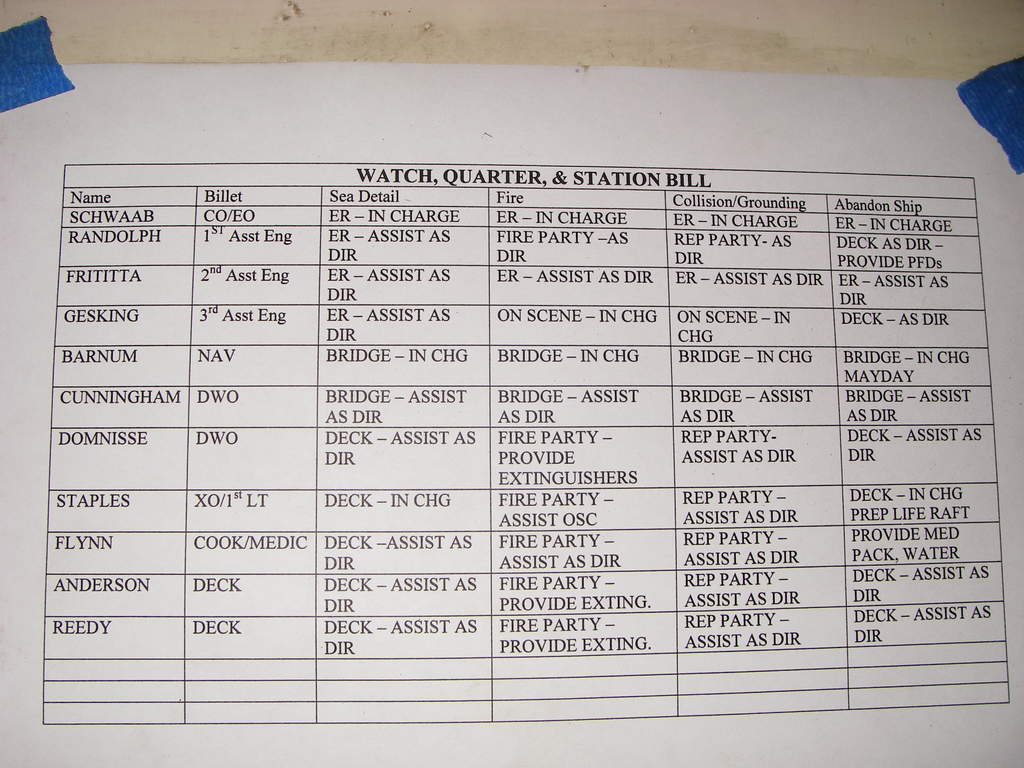
  • Assigning responsibilities (consider this a watch/quarter/station bill) – Generations of Sailors in the Navy have learned this the hard way; if someone is not specifically assigned to do something during a casualty (fire/flooding/etc) by name or by watchstation then there is a probability it will not get done. Example of a watch/Quarter/Station Bill. Assign people to do things.
  • Planning the drill – Say for instance you have determined fire is the biggest risk to your group. Plan a fire drill. Come up with a realistic scenario in which a fire may break out in your retreat. Start out small and simple. A small pretend fire in a trashcan is easy to do. Eventually you want to work up to the big fire drill such as multiple levels in a building. In all cases (and I cannot emphasize this enough) never light an actual fire in a building to practice.
  • Realism – The more realistic the scenario, the more your people/family will take away from the drill. On a submarine during a fire drill the fire teams don Fire Fighting Ensembles, Scott Air Packs, grab a thermal imager and flake out (and pressurize) fire hoses. They get those fire hoses on scene and try to attack from multiple directions. Often the team has their vision impaired as it would be during an actual fire. Probably you would not have these items available to you. How could you make it realistic? In a survival scenario where the fire department won’t be coming to help, your objective should be to get firefighting agent to the scene as quickly as possible. In most cases this would be maybe a few fire extinguishers and water. A simple flashing red led light in a trash can or wherever you want to simulate the fire can often suffice to get people to bring the extinguishing agent to the right location. If you have a way to create non-toxic smoke safely then I suggest doing so. The Halloween foggers work quite well.  Another way to simulate smoke (and something that is reusable over and over) is a light blue hairnet. One of these placed over the face or (if you are lucky enough to have breathing equipment) a mask can effectively simulate a smoky environment. Make it as realistic (safely) as you can. The time to find out you, your family or your group doesn’t know what it is doing is when the SHTF.
  • The drill process – You want to get the most out of the drill and identify any issue so you can fix them. Have a process. Pre-brief the drill with your drill team (it may only be you and one other). Run the drill and observe/write-down actions and issues. Make sure you get response times written down. After the drill gather the observers together and collate comments. Finally talk to the group. Go over what happened, what went right and what went wrong. Your group cannot get better if they do not know what they did wrong and how to fix it.

Community – Being a Submariner, I am proud part of a select (and demented) community. The key word is community. We rely on each other to help solve problems. A submarine underway is a survival community all on its own. As mentioned above, we are the fire department. We are also the maintainers of our resources. When we leave the pier we leave it with what we have onboard. If you forget something, well, it is too bad. Make do without it. As a community (crew) we make sure we have everything onboard to get underway and do our time at sea effectively. Food and stores must be loaded. Critical parts stowed. We rely on each other as any good community should. Some of the things we do that can be applied to a community survival situation:

  • Qualifying and cross-qualifying – On a submarine each person must “qualify” the boat. What this means is an individual has to have a decent understanding of every system onboard the submarine. Take a Los Angeles Class Fast Attack submarine that is three levels of systems in a 360 foot long tube.  You have three major hydraulic systems, high pressure air, ventilation, weapons, etc, etc. It is a lot of stuff. The person must also qualify to stand a security watch in port and an underway watchstation. Finally the individual must also thoroughly understand damage control and how to respond during different casualties (such as fire, flooding, steam line rupture, etc). 

As a community it is important for everyone to know as much as they can about the general working of the community. How does the community respond to an attack? A fire? What are the systems that are in place within the community (such as water, sanitation, power) and basically how do they work. You want the people within the community to have understanding of the workings in order to respond to situations.
Within a community you will always have specialists. People may be firearms experts. Some can drop a fishing line in the water and will a fish onto their hook. Others can grow crops. This is where cross-qualifying comes into play. In a survival scenario it is important that people know how to do more than one job. The sad reality is that in a SHTF scenario not everyone will survive. Having people cross-qualify and learning multiple jobs lessens the loss of an individual. A cross qualified person also gives versatility in rotating personnel through rest periods and spreading the workload.

  • Relaxation – Every person needs down time. People always on the edge ready for a trip-wire event lose sharpness and focus. On a submarine, I knew there would be days I would get little rest. In a survival situation the same thing will happen. It is vital that every opportunity to get rest or unwind should be taken. I like to think of it as banking time. It is a balancing game. There will ALWAYS be work that needs to get done. Rest should be part of the work routine. As a Submariner out to sea we often depended on each other for entertainment. Take 150 guys, stuff then in a steel tube, deprive them of sunlight and news and entertainment will happen. Sailors at sea have been figuring out ways to break up the monotony of a long voyage for years on end. As a survival community it is vital that the community celebrate when they can. We celebrate halfway night (mid way through a 6 or 7 month deployment). A community can celebrate the harvest. A community can make any occasion a reason to celebrate what God has given them and it is important that they do. Celebrating life’s little victories and accomplishments makes things go better.
  • Recognition – On Submarines we recognize Sailors for outstanding work. Sometimes it is a medal. Sometimes it is advancement in rank. Other times it is a well deserved extra day off. It is human nature for most of us to get some recognition of a job well done.  Personally I never sought it out but was always grateful when it happened. It is important for the community to celebrate accomplishments by individuals within the community. Each group must decide on their own what that may be, but recognition is important. With my own sons, it can be a simple pat on the back and the words “good job”.

In the end, survival will always be how well the community binds together. Individual survival can happen for awhile but for us to go on we need to interface, interact and rebuild. Fellowship and reliance on others is what makes Submariners strong and what makes a group/family/community stronger. Some of what I have talked about is not for everybody and cannot be applied to every situation. It is something to ponder. Just like some of the posts here on SurvivalBlog are not always applicable to my situation, I appreciate the time this online community has invested in getting the information out there and I take a lot of what people have to say to heart. Thanks for all that you do and keep posting. I need something to print out/save and take underway to read!


Letter Re: Food Forest Gardens

Dear Mr Rawles,
Further to the recent excellent Food Forest Gardens article, I would like to add my support of Martin Crawford’s book Creating a Forest Garden: Working with Nature to Grow Edible Crops. I would also add that his web site is absolutely fascinating for reading through the varied types (and breeds) of fruit  and nuts. Though it is of UK bias, there are a lot of North American types included and as a source of information on types of trees it is the most extensive  source I have found.
 
On a personal note I have bought upwards of 250 fruit, nut, berry trees from Martin over the years I when I have spoken to him he is pleasant and knowledgeable.
 
Basically the web site is a valuable source of plant information for those interested. Keep up the good work. Regards, Bill C.


Economics and Investing:

The Two Worlds of 2012: Will We Have “Inflation” or “Deflation”?

Europe Brings Out The “Capital Controls” Bazooka

U.S. Derivatives Probe Eyes Bank Control of LCH.Clearnet

Pierre M. sent this: Italy ‘may need bailout’The Irish Times

Items from The Economatrix:

Fed Says US Wealth Fell 38.8% in 2007-2010 in Housing

S&P Says US to Avoid “Fiscal Cliff,” Risks Remain

Moody’s Cuts Cyprus Sovereign Rating Two Notches

Fall In May Retail Sails Driven Entirely By Lower Gas Station Spending


Odds ‘n Sods:

We are pleased to welcome our newest volunteer foreign correspondent, Giorgio in Italy. Here is a brief biography: “I am 40 years old and lucky enough to be married to a beautiful and intelligent soul mate who is an Italian professoressa, fluent in five languages. We have been married eight years, with, alas, no children. We live 8-to-9 months a year in northern Italy, an hour from Milan, with the rest of our time spent in the States or traveling. Having traveled and, periodically, worked in much of Europe and sub-Saharan Africa, we have had some experience in dealing with diverse cultures and getting the “other guy’s” perspective. My degree is in Aviation, but I no longer work as a pilot. My skill set is varied and, though by no means what I would consider expert, competent in survival-relevant subjects including hunting, shooting, security, self-defense, mechanics, fitness and wilderness survival.”

   o o o

Alan W. sent this article and map link: Revealed: 64 Drone Bases on American Soil. Note that there is only one small Wasp and Raven (hand-launched UAV) training facility in the American Redoubt. at the Montana National Guard Limestone Hills Training Area (LHTA), near Townsend, Montana, (46°20’10.09″N, 111°36’9.12″W.) It is used just intermittently. There are also very few UAV sites in the Plains States. The heaviest concentrations, naturally, are on the east and west coasts.

   o o o

F.J. sent this:  Hydrovolts tap canal currents for 12 kW of power apiece.

   o o o

This ads new meaning to “Getting Real”: Get Freaky At The Tiki With Reality Based Training. (Thanks to J.D. for the link.)

   o o o

Woman pastor dies after contracting flesh-eating bug in sixth case of deadly bacteria identified in America


Jim’s Quote of the Day:

"The Roman Republic fell, not because of the ambition of Caesar or Augustus, but because it had already long ceased to be in any real sense a republic at all. When the sturdy Roman plebeian, who lived by his own labor, who voted without reward according to his own convictions, and who with his fellows formed in war the terrible Roman legion, had been changed into an idle creature who craved nothing in life save the gratification of a thirst for vapid excitement, who was fed by the state, and directly or indirectly sold his vote to the highest bidder, then the end of the republic was at hand, and nothing could save it. The laws were the same as they had been, but the people behind the laws had changed, and so the laws counted for nothing." – President Theodore Roosevelt


Notes from JWR:

Notes from JWR:

Today we present another entry for Round 41 of the SurvivalBlog non-fiction writing contest. The prizes for this round include:

First Prize: A.) A gift certificate worth $1,000, courtesy of Spec Ops Brand, B.) A course certificate from onPoint Tactical. This certificate will be for the prize winner’s choice of three-day civilian courses. (Excluding those restricted for military or government teams.) Three day onPoint courses normally cost $795, and C.) Two cases of Mountain House freeze dried assorted entrees in #10 cans, courtesy of Ready Made Resources. (A $350 value.) D.) a $300 gift certificate from CJL Enterprize, for any of their military surplus gear, E.) A 9-Tray Excalibur Food Dehydrator from Safecastle.com (a $300 value), and F.) A $250 gift certificate from Sunflower Ammo.

Second Prize: A.) A Glock form factor SIRT laser training pistol and a SIRT AR-15/M4 Laser Training Bolt, courtesy of Next Level Training. Together, these have a retail value of $589. B.) A FloJak FP-50 stainless steel hand well pump (a $600 value), courtesy of FloJak.com. C.) A “grab bag” of preparedness gear and books from Jim’s Amazing Secret Bunker of Redundant Redundancy (JASBORR) with a retail value of at least $300, D.) A $250 gift card from Emergency Essentials, and E.) two cases of Meals, Ready to Eat (MREs), courtesy of CampingSurvival.com (a $180 value) and F.) A Tactical Trauma Bag #3 from JRH Enterprises (a $200 value).

Third Prize: A.) A Royal Berkey water filter, courtesy of Directive 21. (This filter system is a $275 value.), B.) A large handmade clothes drying rack, a washboard and a Homesteading for Beginners DVD, all courtesy of The Homestead Store, with a combined value of $206, C.) Expanded sets of both washable feminine pads and liners, donated by Naturally Cozy. This is a $185 retail value, D.) A Commence Fire! emergency stove with three tinder refill kits. (A $160 value.), and E.) Two Super Survival Pack seed collections, a $150 value, courtesy of Seed for Security.

Round 41 ends on July 31st, so get busy writing and e-mail us your entry. Remember that there is a 1,500-word minimum, and articles that relate practical “how to” skills for survival have an advantage in the judging.

But first, here is an essay that I wrote, in response to some anxious queries from several SurvivalBlog readers:


20 Reasons Why America’s Next Bank Holiday Will Be a Nightmare

The world is on now on the brink of a global credit crisis that could be far worse than the tumultuous events of 2008. The ongoing sovereign debt crisis in the southern reaches of the Eurozone indicate that bank runs in the region will continue, and that more bank closure “holidays” will be declared. Under a bank holiday, virtually all deposits could be frozen and irredeemable for days, weeks, or even months. The key question is: Will this crisis spread to the rest of Europe and then even to the United States? I urge SurvivalBlog readers–particularly those in Europe–to be proactive, to stay “ahead of the power curve.” While the Generally Dumb Public (GDP) wakes up some morning to hear news of a bank holiday, you will have long hence prepared yourself.

Digits Lost in the Ether–Redeemable Mañana?

Most people don’t realize that printed U.S. currency and minted coins amount to less than $800 billion, worldwide. That is just a small portion of the aggregate Money Zero Maturity (MZM) money supply that now exceeds $7 Trillion. So what is in your bank account is just electronic money, and there is absolutely no way that even a fraction of depositors could get physical cash to redeem the digits in their accounts. If there is a bank holiday declared, there will undoubtedly be severe restrictions on cash withdrawals when banks re-open. Given the precedent of the limits on withdrawals of a few institutions during the Savings and Loan crisis of the 1980s and 1990s, I predict that withdrawal restrictions could go on for many months.

Here are 20 Reasons why America’s next bank holiday will be a nightmare:

  1. A bank holiday will create a virtual blackout of information on not just checking and saving accounts, but also automated mortgage payments, CDs, and more. Our presently quite transparent banking system will suddenly become opaque. Your bank balance will become invisible. Your handy-dandy online banking web page will be replaced by a “Service Temporarily Unavailable” notice. The willingness to accept checks will evaporate in less than a day. The FUD factor (Fear, Uncertainty and Doubt) will be overwhelming.
  2. Most businesses will no longer honor personal checks, corporate checks, or bank money orders. Showing a merchant your most recent bank statement isn’t likely to sway him. Again, the FUD factor will rule.
  3. All checks in the U.S. are cleared through the automated clearinghouse (ACH) network. Most of this network is inside of banking system firewalls. Many Federal, State, and local tax payments are also handled through ACH. (A similar network exists for European banks–the Pan-European Automated Clearing House (PE-ACH), under the Single Euro Payments Area (SEPA) system).
  4. Credit cards might not be accepted. The FUD factor will dictate that anything even peripherally related to the banking system will be suspect. (Even though the credit card companies have their own credit clearing mechanisms that are only attached to the banking milieu.)
  5. Except for a few grandfathered recipients, Social Security payments are now made exclusively via bank direct deposit.
  6. Military monthly pay, housing allowances, and ration payments are now made exclusively via bank direct deposit, in CONUS. That is true virtually across the board (Active component, Reserve, and National Guard.) Ditto for monthly military retirement payments.
  7. Many State and Federal employees no longer get physical paychecks. They too, are trapped in the “direct deposit only” world.
  8. Many Americans are now very dependent on bank debit cards (also known as a bank cards or check cards.) In fact, many people don’t even carry more than a few dollars in their wallets. If our world suddenly goes “cash only” most people will suddenly be out of cash.
  9. ATMs, debit card transactions, and online banking can be shut down in minutes. This huge vulnerability of banking customers has already been evidenced by a few minor glitches.
  10. Online payment systems like PayPal will be sharply degraded, because they rely on their ability to move funds to and from banks. More importantly, online payments are inextricably tied to credit card processing. If credit card processing is suspended, then online payments will be “dead in the water.”
  11. Many regular monthly payments such as mortgages, insurance premiums, and some utilities are automatically debited from checking accounts. These will all come to a screeching halt.
  12. SWIFT wire transfers will probably be suspended, freezing a good portion of global commerce. Similarly, International ACH transactions (IATs) will also be shut down, since they access the U.S. ACH network.
  13. The ability to process credit card payments will be dubious, at best. Many merchants will wisely “just say no” to credit cards, even if their countertop POP terminals are still functioning and show available credit. And the fact that many credit cards are now just debit cards in disguise will only add to the reluctance of merchants to take any credit cards.
  14. Point of purchase (POP) processing of credit and debit cards at gas stations has become ubiquitous. Nearly everyone now uses the “pay at the pump” option. Gas and diesel could become “cash only” transactions.
  15. Most American families keep less than $300 in cash at home at any given time, including their kids’ piggy banks. For most families, that wouldn’t cover even one month’s rent.
  16. Formerly distributed as “Food Stamps”, the USDA‘s Supplemental Nutrition Assistance Program (SNAP), provides benefits to low income families through Electronic Benefit Transfer (EBT) card payments. These cards look much like credit cards. And like checks, EBT payments are all routed through the ACH network. Again, this is a network that is inside banking system firewalls. If the banking system goes into holiday mode, then it may take days or even weeks to get EBT processing back on line. If the EBT payments stop, we can expect riots in metropolitan areas in less than a week.
  17. Gift cards will be “iffy.” There are now two types of gift cards: “open loop” (or “network”) cards and traditional “closed loop” cards. Open loop cards are issued by banks or credit card companies and can be redeemed many places. It is likely that only closed loop cards will be honored by the issuing stores, because merchants will fear that open loop cards might have been zeroed out elsewhere. (If they can’t confirm the available balance, the card will be refused.)
  18. Most Internet vendors are almost entirely dependent on credit card processing. If that processing system is disrupted, then mailorder firms will either have to cease operations, or have them slow to a snail’s pace, and be restricted to only non-bank money orders.
  19. Reversion to U.S. Postal Service money orders (commonly called “PMOs“) will only be partially viable solution. This is because many small town and rural post offices don’t keep enough cash in their tills to be able to hand you $1,000 when you go to cash a PMO. You may be thinking, “Oh well, I’ll just ask them to write me a blank PMO, in exchange. Nope. A recent change to postal regulations designed to curtail money laundering banned money order-for-money order issuance. Bummer. And if you are considering using “Forever” postage stamps, hold your horses. Under a hygiene regulation published in the Domestic Mail Manual (DMM), postal clerks are not allowed to cash out (“buy back”) stamp booklets unless they are still in their sealed clear plastic master packages. So it might take decades to use up your Forever stamps, or you will be forced to liquidate them on the gray market at a slight loss.
  20. Bank safe deposit boxes will probably be inaccessible. Plan accordingly.

Some Observations and Mitigation Steps:

Because so many pay and retirement benefit systems are now handled via bank direct deposit only, we could easily live through a frustrating “Roach Motel” period of several months when “Dollars check in, but they don’t check out.” Be prepared to ride through that period.

If the European credit spreads to the United States, then immediately visit your company’s payroll office, and ask to be removed from their direct deposit system. This change might take a couple weeks. With a paper paycheck, you can probably cash it elsewhere, even if you own bank closes its doors–perhaps even at your local grocery store.

Keep plenty of well-hidden cash at home. Since it won’t be earning interest, some of this cash might as well be in $2 rolls of nickels. That method will also give you a hedge on inflation, and also serve as insurance against a currency reform. (Where a zero could be lopped off the Dollar, overnight.)

Be prepared for times for when anything other than greenback cash or perhaps silver coins will be eyed with suspicion, or rejected outright. Even USPS PMOs and drug store money orders may be refused. In the era of bank holidays, cash will talk. Keep plenty of it on hand. Oh, and needless to say, don’t store your cash in a bank safe deposit box. You probably won’t have access to it during a bank holiday.

Be wise and circumspect in storing cash at home. Don’t tell anyone other than your spouse about that cash. See the SurvivalBlog archives for suggestions on building secret hiding places, like this one.

A good portion of your “stash of cash” should be in the form of $1 and $5 bills. This is because during a banking crisis, many people will not be able make change for small transactions. And if your local power, water, and phone companies refuse checks, then you will need to be able to pay them the exact amount of your monthly bill. (They probably won’t have much “change”, either.)

Apply for at least one gasoline station chain charge card. In turbulent times when they won’t take your check or your VISA card, they might still take their own chain card.

If you have to pay your utility bills in in cash or by PMO, do you know where their business offices are located? And consider the sort neighborhood where those offices are located. (Unless you live in a free state for open carry or Constitutional Carry, do you have your CCW permit, and plenty of pistol practice?) For safety, it might be wise to form a neighborhood posse to go pay those bills in a group of of six people once a month.

Your local supermarket may declare “cash only.” This is yet another reason why it it is vitally important for every family to have a comprehensive food storage program. By the same token, fuel storage also makes sense, if your local fire code allows it.

At the tail end of a banking crisis–when the bank doors do re-open–the Federal Reserve will certainly have to crank up the printing presses. Even people that never had “mattress money” will want some. All this new cash will increase the velocity of money, locally. This will be inflationary, even at the same time that a the macro level, we will witness a huge dollar deflation. (This is because the multiplier effect of every dollar on deposit will work in reverse, as withdrawals are made.) These will be strange times, indeed. If you start to see any evidence of mass inflation kicking in, then be ready to spend your dollars as quickly as possible to parlay them into practical, barterable tangibles. Don’t be the last one standing in the game of Dollar Musical Chairs.

Conclusion
The threats of credit crunches, bank runs, and bank holidays are not new. No society is immune from them. We’ve been fortunate here in the United States to have not suffered any limits on bank withdrawals since the Savings and Loan crisis of the 1980s and 1990s. But don’t expect this stability to be permanent. We live in a dynamic world with rapidly changing threats to our lives and livelihoods. Prepare for the worst and hope for the best.


Food Forest Gardens, by Jason T.

Author’s Introductory Note: As I read through page after page of food items and materials that preppers should stock up on, I have to wonder, “Have people really thought out what is coming?” I believe we are heading for at least a collapse of the US dollar, if not all fiat currencies. We are looking at a financial collapse greater in magnitude than the Great Depression. I have spent the last four years studying economics in my spare time, and though I understand that my sources can be (and are) biased, I have looked at a lot of writings from a lot of very smart people, and none of them have given me a way out. Our economic future ranges from really ugly to apocalyptic.
For the last three years, I have sought and prayed for a way out of what I see coming. This is not a one off event that a few years of stored food will see us through, this is a collapse of such a magnitude that our concept of “normal” is going to undergo a radical adjustment. How do you deal with such an event? How do you plan to deal with decades, even generational time frames? Storing food is not enough. Every supply you can stock will be exhausted long before we see “normal” again, if ever. After three years of looking and praying, this is the best answer I have found.

An Australian, Bill Mollison, coined the term permaculture over two decades ago. His work is almost unknown inside the U.S. (Go ahead, talk to your local land grant college and see what they can tell you about permaculture and food forests. Outside of the Northwest and possibly North Carolina you will probably just get blank looks.) Permaculture is a concept that encompasses many ideas about culture, sustainability, and agriculture. One of its big ideas is using perennial plants as in a forest setting, rather than the annual plants that provide most of our food today.

Think about the amount of energy that is required to produce a crop of corn or wheat. The fields are cultivated before planting to kill the weeds, then the seeds are drilled into the soil. You may cultivate a few more times before the plants are up to kill weeds and add fertilizer, then you spray pesticides throughout the growing season to kill insects and herbicides to reduce weed competition. Finally, you harvest the crop and send it to be dried down, sorted, graded, and finally sold for a profit, generally a very small profit. Do you think this method of agriculture will survive a currency collapse? Farmers will likely have priority for fuel in a financial crisis, if they are big enough. How will you be able to afford their crop?

A food forest attempts to create an early succession ecosystem comprised of a wide variety of edible plants, nitrogen fixing plants, bio-accumulators, fiber plants, and other plants useful to humans and animals. A forest ecosystem is the natural state of the environment in most temperate regions. It requires no fertilizer or pesticide, it takes care of itself. A forest garden attempts to mimic the natural environment, in doing so, all the inputs and energy that modern agriculture requires are eliminated.

Where do you begin?

The first thing you need is land that is owned outright. My wife’s family has a piece of property that has been in the family for 70 years. It is six acres of mostly pasture with about two acres of pine woodlands. In a failing economy, it is entirely possible that the land will eventually be taxed out from under us, but that is a concern for another article.

How much can you put into six acres of land?

Here is what I have done over the last two years. I presently have:

8 apple trees

3 peach trees

2 pear trees

2 sweet cherry trees

2 mulberry trees

2 pawpaw trees

3 chinese chestnut trees

4 pecan trees

2 hazelnut trees

15 blackberry bushes

5 raspberry bushes

1 goji berry

1 gooseberry

1 aronia berry

50 strawberries

2 fig trees

6 grape vines

2 muscadine vines

8 blueberry plants

8 varieties of edible bamboo


I can expect a yield somewhere in the vicinity of 3,000 pounds of fruits and nuts, based on what I have in the ground right now. I will have just under an acre planted when my current plants are mature, most of that will be bamboo. I am only about 1/3 of the way done. I have a list of 63 edible plants that I plan to incorporate into my food forest. The most practical guide to creating a food forest I have found is Martin Crawford’s book Creating a Forest Garden: Working with Nature to Grow Edible Crops . There are a number of other books available, but Martin’s book provides an extensive list of edible plants and detailed descriptions of each of them. His book is a practical how-to guide for creating your food forest. He lists over 500 species of plants in his book, most suitable for zones 9 through 5.

What do you do first?

Plan. Plan your forest canopy before you start putting trees in the ground. You want an open canopy with light or dappled shade. I started putting plants into the ground before I had Martin’s book in hand. I have planted my nitrogen fixing trees to close to my fruit trees. I will end up coppicing the nitrogen fixers every few years because of this mistake. Plan for your nitrogen fixers and accumulator plants before you put your trees into the ground. Plan for your tall trees to be behind your smaller trees in relation to the sun’s direction. Plan for your shrubs to grow up and interact with your trees. Plan your ground cover layers and how you will implement them.

I have Mimosa trees (Chinese silk trees) all around the property. These are nitrogen fixing trees that will grow to 40 feet. Since these trees were already present and growing, I did not feel the need to seek out additional nitrogen fixing trees. Also, when I tilled an area, seedlings sprang up in great abundance. I have used my crop of nitrogen fixing seedlings by interplanting them with my fruit trees. I still have a great abundance of them which I will disperse throughout my bamboo groves. In his book, Martin calculates that you want about 40% of your forest canopy to be comprised of some sort of nitrogen fixing plant. Mimosa trees grow to a very open canopy which is perfect for a forest garden. Other climate zones would probably do better with some type of locust tree or acacia. I believe in using what I have first, it costs less.

I will add comfrey as a bio-accumulator sometime this year. Martin discusses comfrey in his book and comes up with roughly six plants per semi-dwarf fruit tree. Comfrey is a chop and drop plant. Several times during the year, you cut the plant down and spread the leaves and stems around the base of your fruit trees as a sort of fertilizer/compost. There are other accumulator plants, but comfrey is the most well known, and will readily sprout from roots and re-grow.

How do you clear the land?

I have used cardboard to smother and kill off grass, I have tilled areas, and I am trying tall cover crops of buckwheat, all in an attempt to clear an area for planting. As an area is cleared, first your trees and shrubs are put in place, then the ground cover of choice is seeded into the newly opened area. An area might be mulched for a year before your ground cover is planted. Oregano, wild strawberries, mustard greens, creeping brambles, and others are mentioned as effective, edible, ground covers. Mostly what I have right now is white clover as a nitrogen fixer to help prepare the ground for a more desirable crop. I am eager to see how my buckwheat area develops this year. I have seeded with buckwheat in the hope that it will out-compete the grass without any additional inputs.

Putting your shrubs in place

I have numerous blueberry bushes interspersed with my fruit trees. I have planted the blueberry bushes to close to my fruit trees and in some locations, I have placed them in the shadow of the trees. These will need to be moved at some point in the future. I have only recently added gooseberry and aronia; these will tolerate much more shade than my blueberries. In fact, many shrub species are able to tolerate a decent amount of shade, which allows them to be planted more densely inside a forest garden. Saskatoon, sea buckthorn, currants, goji berries, and many others can be planted into the shade of your forest garden. Sea buckthorn will actually do double duty as a fruit bearing plant and a nitrogen fixer.

Things you learn along the way

There are many ways to create a forest garden. I have started out in a systematic way by clearing ground and planting first my trees, then my shrubs, and finally ground cover plants. I am planting one variety at a time. Martin walks you through each of these phases in his book, but I have since learned that there are other ways to accomplish your objective.

Sepp Holtzer and other people doing permaculture and forest gardens often put together a large and diverse collection of seeds and plant everything all at once. I believe they mostly do this with ground covers and shrubs. They start out with an entire ecosystem growing competitively in the lower layers. You will get a lot of nitrogen fixing and carbon sequestering going on all at once. I think you will have a difficult time harvesting until the plants have sorted themselves out, but I think you will get establishment much more quickly. I have only just learned about this approach, and I will likely give it a try on some corner of our property.

Conclusion

After almost four years of searching for a way to deal with the coming tidal wave of debt and destruction approaching us all, a food forest garden is the best idea I have found. The idea is to build a complete ecosystem, that is geared toward producing food for you and your family, and sustaining its own fertility. You can incorporate whatever you need into your food forest. There are plants that will produce fiber, plants that will produce dyes, medicinal plants that I didn’t even mention, food, timber, whatever you need can be incorporated into your forest garden design; if it will grow in your climate.

My goals are maximum sustainability and maximum self-reliance. To achieve these goals in a world of limited fuel and money, I had to look outside the box of conventional thinking. There will be no more runs to home depot for bags of mulch and compost. There may be very few runs anywhere in the future. What we have on our own property is what we will have to work with. A close community of like-minded individuals will/may offset our own shortcomings, but being as prepared as we can possibly imagine is the best way to achieve optimal results.

JWR Adds: I recommend planting bamboo and other invasive plants only in the most secure planters with solid bottoms. (Preferably cast concrete!) Letting bamboo find its own limits on your property is an invitation to expending countless hours of toil and gallons of sweat. The same can be said for some berry bushes, especially in damp climates. Plan ahead!