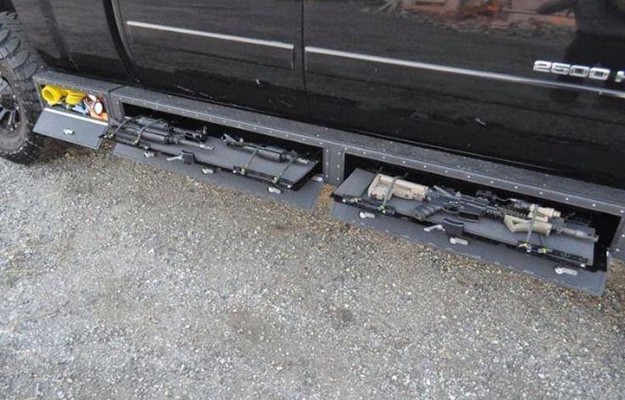
Letter Re: Re: Studying Guerilla Warfare Tactics

Hi Jim,
To follow up on this discussion, another good publication to study guerilla and counter-guerilla warfare is the book Total Resistance by Major H. Von Dach.

Although the publication was written in the 1960s and concerns Swiss plans for dealing with a Soviet invasion, I believe it has quite a bit of information that is directly useful, or which could be easily updated, for use in today’s world. I’m not sure that the English-language version is still in print, but used copies can be found. – J.B. and Co.


Odds ‘n Sods:

Reader J.B.G. sent this for our Theater of The Absurd Department: Cost of shotgun and firearm licenses must rise say police chiefs. Oh, so they tell us that there’s a funding gap in their scheme to to keep their citizenry disarmed. Their solution: Charge the few who still have some sporting guns even more to license them. This somehow reminds me of when Germany’s Nazi regime had the temerity to sell full fare train tickets to some Jews, to cover the costs of their forced relocation to the designated ghettos before their planned extermination. (This is documented in the book Fathoming the Holocaust by Ronald J. Berger.)

   o o o

Reddit has a link to an extensive Imgur gallery showing homemade guns. (Thanks to H.L. for the link.)

   o o o

Looters take TVs, jewelry from Oklahoma tornado devastation

   o o o

Bill Regulating 3D Printed Guns Announced in New York City

   o o o

Learn A Post-Collapse Trade Before It’s Too Late


Note from JWR:

Today we present another entry for Round 47 of the SurvivalBlog non-fiction writing contest. The prizes for this round include:

First Prize: A.) Gunsite Academy Three Day Course Certificate, good for any one, two, or three course. (A $1,195 value.) B.) A course certificate from onPoint Tactical. This certificate will be for the prize winner’s choice of three-day civilian courses. (Excluding those restricted for military or government teams.) Three day onPoint courses normally cost $795, and C.) Two cases of Mountain House freeze dried assorted entrees in #10 cans, courtesy of Ready Made Resources. (A $350 value.) D.) a $300 gift certificate from CJL Enterprize, for any of their military surplus gear, E.) A 9-Tray Excalibur Food Dehydrator from Safecastle.com (a $300 value), F.) Two BirkSun.com photovoltaic backpacks (one Level, and one Atlas, both black), with a combined value of $275, G.) A $250 gift certificate from Sunflower Ammo. and H.) A roll of $10 face value in pre-1965 U.S. 90% silver quarters, courtesy of GoldAndSilverOnline.com. The current value of this roll is at least $225.

Second Prize: A.) A gift certificate worth $1,000, courtesy of Spec Ops Brand, B.) A Glock form factor SIRT laser training pistol and a SIRT AR-15/M4 Laser Training Bolt, courtesy of Next Level Training. Together, these have a retail value of $589. C.) A FloJak FP-50 stainless steel hand well pump (a $600 value), courtesy of FloJak.com. D.) $300 worth of ammo from Patriot Firearms and Munitions. (They also offer a 10% discount for all SurvivalBlog readers with coupon code SVB10P.), E.) A $250 gift card from Emergency Essentials and F.) Two cases of Meals, Ready to Eat (MREs), courtesy of CampingSurvival.com (a $180 value).

Third Prize: A.) A Royal Berkey water filter, courtesy of Directive 21. (This filter system is a $275 value.), B.) A large handmade clothes drying rack, a washboard and a Homesteading for Beginners DVD, all courtesy of The Homestead Store, with a combined value of $206, C.) Expanded sets of both washable feminine pads and liners, donated by Naturally Cozy. This is a $185 retail value, D.) A Commence Fire! emergency stove with three tinder refill kits. (A $160 value. E.) A Tactical Trauma Bag #3 from JRH Enterprises (a $200 value), and F.) Two Super Survival Pack seed collections, a $150 value, courtesy of Seed for Security.

Round 47 ends on July 31st so get busy writing and e-mail us your entry. Remember that there is a 1,500-word minimum, and that articles on practical “how to” skills for survival have an advantage in the judging.


Medical Notes from Nicaraguan Villages, by COEMT

Here are some insights that I gained from a recent week-long medical mission trip to Nicaragua. We treated hundreds of men, women, and children living in remote villages for general medical complaints.  I envision these conditions as being similar to what many of us would see in TEOTWAWKI.

Living conditions:
Mostly, the men in these villages are subsistence farmers, picking coffee beans, or something similar.  The women stay at home and take care of the children, grandparents, and animals – chickens and pigs.  Their average income is very low, in the 10’s of dollars per month.

Their houses are really shacks made with available materials.  They were about as big as a two-car garage, some quite a bit smaller.  Many are composed of corrugated steel sheets, plastic sheeting, and some planks.  Some have adobe walls, but few are all adobe.  With many people in a small space, they are very crowded.  One family I interviewed had 11 people in the home, probably in 3 rooms.
Their cooking is done entirely over a wood stove, many indoors without chimneys.  Smoke inhalation is a constant for everyone in the house. 
Their diet consists mostly of rice and beans to eat with coffee, soda and juice to drink.  There is literally no money left after they buy wood for cooking and their food.  There was even a sad story of how a pot of beans on the stove must be guarded against theft.

Primary medical complaints:
1)       Headaches, Dizziness – from dehydration.  They know the water has parasites, so they mostly drink coffee and sodas or juices which all dehydrate at some level.
2)       Burning eyes, sore throat, coughing – from smoke inhalation all day long
3)       Muscle aches – from lots of hard manual labor, walking everywhere, carrying children all day, plus dehydration
4)       Gastritis, Heartburn, Abdominal Pain – from intestinal parasites gotten from drinking surface water and eating beans daily, and lots of coffee.
5)       Tooth Decay, Abscesses, Rotten Teeth – from not brushing/flossing and drinking mostly sodas and coffee every day.
6)       Infections requiring antibiotics – of almost every conceivable type.

NOTE:  I’m a licensed EMT.  The below lessons are intended as educational material and do not constitute medical advice inasmuch as they may be outside of the scope of my practice or coming from instructors, experience, or reading.  The lessons are, however, within the scope of my many years of life, caring for myself and my family members.  And, in case you’re wondering, I was working under the direction of a Physician’s Assistant and an Nurse Practitioner.  I also mention several brand-name OTC products below.  I only use them because most people will recognize them a lot better than the chemical name of the medicine.  Please use your own good judgment on what is best for you and yours.

Lessons taken for TEOTWAWKI scenarios
1)        Have a way to obtain pure water without fire.  Bleach or Pool Shock (calcium hypochlorite)  work well and go a very long way.  At 1 tsp to treat 10 gallons of water, a gallon of bleach can treat up to 7,680 gallons, or enough water for a family of 4 for over 5 years, at a gallon per person per day.  (This is from a government web site.  Please do your own research.) 
If I could have handed out a quart of bleach to each family, it would change their lives.  Unfortunately, they cannot afford it on their low incomes.  And they can’t afford the wood to both cook food and boil water.

2)       Drink lots of clean water.  Most of us aren’t used to heavy physical labor all day, every day.  Drink as much as you want.  While working, you may sweat more, but you’ll stay cooler. 
Most of the folks I saw were dehydrated.  In one case, I had a sickly-looking pregnant woman drink as much clean water as she wanted.  About 20 minutes later, she looked way, way better, and said she felt better too.  Wish I could have given her a 55 gallon drum to take home.

3)       Avoid smoke inhalation.  This is so obvious as to sound stupid, but the Nicaraguans didn’t even think about the problems they cause themselves.  To avoid smoke, cook with fire outside, on a wood or gas stove with chimney inside, or without fire.  Gas, of course, doesn’t create smoke when burned, so has better OPSEC, but residual carbon monoxide is even more dangerous than outright smoke.  Solar ovens and solar-powered electric stoves/ovens are good choices as well.
The only remedy I could give those folks was to recommend they get themselves and their children outside and away from the smoke as much as possible, and to open their windows and doors – if their homes even have them.

4)       Muscle aches are a given when doing the daily activities that will be required in TEOTWAWKI.  Chopping, lifting, carrying, picking, bending over and so on take a toll on muscles.  A couple more pain reducing strategies include taking stretch breaks and learning to use the other side of your body.  Switch the tools to your other, non-dominate hand.  It’s uncomfortable learning a different way to do things, but you’ll be able to work longer and more comfortably.  Start practicing now when you don’t need it to get comfortable with it when you really need it. 
I recommended this to my patients.  I can only hope they will follow through with switching hands/arms/sides every so often.  I also wish I had been able to give out tubes of Ben Gay to everyone I saw.  It’s not a cure, but it sure feels good when you’re sore.  Advil/Ibuprofen will work, but it has some fairly serious intestinal side effects – mostly upset stomach and constipation – not good for those folks.  Aspirin and Tylenol (acetaminophen) will also work, but equally isn’t great for long-term use.

5)       Get a few pairs of really comfortable, sturdy work and walking shoes.  Break them in now so you won’t suffer when you need them. 
The only people I saw with good boots were the men who worked in the fields.  Many of the women wore flipflops – because that’s the only pair of shoes they owned.  And they walked on rocky roads and paths all the time!  Not good for many reasons.

6)       Have a lot of intestinal meds available.  The list of intestinal problems is long:  Diarrhea, constipation, gas, heartburn, vomiting, etc.  The effects are pretty simple:  pain, discomfort, and disability.  And it’s difficult to work when your belly hurts.  Example meds to have on hand:  heartburn – Tums or Rolaids; diarrhea – Imodium; constipation – stool softener and enema bag; vomiting – Pepto-Bismol; gas – BeanO or Tums.  I recommend having a few treatments of each type for each person in your party.

I gave these meds out to dozens of my patients for temporary relief, along with antiparasitics as a long-term solution.  You shouldn’t need antiparasitics if you are careful about purified water.  If not, you’ll need them, plus a bunch of other meds for the diseases that also come with contaminated water:  typhoid and dysentery among others.

7)       Brush and floss your teeth every day.  Brush your tongue.  Use an antiseptic mouthwash (Listerine).  Have a dental hygienist in your group.  Do everything you can to keep your teeth, tongue and mouth clean.  This is such a simple thing, but without dental care easily available, it can get out of hand quickly and the solutions aren’t good.
Many of the people we treated needed more than a few teeth to be pulled.  Some patients as young as 12 years old.  In some cases, our dentist didn’t even pull all of the teeth he could have because of the risks to the patient with no longer-term or follow-up care. 

8)       If you’re going to get antibiotics at the pet store, get a bunch of education too.  Our pharmacy was extremely well-stocked.  We had about every antibiotic you could name:  Amoxicillin, Doxycycline, Erythromycin, Penicillin, and so on.  This was a new area to me, except from personal experience.  It’s a very complex topic incorporating microbiology, pharmacology, and lots of other “ologies”.  The big thing I learned is that antibiotics are specialized also.  One antibiotic will work for one thing but not touch another.  Going to the pet store and stocking up on FishMox in the belief that it’s a cure all is false hope and could cause someone to die.

Learn as much as you can about what you’re buying/getting.  If you go down this path, you’re in deep water.  The fancy medical words are indications, contraindications, effects, side effects, route, dosage and so on.  The English words are what you take it for, when you don’t take it, what it does that you want, what it does that you might not want, how you take it, how much and so on. 
My own story is that one stepson had an infection that required three different antibiotics prescriptions before he was cured.  The first antibiotic didn’t do anything.  He got hives from the second one.  The third one finally worked.

One comment:  Antibiotics are only useful for bacterial infections like pneumonia. They do nothing for viral infections like the common cold or flu.  Unfortunately, it’s very difficult to tell the difference between the two, even for doctors.  The only reason a doctor should give out antibiotics for a cold is if there is a real risk of pneumonia.  The current superbug scare we have is due at least in part to overprescription of antibiotics.  The germs that are left are resistant, as well as having mutated, rendering the current antibiotics harmless to them.

9)       Bactine and PhisoHex are a fantastic combination for superficial wounds.  While in country, a couple of teammates came to me for small wound treatment.  I had an AHA moment with Bactine.  It’s terrific in two ways:  topical pain reliever and antiseptic.  Topical (on the skin) pain relief is rare in the OTC med world, but super useful because I wanted to scrub the wounds to get rid of any dirt.  The antiseptic property is also nice to have.  Phisohex is another wonderful thing because it’s an antiseptic soap that doesn’t sting when you wash/scrub with it.  NOTE:  this is not a pain-free solution.  It hurts less.
I simply applied Bactine, waited for a while, then scrubbed with Phisohex and a few sterile gauze pads.  Then I reapplied Bactine for more pain relief.  In two cases (a big toe and forearm) I applied a Band-Aid for protection.  The other, I didn’t (head wound).

10)    Hand Sanitizer is wonderful  in a pinch, but doesn’t replace washing.  Being raised before the current germ phobia developed, I’ve never been big on hand sanitizer.  Of course, I used it in the Ambulance and Emergency department.  But I used it regularly while I was working in Nicaragua, treating dozens of people each day.  I have no idea what they might have been carrying, but I’m sure I’m not immune to it.  It’s a quick and easy dose of insurance when you’re in a hurry.  Washing with soap and water is even better. That said, I want to point out that keeping a house spotlessly sanitized and trying to keep the family in an antiseptic bubble is not good for  long-term health.  Reason being:  Our bodies develop immunity to germs through exposure to those very germs!  If you want to have the most robust immune system, go get dirty with a bunch of people!  Yes, you might get sick, but you’ll be immune when you recover, at least for a time.  This is exactly how vaccines work – exposing you to the specific germs you want immunity to.

Final note for SurvivalBlog readers:  all medical training is valuable, although difficult and time-consuming.  I started down the EMT/Paramedic path when I started seriously prepping last year.  The more I learn the more interesting and useful it is.  As one EMT I talked to said, “You never know when you’ll need it.”

JWR Adds: The SODIS method for water sterilization is ideal for impoverished regions, since the plastic bottles can be obtained free at almost any dump. If you are careful handling them, the bottles can be useful for several years.


Letter Re: Survival Tips from the May 20, 2013 Oklahoma Tornado

Hello JWR,
 I have a possible solution to TornadoDoc’s generator noise problem! Go to the auto parts store and buy a generic car muffler. The cheapest one you can find. Then purchase a length of flexible muffler pipe and clamps, as well as two couplers. One is for the muffler to pipe, the other for muffler to generator. Depending on how mechanically adept you are, you may be able to do this yourself. Remove the muffler/spark arrestor from your genset. Weld the coupler over the hole, then put it back on. When you use the auto muffler it will make your genny very quiet! Watch out for heat though, the muffler and flex pipe will get hot! Be sure it’s not touching any combustibles and that everyone knows not to touch it! When not in use you can take the pipe and muffler off to save space. I have done this for a couple of generators and it works well. – Mister Clark from Washington State


Odds ‘n Sods:

Geoff S. sent this article on large-scale greenhouse farming: Farm flourishes on Alaska tundra. (Of course to be able to afford all of those greenhouses, it helps to live where strawberries sell for $6 to $9 per pound.)

   o o o

I noticed that Ready Made Resources has added some very effective smoke grenades to their product line. Don’t confuse these with the small, commonly-available pyrotechnic toys. In contrast, these ones really crank out voluminous smoke!

   o o o

This was interesting: Know Where to Run to: The Five Best Countries With No Extradition

   o o o

JRH Enterprises is having a Father’s Day Weekend sale on  ITT PVS-14 Third Generation Pinnacle Autogated Night Vision units, new with 5 year warranty.  They are including  all the accessories AND a shuttered eye guard and weapons mount free, all for $2.695.  (99% of PVS-14 orders from JRH ship within one business day.) JRH also has a very few of the DBAL-I2 infrared lasers available right now also with no lead time.

   o o o

Liberal Talk Show Host Freaks Out On Air Screaming ‘Barack Obama is a Liar’

   o o o

A bomb up his bum? This doesn’t bode well for future TSA security screening policies at airports…


Jim’s Quote of the Day:

“You either get out of the system or you make a major contribution of your wealth to the d*mn OTC derivative manufacturers and distributors. This broken banking system is still hiding their huge losses thanks to the political sell out by the gatekeepers of international accounting, the FASB. They have lost their souls to evil.” – Jim Sinclair


Note from JWR:

Today we present another entry for Round 47 of the SurvivalBlog non-fiction writing contest. The prizes for this round include:

First Prize: A.) Gunsite Academy Three Day Course Certificate, good for any one, two, or three course. (A $1,195 value.) B.) A course certificate from onPoint Tactical. This certificate will be for the prize winner’s choice of three-day civilian courses. (Excluding those restricted for military or government teams.) Three day onPoint courses normally cost $795, and C.) Two cases of Mountain House freeze dried assorted entrees in #10 cans, courtesy of Ready Made Resources. (A $350 value.) D.) a $300 gift certificate from CJL Enterprize, for any of their military surplus gear, E.) A 9-Tray Excalibur Food Dehydrator from Safecastle.com (a $300 value), F.) Two BirkSun.com photovoltaic backpacks (one Level, and one Atlas, both black), with a combined value of $275, G.) A $250 gift certificate from Sunflower Ammo. and H.) A roll of $10 face value in pre-1965 U.S. 90% silver quarters, courtesy of GoldAndSilverOnline.com. The current value of this roll is at least $225.

Second Prize: A.) A gift certificate worth $1,000, courtesy of Spec Ops Brand, B.) A Glock form factor SIRT laser training pistol and a SIRT AR-15/M4 Laser Training Bolt, courtesy of Next Level Training. Together, these have a retail value of $589. C.) A FloJak FP-50 stainless steel hand well pump (a $600 value), courtesy of FloJak.com. D.) $300 worth of ammo from Patriot Firearms and Munitions. (They also offer a 10% discount for all SurvivalBlog readers with coupon code SVB10P.), E.) A $250 gift card from Emergency Essentials and F.) Two cases of Meals, Ready to Eat (MREs), courtesy of CampingSurvival.com (a $180 value).

Third Prize: A.) A Royal Berkey water filter, courtesy of Directive 21. (This filter system is a $275 value.), B.) A large handmade clothes drying rack, a washboard and a Homesteading for Beginners DVD, all courtesy of The Homestead Store, with a combined value of $206, C.) Expanded sets of both washable feminine pads and liners, donated by Naturally Cozy. This is a $185 retail value, D.) A Commence Fire! emergency stove with three tinder refill kits. (A $160 value. E.) A Tactical Trauma Bag #3 from JRH Enterprises (a $200 value), and F.) Two Super Survival Pack seed collections, a $150 value, courtesy of Seed for Security.

Round 47 ends on July 31st so get busy writing and e-mail us your entry. Remember that there is a 1,500-word minimum, and that articles on practical “how to” skills for survival have an advantage in the judging.


Seventeen and Prepping, by Michael on the East Coast

Greetings, my fellow SurvivalBlog readers! My name is Michael, and I am seventeen years old. I live somewhere on the East Coast of the United States of America with my mother and father. To the rest of the world, I appear a normal teenage boy: Glued to my iPad, where I read SurvivalBlog each night before bed, obsessed with both new and old music, and always quoting music lyrics, movies and television shows with my friends. Yet what both the majority my friends and society do not know is for the last year I have been preparing for The End of the World as We Know It. Yes, dear reader, it affects even the youngest in our society: this fear of a “world gone mad.” Generally, optimism is my life philosophy, but I see society on a dangerous trend towards self-ruination. Realism has taken deep root in the way that I handle the world around me. My goal for this essay is to be the example to those who say that they cannot prepare because of financial, familial, social, political, or other factors. I also want to give those holed away in the mountains or in “The Unnamed Western State” a sense of peace, knowing that regular, everyday citizens of our society understand that preparing for a future that might not come to fruition is better than partying on and having to learn the hard way.

My prepping story began when I was eight years old. My parents bought me a copy of the book The Worst-Case Scenario Survival Handbook by Joshua Piven and David Borgenicht. I fell in love with the book, as it revealed how to land a plane, jump off a building (and there is a safe way!), and escape from killer bees. The book made me think of the classic cheesy Hollywood inspired “doomsday” films that seem to open each summer blockbuster season. I thought, “How would I take care of myself if something terrible happened?” Thankfully, those thoughts faded just as quickly as they came. I still have the book a full eight years after my days dreaming of the end of the world. However, prepping fell out of my thoughts for many years, as I entered an academically challenging school where my time to consider such things was severely diminished under the weight of 12 page research papers, math homework and more. Prepping, like an urge to contact a long-forgotten friend, though, did come back. One of my father’s friends is a gunsmith and a prepper who gave me a paperback of one of James Wesley Rawles’ novel Patriots. I was in tenth grade at the time. The book did not stand a chance against my voracious appetite to keep turning the pages: I finished it within a day. Going back and reviewing the elaborate ways that the Gray’s prepared The Group” for TEOTWAWKI-style living was quite a shock, and made me consider The Worst Case Scenario Survival Handbook a trifling attempt to capture some of what the fictional Grays did at their wilderness fortress.

As I thought about Patriots, I considered where I was located in the country and the world. Being on the East Coast, many nuclear power plants exist and are an open target for some form of terrorist takeover or attack. Nuclear threats from a “rogue state” like Iran or North Korea could be a threat, but many years further on. By the time that North Korea has a missile that can reach where I am and stay in one piece, I will be dead and gone, and thus I considered myself safe. Yet such events as a Coronal Mass Ejection (CME), Flu pandemic, economic collapse and innumerable more catastrophes made me reconsider my “high on the horse” mentality quickly. As I did then, I continue to want to leave the East Coast for good, as I see it leading to the destruction of the American way of life and a haven for looters and other miscreants after a TEOTWAWKI event. As it turns out my father has a job opportunity that will take him west after I graduate high school. Naturally, my mother and I will follow him out there. As Robinson Jeffers said in his poem Shine, Perishing Republic, which includes this stanza:

“But for my children, I would have them keep their distance from the thickening center;
corruption
Never has been compulsory, when the cities lie at the monster’s feet there are left the mountains.”

I believe that prepping is a task best undertaken by the community that surrounds oneself. My parents, for example, are my strongest and most dedicated supporters on this long and arduous process of collecting and storing the things necessary to continue life as we know it. My mother has kidney, sinus, back, and other health concerns that force me to stock up on such products such as antibiotics, namely Levofloxin and Avalox. As a family, we also contract many other infections, and to combat this I attempt to keep a full prescription of Amoxicillin inside of my bug-out-bag, just in case. Advil, Tylenol, Mucinex, sleeping medications, cough drops and more play as crucial a role in my bug-out-bag as a room full of ammunition or a new AR-15 would be to an otherwise “healthy” prepper, given our medical histories and other complications. Procuring these medications, especially the antibiotics, requires nothing short of an act of Congress to get, as doctors are more reticent now than ever to forking over such prescriptions for infections that do not exist. Nevertheless, my mother and father allow me to store these medications when obtainable in an effort to protect us from what may lie around the corner.

In addition, as a family, we also work as a team on buying such things as ammunition. Our gun battery is not what I would consider sufficient, yet we are making strides forward. We have a 9mm Glock Model 17 and a .22 Long Rifle Beretta handgun. Because the nature of ammo is transient on the shelves in Wal-Mart or any other dealer, just finding ammo in either of these calibers is an act of Providence! My father enlists the help of my mother to purchase ammo in the “bulk packs”, as an individual can only purchase one per day. I am the one who stores and checks all of the ammo for defects once purchased, keeping it separate from our firearms, which are in my parent’s room, locked up. Nothing like a little bit of physical distance to keep “the lock from the key”. In addition, my mother is supportive of my father and I going to a local gun range every so often and honing our skills, of which I am grateful for her trust in my fathers and my abilities.

Because I have supportive parents, they fostered my desire to form my very own bug-out-bag. My first bag was a disaster. I constructed it last year, and at the time, it was the best thing since sliced bread to me. It was a L.L. Bean backpack that I had formerly used for school, but now insisted that it needed repurposing into a “survival kit.” My father was none too pleased because I had just gotten this backpack, but my mother was yielding, buying me a new backpack to replace the one that would soon become my “survival kit.” I woefully overfilled this poor backpack, whose purpose was to carry about 15 to 20 pounds for only a brief time. I weighed it at one point and was horrified to find that it weighed 45 pounds! I could barely carry it 15 steps when relaxed and not stressed, let alone under duress. My mother had forbid me to carry it outside the house, fearing for my physical safety! Yet, as I got older and wiser, I realized that a frame bag would take a majority of the weight from the supplies and distribute it, making carrying 45 pounds similar to carrying 20 in my current bag. After finally having this stroke of genius, I went out and purchased a Kelty Redstone 60 frame backpack. I spent the big money, and it was absolutely worth every penny. Now I can pack so much more than I could have in my old bag, and not even feel a difference! I ascertained a moral out of this: Always buy the best gear that you can afford, and make sure that it is applicable to the job you want it to do.

Now that I have made my decision and have a better bug-out-bag than I did before, I can now pack my bag with more than I ever imagined I could. Now, I have 5 days worth of clothes and food in my bag at all times, ready to go. In addition, I have a Kaito Voyager radio for staying in touch with the outside world, a 3 D-cell MagLite flashlight, a small quantity of ammunition, all of my medical supplies, toiletries and more. In addition to the bag itself, however, my room can be converted into survivalist headquarters in the event of a catastrophe. A set of clothes that include a L.L. Bean rain coat, blue jeans, sweat pants, long johns, and boot socks stay perched atop my Sturm T0 sleeping bag, which I recently purchased. The bag is amazing: it can keep me warm on even cold concrete, and while I may wake up stiff, I can sleep easy knowing that I will not become ill from being chilled. I also love the Sturm because it connects perfectly to the bottom of my Kelty bug-out-bag, where I would connect it for easy carrying if an event forced an evacuation of my home. In addition, my steel-toe boots sit beside my bed at night, along with a pair of Teva sandals and flip flops, just in case. This setup is just the “Warm weather” or “hurricane season” wear; I make the change from my “Winter weather” to “Warm weather” whenever the temperature remains above 60 degrees F at night, as only then could I survive in my summer clothes outdoors. Yet when the temperature dives below 60 degrees F at night, I make a swift change to my survival supplies, bringing out the “Winter Weather” supplies. These changes include bringing out ski pants that I have in my closet to an accessible place for quick access, bringing out my LL Bean heavy winter coat, filling it with a lighter, hand and boot warmers, Clif Bars and a small flashlight. This jacket stays next to the ski pants, where they sit in preparation for whatever life may throw at them. I also replace the sandals and flip flops with a pair of Bass winter boots that sit next to my steel toe boots, ever ready to tackle the next problem.

While my parents and I think that these plans are fantastic and prudent, there are many detractors. Some questions that I seem to get a lot from both friends my age and adults: How do you plan to implement these plans? Where would you go if you could no longer stay at your home? Why are you a “prepper” anyway? I will answer these questions respectively, starting with how my family and I would implement these plans. If there was ever a catastrophe great enough to displace thousands from their homes, and this happened at least 60 miles from my house, we would make the getaway plans effective. I would grab my bug-out-bag, put on my spare clothes I keep by my bed, put on shoes or boots, grab additional clothes that are stored in my closet, grab the family ammo tin, my watches and any other sentimental items that can be transported without additional weight. My mom and dad would grab their kits and any small items they would need and we would move to either my mother or my father’s car. The decision on which car to take would be on the amount of gas in each. As for where we would end up, we have a family friend that lives “somewhere out West” that has agreed to take us in if any catastrophe ever happened, and this is where we would formulate our plans to either return home, stay put, or move further out west, depending on the situation. As for why I personally am a “prepper”. I believe in a Supreme Being that has endowed me with enough intellect to understand when times are getting rough. With many potential threats to society now becoming apparent (CME, Yellowstone Eruption, Power grid failure, economic collapse, etc), now is the hour to hear the “little voice” within us all and begin making preparations not only for ourselves, but for the next generation of Americans as well. These preparations do not have to be on a massive scale to be a benefit; rather it is the small steps that move us forward with more wisdom and guidance than those who will attempt too great a stride too late, succumbing to a TEOTWAWKI style event rather than being a survivor.

I sincerely hope that this article has inspired you all to either begin preparing for events outside our “Circles of Influence”, or to continue on a path that protects you from those events. My family and I pray daily for the SurvivalBlog readership and the aversion of devastating events. I wish you all the best. Never Surrender. Stay Strong.


Letter Re: Some Experience With Potatoes

Good Morning Captain Rawles,
How would you like your potatoes this morning? We have finished digging our potatoes and stored them. We usually plant a Lasota Red type of potato. We purchase them in 50 pound sacks at the local feed store. “Planting potatoes” are different from the potatoes you buy in the store to eat. Potatoes from the store are treated with some kind of food grade additive to prevent them from sprouting for a while. If you plant these, there will usually be very few that come up. However, if you have had them for a while and the “eyes” have sprouted, they will do well. In our area some grocery stores sell planting potatoes to eat at times.

Planting time depends on the soil temperature. Without a soil thermometer, we usually plant ours when the first Redbud trees (Cercis canadensis L.) bloom in the south which is usually at the end of February. The red bud tree bloom is determined by the soil temp and amount of sunlight.

To prepare a potato for planting, you slice or cut the potato in such a way that each piece will have an eye on it. Once they are cut, the pieces need to sit a few days for the starch in the potato to form a “seal”. The cut will turn darker and shrink a little. That’s when they are ready to plant. They should be planted roughly 12 inches apart, 1/2″ deep with the eyes up. The eye is where the potato shoot will come out and up through the soil. If they sit too long, little hair like roots will appear on the cut side. Then they need to be planted quickly.

Potatoes require a lot of fertilizer to make a crop. My father would use cow manure in the bottom of his row that he opened with a middle buster about 8 inches deep. He would shovel the cow manure into the row, then use a small sweep type plow mounted on his tractor to mix  the soil and manure so that the potato “seed” would not be in pure manure which would burn the “seed”. The cow manure he used was aged and dried. He also used bagged sheep manure from big box stores if it was at a reasonable price. I use commercial 13-13-13 now with good results. This type fertilizer must be mixed with the soil also. One 50 pound bag will do about 6 rows 150 foot long. Once the potato plants get about 12 inches tall, I place a light band of fertilizer close beside the plants and then cover with dirt with a small sweep type plow. The potatoes will be blooming about this time. When store bought fertilizer is no longer available, I will go back to manure myself.

The potatoes must be checked regularly after they bloom. Potato bugs can reduce your yield and if bad enough, even kill the plants. You should see cracks in the ground between the hills of potatoes as the potatoes under the soil start reaching a size of two inches. They can continue to grow until the vines start to turn light green or yellow. You should scratch around a plant or two occasionally to check the condition of the potatoes. The potatoes you uncover will provide an early taste of things to come. You need to be looking for white spots or bumps on the potatoes. Once you find these, the potatoes must be dug because they will start rotting in the ground. The best way to do this is with a tractor and a middle buster with the tip set below the potatoes. A shovel or a potato fork can also be used if you are without a tractor. Once potatoes are dug, they should be spread out flat on a dry surface (no piles). This can be on a sheet of plywood or another surface other than concrete. There is danger of the concrete sweating which will cause the potatoes to rot or sprout. They must also be protected from freezing, blowing rain and direct sunlight. You are looking for a cool dry place. In the south, there is not a cool place outside during the summer. I have mine stored on some slotted metal racks (1/8″ round wire). I have some on a layer of used paper feed sacks on a platform about three feet above a dirt floor. This lets the breezes blow across them. The metal roof of this building is about 10 feet above the racks, so they are not affected by the radiant heat from the sun. Check the potatoes regularly to remove any rotted potatoes. If they touch a good potato, it will rot also.

When I stored my potatoes, I separated the ones smaller than 1 inch diameter. I will use them to plant a fall crop in September or next spring. I planted extra to have seed for next year, if there are none to be had in the stores for whatever reason. The 50 pounds I planted yielded about 9 each 5 gallon buckets. This would be roughly a 6 month supply for four people. The yield was reduced because we had a severe attack of potato bugs. I treated the plants twice with a mild insect dust. If I had no bugs, I should have made 20 of the 5 gallon buckets. This is another problem to plan for in the future. I suppose I could make some chicken tractors and let our chickens work on the bugs. When our retreat is fully manned, I will need to plant at least 150 pounds of potatoes.

Now back to the breakfast question. I like what I call country fried potatoes for breakfast. You take some new potatoes, slice them about 1/16″ to 1/8″ thick. Apply salt and black pepper, then roll in flour or shake in a bag of flour. Then you fry them in oil until golden brown. Once they are done, I like to eat them with a couple of home raised yard eggs fried sunny side up on top of the potatoes.
If you have left over mashed potatoes from the night before, I like to make potato pancakes. You mix your mashed potatoes with a little chopped onion, a spoon or two of flour, and a yard egg. Fry in oil until golden brown. My kids liked them with ketchup. – M.E.R.


Letter Re: Preparedness for Hazardous Chemical Spills

Dear Sir,
I work as an firefighter/EMT and Hazardous Materials Tech in the Greater Louisville, Kentucky region. I would like to provide your readership with two examples of ‘stabilized’ emergencies going wrong in the last year in the Louisville area alone. Both could have been catastrophic had it not been for quick thinking and pure dumb luck.

The first incident began in late October of last year when 11 cars of a 57-car Paducah and Louisville line (a CSX owned company) derailed in the southwest corner of Jefferson County, very near Fort Knox. The cars that derailed were carrying Butadiene and Hydrogen Fluoride. Understand that Hydrogen Fluoride is a very powerful asphyxiant and as an added bonus is heavier than air so it doesn’t easily disperse into the atmosphere. The incident was stabilized and just about to leave the front of the news when three days later, workers ignited fumes from the Butadiene car and caused an explosion. Three severely burned forms walked themselves up to the street and and were transported to hospital. Intense flames were feet from the Hydrogen Fluoride car although not quite impinging. Just as the city was getting used to the main highway in the area being shut down and ready to concentrate on other news an entire small city had to be evacuated!

The next incident was less severe, but also nerve racking for the surrounding population. A hydrochloric acid leak at a Dow Chemical plant in ‘Rubbertown,’ a part of Louisville, caused a one mile shelter in place order to be called for. The leak was contained to a ‘drainage pool’ (a purpose built concrete lined pool designed to catch chemical leaks. Just as this was winding down, the pool was found to have a crack in it and Haz Mat teams needed to be called out again.

The take-a-way is like this: Know what is going on in your area. What is commonly transported down the railway that runs a mile from your property and be ready to take action even if the situation seems to be mitigated. Even when the authority involved says ‘all clear’ remain cautious. I encourage all concerned to map the railways, chemical plants, and pipelines in your area. Also be aware of light industrial parks where highly dangerous activities occur on a regular basis. Just because they say light industry doesn’t mean they’re making teddy bears in there. – Sam H.


Letter Re: Mad Max Modifications: Improvised Armor for Vehicular Platforms

James,
Just a note on the penetrating power of the 5.56 NATO M855 ball round on various materials.  Much ink has been wasted noting the presence of a steel or tungsten “penetrator” being manufactured inside the M855 round. It weighs about 3 grains.  It is insignificant so far as getting the bullet inside a car unless you open the door first.  True, any load in the 5.56 will make impressive wounds or even penetrate 1/4” or even 3/8” mild steel plate…as long as there absolutely nothing in the way before it arrives on target.  Put a 1/8th inch tick sheet of aluminum a foot in front of it, and witness a stunning reduction in it’s effect on the steel behind.  Two sheets of 1/8” steel plate, with a foot of air between them will stop the 5.56 cold.  Any load.

In my experience on several junked cars, an ordinary car door will, more often than not, stop the 5.56 before it can enter the passenger compartment and cause anything like a serious wound. Inserting a piece of 3/4” plywood inside the door of a 1988 Buick Station Wagon, I was unable to get any penetrations in the 5.56 caliber, regardless of the weight of the bullet.  But note that I did not try the newer bonded LE loads, nor the ammunition using the Barnes solid copper bullets. These show better performance on auto bodies.  The largest shred of bullet that even stuck to the outer veneer layer looked like a piece of glitter.  Contrast this to routine through and through holes in the plywood made by garden variety 9mm, .40, and .45 pistol ammunition.  

Occasionally, a bullet would hit window control hardware, or lock work, and fail to make it through, the most did. The 5.56 launches a very tiny, low mass bullet at high velocity.  When it encounters any sort of layered barrier, it self destructs, yielding all of it’s energy upon whatever that material is. Heavier, sturdier .30 caliber rifle bullets represent a very serious threat to occupants of a motor vehicle, and require expensive countermeasures.  But don’t be fooled by the impressive holes in homogenous steel plate, thinking the 5.56 will replicate this performance on a steel auto body or door.  If you must use an AR system on a vehicle, then consider the far superior .300 AAC Blackout cartridge, launching serious high-mass .30 caliber bullets. Avoid the light weight varmint-type bullets…the 147s and 125 Sierra’s shine in this arena. – Paul S.

JWR Replies: For far more reliable penetration of car doors, .308, .30-06, and 7.62x54r will rule the day. Black tip armor piercing (AP) bullets are best, but plain old FMJ (“ball”) penetrates admirably. Yes, a .50 BMG rifle would be better, but a .308 is far more portable and versatile.