
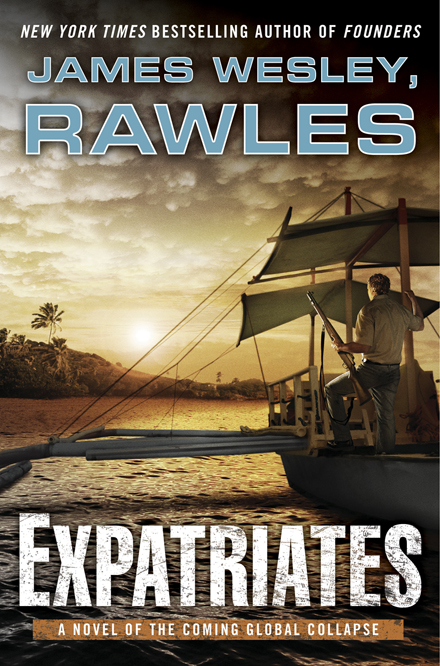
Sample Chapter From My Novel Expatriates


The following is another sample chapter from my upcoming novel Expatriates: A Novel of the Coming Global Collapse. Please wait until the release day (October 1st, 2013) to place your order.

Introductory Notes: My upcoming novel opens with a prominent disclaimer that includes: “This is a work of fiction.  All of the events described are imaginary, taking place in the future, and do not represent the world as we know it in the present day. It does not reflect the current geopolitical situation, governmental policies, or the strategic posture of any nation. It is not intended to be commentary on the policies, leadership, goals, strategies, or plans of any nation. This novel is not intended to be predictive of the territorial aspirations tactics of any nation or any planned use of terrorist tactics. Again, it takes place in the future, under fictional new leadership. Any resemblance to living people is purely coincidental.

This chapter describes a nighttime encounter between an essentially radar-transparent wooden outrigger Philippine fishing boat (the Tiburon) and an Indonesian fast patrol boat (the Sadarin.)

Chapter 20: E&E

“When it all comes down, the last man standing is going to be standing there in shorts and sneakers [armed] with a ’98 Mauser, and all the ninja-looking guys belly up at his feet – with all their cool gear.” – Louis Awerbuck

On Board Tiburon, The Banda Sea – Late October, The Second Year

The seas were calm and the night was almost pitch dark.  It was overcast, the quarter moon had not yet risen, and the Jeffords could barely distinguish the horizon. They motored on, regularly checking the compass and the GPS.

Tatang sat dozing in the side chair while Peter held the wheel. As he gazed ahead, Peter saw the flare of a cigarette lighter about 400 or 500 yards ahead—someone lighting a cigarette on the deck of a boat of some sort.  Jeffords hesitated for a moment, and then cut the throttle to bring Tiburon to slow maneuvering speed.  He swung the wheel sharply.  The motion roused Tatang. Peter ducked his head toward the old man’s ear and whispered, “Quiet.”  He could hear excited voices in the distance.

A pair of big diesel engines rumbled to life. Just as Peter completed their turn about and the Tiburon’s stern was pointed toward the strange boat a searchlight snapped on and began scanning.  Peter slammed the throttle forward and he said, “Take the wheel!”

Peter stepped away from the helm and snatched up Navarro’s M1 rifle.  Tatang took the wheel and shoved hard on the throttle, but he found that it was already wide open.  The searchlight found them, blindingly bright. Peter’s eyes had been accustomed to the darkness and this change overwhelmed his senses. There were more shouts from the other boat. It was now 500 yards away and had started to turn towards them.  Peter judged that it was a 50-footer, and it had the profile of some sort of pilothouse patrol boat, with pedestal-mounted machineguns, fore and aft. Before it completed its turn, he could make out the boat’s hull number: 855.Tatang muttered, “We’re in a tight spot, aren’t we, Mister J.?”

Across the dark sea, Kapten Assegaf switched on Sadarin’s hailer, emitting a high warble.  Then he keyed his microphone and issued a warning to stop, in Indonesian. He repeated the command in Dutch, and then English: “Hou’ vast! You are ordered to stop, or we will be shooting.” The young, impetuous captain was grinning. He knew that the outrigger boat was no match for his boat, with its pair of MTU diesels. Despite a few patches to its hull that gave her more drag than in her early days, Sadarin was still a very fast patrol boat.

The patrol boat was quickly gaining on Tiburon. Peter crouched behind the stern rail, put the rifle to his right shoulder and clicked its safety bar forward with the front of his trigger finger.  He said aloud,  “Help me get out of this, Lord.”  Then he took aim at the searchlight. The glare was intense.

He fired three times in rapid succession.  The third shot hit the searchlight, extinguishing it.  Tatang then immediately jerked the wheel, turning Tiburon sharply to starboard.  The .50 caliber M2 Browning on the forward deck of the patrol boat sputtered to life, firing blindly in reply, in a deep staccato.

To Peter’s dismay, moments later a second searchlight snapped on and began to scan.  “Kasimanwa ko,” Tatang muttered, which Jeffords recognized as a Tagalog reference to excrement.

Peter fired two shots at the searchlight The second one hit the mark, again casting them into darkness.  Immediately after, Tatang wisely swung the wheel again, this time hard to port. The .50 caliber fired again blindly. The muzzle flashes were all they could see.   The first few rounds passed over their heads. Every fifth round was a tracer.  The arc of the tracers increased farther and farther to starboard.   Tatang changed course once more, quartering away from Sadarin.  Between bursts from the machinegun, they could hear excited shouts from the Indonesian crewmen.  Two Indo sailors with Pindad SS2 5.56mm assault rifles joined in, blindly firing in long fully automatic bursts. But like the big Browning, all of their bursts were fired high and wide–nearly all toward their previous heading.

After a minute, they were about 1,000 yards away from the patrol boat.  Peter realized that his rifle was more than half empty, so he fumbled for a minute to unload it and reload it with a full 8-round clip from his pocket.  The Garand, he knew, had the limitation of an “all or nothing” ejecting cartridge clip—there was no way to top off the rifle without changing the clip completely.  He wanted to be ready with a full 8-round clip in case he had to fire again.

Captain Assegaf used his bullhorn again, this time ordering his own crew, “Diam, diam!”  The shooting stopped.  Realizing what was happening, Peter whispered urgently, “Stop, stop! Preno!”

Tatang chopped the throttle and then turned off the engine completely. Moments later, the Indonesian captain shut his engines down, too. It was eerily quiet and still quite dark.  Below deck, two of the Indonesian Air Force radar technicians were wailing and crying, convinced that they were about to die for failing to do their job. 
Hoping to hear the engine of Tiburon, the Indonesians were listening intently. It was so quiet that Jeffords could hear the sound of squeaking footsteps on the deck of the patrol boat.  There was an anxious, questioning voice from below deck and then another shout of “Diam!” from Captain Assegaf, this time without the benefit of the bullhorn.

Peter crept toward the helm chair.  The storm door slowly slid open. Rhiannon’s head popped out.  Peter reached across the door and clamped his hand across her mouth.  He leaned forward and whispered into her ear: “An Indo patrol boat.  I shot out their lights, so now it’s cat and mouse. Keep Sarah and Joseph super quiet.”
Rhiannon gave an exaggerated nod and quietly descended back into the cabin, sliding shut the storm door as gently as possible.

The unnerving quiet continued for two minutes.  Sadarin’s signals officer approached Captain Assegaf to report that there was no radar contact.  Worse yet, the ship’s sonar could only be used as a depth finder. It was not designed to locate other vessels. Assegaf began cursing loudly.  He ordered hand flashlights and a flare gun be brought up from below, but there was some difficulty in finding the waterproof box that held the flare gun and flares.  Instead of its usual location, it was inadvertently hidden under a pile of life vests. This led to even more consternation and shouting.

By the time that they started scanning with the hand flashlights, the two boats had drifted apart and were separated by 1,250 yards. Because the Indonesians’ flashlights lacked sufficient range, the sailors had no luck spotting Tiburon. Captain Assegaf let loose a long string of profanity and slapped his signals officer on the side of his head.  Frustrated, he impetuously fired up the boat’s diesels. He hesitated for a moment, and then took a guess at Tiburon’s last heading, but he guessed wrong.  He turned Sadarin 30 degrees to starboard as he advanced his throttles to 3/4th, pushing the boat up to 25 knots. 

Peter inched up to Tatang and asked in a half-whisper, “Now that they’re started their engines, won’t that mask the sound if we start ours?”

The old man thought for a moment and then answered, “Yeah, but they could stop any time and listen again, and then they’d hear where we are. We’d really be in the kamalasan. Right now, they don’t know if we are pirates, smugglers, or refugees. And even refugees are probably all ‘shoot on sight.’ We are safer just drifting for now, Mister J. It is still six hours to the daylight, and the clouds will stop most of the moonlight.  The moon rise won’t be for about two hours. Just pray hard that they get far enough away that they can’t hear our engine.”

Jeffords did pray, fervently.

The Indonesian patrol boat was more than a mile away when they began launching parachute flares.  But at that distance, they didn’t throw enough light to reveal Tiburon’s position. 

Even worse than the misplaced flare gun kit was the fact that up until fifteen days before, Sadarin had been equipped with a pair of Fulinon Gen 3 light amplification night vision goggles (NVGs).  But the navy had requisitioned the NVGs from every ship less than 25 meters in length for an unspecified “priority tasking.” Assegaf assumed that this meant the Philippines campaign.  He was furious.  If he had the NVGs or at least if he had the flare gun close at hand, then the intruder would not have been able to slip away. 

Rhiannon and Joseph came up on deck.  “Sarah is asleep,” Rhiannon reported in a whisper.

Peter had the binoculars out, trying to gauge the distance between Tiburon and Sadarin. He started to chuckle and said,  “I told you that you have a stealthy boat, Tatang.”

Tatang put on a huge grin that Peter could see even in the very dim light. “Yes, she’s a stealthy old shark, and she just put those Indo bastards on a whatcha-call wild geese chase.”

The two men shared a laugh.

After another half hour, when the Indonesian flares could barely be seen six miles away, Tatang restarted Tiburon’s engine. He turned the bow to the southeast, quartering away from the Indonesian boat.  Speaking at a normal level for the first time since the incident began, Tatang said, “Now, we gotta put a lot a miles between them and us before the daylight. They’ll try to get a patrol plane up to look for us, sure as anything.”  He pushed the throttle forward all the way to its stop and added, “Go, baby, go.”

Joseph said, “Do you know how lucky we are?”

Rhiannon shook her head and said, “Poor choice of words, Joey.  The word isn’t lucky, it is blessed.”

As dawn broke, after a fruitless night of searching, Assegaf had a long talk with his first mate, an old NCO who had seventeen years of service with the navy. They discussed how they would write their report of the incident with the “unidentified fishing boat.”  They agreed that it would be counterproductive to complain about the lack of NVGs and that the misplaced flare gun kit should be blamed on a junior grade sailor and a reprimand issued before they returned to port.

Assegaf’s next conversation was with the senior Air Force radar technician to determine why the radar couldn’t detect the fishing boat.  After a brief lecture on radar fundamentals, the NCO explained that the ship’s radar had a feature called “near field clutter rejection.” Thus, the radar did not display any target less than two kilometers away if was moving at less than twenty kilometers per hour and if it had a radar cross section smaller than that of a small boat or passenger car.

Kapten Assegaf fumed about the fishing boat getting away. More than just the disappointment, it was writing the After Action Report that troubled him.  Given the recent political shifts within the TNI-AL, his report would have to be very carefully worded.


Pat’s Product Review: Springfield Armory EMP 40

It’s been a few years since Springfield Armory came out with their Enhanced Micro Pistol (EMP) and I decided to take a wait and see attitude – I waited until they actually hit the market. What is unique with the EMP is that, it appears to be a 1911 handgun, with a big change. Springfield Armory redesigned most of the parts, to reduce the overall size of the EMP. It’s not a chopped or cut down full-sized 1911 – far from it. Almost every part was redesigned by Springfield Armory, including the frame, slide, trigger, hammer, backstrap, etc. None of these parts will interchange in a regular 1911.  The EMP is the very first production 1911 made from the ground up to shoot short cartridges like the 9mm and .40 S&W.
 
Let’s take a quick look at some of the features the EMP has to offer. My sample is in .40 S&W, and you can also have it in 9mm…the .40S&W has an all-steel frame, while the 9mm can be had with a light-weight aluminum frame. The .40 EMP sample has a 3-inch barrel, that is made out of stainless steel and is match-grade, with a fully supported ramp for the bull barrel. The recoil system is a dual spring set-up, and the sights are Novak-style, low profile, that are dove-tailed into the slide, front and back and have 3-dot Tritium for night use and ambi safety. The trigger is an aluminum match-grade, and my sample had a super-smooth 4.5-pound pull – no need to adjust or do anything to the trigger pull, it was perfect for me. The slide is made out of forged stainless steel with a satin finish – nice touch. Grips are G10 with angled grooves for a sure grip on the gun under any weather conditions. We also have a beaver-tail grip safety and combat hammer and flat mainspring housing. The all-steel frame is Armory coated for a nice subdued black finish and it’s pretty tough stuff.
 
The EMP 40 weighs in at 33-ounces with the all-steel frame, I’d like to see Springfield come out with one in an aluminum frame, to shave a little more weight from the gun – of course, that would increase felt recoil, and the little EMP 40 does buck, no doubt about that at all. The 9mm version can be had with an aluminum frame and comes in at 27-ounces. The EMP 40 feels heavier than it is – at least in my hand – for some strange reason. However, the little gun balances nicely and is fast-handling, too. The ejection port is lowered and flared, and I had no malfunctions of any type in my testing. The gun is very tightly fitted – you would believe this gun was assembled and fitted by a custom 1911 gunsmith because it is so tightly put together. The EMP 40 also comes with three, 8-round magazines, a nice touch! And, the magazines have slam pads for speed reloads, no worries about getting the meat of you hand caught between the magazine and the magazine well when you slam a reload home.
 
The only thing I’d like to see on the EMP is a checkered front strap. However, I overcame this handicap and installed a Crimson Trace LG-912 laser grip – I removed the outstanding G10 grips that came on the EMP 40, and replaced them with the Crimson Trace LG-912 sample I received had their new Black G10 laser grips. For those not familiar with Crimson Trace, their laser grips are “instinctive” in that, you don’t have to think about them – when you grip your gun properly, and pressure is applied to the grip, there is a front activation switch and it activates the laser – you don’t have to think about it, or press any extra buttons. There is a manual on/off switch, for when the gun isn’t in use. However, I saw no need to turn the Crimson Trace LG-912 off, I left it on. The laser grips are sited-in at the factory for 50-feet, and my sample was dead-on – at that distance. However, I made adjustments – which are easy to do – and zeroed my sample in at 25-yards – just a “me” thing.
 
I had a great selection of .40S&W ammo on-hand for my testing. And, with the great ammo drought we’ve been facing, I’ve cut back to only shooting about 200 rounds in my firearms tests these days. However, the EMP 40 was so much fun to shoot, I burned through more than 500 rounds of ammo in my testing. I shot the EMP for more than three months, and never had any problems. I used Italian Gun Grease to lube the pistol at the onset of my testing and never cleaned or lubed the gun after that. I’ve found, in my humble opinion, that Italian Gun Grease lube is the absolute best there is on the market – bar none. In my testing, I had ammo from Black Hills Ammunition 155-grain JHP, 180-grain JHP and the 140-grain Barnes all-copper TAC-XP hollow point, as well as the 180-grain FMJ reloaded ammo. From Buffalo Bore Ammunition I had their standard pressure 140-grain Barnes all-copper TAC-XP hollow point and the same in 125-grain – both are standard pressure, but still a bit hotter than any other maker’s standard pressure 40 S&W loads. I also had their brand-new 200-grain Hard Cast standard pressure load, that they call their Outdoorsman Load – great if you need some serious penetration on dangerous game, this load will get your attention! I also had 155-grain JHP +P, 180-grain JHP+P and 180-grain FMJ +P load, and this last one will also get your attention – and would be great for carrying in the boonies where you might encounter dangerous game – it will penetrate, like the 200-grain Hard Cast load will.
 
I thought about doing my accuracy testing at 15 yards, considering the short 3-inch barrel on the EMP 40, but after thinking it over, I did my testing at 25 yards, with the gun rested on a sleeping bag, over the hood of my SUV. I will say, the EMP 40 was very consistent in the accuracy department – there honestly wasn’t a clear-cut winner in my humble opinion. Most groups hovered around 3-inches or a bit less. The Buffalo Bore 200-grain Hard Cast load would shoot a bit tighter groups. The Buffalo Bore 155-grain +P load showed a little sign of the empty cases starting to bulge ever so slightly – nothing to worry about, but it was something I noted just the same. The 180-grain +P JHP didn’t show any such signs.
 
The Buffalo Bore 125-grain Barnes TAC-XP all-copper hollow point was going to be my load of choice, for self-defense. However, I found that load was a bit hot – even though it is rated at being standard pressure – it was a bit harder for me to recover rapidly from shot-to-shot with this load. The 140-grain Barnes all-copper hollow point wasn’t as bad. In the end, I decided on the Black Hills 140-grain Barnes TAC-XP all-copper hollow point as my street carry load in the EMP 40 – it was slightly more accurate than the Buffalo Bore load with the same bullet. However, I wouldn’t feel the least bit handicapped with any of the JHP or Barnes TAC-XP loads for self-defense against two-legged predators, and any of the FMJ or Hard Cast loads for carrying out in the boonies. Now, I should mention that, Springfield Armory recommends that you do not fire +P ammo in any of their 1911s with barrels shorter than 5-inches. I’m sure part of this is a legal-eagle thing – liability purposes or concerns. I wouldn’t shoot a steady diet of +P loads through the EMP 40, for the simple fact that it accelerates wear and tear on the gun. And it is a bit hard on the shooter, too.
 
For some reason, and I can’t explain it, I really liked the Buffalo Bore 200-grain hard Cast load in this gun – no explanation for it, it just felt good to shoot – even though it was the heaviest load I tested. The Black Hills 140-grain Barnes TAC-XP all-copper hollow point seemed to cycle the slide smoother than the other loads, too. Maybe just a subjective thing in my book – I really can’t explain it. But if you do a lot of shooting like I do, you pick-up on slight differences in how a gun handles different ammo – some cycle the slides smoother than others do. Some cycle the slides fast, some slower.
 
Springfield Armory also includes a nice large carrying case for the EMP to ride in on your trips to the range. And, if you can legally carry the EMP 40, Springfield includes a nice polymer paddle holster and a double magazine case, too. I don’t know why more gun companies don’t do this – it is always a pain to find a holster to fit new gun designs – other than using generic type Nylon holsters, that don’t fit anything quite right. However, Springfield Armory stepped-up and provides holsters and mag pouches for most of their handguns they sell today. including their XD line. Thanks, Springfield!
 
There is nothing negative to report on the EMP 40, just some “druthers” – I mentioned I’d like to see the front strap checkered, but this can be overcome with some skate board tape – and I apply this to the front strap on a lot of semiauto pistols – its cheap and it lasts a long, long time and is easy enough to replace when it wears out. I’d like to see the EMP 40 offered with an aluminum frame – however I know the felt recoil will be quite a bit more substantial to the all-steel frame version – but still, I’d like to see it offered. And, needless to say, the Crimson Trace LG-912 laser grips were the perfect addition to the EMP 40 – maybe Springfield Armory could offer the EMP with the Crimson Trace laser grips – just another option that consumers could choose from. If you feel you must “hang” anything onto your EMP, the Crimson Trace laser grips are the way to go – and I like the instinctive aspect – nothing to think about, just grip the pistol properly and they turn on – and there is that intimidation factor, when the bad guy sees that laser pointed at them. It just might cause them to give-up the fight, before it begins.
 
I’m always on the look out for the perfect concealed carry handgun – and I’m not sure if I’ll ever find “the” one that is perfect for me, but the EMP 40 comes close, very close – perhaps if they come out with an aluminum framed version, that might be it and my quest will end. However, as it is, the EMP 40 is hard to beat, with the right load, and the Crimson Trace laser grip. II can think of a lot worse set-ups, but it’s hard to think of many that are a much better combination than this.
 
If you’re in the market for a great concealed carry pistol in .40 S&W or in 9mm then take a close look at the EMP line-up. I think you’ll be very pleased, and like most Springfield Armory firearms, they are always in great demand, and a bit hard to find. But it’s worth the effort to seek out an EMP – I think you’ll like it, once you hold one in your hand, and like it even more once you fire it – and prepare to be amazed at how accurate this little pistol can be.


Letter Re: Stuff Hitting the Fan – Part 3: Communications

Dear James,
I need to respond the the letter “Stuff Hitting the Fan – Part 3”, with regards to communications. I am a ham radio operator holding a Amateur Extra Class license, and have a little CB and shortwave experience.  As such, I want to make some corrections R.L.’s letter and offer some advice.

1. An adequate ham transceiver for the HF bands (160m to 10m), will also cover the non-ham bands as receiver. This includes all of the broadcast shortwave bands, and the AM broadcast bands in the United States.

This will not include US broadcast FM, or the police and fire frequencies, which are outside it’s frequency range (you would need a VHF transceiver for those bands). So if you get a HF ham transceiver such as the Yaesu 450D, you can save half your money by not buying a shortwave receiver too.

2. All shortwave broadcasts use the AM mode. None use single side band or CW. 
    
3. Shortwave broadcasts to the western US are pretty rare right now. On the eastern seaboard you can get Europe, but there aren’t many people targeting the US with shortwave because of the prevalence of the Internet. There are, however, some stations you can pick up in Nevada (for example) that are clear even though they are not targeted to the US.

These are: the Australian Broadcasting Company, Radio New Zealand, and China Radio International. Unfortunately, the Brits and the Germans are no longer broadcasting in English to the US. If you speak Spanish, there is a lot of shortwave activity coming out of Latin America. 

4. There is a cheap and legal way to make your CB base stations more effective. Use single side band (either lower or upper), and use a horizontal dipole antenna not far off the ground. This will cause your signal to go nearly straight up to the ionosphere, where will be reflected back down like water out of a shower head.  The advantage here is that your signal will get into places like  between building, gullies, valleys and behind mountains, where it would normally not be able to go. The receiving station should have their antenna set horizontally to receive this well. This sort of antenna usage is called NVIS for Near Vertical Incidence Skywave. -The range for NVIS is typically a radius of 250 to 400 miles. Your actual range will depend on the time of day, the condition of the ionosphere, and the amount of transmit power used.

Thanks for your efforts, – Jeff Bear

JWR Replies: As blog reader “Templar” mentioned, NVIS will not work at CB frequencies unless there are exceptional ionospheric conditions. NVIS is generally limited to the 2-10 MHz range. Higher frequencies usually punch through the ionosphere. (This exaggerated scale illustration from QSL magazine sums up ionospheric skip.) As I mentioned in my novel “Patriots”, the key advantage of NVIS for HF transmission is that it is very difficult to locate via radio direction finding if the intercept outstations are beyond groundwave reception distance.


Recipe of the Week:

Amber’s Granola Bars
 
Here is a great recipe for using your stored oats, honey, nuts, seeds, dried fruits, etc.

Ingredients:

• 6 cups Rolled Oats (not Quick Oats)
• 4 Tablespoons Butter, Melted, Plus More For Greasing
• 1/4 cup Vegetable Or Olive Oil
• 1 teaspoon Salt
• 1 cup Brown Sugar
• 1/2 cup Honey
• 1/4 cup Apple Juice (I make mine fresh from our juicer)
• 1/4 cup Molasses
• 3 teaspoons Vanilla Extract
• 1-1/2 cup Rice Krispies (can be substituted for Optional Ingredients)
• 1 cup Wheat Germ
• 1/2 cup Finely Chopped Pecans
• 1/4 cup Roughly Chopped Almonds

Optional Ingredients: 
 
       Flax Seed
       Raisins
       Dried Cranberries
       Dried Blueberries
       Shredded Coconut
       Cinnamon

Preparation Instructions:

Preheat the oven to 350 degrees F.
In a bowl, toss the oats with the canola oil, melted butter and salt. Spread the mixture out on 2 baking sheets and toast in the oven for 15 to 20 minutes, shaking the pan twice and making sure they don’t burn. Remove from the oven and set aside.
Reduce the heat to 325 degrees F.
In a medium saucepan, combine the brown sugar, honey, apple juice and molasses. Heat the mixture slowly, stirring until all combined. Stir in the vanilla.
Toss together the toasted oats, rice cereal, wheat germ, pecans and almonds. Pour in the sugar mixture, stirring as you pour. Toss to combine; it will be sticky!
Press into 1 baking sheet (thoroughly greased with butter, or line pan with foil and grease foil) and bake until golden, about 20-25 minutes. Remove from oven and let cool. Cut pieces with a sharp knife and remove from the pan.
 
These are really easy and fun to make! They last a long time as well. My husband and I are going to make a batch and food saver them to test how long they will stay not only edible, but also how long they will stay fresh tasting. Our guess is several months.

May the Lord bless each of you, and may you enjoy these as much as we do!

Useful Recipe and Cooking Links:

Granola Recipes

Homemade Granola Bars

Do you have a favorite recipe that would be of interest to SurvivalBlog readers? Please send it via e-mail. Thanks!


Economics and Investing:

Brandon Smith: What To Expect During The Next Stage Of Collapse

Well-Known Stocks to Avoid as Mortgage Rates Rise

James W. sent: Indian rupee resumes slide as fears grow for slowing economy

Items from The Economatrix:

First Signs of Hyperinflation Have Arrived: US National Debt Can Travel From the Earth to the Sun and Back a Stunning 83 Times!

U.S. Government Prepares Mass Pension-Rape

33 Shocking Facts Which Show How Badly The Economy Has Tanked Under Obama


Jim’s Quote of the Day:

“[General Francis] Marion’s Men were also discouraged. The forces mounting against them seemed overwhelming. As they sat around their campfires, they began to talk as if certain ruin would overtake them. Finally Col. Peter Horry [a compatriot of Marion’s] said to his troops: “I am ashamed to hear you talk like this. We have often, before now, seen as heavy clouds hanging over us; and yet, with heaven’s blessing on our arms, those clouds have been dispersed, and golden days restored. And who knows we may shortly see it so again?” – Robert D. Bass, Swamp Fox: The Life and campaigns of General Francis Marion, 1959


Notes from JWR:

Today is the sad 30th anniversary of the willful air-to-air missile shoot-down of KAL Flight 007, which took the lives of 269 people, including U.S. Congressman Larry McDonald and Tae Kwon Do Master Hyong Ung “Billy” Hong. There were 105 Koreans, 62 Americans, 28 Japanese, and 23 Taiwanese on board. The airliner was a Boeing 747. The Soviet fighter was a SU-15, piloted by Major Genadi Osipovich. He had direct orders to shoot down the plane.

Today we present Part 3 of a four-part entry for Round 48 of the SurvivalBlog non-fiction writing contest. The prizes for this round include:

First Prize: A.) Gunsite Academy Three Day Course Certificate, good for any one, two, or three course. (A $1,195 value.) B.) A course certificate from onPoint Tactical. This certificate will be for the prize winner’s choice of three-day civilian courses. (Excluding those restricted for military or government teams.) Three day onPoint courses normally cost $795, and C.) Two cases of Mountain House freeze dried assorted entrees in #10 cans, courtesy of Ready Made Resources. (A $350 value.) D.) a $300 gift certificate from CJL Enterprize, for any of their military surplus gear, E.) A 9-Tray Excalibur Food Dehydrator from Safecastle.com (a $300 value), F.) A $300 Gift Certificate from Freeze Dry Guy. G.) Two BirkSun.com photovoltaic backpacks (one Level, and one Atlas, both black), with a combined value of $275, H.) A $250 gift certificate from Sunflower Ammo. and I.) A roll of $10 face value in pre-1965 U.S. 90% silver quarters, courtesy of GoldAndSilverOnline.com. The current value of this roll is at least $225.

Second Prize: A.) A gift certificate worth $1,000, courtesy of Spec Ops Brand, B.) A Glock form factor SIRT laser training pistol and a SIRT AR-15/M4 Laser Training Bolt, courtesy of Next Level Training. Together, these have a retail value of $589. C.) A FloJak FP-50 stainless steel hand well pump (a $600 value), courtesy of FloJak.com. D.) $300 worth of ammo from Patriot Firearms and Munitions. (They also offer a 10% discount for all SurvivalBlog readers with coupon code SVB10P.), E.) A $250 gift card from Emergency Essentials F.) A full set of all 22 of the books published by PrepperPress.com. This is more than a $200 value, and G.) Two cases of Meals, Ready to Eat (MREs), courtesy of CampingSurvival.com (a $180 value).

Third Prize: A.) A Royal Berkey water filter, courtesy of Directive 21. (This filter system is a $275 value.), B.) A large handmade clothes drying rack, a washboard and a Homesteading for Beginners DVD, all courtesy of The Homestead Store, with a combined value of $206, C.) Expanded sets of both washable feminine pads and liners, donated by Naturally Cozy. This is a $185 retail value, D.) A Commence Fire! emergency stove with three tinder refill kits. (A $160 value.), E.) Two Super Survival Pack seed collections, a $150 value, courtesy of Seed for Security., E.) A Tactical Trauma Bag #3 from JRH Enterprises (a $200 value).

But first, as they say, “here is a word from our sponsors”:


National Preparedness Month — Three Concurrent Mountain House Sales!

During National Preparedness Month, Mountain House has removed their Minimum Advertised Price (MAP) restrictions on their authorized dealers for long term storage foods packed in #10 cans. This is the first time the company has ever done so, and it has created the opportunity for low prices that haven’t been seen in decades. Three SurvivalBlog advertisers are Mountain House dealers, and I strongly recommend that you stock up to take advantage of these sales prices in September.

Here is a summary of the three September sales:

A month-long sale on Mountain House long term storage foods began today at Safecastle.

Their average discount is almost 44%, with free shipping. (They may be adjusting their discounts as they go forward for special one-day or two-day deal offers through the month.) Their Mountain House product discounts (as of today) range from 38% to 58% off. With multiple member rebates and incentives running through September, actual savings are even greater than that. 

They have a special web page with the complete rundown on all the deals that apply.

Check their Mountain House cans category page as well as their Now On Sale category page.

Meanwhile, Ready Made Resources has a started a 45% to 70% off sale on Mountain House long term storage foods packed in #10 cans, for the full month of September. They also offer free shipping and will even mix and match some varieties to make 6-can cases. (All cans must be ordered in 6-can increments, and their special “mix and match” service is limited to stock on hand.)

And Camping Survival has also announced some sale prices on Mountain House foods in #10 cans up to 54% off regular price for the whole month of September.

Because of the huge volume of orders expected, you can expect up to a 15-day delay before your order ships, with all three Mountain House dealers. Note that the deepest discounts are limited to selected varieties and to stock on hand, so place your order soon. Check with the vendors’ web sites often, as they will be adjusting some pricing during the month, and listing the food varieties that have run out.


Stuff Hitting the Fan: A Position Paper – Part 3, by R.L.

(Level II Scenario, continued)

Utilities

For me, a 1,000 Gigawatt generator is not needed. Just 12 volt deep cycle storage batteries and a photovoltaic panel to charge them up, along with with a homemade generator from a lawnmower engine fan belted to a Chevrolet car alternator will be enough to power some communication electronics and spot lighting.  Deep cycle batteries are preferable to regular 12 V car batteries as they last much longer, but car batteries will certainly do in a pinch.  Incandescent lights need more power than fluorescents which need more than white LED arrays. Do some experimenting.  Another way to generate electricity is by turning a DC motor into a generator.  A DC motor accepts a DC voltage, from a battery for example, applied across two terminals and translates that energy to a rotary mechanical motion that drives whatever the motor is hooked up to, (a cordless drill, a kids play jeep, whatever).  A generator is the exact same motor, except instead of applying a voltage and harvesting a rotary force, you apply a rotary force and harvest a voltage.  All you do is hook something to the motor shaft, a bicycle, hand crank, a water or wind wheel, and turn it and a voltage is generated across the same two terminals the battery was previously hooked to.  Pay attention to polarity.  The motor should have a plate on it indicating what amount of voltage and amperage it will generate.  As you put the generator under a load it will become harder to turn, the result of a phenomenon called back EMF.

I don’t know much about big generators.  The options are basically gas, diesel or propane.  Diesel appears to be the best option.  Gas is more dangerous to store than diesel and the diesel generators last longer under a sustained usage (lower RPM).  Propane may also have problems lasting due to top end lubrication (I’m not sure about that) but propane is the easiest to store.  A generator could be used sporadically, say a couple hours a day to keep the refrigerator cold or run appliances.  If you do store gas or diesel, treat it with preservatives while it is fresh, at the beginning of the storage cycle, and store it in a safe manner.

There are a lot of electronics that could be harvested from a car, 12 Volt lighting, batteries, radios, CBs, meters and gauges.  Not to mention the metal to fabricate tools, hydraulics to provide motive force, petroleum products, the motor, the wheels and tires, transaxles to translate a rotary force 90 degrees, seats (what Southern abode is complete without an old car seat gracing the front porch?).

We have pretty well considered water; (did I just say well?)  That’s the next step in a more permanent water supply:  a well.  It is certainly possible to hand dig a well, but before attempting to do that, you should find out how to go about it because a well cave-in is nothing to be ‘cave’alier about.  The best bet is to have the well dug by a professional; don’t forget to have a way to get the water up without electricity, or have a generator.  Research how to locate a well with regard to septic systems, water table etc.

Lighting is also covered by using Kerosene lamps and /or rechargeable solar powered lamps.  Have spare wicks, globes, bulbs, switches, and plentiful fuel or energy.  Even if using Kerosene lamps, it would be wise to have a more concentrated, focused, portable, powerful method of lighting available to use when needed.  Of course, a flashlight fills the bill quite nicely.  Have some way to use rechargeable batteries. 

For more permanent ways to dispose of bodily waste, I reckon the most lo-tech is the good ol’ outhouse.  Dig a pit about 6-8 feet deep, build a portable house to cover it and provide privacy.  When it gets near full, cover the last few feet with dirt, dig a new hole and pull the house (built on skids?) over to it.  Lime might be used to keep the smell down, another exciting topic to research.  Other options are methane digester toilets, burning the waste in ‘honey pots” or using the existing septic system by hauling in flushing water by hand.  The latter option is probably the easiest and less damaging to the water table than an outhouse, non-potable water can be used for flushing.

Washing dishes in a water conservation mode can be done by using the following process:   1.) scrape the loose food of for the dogs to eat or to compost for the garden, 2.) fill one sink with water and some soap, 3.) fill another sink with water and a 1/4 cup of Clorox, 4.) Wash the dishes in the soapy water, 5.) rinse/disinfect in the Clorox water and 6.) set out to drain or towel dry.  Dishtowels will be worth their weight in gold; I suspect the cloth could be purchased fairly cheaply and towels cut, and hemmed, from the roll.  If need be, recycle the water through a distiller or use it to wash something else.

Washing clothes will be a chore.  I guess a big washtub or two and a washboard is the way to go, hang em up on a clothes line, it’s been done before.  Another option is to cut a hole in the top of a five-gallon bucket lid and agitate using a (clean) plunger, kind of like an old-fashioned butter churn.  A clothes wringer would be cool (A large industrial mop bucket with a wringer might suffice).  Speaking of which, study up on ways that these common things were done before electricity, read books on pioneers that kind of stuff.  Figure out how to make soap or stock up on enough to hold you over for a year or two, just in case, God forbid, a collapse drags on that long.

Trash disposal will be non-existent in a survival situation.  Around here if we miss one trash day, it starts to pile up something fierce.  Over the long term, this could be a serious health hazard.  Trash piling up will smell, attract rodents and flies, and encourage disease.  On the bright side, there will be less packaging to be disposed of since most new production will be home generated, food and such.  None the less, have a sanitation plan.  Separate trash at the point of origin, paper and combustibles in one can,  biodegradables in another, glass and metal in a third.  Burn the combustibles, compost the bio-degradable, and bury or pile up the metals and glass.   Re-cycle everything possible.  Keep the area cleaned up from trash blowing into the yard.

Bathing could be accomplished by heating water on a stove and pouring into a tub or maybe by constructing a solar shower outside for summer use.

Communications

Communications could be clutch.  Try to cover as much as the spectrum as possible.  Get a short-wave radio, or Ham transceiver, covering at least 15 kHz to 30 MHz; a police/fire scanner covering the local emergency bands, an AM/FM radio, CB radios, and a television.  Have the ability to power all these with a 12-volt battery.  A Ham rig would be cool to enable two way conversations.  The shortwave should cover the upper and lower sidebands as well as CW signals.  The police scanner will be useful if there are riots or civil unrest.  CB radios, especially ones with sideband channels, can be used for personal communications, maybe one base station and 2 or 3 handhelds, all with rechargeable batteries.  Avoid having an ‘antenna farm’ outside your house so as not to draw a lot of attention.  Point to point communications in the form of intercoms, sound powered phones, hand, mirror, and semaphore signals could also be used.

Transportation

If the gasoline is flowing, well and good, if not, it’s back to bicycles, horses and feet.  Make sure the car stays tuned up, has good tires, a full tank of gas and is in good working order.  Stock up on spare parts, water pump, alternator, fluids, and plugs, et al.  You can build an ‘Urban Assault Vehicle’ with winches, heavy-duty bumpers, and extra gas cans and all that stuff if you are so inclined.  Having a couple bikes handy might be a good thing.  Spare inner tubes etc, etc. 

Education

The immediate concern regarding education is knowledge gained before problems occur.  Learn how to do stuff, study farming, gardening, carpentry, blacksmithing, medicine, cooking and preserving, stone masonry, weaving, trapping, hunting, fishing, metal working, electricity, plumbing, the list goes on and on.  Pick one or two things to get really good at and cross train in the others.  Gather information, books, magazine and Internet articles to keep as a reference library.  Don’t neglect classics and light reading. And the three R’s, reading, ‘riting and ‘rithmatic.   Set up schooling for the children if the schools shut down for a while and train constantly in as many sufficiency disciplines as possible.  Have school supplies available.

Recreation

Picture yourself in a shelter with four young kids and no crayons; picture yourself climbing the walls.  Games, books, coloring books and crayons, lots-o-paper and pencils (exactly how would you go about making a pencil anyway?) textbooks for higher education, radio, outdoor activities.  Have fun.

Government Relations

A real wild card, chances are they won’t be prepared (in a good way) for a serious societal emergency.  Of course with the current bunch of crafty, disingenuous, lying, cheating, stealing, power mad, constitution stompin’ yahoos in Washington, that won’t matter as they are likely to make a power grab (for the good of the people, don’t you like children?) using the various Executive Orders surreptitiously signed into law over the last few decades.  “I’m from the government and I’m here to help you.”  Yeah, right.

As far as self-government goes, pick a leader, establish a legislative and a judicial body is one option, follow the US Constitution; another might be to set up a system of Judges like the early Hebrew people had in the Bible.  Definitely something to think about.

Local Area Relations

That would be your neighbors.  Help them get informed about survival in general, if not your plans specifically.  If your neighbor has his own food supply, he won’t be knocking on your door for a handout when the SHTF.  This is where it gets a little confusing.  If someone is doing a full combat assault on your house, hey lock and load, ready on the right, ready on the left, commence fire, not a real moral dilemma; but, if your neighbor, your beer drinking buddy, and his extended family are starving next door and you’ve got some food stashed back, but not really enough to hand out willy-nilly without endangering your own family, then what?  One possible solution would be to store a lot of extra bulk foods, (corn, beans and rice) to be able to share liberally, also within your group, if you hand out a meal, someone within the group fasts for that meal for a net loss of nothing, as long as no one fasts excessively.  Maybe a combination of both, even so keep an ultra low profile, maybe leave a bag of groceries on the front steps at night.  If the food is distributed openly, the person receiving it can hoe in the garden or chop some firewood to help out.  Help as much as possible within your neighborhood and community.  Try to form supporting groups of people that have diverse skills and knowledge. 

Job Security

If your job goes under due to societal issues, you will need an alternate career until everything gets back to normal.  Gather tools and supplies to accommodate a backup career.  Try to focus on something that 1) you know how to do and  2) will be in demand.  Some job where the work came to you rather than you going to the work would be desirable.  Something like a produce stand would be ideal or battery charging station, just a thought.

Bugging Out

Bugging out, aka leaving your home base, without a clear destination that is able to absorb you and your family, is just another way of saying: refugee.  Refugees are helpless and totally dependent upon the vagrancies of whatever group takes control of them, be it a government or an armed band of thugs; or both as happened during Katrina.  Forget bugging out to the forest with a .30-30 and a backpack; it won’t work.

Have a secure bugout location in mind before you leave.  Bring what you can: weapons, ammunition, food, medicine, seeds, tools, blankets, camping gear, pots and pans, functional clothing and footwear, candles, lighters, whiskey, kerosene lamps, Clorox, soap, detergent, towels, gasoline and kerosene (keep your vehicle gassed up).

Be prepared to take back roads as the interstate system might be shut down.  Travel with a group if possible and keep a well-armed presence.  Have actual paper maps; don’t depend on the GPS system being up and running.  Beware of roadblocks.  


Level III Scenario

I guess I really don’t know what to say about this type of scenario.  Lock and load.  Pretty much like a super level II scene.  Sort of like the movie “The Postman” without the happy parts.  Who knows?

Conclusion

Do not be dismayed by the prospect of societal collapse; take precautions but don’t freak out; it won’t do any good anyway.  If I were to guess about the potential for a societal collapse, I would say probably a mild level II scenario with more inconvenience than danger.  The foregoing text dealt with a more severe level II with the premise that is would be better to be over prepared than under, “better a year too early than a day too late”, as the saying goes.  Which is good advice, don’t wait until it is too late to start preparing, it may be too late by then to get many items.  Get the bulk foods first and secure drinking water now, then start in on the other items.  Gather together with family and friends to prepare; plan on congregating together if it gets hairy.

At times this paper takes on a Christian evangelical bent.  I don’t apologize for that.  If you aren’t right with God, you need to get right.  All you have to do is realize that you need God in your life and ask Jesus into your heart.  Matthew 7:7-8 says:

“Ask and it will be given to you; seek and you will find; knock and the door will be opened to you.  For everyone who asks, receives; he who seeks, finds; and to him who knocks, the door will be opened.”

Self-sufficiency will give you a peace of mind regardless of the actuality of an emergency taking place.  You don’t buy car insurance planning on getting into a wreck, but you buy it anyway for the peace of mind and the protection afforded in you do have an accident.  Use the same approach for “collapse insurance”.  You can probably do everything mentioned in this paper for the amount of money you spend on insurance in one year, and to a large extent, these are one time expenditures not re-occurring expenses.  Better safe than sorry.  But, put your trust in God.

This reminds me of a joke: A guy dies and goes to heaven and Saint Peter says:  “We have a point system to get into heaven, it takes a hundred points to get in the door, tell me about your life.”  “Well”, the guy says “I was a preacher for seventy years and led many hundreds of people to know Christ the Savior.”  Saint Peter says “OK, that’ll be 3 points.”  The preacher says “I started a soup kitchen in my town and fed many homeless people every day with my own money.”  “4 points” says the Saint.  By this time the preacher is getting a little nervous.  “Okay…I operated an orphanage in my home and kept dozens of children there for the last 40 years.”  “Ummm, 3 points” says Saint Peter.  “Now wait a minute”, explodes the preacher, “at this rate, the only way I’ll get into heaven is by the Grace of God !”  “100 points!” says Peter throwing open the Pearly gates.

2 Timothy 4:7

“I have fought the good fight, I have finished the race, I have kept the faith.”

to be concluded later this week, with some appendices.


Letter Re: Declining Aquifers

Hello Mr. Rawles,
I am a great fan of your work and I eagerly anticipate the release of your new novel.   I live in rural Northeastern Colorado, where both sides of my family settled in the 1870s.  The mid-sized ranch, 1,900 acres, that I live on has been owned by my family for 104 years.  I raise cattle, goats, horses and hay along with my dad, my wife and kids.  I also have a “government job” in local emergency services to help make ends meet. 
 
I read the recent article by Denise Chow of Live Science, titled Water Woes: Vast US Aquifer Is Being Tapped Out about the Ogallala Aquifer and thought you might be interested in it.  I can vouch that the water table is indeed dropping, from personal experience.  We are on the edge of the Ogallala Aquifer and we have always had an ample supply of water until about five years ago when the wells in our area started going dry.  We have a stock well with a windmill on our place, that was originally hand dug by my great-grandfather in the early 1890s, which went dry two years ago.  I believe that this problem will help contribute to and be a factor in the coming collapse.  There are some center pivot irrigation wells in our area that are no longer being used because they either went dry, or were told to shut down by the state to conserve water.  This has reduced the amount of high yield crops being raised because they now have to be dry land farmed and produce lower yields.
 
Keep up the good work and God Bless, – Michael M.


Odds ‘n Sods:

R.H. kindly sent us the full scoop on Maryland’s new ban on semi-auto rifles and standard capacity magazines that goes into effect in one month (October 1, 2013.) Vote with your feet, if you can. But if you can’t, then stock up, soon!

   o o o

Common Household Items that Add Hundreds of Dollars to Energy Bills. [JWR’s Comment: Don’t overlook the umpteen power cubes (AC to DC transformers) throughout your house. By simply plugging them in to a $5 power strip you can turn off those “wall warts” with the flick of a switch when they aren’t in use. I also highly recommend buying a Kill A Watt Electricity Usage Monitor, so you can budget and reduce your power consumption. This will be crucial as you transition to alternative power systems in the coming years.]

   o o o

R.B.S. suggested watching a documentary on the demographics of Islam.

   o o o

Rick H. in Ohio recommended this book review: “Evil Invades Sanctuary: The Case for Security in Faith-Based Organizations”

   o o o

The “misguided” circuit court judge’s injunction against open carry in Mississippi has been vacated by the state’s Supreme Court. (Thanks to Papa in Mississippi for the link.)


Jim’s Quote of the Day:

“Perverse disputings of men of corrupt minds, and destitute of the truth, supposing that gain is godliness: from such withdraw thyself.
But godliness with contentment is great gain.
For we brought nothing into [this] world, [and it is] certain we can carry nothing out.
And having food and raiment let us be therewith content.
But they that will be rich fall into temptation and a snare, and [into] many foolish and hurtful lusts, which drown men in destruction and perdition.
For the love of money is the root of all evil: which while some coveted after, they have erred from the faith, and pierced themselves through with many sorrows.

But thou, O man of God, flee these things; and follow after righteousness, godliness, faith, love, patience, meekness.
Fight the good fight of faith, lay hold on eternal life, whereunto thou art also called, and hast professed a good profession before many witnesses.” – 1Timothy 6:5-12 (KJV)


Note from JWR:

Today we present Part 2 of a four-part entry for Round 48 of the SurvivalBlog non-fiction writing contest. The prizes for this round include:

First Prize: A.) Gunsite Academy Three Day Course Certificate, good for any one, two, or three course. (A $1,195 value.) B.) A course certificate from onPoint Tactical. This certificate will be for the prize winner’s choice of three-day civilian courses. (Excluding those restricted for military or government teams.) Three day onPoint courses normally cost $795, and C.) Two cases of Mountain House freeze dried assorted entrees in #10 cans, courtesy of Ready Made Resources. (A $350 value.) D.) a $300 gift certificate from CJL Enterprize, for any of their military surplus gear, E.) A 9-Tray Excalibur Food Dehydrator from Safecastle.com (a $300 value), F.) A $300 Gift Certificate from Freeze Dry Guy. G.) Two BirkSun.com photovoltaic backpacks (one Level, and one Atlas, both black), with a combined value of $275, H.) A $250 gift certificate from Sunflower Ammo. and I.) A roll of $10 face value in pre-1965 U.S. 90% silver quarters, courtesy of GoldAndSilverOnline.com. The current value of this roll is at least $225.

Second Prize: A.) A gift certificate worth $1,000, courtesy of Spec Ops Brand, B.) A Glock form factor SIRT laser training pistol and a SIRT AR-15/M4 Laser Training Bolt, courtesy of Next Level Training. Together, these have a retail value of $589. C.) A FloJak FP-50 stainless steel hand well pump (a $600 value), courtesy of FloJak.com. D.) $300 worth of ammo from Patriot Firearms and Munitions. (They also offer a 10% discount for all SurvivalBlog readers with coupon code SVB10P.), E.) A $250 gift card from Emergency Essentials F.) A full set of all 22 of the books published by PrepperPress.com. This is more than a $200 value, and G.) Two cases of Meals, Ready to Eat (MREs), courtesy of CampingSurvival.com (a $180 value).

Third Prize: A.) A Royal Berkey water filter, courtesy of Directive 21. (This filter system is a $275 value.), B.) A large handmade clothes drying rack, a washboard and a Homesteading for Beginners DVD, all courtesy of The Homestead Store, with a combined value of $206, C.) Expanded sets of both washable feminine pads and liners, donated by Naturally Cozy. This is a $185 retail value, D.) A Commence Fire! emergency stove with three tinder refill kits. (A $160 value.), E.) Two Super Survival Pack seed collections, a $150 value, courtesy of Seed for Security., E.) A Tactical Trauma Bag #3 from JRH Enterprises (a $200 value).

Round 48 ends on September 30th so get busy writing and e-mail us your entry. Remember that there is a 1,500-word minimum, and that articles on practical “how to” skills for survival have an advantage in the judging.