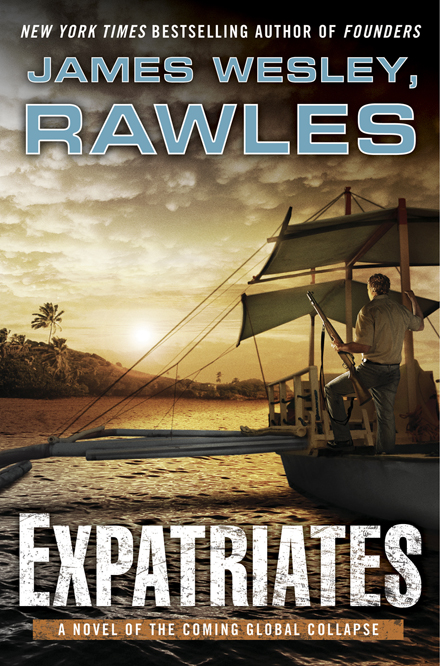
Some Shameless Self-Promotion: A Conversation with James Wesley, Rawles on His Latest Novel: Expatriates

Introductory Note: The following is an edited transcript of my conversation with my Publicist from E.P. Dutton, Emily Brock:

1.) Expatriates is the fourth novel in your Coming Collapse series.  What inspired you to write about survivalism?  Do you believe a real-life collapse is in our near future?

I believe that global economic instability is rising substantially, so the risk of economic collapse is greater than ever before.  Along with instability comes the risk of civil wars, regional wars, and perhaps even a Third World War.  It is indeed time for people to stock up, team up, and batten down the hatches.

2.) Expatriates is different from your other novels in that it mainly takes place outside the United States, in Australia. What drew you to writing about characters away from their native country?

There are now more than 5.25 million American citizens living overseas.  I recognized that the stress that they would go through in the event of a global collapse would be tremendous.  There is nothing quite like being stranded in a foreign country. And to be simultaneously cut off from any information about the well-being of your relatives would be devastating. So I saw this as both an opportunity to avoid any trodden ground from my previous novels, and as way to to describe some times of truly deep drama.

But it is notable that one of the storylines in Expatriates takes place in Central Florida, where there is also plenty of excitement.

3.) Both survivalism and religion play a large role in Expatriates. How do you see those two aspects balancing in the novel?

I consider them complimentary.  Being well-stocked allows survivalists to dispense Christian charity.  The deeper your larder, the more generous you can be.

4.) Tell me a little bit about your writing process. How do you begin to formulate your plots and characters?

The plots of my novels are essentially extrapolations of current trends.  The characters portray people from all walks of life. By showing both prepared and unprepared individuals, it allows me to show the breadth and depth of what is really required to pull through traumatic times or starvation, infrastructure disruption, and severe shortages.

5.) Are the personalities of the characters in Expatriates modeled after survivalists and friends you know?

Many of the characters in my earlier novels were drawn directly on the personalities and backgrounds of my close friends.  But in Expatriates, I have fictionalized the lives of a few of my blog readers whom I’ve never met in person.  A few of these characters combine the personas of several people.

6.) Some of the topics that arise in the novel, such as Islamic extremism and gun ownership, could be construed as very controversial. Was this your intention?

My intent was not to stir up angst or animus, but I have never been one to shy away from speaking out on key societal issues.  For instance, I have been very outspokenly pro-Christian, Pro-Preparedness, pro-Gun Ownership, Anti-Racist, and Anti-Slavery.  (Most Americans don’t realize that slavery is still being practiced in North Africa.)

The rise of Radical Islam is quite troubling. And if observed from a multi-generational perspective, it is genuinely frightening.

The right to keep and bear arms is the crucial cornerstone of the Bill of Rights. In effect, it is the right that insures all of our others. I believe that the current statist efforts to disarm the citizenry are not just misguided but inherently evil.  It is as if they foolishly want to make us all victims. As I’ve been quoted before: The Second Amendment is about protecting your right to go deer hunting the same way that the First Amendment is about protecting your right to publish poetry.

7.) You have mentioned in the past that you hope readers will learn as much as possible about survivalism through reading your novels. You have written non-fiction guides in the past, but do you believe that fiction is a better medium to get your message across?

We live in an age of information overload.  We are bombarded with television, radio, magazines, billboards, web pages, blogs, and text messages.  In this era, most people won’t take the time to sit down and read a survival manual.  But there is something captivating about novels.  By weaving a lot of practical and tactical tips into a fictional storyline, I can keep people’s attention. Many readers tell me that they read my novels twice: The first time through for fun, and the second time highlighting passages and taking notes.


Two Letters Re: Being Charitable When the SHTF

Mr Rawles,
Thank you for taking the time to read my articles and to comment on them. I appreciate the points you raised regarding charity via the church and other local organizations. I was possibly a little unclear and maybe should have stressed more that I was referring to the time during a collapse when getting supplies to organizations in order that they can disperse them could be difficult if not downright dangerous.

I disagree that I am your diametric opposite Mr Rawles. I am neither a thief nor a looter and I agree with your assessment that a collapse would have to be massive before I would consider such measures. Myself or anyone else who undertook to use materials from people’s homes should be prepared to compensate any proven heirs who did arrive at a later time.

The purpose of these articles is to make people think. To remove them from their comfort zone and make them consider how truly vile a total collapse would be. To hopefully make them think about some of the situations they may face that they have never faced before and to force them to consider what they would do in these situations.

If anything I hope my articles make people stop and think about their future, about preparedness, and about making sure that their relative isn’t the ‘old Mrs Jones’ I refer to, and that something good comes out of my writing.

I think we have a responsibility to look at all aspects of a given picture and I believe there are many different ways of doing that. Raising awareness is I believe, why we write for public consumption.

I stand by the articles I have written. They have raised a great deal of debate and questioning on several sites and that was the intention.

Once again thank you for taking the time to read and comment on the articles.

Wishing you all good things for the future. – Chris Carrington

Jim;
Regarding Chris Carrington’s essay, “Why I won’t be charitable when the SHTF”:

Admittedly, this is an issue I have struggled with and despite trying to adhere to WWJD (“what would Jesus do?”) in all things, whether to give, when to give, who to and how much is something I would have great difficulty deciding on and given my terrible location in terms of population density, the temptation is to take a blanket approach of don’t give as to not put me and my loved ones in detriment (unless we’re bartering, which isn’t charity anyway). While using a third party through the local church is a possibility, the risk of that third party revealing their source whether mistakenly or under duress is too great a risk to OPSEC. What if there are no Third Party volunteers for this position? And would I be comfortable putting this potential hazardous vocation on their shoulders? It is a real quandary.

While family and some very close friends are aware of my interest in preparedness (yet no idea to what extent) I still picture myself begrudging their lack of foresight despite certain warnings I and the general political/economic/cultural landscape has given, and a subsequent argument on the doorstep  with my partner (who’s generosity know no bounds) about “what do we do if supplies run out before society gets back off its knees?”. While they spend on cinema memberships, drinks out, uneconomical vehicles, perpetuation/ of indebtedness  and other whimsy, my personal expenditure is on food and travel to work alone (with the odd date, some fishing bait and a brew with a buddy) everything else goes towards options, shielding us from indebtedness and hurt down the road. So “give until it hurts” sometimes feels like a preparedness oxymoron (not to take away from you sage counsel Captain Rawles, your view to do this is inspirational).
“I know where I’m coming when disaster strikes” – How many times have you possibly heard that when discussing preps? (with trusted folk of course) and how frustrating it can be that they miss the point entirely, that they should prep too and their lack of understanding on the logistical nightmare prepping for one can be, never mind immediate and extended family. A lesson they are going to learn the hardest way imaginable (Praise be that the Lord has given dreams to the least prepared members of collapse, prompting some action). Again, charity is one of the toughest areas of survival I have come across.

I dread to think where my conscience would side in the event of charity cases in TEOTWAWKI, would it be my rational, harsh reality thinking brain which agrees  with Chris Carrington, or my staunch faith in Christ  and belief in Psalm 23?

I think the only solution to this comes down to our best assets when the SHTF, community and knowledge. Surrounding yourself with people who come to understand and more importantly appreciate the survival database you hold in your head (without revealing what you have) and quickly make yourself invaluable to those around you, in turn creating opsec as opposed to compromising it. Those that have read Lucifer’s Hammer may recall the intellectual (septic tank man, I forget the name) who in ill health steered the chemical weapon project that secured the defeat of the antagonist horde, and how valued he was by his cohort due to his knowledge base. This being a prime example of the “give a man a fish/teach a man to fish” principle. The Mongols under Genghis knew to look out for skilled individuals to bring into the fold, the “bad guys” in schumer time may apply the same theorem, if they know what’s good for them. Not a desirable situation but the alternative could be far less palatable.

I’m prepping for me and mine and putting together anonymously authored pamphlets of essential precepts to urban survival and becoming part of the solution (eating perishables first, rules to avoid a public health nightmare, encouraging trade and barter with some etiquette pointers, security tips, steering folks to church for community building purposes, encouraging people to come forth with their skill set, which I will monitor covertly through the church etc) with water purification tablets and instructions attached. This will hopefully begin the networking process necessary to pulling through.

Be the welder, be the medically adept individual, be the mechanic, be the CB radio operator, be the large scale gardener with seed bank, be the tree surgeon/wood cutter,  the security consultant and so on, in other words, make yourself an asset to those around you so your preservation is to their benefit.

Any other “crunch” vocation suggestions would be greatly appreciated.

May the Lord preserve us and judge us fittingly and my prayers go out to my American Brethren. – R.D.  in England

JWR Replies: Mostly for “grid up” circumstances, I made some suggestions on Depression-proof jobs in these SurvivalBlog posts:

What Recovery? Find Yourself a Recoveryless Job

Depression Proof Jobs for a 20 Year Depression – Part 1: The Counter-Cyclical Jobs

Depression Proof Jobs for a 20 Year Depression – Part 2: Developing a Home-Based Business

More About Depression Proof Jobs–Consider the Three Ks

and,

A Second Income–A Key Goal for Family Preparedness


Economics and Investing:

Lack of Economic Data Hiding True Health of Housing Market

The Baltic Dry Index (for transoceanic shipping rates) is still in the dumpster.

H.L. sent: As U.S. averts default, Japan and China brace for next dollar drama

And for some humor: Hitler Learns About the Obamacare Exchanges

Items from The Economatrix:

The Sun Is Setting On Dollar Supremacy, And With It, American Power

Gas Prices Could Dip Below $3 by Year-End

Ron Paul Fears The Future Under Janet Yellen “Is Grim Indeed”


Jim’s Quote of the Day:

“Hear, ye deaf; and look, ye blind, that ye may see.
Who is blind, but my servant? or deaf, as my messenger that I sent? who is blind as he that is perfect, and blind as the LORD’S servant?
Seeing many things, but thou observest not; opening the ears, but he heareth not.

The LORD is well pleased for his righteousness’ sake; he will magnify the law, and make it honourable.
But this is a people robbed and spoiled; they are all of them snared in holes, and they are hid in prison houses: they are for a prey, and none delivereth; for a spoil, and none saith, Restore.

Who among you will give ear to this? who will hearken and hear for the time to come?
Who gave Jacob for a spoil, and Israel to the robbers? did not the LORD, he against whom we have sinned? for they would not walk in his ways, neither were they obedient unto his law.
Therefore he hath poured upon him the fury of his anger, and the strength of battle: and it hath set him on fire round about, yet he knew not; and it burned him, yet he laid it not to heart.” – Isaiah 42:18-25 (KJV)


Notes from JWR:

I ‘m pleased to announce that another prize has been added to the First Prize package for the SurvivalBlog non-fiction writing contest. The fine folks at Privacy Abroad in Switzerland are donating both a secure Virtual Private Network (VPN) annual subscription and a DigitalSafe annual subscription.  With these, the prize winner will have a VPN tunnel, secure Swiss data storage, and a secure e-mail service.  These prizes have a combined value of $195. This addition brings the value of the First Prize package to $4,185, and the combined value of the top three prizes to $8,730!

Today is the birthday of Matthew Henry (born 1622, died 22 June, 1714.) He was a Presbyterian minister who lived primarily in Chester, England. Matthew Henry’s six-volume Exposition of the Old and New Testaments (commonly called Matthew Henry’s Commentary) is a must for the bookshelf of any serious Bible scholar. I’ve been told that the full text of his commentarties is now searchable at E-sword.net.

Today we present another entry for Round 49 of the SurvivalBlog non-fiction writing contest. The prizes for this round include:

First Prize: A.) Gunsite Academy Three Day Course Certificate, good for any one, two, or three course. (A $1,195 value.) B.) A course certificate from onPoint Tactical. This certificate will be for the prize winner’s choice of three-day civilian courses. (Excluding those restricted for military or government teams.) Three day onPoint courses normally cost $795, and C.) Two cases of Mountain House freeze dried assorted entrees in #10 cans, courtesy of Ready Made Resources. (A $350 value.) D.) a $300 gift certificate from CJL Enterprize, for any of their military surplus gear, E.) A 9-Tray Excalibur Food Dehydrator from Safecastle.com (a $300 value), F.) A $300 Gift Certificate from Freeze Dry Guy. G.) Two BirkSun.com photovolataic backpacks (one Level, and one Atlas, both black), with a combined value of $275, H.) A $250 gift certificate from Sunflower Ammo. I.) A roll of $10 face value in pre-1965 U.S. 90% silver quarters, courtesy of GoldAndSilverOnline.com. The current value of this roll is at least $225, and J.) Both VPN tunnel and DigitalSafe annual subscriptions from Privacy Abroad. They have a combined value of $195.

Second Prize: A.) A gift certificate worth $1,000, courtesy of Spec Ops Brand, B.) A Glock form factor SIRT laser training pistol and a SIRT AR-15/M4 Laser Training Bolt, courtesy of Next Level Training. Together, these have a retail value of $589. C.) A FloJak FP-50 stainless steel hand well pump (a $600 value), courtesy of FloJak.com. D.) $300 worth of ammo from Patriot Firearms and Munitions. (They also offer a 10% discount for all SurvivalBlog readers with coupon code SVB10P.), E.) A $250 gift card from Emergency Essentials F.) A full set of all 22 of the books published by PrepperPress.com. This is more than a $200 value, and G.) Two cases of Meals, Ready to Eat (MREs), courtesy of CampingSurvival.com (a $180 value).

Third Prize: A.) A Royal Berkey water filter, courtesy of Directive 21. (This filter system is a $275 value.), B.) A large handmade clothes drying rack, a washboard and a Homesteading for Beginners DVD, all courtesy of The Homestead Store, with a combined value of $206, C.) Expanded sets of both washable feminine pads and liners, donated by Naturally Cozy. This is a $185 retail value, D.) A Commence Fire! emergency stove with three tinder refill kits. (A $160 value.), E.) Two Super Survival Pack seed collections, a $150 value, courtesy of Seed for Security., F.) A MURS Dakota Alert Base Station Kit with a retail value of $240 from JRH Enterprises , and G.) A Nesco / American Harvest Gardenmaster Dehydrator with an extra set of trays, and the book The Dehydrator Bible, from Mayflower Trading. (A $210 value.)

Round 49 ends on November 30th, so get busy writing and e-mail us your entry. Remember that there is a 1,500-word minimum, and that articles on practical “how to” skills for survival have an advantage in the judging.


Surviving The E.R., by J. in Montana

This article will focus on the latter half of the oft used phrase The End of the World As We Know It.  Operative portion being “As We Know It.”

As an emergency room (ER) nurse, I have the perspective of seeing on a daily basis, for patients and family members of patients, the end of their world as they know it.  While the world keeps turning for everyone else, a tragic disaster unfolds for them and life will never be the same.  I offer this article from the perspective of one who has seen a wide range of traumatic events and people’s reaction to those events, with the intention of helping to make these family-scale catastrophes less traumatic and painful, and perhaps even decrease their frequency or severity.

First, a caveat, this is geared primarily for the US healthcare system.  I have lived, worked, and traveled abroad and seen some of how other countries operate and much of what follows will be applicable to those other systems, but there will be small operational differences.  Your mileage may vary.

To begin with, the hospital in general and the emergency room in particular is a hostile and foreign environment to many, and for good reason.  A large percentage of patients are there with substance abuse and mental health problems.  There are sick and injured patients, demanding family members, not enough staff, screaming, yelling, vomiting, defecating and bleeding people everywhere.  And there are drug resistant and normal everyday microbes waiting for a host.  Into the middle of this chaos comes you or your loved one.  How to get the best out come possible?

For starters, don’t come.  I know if widely followed this advice would seriously disrupt the bottom line of many hospital ERs, who make their money on the non-urgent, well insured patients who come in for minor problems, but a positive financial impact on the department does not necessarily equal a positive health impact on the patient.  Actually the idea of a positive financial impact is a bit of a misnomer; precious few community hospital emergency departments in the country that makes money (excluding for-profit hospital groups), they operate at a deficit, but that is a discussion for another day.  

So what should you consider not going to the ER for?  While this should not be construed as personal or specific medical advise, in general the following things can be served equally well, if not better, by other means:

–          Orthopedic injuries.  If it is a sprain, strain, or even many fractures, odds are you don’t need the ER.  Sure, we’ll do an X-ray, give you some pain meds, tell you to ice it, and follow up with the orthopedist in 3-5 days.  And when you do, they’ll repeat the X-ray and the exam and give you a prognosis and treatment plan.  Why not skip the middle man?  More often than not, our treatment and recommendation in the er is totally unrelated to the X-ray, we only do the X-ray because people want and expect it.  But it doesn’t change anything.  RICE is the treatment: rest, ice/ibuprofen, compression, elevation.  The reason the orthopedic doc doesn’t want to see you for 3-5 days is the swelling must begin to recede for them to do a good evaluation.  So skip the ER for your sprains and strains and go straight to the orthopod or urgent care center even if you must wait a day, UNLESS: you have numbness or reduced circulation downstream from the injury, have major gross deformity (foot is pointed the wrong direction), or pain that is  more severe than than you can handle with ice and ibuprofen or that is out of line for what you would expect for the injury. 

–          Upper respiratory infections.  You have a cough, cold, sinus pressure, drainage, and feel ill.  First option, rest, stay hydrated, take Tylenol and over the counter decongestants and cough suppressants.  Next best, go see your regular doctor in a regular office visit.  Next best, go to an urgent care or walk in clinic.  IF you have high fevers not controlled with Tylenol and ibuprofen and body aches and feel like you have been run over by a train and have neck stiffness, then come to the ER.  If not…

–          Nausea and vomiting.  Groups with with belly pain this group is the number one chief complaint in the ER anywhere in the country.  This is because so many things manifest as abdominal pain, and some of them are true emergencies.  But if all you have is nausea and vomiting and can’t keep anything down, it is likely a stomach virus, one of the zillions of varieties of Noroviruses, for which there is no cure, only meds to reduce the nausea and iv fluids to maintain hydration status.  So what can you do to avoid the ER for this?  Ask your doctor ahead of time for a prescription for anti-emetics; Zofran (ondansetron) and Phenergan (promethazine).  There are others that work well, but I am partial to these two because the Zofran comes in both a pill form and a dissolvable under the tongue form in case you are so nauseated your can’t even keep a pill down and won’t cause drowsiness like the other anti-emetics.  Phenergan also comes in pill form, as well as suppository form, for the same reason.  It can cause drowsiness, though sometimes that is a desirable feature!  Many doctors are very willing to prescribe anti-emetics for just-in-case use at home, even more so than antibiotics.  This can also be a good foot in the door, so to speak, for getting your doctor on board with prescribing meds for just in case use.
–          Children with fever.  If your kid is more than a couple months old, and has a fever with no other specific symptoms, give them alternating doses of Tylenol and ibuprofen.  If this works to keep the fever down, they are able to stay hydrated and pee normal amounts, and have no other symptoms (neck stiffness, ear pain, abdominal pain,etc) then it is likely a viral bug and will get better in a day or two.  A fever in an infant under 30 days old however is another matter and should be seen by a professional.

–          When in doubt, call you primary doctor.  Often they will tell you to go to the ER, because they can’t see you or assess you over the phone and don’t want the liability of telling you it is no big deal, even when it isn’t.  So instead, go see grandma, or your grandmother equivalent.  Seriously, elders have been around awhile and those who have reared several kids often have a good idea of that sick vs not sick assessment tool.  Chicken soup, ginger ale, Tylenol, water, saltine crackers, and rest; these things really do work!

So that addresses over half the patients I see in my ER on any given day.  What about the rest, the real emergencies that really need help?  How can you prepare for these and handle yourself and your loved ones best?  Here are some tips:   

Bring an advocate.  Someone who isn’t distracted with pain and illness, who won’t be impaired by meds, and who can ask questions, write down answers, observe that things are being done right and in a timely fashion, advocate for pain control, and generally look out for you when you can’t look out for yourself. 

Have a list of medicines you take, the doses, frequency, and what they are for.  Also a list of medical problems you have had or are being treated for, and a list of prior surgeries and any allergies you may have to medicines.  Your primary doctor’s name and phone number are also helpful.

Now what if you are the advocate, what should you bring and how can you help?

Bring: snacks, water, and reading material since you may be there a while.  Notebook and writing stick is also helpful to keep track of things.  Phone and a charger!  Many hospitals have poor signal and your phone will chew through battery faster searching for a signal.  Maybe a smart phone, tablet, or laptop, so you can research tests, meds, and diagnosis and things the docs and nurses are telling you.  

Ask questions.  In a polite and genuine manner, ask what the anticipated side effects of meds are.  Rather than simply agreeing to treatments, ask (again in a polite and respectful manner) what the options are.  Ask what the consequence would be of foregoing a particular diagnostic  test (such as CT scan).  If there is anything you don’t fully understand, ask, and then repeat back to the person who explained it to you, in your own words what you think you understand.  If you think the patient you are advocating for needs more pain meds, ask.  If you observe people not washing their hands before touching the patient, ask.  If no one has been in to see the patient and you are not clear on what you are waiting for, ask.  You may notice a theme here.  Most nurses and many doctors too like to teach and help patients and family members who are genuinely interested in learning and want to be healthy.  On the other hand, NO ONE likes to be hassled, bothered, pestered, criticized, or challenged.  Your goal as the advocate (or patient for that matter) is to be perceived as the former rather than the latter.  Be extra nice and tactful when making requests and asking for things, to avoid setting up an adversarial dynamic.  Instead, ask what you can do to help, for example getting warm blankets, repositioning the patient or boosting up in bed, getting water, etc.  Even if there is nothing for you to do, offering is nice. 

Even if it has been a long time you have been waiting, remember that is a good thing (usually).  The national average is over an hour before being seen by a provider, and over 2 hours until disposition.  In many big city ERs it is not unusual to spend 6-8 hours in the ER.  Remember, as I often tell people, you never want to be the most important person in the ER.  If you are the patient everyone is rushing into the room to see, that is usually a very bad sign.  Remember, this isn’t a clinic, this is the EMERGENCY room.  If you have the option, maybe you should have gone to an urgent care or walk in clinic; they are usually faster and much less expensive.

Understand the balance of power in the ER.  As a patient, you do have the right to refuse treatments or tests.  Some doctors may try and steam roll you, saying that if you don’t want their help, then there is nothing more that they can do for you.  This gets into tricky territory; if you are not having a dangerous or life threatening emergency and you are merely sick or in pain, then technically they are right, they don’t have to treat you further.  Better to not get into that adversarial position, instead asking questions instead of making demands.  If you can explain your concerns and illustrate your comprehension of the situation, you stand a better chance of negotiation what you want with the doctor.  Remember, in the ER most of the people we deal with are not rational or normal.  If you can demonstrate that you are a rational and sane individual, we are happy to work with you, but we do not assume that is the case, that is for you to demonstrate, because experience has demonstrated to us that patients are all crazy and mostly not that bright.  You can be the rare exception, and this will benefit your care.  By the way, you always have the power to leave when every you want.  It is called AMA, or “Against Medical Advice.”  Be aware however you will still get bill for assessments and treatments performed up to that point, and insurance generally will not cover a visit if you leave AMA. 

If things are really bad, ask for or accept the help of the chaplain.  It doesn’t matter if you are religious, they won’t push prayer on you unless you ask, what they will do is be a resource for you.  They can make calls for you, ask questions for you, help coordinate arrangements, relay information, liaison with other departments and staff, relay concerns, pretty much what ever you need from a non-medical standpoint.  They are one of the few resources you have as a patient or patient advocate who probably knows the system better than you and is there with the sole job of assisting you.  Religious or not, if things get bad, take advantage of the chaplain’s services, even if it is just a safe place to blow off steam or vent concerns or frustrations.

Clearly you didn’t plan for this to happen.  If I had a nickel for every time someone told me they didn’t have time to be in the ER, I’d have a nice little hedge on inflation.  But before it happens you can take steps to be a bit better prepared for disaster.

JWR Adds: Hospital Acquired infections (HAIs)–also known as nosocomial infections–are spread at alarmingly high rates, even in First World countries. These infectious diseases can include MRSA, ESBL-producing bacteria, Vancomycin-Resistant Enterococci (VRE), Pneumonia, and Psuedomonas Aeruginosa. For this and other reasons, I recommend avoiding purely elective in-hospital procedures, such as cosmetic surgery. Do you really need a smaller nose, a pointy chin, or “permanent makeup”? Probably not.


Letter Re: Remembering Robert W. Ford

James,
You recently mentioned the death of the late Robert W. Ford, in England. I highly recommend his book Wind Between The Worlds, his account of experiences in Tibet, captivity by the communist Chinese, and his fight against brainwashing. It is an inspiring story of mental resistance which makes you wonder how well you would have fared in his
position. A free PDF is available to download.

Regards, – Don in Oregon


Economics and Investing:

New Jersey Island Won’t Get Its Landlines Back After Sandy Because Copper Is Too Expensive. [JWR Adds: It might be less expensive for the phone company to provide a 3-watt PV panel and DC-to-DC phone charger for each customer!]

K.A. and Michael C. both sent this Zero Hedge link: Foodstamp Program Shutdown Imminent?

The global copper supply glut is expected to triple in 2014–showing that the economic depression is continuing.

Items from The Economatrix:

Debt Deadline Approaches: Here’s What Would Happen If U.S. Defaults

This Is What Has The United States Truly Terrified

Fitch Places U.S. on Rating Watch Negative, Markets Slump


Jim’s Quote of the Day:

“Yet, although history never quite repeats itself, and just because no development is inevitable, we can in a measure learn from the past to avoid a repetition of the same process. One need not be a prophet to be aware of impending dangers. An accidental combination of experience and interest will often reveal events to one man under aspects which few yet see.” – Friedrich A. Hayek, The Road to Serfdom


Note from JWR:

Today we present another entry for Round 49 of the SurvivalBlog non-fiction writing contest. The prizes for this round include:

First Prize: A.) Gunsite Academy Three Day Course Certificate, good for any one, two, or three course. (A $1,195 value.) B.) A course certificate from onPoint Tactical. This certificate will be for the prize winner’s choice of three-day civilian courses. (Excluding those restricted for military or government teams.) Three day onPoint courses normally cost $795, and C.) Two cases of Mountain House freeze dried assorted entrees in #10 cans, courtesy of Ready Made Resources. (A $350 value.) D.) a $300 gift certificate from CJL Enterprize, for any of their military surplus gear, E.) A 9-Tray Excalibur Food Dehydrator from Safecastle.com (a $300 value), F.) Two BirkSun.com photovoltaic backpacks (one Level, and one Atlas, both black), with a combined value of $275, G.) A $250 gift certificate from Sunflower Ammo. and H.) A roll of $10 face value in pre-1965 U.S. 90% silver quarters, courtesy of GoldAndSilverOnline.com. The current value of this roll is at least $225.

Second Prize: A.) A gift certificate worth $1,000, courtesy of Spec Ops Brand, B.) A Glock form factor SIRT laser training pistol and a SIRT AR-15/M4 Laser Training Bolt, courtesy of Next Level Training. Together, these have a retail value of $589. C.) A FloJak FP-50 stainless steel hand well pump (a $600 value), courtesy of FloJak.com. D.) $300 worth of ammo from Patriot Firearms and Munitions. (They also offer a 10% discount for all SurvivalBlog readers with coupon code SVB10P.), E.) A $250 gift card from Emergency Essentials F.) A full set of all 22 of the books published by PrepperPress.com. This is more than a $200 value, and G.) Two cases of Meals, Ready to Eat (MREs), courtesy of CampingSurvival.com (a $180 value).

Third Prize: A.) A Royal Berkey water filter, courtesy of Directive 21. (This filter system is a $275 value.), B.) A large handmade clothes drying rack, a washboard and a Homesteading for Beginners DVD, all courtesy of The Homestead Store, with a combined value of $206, C.) Expanded sets of both washable feminine pads and liners, donated by Naturally Cozy. This is a $185 retail value, D.) A Commence Fire! emergency stove with three tinder refill kits. (A $160 value.), E.) Two Super Survival Pack seed collections, a $150 value, courtesy of Seed for Security., F.) A MURS Dakota Alert Base Station Kit with a retail value of $240 from JRH Enterprises (a $240 value,) and G.) A Nesco / American Harvest Gardenmaster Dehydrator with an extra set of trays, and the book The Dehydrator Bible, from Mayflower Trading. (A $210 value.)

Round 49 ends on November 30th, so get busy writing and e-mail us your entry. Remember that there is a 1,500-word minimum, and that articles on practical “how to” skills for survival have an advantage in the judging.


We Have Lost Our Way, by An Optimist in the Redoubt

This may inflame some folks, but for others I hope it jogs our brain cells to ask, how did we get to this spot, and why are we of this prepper mindset?

Think back to the early sixties (if you can), 6th grade in sunny California, and unlike my folks who suffered through the Great Depression, life was good.  NY Yankees’ Mickey Mantle and Roger Maris were hitting away, trying to break the Babe’s home run record.  Every kid in my school played ball, at every opportunity, and you carried your glove with you, everywhere…it was a mark of boyhood.  The school janitor was our ump, and recess went by all to fast.  Girls did their own thing, and to be honest I don’t remember what it was.  Even the teachers were “betting” on Mantle, but the principal held out for Maris. America invented baseball, along with the Colt .45 peacemaker and 1911, flying saucers, the muscle car, the movies, Rock and Roll,  NASA, the transistor radio, drive-in theaters, cowboys and the wild west, and countless scores of other things.  We were a nation of heroes and legends who won the World War against fascism and evil.  We even won at the Alamo even when we lost, because of men like Crockett and Bowie and Travis.  Sports figures were heroes, not thugs, they were paid well but not rich, and they spent time with kids, not like today’s sports celebrities, who spend more time using performance enhancers to cheat.  Kids played outside, with no fear.

Eisenhower, the commanding General of “the Allies” in WWII, was President.  Kennedy and Nixon were running for President, and the girls all wanted Kennedy because he was the better looking and younger of the two.  We all felt a sense of strength in Kennedy, whether or not that was true.  He was perceived as a just man who would not be slapped around, who knew right from wrong, and had proven himself in battle.  John and Jackie Kennedy were the darlings of the era.  Nobody disliked them.  When we look back at those times, now-liberal agendas were simply not on the table and not debated as today.  And Kennedy was not mocked for his frequent mentions of the Almighty.  BHO would have never been elected during this time, regardless of skin color or attitudes then, but because of his socialist views, his associates, and his lack of proven leadership qualities.

Most boys were in Scouts, and most went through hunter safety.  I still remember that nobody caught any flak for walking down the street with your .22.  We all had a warrior mindset, but not a mindset of violence or evil to our fellow Americans, but rather, respect.  The NRA was not involved in politics like today, because there was no need to protect peoples’ 2nd Amendment rights…everyone just had them – this was America!.  Kids could go into Joe Agueda’s gas station and buy .22 rounds for very little money.  There were no background checks of course.

Most things were based on horse sense.  There were not a lot of “WSM’s” (whining, sniveling malcontents) who showed themselves back then.  Men married women.  Homosexual people did not join up in the military and if found out they were booted out.  Women did not serve on board ships in the Navy with men.  Duh.  People refrained from certain locker-room talk in front of women and kids, flipped the bird only to your worst enemy, and the “F” bomb was not dropped in public, especially by young people, and never on the silver screen.  People helped others who were in need or in trouble.  People who acted like jerks were shunned, and those who were honorable were respected.

Certain things were never done.   Nobody, not even nuts,  not even suicidal nuts,  walked into a school full of children or into a movie theater or a military installation or a church,  and opened fire.  There was always a general, overall sense that this country was one of real manhood, whose people were warriors, who would protect us all from harmful people, from mentally deranged people.   There were far less threats because those of that bent were not allowed to just go about in society doing as they wished.  There were consequences, not like today.  There was far more respectful treatment among us.  Life was sometimes harsh,  sometimes “unfair”, and sometimes folks’ “rights” were violated…but we were far, far safer than today, and without “political correctness”.  There were winners and losers, and that was not considered a detriment to our society.  People just dealt with it.  Like Clint Eastwood’s character in “Heartbreak Ridge” said, “Adapt, improvise, overcome”.

While people were different in many ways, and there were always the criminal types (“hoodlums” Granny called them) …it seemed like most Americans were on the same page.  Yes there was still problems with segregation in those days, especially in the South –  a  scar, a blight, and a curse on our country ever since the inclusion of slavery on our shores.  Native Americans and Japanese citizens were also treated poorly in our history.   In spite of our weaknesses and failures and differences, we seemed to be more of a nation of patriots, even black men (called “negroes” then) rose above the racial inequalities and fought their hearts out or competed their hearts out when called; As did our Native Americans, as did our Japanese people…persecuted and oft times ridiculed, but fought anyway, because we were a nation of patriots.  Adults were also hard working patriots, with a sense of dignity and loathing for handouts.  We all come from pioneers and fighters, most of whom were from foreign shores. Our whole culture is one based on survival in the face of hardships.

The UN was still an infant back then, and heralded by many as a new, ground-breaking way to have peace on Earth (okay so that didn’t work so bueno.)  All of us in grade school had to know who Dag Hamerskjold was, the 2nd secretary general of the UN…he died in a plane crash while in office, and President Kennedy called him “the greatest statesman of this century”.  At about the same time, Fidel Castro had stormed Cuba and we were all taught that he was a no-good, a “red” (communist) who murdered his own people and enslaved many, like Stalin or Hitler.  In spite of the celeb’s today who want us to believe Cuba is wrongfully persecuted by the USA, talk to those who risked their lives to get out of there, to be here.

The 50’s and early 60’s were lazy, blissful days.  Saturday matinees, and Little League.   Weekly ball games on TV called by legends Pee Wee Reese and Dizzy Dean, and heavyweight boxing matches on “the boob tube” as my Dad called it (to him there would never be another Rocky Marciano – and Cassius Clay was no Marciano, he would say).  Push manual lawn mowers, record stores, rotary dial phones and party lines, hot cars, cheap gas, “Bonanza” (yay!) and Lawrence Welk (yech!)  It seemed like everybody smoked cigarettes except a few of the old timers who stuck with their pipes.  There were no microwaves, bottled water, smart phones, the internet, video games, iPods or pads, Kindles, methamphetamine labs or crack houses (although there were “dope fiends”), rock concerts, gyms, espresso coffee, pizza or fast food joints.  There was also no Super Bowl much less “tailgate parties”, nor were there any “R” rated movies or any other rating for that matter…”Ben Hur” and “Ol’ Yeller” were the hit movies.  And there were definitely no terrorists.  Still,  there were lots of mistakes made in those days, from abusing our lands and wildlife to unwise medical practices to liberal parenting models (thanks to Dr. Benjamin Spock)..we are, after all, fallen, imperfect human beings in constant need of a Savior!

Most importantly, there were no preppers as we know it today.  Folks just modestly put away here and there for emergencies, or disasters, not counting the “fall out shelter” craze that went on for awhile during the Cold War.  But Mom’s knew more back then about making things, and all Mom’s cooked like crazy back then.  Government and/or economic collapse was hardly ever talked about, pandemics and natural disasters were mentioned occasionally, there were no movies about these themes.  And climate change was not on the table at all.  Catch this:  Nobody would have ever dreamed that just owning a gun and ammo would be a big deal, or that .22 LR would ever be in short supply.

When we were stopped and questioned by the local gendarme’s back then, it was always “yes sir” and “no sir”…or you suffered the consequences.  Same applied to teachers and neighbors.  In those days the male teachers wore coats and ties and were well-groomed, and used those long yellow chalk board erasers on sassy boys, with reckless abandon.  The female teachers wore dresses in class, and were equally well known for their lightening fast disciplinary techniques, again, mostly with the boys.  Parents used corporal punishment on children as well, with no fear of child abuse charges because somebody’s bottom got a spanking…it was just…common sense!  Try that today.  Respect.

Little did we realize, but there were hard and confusing times shortly ahead,  much different than the challenges of WWII and Korea.   There were also insidious forces at work behind the scenes, on the attack from the inside to change our way of life as we knew it.  Nothing like Pearl Harbor mind you, but attacks nonetheless.  Many of us remember watching little Nikita Khrushchev pound his shoe on the podium at the UN and warning us that communism would take us over…from within!

 As just one example, most of us did not realize that the number of attorneys would explode over the next few decades, litigating the USA into a society of fear and loathing where anyone could get sued for anything. The ACLU, founded by a card carrying communist, would become extremely powerful and give birth to many like organizations, such as the National Lawyers Guild.  These organizations have put a serious dent in legal fairness, common sense, and Americanism, and continue to do so, unabated.  They have warped our judicial system and have made a mockery of criminal justice.  

What has taken it’s toll on America?  The killing of the Kennedy’s and MLK, Viet Nam, the drug culture, abortion, segregation unrest, bigger and more abusive government, taxes, crime, liberal prison reforms, powerful labor unions, the growth of gangs, “alternative” lifestyles, Hollywood, the MTV culture, environmental hazards and disasters, the entitlement lifestyle, porous borders, ill health and obesity, and most importantly, the rejection of our Christian heritage.  We are a nation divided.  There are now many Americans who have zero respect for parents, teachers or elders, for our laws and our Constitution, our heritage, or for our military protectors.

Like the frog in the hot water, we are now close to the boiling point, and we are complacent, choosing to boil to death rather than jump out of the cauldron.  This is very dangerous for our society.

An example:  Who would have thought years ago that it is “normal” to hear a Hollywood talking head on the radio, advertising tax specialist assistance in order to keep the IRS from seizing our bank accounts and homes because  of “back taxes”?.  Why are we standing for this nonsense?  We are taxed to death already, and nobody’s homes or paychecks should be seized by anyone in this country much less our own government!.  Yet we ignore the advertisement and think about getting a latte instead.

So we prepare for the worst because we can’t rely on our leaders in Washington to do right by us.  Instead, we fear our own government, and with good reason.  With each passing year, the government shows itself to be a heartless and really dumb entity that exists to victimize it’s own citizens.  To add insult to injury, our government and the Central Bank are bedfellows, and between the two, have managed to drive us to financial Armageddon.  The American dream is a little hard to come by when everyone ends up broke.

We prep because we can’t trust the rest of the world to leave us in peace and worry about their own countries.

We prep because we  want to take care of our families and give our little ones a fighting chance.

We prep because we don’t want to be boiled frogs.

Those who take the necessary precautions, those who are the willing, will be able to take our heritage back from those who are stealing it and destroying it.  Because we have respect for our country.  But if we continue to thumb our noses at the Creator of the universe and all mankind, it won’t matter.  Time to realize that Jesus is coming back, and now is not the time to be goofing off!



Letter Re: Gluten Free Foods at COSTCO

Dear Mr. Rawles,
I follow you via RSS and have purchases your past archives from Amazon. Following the advice in your blog, I just got done on COSTCO.com purchasing some gluten free meal kits. I find it amazing they have these for people with food allergies and yet at rock bottom prices (even with the non-member surcharge.)

I will sleep much better at night for my wife, 17 month old daughter and myself.

God Bless you and thank you for your wealth of resources!

Thanks! – Andy P.

JWR Replies: As I highlighted in the Rawles Gets You Ready Preparedness Course, shopping at Big Box stores like COSTCO is one of the most time-efficient and cost-effective ways to stock up on staple foods. I still highly recommend that. Notably, in recent years, COSTCO has expanded their line to include some specialized long term storage foods in large #10 cans. And, as you mentioned it is great to see that they offer food that are guaranteed to be gluten free. These changes have made a good thing even better