Odds ‘n Sods:

Reader AmEx (American Expatriate) sent: What the Government Does with Americans’ Data

o o o

Over at my friend Commander Zero’s blog: Feds Say Possession of “Large Amounts” of Weapons May Indicate Terrorist Activity. JWR’s Comment: The linked article has a photo of what could best be described as a “starter” gun collection (a couple of ARs, a FAL, an AK, and a few handguns.) If that constitutes a “weapons cache”, then the agents must be from some gun-deprived eastern Nanny State. They would surely have a fit of apoplexy if they walked into JASBORR. This somehow reminds me of a piece that I wrote back in March of 2007. (That, BTW, is still wandering around the Internet in one of those endlessly-forwarded e-mails–with attribution to my authorship removed, and no mention of copyright.)

o o o

Cheryl liked this one: Washington’s Blog: Americans Have Lost VIRTUALLY ALL of Our Constitutional Rights


Jim’s Quote of the Day:

“If it’s your job to eat a frog, it’s best to do it first thing in the morning. And If it’s your job to eat two frogs, it’s best to eat the biggest one first.” – Mark Twain


Notes from JWR:

October 20th is the birthday of actor Viggo Mortensen (born 1958.) Part of each year, he lives on his ranch in North Idaho, deep in the American Redoubt. Also at his ranch is his horse-for-life “TJ”–one of the five paint horses that were used in the filming of the movie Hidalgo.

This is also the birthday of exhibition shooter Ed McGivern (born 1874, died December 12, 1957.) His classic book Fast and Fancy Revolver Shooting is still in print, after 75 years! McGivern was born in Nebraska, but was a long-time resident of Butte, Montana.

Today we present another entry for Round 49 of the SurvivalBlog non-fiction writing contest. The $8,730 worth of prizes for this round include:

First Prize: A.) Gunsite Academy Three Day Course Certificate, good for any one, two, or three course. (A $1,195 value.) B.) A course certificate from onPoint Tactical. This certificate will be for the prize winner’s choice of three-day civilian courses. (Excluding those restricted for military or government teams.) Three day onPoint courses normally cost $795, and C.) Two cases of Mountain House freeze dried assorted entrees in #10 cans, courtesy of Ready Made Resources. (A $350 value.) D.) a $300 gift certificate from CJL Enterprize, for any of their military surplus gear, E.) A 9-Tray Excalibur Food Dehydrator from Safecastle.com (a $300 value), F.) A $300 Gift Certificate from Freeze Dry Guy. G.) Two BirkSun.com photovoltaic backpacks (one Level, and one Atlas, both black), with a combined value of $275, H.) A $250 gift certificate from Sunflower Ammo. I.) A roll of $10 face value in pre-1965 U.S. 90% silver quarters, courtesy of GoldAndSilverOnline.com. The current value of this roll is at least $225, and J.) Both VPN tunnel and DigitalSafe annual subscriptions from Privacy Abroad. They have a combined value of $195.

Second Prize: A.) A gift certificate worth $1,000, courtesy of Spec Ops Brand, B.) A Glock form factor SIRT laser training pistol and a SIRT AR-15/M4 Laser Training Bolt, courtesy of Next Level Training. Together, these have a retail value of $589. C.) A FloJak FP-50 stainless steel hand well pump (a $600 value), courtesy of FloJak.com. D.) $300 worth of ammo from Patriot Firearms and Munitions. (They also offer a 10% discount for all SurvivalBlog readers with coupon code SVB10P.), E.) A $250 gift card from Emergency Essentials F.) A full set of all 22 of the books published by PrepperPress.com. This is more than a $200 value, and G.) Two cases of Meals, Ready to Eat (MREs), courtesy of CampingSurvival.com (a $180 value).

Third Prize: A.) A Royal Berkey water filter, courtesy of Directive 21. (This filter system is a $275 value.), B.) A large handmade clothes drying rack, a washboard and a Homesteading for Beginners DVD, all courtesy of The Homestead Store, with a combined value of $206, C.) Expanded sets of both washable feminine pads and liners, donated by Naturally Cozy. This is a $185 retail value, D.) A Commence Fire! emergency stove with three tinder refill kits. (A $160 value.), E.) Two Super Survival Pack seed collections, a $150 value, courtesy of Seed for Security., F.) A MURS Dakota Alert Base Station Kit with a retail value of $240 from JRH Enterprises , and G.) A Nesco / American Harvest Gardenmaster Dehydrator with an extra set of trays, and the book The Dehydrator Bible, from Mayflower Trading. (A $210 value.)

Round 49 ends on November 30th, so get busy writing and e-mail us your entry. Remember that there is a 1,500-word minimum, and that articles on practical “how to” skills for survival have an advantage in the judging.


Keeping Time When The Schumer Hits The Fan, by Brad F.

I am a retail jeweler that is nearing retirement and am looking forward to my move to the Redoubt where we already have a house with some land to grow and raise things on.

So in reading the SurvivalBlog, I have been thinking how we will keep time after the watch batteries run out and the mechanical watches stop working, and of course the electric clocks have stopped.

There are multiple ways to achieve accurate time keeping when the power is off, some temporary and some permanent. My first solution is to buy a solar powered wrist watch, then make sure that I have one or two mechanical clocks and when time permits, construct a sun dial.

The recommendations below are just my take on solutions and if you choose to purchase any products that I suggest, I will have no economic or other benefit. I just thought that time keeping might not be a high priority on everyone’s list of lists but something useful to think about.

In the past I have sold Citizen Eco-Drive watches and they have been very reliable. They come with a five year warranty and have performed well, with a very low percentage of non working watches.  Citizen first sold them in the mid 1990s, so I expect that they have improved the technology since then. I have not owned one since then as I have been wearing high end mechanical watches which need expert watchmakers to keep operating. When the Schumer hits the fan, these will eventually stop operating and the other battery operated watches that I have will also stop when the small power cell goes dead.

The Eco-Drive has a solar collector under the dial and the battery will not ever have to be replaced. Any light will charge it. Casio also makes a solar drive watch, but most are more expensive and have complicated functions.  Citizen has a large selection of watches with Eco-Drive as I viewed the company web site today. Unfortunately, men’s styles outnumber the women’ styles in the Eco-Drive.

My recommendation is the simple stainless steel with time and calendar only as the complicated movements are nice to look at and the stop watch function is useful at times, but they add an unknown factor of failure. So the simple timekeeper is what I will buy online soon. My choice is model number AW1150-07E. 

Most people will opt for the metal bracelet. Not me. I want the comfort of a leather strap as they tend to soak the sweat and are more comfortable for me. The watch that I will order comes with a synthetic black rubber band. I will get a few black leather bands and spring bars that attach band to the case so I can replace as needed as leather is my preference.

Normally, I do not recommend that a person attempts to change the power cell in their own watch as there are many mine fields in doing so. It seems that the cheaper the watch the more difficult it is to remove and replace the case back. Jewelers have special tools to either unscrew or snap open the back and a pressure tool to reinstall the snap backs and that results in a broken crystal on occasion. So unless you have a screw case back and proper wrench, it is unlikely that a non jeweler would have much success at battery installation even if the correct battery was on hand.  There are at least fifty different batteries that fit watches and they have various shelf lives, lithium having the longest shelf and working life, most are silver oxide and the advertised shelf life is one year. My experience is that the shelf life is much longer. I have not done a real time study but used some that have been around for several years and they worked just fine.

A person that is determined to keep his or her battery powered watch( with a screw back only) operating for a long as possible could go to their local jeweler to find out the specific battery required and then order from a jewelers supply a number of batteries and a case opener . I talked to Roseco, Inc., 13740 Omega Road, Dallas, TX 75244 -972-991-9731 and they will sell to non jewelers watch case openers and batteries. The one that I recommend for a screw back watch would be L-G Master case opener wrench Stock number WCW100. ($45.95) This is an adjustable wrench that will fit ladies and men’s watches. Small screwdrivers, item number SSE100 ($4.69) also from Roseco, Inc. will be required and the Home Depot or Ace Hardware also has similar small sets in stock.

One thing to know is if the crown on the watch is pulled out, it ;eaves and incomplete circuit and the watch will stop as the battery is not being used. So a watch will have a good battery that is not using power at the maximum, only the shelf life discharge. This would be a way of keeping several watches in reserve, remember they might work when needed or not depending on the shelf life of each specific battery. I have seen some that will work five years after the crown is pulled out, most likely the exception.

If a person is handy, most windup clocks can be cleaned and oiled and they will run and keep time.

Overview of the task: Remove from case, remove hands and dial, go carefully with this as hands and dial damage easily. Clean movement in a petroleum based cleaner, kerosene, benzene or other light solvent, using a brush to remove black residue from the bearings. Rinse in rubbing alcohol and let dry. Using very light oil, 3 in one, etc. apply a VERY VERY SMALL amount in each bearing and a little on the Main Spring. Attach dial and carefully install hands, hour hand first and then the minute hand,  line up the hour hand at the 6 o’clock position and then put the minute hand at the 12 o’clock position and the hands should be in time with each other, and last, the seconds hand if there is one. Make sure the hands are level and do not touch each other as that will stop the clock. Return it to the case; be sure to clean the crystal before installation. Most clocks have time adjustments but the clock most likely was keeping time before it stopped, so it should keep time after cleaning if adjustments have not been disturbed.

If adjusting is required there usually is an adjustment on the escapement or balance wheel on a windup clock. On a pendulum clock the adjustment is to raise or lower the pendulum, lower is slower. Amazon has several books on clock repair listed.

There is another solution to a battery powered clock, which is to have a solar panel with battery charger and rechargeable batteries. Then the only challenge is to reset a clock when changing batteries and if you anticipate when the battery will expire or just plan to put a freshly recharged battery in at regular times you should be able to do it quickly and the time will not be off too much.

Another solution is a sun dial which has ancient roots. There is a good video demonstrated how to make a sun dial. Even though it is constructed from foam board, I would think one could be made from stainless steel and brass or copper for markers that will be my plan. Just remember to get your location correct in order for the sun dial to be accurate.

https://www.youtube.com/watch?v=14GOFiJSElI  Sun Dial
http://www.wikihow.com/Make-a-Sundial  simple Sun Dial

It is fortunate that I have a Jaeger Le Coulter Atmos Clock which is powered by air pressure. They will operate for 10-20 years without service. In a TEOTWAWKI situation when this clock stops it will not be able to be repaired until the world is functioning again. When this clock was sent to the company, Le Coulter, for servicing six years ago, the cost was $1,500. These are available on EBay from $700 to over $2,600. I believe the retail cost is $5,000 at this time. These might not be in the budget and buying a used clock that may operate for a long time  that is costly to repair or might not be able to be repaired might not be the best use of funds while prepping. Just wanted to inform what is available in time keeping that does not need electricity.

My solution is to have most of the above time keeping devises and to monitor them as to accuracy and adjust as required before they become critical.

When I move to the American Redoubt, I will take some watch batteries, work bench and tools to replace batteries and even to clean and repair windup clocks if there are any in the neighborhood. Since I am thinking about the subject, I will make an effort to stop by yard sales etc, and buy all Big Ben or Baby Ben clocks as they are easy to repair and of course, no electricity or batteries needed. Many people have old wind up wall or desk clocks and they will come in handy in the future if they are operating.



Letter Re: Jewish Resistance During WWII

James,
Your mention of Zus Bielski’s birthday and the film Defiance. (and the book upon which it is based) brought to mind an excellent 90-minute documentary by PBS, “Resistance: Untold Stories of Jewish Partisans,” produced in 2001. It is available online at Vimeo.  (or from PBS Home Video on DVD)

It includes interviews with many partisans among them Aron Bielski, the youngest of the brothers (still living). After more than half a century since the holocaust, the myth still persists that all of the Jews just walked peacefully to their deaths at the hands of the Nazis.  Nothing could be further from the truth!  More than 20,000 Jews fought the Nazis as partisans. In this group memoir, eleven men and women, now in their 70s and 80s, recount their battle against the Nazis in Poland, Lithuania, and Belorussia from 1941 to 1945. They chronicle their battle for survival, the almost insolvable dilemmas facing Jewish partisans (provisions, weapons, and prejudice) and the emotional aftermath of war. This is among the best documentaries of their story that I have seen. – Dollardog


Letter Re: Preparing for EMP and DEW — A Layman’s Guide

Dear Editor:
In answer to Norm’s question: Yes, insulating items that are already inside a Faraday shield appears to be superfluous. As long as the shield works (is unbroken and made of the right materials and configurations to counter the frequencies targeted), the overwhelming vast majority of the energy does stay outside. This has been verified in our tests and is a basis for the products we make. For example, we tested our laptop EMP shield against an EMP simulator made by APELC in Texas – no visible upset was observed despite their machine throwing over 150 kV/m at our shielded laptop. An unshielded computer next to the shielded one was reset – had we attached cables to provide a pathway into the unshielded computer, it’s likely that computer would have been permanently destroyed.

To give you an idea of what “overwhelming vast majority” means – we also covered their probe with our shield to protect it from being damaged. At a field strength of roughly 150 kilovolts/m or higher, the probe measured 15 volts – and the closure around the probe was not very good, so it’s very possible the probe would have measured even less with a good seal.

We have some videos of the testing on our web site and Youtube channels (EM Starfish Defender) that you can see – while we don’t provide the field strengths, they should all be  50,000 -150,000+ volts/meter. Our Marx generator and the APELC device are roughly equivalent – the major factor is the APELC device (outdoors version) uses much more power because it generates a pulse at a distance whereas ours is up-close (and therefore needs less energy to achieve the same field strength). Their machine also produces a spark in a shorter time frame than ours.

I have received a lot of questions being tossed my way. I was hoping to clarify a couple points that I could have written better.

Point 1: I had written that E1/E2 is not significant over large distances. I failed to clarify that this is true on an INDIVIDUAL level, not a societal one. According to Army graphs, field strengths of up to 25,000 v/m of E1 energy can be generated across most of the United States. A field strength of 50,000 v/m covers a far smaller area. The EMP Commission report stated that radios and personal computers require strengths of 50 kv/M or more on average in order for anomalies to start occurring – even then, most of the time these small electronics can be fixed by resetting them. (All numbers are approximate and the report should be consulted for the exact statements). Our own testing results are consistent with this finding – so most small/personal electronics are safe from E1 to start with – UNLESS a “super-EMP” is used. In a Faraday cage, they are definitely safe, even from “super-EMP” weapons.

HOWEVER, societal-scale electronics such as traffic lights, railroad switches, etc can exhibit anomalies, according to the EMP Commission Report, in field strengths as low as 6-7,000 v/m – these are approximate numbers and the full report should be consulted. That said, anomalies does not equate to destruction. A simple manual reset should fix most problems. Repair times are estimated to be relatively short. The main problem is attempting restoration with communications, electricity, and transportation all being down – nobody has tested out the theory, which is the problem with EMP.

Credit to D. Gore for pointing out that this needed clarification.

Point 2: I had stated that one of the biggest fears that we have are that the backup systems at nuclear power plants are not EMP-proofed. According to Ralph Machesky (who works at Applied Research Associates), they are not. This makes sense from our perspective, because the backup generators are supposed to be there in case the primaries fail, which is not supposed to happen; EMP-proofing the generators seems beyond the minimum standard. We also believe this to be the case. However, if any readers work in the industry and have first-hand knowledge of whether this is true or not, they should feel free to chime in.

Thanks again, – Joel Ho


Economics and Investing:

ZeroHedge reports: Creeping Capital Controls At JPMorgan Chase?

Bob in Virginia liked this piece: Two views of our current economic and energy crisis

Commentary from The Money GPS: QE3.5? ~ The Fed’s New Scheme. Don’t miss his comments at 2:08 on total long-term government obligations.

K.N. sent: China’s soaring fiscal deficit rings alarm bells

Items from The Economatrix:

Jim Rogers Blasts “This Is Going To End Badly… And The Rest Of The World Knows It

Early Stages of Hyperinflation Next Year-John Williams

Slowly At First, Then All At Once


Odds ‘n Sods:

Reader E.B. suggested this movie review: Dragon Day: Red Dawn for Intellectuals

   o o o

H.L. sent: Bitdrop app beats NSA surveillance with anonymous encrypted file transfers

   o o o

Fascinating photos: 10 Unique Ocean Landscapes

   o o o

File Under F Troop Follies: Sacrebleu! ATF threatens French-style firing squad for agents who leak secrets

   o o o

Andrew Dickehage hospitalized after being attacked by three coyotes in Boulder County. Just imagine if this had been three wolves, instead.


Jim’s Quote of the Day:

These things have I spoken unto you, that ye should not be offended.
They shall put you out of the synagogues: yea, the time cometh, that whosoever killeth you will think that he doeth God service.
And these things will they do unto you, because they have not known the Father, nor me.
But these things have I told you, that when the time shall come, ye may remember that I told you of them. And these things I said not unto you at the beginning, because I was with you.” – John 16:1-4 (KJV)


Notes from JWR:

October 19th is the birthday of three notables: the late Alexander Zeisal “Zus” Bielski (born 1912), investor Jim Rogers (born 1942) and James Howard Kunstler (born 1948.) Kunstler is well-known to SurvivalBlog readers as the author of the novel World Made by Hand and the nonfiction book The Long Emergency. A fictionalized portrayal of Zus Bielski is seen in the movie Defiance. (This movie was loosely based on the excellent book Defiance: The Bielski Partisans written by Nechama Tec.)

Today we present another entry for Round 49 of the SurvivalBlog non-fiction writing contest. The $8,730 worth of prizes for this round include:

First Prize: A.) Gunsite Academy Three Day Course Certificate, good for any one, two, or three course. (A $1,195 value.) B.) A course certificate from onPoint Tactical. This certificate will be for the prize winner’s choice of three-day civilian courses. (Excluding those restricted for military or government teams.) Three day onPoint courses normally cost $795, and C.) Two cases of Mountain House freeze dried assorted entrees in #10 cans, courtesy of Ready Made Resources. (A $350 value.) D.) a $300 gift certificate from CJL Enterprize, for any of their military surplus gear, E.) A 9-Tray Excalibur Food Dehydrator from Safecastle.com (a $300 value), F.) A $300 Gift Certificate from Freeze Dry Guy. G.) Two BirkSun.com photovoltaic backpacks (one Level, and one Atlas, both black), with a combined value of $275, H.) A $250 gift certificate from Sunflower Ammo. I.) A roll of $10 face value in pre-1965 U.S. 90% silver quarters, courtesy of GoldAndSilverOnline.com. The current value of this roll is at least $225, and J.) Both VPN tunnel and DigitalSafe annual subscriptions from Privacy Abroad. They have a combined value of $195.

Second Prize: A.) A gift certificate worth $1,000, courtesy of Spec Ops Brand, B.) A Glock form factor SIRT laser training pistol and a SIRT AR-15/M4 Laser Training Bolt, courtesy of Next Level Training. Together, these have a retail value of $589. C.) A FloJak FP-50 stainless steel hand well pump (a $600 value), courtesy of FloJak.com. D.) $300 worth of ammo from Patriot Firearms and Munitions. (They also offer a 10% discount for all SurvivalBlog readers with coupon code SVB10P.), E.) A $250 gift card from Emergency Essentials F.) A full set of all 22 of the books published by PrepperPress.com. This is more than a $200 value, and G.) Two cases of Meals, Ready to Eat (MREs), courtesy of CampingSurvival.com (a $180 value).

Third Prize: A.) A Royal Berkey water filter, courtesy of Directive 21. (This filter system is a $275 value.), B.) A large handmade clothes drying rack, a washboard and a Homesteading for Beginners DVD, all courtesy of The Homestead Store, with a combined value of $206, C.) Expanded sets of both washable feminine pads and liners, donated by Naturally Cozy. This is a $185 retail value, D.) A Commence Fire! emergency stove with three tinder refill kits. (A $160 value.), E.) Two Super Survival Pack seed collections, a $150 value, courtesy of Seed for Security., F.) A MURS Dakota Alert Base Station Kit with a retail value of $240 from JRH Enterprises , and G.) A Nesco / American Harvest Gardenmaster Dehydrator with an extra set of trays, and the book The Dehydrator Bible, from Mayflower Trading. (A $210 value.)

Round 49 ends on November 30th, so get busy writing and e-mail us your entry. Remember that there is a 1,500-word minimum, and that articles on practical “how to” skills for survival have an advantage in the judging.


A Tale of Quail, by KD1

Always trying to learn and become better prepared I thought our family needed to start pursuing livestock and learning the ins and outs to raising them.  Since I deplore powdered eggs I thought we’d start with poultry.  After reading how easy quail were to raise I decided to give them a try this spring.  After all, it met many of the requirements I needed for raising poultry.  The chicks are easy to raise and inexpensive.  They take very little space.  I live in a subdivision so had only a small area to house them in as well as city regulations to follow.  Quail only need about 1 square foot each so my rabbit hutch was perfect for the eight babies I acquired.  Quail are quiet, social and friendly.  Great, they won’t bug the neighbors or waken them at 5:00 in the morning crowing.  They are quick to mature in just eight weeks with females laying an egg six out of seven days.  The eggs, though small, are said to be healthier than a chicken egg, less bad cholesterol and more good cholesterol.  The perfect project I thought for me and our family to prepare and have in case the Schumer Hits the Fan (SHTF).  Also, our retreat is three hours away so the quail would be relatively easy to transport, if necessary.
 
I started with 8 tiny babies only a couple of days old.  They are so tiny you must be extra careful they don’t drown in their drinking water.  I used a small waterer but many people place marbles in a small lid with water to prevent this tragedy from happening.  They need to be kept warm and it is important to use a heat lamp with a red or blue bulb.  If you use a white bulb they will peck at each other.  For the first week the temperature in their cage needs to be 100 degrees and then you can lower the temp 5 degrees each week.  When you hit 75 degrees they are ready to with stand the elements.  I did protect my quail though by bringing them into the garage at night or if we had wind and rain for a few extra months.  Quail need a higher protein feed than chickens.  Their feed should be 25% to 30% protein or higher if you can find it.  This is usually found in a game bird starter feed.  Our local feed store did not carry any feed higher than 22% so I had to travel an hour to get the feed I needed.  It is important they get clean water every day as they are messy little birds and the water is always dirty.  Bacteria in their food or water containers can kill your quail.  Some owners use a bunny bottle that hangs on the outside of the pen keeping the water clean and easy to change.  Mine have not figured out how to drink from this bottle so I keep the waterer inside.  Also, it is important the first couple of weeks to not have a smooth flooring as they can get straddle leg and will die.  Baby quail have extremely fragile legs for a couple of weeks after hatching and must have good footing.  I used good quality paper towels that had a bumpy texture.  Other people use an old towel or animal bedding.  I found the paper towels were easy to remove when cleaning the cage and replacing it. 
 
When I first got the babies I was up every two hours checking on them.  It was hard to keep the temperature even.  When the night was cold I had to move the heat lamp closer.  During the day when it was warmer I had to move the heat lamp away.  I was always worried they were being cooked or freezing.  You can tell if the babies are hot or cold by watching how they act.  If they are cold they huddle together close to the heat lamp.  If hot, they get as far away from the lamp as they can.  I also watched their water dish.  If baby quail get wet they will almost always die even if you dry them out.  So it’s important to keep them warm and dry.
 
For housing we started with a small bird cage.  The quail go through a “boink” stage.  They jump when startled or just for fun, hitting their heads on the top of their cage.  This can kill them by breaking their necks or causing head damage.  We left the top of the cage unattached so when they jumped and hit the top it was flexible and moved too.  At about 3 weeks we moved them to a larger wire cage.  This cage did not have a removable top so we put bubble wrap on the ceiling.  This seemed to work rather well and did not hurt the birds when they jumped and “boinked” their heads.  At 5 weeks we moved them to the rabbit hutch.   With this new home we glued foam on the ceiling.  This has worked very good as well.  We also put ½ inch hardware material on the floor making it much easier for the birds to walk and keeping them safe from predators.  It also makes cleaning the cage very easy.  Do not use ¼ inch hardware material as the feces does not fall through and is then very hard to clean.  Our hutch has a tray that slides out that makes emptying and cleaning a breeze.  The birds like to perch so I put a branch inside their cage to sit on and hide behind.  This helps them feel very secure and happy.
 
As the weeks went by I became more confident.  All eight were still alive and growing.  They would sing beautiful songs and were fun to watch.  At 4-5 weeks I started to feed them a boiled egg each morning.  Great protein and they loved eating it.  Then we moved on to fruits and vegetables.  A perfect place to send your food scraps as they are great little garbage disposals.  My quail love honeydew and apples but will eat anything I place in front of them including pasta and bread.  They love dust baths and are a riot to watch when bathing.  I fill their small plastic box twice a week and they dive right in and have dust flying everywhere.  They can fly rather well at just a few weeks so beware.  I’ve had them fly out when feeding or watering them.  They are tough to catch.  One afternoon when one flew out I opened one side of the hutch, closing the inside door to keep the others in.  An hour later the escapee had found his way back inside the hutch.  I peeked several times to see what was happening and found him calling and the others returning his call to help him find his way home.  It seems the grass wasn’t greener on the other side and this little fellow wanted to be back with his family.  Later when one would escape my husband made a butterfly net or rather a quail net.  It was very easy to catch one on the run or fly with this inventive net.
 
I wanted to raise quail just for the eggs.  I’m not interested at this time in their meat.  So how can you tell the difference between a hen and a rooster?  It is actually very hard to sex these birds.  The best way is by color and that takes a few months.  The type of quail I have show stronger markings in the males.  The males have a white eye band and neck.  The females coloring is more muted with these bands a beige color.  It is still difficult to distinguish the coloring between the two.  Some watch for the males to crow (which is nothing like a chicken) but who wants to get up at 4:00 am to watch the little birds?  When you finally figure it out it is best to keep one male for every two or three females.  I’ve read that if you keep all females one of the females will become the boss and rule the roost.  Out of my 8 hatchlings I have 6 males and only 2 females.  What are the odds?  There went my [planned] eggs!  Also, domesticated quail seldom set their eggs and lay them wherever they are standing.  I was very disappointed when I learned this.  To have babies you must incubate the eggs.  When SHTF it will be rather difficult without electricity to run an incubator.  The females need 12-14 hours of sun so this will also be hard during a grid down situation in the winter.  Also, the females usually only live a couple of years with males living three years. 
 
I enjoyed this little adventure.  There is a lot of information on the internet about raising quail that helped me.  The babies were fun to raise and something I was able to do easily in a subdivision.  My family loved the bowls of little hard boiled quail eggs in Brazil and so we were excited to have our own tiny eggs.  They sing a beautiful song and are fun to watch.  But sadly I think I will move on to bantam chickens.  I know they will set and raise chicks which will be far more beneficial than the quail in a TEOTWAWKI situation.  I have thought about using a bantam to raise quail chicks and may try this next spring.  This is why it is important to not only plan for the future but to put into action your plans.  Your plan may not be as simple or as profitable as you thought.  I learned a valuable lesson this summer.  These are fun little birds to raise but in my opinion will not be useful during a SHTF scenario. 


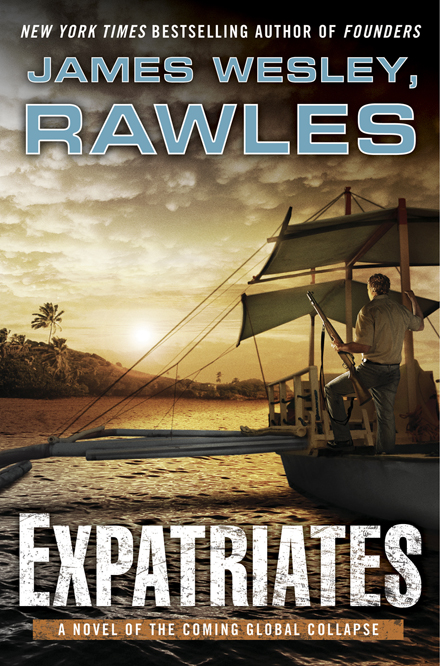
Some Shameless Self-Promotion: A Conversation with James Wesley, Rawles on His Latest Novel: Expatriates

Introductory Note: The following is an edited transcript of my conversation with my Publicist from E.P. Dutton, Emily Brock:

1.) Expatriates is the fourth novel in your Coming Collapse series.  What inspired you to write about survivalism?  Do you believe a real-life collapse is in our near future?

I believe that global economic instability is rising substantially, so the risk of economic collapse is greater than ever before.  Along with instability comes the risk of civil wars, regional wars, and perhaps even a Third World War.  It is indeed time for people to stock up, team up, and batten down the hatches.

2.) Expatriates is different from your other novels in that it mainly takes place outside the United States, in Australia. What drew you to writing about characters away from their native country?

There are now more than 5.25 million American citizens living overseas.  I recognized that the stress that they would go through in the event of a global collapse would be tremendous.  There is nothing quite like being stranded in a foreign country. And to be simultaneously cut off from any information about the well-being of your relatives would be devastating. So I saw this as both an opportunity to avoid any trodden ground from my previous novels, and as way to to describe some times of truly deep drama.

But it is notable that one of the storylines in Expatriates takes place in Central Florida, where there is also plenty of excitement.

3.) Both survivalism and religion play a large role in Expatriates. How do you see those two aspects balancing in the novel?

I consider them complimentary.  Being well-stocked allows survivalists to dispense Christian charity.  The deeper your larder, the more generous you can be.

4.) Tell me a little bit about your writing process. How do you begin to formulate your plots and characters?

The plots of my novels are essentially extrapolations of current trends.  The characters portray people from all walks of life. By showing both prepared and unprepared individuals, it allows me to show the breadth and depth of what is really required to pull through traumatic times or starvation, infrastructure disruption, and severe shortages.

5.) Are the personalities of the characters in Expatriates modeled after survivalists and friends you know?

Many of the characters in my earlier novels were drawn directly on the personalities and backgrounds of my close friends.  But in Expatriates, I have fictionalized the lives of a few of my blog readers whom I’ve never met in person.  A few of these characters combine the personas of several people.

6.) Some of the topics that arise in the novel, such as Islamic extremism and gun ownership, could be construed as very controversial. Was this your intention?

My intent was not to stir up angst or animus, but I have never been one to shy away from speaking out on key societal issues.  For instance, I have been very outspokenly pro-Christian, Pro-Preparedness, pro-Gun Ownership, Anti-Racist, and Anti-Slavery.  (Most Americans don’t realize that slavery is still being practiced in North Africa.)

The rise of Radical Islam is quite troubling. And if observed from a multi-generational perspective, it is genuinely frightening.

The right to keep and bear arms is the crucial cornerstone of the Bill of Rights. In effect, it is the right that insures all of our others. I believe that the current statist efforts to disarm the citizenry are not just misguided but inherently evil.  It is as if they foolishly want to make us all victims. As I’ve been quoted before: The Second Amendment is about protecting your right to go deer hunting the same way that the First Amendment is about protecting your right to publish poetry.

7.) You have mentioned in the past that you hope readers will learn as much as possible about survivalism through reading your novels. You have written non-fiction guides in the past, but do you believe that fiction is a better medium to get your message across?

We live in an age of information overload.  We are bombarded with television, radio, magazines, billboards, web pages, blogs, and text messages.  In this era, most people won’t take the time to sit down and read a survival manual.  But there is something captivating about novels.  By weaving a lot of practical and tactical tips into a fictional storyline, I can keep people’s attention. Many readers tell me that they read my novels twice: The first time through for fun, and the second time highlighting passages and taking notes.


Two Letters Re: Being Charitable When the SHTF

Mr Rawles,
Thank you for taking the time to read my articles and to comment on them. I appreciate the points you raised regarding charity via the church and other local organizations. I was possibly a little unclear and maybe should have stressed more that I was referring to the time during a collapse when getting supplies to organizations in order that they can disperse them could be difficult if not downright dangerous.

I disagree that I am your diametric opposite Mr Rawles. I am neither a thief nor a looter and I agree with your assessment that a collapse would have to be massive before I would consider such measures. Myself or anyone else who undertook to use materials from people’s homes should be prepared to compensate any proven heirs who did arrive at a later time.

The purpose of these articles is to make people think. To remove them from their comfort zone and make them consider how truly vile a total collapse would be. To hopefully make them think about some of the situations they may face that they have never faced before and to force them to consider what they would do in these situations.

If anything I hope my articles make people stop and think about their future, about preparedness, and about making sure that their relative isn’t the ‘old Mrs Jones’ I refer to, and that something good comes out of my writing.

I think we have a responsibility to look at all aspects of a given picture and I believe there are many different ways of doing that. Raising awareness is I believe, why we write for public consumption.

I stand by the articles I have written. They have raised a great deal of debate and questioning on several sites and that was the intention.

Once again thank you for taking the time to read and comment on the articles.

Wishing you all good things for the future. – Chris Carrington

Jim;
Regarding Chris Carrington’s essay, “Why I won’t be charitable when the SHTF”:

Admittedly, this is an issue I have struggled with and despite trying to adhere to WWJD (“what would Jesus do?”) in all things, whether to give, when to give, who to and how much is something I would have great difficulty deciding on and given my terrible location in terms of population density, the temptation is to take a blanket approach of don’t give as to not put me and my loved ones in detriment (unless we’re bartering, which isn’t charity anyway). While using a third party through the local church is a possibility, the risk of that third party revealing their source whether mistakenly or under duress is too great a risk to OPSEC. What if there are no Third Party volunteers for this position? And would I be comfortable putting this potential hazardous vocation on their shoulders? It is a real quandary.

While family and some very close friends are aware of my interest in preparedness (yet no idea to what extent) I still picture myself begrudging their lack of foresight despite certain warnings I and the general political/economic/cultural landscape has given, and a subsequent argument on the doorstep  with my partner (who’s generosity know no bounds) about “what do we do if supplies run out before society gets back off its knees?”. While they spend on cinema memberships, drinks out, uneconomical vehicles, perpetuation/ of indebtedness  and other whimsy, my personal expenditure is on food and travel to work alone (with the odd date, some fishing bait and a brew with a buddy) everything else goes towards options, shielding us from indebtedness and hurt down the road. So “give until it hurts” sometimes feels like a preparedness oxymoron (not to take away from you sage counsel Captain Rawles, your view to do this is inspirational).
“I know where I’m coming when disaster strikes” – How many times have you possibly heard that when discussing preps? (with trusted folk of course) and how frustrating it can be that they miss the point entirely, that they should prep too and their lack of understanding on the logistical nightmare prepping for one can be, never mind immediate and extended family. A lesson they are going to learn the hardest way imaginable (Praise be that the Lord has given dreams to the least prepared members of collapse, prompting some action). Again, charity is one of the toughest areas of survival I have come across.

I dread to think where my conscience would side in the event of charity cases in TEOTWAWKI, would it be my rational, harsh reality thinking brain which agrees  with Chris Carrington, or my staunch faith in Christ  and belief in Psalm 23?

I think the only solution to this comes down to our best assets when the SHTF, community and knowledge. Surrounding yourself with people who come to understand and more importantly appreciate the survival database you hold in your head (without revealing what you have) and quickly make yourself invaluable to those around you, in turn creating opsec as opposed to compromising it. Those that have read Lucifer’s Hammer may recall the intellectual (septic tank man, I forget the name) who in ill health steered the chemical weapon project that secured the defeat of the antagonist horde, and how valued he was by his cohort due to his knowledge base. This being a prime example of the “give a man a fish/teach a man to fish” principle. The Mongols under Genghis knew to look out for skilled individuals to bring into the fold, the “bad guys” in schumer time may apply the same theorem, if they know what’s good for them. Not a desirable situation but the alternative could be far less palatable.

I’m prepping for me and mine and putting together anonymously authored pamphlets of essential precepts to urban survival and becoming part of the solution (eating perishables first, rules to avoid a public health nightmare, encouraging trade and barter with some etiquette pointers, security tips, steering folks to church for community building purposes, encouraging people to come forth with their skill set, which I will monitor covertly through the church etc) with water purification tablets and instructions attached. This will hopefully begin the networking process necessary to pulling through.

Be the welder, be the medically adept individual, be the mechanic, be the CB radio operator, be the large scale gardener with seed bank, be the tree surgeon/wood cutter,  the security consultant and so on, in other words, make yourself an asset to those around you so your preservation is to their benefit.

Any other “crunch” vocation suggestions would be greatly appreciated.

May the Lord preserve us and judge us fittingly and my prayers go out to my American Brethren. – R.D.  in England

JWR Replies: Mostly for “grid up” circumstances, I made some suggestions on Depression-proof jobs in these SurvivalBlog posts:

What Recovery? Find Yourself a Recoveryless Job

Depression Proof Jobs for a 20 Year Depression – Part 1: The Counter-Cyclical Jobs

Depression Proof Jobs for a 20 Year Depression – Part 2: Developing a Home-Based Business

More About Depression Proof Jobs–Consider the Three Ks

and,

A Second Income–A Key Goal for Family Preparedness


Economics and Investing:

Lack of Economic Data Hiding True Health of Housing Market

The Baltic Dry Index (for transoceanic shipping rates) is still in the dumpster.

H.L. sent: As U.S. averts default, Japan and China brace for next dollar drama

And for some humor: Hitler Learns About the Obamacare Exchanges

Items from The Economatrix:

The Sun Is Setting On Dollar Supremacy, And With It, American Power

Gas Prices Could Dip Below $3 by Year-End

Ron Paul Fears The Future Under Janet Yellen “Is Grim Indeed”