Iraq Could Be Oil Market Linchpin
o o o
‘It’s Gonna Be a Bloodbath’: Expert Reveals the Economic Defects Under the Government’s Numbers
o o o
Exposed – Dangerous 2015 Ahead As Global Governments Plan To Steal Money
o o o

Google and other tech giants want an exemption from “Do not track” Using a search engine like DuckDuckGo, your own email server, and more will be needed if you want any hope of a level of privacy. This doesn’t even consider the NSA… – P.S.
o o o
The Drone That Could Save You From Drowning. – P.S.
o o o
Bring back thrift – G.G.
o o o
U.N. sending thousands of Muslims to America. – T.P.
“The United States, with its commitment to accepting 70,000 displaced people a year, absorbs more refugees than all other countries combined. This number is understated, however, as once refugees get to the United States they are placed on a fast track to citizenship and are able to get their extended families to join them in the states under the government’s Refuge Family Reunification program.”o o o
From Mac Slavo at shtfplan.com: Billionaire Warns Of Massive Crash That Will Wipe Out America’s Colleges: “You’re Going To See A Repeat Of What We Saw In The Housing Market”. – B.B.
Not a surprise to anyone who has followed inflation.us in the past couple of years.
“Don’t play his game. Play yours.” ? Rachel Caine, Fall of Night
Now available for pre-ordering at Amazon.com, but I’d prefer that you wait for December 30th to order: Tools for Survival: What You Need to Survive When You’re on Your Own. This book is a guide to the selection, use, and care of tools. It will also be available as an e-book and audiobook. -JWR
o o o
Today, we present another entry for Round 56 of the SurvivalBlog non-fiction writing contest. The $12,000+ worth of prizes for this round include:
First Prize:
Second Prize:
Third Prize:
Round 56 ends on January 31st, so get busy writing and e-mail us your entry. Remember that there is a 1,500-word minimum, and that articles on practical “how to” skills for survival have an advantage in the judging.
You’ve all seen it. Hollywood makes films of a plane crash or shipwreck that cause only one or a few survivors to end up on a deserted island. He or she– the main character– frantically panics at first, maybe even screaming. Then a few months go by, the camera cuts back to him or her, and now this person is an advanced survivalist with a wide variety of skills and gear. They seamlessly kill and eat animals and make impractical but cool looking shelters. Then, he, for the sake of drama, is faced with some dire problem and has to overcome it with only his wits.
Of course, this is just for entertainment purposes and is nothing like REAL survival. Real survival is horrible. This is just the plain and simple truth. Hollywood wouldn’t make much money, if the whole time there was just some city boy struggling to recreate the bow drill that he’d seen on TV one time to get a fire going. They just wouldn’t make money if they showed some surfer girl from California frantically throwing sticks in a big pile to make “shelter”. Similarly, no profit would come from the sad outcome that most unprepared people face in a true survival situation. In real shipwrecks and plane crashes, even the people who initially survive the crash die a few days later from making common mistakes, such as drinking ocean water and pee, misidentifying poisonous plants and snakes, or something else. Survival, in all truthfulness, is never pretty or entertaining.
The truth is that even experienced survivalists, with their survival kits or gear, die sometimes when put through nature. Of course, with that being said, most of the time, basic knowledge and skills or gear can be a huge asset if you ever were lost in the wilderness or, for today’s purposes, the SHTF. So, let’s set up a scenario to get you thinking along the same lines as I am.
Let’s us say that you and your wife get back from work, and you sit down on the couch to watch football while your wife begins to prepare dinner. She kindly asks you to go pick the kids up from school. You unwillingly stand up and begin to leave. She says something like, “Don’t forget to talk to Matt’s teacher when you get there” or “Klay has been having trouble with his asthma recently, so bring him the inhaler from the pharmacy.” You hop in the car and dutifully drive to the pharmacy to pick the inhaler up and then drive to the high school to pick up your two oldest. After that, you go to the local kindergarten and get your youngest. You turn on the radio as you drive back to the house, but then, all of the sudden, the radio shuts off and the car slides to a stop. Sparks start shooting out of your radio, and then the engine catches fire. A semi truck slams into the car adjacent you. Your immediate instinct is to jump out of of the car, but the lock is jammed so you break the window and exit quickly. After you are out of harm’s way, you have time to ask what just happened.
You find out that ALL electricity, almost without exception, is gone. You, without any survival knowledge whatsoever, are forced to find your way home. You have stored food and other preps at home. However, none of it will matter, unless you make it home. In essence, you let your entire family down because you didn’t know what to do and how to survive off the land. The truth is that you could’ve made it home quickly and easily if you had had only some basic navigation skills and some basic hunting, fishing, and trapping know-how, but you didn’t know how. So all of your prepping was futile. One EMP hits, when you don’t have your preps close by, and you die almost instantly.
Obviously, there are various situations where you would need to get home when the SHTF, but what about when you need to get OUT of home. Yes, survivalism does play a key role in almost all realistic bug out plans. For another scenario, let’s consider that you and your family were already home when the SHTF, and you have been waiting out the riots in your house with your preps. You begin to fear that looting may spread into your neighborhood, and just as that thought crosses your mind, a Molotov cocktail flies through your window exploding on impact. You grab what you can and run out the back door with your family. Luckily, you make it into the woods, away from all of the crime and the chaos. Your kids are distraught because the house is burned down.
All you managed to grab was your bug out bag, a small 22. rifle, and some take down arrows. What you do with those can be the difference between life and death. A wise survivalist would know of several uses for each tool and exactly how to use them, but you are not a wise survivalist. On the contrary, you aren’t a survivalist at all. You have no clue what to do; you throw the arrows away and lighten your load by getting rid of some of the gear in your back pack. Unfortunately, you lightened your load a bit too much; a month later all of your kids are dead from starvation, and your wife is dead from exposure. You wish you hadn’t left those take down arrows because you could have used them for a handmade bow, which could have provided you with food without making as much noise as the rifle. You also wish that you hadn’t relied on your own primitive fire-starting skills so much that you had left your lighter at the house so that you could have kept your family warm and protected them with shelter. So, now that you know the why, it’s time to learn the what and how.
What is survivalism and how does it differ from prepping. Survivalism is the skill of Bushcraft, and it holds within its own category things like hunting, trapping, fishing, fire starting, shelter making, water purifying, and more. It differs from prepping, because it is more orientated on living off the land with little or no equipment, while prepping tends to focus on using your gear to keep your lifestyle as happy and healthy as possible during catastrophes. There is a lot of crossover between the two terms, and the reason for that is because they go hand in hand. Prepping can never be realistic unless you have survivalism to supplement it and vice versa. The point I’m trying to make is that you must have survivalism in order to prep. There is just no way around it.
So, now you know you must have, at the very least, some basic survival knowledge. Where do you start? Well, you can begin by reading some books and watching some YouTube videos. Remember, the Internet has almost everything on it. You just need to know where to look. I will supply you with some knowledge, nevertheless.
In conclusion, I’ve shown you why survival is important to prepping, what survival is, how it differs from prepping, and how to become a basic survivalist. Never underestimate the importance of survivalism and keeping your survival knowledge sharpened. I hope that you learned a lot and were entertained. God bless you.
The thing about armor plate on a vehicle is it’s really heavy. The point of a vehicle is that it moves. Also, the engine, transmission, and suspension are all built for the specific weight of the vehicle, not a couple thousand pounds of steel. If you add the weight of armor, you have to upgrade everything, or modify it to go slower with the existing system, without flipping over or disabling itself. Top Gear, a car show in the UK, actually tried this with SUVs a couple years ago. It did not work well.
DIV Bond Car Pt. 1 video
The Math:
3/8 inch steel plate weighs 15.32 pounds ref: http://www.turnersteelcoinc.com/html/plates.html A school bus is up to 46 feet long and 10 wide. If you ignore the roof but armor the floor and engine compartment, that’s around 46 long * 10 high * 3 sides + 10 * 10 * 2 (front and rear) = 1380 sq ft longways + 100 each front and rear ends = 1580 sq feet total, leaving the roof unarmored. At 15.32 lbs per square foot of 3/8 inch steel, that’s 24,205 pounds of steel.
That’s more than 12 tons. The bus itself weight between five and ten tons, depending on how it is made, so you’re looking at a vehicle weighing around 17 tons, before you put living quarters, water tanks, fuel, or sleeping accommodations inside, and it is now heavy enough to be of concern crossing certain bridges and overpasses and heavy enough to potentially cause landslides on unreinforced roads. Does any of that sound wise?
If you add lots of armor plate, you also change the point of balance, making the vehicle top heavy, so it has to go slower around corners. If you DO opt for heavy steel armor plate to cover a bus to its roof and underneath like an MRAP, that’s even worse.
Overweight vehicles are currently of interest to both the highway patrol and homeland security, both for taxes and potential threat, since they might be bombs rather than armor plate. While they won’t set off gamma ray detectors on the interstate system, thankfully, they will certainly require lots of stops at the commercial truck weigh stations, and they become interesting to the more paranoid law enforcement.
It is probably a better idea to have a conventional cheerful snow bird fiberglass RV that draws no attention, staying at the usual upscale RV parks and sporting the Good Sam equivalent bumper sticker broadcasting how harmless you are, possibly distracting with talk about how much fun it was to restore the RV from the rotting hulk it was when you bought it cheap at an estate sale auction. Look like a tourist couple, and hide a gun locker in the floor. An RV won’t draw attention and gets a free pass moving around, because you’re retired tourists seeing America, not hippie/trimmers carrying a hundred pounds of dope and begging for a DEA raid, which is what most people think when seeing a converted school bus. I’m just saying. Sincerely, – I.K.
Cops Hate Being Filmed. So Why Are They OK With Body Cameras?. Police body cameras are worthless, as long as the police can turn them off at will. – T.P.
o o o
o o o
Nuclear Power Plant In South Korea Hacked
o o o
But We Should Demand That Toy Guns Be Painted Bright Colors?. – T.P.
“Jesus saith unto him, Go thy way; thy son liveth. And the man believed the word that Jesus had spoken unto him, and he went his way. And as he was now going down, his servants met him, and told him, saying, Thy son liveth. Then enquired he of them the hour when he began to amend. And they said unto him, Yesterday at the seventh hour the fever left him. So the father knew that it was at the same hour, in which Jesus said unto him, Thy son liveth: and himself believed, and his whole house.” John 4:50-53 (KJV)
Camping Survival is offering a Mountain House with 15% off pouches and 25% off of #10 cans. Check it out if you need to replenish your stores before the new year. (Price increases by Mountain House are expected January 1st.)
o o o
Today, we present another entry for Round 56 of the SurvivalBlog non-fiction writing contest. The $12,000+ worth of prizes for this round include:
First Prize:
Second Prize:
Third Prize:
Round 56 ends on January 31st, so get busy writing and e-mail us your entry. Remember that there is a 1,500-word minimum, and that articles on practical “how to” skills for survival have an advantage in the judging.
For the purposes of this essay, I am going to assume that you have done two things in your life. First is simply this; you have accepted Jesus Christ as your personal savior. If you do not know what that means, I would recommend you stop reading now and find a solid pastor who can explain it to you, because none of this will really make any sense to you. Second is that you have gained, at the very least, a rudimentary understanding of the Bible.
That being said, it is very likely that today day you are using the Internet, your computer, or most likely both as a Bible study tool. That is fine. There are a lot of really good programs and web pages out there to help you along the way. I would caution you to know your sources, though. Just like medical information, there is also a lot of bogus information out there. That being said, in a TEOTWAWKI event, those tools will be taken away from you almost overnight. Also, keep in mind that you will likely be cut off from your local church. Most of us, 85% of us, drive 25 minutes to church. How far out of reality is that after a crunch?
As you prepare your 3B’s– beans, bullets, and bandaids– perhaps we should add a 4th B– the Bible. We can all agree that in a TEOTWAWKI situation part of what we do, in getting as prepared as possible, is aimed at helping others. That concept is straight from James 1:2-4
My brethren, count it all joy when ye fall into divers temptations; knowing this, that the trying of your faith worketh patience. But let patience have her perfect work, that ye may be perfect and entire, wanting nothing.Have faith, be prepared, rejoice in times of trouble and care for widows and orphans. Without a working knowledge of scripture it is far too easy to lose our moral compass. So what do we do if you have never really studied the Bible for yourself? First, don’t feel bad! You are not alone. According to researcher George Barna, only 45% of Americans read their Bible in a given week. (barna.org) As a pastor, I talk about this all of the time. People seem to think that because I have a degree and an office, I somehow have special insight into the Bible. The truth is… I don’t. Like a mechanic, I just have a better set of tools than you and a little more training on how those tools work. Here is my take on low-tech Bible study:
- Just start. Don’t be intimidated! The truth is that God is not trying to hide from us. God, by definition, must self-reveal; we can’t understand Him, so He chose to make Himself understandable. When we celebrate Christmas, what we are really celebrating is God becoming man. Put another way, it’s God assuming a form that we can relate to. Jesus called Himself the Good Shepherd. Why? It’s because we are His sheep. I have spent some time studying this and have come to the following conclusion. God calls us sheep for a reason. Sheep are stupid! Cows don’t need to be tended because comparatively they are geniuses! My point here is not to make you feel bad; it is to encourage you. Shepherds love their sheep; there is a special bond between them. God is not trying to hide from you. His Word is there to show us who He is! So take the plunge and dive in. One word of caution here; use a good MODERN translation. If King James were alive today, he would have ordered the New Living Translation to be written. As an aside, the “Charles Ryrie Study Bible” is a great choice. Another would be the “Life Application Study Bible” in New Living Translation.
- Pick a book. Just pick one. I know that sounds simple, but just pick one to start with. The gospels– Matthew, Mark, Luke, and John– all tell the story of Jesus from a different point of view and make a great starting point. You could also pick all of the books by one author, say Paul. The value of studying in sets, like this, keeps us from isolating a single verse and building a belief on that verse. We need to look at the totality of scripture to ensure we are keeping to good theology. There is more on that later in the peer review section. One point to keep in mind when picking a book is knowing what type of literature you are reading. Psalms are poetry. We read that differently than Revelation, which is prophesy. Jesus teaches in parables– stories with a meaning– so they are open to interpretation and not meant to be taken as doctrinal statements. The Bible is full of rich content. Read it all, and enjoy it as God intended you to! He is a diverse God, the heavens declare His glory. He means for our experience of Him in Scripture to be rich and diverse as well. Pick a book and jump in. The water is fine!
- Pray first. 1 Corinthians 2:6-13 reminds us that God will impart wisdom to those who seek Him. All serious study of God’s word should begin with a knee bowed to Him in prayer. Without that, we are dependent only on our own understanding. That stands in direct opposition to Proverbs 3:5, “Trust in the LORD with all your heart; do not depend on your own understanding”. I find it interesting to hear responses to my sermons sometimes. Aside from the usual thank you very much response, occasionally I will get a specific, “Pastor you said XYZ, and that really touched me!” The funny thing is I very rarely ever actually said, “XY or Z” at least not in the way they heard it. So what is the explanation? It’s simply this; the Holy Spirit gives insight to scripture! He speaks to willing hearts! His job, amongst other things, is to enlighten Scripture for us. We are totally dependent upon His insight to rightly understand God’s word. That is not to assume that every thought that pops into your head is a new revelation from God; we must also depend upon the guidance of God and a solid community around us to determine His will. That is the reason Scripture has historically been studied in community. Keep in mind that prior to 1493 (the advent of the printing press) the idea of owning a Bible for personal study was laughable for the common man; it was just too expensive. Scripture was always read and studied in a group. The Bible was not written to be studied in isolation. Notice many books start out “To the Church in ____ “. The New Testament was written in letter form to entire communities. These letters were read to the community at large, then hand copied, and passed around to other communities. Living in community matters. Community has been God’s design from the very beginning. Notice that Adam was incomplete without Eve. Community is even reflected in God’s nature; He exists in community with Himself– Father, Son, and Holy Spirit. Strength of community can not be underestimated, especially when isolation becomes the norm by necessity. Historically there has been a marked rise in cult leaders during times of crisis. The next crisis will prove no different, I fear.
- Here are a few practical tips:
- Read the ENTIRE book first. I realize that sounds simplistic, but it matters. I would advocate reading the entire book three to four times before you start to dissect it. Why? To better understand the whole at the start. Scripture, as a whole, far exceeds the sum of its parts. Scripture enlightens our understanding of Scripture.
- Seek to answer three questions every time you open God’s Word– What? So What? And Now What? In short, we want to look at these three questions to add to our understanding. What did the original author intend as a purpose in writing this letter? For example, was it to encourage? 1 & 2 Timothy were written to Paul’s young protege at the end of Paul’s life to encourage him. Was it to correct a specific problem? 1st Corinthians was written to address a specific problem in the church at Corinth. Or was it maybe to add a comprehensive manual on basic beliefs? The book of Romans was written to a church that had no real leadership at its founding, so Paul was writing to give them the basics of faith.
We must know the original intent to rightly answer the second question… So What?
So what does this mean for me? Am I in a similar situation? Do I have a similar problem? If we understand the author’s intent, I can begin to see how this affects me?
So now what? The last question we want to ask is this… What do I do with this knowledge? ALWAYS be on the lookout for application! Knowledge gained but not applied will only serve our pride. Our study of scripture MUST lead us to action.
Finally, you will need tools. Just as in any other situation, the right tool makes all the difference. Have tools available to understand the answers to the questions– What… So What… Now What. These tools might include a good commentary. Ask your pastor, priest, or rabbi to recommend one that speaks to your denominational theology. A Vines Expository Dictionary of New Testament Words and a good Concordance are also good tools.
The truth is that, in a crisis, people of faith will be held to account for how we operate. We must be prepared to step up, step in, and lead like people of faith, serving the King of kings!
Hugh,
Let me say that at one point I was the sole North American distributor for the German Wiesel 1 AWC. I never sold any, so that and a ten spot will buy me a cup of coffee at Starbucks. However, it did afford me an education in lots of bits and bobs.
First, figure out what your engine is rated to haul. Then halve that number to be able to haul it around under harsh conditions. Lots of early armored cars and tanks suffered from a fine automobile engine being stuffed into a vehicle at the upper edge of what the engine could carry. There were lots of overheated vehicles, and in some 1930’s reports you could follow an armored column doing peacetime maneuvers by following the broken down tanks and armored cars.
Second, look at layers of armor vs. a single monolithic block. To give an example, the side armor on a WW II M5 was on average 1 to 1 1/8 inch thick or 40 to 45 pounds per square foot. This was considered sufficient armor to stop all light arms and artillery splinters. This is using RHA or rolled homogeneous armor, which is still the standard that everything else is tested against. The current generation of armor, such as is used on the LAV-25, can provide the same protection using 1/4 inch of armor at just over 10 pounds per square foot. It does this by alternating layers of ceramic armor, modern alloyed metals, and spall liners. Considering that each side of a bus is roughly 40 feet by 10 feet or 400 square feet this is the difference between 18,000 pounds per side and 4,000 pounds. For the whole bus, this is the difference between 81,000 pounds for RHA and 18,000 pounds, and that is just the armor. It’s 9 tons vs. just over 40 tons.
If I were to be working on hillbilly armor I would use AR500 plate steel, design it so that it is sloped radically, only protect part of the vehicle, and then spray it down with Rhinocoat hard coat. Rhinocoat prevents spalling …
A 1/4 inch AR500 plate with Rhinocoat hard coat weighs roughly 9 pounds per square foot and will stop non-AP .30 caliber rounds. You are still going to end up with adding close to nine tons of weight to the bus if you armor it all over.
Your average-sized 55 passenger bus is designed to hold roughly 7 tons of people and gear. So empty of people, you are two tons over its weight capacity already. Reduce the armor on the top and the bottom of the bus, and only armor the driver’s area and maybe the first 1/4 of the bus. This should be enough room for 12 people or so. – H.D.
Police stress “need” for social media data-mining upgrades. – T.P.
o o o
SurvivalBlog Reader P.S. writes in about some interesting research:
I’ve always had many questions about the U.S. crime rates. Examples:
Are crime rates increasing? Are some areas becoming more violent than others? What has been the influence of gun control?
I’m starting to look at the data available from the Uniform Crime Reporting website.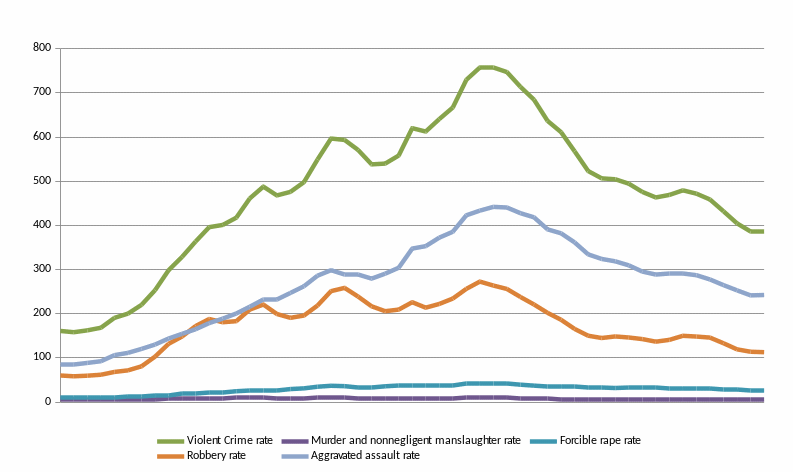
Here is some very early analysis. Note that all metrics are per-capita rates (per 100,000 people) such that they account for national and regional population changes. Also, data is only available through the end of 2012 at this time.
Nationally, many of the crime rates are down to 1970-1971 levels. The murder and rape rates are down too; they’re just not as visible in the chart given the other data points on the vertical axis.
o o o
Say What?! Driver Wanted for Obama Motorcade. Novice Welcome. – P.M.
o o o
Italian police discover stash of 500,000 CHINESE made, fake Euro coins. – T.P.
“And they went up out of Egypt, and came into the land of Canaan unto Jacob their father, and told him, saying, Joseph is yet alive, and he is governor over all the land of Egypt. And Jacob’s heart fainted, for he believed them not. And they told him all the words of Joseph, which he had said unto them: and when he saw the wagons which Joseph had sent to carry him, the spirit of Jacob their father revived: and Israel said, It is enough; Joseph my son is yet alive: I will go and see him before I die.” Gen 45:25-28 (KJV)