Odds ‘n Sods:

PROOF that the US peaked during Ronald Reagan’s presidency. – S.B.

o o o

Australian Parents Will Lose $11K For Every Child They Don’t Vaccinate. – H.L.

o o o

The One Item an Expert Hunting Guide Says You Must Always Carry With You. – K.C.

o o o

Alachua County’s armored vehicle makes traffic stop after driver flips the bird. – T.P.

o o o

“Gun Free Zones” Fail Again in NC. College Employee Cornered, Murdered. – D.S.


Notes for Monday – April 13, 2015

April 13, 1743 was the birthday of Thomas Jefferson. (He died on July 4, 1826, just a few hours before the death of John Adams. How patriotic of both of them to pass away on the Fourth of July.)


Book Review: “The Art of the Rifle” by Jeff Cooper, by J.S.

I recently finished reading Jeff Cooper’s The Art of the Rifle and thought it would be good to share the relevant points with the readers here.

Reviewer’s Note: I’m fully aware the author was a retired Marine Colonel, and as one who served as a Marine myself I know that it would be proper, when referring to the author, to include his rank. However, Cooper does not emphasize his military service in the book, and there on the cover in bold white letters it reads “Jeff Cooper”, so I will refer to him in this manner. There is no offense or slight meant.

My one-sentence overview, for the very busy folks or those who just want to scroll down to the Odds ‘n Sods: Get a centerfire rifle of moderate power (.308/.30-06 class) that is easy to handle, and practice with it until you can reliably and quickly hit man or game-sized targets at unknown distances out to at least 300 yards, if not more.

What It Isn’t

This is not a book crammed with tables, data, and studies on the most effective gear and techniques. If it were, a more appropriate title would have been The Science of the Rifle. It is not objective in the slightest. Cooper had a philosophy on riflecraft that he honed through years of personal and anecdotal experience; one reads the book to obtain a sliver of his experiences and thoughts, and also to read about real ways to improve one’s ability to shoot a rifle. It is not a book that talks much about gear and equipment. In this way it is fairly timeless; as long as there are shouldered weapons that project aerodynamic bits at high speed that are affected by wind, gravity, and other factors, this book will remain relevant. The book can help a strictly range/target shooter, but it is intended for the field shooter, whether a hunter of game or of men. It is not, however, intended for the high magnification, ultra-long range crowd specifically.

What It Is

The book is actually quite short– not quite 100 pages– and was written in 1997. I am not aware of any newer versions, and as the author passed in 2006 this book will remain unchanged. As noted above it is more about Cooper’s personal philosophy and not a living document on the very best and latest in rifle shooting. It does cover the essential elements of rifle shooting, and Cooper makes it very clear that few completely master the basics. It is not the author’s analogy, but riflecraft is simple, like hitting a baseball with a wooden bat is simple, though very, very few get to the level of Ted Williams, Pete Rose, Derek Jeter, et cetera.

Chapter Summaries:

Reviewer’s Note: These summaries are not intended to act as Cliff Notes or condensed versions of the chapters themselves. In no way should anyone believe they have read Jeff Cooper’s book in shorthand by reading these summaries! If you want to actually obtain anything relevant, buy the book and read it yourself.

  1. The Queen

    Overview of Cooper’s philosophy: the decline in interest in accurate field shooting, pragmatism (rifles are amoral instruments), and a short history.

    Good quote: “If the shooter does not cherish his weapon and feel sensual pleasure in handling it, it is unlikely he will ever make it perform as efficiently as it can” (Page 2). Meaning, you should care about your rifle! Take care of your tools and you know the rest.

  2. Why?

    “Why do you want to learn how to shoot a rifle?” In Cooper’s view, a rifle is a tool of power that a skilled wielder can bring to bear upon his environment. “Who is a good shot?” To Cooper, consistency and being able to perform on demand are what matters. One great shot doesn’t make one a good shooter. This is simple logic and applies in just about every area. Any schlub can head out to the local golf course and hole-in-one the very first par 3 with simple dumb luck on his side; it does not make him ready for the PGA. (This, again, is my analogy, not the author’s.) Cooper’s example was of Billy Dixon, who shot a man in battle with a “buffalo rifle” at over 1,300 yards in 1874. Even Dixon called it a lucky one-off shot, but he is still honored as one of the finest rifle shooters in history.

  3. The Instrument

    Here Cooper does write a bit about what, in his mind, constitutes a proper rifle. He feels that nearly all rifles are more accurate than their shooters. He discounts entirely the smaller calibers, especially the .223 that was popular then and is even more so today. His starting point is the .30-06/.308. He advocates a repeater, especially a bolt-action, and does not feel a semi-automatic rifle’s advantages (faster firing) overcome its disadvantages (added weight and complexity). To Cooper, a skilled rifle shooter should be able to fire, keep the rifle in the shoulder, work the bolt, and bring the rifle back down on target just as fast as a semi-auto.

    Reviewer’s Note: This may be one area where the book is a bit dated. Cooper was absolutely familiar with the top .30-06/.308 semi-automatic rifles of his time: the M14/M1A, the G3/HK91, the FAL, and especially the M1 Garand (which is on the cover of the book, BTW). All are heavier than a medium-barreled, sporter stocked bolt action rifle, by a lot, and all have ergonomic shortcomings as well (sorry fans, they just do). I have personally shot an AR10 pattern .308 that, without a scope or magazine was in the sub-eight pound range and, fitted with a muzzle brake, kicked less than an AR15 in 5.56mm. One could get on the next target extremely quickly with this rifle. It was, of course, very loud; this is the trade-off. No, it’s not as light as a short-barreled bolt action, but it is reliable and has twenty shots on hand. YMMV.

    Cooper also writes about optics, very briefly, and recommends one in the two to four power range. He leaves newer (in 1997) devices like red dots, reflex sights, and NV scopes as “to be considered when they have proven themselves.” Most of the chapter, though, is taken up by ergonomics, specifically weight and stock length of pull. Then, as now, shooters tote around rifles that are too heavy far more often than ones that are too light. He also speaks about having a good trigger (more about this in another chapter summary).

  4. Gun Handling Cooper’s four rules:
    1. All guns are always loaded. Even if they are not, treat them as if they are.
    2. Never let the muzzle cover anything you are not willing to destroy. (For those who insist that this particular gun is unloaded, see Rule 1.)
    3. Keep your finger off the trigger until your sights are on the target. This is the Golden Rule. Its violation is directly responsible for about 80 percent of firearms mishaps.
    4. Be sure of your target. Never shoot at anything that you have not positively identified.

    Cooper also writes about how to care for a stored or cased rifle. He is also a proponent of carrying a rifle, in most cases, loaded with an empty chamber (Condition 3). Much can be debated about this approach, but he makes a strong, reasoned case here. Other important points: Don’t leave your weapon unattended, keep the muzzle out of the dirt, don’t overclean your rifle, never depend on the safety (see the Four Rules).

  5. Sighting and Aiming

    Here, he covers far more about practical field use than target range shooting. He includes the use of different types of iron sights and the low magnification scopes Cooper preferred. He is clearly not a proponent of field doping– mechanically changing the point of impact of sights or scopes based on elevation, wind, or range. Cooper is far more concerned about accounting for vertical drop by simply moving the reticle or aiming point. Most of the chapter focuses on precisely where to aim to achieve maximum effect, especially on game animals.

    Good quote: “Where to aim is fully as important as how to aim.” (Page 25)

  6. Trajectory

    Here Cooper dispels some common myths about bullet trajectory and also admits this bleeds more into the realm of science than art.

    Good quote: “High average velocity, with accompanying flat trajectory, is desirable, but no trajectory can ever be flat enough to compensate for bad marksmanship.” (Page 28)

  7. The Firing Positions

    This is probably the longest chapter in the book, with the most photos. He describes the prone, sitting, kneeling, and standing/offhand positions and also compels a sportsman to get as close and as steady as possible to the target.

  8. The Rest Positions

    Not, as one might initially believe, shooting from a bench rest, but this is about how to properly rest a rifle in field conditions. In short, don’t rest the weapon itself on anything other than your own hand; the hand always goes between the rest (tree, rock, or whatever) and the rifle. Here, he also covers proper bipod use, but Cooper discounts its actual use in field shooting.

  9. The Hand and the Finger

    Here Cooper writes about how to actually hold the rifle and a lot about what constitutes a quality trigger (single, two stage, or set). Cooper prefers the two-stage style.

  10. The Eye

    Cooper goes into greater detail on some topics from Chapter 5, specifically iron sights and also scopes. Surprisingly, he does not specifically describe the “scout scope” concept that he is well known for. His requirements for a properly mounted scope are no farther back than the trigger guard, which is farther forward than some might prefer but certainly not a true “scout” mount. Throughout the book, however, there are photos of rifles with the scope mounted in the forward “scout” position. His technique for proper scope use is to get on target with your usual unaided binocular vision, then to quickly transition to the scope and make a clean shot. This guards against trying to follow game through the narrow field of view a scope offers. Cooper also writes about field awareness– actually looking for game/targets. It doesn’t matter how good a shot you are if you never actually identify a target.

  11. The Shooting Sling

    Here Cooper writes about a lost art– using a sling to support accuracy, not just to tote the rifle around. As he is writing about practical field use, most of the chapter is how to quickly get into a proper shooting sling. He writes at length about the “Ching Sling”. As most rifles do not have the swivels to mount this particular flavor of sling, it would take modifying an existing rifle to use this sling and technique. It is very fast, however.

  12. Breathing

    This is a very short chapter on proper breathing for field shooting.

  13. The Snapshot

    Up to this point, most of the book has covered shooting with time, a few seconds at least, to prepare for the shot, where one has time to get into a good, solid position, work the action, line up the rifle with the target, take it off safe, and pull the trigger smoothly. Here, Cooper writes about the quick shot, especially in tight cover and/or against dangerous game. He advocates a three count, where the shooter gets the rifle to the shoulder (while taking it off safe and placing the finger on the trigger), confirms the target, and presses the trigger.

  14. Wind

    A surprisingly short chapter on accounting for wind in field shooting. As expected, Cooper does not describe how to properly change your scope’s POI (point of impact) using the turrets or fancy reticles. He does point out that heavier bullets are better for long range shooting, and lighter, faster bullets are typically better at closer ranges. Heavy bullets have more arc, but they carry better and drop less at longer ranges.

    Reviewer’s Note: In 1997, this would have been revelatory to a lot of people. Since then, the focus has definitely been on longer range shooting, which has led to an emphasis on progressively heavier and heavier bullets in the common calibers. The 150ish grain .308 has fallen way out of favor for the 168 and 175 grain projectiles, and in .223 most of the development has been with 75+ grain bullets.

  15. Zeroing

    Some quick points about this chapter: You should zero your own rifle. You should zero it first from a steady bench rest (and at different known ranges), but then also from a typical firing position.

  16. Reloading and Readiness

    Cooper reiterates his stance on Condition 3 carrying and goes into greater detail about how to quickly reload your rifle. Since his emphasis is on manual repeaters throughout the book, nothing is mentioned of semi-autos here.

  17. The Mind of the Rifleman

    This includes some of Cooper’s thoughts about the psychology of shooting.

  18. The Mystique of the One-Shot Kill

    More anecdotal and philosophical musings are included in this chapter, specifically about wishing for but never expecting a one-shot kill. Always reload and expect to have to fire again. Observe your target, yes, but with a round in the chamber!

  19. Testing and Evaluation of Marksmanship

    These are practical tests that Cooper honed at Gunsite: Snapshot, the Rifle Ten, the Rifle Bounce. In the essence of not plagiarizing Cooper, I won’t describe them here, but they cover a series of known distance drills, for time, that he feels are good range tests of practical marksmanship.

Takeaways for the SurvivalBlog Reader

I should interject here with my own level of experience. I served as a Marine infantryman and was a ninety-fifth percentile rifle shooter and ninety-ninth percentile pistol shooter, which was good enough to take part in my unit’s shooting team but not good enough to take trophies or attain the rarefied air of the Marine Corps shooting team. I also served as a range coach for pistol, rifle, and machine guns. I am also a deer, elk, and bird hunter with a moderate level of experience, not nearly to Cooper’s extent. I have not attended the school Cooper founded, Gunsite (although I would love to). In short, within the four stages of ignorance (or competence, for you glass-half-full people), I am somewhere in between #2 and #3: I am just conscious enough to know that I have a lot to learn, and there are many, many people who are beyond me in skill and experience.

I feel this book is intended for people just like me. On the ten scale, with 1 being, “I have never shot a rifle…does the big end go on my shoulder?” and 10 being, “I am one of the hundred best rifle shooters in the world,” Jeff Cooper’s book is probably best suited for the 3-6 crowd– people who have some familiarity with rifle shooting and want to be better, fully understanding that a book alone will never get them to become a 9 or 10. The experienced 7+ people likely already are either doing what Cooper describes in his book or subscribe to another valid system that works for them.

I believe the book is perfectly suited to the preparedness mindset and the civilian rifleman concept. So much is written about military precision shooting, but as a sniper or designated marksman you are called on to be a specialist, and you’re not alone. As a civilian rifleman, whether hunting for meat to put on the dinner table or to defend home and family, you normally do not have either the freedom or the opportunity to specialize too greatly. Cooper’s idea of a general purpose rifle that can take down all common game animals, while also allowing someone to deal with human threats out to realistic first-shot distances, holds true for any of us in any survival scenario. We will also be faced with a conservation of ammunition issue and the ability to make accurate first shots to the vitals (hunting or combat) will be critical.

While firearms restrictions are unfortunate and by no means is this sour grapes, but the Cooper-type rifle is about as legal-friendly as can be. It even works with antique, pre-1899 rifles.

Cooper’s concepts allow us to have one good, general use rifle in a common, easy to find caliber that does not have to be particularly expensive. In the book he expounds upon the Krag rifle; sporterized, yet still useful, Krags can be found for $200 or less. Mosin-Nagants, while long and heavy, fit fine in Cooper’s requirements and are even less expensive. Unlike video games, one cannot realistically carry multiple long arms for all scenarios. Sure, a Barrett in .50 BMG will be able to deal with targets that a Cooper-type rifle will not, but it is a poor choice for general use. Few of us could fire one effectively without quite a bit of time to prepare a position, deploy the bipod, et cetera.

I personally found it interesting that the two most popular rifle platforms in America today– the AR15 and AK– do not meet Cooper’s requirements in any way. Neither fire a cartridge he would consider adequate (yes, even the better AR loadings like the 6.5 or 6.8). Both have terrible stock triggers; if you insist on one as your primary rifle, you MUST get a better trigger. They are very rarely slung; when I use my sling at the rifle range, in firing positions, others look at me as if I’m from Mars. It is not something solely used to carry your rifle around anymore than your head is solely used to carry a hat. As I mentioned in my note above, I believe a 16” barreled AR10 pattern rifle, built lightweight, ultra-reliable, with a solid A1-length stock, could meet the requirements.

Most of all, practice now! When things fall apart, it is too late to zero your rifle and ensure you can hit targets quickly. Reduce the variables as close as possible down to the rifle and ammunition itself. It does no good to have a ½ MOA rifle if you, the shooter, introduce 12 MOA of variation in point of impact through poor positioning, nervous shakes, poor breathing, and poor trigger use.


Pat Cascio’s Product Review: Inter Ordnance “AK-47”

As many SurvivalBlog readers will remember, I’ve reviewed several AK-47 type rifles in the past; some were better than others. To be sure, when we are talking about an AK-47 in civilian terms, we really aren’t discussing genuine AK-47s, rather we’re talking about a mixed bag of semiauto-only rifles that resemble the real McCoy, which is made in Russia.

I did have the opportunity to fire a genuine AK when I worked for the late Col. Rex Applegate. It was part of his collection of more than 20 select-fire weapons, from his more than 850-gun collection. As I recall, his AK was a Chinese clone, a souvenir that he brought back from a trip to Vietnam as an “advisor”. His AK was beat to death. It rattled if you even looked at it; that’s how loose it was. However, the darn thing went “bang” each time the trigger was pulled, and that’s what AKs are supposed to do. I was also able to fire some of his other unique firearms, including a genuine Tommy Gun, an H&K MP5, and a few others, not to mention many of his other guns from his collection. It was an honor to have worked for the late Colonel; he taught me a lot about firearms and knives, and it was at his insistence that I become a gun writer. When the Colonel told you to do something, you did it. Additionally, Applegate opened a lot of doors for me, many doors that I would have had to knocked on several times before they were opened to me. However, because of Applegate, those doors opened magically.

So, I do have a very limited experience with at least one select-fire AK, albeit made in China. However, I do have a LOT of trigger time behind semiauto versions of the AK, made by many different companies. Some are assembled from imported parts from various European countries; though the guns themselves can’t be imported, many of the parts can. Once here, they are assembled onto USA-made receivers, along with the requisite number of U.S.-made parts to make them legal. Some AKs are brought in with a single stack magazine well, and the mag well is opened up to accommodate the double stack magazines.

One of the biggest importers is Century Arms. With many of their AK-style of guns, it can be a hit or miss proposition, whether you get a “good” one. One of the most common complaints seems to be the front sight; it’s not aligned with the rear sight and usually canted quite a bit from center. This means you have to a adjust it for windage, moving the front sight from one side or the other. Quite often, there isn’t enough adjustment to zero the rifle. In all honesty, I’ve only had one “bad” AK from Century Arms, and it turned out to be a bent gas piston, which was an easy fix. However, I’ve had more than my share of their guns with the front sight canted off-center.

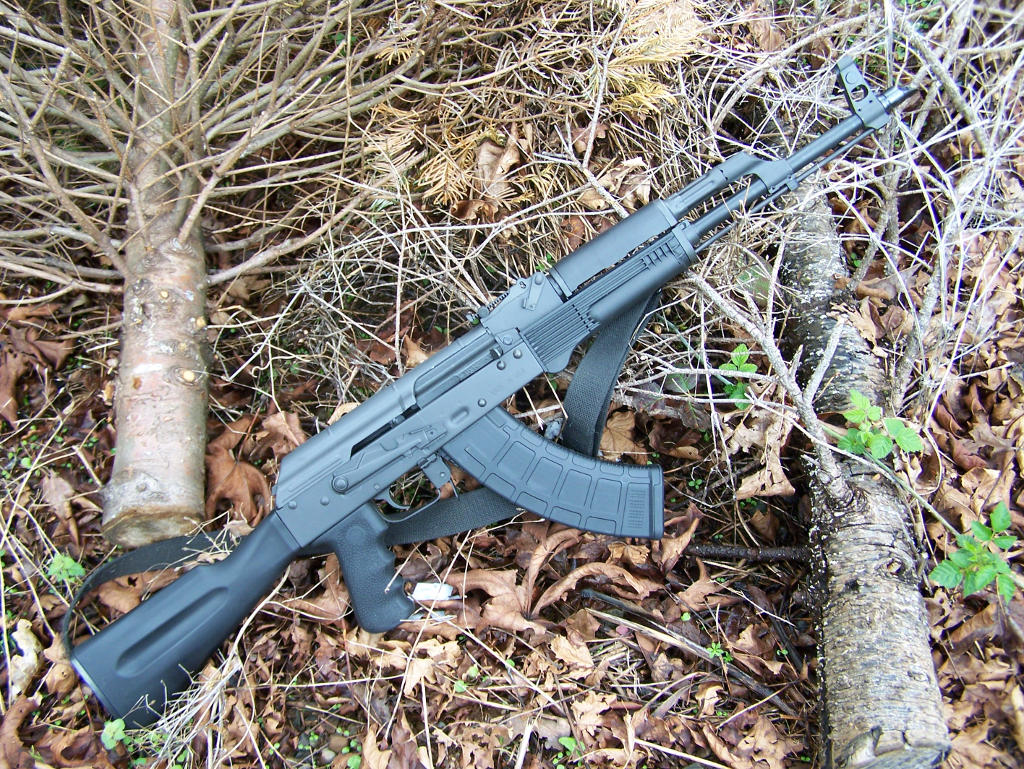
Enter IO Inc (Inter Ordnance) and their line of semiauto only AK-style of rifles. Some months ago, I picked up one of their AKM247 “AKs” at my local gun shop, since I’d heard nothing but good things about this company, their warranty, and their line of guns. However, I’m sad to say, my sample AKM247 was defective right out of the box. It started having problems; the gun would fire a couple of rounds, then the bolt would hang-up halfway through cycling, and I had to put it on the bumper of my rig in order to fully cycle the bolt. This happened numerous times. I took the gun back to my local gun shop and exchanged it for something different. That seemed like the end of the story, for me. My local gun shop made numerous attempts to contact IO Inc on the phone. Once they finally did get a real person to speak with, it was another THREE MONTHS before IO Inc gave them a return authorization so that they could return the defective rifle. It was about three weeks later that a replacement rifle was returned to my local dealer.

100_5838

It appears that the receiver was a bit out of spec on the gun I had, and the bolt/bolt carrier group was jumping out of the rails in the frame, seriously tying up the gun, which is not a good thing, to be sure. While I applaud IO Inc in their fast turnaround time, once they got the gun back in their hands, there is no excuse for putting off sending my dealer a return authorization number so they could return the rifle to them. I mean, really? Three months?

A month or so ago, my local gun shop received another IO Inc AKM247 in that was just like the one I had before. Needless to say, I hesitated for several days before actually buying the gun. I checked it out as closely as I could, and everything seemed fine. However, you don’t know if a gun is going to work until you actually fire it.

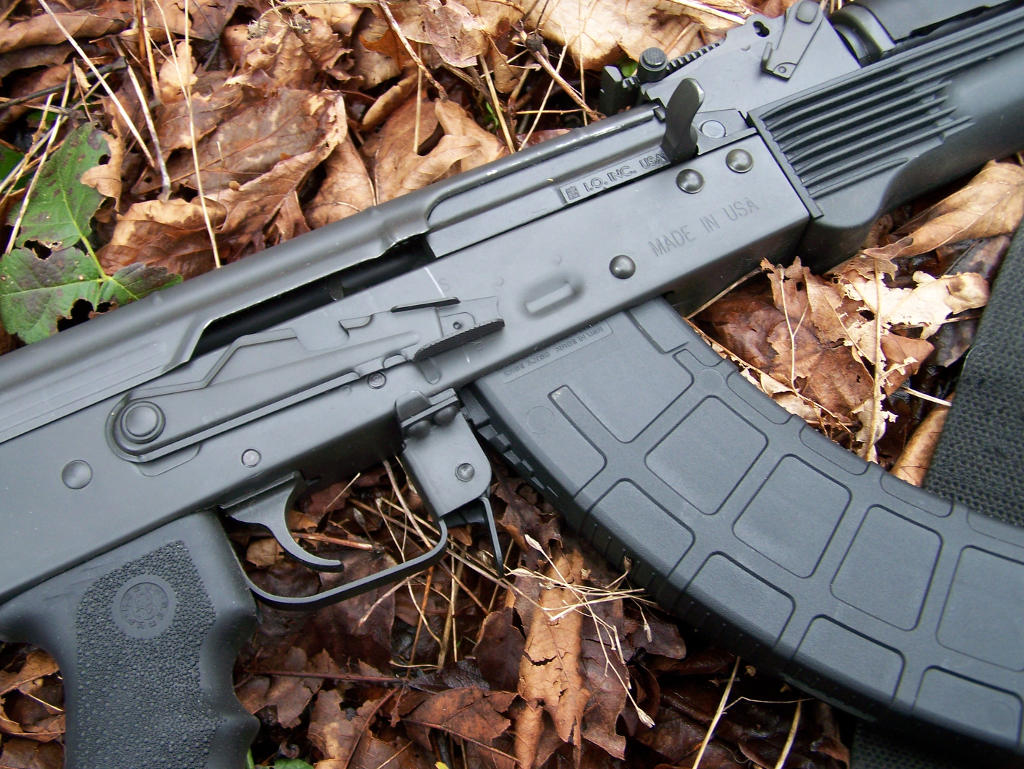
The IO Inc AKM247 model is totally made in the USA, which is good news! It is made from original Polish blueprints, and many claim that these are some of the best AKs in the world. Needless to say, IO Inc had to make the necessary modifications, so this rifle would be semiauto only. All of the furniture on the AKM247 is black polymer, which is very attractive and extremely tough stuff. I like it better than the wood furniture that comes on so many other AKs I’ve had. My rifle has a “tactical” pistol grip that I didn’t care for, so I swapped it out for a Hogue AK pistol grip, which is the best in my humble opinion. Front and rear sights are adjustable. The rear is adjustable for elevation only, and the front site is adjustable for windage and elevation. However, my sample was obviously sighted-in at IO Inc, and no adjustments were necessary, with the rear sight at the 100-yard/meter setting. The gun shot dead-on! Overall length of the AKM247 is 36-inches with a 16.25-inch Bbl, and the gun weighs in at 7-lbs. It’s actually very fast handling. The finish on some of the metal parts is manganese phosphate, parkerized!

100_5842

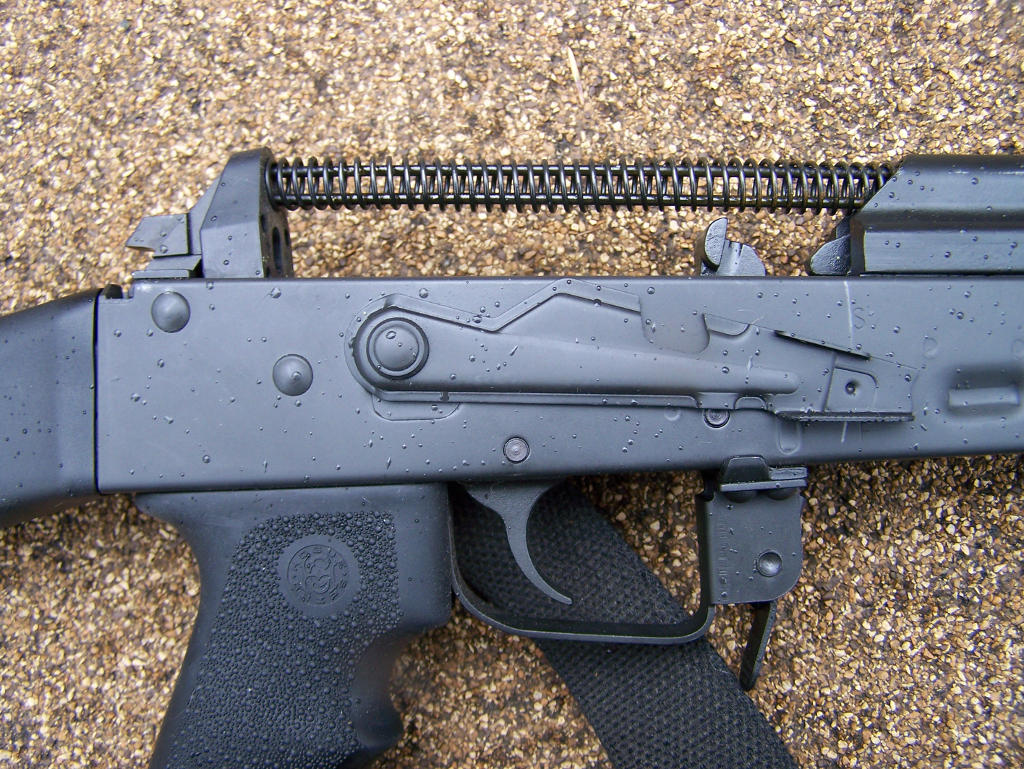
The barrel, inside and out, is Nitrated– very though stuff. Many AKs come with a chrome-lined barrel, and some insist that chromed barrels aren’t as accurate as non-chromed barrels. I don’t know if I buy into that. However, I know that Nitrated barrels are very resistant to rusting, and the coating lasts a very long time. We also have a recoil buffer on the recoil spring. Some AK users swear by their little polymer blocks, claiming they reduce felt recoil and help extend the life of a gun. Again, I’m not buying that. However, the recoil buffer is there. We also have a bolt hold-open milled into the safety. Now, the bolt won’t automatically hold open after the last shot, if fired; instead, you need to manually draw the bolt back with one hand, while pushing up on the safety with the other hand, getting that little milled groove in the safety pushed up into the bolt handle. That’s not something I’d normally use, but it’s there if you need it.

The trigger pull on my AKM247 sample is, without a doubt, the absolute best I’ve ever felt on any AK; take-up isn’t nearly as long as found on other AK types of rifles, and it is a very smooth trigger pull, letting off at 3 1/2-lbs. We are talking one super-sweet trigger pull, and there is no trigger backlash, either. (Trigger backlash is where the trigger can slap your trigger finger.) Nice!

The AKM247 also has a standard AK muzzle brake, as well as a bayonet lug, but no bayonet is included. There is also a cleaning rod that is extremely tight and hard to get out from under the barrel. That’s not a bad thing; it doesn’t rattle as many cleaning rods do on other AKs. The butt stock has sling swivel, and the gas block has another sling attachment point on it but no sling was included.

IO Inc claims that they can get 1.5-inch groups from their AKs. Maybe they can, but I couldn’t. At best, all I could get was groups slightly over 2-inches, if I was on my game all of the time, using the sights on the gun and no scope. Perhaps, with a scope I could get inch and a half groups. However, there is no scope rail mount on this AK. I used a variety of 7.62X39 ammo in my testing, and all seemed to shoot about the same. There was nothing to complain about here. The polymer mag that is included from IO Inc is of their own design, and it is a “waffle” pattern mag. I’ve used their mags before and have found them to be some of the best around. However, my 30-rd mag would only hold 28-rds of ammo, not the 30-rds it should have held. I left the mag loaded for days and tried to squeeze in two more rounds; it wasn’t going to happen. Strange.

100_5849

I did have one serious malfunction, and it was NOT the fault of the rifle. I had a bunch of loose 7.62X39 rounds in a small cardboard box, and I was loading the mag from that box. The first round fired, the second round fired, and the third round, well, sounded like a dud! The bolt was almost frozen on the empty brass in the chamber. I finally was able to get the bolt opened, but the brass (steel case) was stuck fast in the chamber. I had to get out my trusted multi-tool and pry the empty out of the chamber. When I took a close look at it, it turned out to be a .223 round. It had fired the bullet, but the brass expanded and split in the chamber. I examined the gun, and everything was fine. I continued shooting, in all, more than 500-rds without any problems. I can’t fault the gun for getting tied-up with that .223 shell. Either I or someone else dropped a loaded .223 round into my box of 7.62X39 ammo.

With the supply lines cut from Russia, we may never see any more AKs from that country, due to the import restrictions this Administration has placed against Russia over the Crimea thing. However, I have had AKs from Russia (semiauto only AKs), and while they were the genuine thing this IO Inc AKM247 is better made, has tighter tolerances, and is more nicely finished and just the best AK I’ve run across. Also, believe me, I’ve paid a lot more for other AKs, which didn’t come close to this IO Inc AKM247!

To date, this IO Inc AMK247 is hands down the absolute best “AK” I’ve run across. It’s totally reliable, has factory zeroed sights, is made in the USA with tough, real tough, polymer furniture, and is fast handling, as well as more than accurate for an AK. Also, it wouldn’t surprise me in the least, if this gun can shoot inch and a half groups, with a scope mounted on it.

You’ll need to shop around for prices, as they vary so much from dealer-to-dealer. However, I paid $559 for my sample, and I think it was a heck of a bargain. I’m waiting for my local gun shop to get in another identical IO Inc AK, so I can buy it, too. So, if you’re in the market for a new or another AK to add to your collection, check out the IO Inc line-up. They make several different versions, too.

– Senior Product Review Editor, Pat Cascio


Recipe of the Week: Spiced Pumpkin Pancakes, by OkieRanchWife

I saw this recipe on an episode of The Drs. several weeks ago. Usually “healthy” breakfast alternatives taste like wet cardboard, but I thought I’d try them for Easter morning breakfast. I did double the spices listed in the original recipe, and I added turmeric. I have been taking supplements of it. It has helped me with inflammation and has given me more energy. These healthy pancakes really do taste great! They also didn’t give me the pancake bloat or the sugar dump after eating them, due to the oat flour. They are very pantry/emergency cooking friendly, also.

Ingredients:

  • 1 cup old fashioned oats
  • 4 teaspoons baking powder
  • 1 teaspoon ground cinnamon
  • 1 teaspoon ground ginger
  • 1 teaspoon ground turmeric
  • dash of sea salt or Kosher salt
  • 4 large eggs, beaten
  • ½ cup pumpkin puree (You can used canned; I used frozen, cooked pumpkin from my garden last year.)
  • 1 teaspoon vanilla extract
  • cooking oil spray

Directions:

  1. In a blender, grind the oats into a flour; add the baking powder, cinnamon, ginger, turmeric, and salt. Pulse to blend.
  2. Add eggs, pumpkin, and vanilla. Blend until smooth.
  3. Heat a large skillet. (I use cast iron, on medium heat.) Coat with the cooking oil spray.
  4. Scoop ¼ cup of batter for each pancake into the pan.
  5. Cook on one side until golden brown, about 2 minutes.
  6. Flip and cook other side.
  7. Serve with butter, maple syrup, or apple sauce.

o o o

Useful Recipe and Cooking Links:

  • You might check out OkieRanchWife’s blog at reddirtcooking.com if you like cast iron cooking!

Do you have a favorite recipe that would be of interest to SurvivalBlogreaders? Please send it via e-mail. Thanks!


Letter Re: Regarding Massive Solar Events/Power Generation

HJL,

Working for 35 years as a field engineer for a major oil company, then five years as an engineer for the Cat dealer in KY, I was in and out of almost every industry in the U.S. In 2008 I was tasked with making a presentation to the Kentucky Association of Hospital Engineers on the subject of Emergency Diesel Generators. My research for the session included calling on all of the fuel terminals and most of the fuel distributors, as well as studying the fuel requirements of the various major hospitals in the Louisville area. At one major hospital complex there were/are five diesel gensets pulling diesel fuel from one 4,000-gal above-ground fuel tank. In the event of a “lights-out” event, with all five generators running, the complex would also be “lights-out” in 26 hours without on-going JIT fuel deliveries. Backing up the “fuel chain”, none of the local fuel distributors (the folks who actually run the trucks and deliver the fuel) had any emergency generators to run the pumps that fill their trucks. Further back up the “fuel chain”, none of the five fuel terminals had any emergency generators to move the fuel from storage tanks into the distributors’ trucks. One of the distributors claimed that they could/would jury-rig the pumps on their trucks to fill trucks and deliver fuel, but all five fuel terminals were hard-piped (to insure all gallons went through meters and could be billed), with almost no capability to improvise.

After the presentation, one of the attending engineers advised me that in the event of another “Madris Fault”, all hospital operations between the epicenter and a radius out to Louisville/Elizabethtown, KY, would be pretty much destroyed.

While nuclear plants have much larger fuel storage, they do have a major problem with genset requirements– their specifications require that gensets be able to go from start-up to full load in 10 seconds. Looking at cracked heads, failed crankshafts, cracked blocks, spun bearings on crankshafts and connecting rods, cooked turbocharger bearings, et cetera on EMD, Fairbanks-Morse, SACM (French) engines and other makes, in several nuc plants, it becomes apparent that while these engines can withstand fast-starts for a while, the enormous rapid thermal stresses will eventually produce a failure, just when emergency power in required. Interesting times, I’d say. – DH somewhere in IA


Odds ‘n Sods:

*Update* Game Changer OR Paradigm Shift ? – Walter Scott Shooting: Enhanced Video Shows Officer Slager With Taser Darts… – T.P.

o o o

Interesting pictures from Israel as the Passover ends.

o o o

Life insurance discount comes with a high price for your privacy. – D.S.

o o o

In a cameras-everywhere culture, science fiction becomes reality. – D.S.

o o o

More Than 10 Things You Can Start Doing Now to Prepare to ‘Survive,’ According to Delta Force Sgt. Major (Ret.). – G.L.


Hugh’s Quote of the Day:

“They had taken to the movement unlike anything he had ever seen, and he thought that should this venture of the Jews prove successful, the new state would be filled with dancers and musicians, but especially dancers, for dancing like nothing else says: I am still alive.” ? Mark Helprin, Refiner’s Fire


Notes for Sunday – April 12, 2015

April 12th is the birthday of the late novelist Tom Clancy (born 1947, died October 1, 2013). It was Clancy who almost single-handedly created the modern techno-thriller genre. Coincidentally, Tom Clancy’s first literary agent was JWR’s agent, Robert Gottlieb.


Street Combat – This Ain’t No Game! – Part 3 of 9, by Pat Cascio

[Street Combat – This Ain’t No Game is a Survivalblog exclusive.]

Chapter One

HAND-TO-HAND

With a few exceptions, it takes years and years of training to become proficient at defending yourself with nothing but your bare hands and feet. The “average” person on the street isn’t prepared to undertake this sort of lengthy and time-consuming training process. So, what are the options?

I’ve been involved in the martial arts for close to 30 years, now. If there are any shortcuts or secrets, I sure haven’t discovered them. I’m continually amazed at the number of people who come to me for self-defense training with the same question: “How long will it take for me to get my Black Belt?” I wish I had a dollar for every person that asked me that question. I’d be sitting on Easy Street.

First of all, if you’re determined to train in any of the martial arts, be advised that they are not all the same. Many styles are geared toward competition; I have no problem with that, as long as the instructor is presenting it that way. Trophies are nice and look impressive, but try carrying one down the street and using it to defend yourself.

If you run across an instructor who guarantees you’ll get your Black Belt in 100 easy lessons, steer clear of him. There are many unethical instructors out there who will “sell” you a Black Belt after just a short period of training. My fellow martial artist and friend, Tom Saviano, knows of one such school just down the street from him. For $1,500.00 this so-called “instructor” will guarantee you that you’ll become a Black Belt within a year or so.

Saviano runs the White Tiger Kenpo Karate School, 823 South Rt. 53, Addison, IL 60101. Tom has been involved in the martial arts for more years than I have, and he runs a legitimate martial arts school. He and I both teach many of the techniques– American Kenpo Karate– developed by our friend and fellow martial artist, Master John McSweeney! This is a no non-sense type of self-defense, not competition techniques!

Neither Saviano, McSweeney, nor I teach a flashy or fancy style of self-defense. We leave that to the Hollywood Masters. What you will learn is honest, street-proven techniques that work. Is the style we teach the “best” or the “only” style? No, not by a long shot. No reputable martial artist claims they have the “best” or “only” style. Again, if you run across such a person, look else where for your training. If you’re looking for any shortcuts or secrets, you’d better checkout another training hall. The only thing we know about is hard training, long hours, dedication, and continued improvement to time proven methods.

CASE STUDY: School Yard Thrashing

Like most kids, I was a bit on the skinny side growing up. I didn’t fill out until I enlisted in the military at age 17. I did learn a valuable lesson during my earlier school yard “thrashing”; if at all possible, you should pick the time and place for your street combat.

Marshall had recently moved to the neighborhood from Tennessee or Kentucky. I can’t remember which, and it’s not all that important at this point. Marshall was a big kid for his age, much bigger than the rest of the nine year olds, including me.

It was Marshall’s habit to pick on everyone who was smaller than him. Isn’t that what bullies normally do? Marshall wasn’t the brightest kid in Bridgeport (the area of Chicago where I grew up). As a matter of fact, if I recall correctly, Marshall had been held back in school a year or two.

It was Marshall’s habit to come up behind kids, get one in a “bear hug”, and squeeze the living daylight out of them. I knew, even at the age of nine, that I was no match for this back hills kid’s brute strength. I had to pick my place and time!

During Christmas break, we found ourselves in waist deep snow, building “forts” of snow in the school yard. Marshall was there, too. As usual, he was picking on everyone and soundly defeating us all in snowball fights. I saw my opportunity.

While Marshall was busy hurling snowballs at some of the other kids, I approached him from the rear. With all my might, I got Marshall into a strangle hold that he couldn’t break. The hold was so devastating that Marshall almost lost consciousness. The only thing that stopped the world from going dark on Marshall was some of our friends pulling me off Marshall.

There was never, ever, again, a problem with Marshall bullying another kid in the neighborhood. Marshall and I became great friends after that incident.

LESSON LEARNED:

Pick your time and place for Street Combat, if at all possible. Don’t let the aggressor take control of the situation. Wait for your window of opportunity.

Now, in retrospect, it wasn’t the nicest thing to attack Marshall from behind, but I had won a victory for myself and every other nine year old on the block. I had taken a giant step forward in my lifelong learning process. This was my first “victory” over a much larger and stronger opponent.

When you first start training in any self-defense techniques, much of what you learn is of the physical aspect. As you progress, you start developing your mental training abilities. A true martial artist will readily admit that winning a battle is 80-90 percent mental and only 10-20 percent physical.

You must be aware of what is going on around you at all times! Many shooting instructors (myself included) have a color code we teach our students.

  • White is the condition you’re in when you’re completely oblivious to everything around. This is a day dreaming state.
  • Yellow is the condition you should be in during all your waking hours. You are aware of everything going on around you.
  • Red means you have sensed trouble or something out of the ordinary, and you are preparing to take appropriate action.
  • Black means you have engaged the threat or problem, and there’s no turning back. You must bring this situation to a peaceful (if possible) and reasonable end.

TECHNIQUE USED:

Modified Japanese Strangle Hold. If your attacker can’t breath, he’ll have a difficult time attacking you. Cut off his source of oxygen, and he’ll quickly stop his attack against you.

If you can get around behind your attacker, you can easily get him into this deadly strangle hold. Place the bone of your lower right arm against the wind pipe of your attacker. Then, bring your left arm behind your attackers neck. Lock your arms together by using your hands as “locks” in the crook of your arm. Take a single step backwards, pulling your attacker off-balance all the while exerting pressure on his wind pipe. In short order, your attacker will lose consciousness and cease being a threat. Keep in mind, that continued use of the Japanese Strangle Hold will cause death (to your attacker) in short order if you don’t release him.

CASE STUDY: The Cabretta Black Leather Jacket

Like every kid in the neighborhood, I wanted a Cabretta black leather jacket. I don’t know if they still make this sort of jacket style, but they used to be a sort of status symbol. For the most part, they kind of looked like a black leather suit jacket with an imitation fur lining for warmth (that didn’t work as intended).

My folks searched high and low to find a Cabretta black leather jacket for me. Unfortunately, the only one they could find was about two sizes too big for me. It didn’t matter; I wore it anyway with the bottom of the sleeves turned under. I looked good, or at least I think I did!

I was 13 years old and was traveling on a CTA (Chicago Transit Authority) bus with two friends. We were headed to the Museum of Science and Industry, along South Lake Shore Drive in Chicago. The only problem was that we had to transfer buses in a rapidly (racially) changing neighborhood. We had traveled this route numerous times over the years and had never previously encountered any problems, until that day!

Several stops before we were to change from one bus route to another, five black youths got on the bus. They were all about our age or a year or so older. The black youths immediately started checking out my Cabretta black leather jacket. The leader of the bunch asked if he could try it on. Of course, my response was a resounding “No.” I knew there was going to be trouble at this point.

As we approached our stop, my two friends and I exited the front door of the bus. Before we knew it, the five black youths had exited the rear door. They rapidly were upon us, and the leader attempted to pull my Cabretta off my back. I wasn’t about to have any of that and pulled away from him. I was met with his fist on the side of my face.

Outnumbered, in an African-American neighborhood, our plan was to . . . run! At least in this incident, I was aware that there was trouble brewing, and I wasn’t really too surprised when I got “hit upside the head.” As a matter of fact, I didn’t feel any pain until much later.

My one friend managed to make it across the busy boulevard and hopped on the bus heading toward the museum. As for myself and my other friend, we retreated to the safety of a Walgreen’s Drug Store. At least we thought we would be safe once inside.

Three of the black youths followed right behind us. No one, neither black nor white, would come to our aid. Thanks, Chicago! We made our way to the rear of the drug store and were cornered in two phone booths. We fought off the three attackers by kicking, kicking, and kicking them.

By this time, someone had called the Chicago Police Department, who came to our rescue. We updated the cops when they arrived, and they took us in their patrol car to the museum. It was there that we found our other friend fending off the last two black youths in the public restroom. Again, no one made any attempt to come to our friend’s rescue. Thanks (again), Chicago!

LESSON LEARNED:

Mental awareness is the number one key to staying alive on the mean streets of America (or any city or country). Had I not already been involved in a theft of clothing (remember my new winter gloves?), I probably wouldn’t have been tipped off to the impending attempted theft of my Cabretta jacket.

Luckily, my friends and I knew the area where we were to transfer buses. Had we not been familiar with the area, we might have run from our attackers and headed deeper into their terf. Instead, two of us ran inside a public building. The third jumped on a CTA bus and headed for the safety of the museum.

When you don’t have any weapons, except those you brought with you (in our case, our hands and feet), make good use of them. Rapid kicks to a person’s legs will probably give them an excuse to be some place else.

Lastly, don’t be stupid, like I was! I was wearing a hard-to-find and expensive Cabretta black leather jacket. This was an item of clothing best reserved for my own neighborhood, not for a racially-changing area that was known for trouble. Hey, I never said I was the smartest person in the world. My only excuse was that I was 13 years old and wanted to show off my new jacket.

TECHNIQUE USED:

Low Kicks to the Knee and Lower Legs. If your attacker can’t walk, he’ll have a difficult time hurting you. Two of the most effective kicks any martial artist can master is the front snap kick and the side kick.

Unlike “Hollywood” martial artist, we teach only low kicks– kicks usually below the waist and more often to the knee and lower leg area. These kicks are extremely difficult to defend against and are devastating!

The front snap kick is executed by raising the (kicking) leg straight up until the upper part of your leg is horizontal to the ground. You then kick straight out toward your attacker’s groin area with your lower leg (keeping your foot and toes pointed toward the ground). The instep of your foot should make contact with his groin area. This kick is very fast and powerful. If delivered correctly, to the groin area, your opponent will be down for the count.

The side kick is delivered in much the same manner, with the exception being you are kicking out to the right or left side of your body. Your target area is the front or side of the knee. In this case, the side kick is delivered with the side of your foot. If your attacker can’t walk or stand, he’ll no longer be a threat!

One of the best combat techniques was used in this attack. I picked the site for the final battle– inside of a drug store– to be a very public place, where eventually someone called the local police. I refused to allow our attackers the advantage of continuing their attack on the street corner. To allow this, the odds were pretty good that our attackers would have had back-up in pretty short order.

Lastly, I used the best weapon I had– my brain! I was mentally aware of my surroundings and the impending threat (for the most part). I knew there was going to be trouble with these black youths within seconds of their boarding the bus. I also knew that to stay on the bus any longer would have brought us deeper into their terf.

I’ve often wondered about the aspect of asking the bus driver for some type of aid. Upon reflection, I seriously doubt he would have interfered in the upcoming battle. I’ve often watched CTA bus drivers throw both offending parties off their bus, not caring what would happen to either or both parties.

CASE STUDY: Unarmed Against A Knife!

Being unarmed against a knife is a deadly situation that no self-respecting person wants to face. Unfortunately, I was unlucky enough to encounter a knife-wielding assailant on one cool fall day.

By the age of 15, I was fortunate enough to engage in some judo training with my long-time friend, Andy Silva. (Thanks, Andy.) Andy had been training in judo and karate (at the same time) for about a year and had become pretty efficient at it. It was a regular routine for Andy and I to practice in my grandmother’s living room. Andy had mastered several throws and kicks, and I learned everything I could from our training sessions. I mastered the side kick and the front snap kick in these training sessions.

School was back in session, though I didn’t attend a public high school back in Chicago. Instead, I was fortunate enough to get some of my high education at a private Lutheran high school. However, good luck doesn’t always follow good fortune! I had to travel on two and sometimes three CTA buses to get to school. In good weather, it took about a hour and a half to get to school. In bad weather, well, let’s just say it took longer.

I had to transfer from one bus route to another. Unfortunately, the first bus route took me through an all-black area of southside Chicago. My transfer point was (then) in a racially-mixed area!

While waiting to transfer bus routes (at the end-of-the-line), I used to stand in the outside alcove area of a doctor’s office (just in front of the building). This afforded me some protection from the biting wind, and I could watch for my approaching bus. This gave me plenty of time to get to the corner to board the bus.

On one particular day, I was approached by two black youths. Both were probably 15 or 16 years old. One pulled out a folding knife from his jacket pocket and demanded my money. I had made up my mind long ago that I wasn’t going to be a victim any more, so I refused his demands!

The youth started slashing at me. I was trapped in the alcove, with my only means of escape through my attackers! My shirt had been cut in several places by one of the slashing attacks, but I remained unscathed. I kicked out at both youths with a combination of front snap kicks and side kicks, until I saw an opening. I ran toward and around the corner and got on one of the waiting buses (at the end of the route). I took the bus home and decided not to attend school that day.

LESSON LEARNED:

Don’t be stupid! It would have been better to stand in front of the restaurant (on the corner) instead of waiting in an alcove. It was early morning and the doctor’s office wasn’t open, so there was no means of escape or retreat. I had cornered myself in what could have been my last day on the face of this earth.

There was an alternate bus route I could have taken. Unfortunately, it would have added at least an hour to my travel time. Eventually, I learned to take a later bus to school, allowing me to travel with several other students from my neighborhood; there is strength in numbers!

I should have been mentally prepared for the attack, but I wasn’t! I observed the two black youths approaching from down the street. I should have left the “safety” of the alcove and gone to the true safety of the restaurant on the corner, but I didn’t!

TECHNIQUE USED:

Low, front snap kicks to the groin (missed) and side kicks to the lower legs and knee areas of my attackers. My kicks were more effective at this stage of my life. While I didn’t put my attackers down, it did allow me to escape. Kicks to the upper and lower legs are effective against a knife-wielding suspect. They are too busy defending themselves to put much effort in their attack.

CASE STUDY: Unarmed Against A Knife, Part II

“Luck” just seems to follow some people, every place they go. Such is the story of my life.

While living with a relative on the near southwest side of Chicago, I once again had the misfortune of facing a knife-wielding suspect. However, this attack was completely different than the first one. This attack was launched furiously, without warning, and viciously! To this day, I still don’t know why I was attacked.

I worked as a supervisor for a guard company. I worked all hours of the day and night. I was basically “on call” 24 hours per day. This was an armed position, and I made it a habit of being armed most of the time, because I never knew when the radio would “crackle” and I’d be on-duty.

When leaving home one night, I didn’t have my Smith & Wesson Model 10, .38 Spl. revolver with me. I don’t recall where I was headed, but I was going to take the patrol car the company provided me for my personal and business use. It was unusual for me to leave the house unarmed, especially if I was going to be driving the patrol car rather than my 1969 Pontiac Firebird.

As I left the front door of the apartment building, I was immediately set upon by my attacker. He was all over me, like bees to honey! My left forearm was slashed by his knife, before I knew what had happened. I didn’t have time to worry about my bleeding arm. I had to end this attack!

I used a combination of forearm smashes to my attacker’s chest area, followed by side kicks to his lower leg area. I’m not sure which self-defense techniques worked, but he broke off his attack in fairly short order. I ran back upstairs to retrieve my gun. However, by this time, my attacker was long gone.

A trip to see my local doctor resulted in a quick bandage job. I was told to go to the hospital emergency room for a suturing job. I never did! I still have the scarred left forearm as a reminder.

LESSON LEARNED:

I should have known better by this stage of my life. I had obtained my first degree black belts in judo and goju-ryu karate by this time. I was an ardent student of the martial arts, training four or five evenings per week for hours at a time. I had recently been introduced to the art of kung fu as well. My mind was obviously elsewhere that evening. I was operating in condition “white”.

Never ever take anything for granted. An attack can take place anytime, any place, and for any reason! I still don’t know the reason for this attack. I can only surmise that I was going to be the victim of a robbery or random murder.

If you’re going to be armed, you should be this way all of the time and not just part of the time or when you “feel” threatened. You can’t possibly predict when an attack will occur. I don’t know if I would have had time to draw my trusty S&W Model 10 and end this mad man’s attack on me. Perhaps or perhaps not! When you’re taken by complete surprise, with your handgun holstered, you’re probably better off fending off your attacker until you can get some time and/or distance to draw your weapon.

TECHNIQUE USED:

Two of the biggest weapons you have with you are your forearms! They can put an attacker down quick, when used correctly. The fighting was so close-in that traditional karate punches couldn’t be used. I had no room to throw a punch. I had to use my forearms to strike my assailant’s chest area.

To execute a strong forearm smash, you must do two things. First of all, you must be close to your attacker; otherwise, you’ll completely miss your target. A forearm smash doesn’t have very much distance.

Secondly, you must put your entire body weight behind your forearm smash. Most traditional karate styles teach a simple forearm smash to the chest or head area. While effective, it can be improved upon. Master John McSweeney has taken the traditional forearm smash to the next highest level.

To perform a bone-breaking, killing, forearm smash, you must use a “looping” movement. You don’t simply strike out with your forearm. In McSweeney’s “Power Strike” methods, you can either “loop” your forearm up and over and strike your opponent in the head, shoulders, or chest area, or you can “swivel” (from side-to-side, left-to-right) and thereby “loop” your forearm onto your opponent. This movement has devastating effects.

Lastly, low front snap kicks and side kicks to the legs and knees also helped end this attack. Never ever underestimate the effectiveness of low kicks to the legs. Leave the flashy, high kicks to the Hollywood martial artists. While they look effective onscreen, they are lacking in real life situations!

KICKING COMMENTS:

In my martial arts classes and seminars, we place great emphasis on keeping our kicks L-O-W! There’s several good reason for this.

  1. It’s extremely difficult to defend against kicks that are kept at or below knee level.
  2. Kicks to the front of the knee or the side of the knee can collapse the leg. Remember, if they can’t stand, they’ll have a difficult time causing you any harm.
  3. As we get older, it’s more difficult to perform those “high” kicks without a warm-up.
  4. High kicks (those above the waist and up to the head area) are more easily defended against. I’ve proven it time and time again in my classes and seminars. I pick the oldest (and/or slowest person in the class for this demonstration. I can usually place one or two (high) kicks toward their head area. However, even the oldest and/or slowest person can usually catch or grab my leg on the third or fourth attempt. Once they have your leg (captured), you’ll look like a one-legged, Irish step dancer. It’s not a pretty sight, to be sure!

With my comments in mind, this isn’t to say that high kicks are not effective, if delivered with speed and delivered correctly. Many Tae Kwon Do practitioners can routinely kick you “up side your head” all day long. However, this is the exception and not the rule! Try a high kick to someone’s head when your standing on snow- or ice-covered sidewalks. Maybe you’re wearing cowboy boots or sandals when you’re attacked. If you haven’t practiced delivering your high kicks under these circumstances, you’re in trouble!

As mentioned at the onset of this chapter, my good friend and fellow martial artist, Tom Saviano, runs a terrific martial arts school. His school is devoted to real-life, self-defense techniques. Many of the techniques that Saviano teaches were developed by our mutual friend, Master John McSweeney. One such technique is the “Leopard Palm”.

CASE STUDY: The Sumo Wrestler

Saviano trains one of the best all-around “street” fighters I’ve seen– Keith Hackney. Hackney is a former Navy SEAL with arms like boulders. He is a strong kicker (low kicks) and stands about 5′ 11” weighing in at around 200lbs.

Hackney has competed in several “Ultimate Fighting Challenges” over the years. These fights are advertised as real-life scenarios. Well, not exactly! There are certain rules that must be followed when fighting your opponent in these fights. However, keep in mind that there are NO rules on the street, and in a street fight there is no second place winner.

It was Hackney’s good fortune to draw a Sumo Wrestler as his opponent. This walking refrigerator stood 6′ 8” tall and weighed-in at over 640lbs. He was billed as the “world’s largest athlete”. If you saw his size, you wouldn’t have much argument with this claim.

At the start of the fight, Hackney attempted a combination of front snap kicks and side kicks to the monster’s knees and legs, all to no avail! It was a feeble attempt, one better reserved for a lesser opponent. The only real target that Hackney could possibly attack was the head area.

The monster Sumo Wrestler came at Hackney; Hackney hit him with a Leopard Palm to the forehead. The monster reeled and went down like a ton of bricks, only to rise again. Had this been a mere mortal who Hackney was fighting, he would have stayed down!

In 1 minute and 59 seconds, Hackney had beaten the giant, but not without injury. Hackney had broken his right hand as a result of numerous Leopard Palm, Hammer Fist, and Upswing strikes to the Sumo Wrestler.

In an interview after the fight, the giant Sumo Wrestler said he had “never been hit ‘flush’ before.” Hackney gave the monster a lesson he would not soon forget.

LESSON LEARNED:

Obviously, the bigger they are, the harder they fall! Hackney, against the advice of his trainer– Tom Saviano, had decided to launch an attack against the Sumo wrestler’s legs, but it was all without any effect.

The sheer size and build of the Sumo Wrestler didn’t allow for any other vulnerable targets, except for the head and face area. Hackney took advantage of his one and only target, and he gave it everything he had. His ferocious attack yielded a victory.

This was a real “David vs. Goliath” battle, one I wouldn’t have wanted to fight. The sheer size, weight, and mass of the Sumo Wrestler could have proven deadly. Having this man simply fall on top of you might have resulted in serious injuries or even death.

TECHNIQUE USED:

John McSweeney’s “Leopard Palm”. This is one of the strongest (if not the strongest) blow you can deliver with your hands. This is basically a kung-fu type of strike, with the added benefit of McSweeney’s further refinement and development.

To perform a Leopard Palm strike, you have several target areas– the bridge of the nose, upper skull, and jaw. Curl your fingers and bend your hand back. The striking surface is the base of the palm. Power comes from the circular movement of your hand, pulled by the shoulder and back muscles and augmented by turning the waist and moving the body center down in conjunction with the strike. The hand loops up, over, and down, smashing right through the target. This is basically the same strike as former world heavyweight boxing champion, (1952-1955) Rocky Marciano used in many of his knockouts. Marciano normally hit the skull or jawbone, and occasionally he broke his thumb because as a boxer he hit with a clenched fist.

CONCLUSIONS:

You must condition yourself to be constantly alert! Stay in condition “yellow” during all your waking hours. Don’t allow yourself to lapse into condition “white” for any reason. You’ll know when you’re in condition “white.” This is when you find flashing red and blue lights behind your car, because the police caught you doing something wrong! Condition “white” is when you find yourself running a red light, smacking into the rear end of another car, and so forth. Your everyday routine should find you in condition “yellow” at all times. Make sure no one sneaks up on you or startles you. Be aware of your surroundings at all times. Make sure you know where you are at all times. Don’t allow yourself to day dream. Be prepared to defend yourself at all times!

The techniques used in all of the above case studies are easy to learn, effective, and devastating. There are no “secrets” in any martial art style; there are only things not yet revealed! Any self-defense instructors who claim to know the hidden “secrets” of the Orient are fooling themselves or you.

In the next chapter, we’ll discuss some “dirty fighting” techniques. Remember, as legendary gunman Bill Jordan said in his book of the same title, there is “No Second Place Winner” in street combat. In real-life street combat, you either win or you lose. If you lose, odds are pretty good that you’ll end up seriously hurt, crippled for life (physically and/or emotionally), or dead! You have to do whatever it takes to win.

Remember, this is: Street Combat – This Ain’t No Game!



Letter Re: Solar Well Pump

HJL,

I agree with GL, the Grundfos SQF line of off-grid well pumps are superior products. My well is using the 11-SQF-2 pump. The correct operating voltage range is 30-300 VDC or 90-240 VAC @ 50/60 Hz. Maximum current draw of this set of pump products is 8.4 amps, regardless of input voltage. The pump contains an MPPT power controller. Oh, these are NOT inexpensive pumps.

Note, if you are supplying less than 120 volts, the GPM of the pump must be down-rated. This is important when running from solar panels but even more so when running from batteries. See the technical literature for details. It is a very good, thorough document and details configurations for solar, wind, and generator environments. Take note that if your generator outlets are GFCI, Grundfos says that the pump will not operate. I have not confirmed this, as my generator is not GFCI.

Grundfos literature for the SQFlex pumps can be found at Grundfos SQFlex Literature – R.G.


Economics and Investing:

Video: Ann Barnhardt exposes the blatant fraud in US financial markets, the IRS scandal, the financial enslavement of the American people, and whether Obama is conspiring to collapse our economy!

o o o

Why Another Great Stock Market Crash Is Coming

o o o

The mega Chinese stock market bubble: Over half of new investors only have a junior high education or less and the Shanghai Composite is up 100 percent in one year.

o o o

Citi Economist Says It Might Be Time to Abolish Cash


Odds ‘n Sods:

Eighth Grader Charged With Felony Cybercrime For Changing Teacher’s Desktop Wallpaper. Whatever happened to a teacher explaining to a child why this was wrong, that the computer is NOT his property (I remember my parents explaining PROPERTY RIGHTS to me before I even went to school), and calling his parents and all of them sitting down and explaining this to the child! Another clueless teacher! – H.L.

o o o

I don’t recall seeing anything about this in news from the American Redoubt.

Wyoming Governor Vetos Asset Forfeiture Reform Bill

Meanwhile down in New Mexico they got it right, and it only took 4,000 phone calls from citizens.

New Mexico Bill to Curb ‘Policing for Profit’ Signed Into Law. – S.M.

o o o

California approves bill banning child vaccine exemptions. – T.P.

o o o

Police Want “Eye Blinding” Laser To Add To their Military-Style Arsenal. – B.B.

o o o

Illinois schools can require students to hand over their social media passwords. – T.P.