Notes for Tuesday – May 26, 2015

May 26th is the birthday of Randall Hank Williams (Hank Williams, Jr.). He was born in 1949. When not touring, he lives somewhere in Montana, so he qualifies as a Redoubter. He reportedly has a large gun collection, which is heavy on Sharps rifles and rifles that have factory letters showing that they were originally shipped to Montana. His song A Country Boy Can Survive is of course practically a survivalist anthem. His father was just 29 when he died, and despite a couple of close calls, Hank Jr. has lived well past that so he may yet live to a ripe old age.


Mike Williamson’s Review: Benjamin Blatt, Firearm Attorney in Indiana

Benjamin Blatt is licensed in Indiana only at this point, so this review will unfortunately have a limited market. https://www.facebook.com/hoosierattorney

My own knowledge of firearms law is extensive, for a layman and activist who has been at this since 1986. So, coming across a professional with detailed knowledge of the fine points is a great find. Ben recently set me up with two firearms trusts– one trust for NFA items specifically and one for my valuable antiques and collectibles. The price for each was exceptionally reasonable.

The process for both was simple and straightforward. I provided him with information on a questionnaire, and then he provided the trust document, instructions on how to initiate and use it (which is free for any interested parties by email to bblatt11@aol.com), and a cover sheet with the Certification of Trust for setting up a bank account.

In addition, he has set the language and trust so that the itemized list of property (including weapons) is an attachment to the document that neither he nor any examiner needs to see, except with cause and warrant. The privacy of your collection is thereby protected.

He noted to me that quite a few, if not most, online samples are generic and not applicable to the fine points of firearm law. I highly recommend the use of an expert in firearms law specifically in such matters, and if you are in Indiana, Ben has my endorsement.

DISCLAIMER: I have paid Ben for his professional services. I have no financial or other interest.


Ruger P-Series Bargain Handguns, by R.S.

Several weeks ago during a visit to my favorite gun shop I noticed a used Ruger semi-automatic handgun on the bottom shelf of the display. It had a lengthy model number that was unfamiliar, but then it has only been the last several years (coincidental with my newfound interest in prepping) that I have taken a serious interest in firearms. I could see that it had a stainless steel upper assembly with a gray (presumably metal rather than polymer) frame. I could also see that it had an exposed hammer, so I assumed it was an older design rather than a modern, striker-fired type. It came with both a 15 round and a 10 round magazine (the double-stack, relatively high capacity magazine capability was encouraging), although it had no rail to mount a light or laser. Most interesting of all, despite looking like a solid used handgun from a reliable manufacturer, it was only $280.

After returning home I consulted the modern fountain of all knowledge (YouTube) for information on this intriguing model that began, as best as I could recall, with KP93. I was soon introduced to the Ruger P-series of semi-automatic handguns. The model numbers typically correspond to the year the design was released, starting with the P85 and concluding with the P95 (although the P95 continued to be manufactured until the early 2000s). The basic design remained the same with some variations among the different models.

P-series handguns utilize a design similar to a Sig Sauer (some sources suggest the P-series was based on the Sig design), Beretta 92, and other handguns from the era of the 80s and 90s. Unlike modern striker fired designs, the first round is fired with a double-action motion as the trigger first pulls the hammer back and then releases it to fire the round. Subsequent rounds are single-action as the movement of the slide ejects the empty case, cocks the hammer, and loads the next round; the next relatively light trigger pull simply releases the hammer to fire the next round. Alternatively, the hammer may be manually pulled back for the first round so that it is also single-action. In a sense, this design represents a transition from the traditional revolver for which every round is double- or single-action depending on whether the hammer is manually pulled back before firing the round to the modern design where every round is double-action, but the striker-based double-action typically requires much less trigger effort than a traditional double-action.

Regardless of the model year and the individual idiosyncrasies associated with each, the reviewers consistently reached two conclusions: P-series handguns are an excellent example of a highly reliable, American-made firearm and with a street price for a used P-series in excellent condition of $300 or less, they are a bargain.

Convinced by the favorable reviews, I returned to the gun shop two days later but was disappointed to discover that the P-series I had seen was already gone. However, two weeks later it returned to the shop at an even lower price of $270, and I snapped it up. It went straight from the shop to the range, where it fired 50 rounds of the inexpensive, aluminum case ammo without a hiccup. Upon returning home I field-stripped the gun and discovered that the previous owner had left it in serious need of a cleaning; black crud and a brown, sticky substance coated the outside of the barrel and other internal parts, but this made it all the more impressive that it still functioned flawlessly. After a thorough cleaning, it handled another 50 rounds of practice ammo and a few rounds of hollow point with no issues, leading me to concur with the various reviewers: my Ruger P-series is a decided bargain and well worth consideration by the budget-minded prepper.

The particular model I purchased is the KP93DC. The “K” prefix indicates stainless steel upper components including the slide and barrel. (This model is also available with blued steel upper components, but I much prefer the low maintenance durability of stainless steel.) The “DC” suffix indicates “de-cocker” only as opposed to most P-series models that combine a de-cocker with a manual safety. This may be an issue for you one way or the other; I prefer a manual safety on a modern striker fired handgun since the trigger pull is typically fairly light (and I do not want to shoot myself in the foot while drawing it from the holster), but I am comfortable with excluding a manual safety on this P-series since the initial double action force is rather heavy.

As with firing a double-action revolver, I find it more difficult to keep the first round of my P-series on target when fired in double-action mode as compared to a striker-fired trigger pull. However, I also find subsequent single-action rounds to be easier to keep on target than a striker action; if I have time, I will manually cock the hammer for the first round and benefit from the increased accuracy for every shot.

P-series handguns are heavy. However, for many applications such as home defense this can be an advantage. The additional weight helps tame the recoil and is not an issue when not carried for an extended distance or period of time. This is not to suggest that a P-series is unbearably heavy (I just carried mine for several miles through the woods today while retrieving a deer stand), particularly when held in a good holster, but it is noticeably heavier than a modern, polymer frame handgun. It is worth noting that it is not the aluminum or polymer frame of a P-series that is heavy but rather the upper components and, in particular, the slide. Modern designs have slimmed the metal components considerably, thus reducing the weight.

P-series handguns utilize the three dot combat sights with small dots that are typical of Ruger handguns, while my aging eyes prefer larger dots or some other variation that improves visibility. However, there are enough of these handguns in circulation that replacement sights, including tritium sights, are readily available. The rear sight mount is a dove-tail, while the front sight is held in place by two pins. I consider this an advantage as I would rather fix one sight than have both capable of moving, and the front sight which is the smaller of the two is the one I would rather fix in place. (I have already made a mess of both the stock front sight and a replacement fiber-optic front sight on another handgun with a front dove-tail mount by performing the replacement without the use of a sight replacement tool.) A replacement front sight requires marking and drilling two holes, but this is not difficult for someone with modest mechanical skills (particularly if that someone has access to a drill press) and is trivial for a gunsmith.

The grip on my KP93DC is large. While it is still comfortable for me to hold in my average sized hands, this may be an issue for someone with smaller hands. Alternate grips are available for some models, but they do not significantly reduce the thickness, since this is largely determined by the frame. Modern designs have reduced the grip size while still accommodating double-stack magazines, but the P-series are based on an older, less streamlined design. The P95 has a different frame based on the use of reinforced polymer which may better fit some, but it remains important to consider this factor when contemplating a purchase.

Another advantage (in my opinion) of the P-series is the fact that the de-cocker/safety levers are mounted on the slide rather than the frame. They provide an excellent grip when manually actuating the slide to chamber the first round rather than relying on serrations milled into an otherwise smooth slide as is often the case with modern semi-automatics. The older P-series design greatly reduces the grip strength required to hold the slide which is often a far greater impediment for women or the elderly than the force required to overcome the slide spring. Note, also, that both the de-cocker/safety lever and magazine release (which pushes forward rather than side-to-side as with most semi-automatics) are ambidextrous; this is a real plus for me, since I am a lefty.

Most P-series designs do not have a rail integrated into the frame, making them more difficult and/or more costly to fit with a light or laser. The exception is the P95; it has a standard rail molded into the frame although it only has one stop rather than three or more as found on many modern semi-automatics. Also, most P-series handguns are chambered in 9 millimeter although there are some chambered in .40 S&W and even .45 ACP (including the closely related P345). I prefer 9 millimeter, since I can standardize on a single handgun round for my subcompact carry guns along with my full size semi-automatics, 9 mm is generally less expensive than .40 S&W and much less expensive than .45 ACP, and 9 mm is manageable for my wife (at least in a full size handgun). However, the relative scarcity of the larger calibers in the P-series may be an issue for some.

The price of a new Smith and Wesson M&P 9 (or a Ruger SR9 or pretty much any Glock) is enough to purchase two used Ruger P-series. Are there advantages to those high quality handguns using the more modern design? Certainly. However, for those on a more limited budget, for those who need additional handguns, or for those who simply prefer the advantages of the P-series design, used P-series handguns are plentiful, reliable, and represent a decided handgun bargain.


Letter Re: Stoping an Antibiotic Course of Treatment

Jim and Hugh,

The adverse effect of tithing or stopping an antibiotic course of treatment early can be dangerous. The subjective symptoms of decreases in fever, inflammation, or discomfort, or other negative consequence “feelings” of infection is only an indication that the bacteria is in a die off, but the strain of bacteria may not have been completely eradicated. Discontinuing the antibiotic prematurely can cause a supergrowth once stopped in some cases and a bacterial resistance to that antibiotic is developed, so that any subsequent usage of that antibiotic may not work any longer on that bacteria.

This is one of the primary reasons we are dealing with supergrowths, secondary bacterial infections, and with mutations of bacteria today. Not only do doctors and nurse practitioners overprescribe and misprescribe antibiotics, but also because clients do not follow the entire course of the antibiotic ordered. A culture and sensitivity test for precise diagnoses of the cause of the infection is the best indicated practice for the treatment of any bacterial infection with the best apropriate suitable antibiotic. Shalom – KABF

JWR’s Comment: I agree that a course or antibiotics should never be cut short. In my estimation the better approach is convincing your doctor for a second prescription “in case this infection reoccurs.” A few doctors will indeed do so, especially if you live in a remote region.


News From The American Redoubt:

Idaho man finds rare giant earthworm species. – RBS

o o o

Dead whistle pig tests positive for the plague. – RBS

o o o

I’m kind of scratching my head over this job posting: Sales Associate – Full Time – RadioShack.

o o o

It’s Memorial Day And More Oregon Gun Bills are on the Horizon…

o o o

A well-known member of the gun community has passed away. Mike Buckner, formerly of Vale, Oregon and most recently French Glen, Oregon, passed away at a hospital in Bend, Oregon following a surgical procedure associated with his descending aorta and some cardiac vessels. His surgery ended up lasting about 14 hours, which was not a good sign for big man like Mike. Mike passed onto his maker last night around midnight. Two of his best friends were in Bend to support him in the surgery.

Mike was known on Facebook as Mike Mabe, most likely a totally fictitious name but never the less the name by which many knew him.

Mike was a rather jolly good humored fellow who was known in many circles in addition to firearms. He made replicas of antique firearms for use in western reenactments. He worked with youth in hunters safety. He was involved with the Vale ambulance service. He repaired saddles, harnesses, and other livestock tack. He ran a retail establishment in Vale where he was a leading retailer of hobby crafts goods made at the Snake River Correctional Facility in Ontario in addition to antiques and collectibles. Just last year he moved that business to French Glen. He also ran a western chuck wagon that served up delicious dinners at shooting events and other venues. He was probably best known in the local motorcycle community. He was also known to canoe the local rivers. Mike will be missed by those in several circles.

This is a preliminary and unofficial notice from his friends to his many other friends known and unknown. Please pass the word onto others.

Several memorial activities are being planned and will be announced.


Odds ‘n Sods:

E-Bracelets for Pilgrims: Kingdom of Saudi Arabia

o o o

Google Patents Creepy New Toys That Spy on Your Kids, Control Smart Devices in Your Home

Also, the SMART TV’s and certain NEW computers have spying capability, hence we will keep our eight year old TV and OLD computer. Children are better off with old fashioned or SCIENTIFIC toys in any event! Give them cardboard boxes and crayons and let them create! I had a grand time with the cardboard Quaker Oats box, cut in half like a cradle, lining it with cloth, covering the outside with old wallpaper and putting my little dolly in it – AFTER I made her some new clothes. Of course that was the 1940’s! – H.L.

o o o

Another Gift from Obama’s Amnesty: MS-13 Gang Epidemic. – D.M.

o o o

Smart guns: They’re ready. Are we?. – T.P.

o o o

Still Secret and Secure, Safe Rooms Now Hide in Plain Sight. – G.G.


Scot’s Product Review: JRH Enterprises Armor, Helmet and Carrier

DKX Max III Body Armor

I like having body armor. I first bought some to wear while covering civil disturbances, but I was always happy to have it around in case of trouble around my home. My early stuff was soft armor that could be worn concealed and was intended to stop handgun rounds. Choosing body armor is a great conundrum, however. You have to consider the threat you might face and how much weight and bulk you can carry as well as how it affects your mobility. We will be looking at armor here that can protect you from most rifle fire rather than soft armor to defeat handguns. This means we’ll be looking at hard plates that are bulky and heavy compared to soft armor. The plates in question today are the DKX Max III ones available from JRH Enterprises. Before I talk about them, though, I want to go over the options for this sort of protection so you can better determine the best answer for your needs.

Steel Plates

The most common plates in prepperdoom these days are probably steel ones made from AR500– a tough, hardened steel alloy often used for targets. It usually comes in 10×12 inch plates with the top corners cut off at an angle to make them more ergonomic for shooting; these plates usually sell for between $60 to $100 per plate. It has a number of advantages and disadvantages. The biggest advantage is that it will take many hits from most rounds, though 5.56mm M193 can reliably get through it at close range. This is a very common round, so I see this as a serious concern. There are some companies making enhanced steel armor that can stop M193, and if I were buying steel these days I would seriously consider the upgrade.

The second problem with steel armor is weight. Each plate typically goes to about eight pounds in weight. If you add a rear plate and the carrier, you will reach over 20 pounds, which starts to slow most of us down quite a bit. My own rig includes side plates, a couple of rifle magazines, two pistol magazines, and a two-way radio; the result is 30 pounds. I don’t plan to move around while I’m wearing it, and I hope I don’t fall down either.

The third problem is that steel armor stops bullets by breaking them up into small pieces. Where those pieces go is something of a concern. They usually fly off the edges of the plate and they are big enough to do serious damage. Should any parts of your body be in line, it can and likely will be hit. Your chin and arms (which may well be extended holding a firearm) come to mind and have lots of vulnerable blood vessels that could be opened up with these fragments. Eyes could also be at risk. Some argue that it is better to absorb bullet fragments than bullets. While I agree, after looking at the area around steel targets, I have a major concern about the damage fragments can cause.

This can be mitigated at extra cost (and weight) with coatings or Kevlar jackets, such as the ones at D-Rmor Gear https://drmorgear.wordpress.com/products/spall-guards/, but these systems won’t last as long as the plates. Bullets literally tear the coatings and jackets apart. The jackets and coatings add weight and your armor is now approaching 10 pounds per plate, so build some muscles. I originally bought plates before the fragmentation concerns caused armor vendors to come up with solutions, and I have been steadily replacing them. The uncoated plates will go in my car behind the seats.

Ceramic Plates

The next common form of armor is ceramic. Ceramic plates have a number of compositions, and they usually weigh less than steel. The price can be breathtaking, starting at several hundred dollars and hitting $1,500 or more, but they can provide amazing levels of protection. The ceramic material absorbs the bullets, and as they do so the plates crumble and fracture. Some can take many hits, while others only handle a few. Many ceramic plates are somewhat fragile and can crack if dropped. Agencies that use them are encouraged to routinely x-ray them to ensure they are still sound. This is a huge drawback for my needs.

Ultra High Molecular Weight Poly Ethylene/Dyneema Plates

A relatively new player in the field something called Ultra High Molecular Weight Poly Ethylene (UHMWPE). Dyneema is a version of UHMWPE made into fibers and used for a number of products requiring great strength, like fishing lines, high performance sails, and ropes. When used for hard armor, the fibers are compressed into hard plates. The manufacturing processes are proprietary, but I assume they involve adhesives and possibly heat. Another product of this sort is Spectra.

DKX Max III Lightweight Armor Plate

The beauty of it stuff is how light it is. The U.S. made DKX plate JRH Enterprises was kind enough to loan me comes in at 2.9 pounds. After wearing a set of steel, this is like the difference between pushing my car and riding in it. The feeling of mobility is marvelous after trying to move and shoot wearing steel. It is thicker at 1.1 inches than a coated steel plate that will run from .5 to .75 inches, but the weight is what matters the most to me.

Another stunning thing about it, after you get over how light it is, comes when you put it in water. It floats! As a rotten swimmer, who is sometimes around water, that appeals to me. There is no way I would go near water wearing steel armor, but this stuff would actually help me avoid drowning.

Another good point about the DKX armor is that it is certified to the National Institute of Justice’s 0101.06 standard https://www.ncjrs.gov/pdffiles1/nij/223054.pdf for Level III body armor. This requires plates to withstand six hits from 7.62x51mm NATO M80 ball ammunition with steel jackets. This is not an armor-piercing load, nor is it the hardest commonly encountered round to stop, but it is a very respectable level of protection.

I’ve watched several videos of DKX plates being shot and viewed photos of them afterwards, and I think they could handle more than six hits without problems as long as the shots don’t stack on top of one another. Eventually, however, the plates start to disintegrate and bullets begin going through. They cannot take as many hits as steel, but by the time a coated steel plate has taken this many hits, the material that protects you from fragmentation isn’t going to be working well, so you will be facing that danger.

Stopping the 5.56x45mm used in the AR platform is not required for Level III performance, but the DKX plates will handle 5.56mm M193 with the 55-grain full metal jacket (FMJ) bullet just fine. Unfortunately, the manufacturer confirmed that it will not stop 5.56mm M855 ammunition with the steel penetrator, which is the primary drawback I see to this armor. Apparently the steel core is able to slip through the compressed fibers, which stop bullets by friction and absorbtion. Lead bullets are simply swallowed up by the armor, which is a good thing as it contains the entire bullet so there is no fragmentation to endanger the wearer.

An unfortunate side effect of the recent M855 hysteria fomented by the current administration is that this ammunition will probably become more common in the future.

The other drawback to Dyneema type armor is sensitivity to heat. The plate is marked to avoid heat greater than 175 degrees Fahrenheit. Heat apparently causes the material to delaminate and lose the density that stops projectiles. This means you should not leave it in your vehicle, since vehicles can easily reach those temperatures in the summer. I don’t currently store armor in my vehicle, but if I did it would be steel.

Soft armor is also made out of the type of fibers used for Dyneema, and it has gotten a bad rap for not handling contact shots well. That does not appear to be a problem with the hard armor. I have seen photos of a DKX plate that took a contact shot from a .30-06 followed by another from a 5.56, and it stopped both rounds. There was greater damage to the plate and more deformation on the back than when shot from a few feet away, but it appeared capable of handling yet more abuse.

I wasn’t able to obtain a plate that I wouldn’t have to pay for, so I didn’t shoot it. The NIJ certification and the videos and photos I’ve seen of it being shot were sufficient to convince me that it works as specified by the manufacturer. If someone does change their mind and wants to give me one to shoot, I will be happy to do it and report back here.

One thing I don’t like is that it comes with a radio chip that contains the armor information and serial number. DKX says it contains no user information and can only be read from two inches, but I wish it weren’t there. It also requires a specialized device to read it.

The plate carries a 7-year warranty, which is longer than typical for this type of product. JRH sells them for $525 each or $1,000 for a pair. JRH also carries the 11×14 version for $565 that weighs about four pounds. I would seriously consider this size if buying a set, as the extra coverage is comforting. It would, of course, add bulk and weight. The two extra inches of length might make it hard to wear in a vehicle or while lounging about watching the tube.

These plates are curved to better fit one’s anatomy, and the top corners are cut away to allow a shooter to better use a long arm. The cuts are the same on both sides, so the plate is ambidextrous. The curves don’t quite match my body shape (I need to lose 10 pounds), but it makes the plate much more comfortable and easier to move around in than the flat plates.

The bottom line is that I plan to buy this one and move one of my steel plates to other duty. The carrier will be a bit unbalanced with a steel plate in the back and this in the front, but I have pouches to carry junk on the front, so that will even things out a bit.

Condor EXO Plate Carrier

So you decided to buy hard armor. Now you need a way to wear it. Unlike most soft armor, which comes with a carrier, plates are often purchased stand alone so that you can pick how you want to wear them. Hard armor is usually called a plate, hence the need for a plate carrier.

Most plate carriers have Pouch Attachment Ladder System (PALS) webbing so you can hang Modular Lightweight Load-carrying Equipment (MOLLE) on them. There are a gazillion forms of MOLLE pouches and other items that you can hang on your carrier, enough that you can render yourself completely immobile if you wish. As long as one is reasonable, though, it makes a lot of sense to attach gear to the carrier so you can put everything on at once.

There are also plain, minimalist carriers without the webbing, including some that are optimistically advertised as concealable. I have my doubts about concealing hard rifle plates under a shirt, but it could be done under a jacket if desired. Personally, I think soft armor works far better for concealment, but that limits you to protection against handguns instead of rifles.

The $90 Chinese-made Condor EXO carrier offered by JRH Enterprises is of the first sort, festooned with useful PALS webbing, front and back as well as on the cummerbund that wraps around you to hold the front and back in place. The cummerbund has pockets for soft armor side plates to increase coverage. Not all carriers offer this option without buying additional accessories, but if you want to use hard side plates with the Exo for protection from rifles, you will need to add optional pouches. Even the shoulder pads have PALS webbing along with loops to guide the tubing from a hydration bladder.

There is a large pocket in the front for maps and a similar small pocket in the back that is not reachable by most of us when wearing the carrier. There is a drag handle so your friends can pull you to safety if you go down.

The EXO comes in two sizes– small/medium and large/X large. Both the shoulder straps and the cummerbund are adjustable for fit.

It is available in black, tan, and olive drab OD. I completely agree with the recommendation by JRH to avoid black. Black may look cool to some, but it is much more visible in the field than olive drab or tan. I live in a green, southern environment, so OD is a no brainer for me.

If you aren’t satisfied with just OD and tan, you can try some of the spray paint from Aervoe to make it blend better. I use it to salvage some of the “Universal” Camouflage Pattern (UCP) gear that is hitting the market on the cheap as the Army sheds the ineffective and despised pattern.

As well as hard plates, you can fit soft armor into the Exo. Some hard armor requires backing with soft armor for full protection, so this is a necessary feature. You could also shed the plates in a lower threat environment and still retain protection from handguns or if mobility was of more importance than protection.

These things are usually secured by having the cummerbund attach to the front of the vest with Velcro. There is frequently a flap that goes over the cummerbund; that is the case with the EXO. The flap and cummerbund are usually well stuck together in storage and you have to squabble with them to get the carrier on. On the Exo, there are tabs that allow you to keep the flap disengaged from the front of the carrier, and that makes it easier to get on.

Carriers add weight to the armor and other goodies you carry add more than you might expect. The Exo weighs about four pounds, which isn’t bad. The two carriers I own run seven and five pounds, so the Exo saves a bit of weight but probably at the cost of sturdiness.

I was highly suspicious of Condor gear. I’ve had two earlier model carriers go through my possession, and one had several bad seams. The other seemed a bit flimsy. The EXO seems far better than those two carriers, so I suspect Condor is improving their product. For the price, the EXO seems serviceable. I personally own U.S.-made surplus Diamondback carriers purchased on eBay, which are extremely heavy duty, but as pointed out earlier they weigh more. They also cost more.

ACH Helmet from JRH Enterprises

Our noggins contain some valuable stuff, so protecting them is a good plan. I used to wear them when covering civil strife for newspapers. Over the years, I’ve had two– an old steel M1 that was probably from the Marines, judging by the red rank stripes on it, and some sort of generic police riot helmet with a face shield. In those days, I was most worried about being hit with a rock rather than bullets.

These days, I want ballistic protection from bullets. The old riot helmet offered none, and it turned into a sticky, decomposing mess from being in my hot car for many years. The M1, according to my research, should stop a .45 ACP round and would probably stop .38 Specials and some 9mm loads as well. I really wanted more protection than that.

The military also wanted better protection and adopted the Personnel Armor System for Ground Troops (PASGT) in the 1980’s, which included a Kevlar helmet. The better protection came from the Kevlar and the fact the helmet itself is larger. As far as I can determine, the Army does not have its helmets rated by the NIJ and until recently, the military specs (MIL-H-44099A) are focused on fragments from things like artillery and grenades, rather than bullets. That said, there are a number of videos that show PASGT helmets stopping 9mm and .357 magnums floating around the Internet, which clearly means they offer some level of protection against bullets. I have also seen reports from law enforcement agencies that tested surplus helmets from federal grant programs, which indicate similar results. Nonetheless, stopping bullets was not part of the design specs, although there are commercial PASGT helmets on the market that are claimed to meet NIJ Level IIIA just to confuse things.

The claimed Level IIIA performance raises another issue. While the NIJ does rate ballistic helmets, they use a different set of certifications for them than for body armor. Rather than levels, they use types– Type I for .22 to .38 Special, Type II-A for lower velocity 9mm and .357, and Type II for higher velocity 9mm and .357. These are rounds from a handgun that will have a lower velocity than those from a carbine or submachine gun. If you see a helmet that is certified to meet an NIJ Level, ask questions. They should be touting that it meets an NIJ Type certification, not a level. They can certainly say it meets a level standard, but they can’t give it a level certification since the NIJ doesn’t do that for helmets.

While the PASGT offers more protection than the M1, it weighs up to 4.2 pounds depending on size; that’s a big increase from the 2.85 pounds of the M1. This isn’t good for necks and spines. Then they started adding night vision to the mix to further increase the load.

Besides the weight issues, there were complaints that the helmet’s extra coverage hindered situational awareness since it covered the ears. The helmet also often slipped forward while shooting prone and blocked vision. The suspension system was found at fault for comfort and insufficient protection against impacts, so the military, starting with the special ops community, went looking for something better.

Advanced Combat Helmet

The result is the Advanced Combat Helmet (ACH) that JRH loaned me for review. With this helmet, we got a requirement to stop 9mm 124 grain bullets at 1,400 feet per second, what you would get from a submachine gun. This is a very potent threat to defend against, and it exceeds the NIJ Type II certification. It does this with an improved formulation of Kevlar.

While the military doesn’t bother with NIJ ratings for them, the ACH loaned to me by JRH is made in the U.S. by BAE– one of several approved manufacturers of the helmet for the military. BAE claims that its protection is equivalent to Level IIIA. This claim is made for most of the ACH’s marketed to law enforcement.

It also comes in lighter than the PASGT, ranging from 3 to 3.6 pounds depending on size, which is better than a half pound less than the PASGT. This helps considerably. Some of the weight loss is due to the slightly reduced coverage, which is mainly around the ears where awareness is helped at the cost of some protection.

The suspension system is designed to provide more comfort as well as much better protection from bumps than the PASGT. It is also more secure on one’s head.

I have a PASGT; after alternating between wearing it and the ACH, I have to say the ACH is an improvement in comfort, and it interferes less with being able to see and hear. Weight is the biggest difference, but the ACH is trimmer than the PASGT, which helps a lot. My PASGT has been updated with a more modern suspension and padding system that is very similar to what is in the ACH, so it is a lot more comfortable than it was originally. That means the ACH is a major improvement over the original PASGT in that regard. The new suspensions for the PASGT came about to reduce trauma injuries in Iraq that were being prevented by the ACH helmets the special ops guys were using before the regular Army got them.

Modular Integrated Communications Helmets

You will probably also read about Modular Integrated Communications Helmets (MICH) if you do research on this stuff. MICH was an Army Special Operations Command project, and it led to the ACH. There are variants of the MICH that cut off the ear coverage to better allow headsets to be used, but the standard MICH is essentially the same helmet as the ACH.

Again, this is a product I hope to buy when funds are available. The ACH must defeat a very hot 9mm load which makes it better than the PASGT. Enhanced comfort and awareness are also big. It also struck me that the wearer presents a slightly smaller silhouette, which certainly doesn’t hurt either.

If you are going to make an armor purchase, it is worth your while to spend time investigating it. There are tons of material on the Internet and more videos than you can probably stand watching on YouTube about armor and helmets. Be careful though as not all of it is reliable.

I found a lot of helpful information on the D-Rmor Gear site. It is primarily an informative blog, though he does sell some supplemental armor products, like the jackets for steel armor mentioned above. His site contains a lot in one place and is carefully presented. I spent many hours doing research before making my buys and wish I had found his site earlier.

The biggest problem you face in deciding what to buy is probably cost, but after that you need to balance mobility vs. protection. I thought the DKX offered an excellent balance of the three. The same is true of the ACH helmet.

– SurvivalBlog Field Gear Editor, Scot Frank Eire



Pat Cascio’s Review: Ruger’s LC9s Pistol

Many years ago, around the 1990-1993 timeframe, I worked full-time for Col. Rex Applegate, and it was at the good Colonel’s insistence that I become a gun writer. When Applegate said to do something, you did it! I wasn’t about to argue with Applegate, and he opened a lot of doors for me, making it easier to enter the writing field. It was a loss to us all when he passed away unexpectedly. For those who may not know some of the history on Col. Applegate, I’ll pass a little bit along to you. Applegate was one of the founding members of the original OSS training staff of 12 instructors during WW2, and he was the last living member of that group to pass on. The OSS was the forerunner to today’s CIA,and to be sure after WW2 ended Applegate worked for the CIA in several capacities, but none I can mention even though the Colonel is now gone. Applegate was also the author of the longest selling book in history on close combat– Kill Or Get Killed sold by Paladin Press www.paladin-press.com. The US Marine Corps asked Applegate if they could make copies of his book for use in training Marines. Applegate gave them permission to print 5,000 copies of his book in soft cover; he never charged the Marines any royalties for doing so. Applegate received two copies of the book from the Marines, and he gave me one of them!

I met a lot of my heroes in the gun writing field through Col. Applegate, and what shocked me was the fact that Applegate had told them all about me and they were thrilled to meet me. I was a nobody in the firearms field, yet they all treated me like a long lost friend. One was the late Chuck Karwan, and we readily became best friends. Chuck lived about 45 minutes away from where I lived, and I would often show up on his doorstep, early in the morning, with a dozen donuts, and the day rapidly got away from us discussing firearms and shooting on his rural property. I also met Wily Clapp, still one of today’s more knowledgeable gun writers.

Applegate made a phone call on my behalf to Bill Ruger of Sturm, Ruger & Co., Inc fame. Ruger was the first gun company to start sending me gun samples to write about. It was indeed a loss to all of us when Bill Ruger passed away. I continued on with his son, Tom Ruger, who took the helm at the company. I can’t begin to even count the number of firearms that Bill Ruger designed, but it all started when he came out with their .22 LR pistol, back in 1949. Ruger started the company, along with Alex Sturm, on a budget of only $50,000. Sturm passed away in 1951. Many folks may not know that Bill Ruger won the Outstanding American Handgunner award, which is quite the honor, even to this day! While many readers know the name of John Moses Browning, who designed the 1911 handgun, I don’t believe his accomplishments even come close to all the firearms Bill Ruger designed.

I had more than a few conversations with Bill Ruger when I first started writing about firearms, and he always made time for me. Even if he was busy, he would call me back. What I didn’t know about firearms, Applegate filled in the gaps along with Chuck Karwan. If I wanted to know something about military-type weapons, Chuck was my go-to source. If Chuck wanted to know about handgun combat, he came to me. We both went to Applegate when we were stumped on something. I was truly blessed to have such men in my corner, who helped me in my writing career. Karwan was my personal “editor” and would edit my articles before I sent them out to magazine editors. Chuck and Colonel Applegate were both hard on me. My manuscripts would come back covered in red ink; corrections were needed! I was very fortunate in that I had access to Col. Applegate’s gun collection that contained more than 850-firearms, and he would allow me to shoot any of the guns I wanted to shoot, also supplying me with the ammo for my shooting.

If I recall correctly, Ruger firearms is the largest handgun maker in the country, last I heard. It seems like Ruger keeps coming out with more and more new firearms each year, not being content to sit back on past accomplishments and improving some models. One thing I will give Ruger credit for is if there is a problem with a newly-introduced firearm they don’t deny there is a problem; they issue a recall and take care of the problem. Way to go, Ruger!

100_5887

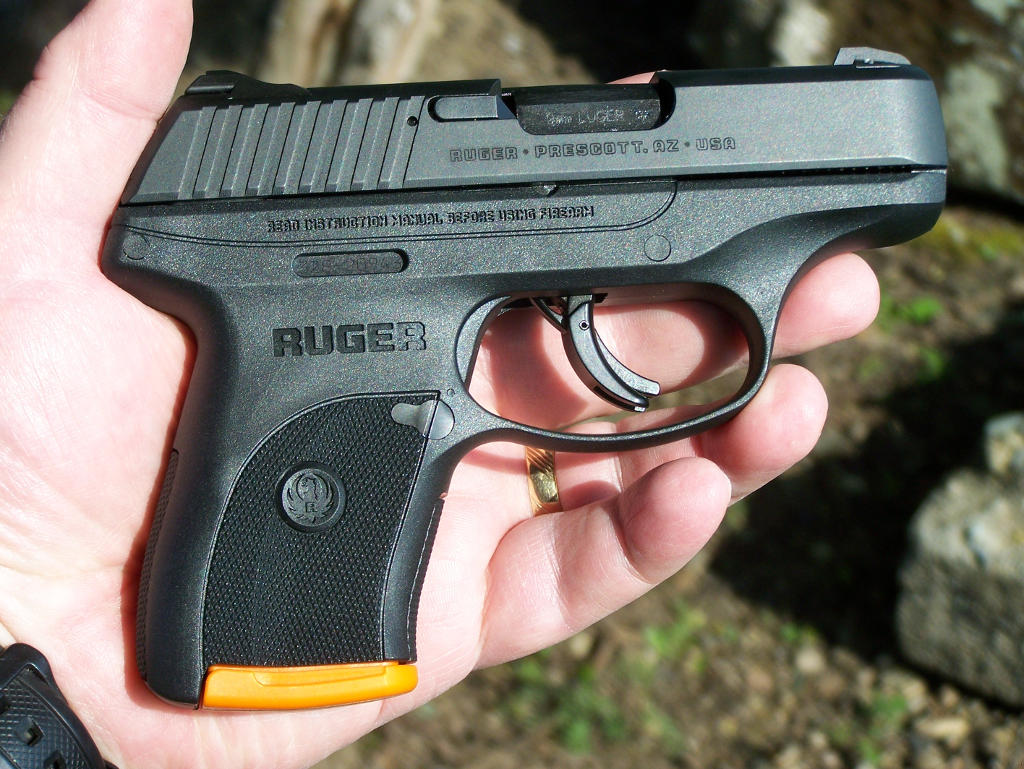
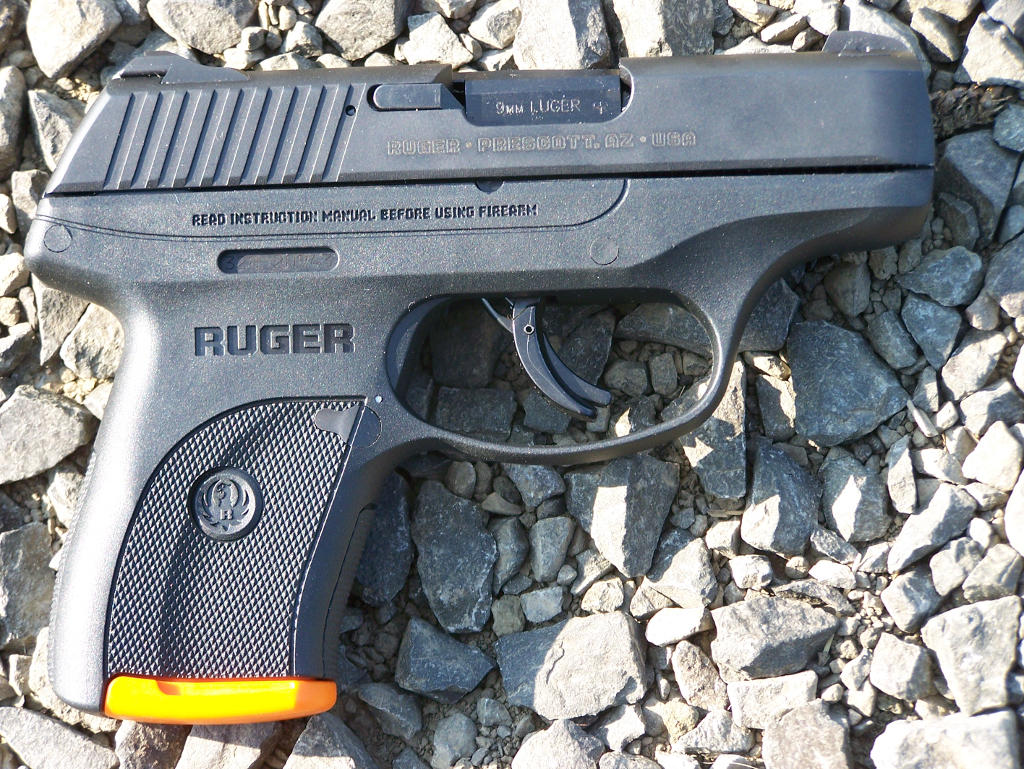
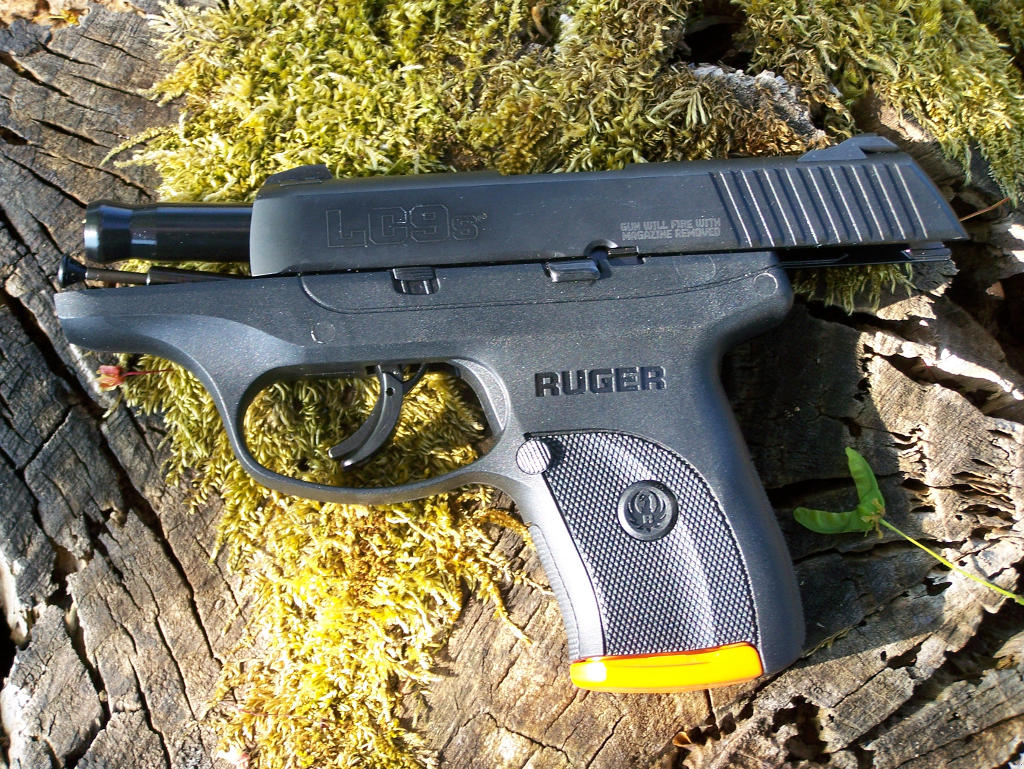
Enter the Ruger LC9s– a compact, 7+1 shot very concealable pistol, chambered in 9mm! I remember a few years back, when this pistol first came out as the LC9. It was a pretty decent pistol, and I purchased the sample that was sent to me. However, the double-action only trigger pull was long and heavy. Still, it was a good close-up handgun for self-defense. The LC9 felt good in the hand, too. Today we are looking at the improved LC9, known as the LC9s, and it has a shorter and much lighter trigger pull, making the gun all that much more accurate, too. The 3-dot sights are highly visible, which I like. The gun has a 3.12-inch Bbl, and the frame is glass-filled Nylon polymer, keeping the weight down to 17.20-oz. The slide itself is made out of through hardened alloy. The gun comes with one magazine, if you don’t count the bright orange inert mag that assists in taking the gun apart for cleaning.

100_5881

I had a good selection of 9mm ammo on hand for testing in the LC9s. I was going to test some +P+ ammo through the little gun. However, Ruger makes it clear, in no uncertain words in highlighted red letters that you should NOT fire any +P+ fodder through this gun. I elected to follow this guidance! From Black Hills Ammunition, www.black-hills.com I had 115-gr JHP +P, 124-gr JHP +P and their 115-gr FMJ ammo on hand. From Buffalo Bore Ammunition, www.buffalobore.com I had their 115-gr JHP +P, 124-gr JHP +P and their subsonic 147-gr FMJ FN ammo ready to go.

100_5880

I elected to keep all accuracy shooting at 15 yards, and I didn’t use a rest. All shooting was off-hand. There were zero malfunctions of any type during my testing of over 200-rds. The new and improved, shorter trigger pull was super sweet. If I did my part, I could keep all rounds inside of 3 1/2 inches. There was one clear winner in the accuracy department, and that was the 147-gr FMJ FN load from Buffalo Bore. Right on the heels of the Buffalo Bore load was the Black Hills 115-gr JHP +P load, and this one would be my choice for carrying in the little LC9s for self-defense. I believe with more practice I could get those groups down to right at three inches if I do my part, though. I did break the 3 1/2 inch groupings with the Buffalo Bore 147-gr FMJ FN load, but it took a lot of concentration on my part.

100_5885

As is my usual practice, I like to carry any handgun I’m testing for at least two week. I carried the little Ruger LC9s in a Blackhawk Products, www.blackhawk.com belt slide holster, and it kept the LC9s tight against my body. It was nice! I would like to see a second mag included with the LC9s; however, many people just don’t carry any spare ammo when they are packing a gun. That’s something I try to stress to my firearms students all the time. However, it’s easy enough to pick up a second mag at your local gun shop at the time of purchase.

The LC9s has quite the following these days with concealed weapon carriers, and it’s no wonder. It’s small, light-weight, accurate, reliable, and priced right– $449 at full retail. However, you can usually find Ruger handguns discounted at most gun shops. I tried hard to find something to not like about the LC9s, but I couldn’t. I just couldn’t! So, if you’re in the market for a dandy little 9mm concealed carry handgun, take a close look at the new and improved LC9s from Ruger. I think you’ll really like it.

– Senior Product Review Editor, Pat Cascio


Recipe of the Week: Campfire Hash Casserole

The few dry and canned ingredients make this great camp/survival food! It can be “doctored” up with various spices and meats. We buy the multi-packs of freeze-dried hash brown potatoes in waxed boxes from Costco at very reasonable prices or in packages through vendors online, and find them so very convenient for use at home regularly as well as when out hunting, camping, or any other time. They, of course, are great for storing for future preparations as well.

Ingredients:

  • 3 Tbsp vegetable oil
  • 2 boxes or packages of freeze-dried hash browns
  • 1/4 cup of freeze-dried or dehydrated onion pieces
  • 1 can cream of mushroom soup
  • 1/2 cup of dried shredded or grated parmesan or cheddar cheese
  • 1 can cooked chicken, beef, or other meat, drained (optional)

Directions:

  1. Boil about 3 1/2 cups water. Meanwhile, open boxes of hash browns and add half of the onion pieces into each.
  2. When water had boiled, pour into the boxes of hash brown potatoes/onion up to the fill line and close. (I use a clothes pin to hold the lid tight while they rehydrate about five minutes.)
  3. Heat oil in a large caste iron skillet over medium or medium- heat heat or campfire coals.
  4. After potatoes/onions have rehydrated, pour them into the hot oil, stirring occasionally until they have cooked through and begin to brown and crisp up. (If adding meat, add it after the potatoes begin to crisp up and just before adding the soup.)
  5. Add the can of soup and stir, until heated through.
  6. Top with the cheese and serve immediately.

Serves 4-6

o o o

Do you have a favorite recipe that would be of interest to SurvivalBlog readers? Please send it via e-mail. Thanks!


Letter Re: How to Get Your Doctor to Help You in the Age of Obamacare

Hugh,

I work for a large drug manufacturer and have spent 22 years as an analytical chemist testing and evaluating the stability of active pharmaceutical ingredients.

Medicines, except liquids, should be stored in the freezer. Liquids should be stored in the refrigerator or as cool as possible. Store the non-liquid medicine in its bottle in a plastic bag with desiccant inside. The worst enemies of drug products and active pharmaceutical ingredients (APIs) are temperature and humidity. The higher the temperature and humidity the faster your medicine will deteriorate. The longest drug stability times are associated with freezer conditions and low humidity. – J.P.