Radio Basics Presentation, by Saratoga

My purpose in writing this article is to focus attention on an area that is lacking for too many people. Having been in a group that did a lot of training, it became clear that this was an area that needed attention. We used email and cell phones to coordinate training location and times, but the thought was always in the back of my mind; what if there was no Internet or cell phones? How would we form up as a group? I have compiled the information into a simple, bullet-point scenario to make it easier to grasp and to focus on key areas. Also, there are exceptions to specific parts of this information, but for the majority of people it will apply.

Section 1 Radio Fundamentals

Radio Basics

  • Radio waves are all around us.
  • They transmit data, conversations, pictures, and music invisibly through the air over thousands of miles.
  • It happens every day, and they have changed society.
  • They control everything from cell phones to satellites.
  • A few of the everyday items:
    1. Garage door openers
    2. Radio-controlled toys
    3. GPS receivers
    4. Baby monitors
    5. Microwave ovens
    6. Airplanes depend on a dozen different radio waves

Radio Spectrum

  • Frequency chart
  • If I want to get this chart on one page, I can’t read many of the sections!
  • There are hundreds of frequency categories.

Section 2 RF Basics, Spectrum Ranges & Bands

RF Basics

  • Electromagnetic waves start at a source and picked up at a destination.
  • Travel near the speed of light.
  • The higher the frequency, the shorter the wavelength.
  • Frequency is measured in Hertz (cycles per second).
  • Radio frequencies measured in;
    1. kilohertz (KHz) – thousands of cycles per second
    2. megahertz (MHz) – millions of cycles per second
    3. gigahertz (GHz) – billions of cycles per second
  • Designing a system requires several categories to be checked off;
    1. Must operate over a certain distance = range
    2. Transfer a certain amount of info within a time frame = data rate
    3. Must do it economically = price
    4. Need to get government agency approvals (FCC) = regulations & licensing
  • Range determined by;
    1. Transmit power; amount of RF power that comes out of the antenna port.
    2. Receiver sensitivity; the minimum signal the radio can receive.Example using sound;

      transmit power = how loud someone can yell

      receiver sensitivity = how soft a voice someone can hear

RF Spectrum Ranges

  • Radio Frequency spectrum ranges from;
    • VLF (Very Low Frequency) – 3kHz to EHF (Extremely High Frequency) – 300GHz
    • All of the frequencies we are concerned with are in the HF, VHF and UHF bands.

Bands & Typical Distances

  • Nearby: VHF & UHF either direct or through repeaters
  • Regional: VHF & UHF through repeaters
  • Country-wide: HF direct, VHF & UHF via internet (unless it is down)
  • World-wide: HF direct, VHF & UHF via internet (unless it is down)

Section 3 Tactical Radios

CB – Citizens Band

  • Total of 40 channels.
  • Channels from 26.965 to 27.405 MHz (11 meter HF band).
  • Reliable range is 5-10 miles but can be much farther with the right conditions.
  • For use in personal and business activities of the general public.
  • There is no age, citizenship, or license requirements.
  • Can use any of the 40 channels, but channel 9 is used only for emergencies or traveler assistance.
  • Usage of all channels is on a shared basis.
  • Generally limited to 4 watts.

GMRS – General Mobile Radio Service

  • Total of 15 channels.
  • Channels 1-7 shared with FRS.
  • Channels from 462.5625 to 467.900 MHz (just above the 70cm Ham band) in the UHF band.
  • Range is normally 2-5 miles.
  • Requires a license ($85 / 5 years) but no exam.
  • Can transmit up to 50 watts but 1 – 5 watts is more common.

FRS – Family Radio Service Total of 14 channels.

  • Channels 1-7 shared with GMRS.
  • Channels from 462.5625 to 467.7125 MHz (just above the 70cm Ham band) in the UHF band.
  • Range is about 1-2 miles.
  • Initially proposed by Radio Shack in 1994 for use by families, authorized in the US since 1996.
  • Limited to 500 milliwatts (0.5 watts).
  • Must use permanently attached antennas.

MURS – Multi-Use Radio Service

  • Total of 5 channels.
  • Channels from 151.820 to 154.600 MHz (just above the 2m Ham band) in the VHF band.
  • Range is 2-5 miles.

MARINE

  • Total of 50 channels.
  • Channels from 156.000 to 157.025 MHz (just above the 2m Ham band) in the VHF band.
  • Limited to “on the water.”
  • Range is about 20 miles.

Scanners

  • Receiver used to monitor police, fire and emergency medical services on VHF and UHF.
  • Sequentially monitor multiple programmed channels or search between frequency limits.
  • Stops on an active frequency and resumes scanning other frequencies when that activity ceases.

Conclusion

Type Channels Range Power
CB 40 about 10 miles 4 watts
GMRS 15 about 2 miles 1-5 watts
FRS 14 about 2 miles 0.5 watts
MURS 5 about 5 miles 2 watts
Marine 50 about 20 miles 1-25 watts
Total: 132

Section 4 Ham Radio

Why Ham Radio?

  • It is the only form of communication when nothing else works.
  • Can’t be controlled by government despite government involvement (FCC licensing, etc.).
  • Can’t be shut down.
  • Might be able to disrupt one frequency for a limited time in a limited area.
  • Hams are routinely on air when there is no power.
  • Have to practice. You won’t be able to just pick up a radio and be proficient. (If you’ve never fired a gun, you aren’t a sniper with the first round).
  • Amateur radio has a tradition of “Elmers” – people who are willing to help.

How Ham Works

VHF & UHF

  • Radio to radio direct, known as “simplex.” Transmitting & receiving on the same frequency.
  • Most VHF and UHF communication uses “duplex,” using two different frequencies “offset” for transmitting and receiving and often activated by subaudible “tones” through repeaters.
  • Repeaters are powerful radios that, because of their prominent placement on mountaintops or tall buildings, facilitate wider range communication.
  • Technician license covers both VHF & UHF.
  • Both VHF & UHF are line-of-sight, short-range.

HF

  • General or Amateur Extra license needed.
  • HF communications use simplex, not repeaters.
  • HF doesn’t use channels (generally).
  • HF has skip zone (dead spot) at roughly 75-300 miles.
  • Military developed NVIS (Near Vertical Incidence Skywave) to communicate in the skip zone.

Radio Info

  • 3 Types of Radios
    • Handheld
    • Mobile
    • Base Station

Licensing

  • Ham classes are often free, and run by volunteers.
  • There are multiple websites to practice. (See below)
  • Ham exams cost $15 (fee for the Ham examiner) and can often be taken more than once on the same day if you don’t pass.
  • Technician exams are 35 questions out of a pool of 350 possible questions.
  • Get a (the ARRL Ham Radio License Manual) manual for the Technician license. Ham Radio Outlet has them as do numerous websites.

Ham Bands Chart

http://www.arrl.org/graphical-frequency-allocations

Short Wave

  • Generally 11 meters to 120 meters in the HF spectrum.
  • Travels more reliably for longer distances.
  • Often government broadcasts.
  • Listen only.

Antenna Modification

  • Known as a Tiger Tail
  • Use on handheld radios to increase range
  • YouTube Videos
  • Wire: 19.5″ for 2 meter, 6.5″ for 70 centimeter

Section 5 Wrap-up

Conclusion

  • Three Main Types of Radio Communication
    1. Short range – under 50 miles.
    2. Long range – state, country, and even worldwide.
    3. Scanning – keep tabs on what is going on around you.
  • Power (watts) and number of channels are key.
  • Ham radio is far superior to all other radio types.

Radio Comparison Service

comparison

Radio Websites

Exams

ARRL – American Radio Relay league

Manufacturers


Letter Re: Steel Buildings

HJL,

The writer of this letter has a few things wrong with regards the electrical properties of materials.

  1. Dielectric is a property of insulators, and there is no insulator between the zinc coating and the steel base of galvanized steel. Therefore, all the resulting claims that assume that the zinc and steel form a capacitor are false.
  2. The biggest problem with the shell of a metal building acting as a Faraday cage is the gaps between the panels that make up the surface. To act correctly as a Faraday cage the conductive surfaces need to make good electrical connection between the panels along all the seams. Ordinary construction techniques can’t be counted on to provide good electrical connection between the panels at the seams.

    Copper mesh can be used to make a good Faraday cage because copper can be soldered to, and the seams can be soldered or welded to provide reliable electrical connection between the panels.

    Trying to rely on mechanical connection instead of soldering or welding between panels may work as first but with time will degrade as the overlapped joints corrode.

  3. Concrete is slightly conductive, and concrete in contact with the earth such as a foundation or slab on grade with conductive materials embedded in it (think rebar) makes an excellent ground. Embed copper mesh in a concrete floor that is poured on grade, and the copper will be effectively grounded through the concrete. Bringing the mesh up above the concrete around the perimeter of the floor is important to allow it to be coupled without gaps to the conductive walls (and ceiling) that make up the rest of the Faraday cage.
  4. Grounding a Faraday cage never hurts, but is totally unnecessary for the functioning of the Faraday cage. The reason we ground electrical service entrances to buildings is to divert lightning strikes to the power lines to earth ground and greatly reduce the chances of lightning induced building fires. – RR


News From The American Redoubt:

Oregon allowing 15-year-olds to get state-subsidized sex-change operations – MtH

o o o

I recently attended a gun show in Bozeman, Montana, where I met a very skilled AK gunsmith, named Hector E. Bennet. He operates Elk River Tool and Die, in Belgrade, Montana. (He originally ran his business in Houston, Texas, before buying out all of Armory USA/Global Trades’ tooling, equipment, and stock on hand.) I highly recommend his work. He does fantastic quality AK builds. Phone: (406) 404-4227 or e-mail – JWR

o o o

Dollar value in each US state revealed with $100’s relative worth – JBG

Once again, the Redoubt region sizes up well. (Note that costs in Eastern Oregon and Eastern Washington are substantially lower than west of the Cascades.


Economics and Investing:

6 Signs The Great Crash Is Upon Us

o o o

In speaking to the liquidity crisis in Greece, the head of the Greek Banking Council, opines: “If that (cash) had not been removed, the Greek banks would not have had a liquidity problem,” she said…Katseli noted that since 2008, 124 billion euros worth of deposits has been withdrawn from Greek banks and that 40 billion of that money has been removed in the last few months.

You have to wonder how this would play out in a nation likely more leveraged than Greece. – T.K.

o o o

Items from Mr. Econocobas:

Greeks Get First Look At Their Future: Long Bank Lines And Punishing Taxes

Next Up On Europe’s Default Block——-Why Portugal’s Debts Are Unsustainable

China Announces 5th Largest Gold Holdings in World


Odds ‘n Sods:

Army Chief of Staff Gen. Odierno doesn’t want our soldiers to be “over-armed” – T.P.

o o o

Electromagnetic attack could claim 9 of 10 American lives – K.K.

o o o

Video (12min): Why Europe is lost to God – P.M. [Warning: Contains offensive material about genderism ideology]

o o o

?Sure we’re ready for TEOTWAWKI – California Bridge Collapse – F.G.

o o o

Lessons in History continued: ‘Production Versus Plunder’ ~ Part 16


Notes for Monday – July 20, 2015

On July 20th, 1969, at 10:56 p.m. EDT, American astronaut Neil Armstrong, 240,000 miles from Earth, spoke these words to more than a billion people listening at home: “That’s one small step for man, one giant leap for mankind.” Stepping off the lunar landing module Eagle, Armstrong became the first human to walk on the surface of the moon.


Scot’s Product Review: Winchester Ammunition

Winchester was kind enough to furnish some ammunition for me to review in both .223 Remington, 5.56x45mm NATO and 7.62x39mm Russian. The .223 load was their 69 grain Match round while the 77 grain one was the 5.56mm Match load. All of the rounds were tested for accuracy, and it was a very pleasing experience.

I should point out that while .223 and 5.56 look like the same round, the military 5.56 chamber is slightly different and can handle more pressure, so 5.56 ammunition should not be used in .223 chambers. It is acceptable, however, to use the lower pressure .223 rounds in a chamber marked for 5.56. This means, of course, that 5.56 ammunition generally offers more velocity and hits harder than .223 ammo.

The 7.62 loads were the 123 grain PowerPoint , a hunting round Winchester recommends for deer-sized game and the 123 grain full metal jacket (FMJ) that they suggest for target or plinking use.

The .223 and 5.56 ammo was tested in two AR’s. The first is a Lewis Machine and Tool (LMT) Defender. LMT is a brand usually considered in the top tier of AR quality. It has a standard M4 barrel profile, which means it is .750 inches in diameter from the gas port to the muzzle and reduced to .650 inches under the handguards to save weight. This one also has the cut for the M203 Grenade Launcher, which isn’t of much use to most of us. It is chrome lined and has a 1:7 twist rate to stabilize heavy bullets, like the 77 grain one being tested. The barrel is 16 inches long, however, unlike the M4 which has a 14.5 inch barrel. This is to meet federal regulations on short-barreled rifles without having to pin or solder the muzzle device on. You also get slightly more velocity.

The other AR is a home-built with a Bravo Company upper receiver and bolt carrier group and a Daniel Defense 16-inch Light Weight barrel that is .650 inches in diameter for its full length. It is also chrome lined and has a 1:7 twist rate. The thinner barrel is cold hammer forged, which many consider a superior method of barrel making, though there is much argument over the issue. LMT didn’t specify how their barrels were made at the time this carbine was manufactured.

I have grown to really like lighter barrels as they are far handier than the heavier ones. The difference is only a few ounces, but it feels like more. The only drawback to the lighter barrel would be if you are shooting a lot in a short time frame, as you might with an automatic weapon in a firefight. Since very few of us have automatic AR’s, that’s not likely to be an issue unless we work hard at it.

Neither AR has a free floated barrel, which usually but not always improves accuracy. The biggest advantage of free floating the AR barrel may be the fact that you can use a tight sling or rest the handguard on a support without causing barrel deflection.

Both carbines are capable of reliably shooting close to 1 minute of angle (MOA) groups using the right ammunition and a Leupold Vari-X 3.5-10x50mm scope. This is not, of course, going to win a bullseye match, but it is very respectable accuracy from short-barreled defensive weapons.

The 7.62×39 was used in a Century Arms C39V2, a U.S.-made AK-47 I reviewed recently, and a CMMG Mutant, which is a U.S.-made rifle I will be reviewing shortly. The Mutant is a very fascinating design based on the AR platform upsized for the Russian cartridge and using AK magazines. Both weapons have 16-inch barrels.

The .223 cartridge started life with bullets in the 55 grain range, but as shooters tweaked it for accuracy they experimented with heavier bullets with higher ballistic coefficients (BC). The higher the BC, the less a bullet is slowed by drag from air as well as the less it is affected by wind. A light bullet with a low BC may start fast; however, like the tortoise and hare fable, the heavy bullet with a high BC can win the race by retaining velocity and not being pushed off course by a cross wind.

Competitors still like the light bullets for shorter range matches, but as they go past 300 yards or so they began to see big advantages with 69 grain bullets. The Sierra MatchKing 69 grain bullet has turned out to be something of a gold standard for accuracy in rifles with the right barrel, which means having a 1:9 or faster twist rate.

Dabbling further, past 500 yards, shooters began trying 77 grain and heavier bullets with excellent results. The 77’s, however, are the heaviest that they have been able to get to work in AR magazines. Heavier ones are simply too long to fit, so they are used for hand fed single shots in slow fire or in bolt guns with longer magazines.

The Winchester Match 69 grain load uses the storied Sierra MatchKing bullet, while the 77 grain one uses the well regarded Nosler Custom Competition bullet. The 77 grain load appears to have the primers sealed with lacquer, while the 69 grain does not. The primers on both appear to have a slight circular crimp applied but nothing like the heavily-staked crimp found on most military ammo. That makes the brass better for reloading, but AR’s sometime have issues with primers popping out, hence the staking on military ammo.

When I pulled the bullets, I found the cartridge case is heavily crimped into the 77 grain bullet, while there is just a hint of a crimp on the 69 grain one. The 77 grain bullet has what appears to be a black asphalt sealant on it, so the 77 grain load should be far more weather resistant, and weather resistance is a feature that should be of interest to preppers.

I had 40 rounds of each load, and all functioned perfectly with no failures. Muzzle blast and flash were typical of .223 ammunition fired from this sort of rifle. The testing was done in an indoor range, and flash was well contained by the Yankee Hill flash suppressors mounted on both weapons. I would have liked to try a few rounds in total darkness, but I don’t have access to a range at night at the moment.

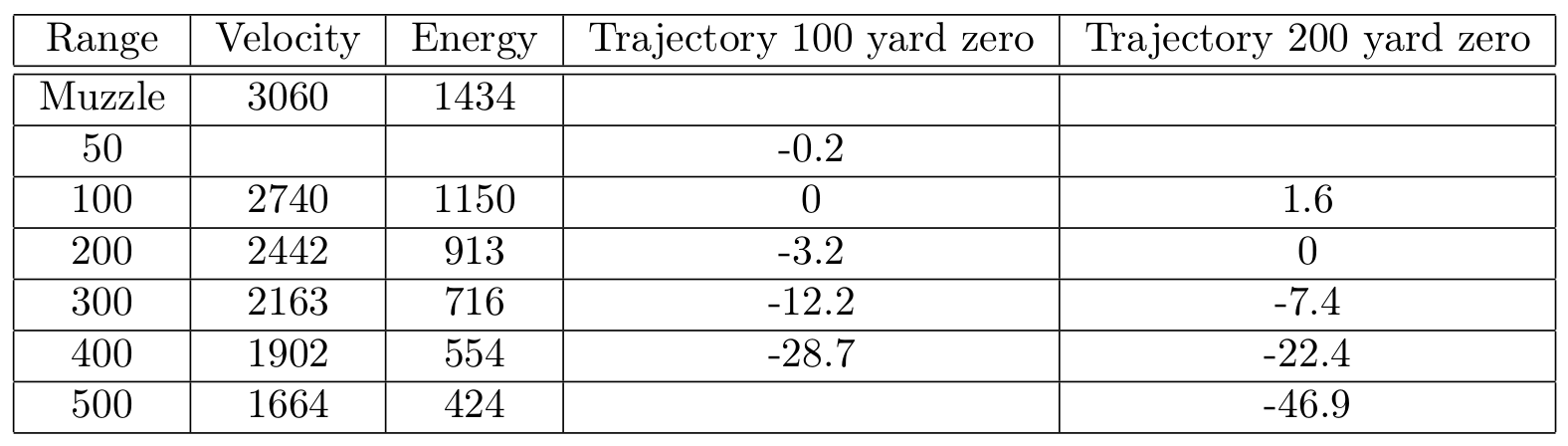
The 69 grain load has the following ballistics, according to Winchester:

Sfig1

I got an average of 2,735 feet per second at the muzzle out of the 16-inch barreled AR’s, which makes me think Winchester used a longer barrel for their figures.

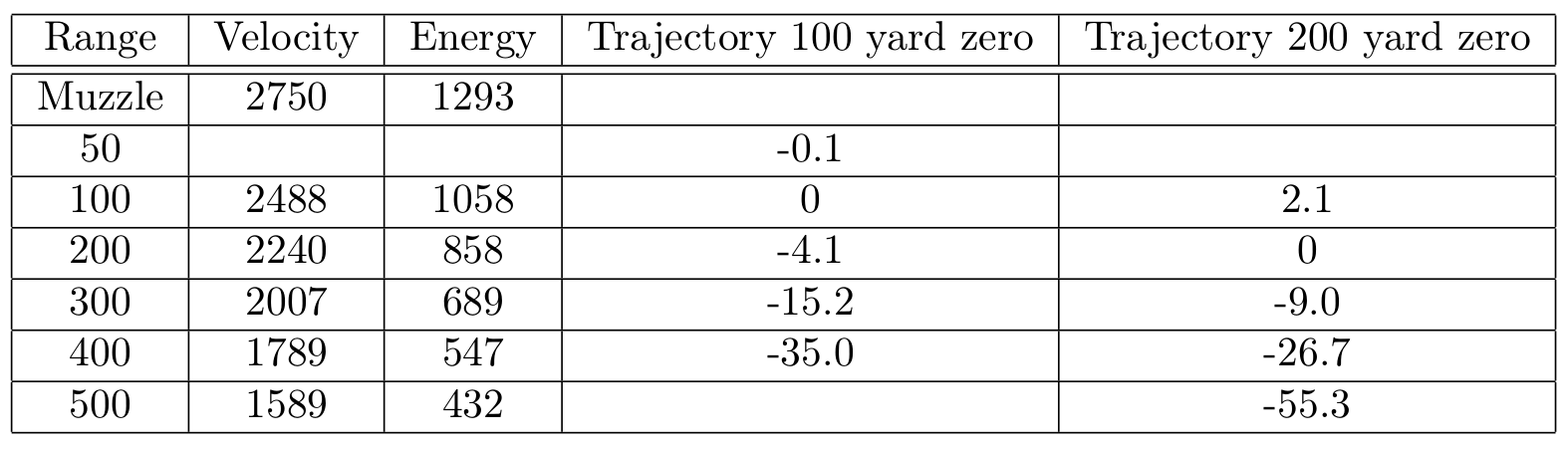
The 77 grain load ballistics from Winchester are:

Sfig2

With this load, I got a 2,732 feet per second average, which impressed me. A Winchester spokesperson said they measured these with 16-inch barrels, and that jives with what I got. That makes this a much hotter load than the 69 grain one.

Accuracy with both loads was good, though I was a bit frustrated with the LMT. It has yet to like a 77 grain bullet, though it has always done well with anything with a 69 grain MatchKing. The homebuilt AR with the Daniel Defense barrel, on the other hand, seems less finicky and shoots well with both bullets, though not as well with either as the LMT does with a 69 grain bullet.

The groups were shot at 100 yards at an indoor range, and the targets were analyzed with OnTarget, a $12 program that allows you to scan targets, input the bullet holes, and let it compute a very useful array of data. This is far easier than playing with a ruler and calculator, and it allows easy archiving of information.

The center to center (CTC) figure is what most of us traditionally measure as group size. It is the distance from the center of the two holes that are the farthest apart.

The average to center of group (ATC) figure may be more useful, however, as it gives us the average distance from the aiming point that a bullet will hit. This is actually what we want to know, how close our shot will come to the aiming point, but the problem with this measurement is that you could have a load and weapon combination that produces a flyer in every group. In other words, you could have several shots go through one hole but one that hits 10 inches out. The average might look okay, but if there are consistent fliers you will have trouble.

I like looking at both CTC and ATC as CTC will warn you about fliers while ATC lets you predict how close your shot will likely fall. The group width and height can give you an idea of which way the groups spread. I often find patterns, and if you know what they are it might help get a hit someday.

Sfig3
Sfig4

I shot five shot groups and used the data from the worst group with each rifle and load. While I’m not the best shot, sometimes I get lucky. I figure it is better to assume worst case than run with the best case. With these loads, the groups were pretty consistent. Ten shot groups are a better idea, but I usually am more consistent with shorter strings, and I like to let barrels cool a bit between groups.

Some of you may be wondering why I am interested in match loads, since this is a prepper site and not a match one. One reason is that I think it is important to have a known, consistent load for each rifle. This would be one that tells us all something is wrong if it won’t shoot well. The sights or action screws could be loose or something else has gone wrong. It also might be that we are just having a bad day. I have spent a fair amount of time testing things only to discover there was a problem I would have caught if I had only started and finished with my known good load.

The next thing is that we may need to make a precise shot at long distance, and having some primo high-grade ammo can help us make it.

A final reason is that the 77 grain match loads have turned out to be very effective rounds for self-defense use. All the work by competitors with them paid off when the US Special Ops troops wanted something capable of greater range and accuracy than their standard AR’s and developed the AR-based MK 12 Special Purpose Rifle. Black Hills Ammunition came up with the Mk 262 match grade round, using 77 grain open tip match (OTM) bullets, that allowed troops to make the best of the new rifle.

The rifle and round came in very handy as troops deployed to the open terrain of Iraq and Afghanistan and discovered that their lighter bullets weren’t delivering the desired performance in accuracy or stopping power. Soldiers equipped with the MK 12 rifle and MK 262 ammunition, however, had much better results. As well as superb accuracy, the 77 grain match bullets also delivered excellent wound ballistics– far better than the standard M855 round. Not only did it work better in the 18-inch barreled MK 12 rifle, but it also worked better in the 14.5 inch barrel M4, making it a very popular item on the front lines.

The one deficiency that I’ve seen noted with it is when there are intermediate barriers, such as auto glass between the shooter and target. Dr. Gary Roberts is a Navy reserve lieutenant commander who studied at the Army Wound Ballistics Research Laboratory and serves on the staff of Stanford University Medical Center. He also consults with federal, military, and law enforcement on wound ballistics and has done extensive research on .223 ammunition. He feels that the 77 grain bullet is not the best choice for getting through barriers in front of the target, even though it performs very well otherwise. It is, on the other hand, a great choice when one is concerned about over penetration.

The end point of this discussion on the MK 262 is that the Winchester 77 grain Match load should be very close to the same round. While the current version of the MK 262 uses a Sierra bullet, there were versions that used the Nosler found in the Winchester round. The velocity is essentially the same as the MK 262, thus the Winchester should make an excellent defensive round.

The 69 grain bullet, however, according to Roberts, does not match its heavier sibling in regard to wound ballistics, so it isn’t a good choice for defensive use. It should be relegated for accuracy testing.

The 7.62x39mm ammunition also worked flawlessly in both rifles. I had 60 rounds of the PowerPoint and 100 rounds of the FMJ. I followed the same procedures as I did with the .223 ammo with the Mutant, but since I did not have a mount to use optics on the C39V2, I had to use its open sights; its groups were not as good as they could have been.

Sfig5

The PowerPoint was clearly the winner in the accuracy category and would be the choice for self-defense as well. Roberts has tested this cartridge, and it is one of the loads he picks for 7.62×39. He notes that it also performs well through auto glass and should make an excellent round for hunting. I was especially impressed with PowerPoint in the Mutant. Many of us have discounted 7.62×39 as being inaccurate, but it is clear that you can get good accuracy with it in the right gun using the right load.

I didn’t find any information on how the Winchester FMJ round might work for defensive use, but Roberts notes a lot of variation in the performance of FMJ loads. Some yaw quickly in flesh and cause a lot of damage, while others simply sail through leaving a small wound. It is clearly a decent round for practice and plinking and, unlike the cheap imported stuff, it offers the advantage of quality reloadable brass, if you want to reload your ammunition.

I didn’t see any evidence of primer sealing on either load, nor did I find any sealant on the bullets. The bullets were both crimped into the case, but the primers didn’t have any noticeable crimping.

Personally, if I were using a 7.62×39 for defense, I would lay in a stock of the PowerPoints for serious use and use the FMJ for practice. One nice thing I noted is that the two rounds shot pretty close to the same point in both guns.

The PowerPoint and Mutant combination have made me think far better of this cartridge. Watch for the Mutant review, which should be up next.

– SurvivalBlog Field Gear Editor, Scot Frank Eire


Pat Cascio’s Product Review: Springfield Armory XDm 9mm

I’ve had a life-long interest in firearms, since I was a little boy back in the 1950s. I grew up watching all the western tv shows, like The Lone Ranger, Hopalong Cassidy, The Cisco Kid, Roy Rogers, and many, many other similar shows. To be sure, it was a fun time to be a kid. Today, kids can’t even point their finger at someone without the police being called. It’s a sad state of affairs, to be sure. So, I take firearms and firearms selection very seriously. Additionally, as an NRA firearms instructor who is certified in several disciplines, I’m always asked by my students, “What is the best firearm…” And, as I have stated before, this is a very subjective question. A Pat answer is, “The one you have with you, when you need it.” However, it goes much deeper than that. It all depends on what your intended use is for owning a firearm.

I have various handguns that I carry. Most are carried as part of my testing process for articles, though some are carried strictly for self defense, and some are carried for hunting purposes. Some are purchased for specific things, like a SHTF scenario. When it comes to this purpose, I am extremely particular as to which firearms are the ones I think I may need. They are the ones that won’t let me down– firearms that I know I can count on to see me through whatever disaster comes to mind. For many years, a GLOCK 19 was my go-to handgun in a SHTF situation, and it was kept well hidden in my home, with spare ammo and several spare (loaded) magazines. I knew the GLOCK 19 would always go “bang” when I pulled the trigger. However, the GLOCK 19 wasn’t the best fit for my hand. The Gen 4 models are better than previous iterations, but still it didn’t fit my hand as well as I liked. However, it was 100% reliable, and I knew it would see me through the bad times.

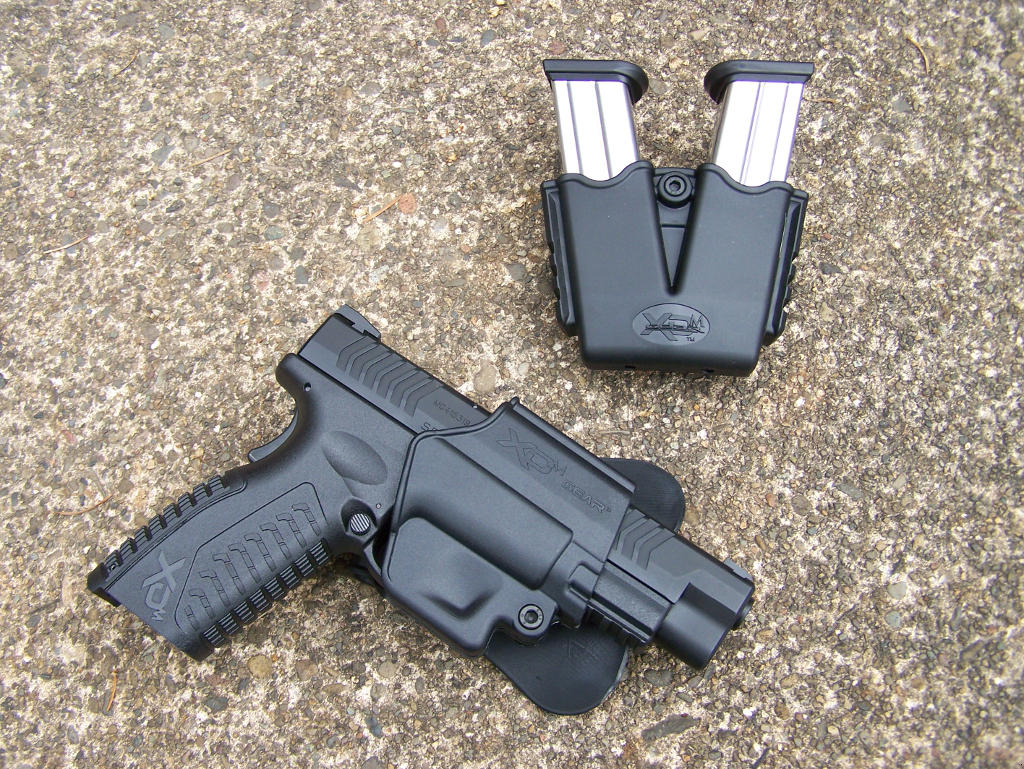
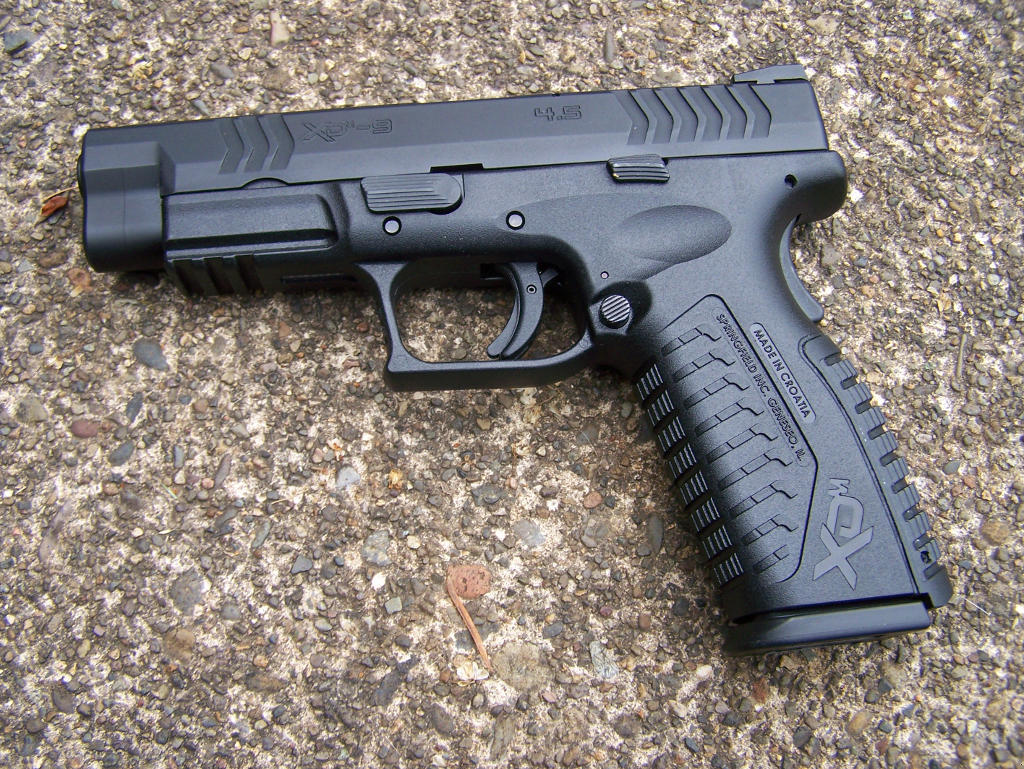
All of this has changed recently, when I received a Springfield Armory XDm full-sized 9mm for testing. To be sure, this is a full-sized, duty gun. And, “yes” it can be concealed with the proper holster and covering garments, though it still is a lot of gun to hide. A quick run down on the XDm is in order. My sample is the black version, but you can get one with a stainless steel slide. The frame is black polymer. The gun weights in at 29 ounces when empty; that’s still a fairly light-weight gun for its size. The black slide is coated in Melonite, and this is some pretty tough stuff and offers great protection from the elements. If you don’t think that’s enough, then go with the stainless steel slide version. We have three dot, white sights– one dot on the front sight and two white dots on the rear sight, which is a very fast sight picture for self defense use. The hammer forged barrel is 4.5 inches long, and it too is coated with Melonite. A full-length recoil guide system is in place. Height of the gun is 5.75 inches and the overall length is 7.6 inches.

100_5902

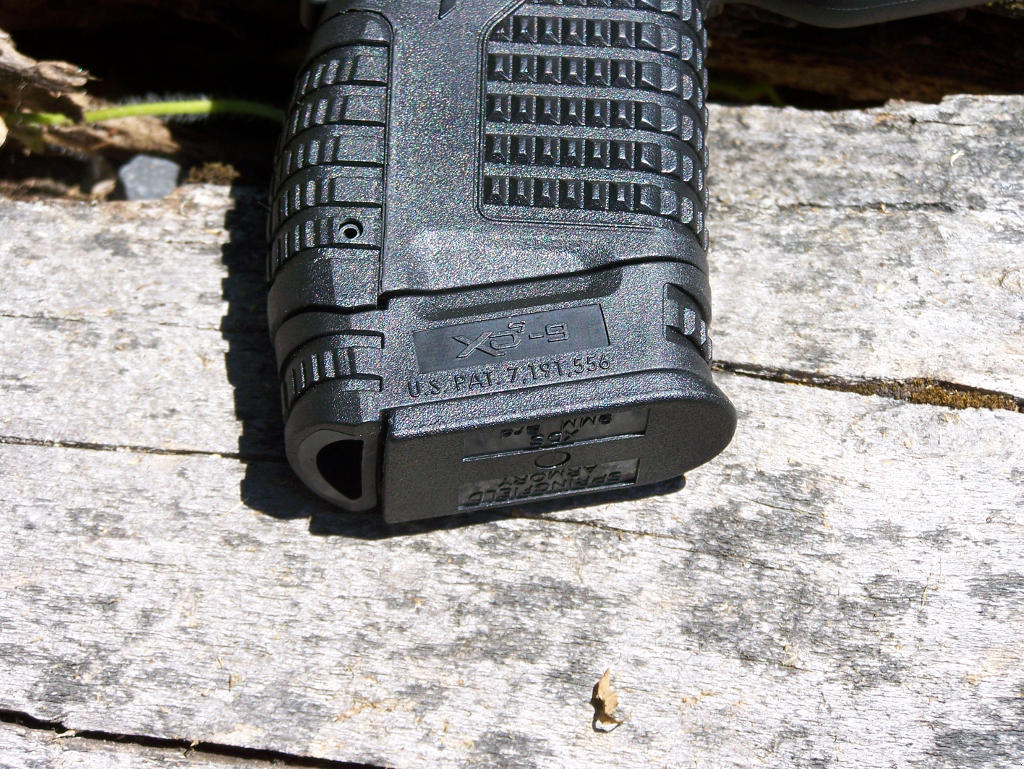
The XDm can also be had in .40S&W as well as .45ACP, if the 9mm isn’t your first choice. In my case, the 9mm is fine for self defense, stoked with a really good JHP round in +P or +P+. Yeah, I know, standard velocity 9mm JHP works very good, too, but I want a little more velocity and a bit more penetration in a 9mm self-defense round, so +P or +P+ is my choice. We can argue which round is better, 9mm, .40S&W, or .45ACP as a man stopper. I’ll concede that, at least in my own mind, the .45ACP stops ’em faster. However, I selected the 9mm XDm version for magazine capacity. This gun comes with two 19-rd magazines. That’s some serious on-hand ammo with 19+1 rounds in the gun and a spare mag with another 19 rounds loaded with JHP +P or +P+ ammo. That should get the job done. In a SHTF scenario, you never know what you might come up against, and having a lot of ammo in the gun, along with one or two more spare mags is very comforting in my mind.

100_5904

I had an early XD pistol in .40S&W, and the only problem I had with it was it didn’t have a very durable coating on the slide. The thing rusted, no matter what I did with it. Today’s XD lineup have a stainless steel slide or Melonite coated slides for superior rust protection. I probably own more Springfield Armory handguns than any other brand, and that’s for good reason; I love their 1911s and their entire XD lineup– XD, XDm, and XDs handguns. The XD handgun came on the scene many years back, but the company that was importing them from Croatia simply didn’t have marketing know-how, and the gun fell flat. Enter Springfield Armory, with their knowledge of marketing and Dave Williams, who runs their Custom Shop, adding his knowledge on improving the XD. Now, we have a real miracle story, and the XD lineup is a hot seller.

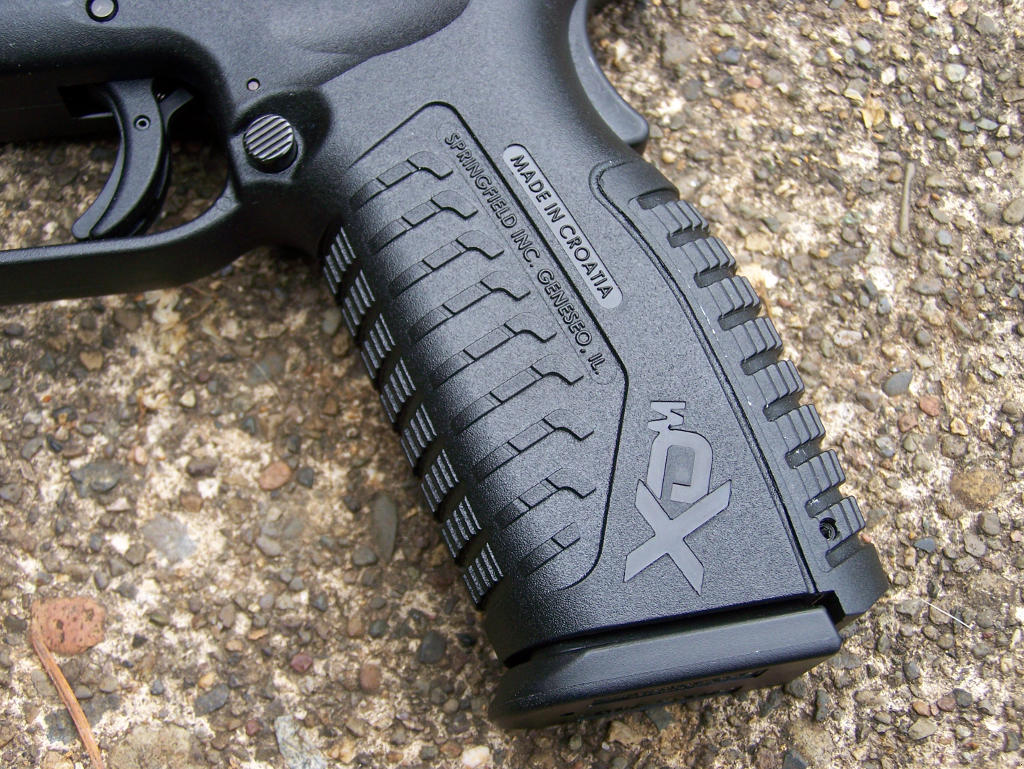
The XDm comes with three interchangeable back straps, and one is sure to fit your hand like a glove. My sample came with the medium-size one already on the gun, and I swapped it out for the smaller one; the gun felt all that much better in my hand. Springfield has something they call Mega-lock texturing on the polymer frame, and I will readily admit that it does feel better than the texturing found on the original XD frame. I like it, a lot! The trigger reset, after firing a shot, is much shorter than that found on the XD model, and the trigger pull is much better to my mind. There is that little safety in the middle of the trigger that prevents the gun from firing, unless you have your finger on the trigger and press the trigger fully rearward. There is also a grip safety that insures the gun won’t fire unless you have a good grip on it. It is instinctive; you don’t have to think about it. You just get a good grip on the gun and the grip safety is deactivated.

100_5906

The trigger pull on my XDm sample came in at 6-lbs, but it feels much lighter than that, and the actual trigger pull is shorter and much smoother than that found on many polymer framed handguns. One thing I never liked on the GLOCK is their “mushy” feeling trigger pull. The trigger guard is undercut just in front of the ambidextrous magazine release, so you can get a good, high grip on the gun. There are also divots on either side of the frame, where your thumb naturally comes to rest when you grip the pistol properly. Angled cocking serrations are on the sides of the slide, making it easy to get a good grip on the slide when chambering a round or unloading the chamber. The dust cover on the frame has Picatinny-style rails for mounting lights or lasers; that’s a nice touch. The trigger guard is squared and the front of it has the Mega-lock texturing, if you are one of the few to place your index finger of your off-hand in front of the squared trigger guard. The frame has a slide release/slide lock and the take-down lever; there’s nothing else to clutter up the frame. The top of the slide has a loaded chamber indicator right behind the barrel, and it will stick up a bit when there is a round in the chamber.

100_5909

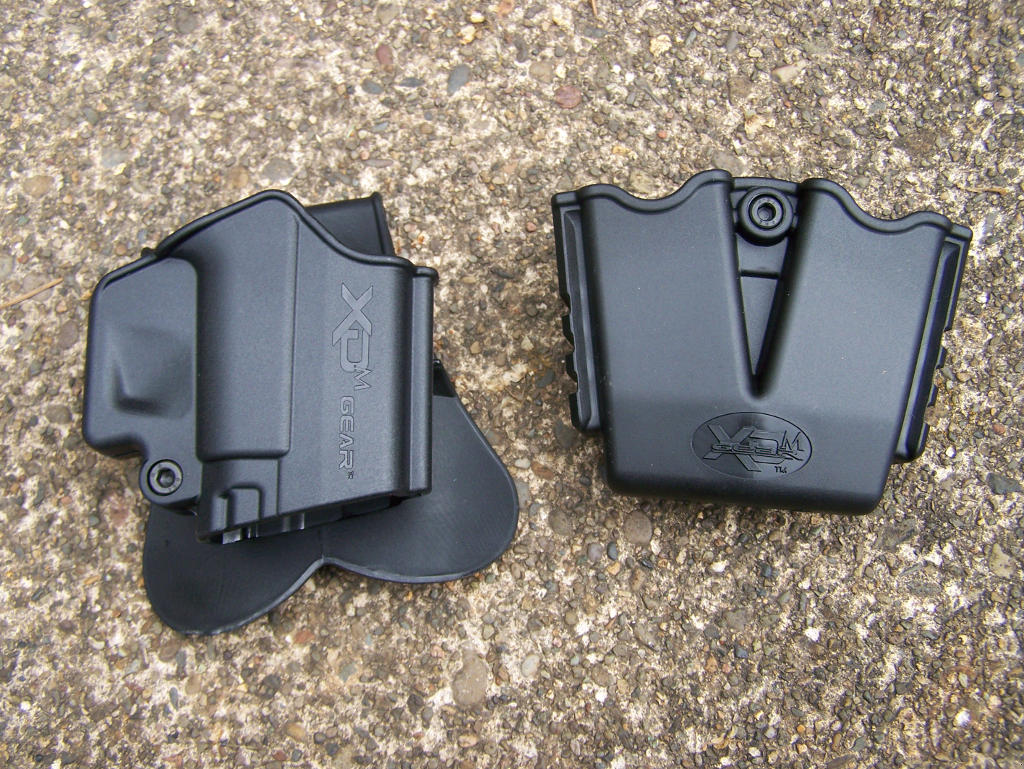
I carried the XDm 9mm for two weeks. I didn’t care for the polymer paddle holster that came with the gun, so I used a Blackhawk products, ballistic Nylon hip holster. That Blackhawk holster kept the gun high and tight to my body. (I just don’t like paddle holsters, period.)

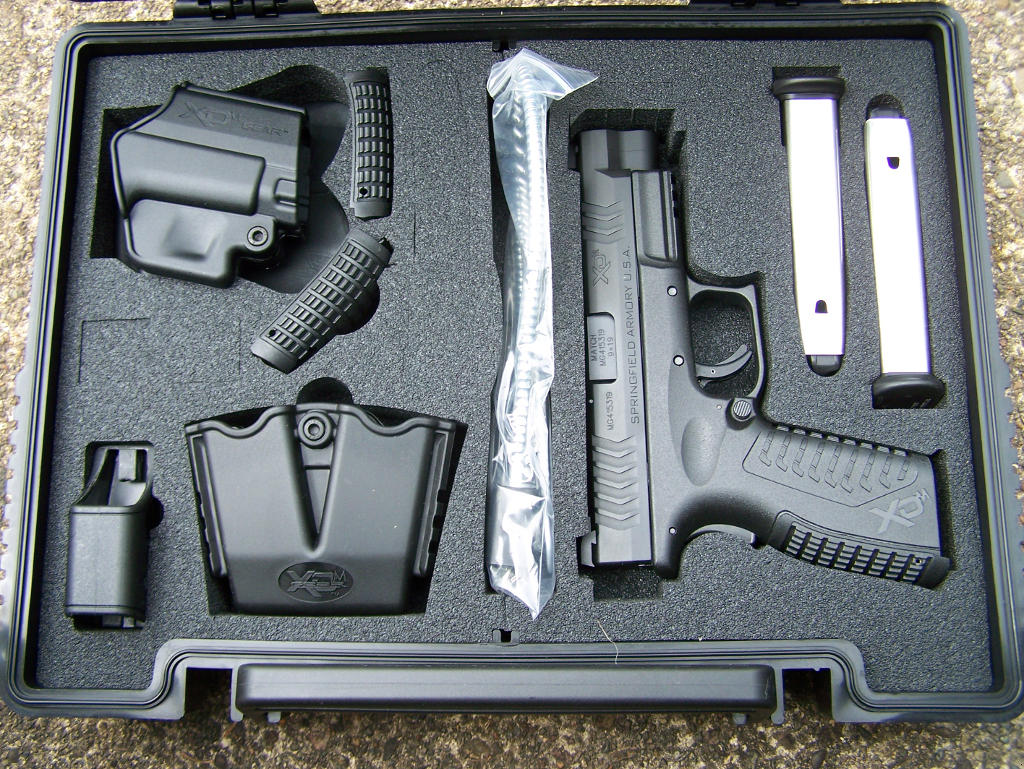
We have a lot of features on the XDm 9mm, to be sure. Plus, when the gun arrives, it comes in a hard shell polymer case with the second 19-rd magazine, as well as a holster and a double magazine pouch along with a bore brush and a great instruction manual. Additionally, you get a coupon for discounts on purchasing more spare magazines or holsters. What’s not to like here?

100_5912

I had an outstanding selection of 9mm ammo on hand for testing in the XDm 9mm. From Buffalo Bore Ammunition I had the following: their 147-gr FMJ FN and JHP (Gold Dot bullets) standard pressure loads, 124-gr FMJ FN Penetrator load +P+ load, 115 and 95 gr Barnes all-copper hollow point loads, but +P+ and a 124-gr JHP (Gold Dot) +P+ load. Whew! From the nice folks at Black Hills Ammunition I had their 115-gr JHP +P load, 124-gr JHP +P load, 115-gr Barnes all-copper hollow point load +P, and their 115-gr FMJ load, which was another great selection of loads for the XDm 9mm.

100_5914

Fully loading the 19-rd mags that come with the XDm 9mm can prove quite the chore, and the mags are very slick inside and out. That’s nice when it comes time for a reload; the mags pop right out, and a full mag inserts smoothly. Getting the last few rounds in the mag are a thumb buster. Use the included magazine loader that comes with the gun. A little trick I learned is to fully load your magazines and let them sit, loaded, for at least two or three weeks; then they are much easier to fully load the next time you use ’em.

In all my testing, I had zero malfunctions from the XDm 9mm, but I did not expect any problems. The gun just perked along during more than 500-rds of shooting. All empty cases where thrown several feet clear of the gun and to my right and slightly to the rear. I didn’t have any problems with the Buffalo Bore +P+ loads, and to be sure many full-sized 9mm handguns just won’t handle +P+ loads reliably, so make sure you test your own particular handgun to make sure it will function 100% of the time with any +P+ loads you want to carry. Also, I wouldn’t feed any 9mm handgun a steady diet of +P+ fodder. Make sure your gun functions 100% of the time with it, and then do most of your practicing with +P or standard velocity loads so you don’t subject your gun to any more wear and tear than necessary.

My accuracy testing was conducted over the hood of my pickup truck, using a rolled-up sleeping bag as a rest, which is my preferred method, instead of using a Ransom Rest. Yeah, I know, I could wring out more accuracy with a more solid rest, but I wouldn’t have a Ransom Rest with me in a gun fight, where I might have a jacket I could use as a rest for long range shooting. All shooting for accuracy was done at 25 yards. The XDm gave me pretty consistent groups right around the three inch mark for five shots, so long as I did my part. I had some groups that were four inches and that came from the 124-gr +P+ Buffalo Bore Penetrator ammo. The best grouping came from the Black Hills 124-gr JHP +P load, which is always a good load and a great self-defense load. The Black Hills 115-gr FMJ load was right on the heels of the 124-gr JHP +P load. Both of these loads just ever so slightly came in under three inches. I think the XDm can do better though. Maybe I just needed more trigger time or a better rest when shooting. Still, a three inch group with ammo it liked is nothing to sneeze at. I’ll take it!

100_6116

Checking around, the XDm 9mm can be had in my neck of the woods for $559 brand new, and I saw some used, but 99% as-new ones for $499. For all you get with the gun, that’s a real bargain from Springfield Armory. Yep, there’s no doubt about it; for a SHTF or End Of The World scenario, the XDm 9mm would be my first choice. It offers lots of ammo on tap, is 100% reliable with any kind of ammo you feed it, and is priced right! What’s not to like here? I’m so glad I retired my GLOCK 19. There is a new king in my house for a SHTF scenario.

– Senior Product Review Editor, Pat Cascio


Recipe of the Week: Nacho Taco Meat, by K.M.

My kids LOVE Tacos, and we’ve found a tasty and healthy recipe to extend the family budget while giving them what they want. With a bag of Nacho chips, we’re able to feed a family of five at least 1.5 meals, sometimes two meals (if the boy’s aren’t hungry!)

Ingredients:

  • 1 lb. ground meat (beef works for us, but I imagine you could substitute what’s available)
  • 1 8-oz. can red kidney beans, drained (dried work fine, if you care to cook them)
  • 1 8-oz. can black beans, drained (dried work fine, if you care to cook them)
  • 1 8-oz. can crushed tomatoes (optional)
  • 1 8-oz. can/jar salsa (optional)
  • 1 onion, diced
  • 3-4 garlic cloves, diced
  • 1 cup shredded butternut squash (or similar, optional)
  • Worcestershire sauce,
  • salt and pepper,
  • basil,
  • garlic powder,
  • cumin,
  • paprika,
  • cayenne powder,
  • chili powder,
  • Tabasco sauce,
  • diced green chili,
  • other seasonings, to taste.

Directions:

  1. Brown onions with a little oil on medium heat until golden.
  2. Add garlic, brown another few minutes.
  3. Add meat, Worcestershire sauce, salt, and pepper; stir occasionally while cooking thoroughly.
  4. Add in the grated squash; it’s a great way to extend the meal, add some nutrition, and the kids will never know it’s there. Grate it using a food processor, or we typically chunk it up then send it through the cheese-grater by hand. Mix well with the meat, and cook another 5 minutes until tender.
  5. Add all canned ingredients (though dried beans must be thoroughly pre-cooked), including liquid from the tomatoes. (You can substitute a cup of Spaghetti sauce or similar, if kids cringe at tomatoes, but an acidic sauce component is important to help break everything down. Add a splash of ketchup, if nothing else.)
  6. Simmer for 10-30 minutes to drive off some of the liquid, or as long as needed, season to taste with all (or any chosen) seasonings to taste. (I like spicy, flavorful food. I dump in the cumin and basil and garlic, and liberally dash w/ the peppers and sauces until my eye’s start to water.)
  7. Simmer with seasoning for 15 minutes on low. Add a pinch of brown sugar to cut some of the spice. (Maple syrup and honey work well, too. Just a dash of sweetener will help cover some of the heat.)

Can be spooned over nacho chips, rolled up in a soft shell, or add a couple cups to a block of cheese in a crock pot for some seriously incredible meaty nachos cheese sauce.

There’s a pre-packaged 1 lb. block of ground beef from our local beef-farmer defrosting in the fridge right now. Guess what my kids are eating tomorrow? LOL!

o o o

Do you have a favorite recipe that would be of interest to SurvivalBlog readers? Please send it via e-mail. Thanks!


Letter Re: Chattanooga Terrorist Attack

Hugh,

Is this worth exploring further? I could not find any more information on this yesterday, but it is definitely interesting as it relates to the Muslim terrorist attack in Chattanooga. Also today, Trevor Loudon has information that expands on it.

I expect more will come out from this in the days ahead. Also very glad to hear that governors of several states are taking the security of our military recruitment centers in their own hands.

Hugh Responds: This shooting in Chattanooga is truly a tragedy, especially for the families of those four marines who were gunned down. Nothing can be said to ease the pain and suffering they feel. I have no doubt that Islamic extremists are on American soil, and I suspect that we will be hearing much more about this type of attack. It is truly difficult to deal with this type of enemy, and despite Obama’s thinking that all they really need are jobs, we will not see peace until we treat this war the same way that all opponents of it who have survived in years past have treated it. The violent extremist only understands violence. Enough with the political correctness! With that said though, it must be stated that the Governors of these states are embarking down a very dangerous road. When you look at history, you will see a long-standing tradition of arming your military to the max when they are on foreign soil, but when they come home, they are disarmed. People have understood for millennia that an armed military at home can easily interfere in the political process, either by participating in a military coup or by becoming the enforcing agent of an unpopular political regime. I would suggest a web search on the phrase “crossing the Rubicon” to grasp the concept in full.

I am not saying that the military person should be at the mercy of such terrorist acts on their own soil though. While the courts have ruled that the civilian police do not have a duty to protect and defend the general population, I fully believe that the MP should be given wide latitude on military installations because if you are not going to allow the military man to protect himself, you have now taken on that responsibility.

Another question to ask is why, if the alphabet agencies can apprehend the mentally ill person that they have primed and armed to commit such terrorist acts, why do they have such a difficult time apprehending a real terrorist, even when they have had the family under surveillance for years? I’m beginning to think that the shooter is not the only one with blood on his hands in this mess.


Notes for Sunday – July 19, 2015

July 19th is coincidentally the birthday of handgun designers Samuel Colt (born 1814) and Gaston Glock (born 1929).

o o o

Today, we present another entry for Round 59 of the SurvivalBlog non-fiction writing contest. The $12,000+ worth of prizes for this round include:

First Prize:

  1. A Gunsite Academy Three Day Course Certificate, good for any one, two, or three day course (a $1,195 value),
  2. A course certificate from onPoint Tactical. This certificate will be for the prize winner’s choice of three-day civilian courses. (Excluding those restricted for military or government teams.) Three day onPoint courses normally cost $795,
  3. DRD Tactical is providing a 5.56 NATO QD Billet upper with a hammer forged, chromlined barrel and a hard case to go with your own AR lower. It will allow any standard AR type rifle to have quick change barrel, which can be assembled in less than one minute without the use of any tools, and a compact carry capability in a hard case or 3-day pack (an $1,100 value),
  4. Gun Mag Warehouse is providing 20 Magpul pmags 30rd Magazines (a value of $300) and a Gun Mag Warehouse T-Shirt. (An equivalent prize will be awarded for residents in states with magazine restrictions.),
  5. Two cases of Mountain House freeze dried assorted entrees in #10 cans, courtesy of Ready Made Resources (a $350 value),
  6. A pre-selected assortment of military surplus gear from CJL Enterprize (a $300 value),
  7. A Model 120 Series Solar Generator provided by Quantum Harvest LLC (a $340 value),
  8. A $300 gift certificate from Freeze Dry Guy,
  9. A $250 gift certificate from Sunflower Ammo,
  10. KellyKettleUSA.com is donating both an AquaBrick water filtration kit and a Stainless Medium Scout Kelly Kettle Complete Kit with a combined retail value of $304,
  11. TexasgiBrass.com is providing a $300 gift certificate, and
  12. Two cases of meals, Ready to Eat (MREs), courtesy of CampingSurvival.com (a $180 value).

Second Prize:

  1. A Glock form factor SIRT laser training pistol and a SIRT AR-15/M4 Laser Training Bolt, courtesy of Next Level Training, which have a combined retail value of $589,
  2. A FloJak EarthStraw “Code Red” 100-foot well pump system (a $500 value), courtesy of FloJak.com,
  3. The Ark Institute is donating a non-GMO, non-hybrid vegetable seed package–enough for two families of four, seed storage materials, a CD-ROM of Geri Guidetti’s book “Build Your Ark! How to Prepare for Self Reliance in Uncertain Times”, and two bottles of Potassium Iodate– a $325 retail value,
  4. A $250 gift card from Emergency Essentials,
  5. Twenty Five books, of the winners choice, of any books published by PrepperPress.com (a $270 value),
  6. TexasgiBrass.com is providing a $150 gift certificate, and
  7. RepackBox is providing a $300 gift certificate to their site.

Third Prize:

  1. A Royal Berkey water filter, courtesy of Directive 21 (a $275 value),
  2. A large handmade clothes drying rack, a washboard, and a Homesteading for Beginners DVD, all courtesy of The Homestead Store, with a combined value of $206,
  3. Expanded sets of both washable feminine pads and liners, donated by Naturally Cozy (a $185 retail value),
  4. Two Super Survival Pack seed collections, a $150 value, courtesy of Seed for Security, LLC,
  5. Mayflower Trading is donating a $200 gift certificate for homesteading appliances,
  6. APEX Gun Parts is donating a $250 purchase credit,
  7. Montie Gear is donating a Precision Rest (a $249 value), and
  8. Two 1,000-foot spools of full mil-spec U.S.-made 750 paracord (in-stock colors only) from www.TOUGHGRID.com (a $240 value).

Round 59 ends on July 31st, so get busy writing and e-mail us your entry. Remember that there is a 1,500-word minimum, and that articles on practical “how to” skills for survival have an advantage in the judging.