SurvivalBlog is seeking additional prize sponsors for our Writing Contest. The prizes are awarded once every two months, and each must have a minimum value of $200. The links provided with each contest entry are a great way to get publicity for your product or service. And for anyone who has been frustrated by our long waiting list for advertising space on SurvivalBlog, this is a way to get more immediate attention from the blog’s 300,000+ readers. Just e-mail us if you are interested in becoming a prize sponsor. Thanks! – JWR
A Gunsite Academy Three Day Course Certificate, good for any one, two, or three day course (a $1,195 value),
A course certificate from onPoint Tactical. This certificate will be for the prize winner’s choice of three-day civilian courses. (Excluding those restricted for military or government teams.) Three day onPoint courses normally cost $795,
DRD Tactical is providing a 5.56 NATO QD Billet upper with a hammer forged, chromlined barrel and a hard case to go with your own AR lower. It will allow any standard AR type rifle to have quick change barrel, which can be assembled in less than one minute without the use of any tools, and a compact carry capability in a hard case or 3-day pack (an $1,100 value),
Gun Mag Warehouse is providing 20 Magpul pmags 30rd Magazines (a value of $300) and a Gun Mag Warehouse T-Shirt. (An equivalent prize will be awarded for residents in states with magazine restrictions.),
Two cases of Mountain House freeze dried assorted entrees in #10 cans, courtesy of Ready Made Resources (a $350 value),
A Model 120 Series Solar Generator provided by Quantum Harvest LLC (a $340 value),
A $250 gift certificate from Sunflower Ammo,
KellyKettleUSA.com is donating both an AquaBrick water filtration kit and a Stainless Medium Scout Kelly Kettle Complete Kit with a combined retail value of $304,
TexasgiBrass.com is providing a $300 gift certificate, and
Two cases of meals, Ready to Eat (MREs), courtesy of CampingSurvival.com (a $180 value).
A FloJak EarthStraw “Code Red” 100-foot well pump system (a $500 value), courtesy of FloJak.com,
The Ark Institute is donating a non-GMO, non-hybrid vegetable seed package–enough for two families of four, seed storage materials, a CD-ROM of Geri Guidetti’s book “Build Your Ark! How to Prepare for Self Reliance in Uncertain Times”, and two bottles of Potassium Iodate– a $325 retail value,
A $300 gift certificate from Freeze Dry Guy,
A $250 gift card from Emergency Essentials,
Twenty Five books, of the winners choice, of any books published by PrepperPress.com (a $270 value),
A pre-selected assortment of military surplus gear from CJL Enterprize (a $300 value),
TexasgiBrass.com is providing a $150 gift certificate,
RepackBox is providing a $300 gift certificate to their site, and
Safecastle is providing a package of 10 Lifestraws (a $200 value).
A large handmade clothes drying rack, a washboard, and a Homesteading for Beginners DVD, all courtesy of The Homestead Store, with a combined value of $206,
Expanded sets of both washable feminine pads and liners, donated by Naturally Cozy (a $185 retail value),
Round 60 ends on September 30th, so get busy writing and e-mail us your entry. Remember that there is a 1,500-word minimum, and that articles on practical “how to” skills for survival have an advantage in the judging.
#1 Trusted Gravity Water Purification System! Start Drinking Purified Water now with a Berkey water filtration system. Find systems, replacement filters, parts and more here.
Get. Out. Now. Or as soon as reasonable. To the many who are reading this and working outside the Redoubt waiting on “something” before they sell their house and move, that is a mistake. This ongoing chronicle lists just one person’s challenges in moving.
A Radical Proposal
Even if much goes to hell (I’m not swearing but only using the proper word for an origin and destination), much won’t, and it will vary. Multiple nuclear bombs is a tiny possibility, like a major earthquake or volcano. It is also unlikely that it will happen suddenly. Most likely it will be a drip, drip, drip, that you won’t leave until it is too late. There are doomsday preppers who have their bunkers and are prepared to disappear for a decade. Most want to create an island where they can exist on their own, never going to church, as it is too far and planning to rarely see their neighbors.
Most likely it will break down a lot, but not everything will go. Twenty percent is likely to be left. What 20% will remain? Much depends on where in the Redoubt or elsewhere you end up. Does it have a refinery with local oil production? What does electricity depend on? Is it hydroelectric or something that requires infrastructure? Is the agriculture “on grid” or do things like irrigation, seeds, fertilization occur without the grid or transport? The answers are different for different areas of the Redoubt.
If you can find an area where there are Amish (not so much here but elsewhere in the USA), food won’t be a problem. Doing something the Amish need or even want as a luxury that you can trade them for food will be useful. (Can you make plow blades, build wagons and carts, weave, or even provide manual farm labor?)
However, you need to figure this out now. It is very difficult to do from the outside, and you won’t know how many solar panels you need before or what size windmill. It differs across the Redoubt, and they won’t be available after the crash. If you are already there, you can start building your personal para-grid infrastructure while renting and then transplant it when you find your ultimate final location.
You need to ask or arrange work that you can do over the Internet, remotely, or have a portable skill. You need to sell your house now, not before the economy crashes and you can’t. Rent if you must. You need to find a location within the Redoubt and move there. College towns and many others have full broadband. It will be easier to look within a few hours drive from where you are already working (and have found a credit union or bank, doctor, post office, et cetera) than having to take long drive vacations to scout and manage things. You’ll need to know which cell phone networks work (4G, 1xRTT?) as you drive around your targeted area and have access to that service? Is there broadband, fiber, or will you have to go to satellite for your Internet access? Are there active Ham clubs nearby? These and more are things you will need to resolve and are easier done from nearby.
Moving to the area where you want to end up has several benefits:
Some benefits of being a citizen of a particular state only accrue after you’ve been there for a year. Start the clock.
Your vote counts as soon as you move in. If every Patriot in Puget Sound moved across the cascades, there would be no sheriff that didn’t follow the Constitution on that side. Ask Gavin Seim if it would have helped in his area.
You will know the area. You’ll learn which doctors will call the authorities if you don’t immediately give your kids 24 vaccinations and which doctors have midwives and dulas in their rolodex. You find where the different stores are for hardware, groceries, and other supplies. You find churches, where to get your car repaired and hair cut and more.
You won’t be a stranger when the crash comes. Would you believe someone who just showed up? If you are already active in the community, renting in town, then move nearby, you aren’t such an outsider.
You can find what is useful. As I said, it will be 20% that remains. Many places have community supported agriculture (CSA). If other farmers are already working hard providing food and will be able to do so even if the grid fails (with help?), why do it yourself? Can you fish or hunt? Maybe you can buy a freeze-dryer so you can supply things in the winter.
This is perhaps the most important; you can find a priest or pastor aligned with your beliefs and arrange to be near them. I can walk to daily mass (I’m Catholic). It might take a few more minutes if there is a blizzard, but I can go. If I was two hours away on a clear day, I wouldn’t be going. If he isn’t prepping already, you can support him.
Dehydrate, can, freeze-dry, preserve for the winter the CSA food available in the late summer and fall. Find something they need that you can provide better than they can do themselves. Do your day job, but also become indispensable to the community after the crash. You will have solar power. You will have the capability of machining metal. You will be able to communicate across the world. I’ve not mentioned creating a totally independent farm. That is really, really, hard, and if you are spending eight hours a day at a computer keyboard, are you going to be able to tend to your Nigerian Dwarf goats to milk them. (Here, there is little CSA milk. Were I to do ranching, it would be them or cows bred for milk not meat.) How is the medical infrastructure? There is oil production and a refinery. Paying $100/gal gasoline is different than no gasoline.
At my location, food is unlikely to be a problem, and electricity is via hydro. There is little milk or dairy, little CSA or local milk and cheese. There is a comm infrastructure, but I can contribute. Other areas are completely different. They may have corn but few other vegetables. They may have little meat, and hunting will be remote. Some are dependent on high-maintenance, high-tech electricity. In some places, water is difficult or expensive to obtain. Some places are easily defensible (hence “redoubt”), others will be overrun easily. Some places are a blue pimple, some are pure red. That you can investigate now. You need to figure out where you fit in in your area.
Remember your pastor, who might not be as well prepared. If he is miles away, can you support him? If you are Catholic, you will have to prep or grow wheat and grapes for communion. That is why we need to create a parallel, robust “grid” of our own.
After TEOTWAWKI, it might be something we barely notice. The Amish will only notice most of their customers have no means of paying, with cash, barter, or other trade. We can build our own “grid”. As we reject the “culture of death”, we can build a culture of life and civilization, including our own backup grid. Think about what parts of the grid the government is dependent on.
Communications
I want to go on a tangent here for a bit and discuss communications. Everyone needs it, especially in a TEOTWAWKI situation, and it can be something valuable to you can provide also if your neighbors don’t have it to keep informed. It is also a good way to build relationship in your new community.
CB Radios require no FCC license and can do up to 12 watts on SSB (4 on AM), and given the right sunspot situation (ask the Creator of the sun to provide this) it can bounce on the ionosphere like 10 meter, though the FCC says you can’t intentionally try to contact someone over 160 miles away. Still, you can listen in on a conversation between neighbors in Idaho, even when you are near the east coast.
For the non-technical, the carrier is merely a waste of power. Transmitting on both sidebands is also a waste. When you take the audio and apply it to the radio wave generator, it generates two sidebands. One sideband is at a higher frequency, and one on a lower frequency; they’re the carrier frequence plus the audio and minus the audio. So, if you eliminate the redundant signal, you need only one sideband. I would suggest Channel 3, upper sideband for Redoubt business.
If you have been thinking of helping AMRRON, you don’t have to wait. Ask a trucker. The Galaxy line of CBs has one that does SSB, there maybe better. The amateur radio operators can help you with antennas (NVIS v.s. omni) so your 12 watts go as far as possible. An infrastructure can be created for comms, including longer distance. Get a mobile, but use it as a base station.
You can do this, and you don’t have to have or give a callsign. Given the trucker usage, think of what you could do simply by driving your vehicle near the top of the local mountain or high ground so you can have your conversation heard over a very large valley.
This is not to dismiss FRS or actual Ham radio, but many don’t have the time to study, and UHF doesn’t travel beyond line-of-sight. I suggest implementing communications that involves “both-and”, rather than “either-or”.
The Practical
There are practice nets, but they are generally for Hams.
Truckers are thankful for information on speed traps and other such road activity. Idaho’s State Patrol has just had Desert Snow Training – so I think they are “fair game“. Also the Spokane County Sheriff. They need CSPOA.org training, not SPLC or forefeiture training. We could all practice daily by listening to CB channel 19 and forwarding the “smokey” reports to truckers. They can report speed traps, and you can relay them. Also, if there is something of an emergency, even a disabled vehicle, CB Channel 9 can be used to report it.
We could also shut down Idaho Desert Snow, at least where we have coverage. Do not think it is just about drugs. The police see you change lanes without signaling, pull you over, and either say they smell marijuana or that your air freshener is suspicious. Then, they ask if you consent to a search. If you don’t consent, they will get a drug dog, which signals 95% of the time though only 40% of the time drugs are found. Additionally, they will use civil forfeiture to seize any cash, guns, or anything else, and because it is civil, it only requires probable cause. Your cash and guns are under arrest, not you. It is deep within the Redoubt. “The program is designed to educate people about policing by funding such events as the Citizens’ Academy as well as further educating the public about the use of drug/SEIZURE dogs within the confines of community policing.” (emphasis added). “An Idaho law enforcement officer known for his “Tall Cop Says Stop” workshops…”
We could also return the favor of the Spokane Sheriff who has said we are worse than ISIS. If you see something, say something… on the CB. I don’t like everything about copblock.org, but they advocate cop watching. PINAC says to film the police. Maybe that pastor would still be alive if we had a network that kept track of and recorded (live streamed to cloud storage) the police.
We should consider carefully. However, just like a gun you have not practiced with or the other practice scenarios necessary, if you don’t often use your radios you aren’t really training and won’t really be ready. If the leadership of the American Redoubt considers it reasonable, we should be practicing all the time or at least until the agencies have CSPOA training and have renounced that they think we are the enemy and want to protect and serve and follow the Constitution. This would be a live, continuous test. If the police come around to recognizing the Constitution, we can then turn around and help them.
One note: I sympathize with the western Redoubt, as they are already fighting the war. Washington has to contend with the Puget Sound area. Oregon contends with Portland, Salem, and so forth, and unless there is a constitutional Sheriff it can get bad for them. Idaho has many bad cops that want to raise revenue instead of protecting rights. I’m east of that (intentionally!). That should go into the decision. It would have been more convenient to be in the west Redoubt, but then I might have to fight. In the east, well, the police are “peace officers”, many openly (constitutional) carry, and I don’t have to push or fight. That must also go into the decision. Some places you might have to actively fight, even if infrequently. Other places are already where you can fit in.
Lot only escaped with his daughters. His wife looked back and ended up as a pillar of salt. Had he left earlier…
Click Here --> The Civil Defense Manual... The A to Z of survival. Looks what's in it... https://civildefensemanual.com/whats-in-the-civil-defense-manual/
Every bespoke SIEGE buckle goes through an hours-long artisanal process resulting in a belt unlike anything else, with blazing fast performance and looks and comfort to match.
I sure would like to hear what Prepperdoc has to say about the conclusions of G.D. on the resilience of the simple freezer in the event of an EMP. It would be nice to know brand name. I have looked at Sundanzer products (24vdc) but was not encouraged by reviews and troubled by the exposure to EMP. It is preferable not to wander in the wilderness. – R.V.
Prepperdoc Responds: Great question, made me do even more study. My personal plan has included household freezers just as contributor G.D. is using. Are these susceptible to EMP / solar flares (e.g., Carrington event)?
Apologies in advance, this is somewhat tedious stuff.
Your biggest concerns are to protect against both the E1-type and E3-type components. Let’s take them separately.
The E1 component of an EMP contains huge amounts of radio frequency power from very low frequency radio waves on up to and well beyond 100 MHz.[1] (The solar flare doesn’t have an E1.) Over in only a few nanoseconds, this can destroy any transistorized components that have the misfortune to be connected to any wires long enough to act as suitable antennas. The old-fashioned refrigeration compressor/mechanical thermostat system might well be fairly immune to E1. The main risk I foresee is that induced higher RF voltages in the compressor windings might puncture enamel insulation if you are unlucky, causing undesired shorts, and burnout due to resulting later current. I can’t really be certain whether the Soviet generators that failed during EMP tests were damaged more by E1 or E3. In any event I believe you could reasonably protect old-fashioned refrigerators/freezers from E1 by a reasonable quality three-varistor surge protector at their plug into the wall outlet, and if you added a commercial low-pass filter in their power cord, I think your protection against E1 would be phenomenal. By contrast, it is possible (but not guaranteed) that a modern microprocessor-based unit even with these power-line protections would have its control circuitry destroyed in a flash…including the brushless DC motor control circuitry of the otherwise innovative Sundanzer DC refrigeration unit.[2, 3] It all hinges on how much wiring is there to pick up the vast radio frequency energy of the E1 EMP component. A surge protector/low-pass filter and a very short amount of wiring, effectively shielded by a metal cabinet, with a well-designed control circuit might survive. I’m not willing to bet on that, however… The good news: an AC compressor could be freed from a destroyed microprocessor controller and rewired with a simple thermostat and would likely be up and running again. So either use plain systems or have thermostats that you can wire in… But I’m concerned that should the Sundanzer individual-winding synchronized DC feeds be damaged, it might never work again unless you have an appropriate replacement control system.…and then what do you do for the 2nd, 3rd and 4th strikes?
E3: Both EMP and solar flares do have an E3 geomagnetic type risk where the shoving aside of the earth’s magnetic field creates relative movement between varying magnetic field and stationary copper wiring, causing vast currents to be induced in any really long (read: power line) wires. Literally THOUSANDS of amperes of current were induced in long wires in the Soviet tests over quite some seconds.[4] The risk that I understand is that these very low frequency currents will unbalance voltage/currents in grid-interconnection and long-distance electrical transmission lines, resulting in very dangerous magnetic saturation of the cores of high voltage interconnection transformers, leading to very high losses and heating, resulting in their destruction (and years of power loss to the affected nation). The worrisome part of that for people who have backup power generation is that during this destructive grid process, both higher AND lower voltages may suddenly appear on either side of house wiring. In my nation, we are accustomed to exquisitely controlled and balanced house wiring voltages. Few households have any protection circuitry. Damage to the neutral wiring (or cores) of transformers anywhere along the power distribution system may cause completely anomalous voltages to appear on your house feed-in. Low voltages may damage compressors by causing excessive currents [though typical protection devices may disconnect the compressor in time] and excessive voltages might permanently damage the compressors, or the Ham radio, battery charging, and other equipment the homeowner might be counting on for later use.
The E3 solution here is first to employ surge protectors (which might pop circuit breakers and get your delicate equipment off line in a few seconds), but even more, to have fast circuitry that will disconnect critical equipment (including refrigeration) in the event of potentially damaging low OR high voltages. My solar-system’s Outback GVFX3648 grid-tie battery-backed-up inverters will disconnect from unusual grid voltages within 2-120 cycles, depending on how egregious the voltage violations. For homes without that (expensive) protection, my first thought was uninterruptible power supplies [e.g., the APC Back-UPS 750], which may adequately protect more-rugged vacuum tube equipment, older refrigerators, and possibly solid state equipment and newer refrigerators. However, a little experimentation at my house showed that that modestly powered UPS’s in the absence of line voltage are completely incapable of handling the huge starting (“locked rotor amp” LRA) current of either my refrigerator or my small freezer; so you might actually prefer a lower-powered UPS so that it simply can’t even begin to damage a freezer compressor; I’m not sure of this. What I think might be an even better solution is to use a device such as a $50 ICM492 single phase line protection module,[5] which is able to disconnect up to 1200 watts (resistive) from both higher and lower dangerous line voltages and could easily control an inexpensive 120-volt-coil relay to disconnect just about anything you needed to protect. I’ll be ordering at least one of these little jewels after doing this research![6] There are other systems available, particularly some by British company Sollatek, that may provide similar protection.
For my money, you are better off with:
an older (thermostat) technology (but recent vintage) AC-based freezer;
a spare mechanical freezer thermostat, if you have a fancier computer-controlled newer freezer;
a spare startup-relay (or hot-start kit) for your precious compressors;
backup power generation, either a generator or more than one capable DC inverter in a Faraday box;
the ICM 492 or a UPS-type device that will disconnect precious equipment quickly; and
three-wire surge protection (and low pass filtering if possible) on anything delicate as well.
Find your secure and sustainable home. The leading marketplace for rural, remote, and off-grid properties worldwide. Affordable ads. No commissions are charged!
#1 Trusted Gravity Water Purification System! Start Drinking Purified Water now with a Berkey water filtration system. Find systems, replacement filters, parts and more here.
FOR SALE: Self-sustaining Rural Property situated meticulously in serene locales distant from densely populated sanctuary cities. Remember…HISTORY Favors the PREPARED!
“And there followed him a great company of people, and of women, which also bewailed and lamented him. But Jesus turning unto them said, Daughters of Jerusalem, weep not for me, but weep for yourselves, and for your children. For, behold, the days are coming, in the which they shall say, Blessed are the barren, and the wombs that never bare, and the paps which never gave suck. Then shall they begin to say to the mountains, Fall on us; and to the hills, Cover us. For if they do these things in a green tree, what shall be done in the dry?” Luke 23:27-31 (KJV)
On September 5, 1774, fed up with the meddling of the crown and being mostly independent-minded, our nation’s founding fathers met together in the First Continental Congress, in Philadelphia, laying the foundation of what would become the world’s greatest nation.
A Gunsite Academy Three Day Course Certificate, good for any one, two, or three day course (a $1,195 value),
A course certificate from onPoint Tactical. This certificate will be for the prize winner’s choice of three-day civilian courses. (Excluding those restricted for military or government teams.) Three day onPoint courses normally cost $795,
DRD Tactical is providing a 5.56 NATO QD Billet upper with a hammer forged, chromlined barrel and a hard case to go with your own AR lower. It will allow any standard AR type rifle to have quick change barrel, which can be assembled in less than one minute without the use of any tools, and a compact carry capability in a hard case or 3-day pack (an $1,100 value),
Gun Mag Warehouse is providing 20 Magpul pmags 30rd Magazines (a value of $300) and a Gun Mag Warehouse T-Shirt. (An equivalent prize will be awarded for residents in states with magazine restrictions.),
Two cases of Mountain House freeze dried assorted entrees in #10 cans, courtesy of Ready Made Resources (a $350 value),
A Model 120 Series Solar Generator provided by Quantum Harvest LLC (a $340 value),
A $250 gift certificate from Sunflower Ammo,
KellyKettleUSA.com is donating both an AquaBrick water filtration kit and a Stainless Medium Scout Kelly Kettle Complete Kit with a combined retail value of $304,
TexasgiBrass.com is providing a $300 gift certificate, and
Two cases of meals, Ready to Eat (MREs), courtesy of CampingSurvival.com (a $180 value).
A FloJak EarthStraw “Code Red” 100-foot well pump system (a $500 value), courtesy of FloJak.com,
The Ark Institute is donating a non-GMO, non-hybrid vegetable seed package–enough for two families of four, seed storage materials, a CD-ROM of Geri Guidetti’s book “Build Your Ark! How to Prepare for Self Reliance in Uncertain Times”, and two bottles of Potassium Iodate– a $325 retail value,
A $300 gift certificate from Freeze Dry Guy,
A $250 gift card from Emergency Essentials,
Twenty Five books, of the winners choice, of any books published by PrepperPress.com (a $270 value),
A pre-selected assortment of military surplus gear from CJL Enterprize (a $300 value),
TexasgiBrass.com is providing a $150 gift certificate,
RepackBox is providing a $300 gift certificate to their site, and
Safecastle is providing a package of 10 Lifestraws (a $200 value).
A large handmade clothes drying rack, a washboard, and a Homesteading for Beginners DVD, all courtesy of The Homestead Store, with a combined value of $206,
Expanded sets of both washable feminine pads and liners, donated by Naturally Cozy (a $185 retail value),
Round 60 ends on September 30th, so get busy writing and e-mail us your entry. Remember that there is a 1,500-word minimum, and that articles on practical “how to” skills for survival have an advantage in the judging.
I consider the ability to communicate in a TEOTWAWKI scenario, and being able to obtain information outside the immediate area, critical. HF communication best fills this need. I had the radios but needed an antenna that would work on most amateur bands and others if needed. Having recently relocated to a more free state, I had all the real estate to put up whatever antenna I wanted. I wanted an antenna that fit into the space of a dipole, is relatively invisible, easy to build, and can be coax fed. The need to bury the cable ruled out a ladder line and tuner fed, all band antenna. A remote tuner was also out, since it added a potential point of failure.
My search of the Internet led me to the OCF (Off Center Fed) antenna design. An OCF antenna is similar to a dipole, except that it is not fed at the center but at a point offset from the center. This offset gives the antenna the multi band capability. This article as well as this one best explain how and why this type of antenna works on multiple bands. Unlike Terminated Folded Dipoles and End Fed Inverted V antennas, an OCF antenna works on multiple bands but not on all frequencies. The benefit of this is that the OCF antenna is much more efficient in getting the signal in the air, rather than heating the terminating resistors, like on the other two antenna types. A properly tuned OCF also does not require the use of a tuner.
This article describes how I built a multiband OCF antenna, including the actual dimensions, measurements, and some performance information. While primarily designed for the 80/40/20 meter bands, this antenna also works on 17/12/6 meters. The article is geared towards people new to antenna building, so it may seem redundant or lengthy to old timers. There are several vendors that sell ready-made OCF antennas, but I wanted to build my own, so I would know how the antenna is put together and how to repair the antenna in a SHTF scenario, in case it gets damaged or wiped out.
Antenna Design
There are two OCF designs on the web that had been tried and tested. One is fed at the 20/80% point and one fed at the 36/64% feed point. The offset percentage refers to the percentage of the wire that is connected on either side of the feed point. The 20/80% design is described in one of the previous links. The 36/64% design is described in this article . The 36/64% fit my needs and space the best.
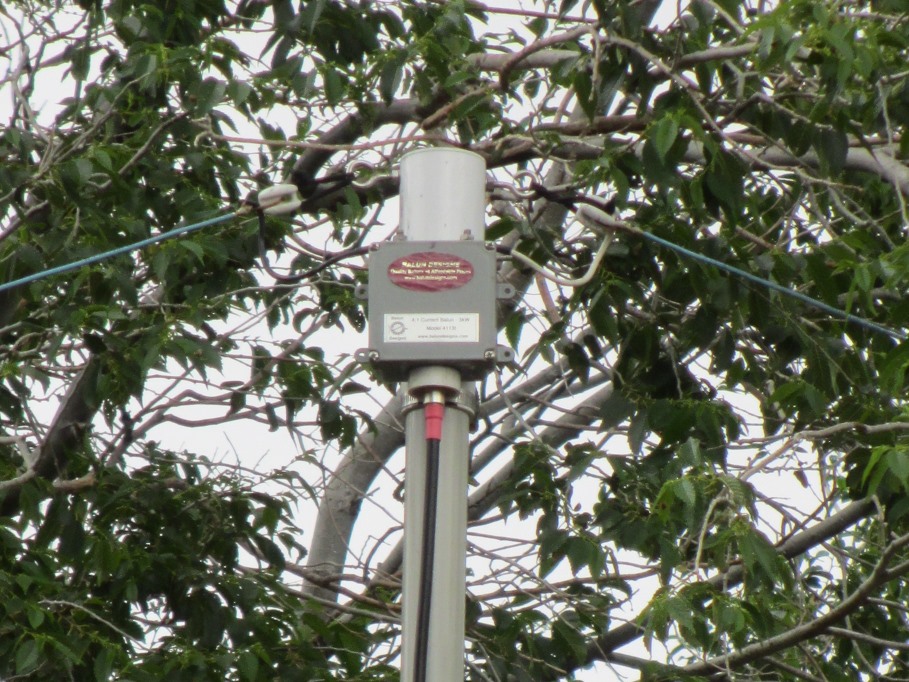
A good quality balun (transmission line transformer – BALanced to UNbalanced) is required for the antenna to work properly and to match the impedance, which is higher than that of a resonant dipole. For lower antenna height, usually below 40’, a 4:1 ratio is recommended; for higher antennas, a 6:1 ratio is recommended. I had a 4:1 current balun (Balundesigns 4113) from a different project, as well as a large reel of sky blue 14ga XHHW stranded copper power wire. This is what I used for the antenna. (I have 14ga solid copperweld as backup, in case the copper ever breaks). The center mast was fabricated from telescoping fiberglass tubing and hose clamps. This way the mast could be easily lower if needed.
Initially, I cut the wires to 85′ 2½“ and 47′ 9½”, as stated in the instructions. (This is longer than the calculated length, which turned out good in the end.) Actual antenna length can vary significantly depending on elevation above ground, ground conditions, nearby objects, et cetera. It is easier to cut a long antenna than to add wire later!
I stripped 6” of the wire at the balun ends and wrapped and soldered the wire around small ceramic egg insulators. (These are inexpensive from e-bay.) I attached those to the center support (to the mast, not balun) with Dacron antenna rope. Be very careful not to nick the copper conductors when stripping the wires, or they will break at a later time. The connection between the balun and antenna conductors was made with some extra flexible 12 ga. extension cord wire to prevent breaking due to wind flexing. If you don’t have any insulators, you can fabricate some from plastic, or even use the rope as insulator. All wire connections were soldered. I loosely attached the wire ends with Dacron rope and pulleys to the end supports to allow trimming the ends as necessary.
The center support and balun were installed on top of the telescoping fiberglass mast at 26 feet using four DX engineering telescoping fiberglass mast sections (8 feet each) and their hose clamp mast kit (could not afford more mast after buying my retreat!). The hose clamp kit makes it easy to lower the mast if future repairs or changes need to be made. It also allows lowering the mast to make the antenna “disappear”. Guy ropes at the 22 foot level protect the mast during strong winds. All balun mounting components, brackets, and so forth were made from PVC pipe, pipe tee’s, and PVC scraps. (The tree in the picture is actually 40’ behind the antenna.) All hardware was stainless steel. The bottom mast section was buried 3’ for support and stability. I used a level to get the bottom section perfectly vertical.
Top Section of Mast With Balun
Each end support is located 90’ from the center support (in case the OCF didn’t work and I needed to revert to a dipole). The end supports are two 12’ pressure treated 4×4’s, buried about three feet deep. This leaves the antenna ends 9’ above ground. The buried sections of the mast and end supports were wrapped in PVC pipe wrap tape for added protection. The ground conditions at my location are loose, volcanic soil. Installing the mast and end supports was surprisingly easy using a post hole drill. For reference and comparison, the orientation of the wire is directly east (short wire) and west (long wire). The elevation is at 7300 feet in open, lightly treed country. Due to the distance from the mast to the end supports, this antenna is more of a flat top than an inverted V.
The feeder from the house to the antenna is DXE400MAX (LMR400 equivalent) coax. Although the cable is direct bury rated, I buried it in PVC conduit for extra protection and easier replacement should the need arise. Any quality, low loss coax will work.
The PL-259 plugs were installed by screwing them over the straightened and folded back shield, as shown (and also on YouTube. I soldered the center conductor prior to cutting off the excess conductor. I used “Contax” paste (CTB8 Thomas & Betts Contax Oxide Inhibiting Compound), to coat and protect the shield and internal threads on the plug, prior to screwing the cable into the plug. The Contax paste also seals the jacket to the connector. Penetrox or Alnox will work just as well. Warming up the tough polyethylene jacket with a hair dryer made installing the plug much easier. I gently held the plug on the serrated part with a pair of vise grip pliers (after crushing the first one), and held the coax jacket with a section of old 3/8” air hose that I slit open and put over the coax jacket to get a better grip. For added reliability I added marine grade, adhesive lined heat shrink tubing at the cable to plug connection. Remember to slide your heat shrink, plug nut, et cetera, over the coax before installing the plug, unless you like hearing yourself mumble some unprintable words. A quick test of the assembled cable with 1000 volts showed no shorts. I filled the plugs with STUF (STUF connector seal– a polyethylene paste to seal out contaminants and moisture), prior to tightening them to the socket. (I have installed PL259 connectors this way for many years, and I never have had a failure or moisture problem.) For safety, the coax is grounded at the entrance into the shack. (Always ground your coax for static and lightening protection.) A long barrel connector was used to go through the wall and as a place to connect the ground wire.
Time For Some Testing
The initial, center band SWR readings with an MFJ259B were 80m/1.8, 40m/1.6, 20m/1.5.
The bands I wanted most were good, so I decided to leave the antenna as is. I bent over the ends of the conductors at the place I was going to solder them and rechecked the SWR. The results looked good, so I stripped 6” off the ends, installed ceramic egg insulators, and soldered the wires. The Dacron rope was routed through the pulley on the end support, and tied off to a stainless steel screw in the end support. The final radiating wire length after soldering was 84’ 8½” and 47’ 3½” with my installation conditions. (Important: Since this is an offset antenna, each side must be trimmed by the same percentage as the antenna offset percentage, not by equal pieces, or you will mess up the offset, and thereby the antenna. Trim a short piece on the short side, and a proportionately longer piece on the long side).
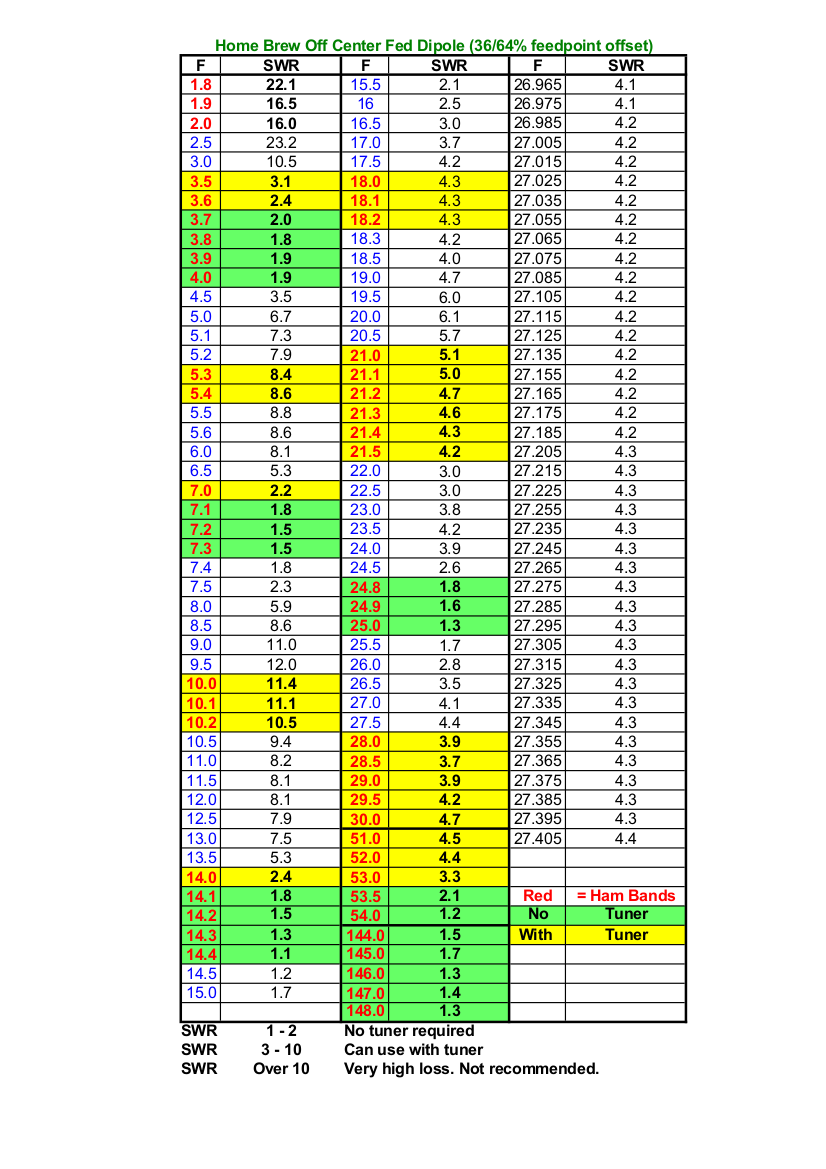
I decided to sweep the completed antenna through the entire frequency range, all the way to 2m (148mhz), although the balun is only rated to 50Mhz (6m). Final phone band SWR readings were 80m/1.8, 60m/8.5, 40m/1.6, 30m/11.1, 20m/1.5, 17m/4.3, 15m/4.6, 12m/1.6, 11m/4.3, 10m/3.9, 6m/4.4 (lower half) to 1.7 (upper half), 2m/1.5. I included the 11m band for any CB operators out there, although the SWR is too high for a CB without a tuner. (Further trimming/testing might achieve a lower SWR on some bands.)
Since the antenna read a low SWR on 2 meters, I gave it a quick test with my 2m HT and a VHF SWR meter. The antenna does work on 2m across the entire band and gets a signal out, although I suspect the balun is more of a radiating dummy load at that frequency rather than the antenna actually radiating. In an emergency though, it’s nice to know the antenna can be used on 2m for local work.
This makes the antenna usable on 5+ bands without a tuner. Due to the heavy duty balun, the other bands can also be used with a tuner, although the losses will go up. The LMR400 equivalent (or any low loss coax) will help to minimize the higher SWR power losses on the “not so resonant” bands. Most internal radio tuners can adjust for an SWR up to about 3. Above that you will have to use an external tuner. There is more on SWR at the end of the article.
Time For The Real Test
I connected my radio to the antenna and listened. To my surprise, there was very little noise and static compared to the old vertical I had in the Golden Horde EBT Empire (big city). I was also amazed at how many stations I heard on all bands that I never heard on my old vertical. I had been missing out on a lot of communications with my old, factory-made vertical, always believing that that’s as good as it got. Not!
After hearing someone calling CQ on 20m, I answered and received an instant reply with good signal reports. He was in Alabama. I was running 20 watts out on my portable radio. 1650 miles, with 20 watts is not bad!
In the six months that have gone by since the initial installation and testing above, I have made several contacts to South America and Australia on 20 meters, and multiple contacts between local and ~2600 miles, including Oregon, Wyoming, Canada, and southern and eastern states on the other bands. All made with 20 watts and good signal reports. This antenna definitely works!
I also received numerous short wave stations from many parts of the world, as well as several U.S. clear channel AM stations. Even though the antenna is low to the ground, with the center at 26’ (almost NVIS), it still appears to have good long range capabilities, even at the lower frequencies.
Lessons Learned
There were several things I learned from this project, including the following:
Functional antennas are easy to build.
You don’t have to spend mega $$$ to get a good antenna that works.
The cost of the mast and coax (my only purchased components) was less than many of the commercially-made OCF antennas found on the web.
The final antenna was almost two feet longer than the formula calculation (468/MHz). Definitely cut your initial wire 5% longer than determined by the formula. (468 divided by the lowest frequency in megahertz.)
You can scale the antenna down to 40m on the lowest band or upsize it to have 160m as the lowest band. The offset percentages remain the same.
A good antenna analyzer makes adjusting the antenna much easier than using a radio and SWR meter. An antenna analyzer is the ultimate tool for experimenting with antennas.
You don’t have to use a manufactured mast. Trees, lumber, bamboo, rope, old utility poles, pipe, chimneys, or other objects will work, as long as it gets the antenna up in the air.
By making your own antenna, you will know how to repair it, if it ever breaks. Being made of wire, any repairs will be easy. In a pinch, wires can be tied in a knot to splice them. For SHTF communications, stay away from complicated things and keep it simple (KISS). If you can’t use it or repair it when you need it, why have it.
When it’s all done and tested, write down all final wire dimensions. This makes it easier if you ever have to make repairs and don’t have access to test equipment.
The pressure treated end supports (brown) and light blue wire blend in with the surrounding environment and are almost invisible. Try to use colors or paint that blend in with your surroundings.
This is an excellent antenna if you have to use coax and can’t use parallel line and a tuner. With the performance I have seen, this antenna is definitely a keeper.
A Final Note on SWR
I get many questions regarding SWR. Everyone has their opinion and thinks they are right. There is not enough space on this page to explain that subject in detail. Simply stated, at less than 100 watts, an SWR of 2 or less is okay for most radios without a tuner. However, always trim your antenna for the lowest SWR first! A SWR higher than 2, directly connected to most radios will cause the radios protective circuit to reduce power. Cheap radios without protection may be damaged.
An SWR up to 4-5 is okay with a tuner, with little loss of performance if you use low loss coax. Over 5 is also okay with a tuner, as long as you are willing to accept the increasing power loss and keep the transmitter power low. High SWR becomes critical if you are operating at high power. The higher the power, the higher the voltage on the coax, even in a perfectly matched system. That’s ohms law. “Force feeding” a high SWR, coax fed system with a tuner can create very high voltages, heat, potential arcing, and stress components like the balun, coax, and tuner. Running 500+ watts through a tuner into a coax fed system with an SWR of 15 will most likely arc in the connectors or turn your tuner, amplifier, or balun into a toaster. That is why balanced wire tuner outputs or end fed wire tuners have long ceramic insulators on the output terminals and don’t use coax. The voltages on these terminals can go over several 1000 volts or higher. (Parallel, ladder, or open wire line can handle these voltages and have low loss.) For an excellent article on SWR and coax, go to the ARRL.org web site and search the archives for “Understanding SWR by Example” in the November 2006 QST magazine. Remember, if you can hear them and they can hear you, you are doing okay!
I’m fairly new to prepping for TEOTWAWKI. I am currently attempting to secure as much ammo and OD green tactical clothing as my budget will allow. I am also a fan of your books; I am currently reading Founders.
You mention many times in your books that ammo, silver/gold coins, and gasoline will become a kind of currency. That being said, do you recommend those who are properly trained buy progressive presses to make their own ammo?
What caliber of pistol rounds would you feel will be more valuable after WTSHTF?
HJL Responds: Most people get into reloading their own ammunition for one of two reasons:
With a few exceptions, you can generally reload for much less financial outlay than purchasing ammo over-the-counter.
You can reload with more consistency, resulting in better accuracy than most commercial ammunition.
If you fall into the second category, you will generally (but not always) get better results with a single stage press and lots of care. If you fall into the first category, and you burn a lot of ammunition practicing, then a progressive most definitely is your friend. When I made the move from a single stage RCBS Rock-Chucker to a Dillon RL550B press, I was suddenly spending far less time reloading than I was shooting– an almost polar opposite of what had existed before. Of course, there are caveats that go with that. If you reload your own ammunition, you must be capable of committing to detail and following through. Errors resulting in empty shells or double powder charges can be catastrophic, and you must be able to manage the process without allowing ANY of these problems to occur.
From a WTSHTF perspective, the value of being able to reload is probably not so much in reloading your own but in being able to reload for others as part of a barter deal. A progressive press is certainly worth its weight in gold at that point. Your time has value, and the progressive press allows you to compress much more productive labor into less time. For your own ammunition needs, it depends on the calibers that you are using. If you are shooting standard military calibers where surplus ammunition can be bought in bulk, you would be hard pressed to reload as inexpensively as you can purchase. If you are reloading non-military or generally less common calibers, then you can easily save a few dollars by reloading. The question then becomes: “Do you trust your reloads when your life is on the line?”
I tend to classify my reload into defensive and non-defensive groups. For non-defensive reloads (meaning practice rounds), I will often reuse the brass to just before the point of failure. This means, however, that there will be occasional jams, brass separations, chamber misfits, and other assorted failures. In training, I tend to look at these failures as just another opportunity to train for the worst possible situation. Can you clear your weapon of one of these failures and resume fire? Can you identify a failure that cannot be easily cleared necessitating moving to a backup weapon? Defensive loads, on the other hand, are made with the utmost care and attention to detail. These are loads that I do not want to ever experience a failure. These are the loads that I hunt with, load my protection weapons with, and plan to use in defense of my family and home. I will not ever use brass that has been shot more than two or three times in these loads and the brass must pass a visual inspection of every round.
So how do you keep from mixing them up? Make sure you have procedures in place so that you do not grab practice ammo when you need self-defense ammo.
As to the calibers, common military/police calibers will obviously have the most appeal in a barter situation. .38special/.357magnum, 9mm, .40S&W, .45ACP for handguns; 5.56 nato, 7.62×39, and 7.62 nato for rifle will always be in demand just because there are so many firearms for them. Other calibers, standard for hunting or common in civilian use in countries that ban military ammo can also be useful, though probably not in as much demand. You would need to research as to what is popular in the area you are located. Just be aware that if you plan on reloading for barter, that means you need to stock up on certain items that have safety issues associated with storage (like smokeless powder and primers). You also have the issue of dealing with the BATF if you stock enough of the components to attract attention or attempt to sell your services without the proper licensing.
Anyone near Dallas/Fort Worth might have an interest in an event hosted by the Mises Instititue: Lew Rockwell, Tom Woods, Tom DiLorenzo, and Jeff Deist will discuss Against PC: Creating a Culture of Liberty.
“Ye stand this day all of you before the Lord your God; your captains of your tribes, your elders, and your officers, with all the men of Israel, your little ones, your wives, and thy stranger that is in thy camp, from the hewer of thy wood unto the drawer of thy water: that thou shouldest enter into covenant with the Lord thy God, and into his oath, which the Lord thy God maketh with thee this day: that he may establish thee to day for a people unto himself, and that he may be unto thee a God, as he hath said unto thee, and as he hath sworn unto thy fathers, to Abraham, to Isaac, and to Jacob.” Deuteronomy 29:10-13 (KJV)
September 4, 1862 is the fateful day that General Lee invaded the North with 50,000 troops. Historians will banter back and forth about the real reasons for the Civil War, but we will probably never fully understand. It is my personal belief that General Lee was gambling on a quick offensive because the South did not have the resources for a prolonged war. Whatever the case was, President Abraham Lincoln trampled the Constitution and created the foundation for the “Big Brother” government we have today.
Medical bartering is as old as the hills, yet still alive today. Though you may not have encountered medical bartering in your own community, a quick web search will reveal that the days of paying your doctor with chickens continue into the 21st century.
Of course, when the grid goes down or our currency collapses, you’ll need to find another method of payment for everything. On the other end, with store shelves empty, medical supplies may become a valuable medium of exchange.
When stocking up on medical items for your family, it’s a great idea to purchase extra, currently inexpensive supplies for others who may want or need them in times of crisis.
Items to consider for bartering include OTC medications and supplies, as well as medical skills. Under current law, bartering for prescription medication is not legal (unless you are a licensed medical professional).
Bartering may occur person-to-person or via an exchange involving a third party. If you have a survival group, a written plan is highly advisable, especially regarding the ethics involved.
For example:
Is the single case of formula you have on hand for your grandchild worth only the $20 you paid for it or worth a $500 rifle to the parents of a starving child? Would such a trade be ethical (as it seems to be in today’s medical system)?
A nickel’s worth of antihistamine may help your runny nose today, but how much would you pay if your toddler were covered head-to-toe with hives?
If a nurse currently receives $15 to administer a $5 bag of IV fluid, will you charge someone the hundreds of dollars a hospital would charge?
Or if you ever had a bad case of gout, what would you pay for a dollar’s worth of naproxen?
Having a written policy with room for flexibility and generosity may prevent disagreements at a later date when fear comes into play.
Many over-the-counter drugs are extremely powerful, especially the ones that were by prescription only not many years ago. Here is a short list of OTC drugs potentially useful for future barter:
Antifungal creams (clotrimazole, Lamisil) – for athlete’s foot, ringworm, other fungal diseases
Multi-vitamins– especially useful for prolonged malnutrition
Insulin is more expensive, but certain formulations require no prescription and may save a diabetic’s life. Fish antibiotics are intended for aquarium use but some are the same as human antibiotics.
It is not legal to share a prescription medication, but leftover antibiotics, steroids, and pain pills may be worth their weight in gold if pharmacies are empty. To comply with the law, it may be best to recruit a physician, pharmacist, or dentist for your group who could then prescribe, sell, or dispense any available prescription medication, or act as a professional third party for a bartering transaction.
Other OTC medical supplies are useful barter items including:
Medical skills are at least as vital as other work (chopping wood, gardening, animal husbandry, defense, et cetera). Whether medical care should be given away without charge should be discussed before the need arises. A balance of paid care and perhaps a tithe of unpaid care is one option. Keep in mind that, in general, what people don’t pay for, they don’t value. Any seasoned medical professional can confirm this is true, and it is often difficult to decide when to “pay it forward”. Loving your neighbor as yourself does not necessarily mean giving everything away (and thus making your own family a burden on society).
Although it’s doubtful you can make a living off medical bartering in times of crisis, having extra medical supplies or skills to exchange may allow you to acquire items you’ve forgotten or could not previously afford, or are running low on (food perhaps). In my Survival Medicine classes I emphasize such skills, to help your own family and community should there be no doctor and you’re truly on your own.
Tonight I ate a rib eye steak that was a little over two years old. It was tender, juicy, and just as good as the day I bought it. It was vacuum packed and frozen at -14 to 0 degrees for the entire time. I see no reason to believe that the steak would not be just as palatable for at least another year. I believe this to be a viable consideration for food storage for, if not the long term, an intermediate period for SHTF situations.
If this is to be considered for a food source for a few years, what about EMP issues? Several years ago, I bought a top of the line 20 cubic foot upright freezer with all the bells and whistles. About a year ago, it began intermittently shutting off and the temperature inside got dangerously close to thawing out. A hurried call to an appliance repairman revealed that the entire electronic control unit can be unplugged from the front of the unit and replaced within seconds and that this cured the problem. After fixing the original problem, I ordered a second control unit, which is now wrapped in foil and has been placed in a metal can along with other valuable items.
About two years ago, I bought a second 20 cubic foot freezer. This time, I special ordered a basic, no frills model. It consumes exactly the same amount of power (140 watts after start up) and contains no electronic circuitry. The schematic diagram shows that the unit contains only switches, temperature sensors, a thermostat and, of course, the compressor. This freezer works just as well as the older freezer and should be as close to EMP proof as possible as all current information indicates that microprocessors are the items at risk during an EMP.
What about power interruptions? My long-term testing of both freezers shows that my Honda EU2000i inverter generator will keep both freezers adequately cold (as well as running several other items simultaneously including the refrigerator/freezer) with about 2½ hours per day of usage. With the Honda, this equates to about 1/3 gallon of fuel per day. Yes, fuel availability could be an issue, but if an EMP event renders most vehicles inoperable, fuel might be somewhat available from abandoned vehicles. Regardless, my RV contains 55 gallons of gas, the SUV 30 gallons, and I have 60 gallons in storage. The stored gas is stabilized with a commercial fuel stabilizer and is rotated through the vehicles as is convenient. At 1/3 gallon per day, I anticipate a minimum of one year of food available from the freezers. Natural gas tends to be more reliable then electricity during an emergency, and natural gas and propane conversions are available for under $200 for Honda and similar generators.
Some of you may have already considered this method of providing nutrition during a crisis, but for those of you who may have not “done the math”, you may find this of value and something that you can implement concurrently with your other long-term storage plans. If you are considering the purchase of a refrigerator or freezer, look closely at the “no frills” models and get the assistance, if needed, of a good service technician to determine what, if any, electronics the unit may contain.
As an aside, I do rotate our food, but I also keep back some food to let it age so I can determine the limits of my storage methods. The steak mentioned above was bought at Costco for $7.95 per pound and it is now $11.95 as I write this. Prepping does pay. I ate the steak with a can of corn that I bought in 2010 and with a “best by” date of September, 2011. Like the steak, it was as if I had bought it yesterday. I’ll keep you posted on the meat as time goes on, assuming we are still here.
Be safe and prep as if your life depended on it. – G.D.