Economics and Investing:

This has, so far, pretty much run parallel to Rickards’s warnings and descriptions, the first round of the reality turning out, if anything, rather “a kinder, gentler” bullet than that described in ‘Currency Wars”… But it’s still plenty deadly. And it’s still only a first round; the numbers are in:

China Dumps A Record $94 Billion In US Treasurys In One Month

o o o

7 Characteristics of Debt-Free People – A.L.

o o o

When “Virtuous Debt” Turns Ferociously Vicious: The Mother Of All Corporate Margin Calls On Deck – A.L.

o o o

America’s Housing Market: This is the time to sell – R.M.

o o o

Items from Mr. Econocobas:

The Elite Have Prepared For The Coming Collapse – Have You?

Chart Of The Day: Homeownership Rate Plunges To 1967 Level


Notes for Monday – September 07, 2015

September 7th is the birthday of Richard Cole, born in 1915. Cole is one of just two living Doolittle Raiders. He was General Doolittle’s co-pilot. This is also the birthday of novelist Taylor Caldwell (born 1900 – August 30, 1985).

Today is also the birthday of Dr. Ludwig Vorgrimler (born 1912 in Freiburg, Germany; died 1983). Vorgrimler was the designer of the Spanish CETME rifle, from which sprang a plethora of roller-lock descendants from HK, including the G3, HK21, and MP5. His bolt design was also copied by the Swiss for their excellent PE57 and SIG 510 rifles. (Although the Swiss felt obliged to mount a “beer keg” charging handle on the right side of the receiver, for the sake of familiarity to Schmidt-Rubin shooters.)


Scot’s Product Review: Katadyn Pocket Water Filter

There is the rule of threes for survival, which says you can go three minutes without air before you’re dead, three days without water, and three weeks without food. That’s not exact science, of course, and there are variables. Someone in great shape can last longer, and a moderate climate will let you go longer without water. In my part of the world, it gets really hot in the summer, and I suspect three days might be optimistic. Luckily, down here in the southeast, it rains a lot, especially in the summer. There is also a lot of standing water, even during the dry season. The problem with standing water is what’s in it. I don’t know about you, but the thought of drinking diluted duck poop is not a good one. In a crisis situation, there will probably also be people poop getting into the water, and that is far worse than duck poop. There is also a lot of road runoff filled with tire scrapings and oil drippings from cars.

So, what is there to do? I have been worrying about this for years, and that led me to store a bunch of water. However, that is going to run out faster than I would like. I also store pool shock, also known as calcium hypochlorite. With this white powder, you can make a lot of liquid chlorine, and chlorine will make water safe from disease-causing bugs. Don’t forget that if you decide to store some, it is highly corrosive. I have rusty tools to prove it. It is best stored outside, well away from anything you care about. The plastic bags it usually comes in also deteriorate, so you have to replace it every couple of years. You can use it to make enough bleach to whiten everything you own several times over, or if you have a pool you can use it for its intended purpose. When you buy pool shock, be sure you get the stuff that has nothing but calcium hypochlorite in it. Some have extra chemicals that make pools nicer, but you might not want to drink those additives. Drinking chlorine also has some drawbacks for me. I’m not crazy about absorbing chemicals, and the stuff tastes bad. You can, at least, let it sit for a while and the chlorine will diminish.

Another option is something called SODIS, which stands for solar water disinfection. I don’t know why there isn’t a W in SODIS, but I think the UN might have been involved in spreading the program. The idea is that if you put nasty water into the right sized clear polyethylene terephthalate (PET) bottles and set them in the sun for six or so hours, the combination of heat and ultraviolet light will pretty much kill all the bad stuff. The bottle must be made of a material that passes UV light, and the clear PET bottles that most bottled water arrives in works just fine. A lot of glass will stop UV, and any color in the bottle is bad. If the bottles get scratched or discolored, they won’t work well, either. I do recognize that many dislike drinking from plastic bottles, especially when they are heated. This is an equation of balancing competing harms, I’m afraid. I don’t like drinking from plastic either, but it beats getting sick immediately.

There are some limitations, of course. SODIS works best if you are between latitude 35 degree north and 35 degrees south. The northern line equates to the border between North and South Carolina. Further north than that and you start losing efficiency and need to let it sit longer. Rain and clouds also cause issues. Having endured over a week of heavy rain lately (averaging more than an inch a day), I’m happy to have not needed SODIS at the moment. Nonetheless, it is still a viable method and another one preppers should know about. It works best when the bottles are laid on a reflective surface. Many people use a piece of steel roofing, sometimes covered with foil to make it brighter.

While SODIS kills bugs, it doesn’t remove chemicals or particles in the water. You need to let it settle or filter it to get the particles out, as they inhibit the action of UV and sunlight on the water.

A traditional method of treating water is boiling. It works very well but requires time and fuel. It is certainly in my playlist, but I see it as having limits. Among those limits is the fact that it doesn’t remove chemicals or particles. Thankfully, there are solar ovens like the All American Solar Oven I reviewed last year that can treat water without having to burn fuel, as long as there is enough sunlight.

Besides chlorine, you can get water treatment tablets, like the Katadyn Micropur ones. They cost $13 for a pack of 30, and each one can render a liter of water safe from bugs. In the worst case, they take four hours to do the job. I have not used them, but they claim the water will taste okay. Some similar products make it taste pretty bad. They advise the shelf life is five years.

A problem with chemical and heat methods is that they don’t remove particles in the water. Some stuff just won’t settle out, so you may be drinking cloudy or colored water, which is disconcerting at best. Things that make water unclear can also make it unpalatable, and that’s where filters come in. I am also a firm believer in redundancy and have become convinced that if one can double treat water, you are probably a lot better off. That meant I wanted something more for our water needs, so I began looking at water filters.

The gold standards for base camp use are the Berkey and Katadyn gravity filters. You pour water in a tank, and it trickles through ceramic filters with tiny little pores small enough to keep out everything but some viruses. You can also add activated charcoal elements that remove many chemicals including the chlorine I dislike so much. The problem here is the phrase “base use”. I wanted something that we could easily carry if we had to evacuate. The additional use for camping came to mind as well. My son is a Scout and may need it for that in the future. That means I wanted to find something portable, and the big gravity filters, while wonderful for base use, aren’t all that portable, especially on foot.

So again I wondered what to do. Turning to the Internet, of course, and spending many hours in the middle of the night doing research led me back to the first thing I thought of– the Swiss-made Katadyn Pocket Water Filter. At least all that research convinced me it was the right choice for my needs. I had been put off by its $288 price, but I finally concluded that its reputation and features made it worth the money, assuming that one needs portability in the equation.

The first concern I had was the life of the filter. This one is rated for 13,000 gallons, assuming that one doesn’t try to filter mud. I found a number of other alternatives that cost less and worked just as well in terms of getting out bugs, but they simply didn’t have the life of the Katadyn. The size of the unit is fine, 13x4x2 inches contained in its case with attachments, though the weight of all of the above was a bit heavier than desired, at 25 ounces. The promised ability to pump about a quart a minute of water wasn’t bad, either. Faster would be better, of course, but this means we could get the gallon a day per person our family needs in under 15 minutes with some left over for the Dachshund. The 20 year guarantee on the thing didn’t hurt either.

You can get a replacement filter for $165. One drawback of any ceramic filter is that like anything ceramic, it can be damaged if dropped. Be careful with it or bad stuff will go through a crack. You can extend the life of the filter by cleaning it with an included pad when the water flow starts to slow down from particles clogging the pores.

This filter can remove everything down to .2 microns, which is really quite small. That means it will remove bacteria and germs along with protozoa from water. Protozoa, like giardia lamblia and cryptosporidium, cause serious gastrointestinal issues and are commonly acquired from bad water. E coli, salmonella, and cholera are bacteria-based diseases also ingested in contaminated water. Things are bad enough now, but should there be a crisis, it is hard to imagine how much more contamination will get into water. The filter is also impregnated with silver to prevent the growth of bacteria on it.

The filter also removes turbidity which is, to the simple minded like me, essentially dirt and junk in the water that makes it cloudy. The dirt can provide a place for bad critters to grow, so at some point it needs to go. You don’t, however, want to run anymore dirt than you have to through the filter, so you should let cloudy water sit for a while so as much of the dirt as possible can settle. It is then a good idea to filter it through something like a coffee filter or fine mesh cloth to get as much more out as you can before you run it through the Pocket Filter.

Once you have run the water though the Pocket Filter, please note that it is not effective against all viruses nor does it remove chemicals. Katadyn publishes a helpful card to provide guidance on what each type of filter and water purification method can do. They also have a very informative guide to water in general that is well worth downloading and reading, whether you have one of their filters or not. Both explain these points and have led me to the conclusion that I want a multi-step process in preparing water if possible.

My plan is to let the water settle for a good while and then run it through some sort of simple filter. Next, I want to kill all the bad stuff, and that means chlorine, tablets, boiling, or SODIS. Having all four available is best, but in a long-term, grid down scenario, SODIS may be the most sustainable. All it needs is sunlight, but with the vagaries of that, it would be wise to be able to treat a bunch of water when the light is good and then store a lot. In other words, have a good supply of bottles on hand. If you live in the far north, this isn’t going to work as well for you as it will for me. I did decide that two days of treatment would be even more insurance than one.

Once that’s done, I want to filter the water through the Katadyn. While you have killed the bad bugs, the water still may not be sparkling clear, and you have a bunch of dead bugs floating in it. Dead bugs don’t seem appetizing to me, and some argue it is best to remove them. I’m not a biologist and can’t offer any definitive comment other than my gut feeling that I would rather not drink them, so it is best to get rid of them along with all the floating particles of dirt and what not. It is also extra insurance. Getting sick in a survival scenario is not a good plan.

At this point, our water should be clear and free of critters that want to make us sick or even kill us. It may still, however, taste bad. I have, in fact read a number of complaints of a bad taste being imparted by these filters, but a bit more on that later. We could still have chemicals in it. Charcoal filters can help with both issues. Activated charcoal is the best form of the stuff, though plain old charcoal can be used as well. It is just far less efficient at adsorbing bad stuff. The word is adsorption, by the way, not absorption. The end result is about the same, the stuff we don’t want stays in the filter, but the process is different. Adsorption means the filter material attracts what we are trying to capture and latches onto it rather than just holding it as an absorbent filter does.

Activated charcoal is wonderful at capturing organic chemicals, like chlorine, that many people object to consuming as well as many things that make water taste bad. These filters are the basis of many of the systems people buy to make their water taste better and are often found in refrigerators that make ice and dispense drinking water. Some of these have some silver in them to prevent growth of bacteria in the filter. Such filters usually have a life expectancy in time as well as gallons. Six months seems typical. Katadyn offers just such a filter for the Pocket Filter and some of their other filters as well.

We do, finally, hit a point of not being able to get everything out that can hurt us, primarily in the area of chemicals. We can obtain specialized filters from the home store or Amazon that will remove many other chemicals, but at some point we have to realize we can’t get it all. That frustrates me, but then I realize that it is true of most municipal water supplies and even the bottled water many people buy. We have to do the best we can and motor on.

At this point, I finally got around to trying the filter. We found that the speed of making clean water was a bit optimistic for my family. I could push a liter through in about 70 seconds, which is 10 more than the advertising. It takes effort to work the pump, but it isn’t awful. It is easier than milling wheat with a hand mill. It would be a major chore for one person to try to produce all the water for a family, so plan on switching off.

Out of curiosity on the taste issue, I ran some tap water through it. Sure enough, the flavor did change. It wasn’t as good. It is hard to put my finger on how it changed, but it was still perfectly drinkable. When I added the charcoal filter, it returned almost to the normal flavor. I tried some assorted standing water from around the house, and some of it tasted awful. I suspect it tasted awful before going through the filter, however. In all cases, the charcoal filter made a major improvement to quality. I highly recommend that you get one.

The charcoal filter comes with two refills. You unscrew the thing and pour in the contents of a package. I found the package had more than the filter could hold, so eventually, if you save the remnants, you will have enough for an extra change. The refills go for $15 for two, and each is supposed to be good for 60 gallons. You should replace it every six months, even if you use less water. Since the refill is powdered activated charcoal, I suspect you could buy a pound of that and save some money, but you would want to keep it tightly sealed, since it can adsorb things from the air too.

A key question in all of this is, would I drink lake water run through the Katadyn without any other of the other steps. The answer is absolutely “Yes!,” if that’s all I could do. The biggest threats to health in water are bacteria and protozoa, and the Katadyn should get them. I would be uncomfortable about it, but I would drink if I were thirsty. I would look for the clearest spot to draw it from and look around for anything that might be contaminating it, like a body or garbage.

Given how hot is here most of the time, I expect to be thirsty most of the time, so this filter makes me a lot happier about my preps. I am still adding PET bottles, maintaining my stock of pool shock, and planning to add some tablets, and more fuel for the various stoves when I can.

– SurvivalBlog Field Gear Editor, Scot Frank Eire mount



Pat Cascio’s Product Review: BearOps Rancor Folder

BearOps is a division of Bear & Son Cutlery and is an up and coming cutlery business. BearOps is producing tactical-types of cutlery, whereas, Bear & Son, produces some more traditional cutlery.

When Tom Ables, who handles the PR from Bear, contacted me with a press release on the BearOps “Rancor” folder, I placed an order for one right away. The Rancor isn’t just a tactical folder; I also consider it a gentleman’s folder. Over the years, I’ve been accused of a lot of things but rarely has anyone, other than my own wife, called me a gentleman. Still, I had to have a Rancor for testing.

To be sure, “survival” doesn’t just mean living in the woods with a knife and a gun. No! Survival covers any number of situations one might encounter. Some survival is planned. Some is unexpected emergencies, such as something as simple as the power going out in your house for a few hours. Some people go into a complete panic when this happens. Sometimes, survival, might mean your car breaking down or a flat tire. Other types of survival might be getting lost in the backwoods on a hunting trip for several days. Still, many people simply don’t think about daily survival, which is just getting through the day. That can often be stressful, if you stop and think about it.

For me, on my small rural homestead, survival usually just means getting through an entire day with unexpected bills or the riding lawn mower breaking down, and it always does. One of my main everyday survival tools is a folding knife. Without it, I would be lost. I don’t know of a single day that goes by where I don’t find a use for a good knife in my pants pocket. UPS, FedEx, or the USPS bring me packages all of the time. Some are easy enough to rip open, and some require a good, sharp knife. Still, other packages, like large ammo orders, require a sharp knife to cut the Nylon banding as well as a multi-tool to rip out the staples also holding the box closed. Still, my most often used tool is a good knife of some sort. To be sure, my wife and oldest daughter also have their own knives, which are “some place”, and so they are always asking to use my knife. It’s handy. They know it’s right there in my right front pocket.

100_6206

The BearOps “Rancor” is the newest addition to their rugged sideliner folders. The particular model I tested is the MC-100-ALCF-S one-handed opening folder. The Rancor has dual thumb studs on the blade, for fast and easy opening of the blade. This is almost a “must” on a folder these days. We have a modified drop point blade that is 2 7/8-inches long and made out of high-tech CMP S30V stainless steel, which is one of the best high-tech stainless steels on the market. This steel holds an edge and isn’t all that hard to re-sharpen when the time comes. Rockwell hardness is 58-60, which is the norm for this type of stainless steel. We have a satin finish on the blade, and the blade rides on bronze phosphorus washers and has a very smooth ball bearing type opening. It’s very smooth.

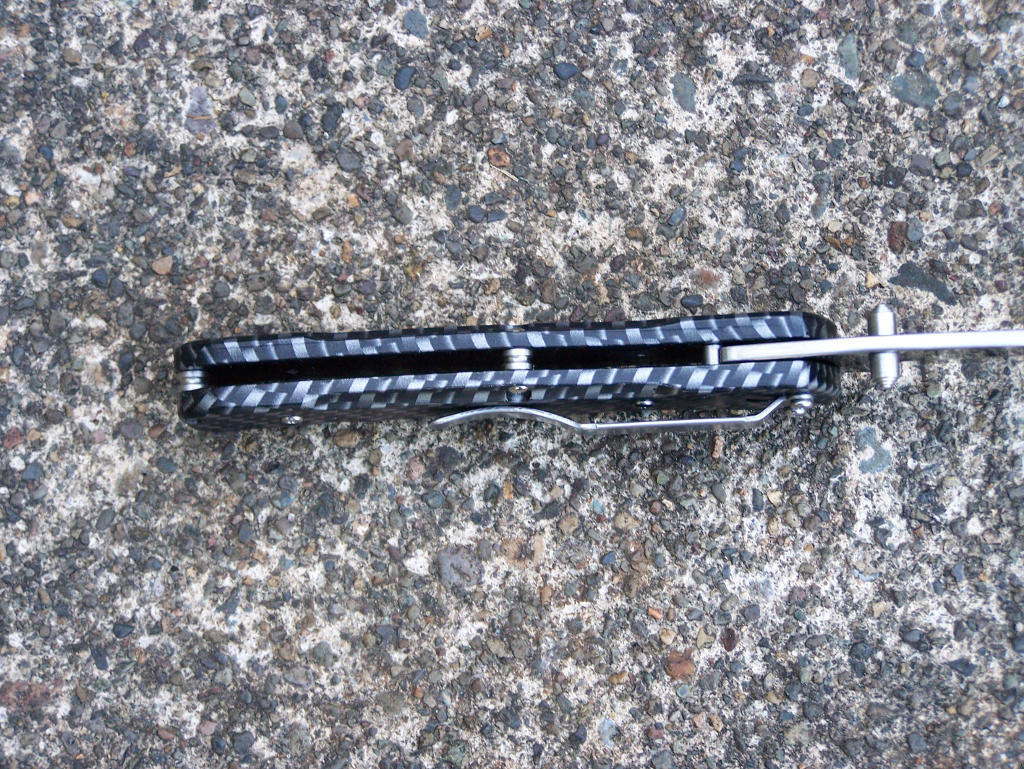
The handle scales are aluminum with grip ridges, and the finish on the handle scales looks for all the world to be carbon fiber, but it’s not. It is a special coating that BearOps puts on the aluminum handle scales to make it appear to be carbon fiber; that’s nice, really nice! The handle itself is 4 3/8 inches long. I like enough handle to fit my hand, even on a folding knife. (Itty-bitty folders don’t appeal to me.) There is also a generous pocket/clothing clip that allows the Rancor to be carried tip down.

100_6208

The Rancor’s blade opened smoothly, using the thumb studs, right or left handed. I like that. Many lesser-made folding knives feel like they have sandpaper for a bearing surface and are very gritty feeling when you open them, and they are hard to open, too. The Rancor came shaving sharp out of the nice gift-type box it came in, and the knife was also in a nice presentation cloth bag inside the box, which is classy.

I’m not sure many folks would consider this a gentleman’s folder because of the size. Most Gent’s folders are smaller than the Rancor. However, I believe the carbon fiber look on the aluminum handle scales makes me want to call this folder a Gent’s folder for some reason. It is very classy looking. One wouldn’t feel embarrassed pulling this folder out of your pocket to clean your finger nails or open a package in the office. So, to my way of thinking, this is a Gent’s folder!

The sideliner lock was perfectly fitted and locked-up the blade tight every time I opened the blade. Many people think this is an easy accomplishment, but nothing could be further from the truth. It takes precise fitting to bring the liner into the exact match with the blade to give us a perfect lock-up. Bear Ops did their homework on this one. The Rancor only weighs 4.5 ounces, so it is light in your pocket. You don’t even know it’s there.

I carried the Rancor for several weeks in my pocket, using it every day for some kind of cutting chore around the house or the homestead. One of the cutting tests I like to do is cutting blackberry vines. In western Oregon, we are never at a loss for these things; they grow fast, even after being sprayed to kill ’em! If a knife, any knife, doesn’t have a sharp blade, it will slip off the vines, some of which are very thick, too. I didn’t know if the Rancor’s blade was long enough to cleanly slice through these tough vines with a single swipe. My fears were not founded. The 2 7/8-inch long blade easily cut through the vines. However, because the knife has a short overall length, those nasty thorns on the blackberry vines managed to reach out and get me a couple times. If you’ve never experienced blackberry vines, they are wicked, very wicked!

100_6209

I cut through poly rope as well as hemp rope with the Rancor with no problems. Opening cardboard boxes was a piece of cake, too. I did manage to “trim” the rosebushes in front of our front window, which is a chore my wife says she will “get to….”. (She hates when I trim the rosebushes because I trim them down quite a bit!) The Rancor was used around the kitchen for cutting chores. While I’d like to report it mastered all of those chores, the short blade sometimes required extra work cutting through fruits and veggies because they are big. The fruits and veggies are big in diameter, so it took a little more work to cleanly cut through those items.

If you’re like me, you use a knife several times per day, especially if you live out in the boonies, like I do. To my way of thinking, a good pocket knife makes my daily “survival” much easier. Believe me, it is survival to me. A good pocket knife makes my life easier. When I’m at my local gun shop that stocks quite a few knives, it seems like no one ever has a good sharp knife on hand to cut something, so I end up handing them my folder. Everyone really liked the classy look of the Rancor. They all thought the handle scales were actually carbon fiber, too.

100_6210

So, if you’re in the market for a new daily use “survival” knife, for some of your cutting needs and you want to have a nice “Gent’s” folder to use, take a close look at the Rancor. The full retail price is only $134.99, and that’s one deal, considering that they use CPM S30V high-tech stainless steel for the blade material. Don’t forget Bear’s respected lifetime warranty.

Just remember, not all “survival” consist of living off the land. To me, daily survival means just getting through the day without getting too frustrated by some minor daily chores I encounter, and a good folding knife makes my day go smoother.

– Senior Product Review Editor, Pat Cascio


Recipe of the Week: The Perfect Omelette

Dear Hugh,

It has taken me 40 years to make the perfect omelette. Okay, okay, I’m slow. I know it already! The secret is to use a non-stick pan and plenty of butter rather than oil or margerine. Heat the pan and butter until hot (nearly smoking) and tip in the eggs beaten with a little salt. Any cheese, ham, onion, or herbs are added to the eggs and beaten up together. Stir a figure 8 twice, and leave it alone to cook. Slide out onto a plate folding it as you go. The pan can be wiped clean with paper. The butter adds a richness to the omlette that I have never achieved before. Now, you may already know this simple trick, and if so, you have the right to be pleased with yourself. However, if you don’t know it, try it. It is great. Please feel free to include in your recipe book. Regards, Gavin

o o o

Do you have a favorite recipe that would be of interest to SurvivalBlog readers? Please send it via e-mail. Thanks!


Letter Re: Building a Simple Multiband Antenna That Works, by The Consultant

Hello Hugh,

At the risk of setting off a flood of letters by Hams expounding the “best antenna ever,” I would like to offer an alternative to the off center fed dipole described by The Consultant. That’s a great antenna but did not fit my property or needs. After much searching and simulation of various antenna designs, I settled on the delta loop antenna.

My delta loop works with low SWR (with tuner) on 80 through 6 meters, with the exception of 60 meters. It consists of 275 feet of THHN #12 gauge black insulated copper wire from the big box store. I have it strung through a few trees in a lazy triangle shape, with the apex at 75 feet above ground. The lower leg comes off my deck at about 15 feet off the ground. 450 ohm ladder line runs about 20 feet down from the feed point to a 4:1 balun, then about 20 feet of 50 ohm RG8 coax heads into my radio room and antenna tuner (an LDG model). I have two ground rods, one at each end of the coax, attached to the coax shield.

The cool thing about this antenna is that the feed point is near ground level. You don’t have to run 50 or 100 feet of transmission line up in the air, with the suspension and weight issues. I have two ropes hoisting the corners up into trees, but that’s the extent of the high wire action.

The antenna is not too noticeably directional on 80 meters, but on the higher bands there are many lobes, making it omnidirectional. This works well for the regional and national nets I participate in, as I can hear stations all around my location. Also, I suspect that the side that is low to the ground gives it some high angle radiation for NVIS-like operation. I can communicate with stations near and far.

Anyway, this is a good alternative to the OCF dipole, is pretty inexpensive, and has a more convenient feed point.

Radio Ready in Virginia


Economics and Investing:

Inside Look At Silver Shortage With CEO Of US Mint’s Silver Eagle Blank Provider

o o o

When “Virtuous Debt” Turns Ferociously Vicious: The Mother Of All Corporate Margin Calls On Deck – A.L.

o o o

Education Debt Burdens Students, Economy; Elite Schools Lobby Against Proposal To Cap Graduate School Loans – PLC

o o o

Keep out Californians: How high home prices in California migrate into other states where Californians follow.


Odds ‘n Sods:

Read the Contract the Islamic State Group Is Forcing Christians to Sign in Syria – D.S.

o o o

Alert: Air traffic collision warning systems, locators, down off East Coast and 5 states until Oct. 1 – D.S.

o o o

NATO, Russia war games fuel risk of war, think tank warns – G.P.

o o o

Are mysterious shootings at cars in 6 states across America tied to Black Lives Matter? – G.L.

o o o

‘Hillary’ replaces ‘Jesus’ in campaign rally song Among normal Americans, even if they are not Christian, replacing “Jesus” with “Hillary” rates at least a raised eyebrow. Among some, it warrants only a snort and a “Well, DUUUH!”… – GJM


Notes for Sunday – September 06, 2015

SurvivalBlog is seeking additional prize sponsors for our Writing Contest. The prizes are awarded once every two months, and each must have a minimum value of $200. The links provided with each contest entry are a great way to get publicity for your product or service. And for anyone who has been frustrated by our long waiting list for advertising space on SurvivalBlog, this is a way to get more immediate attention from the blog’s 300,000+ readers. Just e-mail us if you are interested in becoming a prize sponsor. Thanks! – JWR

o o o

Today, we present another entry for Round 60 of the SurvivalBlog non-fiction writing contest. The $10,000 worth of prizes for this round include:

First Prize:

  1. A Gunsite Academy Three Day Course Certificate, good for any one, two, or three day course (a $1,195 value),
  2. A course certificate from onPoint Tactical. This certificate will be for the prize winner’s choice of three-day civilian courses. (Excluding those restricted for military or government teams.) Three day onPoint courses normally cost $795,
  3. DRD Tactical is providing a 5.56 NATO QD Billet upper with a hammer forged, chromlined barrel and a hard case to go with your own AR lower. It will allow any standard AR type rifle to have quick change barrel, which can be assembled in less than one minute without the use of any tools, and a compact carry capability in a hard case or 3-day pack (an $1,100 value),
  4. Gun Mag Warehouse is providing 20 Magpul pmags 30rd Magazines (a value of $300) and a Gun Mag Warehouse T-Shirt. (An equivalent prize will be awarded for residents in states with magazine restrictions.),
  5. Two cases of Mountain House freeze dried assorted entrees in #10 cans, courtesy of Ready Made Resources (a $350 value),
  6. A Model 120 Series Solar Generator provided by Quantum Harvest LLC (a $340 value),
  7. A $250 gift certificate from Sunflower Ammo,
  8. KellyKettleUSA.com is donating both an AquaBrick water filtration kit and a Stainless Medium Scout Kelly Kettle Complete Kit with a combined retail value of $304,
  9. TexasgiBrass.com is providing a $300 gift certificate, and
  10. Two cases of meals, Ready to Eat (MREs), courtesy of CampingSurvival.com (a $180 value).

Second Prize:

  1. A Glock form factor SIRT laser training pistol and a SIRT AR-15/M4 Laser Training Bolt, courtesy of Next Level Training, which have a combined retail value of $589,
  2. A FloJak EarthStraw “Code Red” 100-foot well pump system (a $500 value), courtesy of FloJak.com,
  3. The Ark Institute is donating a non-GMO, non-hybrid vegetable seed package–enough for two families of four, seed storage materials, a CD-ROM of Geri Guidetti’s book “Build Your Ark! How to Prepare for Self Reliance in Uncertain Times”, and two bottles of Potassium Iodate– a $325 retail value,
  4. A $300 gift certificate from Freeze Dry Guy,
  5. A $250 gift card from Emergency Essentials,
  6. Twenty Five books, of the winners choice, of any books published by PrepperPress.com (a $270 value),
  7. A pre-selected assortment of military surplus gear from CJL Enterprize (a $300 value),
  8. TexasgiBrass.com is providing a $150 gift certificate,
  9. RepackBox is providing a $300 gift certificate to their site, and
  10. Safecastle is providing a package of 10 Lifestraws (a $200 value).

Third Prize:

  1. A Royal Berkey water filter, courtesy of Directive 21 (a $275 value),
  2. A large handmade clothes drying rack, a washboard, and a Homesteading for Beginners DVD, all courtesy of The Homestead Store, with a combined value of $206,
  3. Expanded sets of both washable feminine pads and liners, donated by Naturally Cozy (a $185 retail value),
  4. Two Super Survival Pack seed collections, a $150 value, courtesy of Seed for Security, LLC,
  5. Mayflower Trading is donating a $200 gift certificate for homesteading appliances,
  6. APEX Gun Parts is donating a $250 purchase credit,
  7. Montie Gear is donating a Precision Rest (a $249 value), and
  8. Two 1,000-foot spools of full mil-spec U.S.-made 750 paracord (in-stock colors only) from www.TOUGHGRID.com (a $240 value).

Round 60 ends on September 30th, so get busy writing and e-mail us your entry. Remember that there is a 1,500-word minimum, and that articles on practical “how to” skills for survival have an advantage in the judging.


The 20% Solution, by Redoubting Thomas

Get. Out. Now. Or as soon as reasonable. To the many who are reading this and working outside the Redoubt waiting on “something” before they sell their house and move, that is a mistake. This ongoing chronicle lists just one person’s challenges in moving.

A Radical Proposal

Even if much goes to hell (I’m not swearing but only using the proper word for an origin and destination), much won’t, and it will vary. Multiple nuclear bombs is a tiny possibility, like a major earthquake or volcano. It is also unlikely that it will happen suddenly. Most likely it will be a drip, drip, drip, that you won’t leave until it is too late. There are doomsday preppers who have their bunkers and are prepared to disappear for a decade. Most want to create an island where they can exist on their own, never going to church, as it is too far and planning to rarely see their neighbors.

Most likely it will break down a lot, but not everything will go. Twenty percent is likely to be left. What 20% will remain? Much depends on where in the Redoubt or elsewhere you end up. Does it have a refinery with local oil production? What does electricity depend on? Is it hydroelectric or something that requires infrastructure? Is the agriculture “on grid” or do things like irrigation, seeds, fertilization occur without the grid or transport? The answers are different for different areas of the Redoubt.

If you can find an area where there are Amish (not so much here but elsewhere in the USA), food won’t be a problem. Doing something the Amish need or even want as a luxury that you can trade them for food will be useful. (Can you make plow blades, build wagons and carts, weave, or even provide manual farm labor?)

However, you need to figure this out now. It is very difficult to do from the outside, and you won’t know how many solar panels you need before or what size windmill. It differs across the Redoubt, and they won’t be available after the crash. If you are already there, you can start building your personal para-grid infrastructure while renting and then transplant it when you find your ultimate final location.

You need to ask or arrange work that you can do over the Internet, remotely, or have a portable skill. You need to sell your house now, not before the economy crashes and you can’t. Rent if you must. You need to find a location within the Redoubt and move there. College towns and many others have full broadband. It will be easier to look within a few hours drive from where you are already working (and have found a credit union or bank, doctor, post office, et cetera) than having to take long drive vacations to scout and manage things. You’ll need to know which cell phone networks work (4G, 1xRTT?) as you drive around your targeted area and have access to that service? Is there broadband, fiber, or will you have to go to satellite for your Internet access? Are there active Ham clubs nearby? These and more are things you will need to resolve and are easier done from nearby.

Moving to the area where you want to end up has several benefits:

  1. Some benefits of being a citizen of a particular state only accrue after you’ve been there for a year. Start the clock.
  2. Your vote counts as soon as you move in. If every Patriot in Puget Sound moved across the cascades, there would be no sheriff that didn’t follow the Constitution on that side. Ask Gavin Seim if it would have helped in his area.
  3. You will know the area. You’ll learn which doctors will call the authorities if you don’t immediately give your kids 24 vaccinations and which doctors have midwives and dulas in their rolodex. You find where the different stores are for hardware, groceries, and other supplies. You find churches, where to get your car repaired and hair cut and more.
  4. You won’t be a stranger when the crash comes. Would you believe someone who just showed up? If you are already active in the community, renting in town, then move nearby, you aren’t such an outsider.
  5. You can find what is useful. As I said, it will be 20% that remains. Many places have community supported agriculture (CSA). If other farmers are already working hard providing food and will be able to do so even if the grid fails (with help?), why do it yourself? Can you fish or hunt? Maybe you can buy a freeze-dryer so you can supply things in the winter.
  6. This is perhaps the most important; you can find a priest or pastor aligned with your beliefs and arrange to be near them. I can walk to daily mass (I’m Catholic). It might take a few more minutes if there is a blizzard, but I can go. If I was two hours away on a clear day, I wouldn’t be going. If he isn’t prepping already, you can support him.

Dehydrate, can, freeze-dry, preserve for the winter the CSA food available in the late summer and fall. Find something they need that you can provide better than they can do themselves. Do your day job, but also become indispensable to the community after the crash. You will have solar power. You will have the capability of machining metal. You will be able to communicate across the world. I’ve not mentioned creating a totally independent farm. That is really, really, hard, and if you are spending eight hours a day at a computer keyboard, are you going to be able to tend to your Nigerian Dwarf goats to milk them. (Here, there is little CSA milk. Were I to do ranching, it would be them or cows bred for milk not meat.) How is the medical infrastructure? There is oil production and a refinery. Paying $100/gal gasoline is different than no gasoline.

At my location, food is unlikely to be a problem, and electricity is via hydro. There is little milk or dairy, little CSA or local milk and cheese. There is a comm infrastructure, but I can contribute. Other areas are completely different. They may have corn but few other vegetables. They may have little meat, and hunting will be remote. Some are dependent on high-maintenance, high-tech electricity. In some places, water is difficult or expensive to obtain. Some places are easily defensible (hence “redoubt”), others will be overrun easily. Some places are a blue pimple, some are pure red. That you can investigate now. You need to figure out where you fit in in your area.

Remember your pastor, who might not be as well prepared. If he is miles away, can you support him? If you are Catholic, you will have to prep or grow wheat and grapes for communion. That is why we need to create a parallel, robust “grid” of our own.

After TEOTWAWKI, it might be something we barely notice. The Amish will only notice most of their customers have no means of paying, with cash, barter, or other trade. We can build our own “grid”. As we reject the “culture of death”, we can build a culture of life and civilization, including our own backup grid. Think about what parts of the grid the government is dependent on.

Communications

I want to go on a tangent here for a bit and discuss communications. Everyone needs it, especially in a TEOTWAWKI situation, and it can be something valuable to you can provide also if your neighbors don’t have it to keep informed. It is also a good way to build relationship in your new community.

CB Radios require no FCC license and can do up to 12 watts on SSB (4 on AM), and given the right sunspot situation (ask the Creator of the sun to provide this) it can bounce on the ionosphere like 10 meter, though the FCC says you can’t intentionally try to contact someone over 160 miles away. Still, you can listen in on a conversation between neighbors in Idaho, even when you are near the east coast.

For the non-technical, the carrier is merely a waste of power. Transmitting on both sidebands is also a waste. When you take the audio and apply it to the radio wave generator, it generates two sidebands. One sideband is at a higher frequency, and one on a lower frequency; they’re the carrier frequence plus the audio and minus the audio. So, if you eliminate the redundant signal, you need only one sideband. I would suggest Channel 3, upper sideband for Redoubt business.

If you have been thinking of helping AMRRON, you don’t have to wait. Ask a trucker. The Galaxy line of CBs has one that does SSB, there maybe better. The amateur radio operators can help you with antennas (NVIS v.s. omni) so your 12 watts go as far as possible. An infrastructure can be created for comms, including longer distance. Get a mobile, but use it as a base station.

You can do this, and you don’t have to have or give a callsign. Given the trucker usage, think of what you could do simply by driving your vehicle near the top of the local mountain or high ground so you can have your conversation heard over a very large valley.

This is not to dismiss FRS or actual Ham radio, but many don’t have the time to study, and UHF doesn’t travel beyond line-of-sight. I suggest implementing communications that involves “both-and”, rather than “either-or”.

The Practical

There are practice nets, but they are generally for Hams.

Truckers are thankful for information on speed traps and other such road activity. Idaho’s State Patrol has just had Desert Snow Training – so I think they are “fair game“. Also the Spokane County Sheriff. They need CSPOA.org training, not SPLC or forefeiture training. We could all practice daily by listening to CB channel 19 and forwarding the “smokey” reports to truckers. They can report speed traps, and you can relay them. Also, if there is something of an emergency, even a disabled vehicle, CB Channel 9 can be used to report it.

We could also shut down Idaho Desert Snow, at least where we have coverage. Do not think it is just about drugs. The police see you change lanes without signaling, pull you over, and either say they smell marijuana or that your air freshener is suspicious. Then, they ask if you consent to a search. If you don’t consent, they will get a drug dog, which signals 95% of the time though only 40% of the time drugs are found. Additionally, they will use civil forfeiture to seize any cash, guns, or anything else, and because it is civil, it only requires probable cause. Your cash and guns are under arrest, not you. It is deep within the Redoubt. “The program is designed to educate people about policing by funding such events as the Citizens’ Academy as well as further educating the public about the use of drug/SEIZURE dogs within the confines of community policing.” (emphasis added). “An Idaho law enforcement officer known for his “Tall Cop Says Stop” workshops…”

We could also return the favor of the Spokane Sheriff who has said we are worse than ISIS. If you see something, say something… on the CB. I don’t like everything about copblock.org, but they advocate cop watching. PINAC says to film the police. Maybe that pastor would still be alive if we had a network that kept track of and recorded (live streamed to cloud storage) the police.

We should consider carefully. However, just like a gun you have not practiced with or the other practice scenarios necessary, if you don’t often use your radios you aren’t really training and won’t really be ready. If the leadership of the American Redoubt considers it reasonable, we should be practicing all the time or at least until the agencies have CSPOA training and have renounced that they think we are the enemy and want to protect and serve and follow the Constitution. This would be a live, continuous test. If the police come around to recognizing the Constitution, we can then turn around and help them.

One note: I sympathize with the western Redoubt, as they are already fighting the war. Washington has to contend with the Puget Sound area. Oregon contends with Portland, Salem, and so forth, and unless there is a constitutional Sheriff it can get bad for them. Idaho has many bad cops that want to raise revenue instead of protecting rights. I’m east of that (intentionally!). That should go into the decision. It would have been more convenient to be in the west Redoubt, but then I might have to fight. In the east, well, the police are “peace officers”, many openly (constitutional) carry, and I don’t have to push or fight. That must also go into the decision. Some places you might have to actively fight, even if infrequently. Other places are already where you can fit in.

Lot only escaped with his daughters. His wife looked back and ended up as a pillar of salt. Had he left earlier…


Letter Re: Thoughts for Frozen Food Storage for SHTF

Hugh:

I sure would like to hear what Prepperdoc has to say about the conclusions of G.D. on the resilience of the simple freezer in the event of an EMP. It would be nice to know brand name. I have looked at Sundanzer products (24vdc) but was not encouraged by reviews and troubled by the exposure to EMP. It is preferable not to wander in the wilderness. – R.V.

Prepperdoc Responds: Great question, made me do even more study. My personal plan has included household freezers just as contributor G.D. is using. Are these susceptible to EMP / solar flares (e.g., Carrington event)?

Apologies in advance, this is somewhat tedious stuff.

Your biggest concerns are to protect against both the E1-type and E3-type components. Let’s take them separately.

The E1 component of an EMP contains huge amounts of radio frequency power from very low frequency radio waves on up to and well beyond 100 MHz.[1] (The solar flare doesn’t have an E1.) Over in only a few nanoseconds, this can destroy any transistorized components that have the misfortune to be connected to any wires long enough to act as suitable antennas. The old-fashioned refrigeration compressor/mechanical thermostat system might well be fairly immune to E1. The main risk I foresee is that induced higher RF voltages in the compressor windings might puncture enamel insulation if you are unlucky, causing undesired shorts, and burnout due to resulting later current. I can’t really be certain whether the Soviet generators that failed during EMP tests were damaged more by E1 or E3. In any event I believe you could reasonably protect old-fashioned refrigerators/freezers from E1 by a reasonable quality three-varistor surge protector at their plug into the wall outlet, and if you added a commercial low-pass filter in their power cord, I think your protection against E1 would be phenomenal. By contrast, it is possible (but not guaranteed) that a modern microprocessor-based unit even with these power-line protections would have its control circuitry destroyed in a flash…including the brushless DC motor control circuitry of the otherwise innovative Sundanzer DC refrigeration unit.[2, 3] It all hinges on how much wiring is there to pick up the vast radio frequency energy of the E1 EMP component. A surge protector/low-pass filter and a very short amount of wiring, effectively shielded by a metal cabinet, with a well-designed control circuit might survive. I’m not willing to bet on that, however… The good news: an AC compressor could be freed from a destroyed microprocessor controller and rewired with a simple thermostat and would likely be up and running again. So either use plain systems or have thermostats that you can wire in… But I’m concerned that should the Sundanzer individual-winding synchronized DC feeds be damaged, it might never work again unless you have an appropriate replacement control system.…and then what do you do for the 2nd, 3rd and 4th strikes?

E3: Both EMP and solar flares do have an E3 geomagnetic type risk where the shoving aside of the earth’s magnetic field creates relative movement between varying magnetic field and stationary copper wiring, causing vast currents to be induced in any really long (read: power line) wires. Literally THOUSANDS of amperes of current were induced in long wires in the Soviet tests over quite some seconds.[4] The risk that I understand is that these very low frequency currents will unbalance voltage/currents in grid-interconnection and long-distance electrical transmission lines, resulting in very dangerous magnetic saturation of the cores of high voltage interconnection transformers, leading to very high losses and heating, resulting in their destruction (and years of power loss to the affected nation). The worrisome part of that for people who have backup power generation is that during this destructive grid process, both higher AND lower voltages may suddenly appear on either side of house wiring. In my nation, we are accustomed to exquisitely controlled and balanced house wiring voltages. Few households have any protection circuitry. Damage to the neutral wiring (or cores) of transformers anywhere along the power distribution system may cause completely anomalous voltages to appear on your house feed-in. Low voltages may damage compressors by causing excessive currents [though typical protection devices may disconnect the compressor in time] and excessive voltages might permanently damage the compressors, or the Ham radio, battery charging, and other equipment the homeowner might be counting on for later use.

The E3 solution here is first to employ surge protectors (which might pop circuit breakers and get your delicate equipment off line in a few seconds), but even more, to have fast circuitry that will disconnect critical equipment (including refrigeration) in the event of potentially damaging low OR high voltages. My solar-system’s Outback GVFX3648 grid-tie battery-backed-up inverters will disconnect from unusual grid voltages within 2-120 cycles, depending on how egregious the voltage violations. For homes without that (expensive) protection, my first thought was uninterruptible power supplies [e.g., the APC Back-UPS 750], which may adequately protect more-rugged vacuum tube equipment, older refrigerators, and possibly solid state equipment and newer refrigerators. However, a little experimentation at my house showed that that modestly powered UPS’s in the absence of line voltage are completely incapable of handling the huge starting (“locked rotor amp” LRA) current of either my refrigerator or my small freezer; so you might actually prefer a lower-powered UPS so that it simply can’t even begin to damage a freezer compressor; I’m not sure of this. What I think might be an even better solution is to use a device such as a $50 ICM492 single phase line protection module,[5] which is able to disconnect up to 1200 watts (resistive) from both higher and lower dangerous line voltages and could easily control an inexpensive 120-volt-coil relay to disconnect just about anything you needed to protect. I’ll be ordering at least one of these little jewels after doing this research![6] There are other systems available, particularly some by British company Sollatek, that may provide similar protection.

For my money, you are better off with:

  1. an older (thermostat) technology (but recent vintage) AC-based freezer;
  2. a spare mechanical freezer thermostat, if you have a fancier computer-controlled newer freezer;
  3. a spare startup-relay (or hot-start kit) for your precious compressors;
  4. backup power generation, either a generator or more than one capable DC inverter in a Faraday box;
  5. the ICM 492 or a UPS-type device that will disconnect precious equipment quickly; and
  6. three-wire surge protection (and low pass filtering if possible) on anything delicate as well.

References


[1]http://www.futurescience.com/emp/vehicles.html


[2]http://urbanscout.tribe.net/thread/552a3324-a738-4df8-9ca5-06e210c295ae


[3]https://en.wikipedia.org/wiki/Brushless_DC_electric_motor


[4]https://en.m.wikipedia.org/wiki/Soviet_Project_K_nuclear_tests


[5]http://www.icmcontrols.com/Protect-SinglePhase-Equipment-with-the-ICM492-Digital-Line-Voltage-Monitor-newsevent.html


[6]http://www.supplyhouse.com/ICM-Controls-ICM492-ICM492-Single-Phase-Motor-Protection-80-300-VAC