
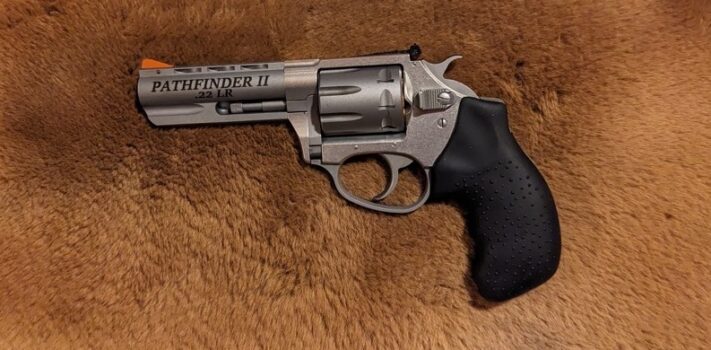


The Charter Arms Pathfinder II is a rugged, eight-shot revolver chambered in .22LR. It has a stainless steel barrel and an anodized aluminum frame. It runs reliably on inexpensive bulk .22LR ammo that many semi-autos find difficult to feed consistently, and is reasonably accurate. Like many handguns chambered in .22LR, it is also a lot of fun to shoot.
The single action trigger is a delight, while the double action trigger is a little heavier than I could wish. The compact rubber grip feels just a little too small in my hands (I wear gloves sized large to extra large). At 20 ounces not counting ammo, the Pathfinder II is easy to carry.
The Pathfinder II comes in three models with black passivate, stainless steel, or OD green & black passivate finishes. Each model had a manufacturer suggested retail price of $510.61 at the time of this writing.
Of the various revolvers that I have used during the course of my life, the Pathfinder II was the most fun to shoot. If you want to find a fun revolver chambered in .22LR, the Pathfinder II is definitely worth a look.
Background
Whenever I can find a good excuse to shoot a firearm chambered in .22LR, I take advantage of it. A recent press release from Charter Arms about their new Pathfinder II revolver offered just such an excuse. I asked if I could borrow a sample for testing and evaluation. Charter Arms was kind enough to agree.
On the day after the Pathfinder II was delivered to the gun store that handles my firearms transfers, that store closed up shop temporarily in order to move to a new location. For the next three months, the Pathfinder II was in limbo while the gun store completed its move. Finally after three months of impatiently waiting, I was able to pick up the revolver at the new location. The Pathfinder II was well worth the wait.
First Impressions
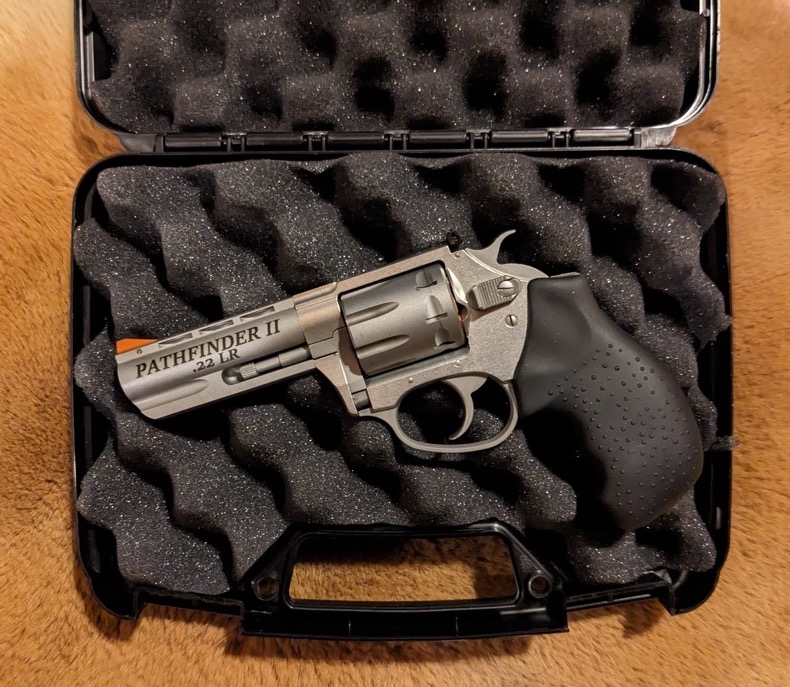
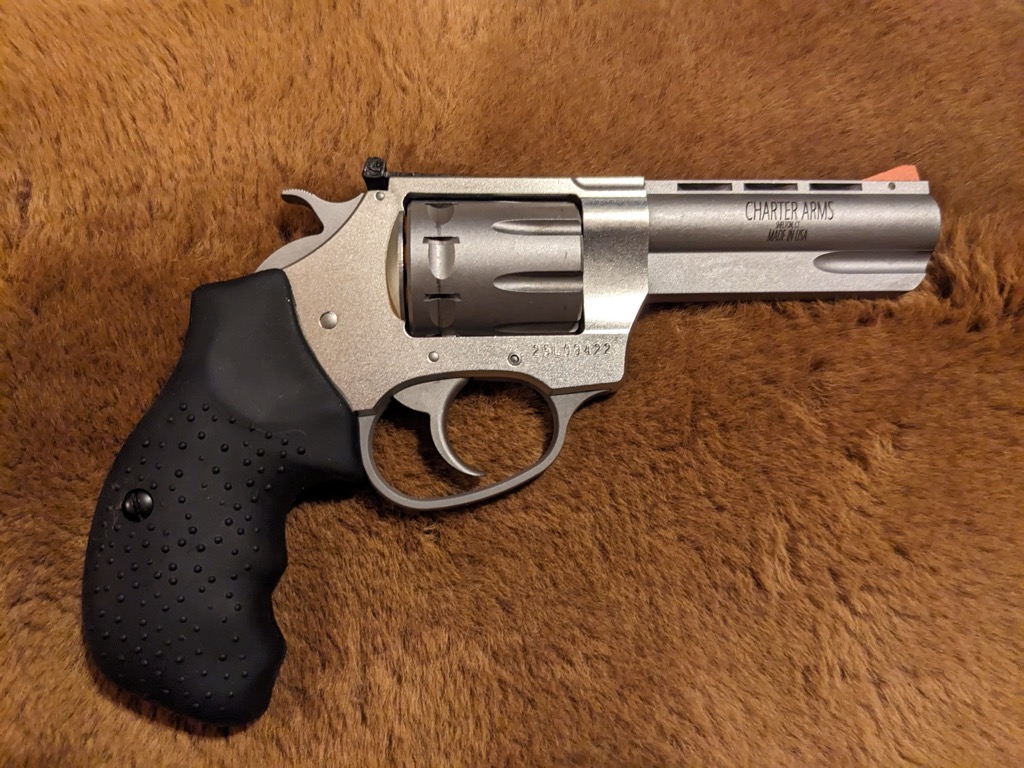 The revolver was shipped in a sturdy plastic case with well-designed latches and a hinge that are unlikely to fail due to material fatigue. Stickers on the case informed me of many things: the model and serial numbers of this particular revolver, that it has a lifetime warranty, that it is made in America, that the State of California wants me to know that using the revolver can expose me to lead, and that Charter Arms is located at 18 Brewster Lane, Shelton, Connecticut, 06484.
 The case contained a number of items: the revolver in a plastic bag, a packing slip, a card with a warning against dry firing the revolver without the use of snap caps, a card with instructions for adjusting the sights, a card with the 333 rule (most self-defense situations take place within three yards, with three shots, fired in under three seconds), a card with cleaning instructions for the anodized aluminum frame (avoid highly acidic, alkaline, or abrasive cleaners), a trigger lock, a warranty registration card, a Charter Arms card with contact and feature information, a Charter Arms decal, the manual, an exploded diagram and parts list, a youth handgun safety act notice, and a Charter Arms 2025 product catalog.
I took the revolver out of the plastic bag and opened the cylinder. I was impressed to see that the revolver was shipped with snap caps in the cylinder. That is an excellent idea, since many potential buyers will want to dry fire the revolver to test the trigger. The snap caps will keep the edge of the chamber of being damaged if this should occur.
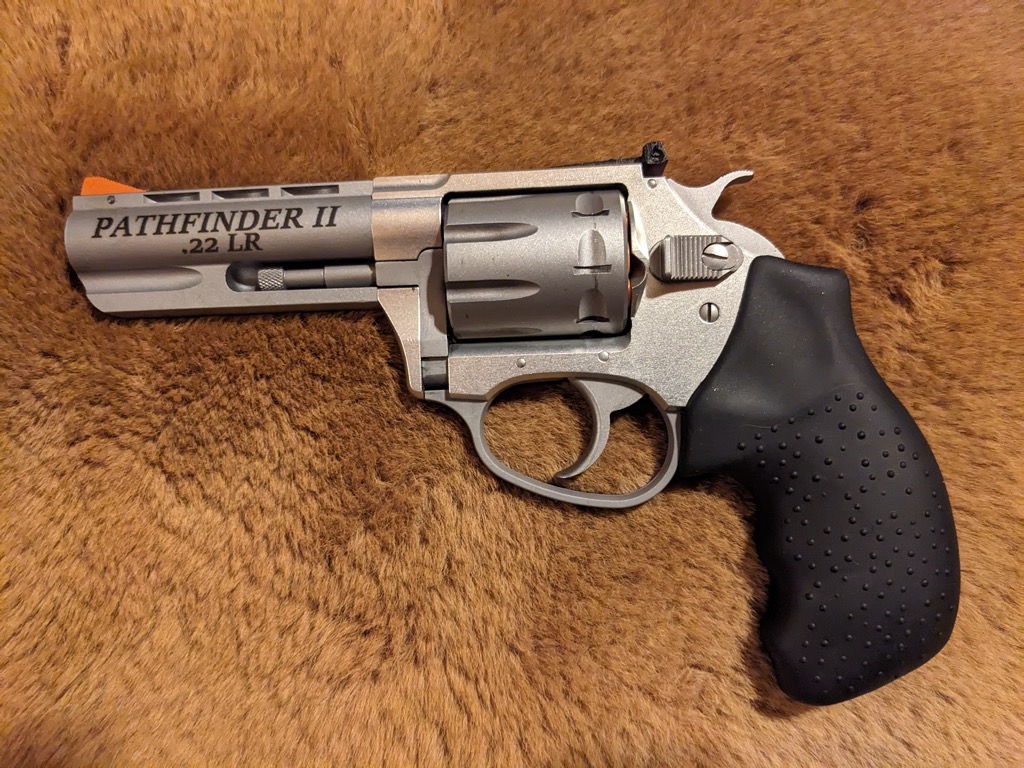
The fit and finish of the Pathfinder II were good. I did find one tiny extraneous tool mark on the left of the frame in front of the cylinder. The cylinder opened and closed smoothly. The trigger pull was smooth in both single and double action. The break was especially crisp in single action.
Trigger Pull Weight
I measured the trigger pull weight on each cylinder using both single and double action. I did this using a Ready Up Gear Digital Trigger Pull Weight Gauge.
During single action use, my eight measurements ranged from a low of 1.88 pounds to a high of 3.51 pounds with an average of 2.67 and a median of 2.55 pounds.
During double action use, my eight measurements ranged from a low of 9.99 pounds to a high of 12.16 pounds with an average of 11.51 and a median of 11.87 pounds.
Reading the Manual
The manual was somewhat on the short side, being composed of only 12 pages including the front and back covers. It was also generic to all models of Charter Arms revolvers. I did note a few points of particular interest:
–It warns against the use of hand loaded ammunition. Such use voids the warranty.
–The basic rules of safe firearms handling are near the beginning of the manual, which is good.
–It suggests waiting 5 minutes after the occurrence of a hangfire. This is quite a long time in comparison with the recommendations of most other manufacturers.
–The pages are not numbered. I find page numbering to be helpful.
–They recommend cleaning the revolver after every range session or after every 50 rounds, whichever comes first. I would have expected a recommendation of after 200 rounds or so.
–They advise against disassembling the revolver, but provide helpful instructions for the proper way to do so if you disregard their advice.
–The lifetime warranty applies only to the original purchaser for defects in material and workmanship.
Range Testing
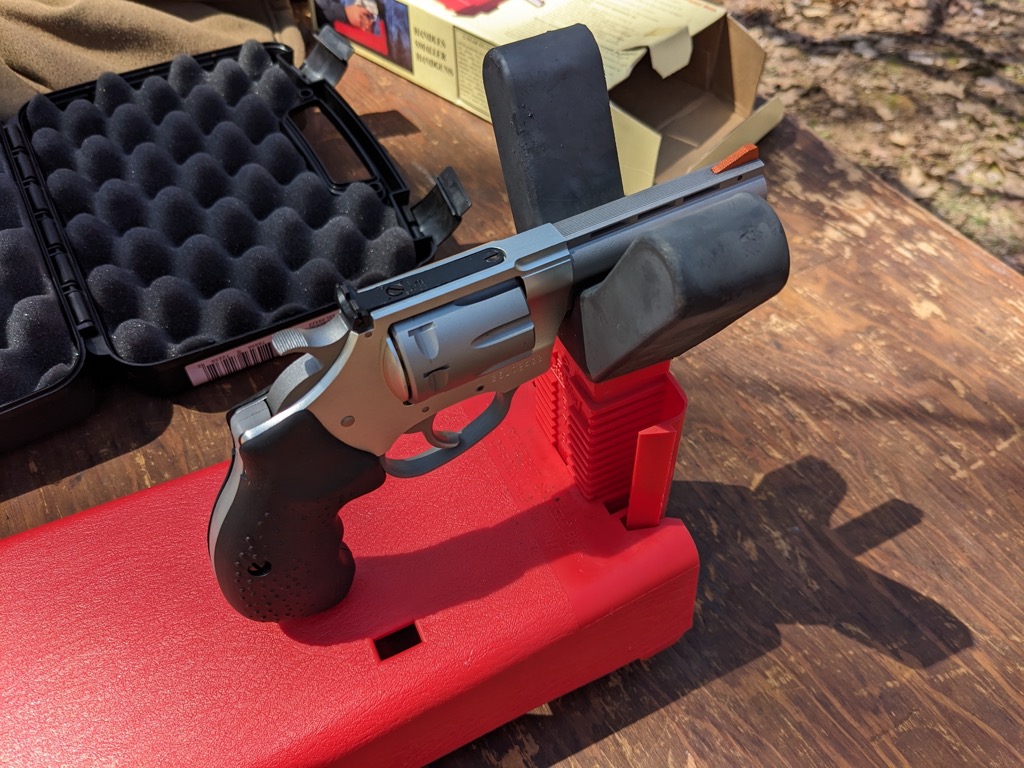 It was a beautiful Spring midafternoon. The temperature was 54 degrees Fahrenheit, but the sun was so warm on my back that I shed the fleece that was covering my T-shirt. A fickle breeze blew intermittently mostly from the south, but swirled around to the other points of the compass. Wind speed varied from dead calm to 10+ mile per hour gusts. I set up a target stand in front of the backstop on the improvised range behind the pole barn. I then set up a table with a pistol rest 15 yards away from the targets stand.
I began by loading eight rounds of MaxxTech 40 grain LRN Standard Velocity ammo into the chambers of the revolver. I then proceeded to fire a series of three-shot groups single action from rest.
The cocking process was quite stiff at first. Upon further testing, I found this problem to be due to a flaw in the MaxxTech ammo. The MaxxTech ammo has unusually thick rims. This causes the back of the casing to rub against the portion of the frame behind the cylinder with greater than average force. I did not have this problem with any of the other ammo that I tested.
In any case, the groups produced by the MaxxTech ammo ranged in size from a low of 1.16 inches to a high of 1.97 inches with an average of 1.45 and a median of 1.22 inches.
Next I fired a series of three-shot groups single action from rest using Federal 38 grain copper-plated hollow point. These groups ranged in size from a low of 0.22 inches to a high of 2.03 inches with an average of 1.18 and a median of 1.28 inches.
Then I fired a series of three-shot groups single action from rest using Remington 36 grain copper-plated hollow point. This particular ammo had not been working well in my semi-autos due to quality control issues. The bullet was seated loosely in some of the cases, which had a negative impact on reliable feeding. In the Pathfinder II on the other hand, this was not an issue.
The groups using the Remington ammo ranged in size from a low of 1.16 inches to a high of 2.47 inches with an average of 1.99 and a median of 2.34 inches.
I fired several three-shot groups double action using the MaxxTech ammo. The additional friction caused by the thicker rims made the trigger incredibly heavy. The trigger was so heavy that I often needed to use both index fingers in order to successfully pull it. These groups ranged in size from a low of 2.28 inches to a high of 5.53 inches with an average of 3.78 and a median of 3.53 inches.
I also fired a single eight-shot group double-action from five yards offhand using the Remington ammo. The trigger was much friendlier using the Remington rather than the MaxxTech ammo. This group was 2.66 inches in size.
Like most firearms, the Pathfinder II likes some ammo better than others. If I owned this revolver, I would test an even wider variety of ammos until I found what it liked best. Then I would buy a lot of that particular ammo.
Cleaning
Following the range session, I made my way to the kitchen table to clean the Pathfinder II. I ran a solvent patch through the bore, followed by a brass brush, two more solvent patches, a dry patch, and a CLP patch. I followed a similar patter for all eight chambers, and all accessible metal parts.
Conclusions
The Charter Arms Pathfinder II in .22LR is a dandy little revolver. It is light, durable, weather resistant, carries eight rounds, is reasonably accurate, and is great fun to shoot.
Disclaimer
Charter Arms loaned me a sample of their Pathfinder II revolver in .22LR for testing and evaluation. They had previously allowed me to test their Double Dog in .357/9mm for an earlier review. I tried not to let their kindness interfere with the objectivity of this review, and I believe that I have succeeded. I did not receive any other financial or other inducement to mention any vendor, product, or service in this article.