
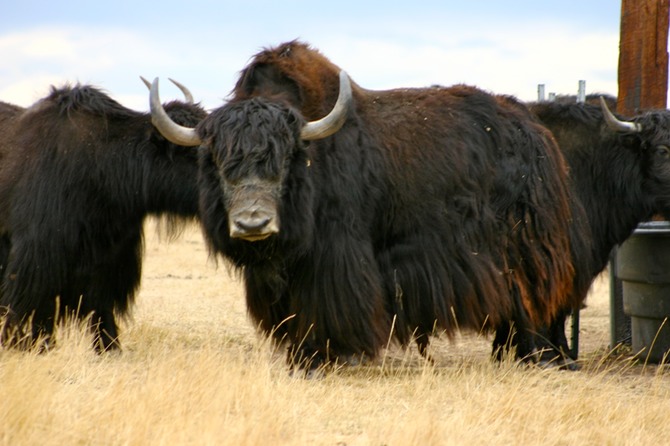
(Copyright 1997 by Linda Rawles )
Yaks are truly a multi-purpose animal. Their meat is extremely low in cholesterol, yet their milk is extremely high in butter fat. They have a wooly undercoat that sheds every spring that can be collected and spun into a beautiful yarn. Since they are originally from Tibet theyare extremely hardy and disease resistant. Yet hot summers do not bother them. They are excellent breeders and mothers. They produce one calf a year. They have been domesticated for over five thousand years. They are easy to tame and easy to fence. They are raised just like any other breed of cattle except that they are very thrifty and thrive on poor forage. Since there are still so few in the country we think there is a real opportunity to sell breeding stock.
They do cross breed with all other cattle, and the resulting female offspring are fertile. (The males are not.) We think there will be a market for our extra bulls to develop crossbreed beef cattle who have the same low cholesterol meat, the same thrifty feeding habits, and the hardiness and disease resistance. We also plan to cross our Yak bull with a Jersey cow to raise a milker with even higher butterfat content than the Jersey with all the positive Yak traits. (Last year our Jersey had a 1/2 Yak bull calf.)
We hope to market a specialty yak dairy product for the gourmet and specialty fibers to handspinners. (I have not milked our yaks yet as their milk is much more valuable as the perfect food for their calves since we are raising breeding stock.) Yak milk is super high in butterfat though, higher than Jersey cows. The preferred milk animal in Tibet is half yak, not full yak, because yak milk is so rich. Yak milk is made into butter, “butter tea”, yogurt, cheese, et cetera.
In Tibet, the butter is even burned as fuel for lamps. Yaks a have a beautiful long flowing hair and a thick soft under wool. The wool is naturally shed in Spring and can be collected and spun into yarn or felted.
The yak’s long hair is used to make ropes, slings, sacks,blankets, and yurts. The under-down wool is collected to be woven or felted into soft clothing. The hide is of course used to make leather, or left with
the hair on to make beautiful rugs.
In Tibet yaks are used to pull plows, to ride, and used as fantastically surefooted pack animals carrying up to 300 pounds each. Yak meat has a mild beef flavor and has a unique tenderness. Yak dung is burned as fuel, and the soot from the burned dung is made into ink! It is no wonder in Tibet they term for yaks is “nor” meaning “material wealth.”
We have found yaks very easy to handle. We did not grow up around livestock, but we have had no problems managing them. When we had the vet out (to stitch up the heifer that had fought off a mountain lion) Jim knocked together a crude alley out of pallets. We put a borrowed squeeze chute at the end of it. We led the heifer down the alley with a bucket of grain. Sometimes grain doesn’t work to lead them–like when they have just gotten into a really lush pasture (Oops, who left the gate open!!!?) I am 5 foot 4 inches and weigh 95 lbs. But to herd them, I just wave my arms, a stick, and shout and I can easily drive our cows and bulls back where they need to go by myself. I like their temperament! They seem quite intelligent, too.
Yaks adapt readily to different climates. Yaks have been kept successfully in the subtropical environment of the Rio de Janiero Zoo with it’s summer temperatures of 104F. Our yaks handled this summer’s 107F+ with no difficulty.
They are also mountain lion proof! One of our 10 month old yak heifers was attacked by a mountain lion. When we found her grazing peacefully the next morning she was bleeding from long claw gashes on her
shoulder and neck. And she was missing half an ear. But she must have run off the mountain lion. Her wounds did not seem to trouble her in the slightest.
This mountain lion by the way had no fear of humans and was known to have eaten two neighboring goats, a sheep, a chicken, and was believed to be responsible for other missing sheep, chickens, and a missing steer. But that is another story…
The reason we started keeping yaks was because we wanted animals that were truly multi-purpose and even more importantly, animals that were extremely hardy, that could survive on poor forage, were disease resistant, were easy calvers, and were excellent mothers. Yaks can survive just about anything: the hardest times, worst weather, and poorest feed.
Addenda:
Yaks have one extra pair of ribs than other cattle.
Yaks have purple tongues — like seen with Chow dogs.