
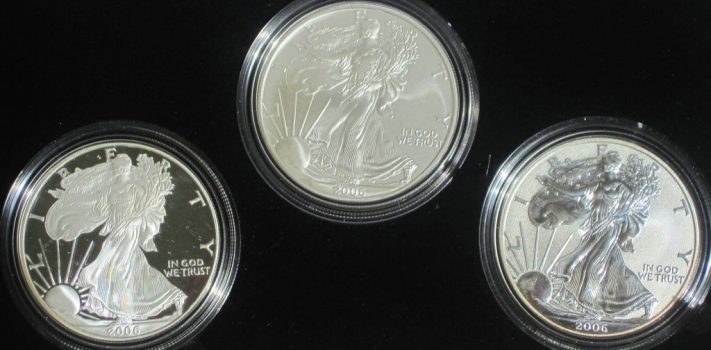


Spot silver jumped 10.35% to $79.59 per troy ounce in just one day, on Friday, December 26, 2025. On that day, there were new all-time highs set for silver, platinum, and gold. Spot silver has gained a phenomenal 166% in value in 2025. And now, amazingly, a $1,000 face value bag of pre-1965 non-numismatic “junk” 90% U.S. silver coins now sells for $56,840. Though prices vary, that effectively means that the melt value of one U.S. pre-1965 silver dime (10-cent piece) is now $5.68.
And today? In Monday morning trading in China, (that was early Sunday evening, in the United States, the New York Globex silver was at $82.40. It has since then dropped to around $76.25, as of this writing.
The Metals Price Ratios
In percentage terms, silver and platinum are consistently rising faster than gold. It was easy to predict this trend, because of several factors, to wit:
- Silver’s scarcity, geologically. There are roughly 8 ounces of silver in the Earth’s crust for every ounce of gold. The traditional monetary ratio (in exchange) was around 15-to-1. The market price ratio has wandered between 40-to-1 and an absurd 110-to-1 in recent years. But in the past 8 weeks, we’ve seen the market price ratio drop from 74-to-1 to 57-to-1. I expect to see that ratio continue to decline — perhaps to as low as 30-to-1, within a few years. For the past three years, I’ve been advising SurvivalBlog readers that they should ratio trade a good portion of their gold holdings into silver. Hopefully, most of you heeded that, and you have realized a handsome profit.
- Growing industrial silver demand. Although the photographic demand for silver had dropped tremendously, the overall demand is growing, particularly for the production of photovoltaic power panels and batteries. Samsung recently announced the fruition of a new ultra-fast charging long-range solid-state electric car battery that will depend heavily on silver. They’ve been developing this for nearly five years. They are both safer and faster to recharge than lithium anode batteries. This new silver-carbon composite nanolayer anode battery technology will undoubtedly increase the demand for silver in the next few years.
- Lack of silver scrap recovery. While the majority of gold used in electronics is recovered from scrap, the majority of silver is not. This means that a lot of silver has incrementally ended up in landfills.
- Declining commercial silver stockpiles. The amount of available aboveground silver has been gradually falling for more than 10 years. The law of supply and demand is inescapable.
- Relentless physical demand from Asia. Asian investors have always liked silver. And not many small investors can afford to buy gold at roughly $4,400 per ounce. So, they are shifting to buying silver.
Paper Silver Versus Physical Silver
It used to be that the paper silver market (futures contracts, mining stock shares, and ETFs) established the market price of silver. However, with consistently strong buying in Asia, the paper market manipulators of the West started to lose traction. Let me explain: Silver was sold more short than long for almost 45 years. Short sellers found that in a thin market like silver, they could manipulate the price fairly easily. So they kept slamming down the price of silver, over and over again. This made the big banks ( JP Morgan, Bank of America, and HSBC) that dealt in futures countless millions of dollars in profit, annually. That also earned their traders huge bonuses, year after year. So they had a vested interest in continuing to sell silver short.
But starting in 2025, the silver short sellers had their comeuppance. It is now the physical silver market that establishes the market price of silver. And this is now all driven by the Asian markets. The Asian traders don’t care if the Comex raises their margin requirements for futures contracts. The Comex and the LBMA are no longer the world’s price-setters, for silver. The price discovery mechanism has shifted to Shanghai and Hong Kong, and it is mostly driven by physical demand rather than paper market fiddling. I cannot overemphasize that this is a monumental shift that will be felt for decades.
For now, JP Morgan is bleeding cash badly, because they took naked silver shorts. As those futures contracts mature, they are forced to buy silver on the open market. January, February, and March are going to be disastrous for the short sellers. There may even be some firms that go bankrupt.
There will be a new “discovery” for many of JP Morgan’s short sellers, in January, 2026. They will discover that they no longer have jobs.
Exchange Managers’ and Government’s Response
Based on their reactions to the silver price spikes in 1980 and 2011, we can expect to see much higher margin requirements for futures contracts, by the Comex (in New York) and the LBMA (in London.) On the Comex, there was a 10% margin increase on December 12th, and another 13% margin increase goes into effect today. But I don’t believe this will stop the silver bull’s rampage.
Both the Comex and LBMA will also very likely change their futures contract settlement rules. I predict that they will both approve physical delivery to only industrial and ETF silver futures contract holders. All others will see their settlements only in cash. Both exchanges may also change their custody rules and stretch out their physical delivery timelines. Inevitably, this will create a credibility gap for the Western metals exchanges. Therefore, the trading nexus will continue to shift to Asia.
 Twice, the price of silver has gone into almost full upright spikes: The Hunt Brothers Short Squeeze in early 1980 and the 2011 silver breakout. To stop the 2011 price rally, the Chicago Mercantile Exchange (CME) raised margin requirements five times in nine days. And, yes, the exchanges may do something draconian again, such as a 99% margin requirement on puts or even a full temporary freeze on long options. Under such a ban, traders could only take short (call) option positions. Depending on how long such a freeze is in effect, this could destroy the silver market as we now know it.
Since silver was recently designated a Critical Mineral, there may also be an Executive Order or an act of Congress that will severely limit exports of silver from the United States. Perhaps even a full physical silver export ban.
The other thing that the government may do is another bank bailout, for the banks with large silver short positions if they are at risk of bankruptcy. (Never forget the unwritten Post-1913 Rule: The Bankers Never Lose.) This bailout could come in several forms, including emergency loans from the U.S Treasury or the Federal Reserve, or even a physical silver drawdown from the silver stockpile at the West Point Mint.
The Worst Case Scenario
 In an absolute Worst Case for the U.S. Treasury and the exchanges, where the spot silver price zooms up to $300+ per ounce, and the silver-to-gold ratio drops below 20-to-1, the government could enact a ban and confiscation of privately-held physical silver, at an arbitrarily-pegged silver price. They could use the Defense Production Act as justification and a weak legal basis. That silver price peg would of course have to be quite temporary, but at least long enough for them to attempt to rob the American citizenry of much of their silver at below the real market price. However, I really doubt that such a silver confiscation will be attempted. As they say in Arkansas: “Them’s Fightin’ Words!”
Correction Risks
I recently had a long conversation with my old friend “The Chartist Gnome”, in Switzerland. He said that we may soon see $5,000 USD gold and $100 USD silver prices. (A 50-to-1 ratio.) But he warned: At that point, there will be the risk of a correction by as much as 25% for silver. That, he said, could be triggered by the Chinese government’s Ministry of Commerce (MOFCOM) banning leveraged silver trading. This would likely bring spot silver back down below $70 and revert to silver-to-gold ratio back up to as high as 62-to-1.
So, my advice to long-time silver stackers is simple: Do not get caught up in “Silver Fever.” Do not buy more silver, now that it has surpassed $80 per Troy ounce. Instead, you should start gradually divesting part of your silver stack, as silver rises. At least recoup your initial acquisition cost. So, say for example, if you bought silver at $20 per ounce and you sell 25% of it at or above $80 per ounce (a quadruple on-paper gain), then what you have left essentially cost you nothing. At that point, you can let the rest of your stack ride for a while, and still sleep well at night. That is the fun way to watch a bull market.
Typically, upright spikes don’t last long. And, as I’ve often written: never attempt to precisely time the top of a spike. Because odds are that you will be wrong.
The safe approach is to slowly unwind your silver position, selling into the rising bull market. Because of ongoing Dollar inflation, be sure to put the proceeds from any sales of silver or gold into other tangibles, fairly quickly. Some good ideas for tangible reinvesting: Paying down home loans/HELOCs, guns, ammunition, quality knives, practical tools, and if you have the garage space, perhaps a restored vintage 4-wheel-drive Jeep, Jeepster, or pickup truck.
SurvivalBlog reader Larry in Idaho had a markedly different opinion than mine on the recent surge in silver prices, and for the sake of showing both sides of market issues, I’m posting his e-mail here:
“I believe that seeing silver and gold as investments is not wise. Selling physical silver at this time is a strategic mistake, as the banks have just lost their ability to suppress the price of silver via paper trading. This is happening because of a massive demand from high-tech manufacturers. This is in concert with a shortage due to the nature of the supply chain which has allowed Beijing to set the price. The gold-silver ratio is crashing and has a long way to go. The silver price has only started going up and will stop rising when the gold-to-sliver ratio returns to more historical levels that existed before the paper traders suppressed the price and when the industrial demand softens. That is going to take a while.”
Bottom Line: Whether you take Larry’s approach or you take mine, always maintain at least 30% of your silver holdings as a multigenerational hedge on inflation. That core holding is your “fire insurance” on the Dollar itself. – JWR