
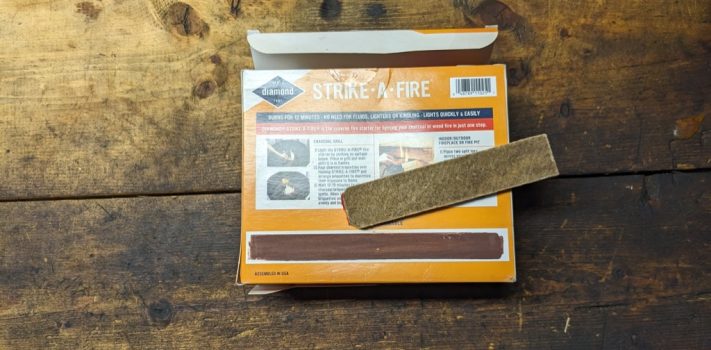


Each Diamond “Strike-A-Fire” Fire Starter (SAF stick) is kind of like a giant match which is 5.75 inches long, 1.13 inches wide, and 0.25 inches thick. The shaft of a SAF stick seems to be made out of some sort of pressed wood that is impregnated with a waxy substance. When the match-like head of a SAF stick is struck on the striking strip on the box, it ignites the SAF stick which then burns for approximately 12 minutes. In the process, the SAF stick creates enough heat to effectively ignite most types of kindling.
[JWR Adds: The SAF sticks are somewhat similar in size to the famous locofoco matches of the 1800s.]
The only significant drawback of SAF sticks that I discovered during my testing is that they are easily blown out when first struck in windy conditions.
A box of 48 SAF sticks cost $14.73 at walmart.com at the time of this writing. That comes out to just under $0.31 each. SAF sticks are “Assembled in USA”.
SAF sticks are so easy to use that I am afraid that they have made me a bit lazy. Rather than gathering tinder and fine kindling, I have often recently found myself just making a pile of some small sticks, some medium-sized sticks, and some large sticks. Then I just light an SAF stick, put it under the pile, and soon have a cheery fire going. I worry that the ease of this process may allow my fire-starting skills to decay somewhat.
For most practical purposes, fatwood works just as well as SAF sticks and costs less per pound when purchased in bulk. But you can’t light fatwood by striking it on the side of the box. So I would not be surprised to find myself buying some more SAF sticks when my first box runs out, even though I will probably feel a little guilty when I do so.
Background
My youngest daughter, “Rivka”, knows that I am an experimental pyromaniac. She supported my habit by buying me a box of SAF sticks for Christmas.
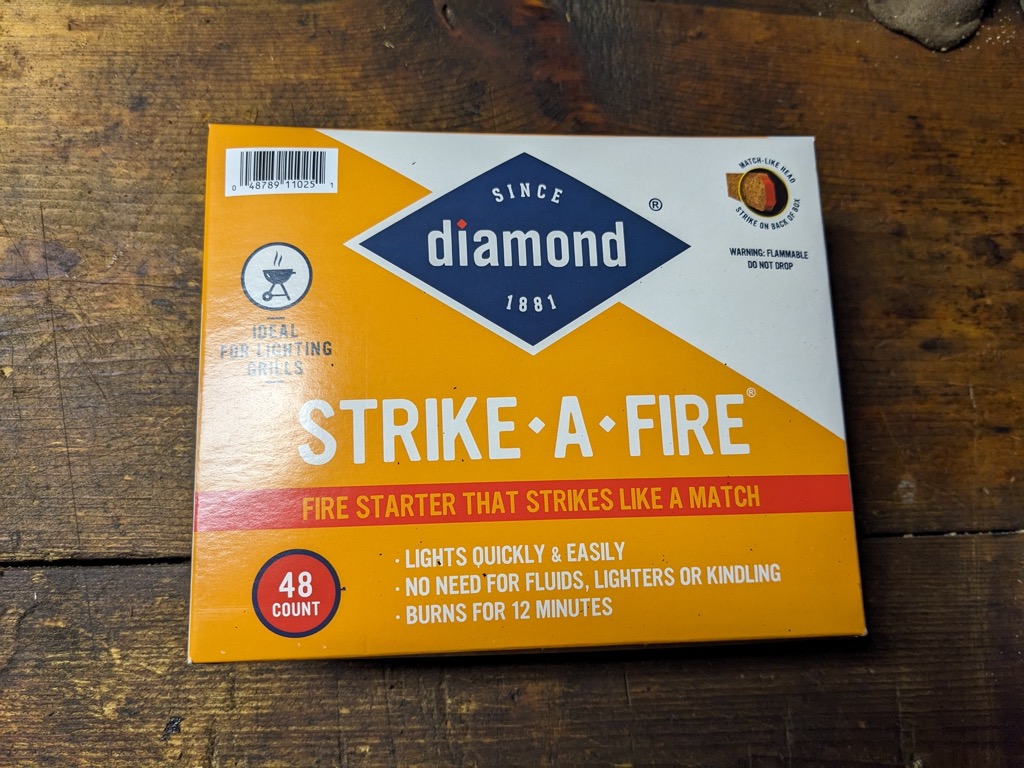
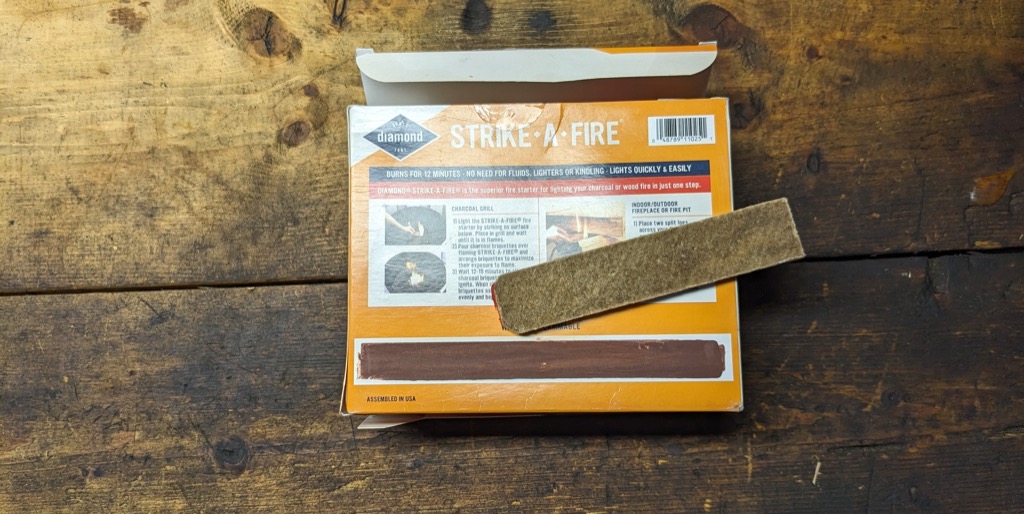 The box measures 3.38 x 6 x 2.5 inches and contains 48 SAF sticks. The SAF sticks are made by the Diamond Company, which is well known for its matches. They make strike on box kitchen matches, long reach strike on box matches, strike anywhere kitchen matches, weatherproof matches, strike on box penny matches, and strike anywhere penny matches. They also manufacture things like toothpicks and torch fuel. Their various products are showcased at their website: diamonddoesitbest.com. Diamond is owned by Royal Oak Enterprises of Roswell, Georgia, which may be best known for their charcoal.
Testing
During my testing, I used SAF sticks to start fires in rocket stoves on a number of occasions. SAF sticks are ideal for that task since it is helpful to have something that can be ignited outside of the stove, that will remain ignited while being dropped into the stove, and that will burn for a significant period of time after it has been dropped into the stove so that fuel can be added on top.
I also used SAF sticks to start fires in our fire pit. My wife, “Kari” doesn’t like waiting around while I gather tinder and small kindling, cut wood shavings, carve feather sticks, and otherwise exercise the arcane arts of the fire-starting craft. She just likes to get the show on the road. Because of that sense of urgency, the SAF sticks have made a great contribution to our domestic tranquility.
SAF sticks also proved useful for re-lighting our outside wood boiler after a cleaning. Things like matches or a burning twist of paper are often blown out when introduced into the boiler by the draft coming from the ignition air fan. A fully ignited SAF stick can endure that blast of air and remain burning long enough for its flame to spread to the fuel in the boiler.
The SAF sticks also proved themselves to be very useful during a five-day camping trip with the grandkids, our two daughters, and our son-in-law. The grandkids usually keep things exciting enough without the need for any extra challenges while starting a campfire. The SAF sticks made the fire-starting process quick and easy so that we could focus more attention on the kids and less on the fire.
The only drawback of the SAF sticks is that they are extremely easy to blow out when first ignited. This means that the match head of the stick is fun and convenient but cannot be depended upon in a critical situation. If conditions are at all breezy outside, it is good to have something like a butane lighter handy to reignite an SAF stick if it blows out.
SAF Sticks and Fatwood
An SAF stick really reminds me of a piece of synthetic fatwood with a giant, strike-on-box match head attached.
Fatwood is pine heartwood that has become impregnated with resin.
Each SAF stick weighs exactly one ounce, and costs about $0.31. Fatwood costs about $0.14 to $0.20 an ounce when purchased in bulk. When you add about $0.01 per ounce of fatwood for matches, the fatwood still presents a significantly more economical alternative than SAF sticks for fire starting. Fatwood is even less expensive if you find your own in the wild.
Bonus Discovery: Diamond Strike Anywhere Matches
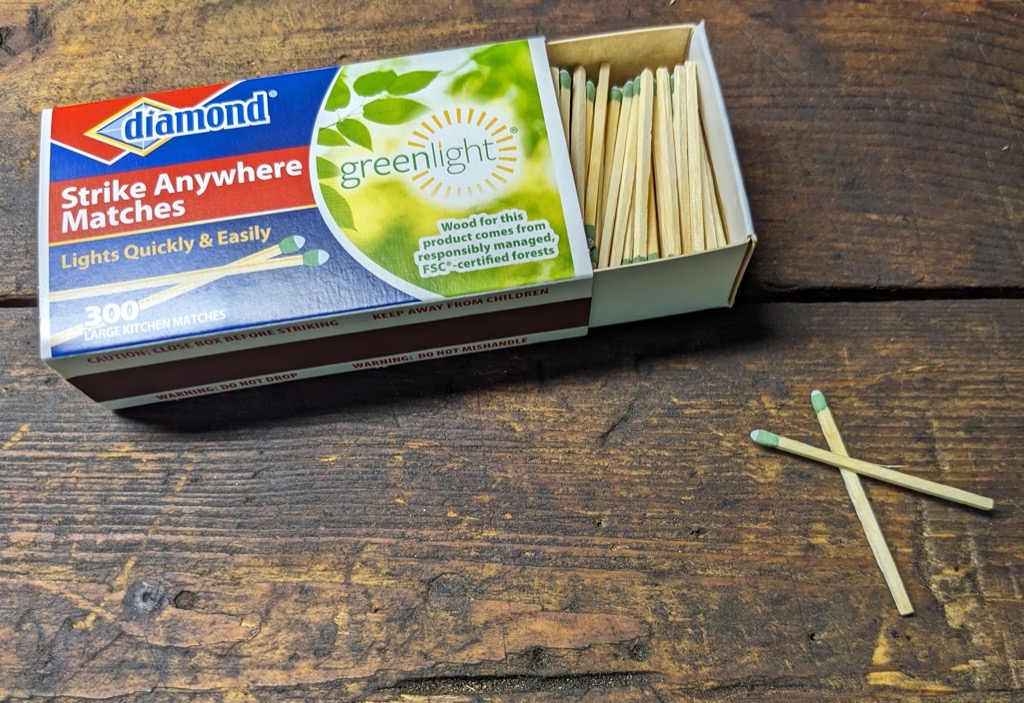 When I was young, Ohio Blue Tip Strike Anywhere Kitchen Matches were my match choice for field use. I carried them in a waterproof case. We also tried to make our own waterproof matches by dipping the heads of the Ohio Blue Tip matches in melted paraffin. The paraffin lubricated the striking surface enough that it made the treated matches somewhat difficult to ignite, but they burned great once they ignited.
After coming home from overseas, I could no longer find strike-anywhere matches for sale. I heard a rumor that strike-anywhere matches were no longer being sold in the United States because they were considered too hazardous to transport. [JWR Adds: At the time, it was also reported that the BATF had urged the ban, because strike-anywhere match heads could be easily cut off or soaked off with a solvent and used as a source of perchlorate in constructing pipe bombs.]
So, as I researched this article, I was delighted to note that Diamond makes two versions of strike anywhere matches: kitchen and penny matches.
I was even more delighted to discover that the Diamond strike anywhere kitchen matches were in stock at our local non-big-box hardware store. I bought a box at my earliest opportunity.
The box indicates that the matches are made in Chile. It also indicates that the match tip contains perchlorate, as you might expect. The box of 300 matches cost me $2.99 .
After I got home, I headed out to the pole barn to play with matches. I was successful in striking matches on the following surfaces:
The striker strip on the box (obviously).
The nail file on the Swiss Army Classic SD knife that I always carry.
A rusty piece of metal that I was using to test the corrosion resistance of some firearms lubricants.
The stone on my bench grinder.
The stone that I use to sharpen my axe.
The concrete floor of the pole barn.
The edge of my wooden work bench.
One of the rocks that surround our fire pit.
The side of a lawnmower blade that I had recently sharpened but not yet reinstalled on the mower.
The side of an old crowbar.
The side of a rocket stove.
The side of a pine 4X4 post.
A wooden shovel handle.
The side of a cardboard box.
A nylon tool holder that fits over a five gallon bucket.
The raised letters on the head of my house key.
The side of an old dynamite crate. (When striking on wooden objects, it seems to work best to strike with the grain rather than across the grain).
The side of an old, galvanized washtub.
There were also a few objects that did not work well:
The nylon zipper on my pants.
The rubber sole of my shoe.
The side of my metal ink pen.
The head of a wire brush. (But the wooden handle of the brush worked well).
The brim of my range cap.
The back of a leather glove.
The cover and pages of my pocket notebook.
I was surprised and pleased that the current Diamond strike anywhere kitchen matches seem to work as well or better than the old Ohio Blue Tip strike anywhere matches.
Conclusions
Strike-A-Fire Fire Starters are great for igniting rocket stoves, fire pits, wood boilers, campfires, and other wood or charcoal fueled fires.
For practical day-to-day use, fatwood and matches may provide an equally effective and more economical alternative. Igniting fatwood with a match is not quite as fun and entertaining, however, as striking a “giant match” on the side of a box of “giant matches.”
The one drawback of SAF sticks is that they can be easily blown out soon after ignition under windy conditions. As a result, it is important to have a back-up plan (like a butane lighter) for igniting SAF sticks whenever they are used.
I am even more excited about finding Diamond Strike Anywhere Kitchen Matches than I was about using SAF sticks. Finding the strike anywhere matches was like meeting a long-lost friend in an unexpected place. I highly recommend them.
Disclaimer
I did not receive any financial or other inducement to mention any vendor, product, or service in this article.