Preparedness Notes for Sunday — March 29, 2026

On March 29, 845, a 5,000-strong army of Danish Vikings invaded Frankish lands and only retreated after besieging Paris and securing a ransom from the Frankish King Charles the Bald. This was part of a series of devastating raids begun by the Vikings that began in the 790s. The Vikings were led by a man named “Reginherus” or Ragnar, sometimes linked to the legendary saga figure Ragnar Lodbrok. The Vikings easily overcame defences set in place by Charlemagne and are known to have attacked the Abbey of Saint-Germain-des-Prés just outside the city. The Vikings returned home with a ransom of 7,000 French livres of gold and silver.

March 29, 1638: The first permanent white settlement in Delaware, Fort Christina (now Wilmington), was founded by Swedish Lutherans.

And on March 29, 2004, Bulgaria, Estonia, Latvia, Lithuania, Romania, Slovakia, and Slovenia joined NATO as full members.

Today feature piece is by JWR.

We stilll need entries for Round 123 and Round 124 of the SurvivalBlog non-fiction writing contest. More than $981,000 worth of prizes have been awarded since we started running this contest.  Round 123 ends on March 31st, so get busy writing and e-mail us your entry. Remember that there is a 1,500-word minimum, and that articles on practical “how-to” skills for survival have an advantage in the judging. In 2023, we polled blog readers, asking for suggested article topics. Please refer to that poll if you haven’t yet chosen an article topic.


Notes on Constructing a 12 VDC Fuel Transfer Pump


JWR’s Introductory Note: This is an update to a reply to a letter that I posted in SurvivalBlog back in February 2007.  Given the recent spike in gasoline and diesel prices, I thought it would be apropos to re-post it.

Every well-equipped retreat should have at least one “field expedient” 12 VDC fuel transfer pump. These pump rigs are popular with dirt bike, ATV, and snowmobile enthusiasts. They are very simple to construct. Here are the materials that you will need:

1 – An automobile or truck electric fuel pump. (The least expensive pumps come from automobile wrecking yards.)

2 – Roughly 15-foot lengths of heavy rubber hose–approved for use as fuel line–of the proper diameter for the fittings on the fuel pump.

2 – Stainless steel fuel line clamps. (Such as “Aero-Seal” brand, or similar, that are tightened with a screwdriver.)

15 to 20 ft. – 16 AWG (or heavier) gauge insulated two-conductor wire. (This will be the power cord for the pump.)

1 – “Cigarette Lighter” type male plug, available from any auto parts store, or via eBay. (Again, for the power cord for the pump.)

1 – Roll of black plastic electrician’s tape or better yet, some thermoplastic “heat shrink” tubing.

1 – Scrap of 3/8″ thick (or greater thickness) plywood, measuring roughly 16″ x 16″. (On which to mount the fuel pump.)

The construction method should be self-evident, based on the materials listed above. The pump is mounted in the center of the board. If you’d like, you can add an electrical switch to the power cord for convenience, but make sure that you get a high amperage switch that is rated for DC, and that you position the switch within a couple of feet of the dashboard plug so that the switch is inside your vehicle. That way, there is far less chance of generating a spark inside a gas vapor cloud.

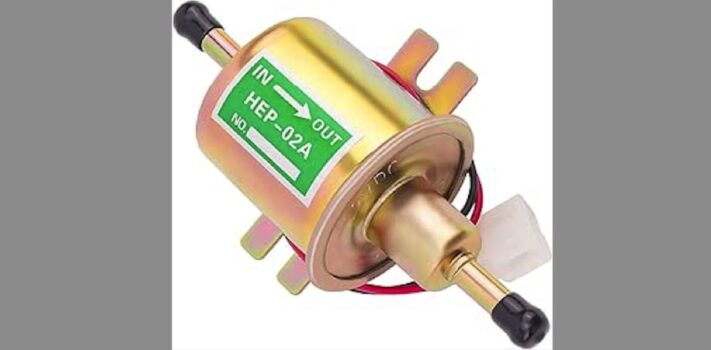
If your vehicle uses an electric fuel pump, then I suggest that you use an identical pump to the one used in your vehicle as the basis for your transfer pump project. (If your vehicle uses an electric fuel pump.) That way, you will have spares on hand, in the event that your vehicle’s fuel pump or any portion of your fuel system’s flexible fuel lines ever fail. If your vehicle uses a mechanical fuel pump or one that is submerged in your fuel tank, then just use a generic 12 VDC fuel pump like the one pictured above. These are widely available via eBay or a wide range of online vendors. Just do a web search on “low-pressure 12V fuel pump.”

By the way, you can also add an “in-line” fuel filter to your fuel transfer pump rig. Following a theme, it is best to use a filter cartridge that is identical to that used in your vehicle. (Always think: “Spares and redundancy, spares and redundancy”, like a mantra.)

The square scrap of plywood will keep the transfer pump out of the mud or snow. It also provides a handy place to mount some large hooks, so that you will have a neat way to coil up the power cord and the fuel transfer hoses, for storage. A 15-foot length of hose should be able to reach any vehicle fuel tank, or even down into an underground tank.

There are commercially-made equivalents to this field fuel pump rig, but they cost more, and they won’t provide you with a spare compatible fuel pump, for if or when your vehicle’s original pump goes Tango Uniform.

Important Provisos:

1.) All of the usual common-sense precautions for handling gasoline and gas cans apply:

  • Use only DOT-approved fuel containers.
  • No sparks.
  • No open flames.
  • Don’t turn on any radio transmitters.
  • Beware of static electricity build-up.

For more details, see this web page on fuel safety basics.

2.) Note that some later-model vehicles have “anti-siphoning” filler necks on their gas tanks. Check for this before you head for the boonies.

3.) Cover any exposed electrical connections with tape or heat shrink tubing, to avoid sparks or shorting.

4.) Transferring fuel with such a rig is best done as a two-man operation: One man inside the vehicle to keep an eye on your vehicle’s gas gauge and flip the switch (or pull the plug), and another man outside to handle the hoses and eyeball the filler necks,

Note: It is not just an expensive waste to spill gas on the ground. It is also toxic and a fire hazard!

By coincidence, soon after I wrote the first draft of my letter reply, I got an e-mail forwarded by Alfie Omega, a regular over at the outstanding Alpha Rubicon website. There, “Pike” has plans for building a very similar fuel transfer pump rig. (I surmise that he had seen the same type that I had.) A couple of nice touches with his design that mine lacked are that the mounting board has a carrying handle slot cut into it at the top-center, and there are hooks mounted all the way around the perimeter of the board, for hose and power cord stowage. But a couple of detractors: His photos show an on-off switch mounted to the board (which, as previously mentioned, could put it in proximity to gas vapors.) And I saw some exposed wiring terminals. If those terminals were touched by a metal object, they could cause a spark.

In conclusion: Plan ahead, design and build your “in-the-field pump” to last, and above all: be safe! –  JWR



JWR’s Meme Of The Week:

The latest meme created by JWR:

Meme Text:

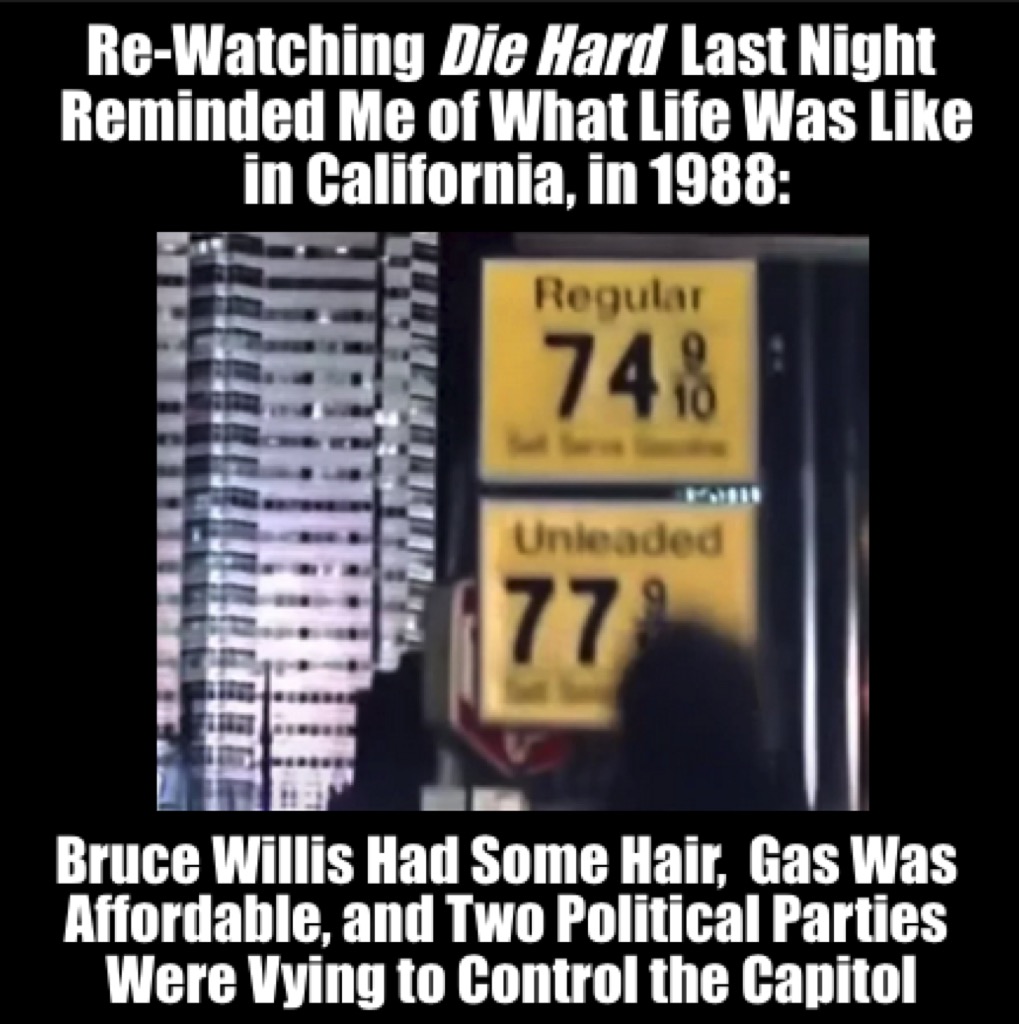
Re-Watching Die Hard Last Night Reminded Me of What Life Was Like in California, in 1988: Bruce Willis Had Some Hair, Gas Was Affordable, and Two Political Parties Were Vying to Control the Capitol

Notes From JWR: Do you have a meme idea? Just e-mail me the concept, and I’ll try to assemble it. And if it is posted then I’ll give you credit. Thanks!

Permission to repost memes that I’ve created is granted, provided that credit to SurvivalBlog.com is included.


The Editors’ Quote Of The Day:

These twelve Jesus sent forth, and commanded them, saying, Go not into the way of the Gentiles, and into any city of the Samaritans enter ye not:

But go rather to the lost sheep of the house of Israel.

And as ye go, preach, saying, The kingdom of heaven is at hand.

Heal the sick, cleanse the lepers, raise the dead, cast out devils: freely ye have received, freely give.

Provide neither gold, nor silver, nor brass in your purses,

Nor scrip for your journey, neither two coats, neither shoes, nor yet staves: for the workman is worthy of his meat.

And into whatsoever city or town ye shall enter, enquire who in it is worthy; and there abide till ye go thence.

And when ye come into an house, salute it.

And if the house be worthy, let your peace come upon it: but if it be not worthy, let your peace return to you.

And whosoever shall not receive you, nor hear your words, when ye depart out of that house or city, shake off the dust of your feet.

Verily I say unto you, It shall be more tolerable for the land of Sodom and Gomorrha in the day of judgment, than for that city.

Behold, I send you forth as sheep in the midst of wolves: be ye therefore wise as serpents, and harmless as doves.

But beware of men: for they will deliver you up to the councils, and they will scourge you in their synagogues;

And ye shall be brought before governors and kings for my sake, for a testimony against them and the Gentiles.

But when they deliver you up, take no thought how or what ye shall speak: for it shall be given you in that same hour what ye shall speak.

For it is not ye that speak, but the Spirit of your Father which speaketh in you.

And the brother shall deliver up the brother to death, and the father the child: and the children shall rise up against their parents, and cause them to be put to death.

And ye shall be hated of all men for my name’s sake: but he that endureth to the end shall be saved.” – Matthew 10: 5-22  (KJV)


Preparedness Notes for Saturday — March 28, 2026

On March 28, 1535, the Cistercian Bloemkamp Abbey (Oldeklooster) in Friesland was attacked and destroyed by a group of millenarian revolutionary Anabaptists.

March 28, 1774: Britain passed the Coercive Act against Massachusetts.

Today’s feature article is a guest piece written by our friend and fellow blogger, Patrice Lewis, the Editrix of the highly-recommended Rural Revolution blog.

We are now seeking entries for Round 124 of the SurvivalBlog non-fiction writing contest.  More than $981,000 worth of prizes have been awarded since we started running this contest.  Round 123 ends on March 31st, so get busy writing and e-mail us your entry. (We have room for one or two articles in Round 123, and any that arrive later will be posted in April.) Remember that there is a 1,500-word minimum, and that articles on practical “how-to” skills for survival have an advantage in the judging. In 2023, we polled blog readers, asking for suggested article topics. Please refer to that poll if you haven’t yet chosen an article topic.


The Price of Beef, by Patrice Lewis

Editor’s Introductory Note:  This guest article was written by our friend and fellow blogger, Patrice Lewis. Her entertaining and informative Rural Revolution blog has been published several times a week since 2009. We highly recommend bookmarking it. – JWR

The price of beef has been on everyone’s mind lately. According to the USDA, the average price of beef jumped from $8.40 per pound in March to $10.10 by December 2025.

A number of recent articles reflect these concerns:

We haven’t bought beef in decades since we raise our own, so I wasn’t familiar with what kinds of prices people are facing. So in late February, I stopped at the beef department of our local grocery store … and was appalled.Continue reading“The Price of Beef, by Patrice Lewis”


Editors’ Prepping Progress

To be prepared for a crisis, every Prepper must establish goals and make both long-term and short-term plans. In this column, the SurvivalBlog editors review their week’s prep activities and planned prep activities for the coming week. These range from healthcare and gear purchases to gardening, ranch improvements, bug-out bag fine-tuning, and food storage. This is something akin to our Retreat Owner Profiles, but written incrementally and in detail, throughout the year.  We always welcome you to share your own successes and wisdom in your e-mailed letters. We post many of those — or excerpts thereof — in the Odds ‘n Sods Column or in the Snippets column. Let’s keep busy and be ready!

Jim Reports:

This week I finished hauling all of the limbs from a big windfallen fir to a burn pile. Thankfully, there was a large clear spot just 75 feet away where it will be safe to burn.

I slaughtered and butchered another batch of seven chickens. Most of these were excess roosters.

I relocated the sheep milking stand into our Ancient Breed flock’s shed.

I replaced a rotted-out cedar post that was just outside of our bullpen. This was a bit more complicated post replacement than usual, because this post had a mounted electrical outlet (for a stock tank heater) as well as an outdoor light pole.

I also installed two more light fixtures in our shop.

Oh, and some more manure hauling.

Now, Lily’s part of the report…

Continue reading“Editors’ Prepping Progress”


The Editors’ Quote Of The Day:

“Truly my soul waiteth upon God: from him cometh my salvation.

He only is my rock and my salvation; he is my defence; I shall not be greatly moved.

How long will ye imagine mischief against a man? ye shall be slain all of you: as a bowing wall shall ye be, and as a tottering fence.

They only consult to cast him down from his excellency: they delight in lies: they bless with their mouth, but they curse inwardly. Selah.

My soul, wait thou only upon God; for my expectation is from him.

He only is my rock and my salvation: he is my defence; I shall not be moved.

In God is my salvation and my glory: the rock of my strength, and my refuge, is in God.

Trust in him at all times; ye people, pour out your heart before him: God is a refuge for us. Selah.

Surely men of low degree are vanity, and men of high degree are a lie: to be laid in the balance, they are altogether lighter than vanity.

Trust not in oppression, and become not vain in robbery: if riches increase, set not your heart upon them.

God hath spoken once; twice have I heard this; that power belongeth unto God.

Also unto thee, O Lord, belongeth mercy: for thou renderest to every man according to his work.” – Psalm 62 (KJV)


Preparedness Notes for Friday — March 27, 2026

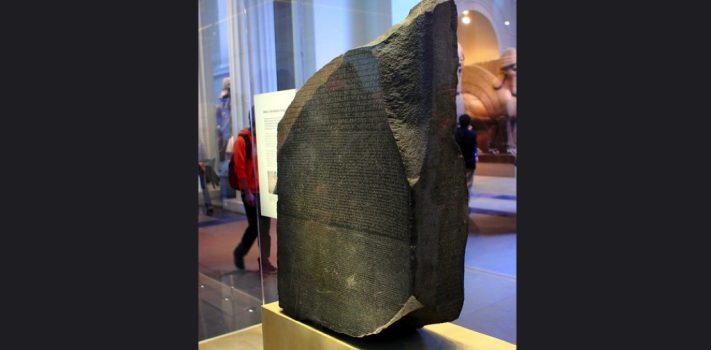
On March 27, 196 BC, the Rosetta Stone and others like it were ordered to be inscribed with the Decree of Memphis proclaiming the rule of the King of Ptolemaic Egypt, Ptolemy V.

March 27, 1513: Spaniard Juan Ponce de León and his expedition first sighted the coast of Florida.

And on March 27, 1855 Canadian geologist Abraham Gesner patented kerosene.

Today’s feature post is a re-post from the SurvivalBlog archives.

Round 123 of the SurvivalBlog non-fiction writing contest ends in just a few days. Get your entries in soon!
More than $981,000 worth of prizes have been awarded since we started running this contest.  Round 123 ends on March 31st, so get busy writing and e-mail us your entry. Remember that there is a 1,500-word minimum, and that articles on practical “how-to” skills for survival have an advantage in the judging. In 2023, we polled blog readers, asking for suggested article topics. Please refer to that poll if you haven’t yet chosen an article topic.


Homestead Fuel Storage and Rotation, by NC Bluedog

Editor’s Note:  This is a re-post of a SurvivalBlog article from May, 2008.  Given the recent fuel price spikes and the many e-mails that I’ve recently received asking about fuel storage, I thought that it was apropos to dig up this practical article from the blog’s early archives.

Given that liquid fuel costs are climbing dramatically, and likely to continue rising, I would like to share some of the practices for fuel storage we employ. For our homestead, liquid fuel equates to four items, namely: Propane, diesel fuel, kerosene and last but not least gasoline. For each fuel, there are specific uses, distinct storage requirements and longevity considerations. Let me discuss each in order:

The primary furnace in our house runs on propane. Currently, we use electricity for water heating and cooking. Our annual propane usage is between 500 to 800 gallons per year, depending on the weather and how much wood we burn in the small heating stove in the living room. My goal when we bought the house was to have one year of supply, so I had installed two 500-gallon (nominal water capacity) above-ground propane tanks (800-gallon capacity at 80% fill). I have the tanks filled during the (typical) summer price drop.

Below-grade tanks, while preferable for several reasons (ballistic protection etc.), are problematic (i.e. expensive) because of the rocky soil and high water table. Nonetheless, I would like to expand my capacity to two years, and will likely bear the excavation expense and install a 1000-gallon underground tank as well. For the grill and portable propane appliances (stove, lights etc.), we keep a supply of 20- and 40-pound tanks available. Small one-pound propane bottles are refilled from these tanks. (Note: US DOT regulations prohibit transporting refilled “disposable” cylinders). Storage life is not of concern with propane, but price and availability are of paramount importance.Continue reading“Homestead Fuel Storage and Rotation, by NC Bluedog”


Economics & Investing Media of the Week

In Economics & Investing Media of the Week we feature photos, charts, graphs, maps, video links, and news items of interest to preppers.

Economics & Investing Links of Interest

Economics & Investing Media Tips:

Please send your economics and investing links to JWR. (Either via e-mail or via our Contact form.) Thanks!


The Editors’ Quote Of The Day:

“I notice that you use plain, simple language, short words and brief sentences. That is the way to write English―it is the modern way and the best way. Stick to it; don’t let fluff and flowers and verbosity creep in. When you catch an adjective, kill it. No, I don’t mean utterly, but kill most of them―then the rest will be valuable. They weaken when they are close together. They give strength when they are wide apart. An adjective habit, or a wordy, diffuse, flowery habit, once fastened upon a person, is as hard to get rid of as any other vice.” – Mark Twain


Preparedness Notes for Thursday — March 26, 2026

On March 26, 1636, the University of Utrecht had its opening ceremony. Pictured is the university’s
Academiegebouw Rectory.

March 26, 1790: The US Congress passed the Naturalization Act, requiring two-year residency.

March 26th, 1812: An earthquake now estimated at 7.7 on the Richter scale destroyed 90% of Caracas, Venezuela, and killed an estimated 15,000–20,000 people.

Today’s feature article is an essay by SurvivalBlog’s Founder and Senior Editor, James Wesley, Rawles (JWR).

There are just a few days left to get your Writing Contest article in for the current round of judging.


An Old RPGer’s View of Socio-Poltical Alignment and Motivations

Like a lot of teenagers of my generation, I played a Role-Playing Game (RPG) called Dungeons and Dragons (“D&D“.) The majority of the players in our smallish-town D&D group were Christians, so we downplayed the wizardry aspect, and concentrated on adventure and combat.  We also shunned most cosplay and Live-Action Roleplaying. (“LARPing”.) This was in the late 1970s, so we had access to just the small-format Chainmail book and the first three D&D boxed-set rulebooks developed by Gary Gygax, et al. This was long before the more popular large-format Advanced D&D books were published.

One key aspect of characters in the D&D game is the term Character Alignment, which ranges from  “Lawfully-Good” to “Neutral”, and to “Chaotically-Evil.”  Alignment was used to describe the ethics and morals of both role-playing characters and Non-Player Characters (NPCs.) I consider these terms a useful way to categorize the real-world alignment and motivations of politicians, journalists, “activists”, military leaders, and pundits. There are indeed good and evil people, and in the sociopolitical realm, their alignment affects the course of human events, globally. Continue reading“An Old RPGer’s View of Socio-Poltical Alignment and Motivations”


The Survivalist’s Odds ‘n Sods

SurvivalBlog presents another edition of The Survivalist’s Odds ‘n Sods. This column is a collection of news bits and pieces that are relevant to the modern survivalist and prepper from JWR. Our goal is to educate our readers, to help them to recognize emerging threats, and to be better prepared for both disasters and negative societal trends. You can’t mitigate a risk if you haven’t first identified a risk. In today’s column, more about drone warfare.

How to Survive Drone Warfare

A very useful new video from Garand Thumb: How To Survive Drone Warfare In Ukraine (Ukraine Veteran).

AI-Powered Lawsuits

I found this linked over at the Whatfinger.com news aggregation site: Absurd AI-Powered Lawsuits Are Causing Chaos in Courts, Attorneys Say, “Clogging the System” and Driving Up Costs. JWR’s Comments: This does not bode well for the use of AI in generating court filings, nationwide.  Prepare for legal gridlock.

Another AI Takeover Scenario