
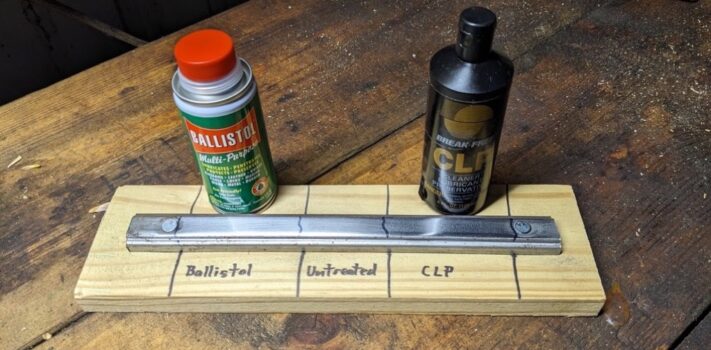


Ballistol is a gun cleaning oil. If my sources are correct, it is composed of white mineral oil, potassium oleate, ammonium oleate, benzyl alcohol, amyl alcohol, isobytyl alcohol, benzyl acetate, and anethole.
One key characteristic of Ballistol is that it emulsifies with water. This makes it an excellent cleaner for firearms that use black powder or corrosive primers. The best solvent for black powder and the salts left by corrosive primers is hot (almost boiling) water. Ballistol works well in conjunction with that hot water. Ballistol is also non-toxic, and can also be used on wood and leather as well as steel.
In my testing, Ballistol did not protect against corrosion as well as Breakfree CLP. As a result, I would recommend using Ballistol in conjunction with hot water for cleaning the bores of firearms utilizing black powder or corrosive primers. But I would recommend following that cleaning by using Breakfree CLP on those firearms as a lubricant and protectorant. (Note: with black powder firearms, the CLP should be used extremely sparingly inside of chambers and barrels. Oils can contaminate black powder, thus rendering it less effective. Often it is helpful to fire a non-corrosive percussion cap into a chamber prior to loading it in order to burn away any oil that might otherwise contaminate the powder).
Ballistol: Made in Germany
At the time of this writing, a four-ounce bottle of Ballistol cost $13.99 on eBay.com. For those who shoot a lot of black powder or corrosive primers, a gallon-sized can of Ballistol cost $90 at ballistol.com.
Background
From time to time, I shoot both black powder and ammo utilizing corrosive primers. On any of those occasions, I use hot water to clean the firearms involved. The hot water does an excellent job of dissolving both black powder residues and the salts left in the barrel by corrosive primers. The heat of the water causes it to evaporate rapidly after use, leaving no moisture behind to cause corrosion.
I know in my mind that using hot water as a solvent will not cause corrosion. But I can’t convince my gut of that fact. Intentionally subjecting a firearm to water still makes my toes curl. That is what makes Ballistol so appealing. It emulsifies in the hot water and leaves a protective film behind as the water evaporates. The thought of that protective film goes a long way toward calming my fears.
With that in mind, I ordered a four-ounce bottle of Ballistol for testing and evaluation.
First Impressions
The label on the bottle indicates that Ballistol lubricates, penetrates, protects, and preserves. It suggests using it on firearms, leather, knives, tools, locks, marine applications, wood, metal, and rubber. It claims to be eco-friendly, skin safe, and carcinogen-free. It asserts that Ballistol dissolves traces of copper, lead, brass, zinc, tambac, and black powder residue. It alleges that it lubricates anything that squeaks or binds such as locks, hinges, sliding doors and windows, fans, etc., etc.
The label did not claim that Ballistol cures cancer or that it will bring world peace. It seemed like pretty much everything else was included.
The more that I read the list of claims, the more my skepticism grew. I knew from reputable sources that Ballistol has its place, but this sounded over the top. I decided to do some testing in one of the areas that I value the most: corrosion resistance.
Corrosion Resistance
I took a rusty door slide, cut out a 10.25-inch section of the slide with an angle grinder, and nailed the section to a board. I then sanded the top of the slide, cleaned it with denatured alcohol, and divided the surface between the nails into two sections, each three inches long, separated by a section two inches long in the middle.
I applied Ballistol to the left section with a clean paper towel and Breakfree CLP to the right section with another clean paper towel. I left the middle section untreated.
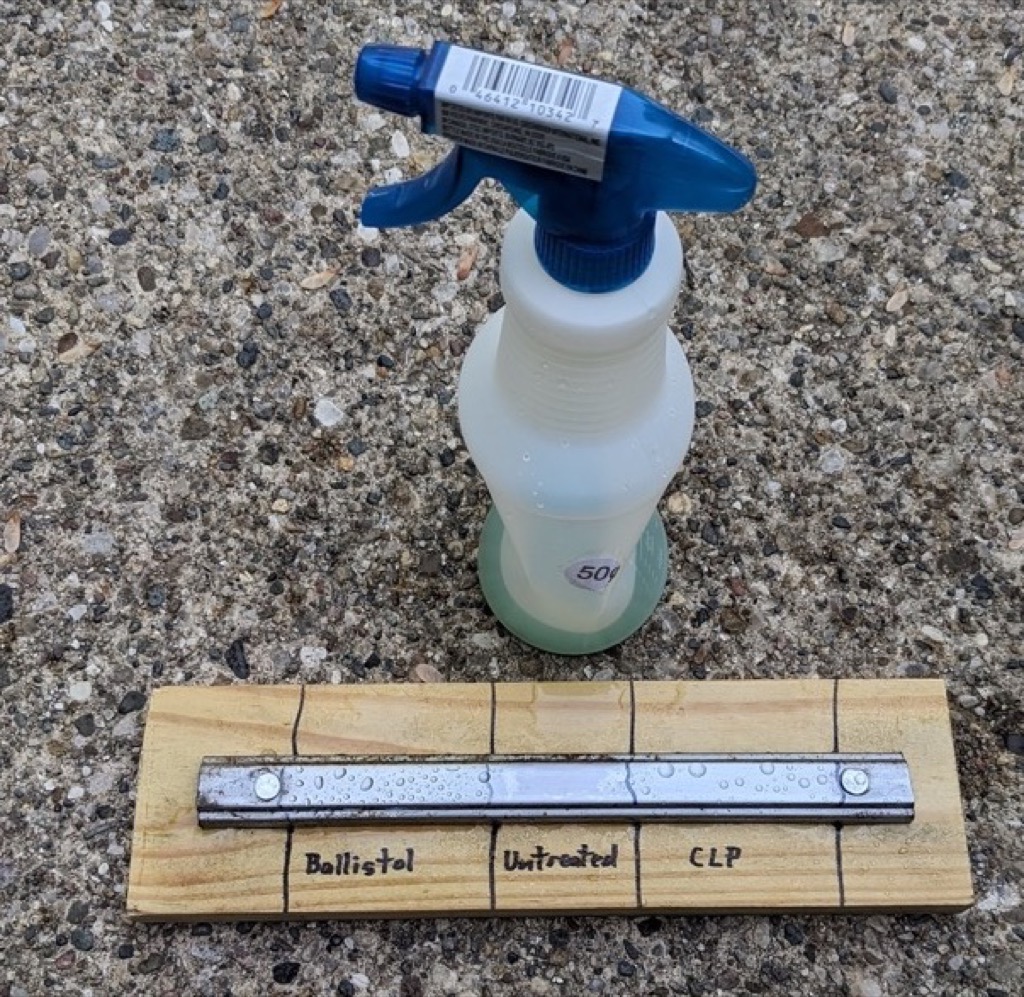
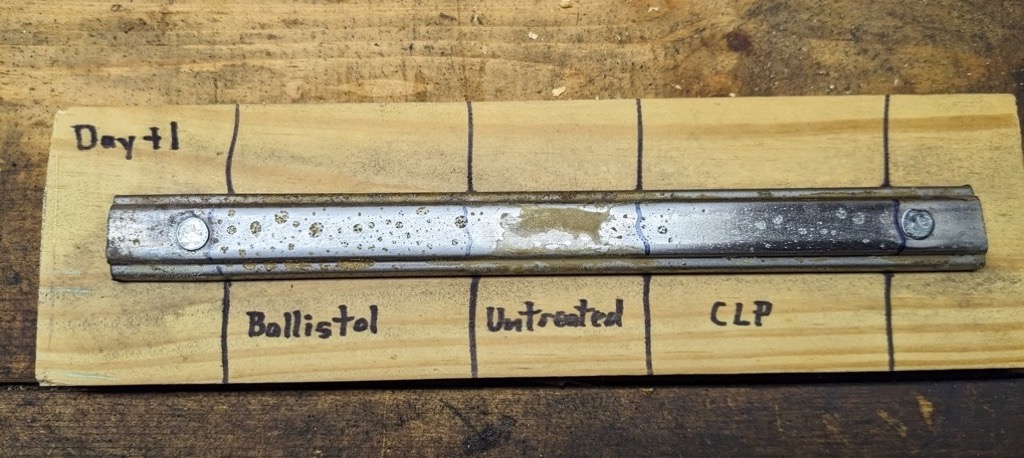 I allowed the products to dry for about 15 minutes. I then put about two tablespoons of salt-based ice melt into a spray bottle and added about 8 ounces of water. I then shook the spray bottle thoroughly. There was not enough water in the bottle to dissolve all of the ice melt. I then sprayed the test surface with a generous amount of the solution from the bottle. By the next day, early signs of corrosion had already begun to appear in the untreated section of the test surface. This was also true to a lesser extent in the Ballistol section. The Breakfree CLP section was still almost totally free of signs of incipient corrosion.
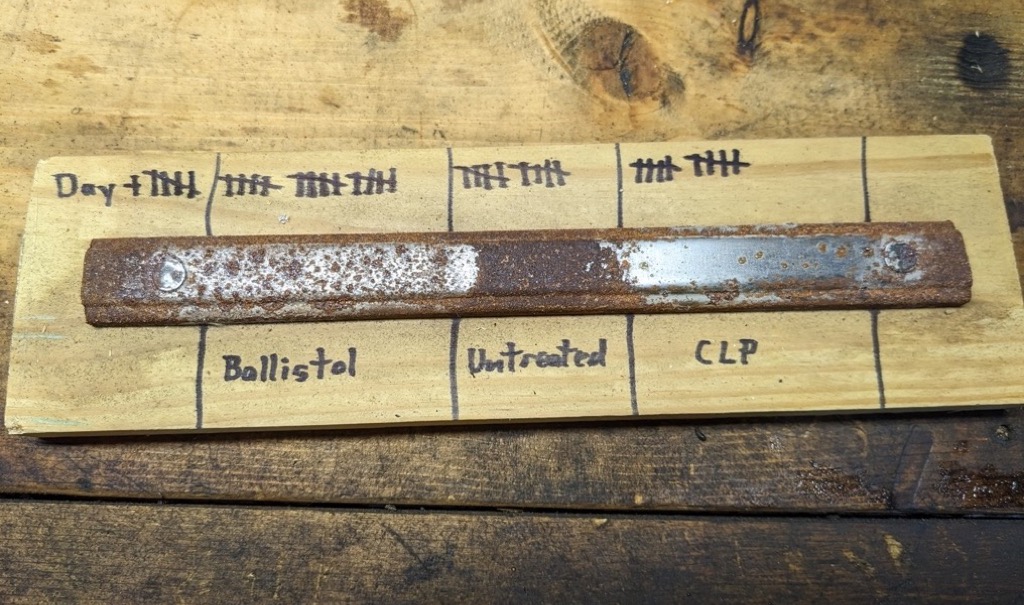 These early trends continued to manifest themselves throughout the developments of the coming days. By the 40th day, the untreated section was almost totally covered with corrosion, the Ballistol section was about half covered with corrosion, and the Breakfree CLP section displayed only isolated signs of corrosion.
This was similar to previous testing that I have done with other products for cleaning, lubricating and protecting firearms. Breakfree CLP remains my lubricant and protectorant of choice for usage under most weather conditions. Extremely cold or dusty conditions are the exception. Under those conditions it is best to avoid the use of CLP. It can thicken during extreme cold or attract dirt under dusty conditions.
Silencer Cleaning
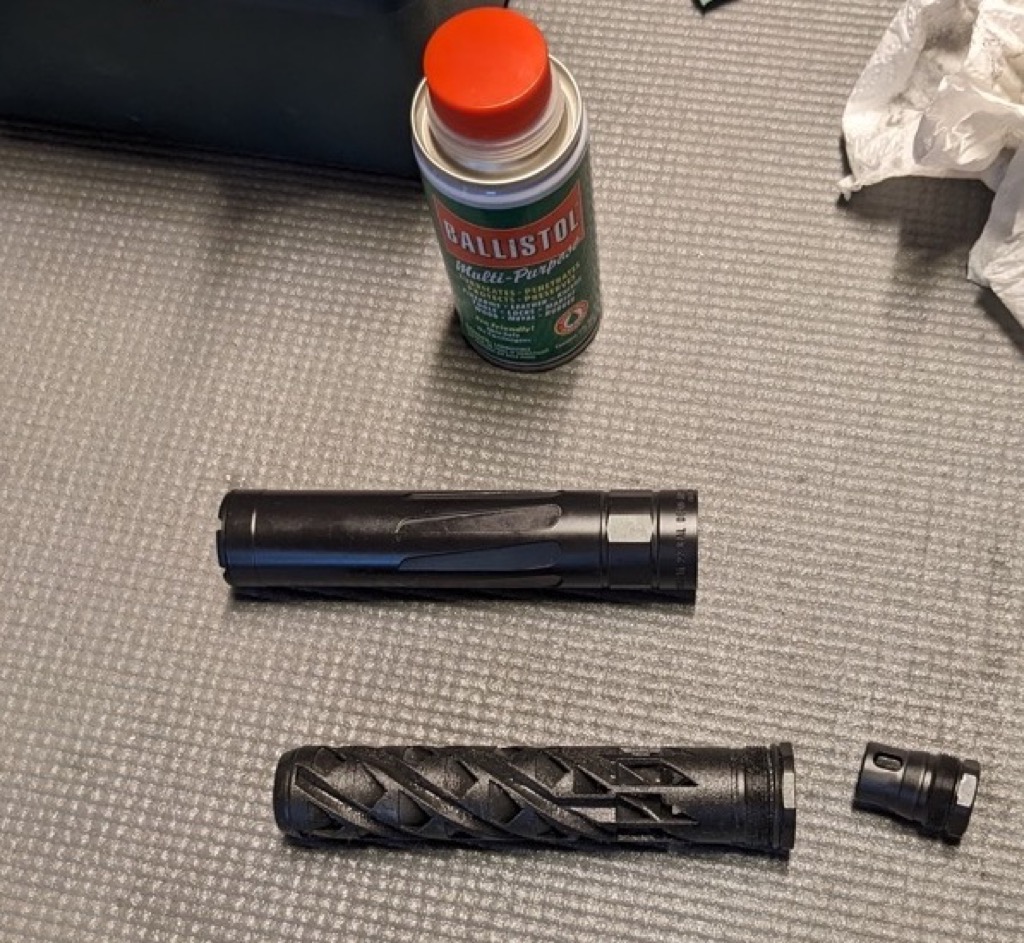 The instructions for my new Dead Air RXD22Ti Silencer specified that I should use a non-toxic, water-soluble, biodegradable product when cleaning the silencer. Ballistol fit that description, so I put it to work. I disassembled the silencer and scrubbed the various components with a toothbrush dipped in Ballistol. I also ran a Ballistol patch through the bore using a cleaning rod and jag. After scrubbing, I wiped away as much Ballistol as possible using a clean paper towel for parts that were accessible outside of the bore and a dry patch for the inside of the bore. I then reassembled the silencer.
Since my silencer is constructed of titanium and stainless steel, I was not overly concerned about corrosion resistance. I could have applied a thin film of Breakfree CLP to the silencer following the cleaning. But I felt that a film of CLP on the inside of the silencer would just provide an additional source of carbon fouling during use.
Ballistol also manufactures a dedicated suppressor cleaner. It comes in 16.9-ounce bottles, and includes rubber stoppers. To use it, one seals one end of the suppressor with a rubber stopper, fills the suppressor with the cleaner, seals the other end with the second stopper, and then allow the suppressor to sit for two hours. For especially dirty suppressors, the cleaner can be heated to about 104 degrees Fahrenheit and left in the suppressor for four hours. After the cleaner has been emptied out, the suppressor can be filled half-way with water, shaken, and emptied.
Since my Dead Air silencer can be disassembled, I plan to continue to use ordinary Ballistol and a toothbrush for cleaning it.
Ballistol History
Early in the 20th century, the Imperial German Army sent out a solicitation for an oil that could be used on firearms, wood, and leather. In response, chemist Dr. Helmut Klever of Chemische Fabrik F.W. Klever developed Ballistol. The name, Ballistol, was a play on words meaning “ballistic oil.”
Ballistol was adopted by the Imperial German Army in 1905, and remained standard issue in the German Army until the end of World War II.
The main Ballistol manufacturing facilities were destroyed during the war, but a small branch factory in Leverkursen survived. Ballistol was primarily known in Europe until late in the 20th century, when it began to be marketed in the United States.
Medicinal Use?
Note: I am not a medical professional, and the information in this section should not be understood as medical advice.
The Ballistol company reports that when the product was first adopted by the Imperial German Army in 1905, in addition to being used to care for firearms, wood, and leather, it was also intended “to be used by soldiers as a wound oil for smaller injuries, chaps, and abrasions.”
You may recall that the good Samaritan used oil and wine to treat the wounds of the man who had fallen among thieves. The alcohol in the wine served as a disinfectant while the oil soothed the pain of the wounds.
In the same way, the alcohols in Ballistol may serve as mild disinfectants while the mineral oil may serve to sooth the pain of wounds. So the idea of using gun oil for wound care is not totally reckless.
There are also anecdotal reports of using Ballistol as a laxative. Taking gun oil internally sounds even more reckless than using it for wound care, and I will stress even more emphatically that this is not medical advice. But the ingredients in Ballistol are non-toxic, and the primary ingredient, mineral oil, is classed as a lubricant laxative. So if the grid goes down, society ceases to function, and you find yourself dangerously constipated and without any other options, Ballistol may not be the worst possible choice of laxative that you could make.
Conclusions
Ballistol is great when used in conjunction with hot water for cleaning firearms that use black powder or corrosive primers. It is best to follow that cleaning with the application of an effective lubricant and protectorant such as Breakfree CLP. (See note above about the use of CLP in the chambers and barrels of black powder firearms).
For my silencer, which is constructed of titanium and stainless steel, it was not necessary to apply a protectorant. I simply used the Ballistol as a solvent, and wiped away the excess.
Disclaimers
I paid cash for my Ballistol. Dead Air Silencers provided me with a sample of their RXD22Ti silencer for an earlier review. I did not receive any other financial or other inducement to mention any vendor, product, or service in this article.