
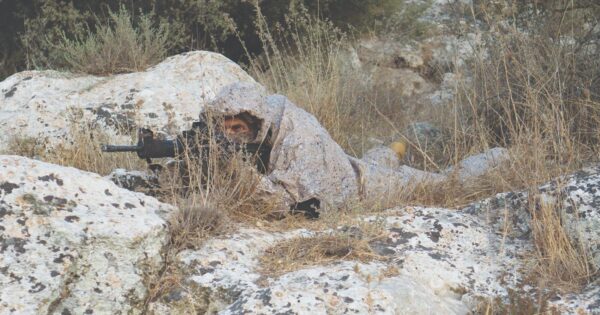


As 2025 draws to a close, I’d like to revisit a topic that often comes up in SurvivalBlog: camouflage clothing and equipment.
Note: To see examples and variants of the camouflage patterns that I’ll mention in this article, see the comprehensive Camopedia.org website. They are to be commended for maintaining a great reference site.
I will begin with some history:
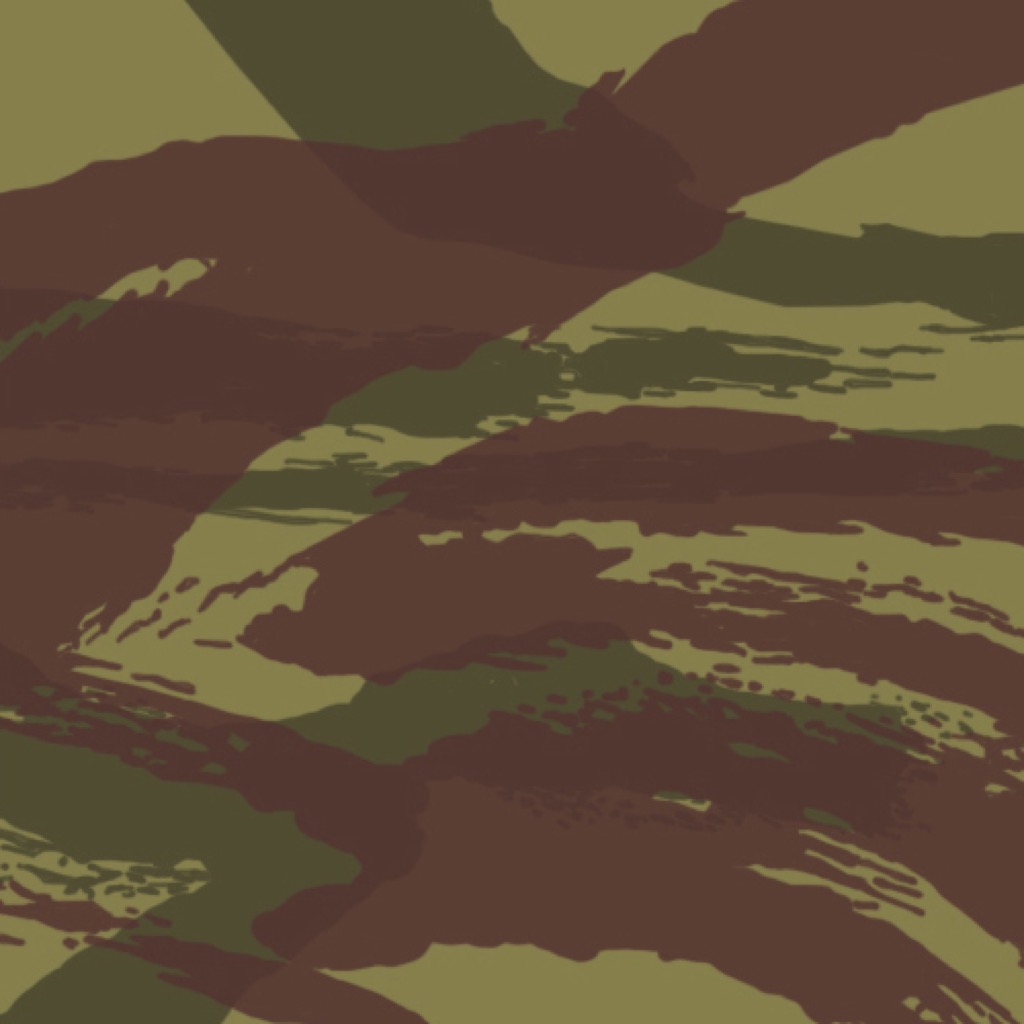
Camouflage uniforms were not standard issue for all but a handful of the world’s armies until the mid-1960s. Experimentation with modern printed camouflage fabric as we now know it began with the German Wehrmacht and Waffen SS, circa 1942-1945. They tried no less than a dozen different patterns. Also in 1942, the US Marine Corps began limited use of a camouflage pattern called Frog Skin. It had been designed by Norvell Gillespie, a civilian horticulturist and the gardening editor for Better Homes & Gardens magazine, at the request of the War Department.
But except for the camouflage used by elite units or for unusual deployments, until the 1980s, most soldiers of major armies still wore khaki, olive drab, or other solid shades of green. The French Army began limited issue of their now famous “Lizard” brushstroke camouflage pattern in 1947, but most French soldiers still wore khaki — both in garrison and in the field.
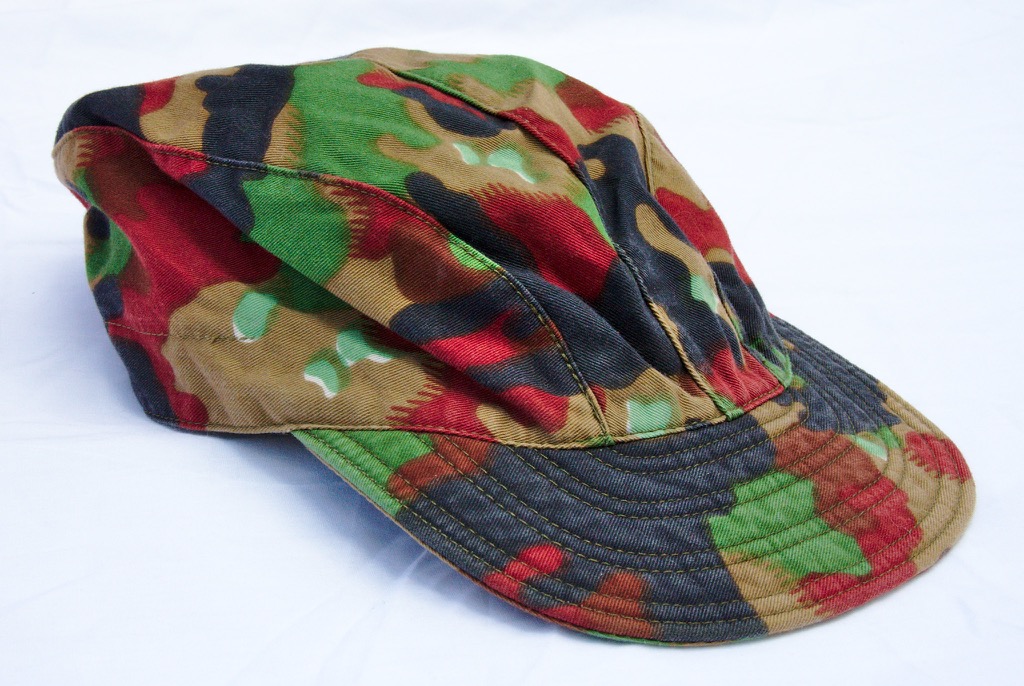 In 1957, the Swiss Army adopted the TarnAnZug (TAZ) 57 pattern with bold blotches of color that quite unusually included red. Switzerland was perhaps the first nation to fully field camouflage uniforms to their entire army, which is mostly a reserve force. The distinctive camouflage pattern was part of the Swiss strategy in repelling an expected invasion from the Soviet Union. They made it illegal to export any of the camouflage material or uniforms, for fear that it could be duplicated and used by foreign infiltrators.
Many Swiss soldiers jokingly referred to TAZ 57 as the “Vier Früchtesalat” — the Four Fruit Salad. This pattern was replaced with TAZ 83, a similar variant (also including red) in 1983. More recently, they fielded TAZ 90 — a more NATO-looking woodland pattern — starting in 1993. (And TAZ 90 immediately became export-banned.) Then, in 2007, they added a limited issue of the TAZ 07 desert pattern for foreign-deployed Swiss peacekeeping forces.
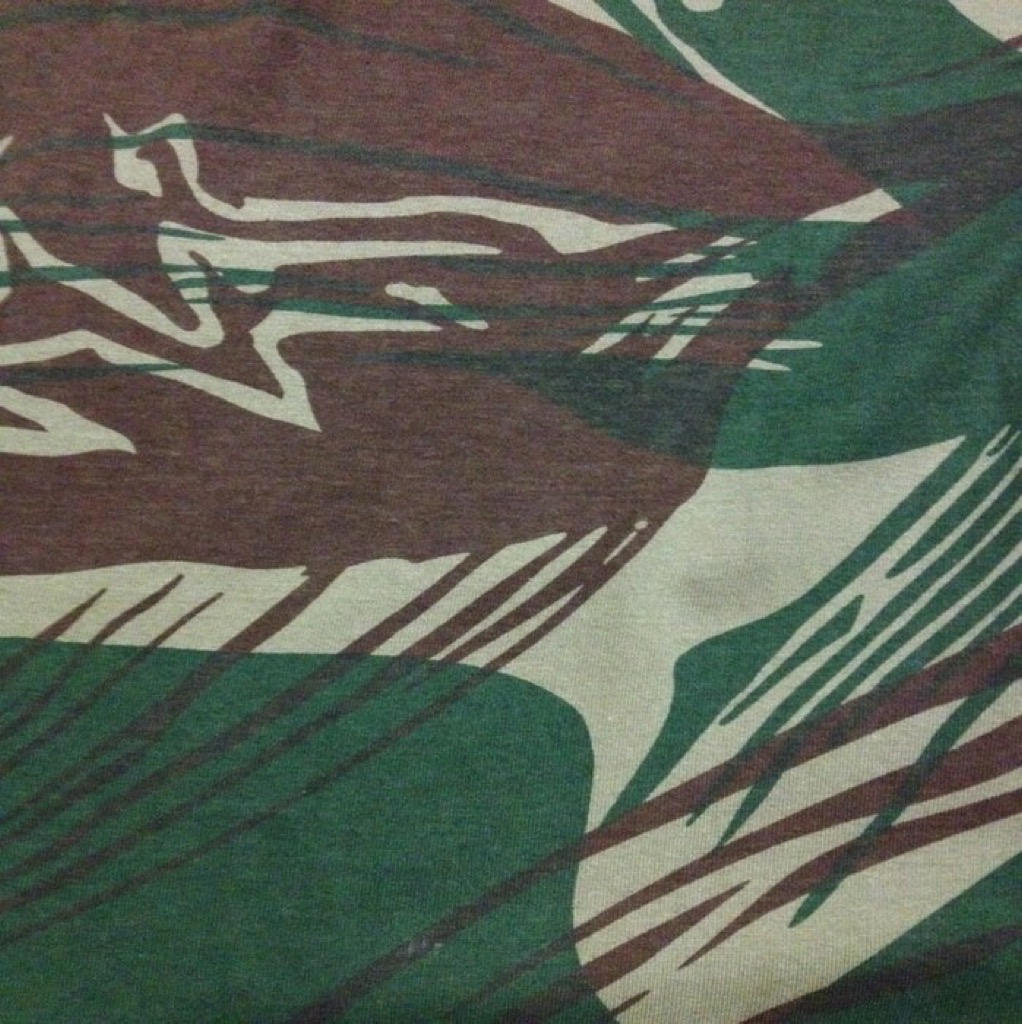 Another early adopter of camouflage for their entire army was a former British colony, Rhodesia. Soon after their nation’s Unilateral Declaration of Independence (UDI) from the UK in 1965, the Rhodesian Army and British South African Police (BSAP) adopted a now iconic and very effective brushstroke camouflage pattern. This pattern was used throughout Rhodesia’s Bush War against communist-supplied and trained terrorists. After the British government intervened to force elections in 1980, Rhodesia became the failed nation-state of Zimbabwe. Following Robert Mugabe’s ZANU-PF takeover, the Zimbabwean Army issued a new variant of the same camouflage. This was copied from the original Rhodesian version, but printed with brown printed over green. Examples of original green-over-brown Rhodesian 1960s/1970s camouflage uniforms are now collectible and often fetch high prices on eBay and at other auction sites.
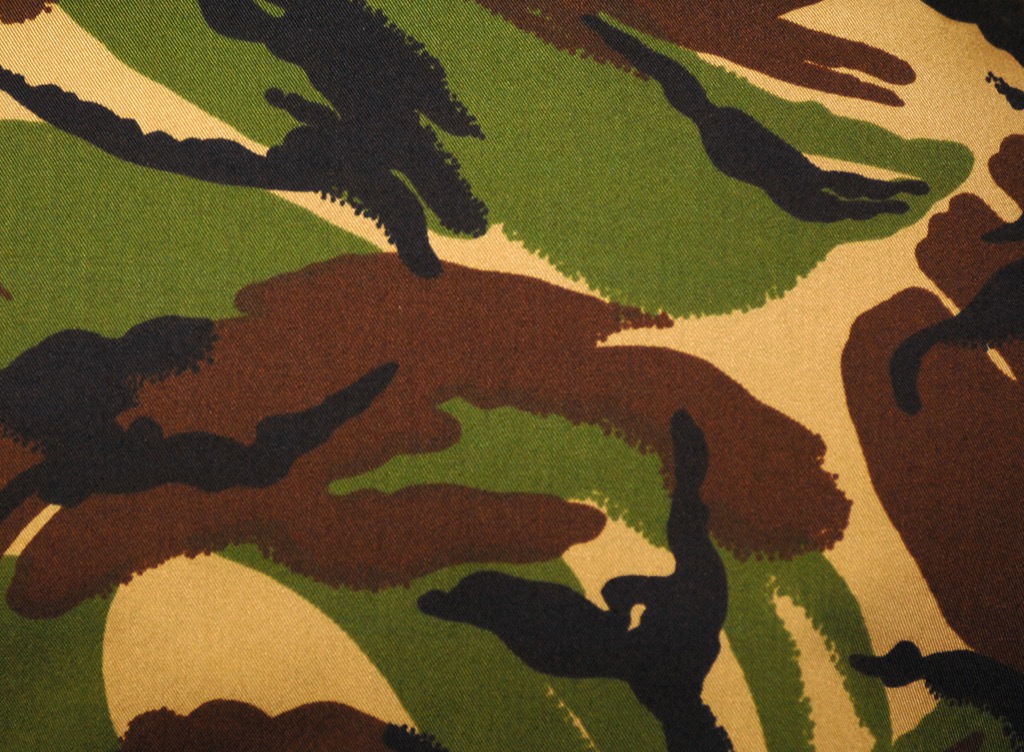 In 1966, the British Army Standard Pattern 1960 (P60) olive green uniform was replaced by a new battledress, but made in Disruptive Pattern Material (DPM). The DPM was essentially a woodlands-optmized camouflage pattern, although it was also quite useful in wetlands/marshlands and even in grasslands. DPM was eventually copied by more than a dozen other nations. There were also some later desert-optimized variants of DPM. Because large numbers of British surplus DPM uniforms were recently donated to Ukraine, you often see them in news videos from the Russo-Ukrainian War.
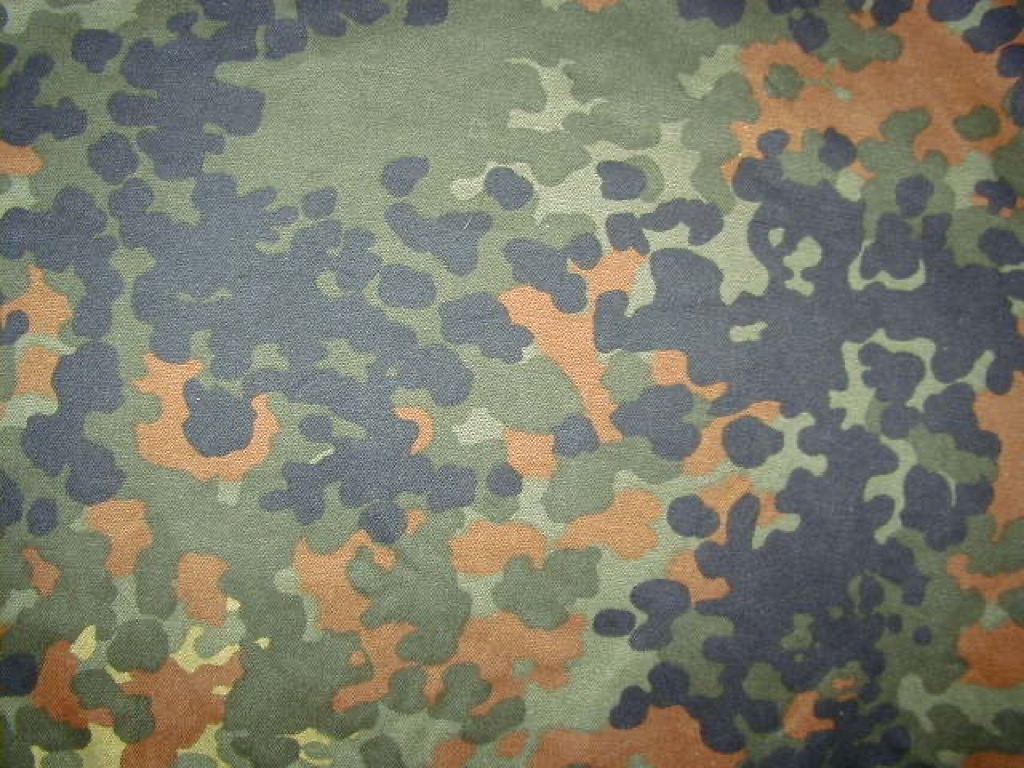 In 1976, the West German Army developed a mottled dot camouflage commonly known as Flecktarnmuster or Fleckentarn. This is actually a family of three-to-six-color disruptive camouflage patterns. The most common one is the woodland five-color pattern. That pattern wasn’t fully fielded by the newly-unified German Army until 1990.
The Ubiquitous Woodland
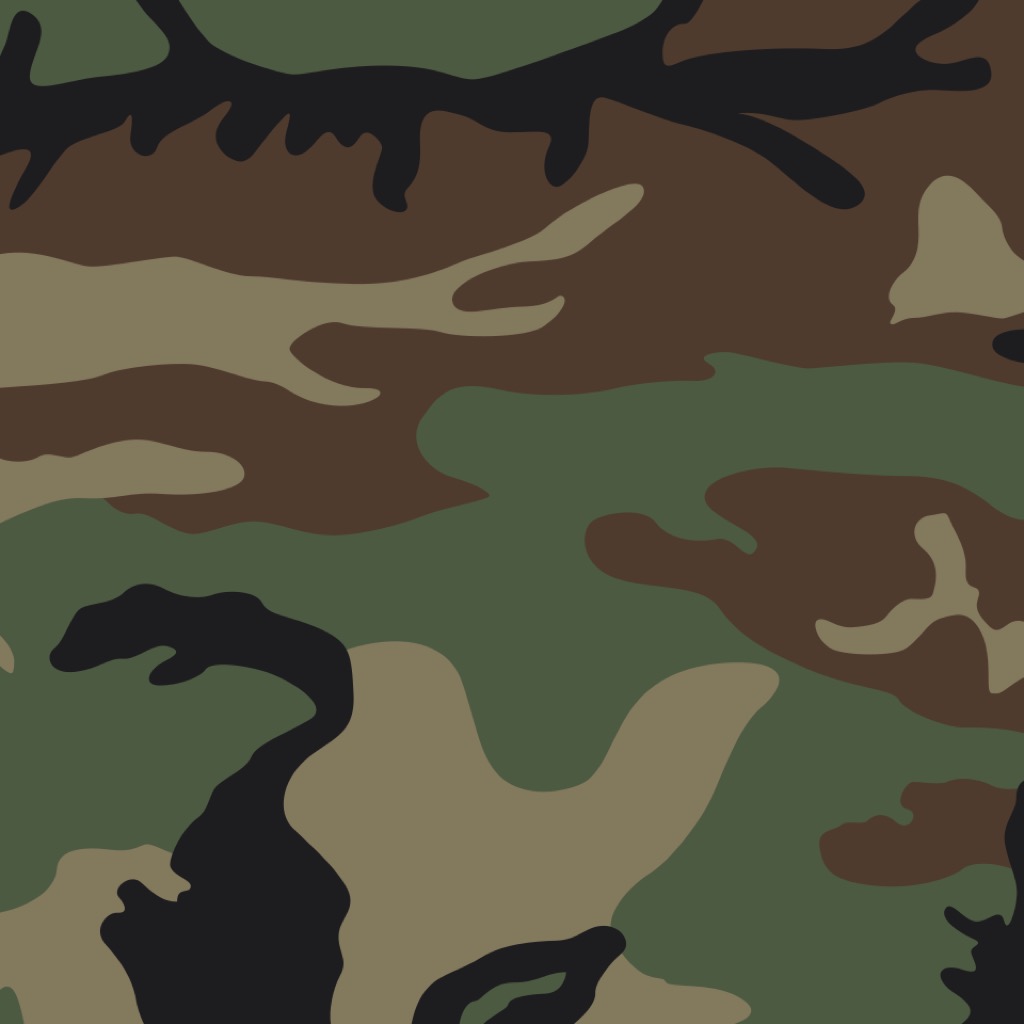 Despite some experimentation during the Vietnam War, the U.S. Army was fairly late to the party, in full-force issue of camouflage uniforms. Not surprisingly, the U.S adopted a camouflage pattern for general issue in 1981 that used colors and a pattern very similar to the British DPM, but with differing rounded blotches and a grayish-green background color, instead of tan. The M81 Woodland pattern was issued from 1981 to 2012 for all of the U.S. Army, the Marine Corps, and the U.S. Air Force. And Woodland is still in limited issue for the United States Marine Forces Special Operations Command (MARSOC) Tier 2 Operators.
The UCP/ACU Fiasco
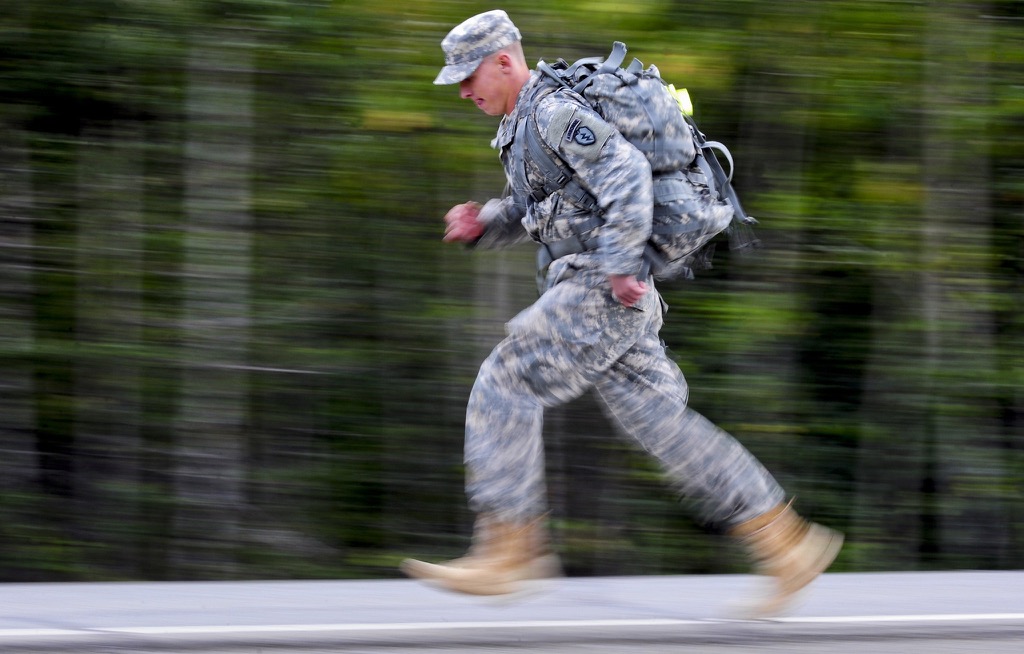 For Desert Storm/Desert Shield and later in OEF and OIF, the U.S. military made limited issues of two different desert camouflage patterns. Then, in 2012, the U.S. Army switched from Woodland to a grayish camouflage pattern — the much-hated Universal Camouflage Pattern (UCP, for the Army Combat Uniform or ACU.) In attempting to create a camouflage that worked universally well in all environments, this designed-by-committee digital monstrosity camo pattern managed to work well in almost none of them. UCP has a conspicuous grayish color that from a distance appears to be a prominent gray blob against most natural backgrounds.
In my estimation, the UCP ACU is about the worst uniform issued since the French used sky blue tunics and pants in World War I. In the context of survivalism, the grayish UCP utility uniform is suitable for use perhaps only in sagebrush country. Because UCP uniforms, packs, web gear, and knee pads are on the surplus market in huge numbers, they are bargain-priced. But, unless you live in a region that is dominated by sagebrush, you shouldn’t buy it.
If you are on a tight budget and you want to re-purpose UCP uniforms and gear by adding more appropriately-colored spray paint colors, then choose your paint very wisely. Many varieties of spray paint (even some “flat” types) are reflective to infrared (IR) and show up like a beacon to both active night vision equipment and to FLIR scopes. A study by HyperStealth Biotechnology Corporation found that one exception that has low near-IR reflectivity is Krylon Ultra-Flat, sold under the trade name “Krylon Camouflage.” Over-dying some uniforms might also be an option, if they include any cotton fibers. But, sadly, most synthetic fabrics do not absorb dye properly.
The Now-Ubiquitous OCP
 In 2015, with the rollout of Operational Camouflage Pattern (OCP)—a slight variation of the Crye Multicam pattern, the U.S. Army announced that it was nearing the end of issuing the much-maligned UCP. The transition from the UCP to OCP Multicam took four years. UCP uniforms were authorized for wear by the U.S. Army until late 2019. Although UCP was only issued for a few years, a huge quantity of it is still flooding the U.S. military surplus market. But gradually, we are seeing much more Multicam/OCP hitting the secondary market.
Match Your Region
If you live in a forested region, the tried and true M81 Woodland BDU pattern is probably best. Alternatively, the USMC Woodland MarPat, the British DPM 85 or 95 pattern, or the very similar pre-2014 Dutch pattern (a DPM clone pattern) also work quite well in the woods. But if you live in a region with a mix of grasslands and woods, or even in arid country, then the OCP Multicam is probably the best all-around choice, short of buying or making a ghillie suit to match your local flora.
Take note that there are a plethora of videos on YouTube showing real-world tests of various camouflage patterns. Use what works best in your particular region.
Match The Season
Beyond having just one camo pattern, you might consider seasonal variations — with lighter greens dominating in the spring and early summer, and darker greens dominating in the late summer and fall. And if you live in a region with snow cover for more than one month in winter, then you should buy some white ponchos or coveralls.
A Horse of a Different Color
Preppers and survivalists who anticipate a breakdown of law and order need to think in terms of more than just the absolute ability to blend into the background. They should avoid looking “just like the military issue”, because every Tom, Dick, and Harry out there will soon have access to the Multicam/OCP pattern. To explain: In a perimeter security situation where you need to rapidly distinguish friend from foe, retreat groups will need to set uniform standards that are fairly unique and hard for anyone else to replicate without considerable planning. This will minimize the risk of infiltrators just strolling into your perimeter. One such solution is easily sourced and cost-effective: Simply standardize with wearing the pants from one type and the shirts and jackets from another pattern. So, for example, you might standardize with OCP Multicam pants worn along with Woodland pattern shirts and jackets. Or, you might wear OD-green pants and Woodland shirts and jackets. This will provide effective camouflage yet also provide reliable friend-or-foe recognition at a distance. – JWR