
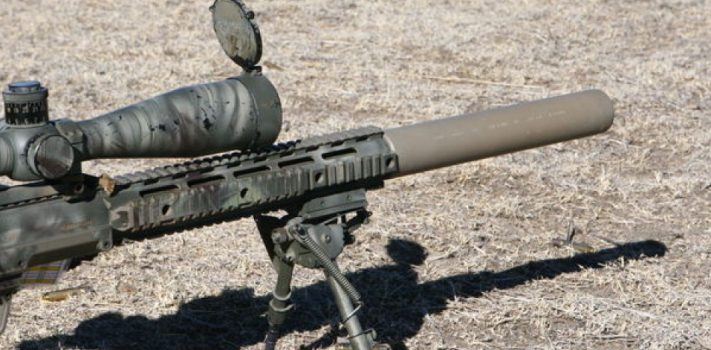


Introductory Legal Proviso: What I’m presenting in this article is solely for informational purposes. Consult local, state, and Federal law before buying or constructing a suppressor. Stay legal! Take note that the following applies only to folks who live in free states. There are many states like California and Illinois that have bans on suppressors. – JWR
—
As of January 1, 2026, the National Firearms Act (NFA) Tax on suppressors (called “silencers” in the legal world), short-barreled rifles (SBRs), and short-barreled shotguns (SBSes) will drop from $200 per transfer to ZERO. So now, although the NFA transfer application no longer requires a $200 tax, the rest of the Federal registration process has not changed. I predict that the change in the law will cause a huge rush of Form 1 and Form 4 registrations that will very likely create a lengthy backlog of form processing and repeated server crashes or manual shut-downs of the ATF’s eForm website. The big surge of registration form submissions will almost certainly also slow down SBR and SBS registrations. This backlog situation could drag on for months or even years.
“Free” May Not Last Long
I’m afraid that the zeroed suppressor tax may turn out to be just a two-year window of opportunity. Why? If the Democrats regain control of Congress and the White House, they could quite easily and quickly reimpose a tax on suppressors. And the reinstated tax might not be $200. Adjusted for inflation, $200 in 1934 dollars is the equivalent of $4,848 in 2025 dollars. Let’s say, for example, that you want to register 12 suppressors (sometimes called “cans”): The transfer tax would tack on $2,400 to the combined purchase price in 2025. But there would be ZERO Dollars in tax for new registrations or transfers, starting in 2026. But in 2029… …who knows? Would we be back to $2,400 in tax? Or a potential tax bill as high as $58,176? Ouch!
It is fairly easy to set up a personal account at the ATF’s eForm website. Instead of traditional hard copy forms, the eForm system allows online form creation and filing. The website design even provides a way for individuals to create draft registrations that can be filed up to 60 days later. UPDATE, 25 December: The ATF has announced that the eForms website will be shut down for Form 1 and Form 4 submissions between December 26th and December 31st, 2025, and that all draft forms will be deleted.
But as I already mentioned, the ATF eForm filing system might get overloaded, particularly in January. So, as a backup, I recommend ordering hard copy blank forms and fingerprint cards.
Relatively Quiet
Firearms sound suppressors work by slowing the release of propellant gases. They can reduce the sound of subsonic pistol shots to just a hand-clap. They don’t completely silence a gun, so the term “silencer” is a misnomer. Firearms that have projectiles that exceed the speed of sound also emit a hypersonic “crack” that cannot be muffled. So, the best cartridges to suppress are low velocity. For example, the standard factory .45 ACP loads are subsonic, but standard 9mm Parabellum loads are hypersonic. And high velocity .22LR is hypersonic, while many .22 “target” loads are subsonic. A good example of the latter is CCI’s popular “.22 Quiet” load.
Suppressor Home-Builds
The rush of suppressor registration filings expected in January will mostly be for commercially-made cans. And most of those licensed manufacturers are expected to fully sell out of inventory. It may be many months before those companies can catch up with demand. But instead of buying commercially, you also have the option of at-home construction, but only after an ATF Form 1 is approved. Also, note that any such builds must be for your own use. You cannot build any for resale, since that takes a special license.
Important Safety Note: Wear eye protection at all times when making or assembling suppressors. Working with any sort of drill, mill, lathe, or grinder can create hazards to your eyes. And even the force of just a small compressed spring can also put your eyes at risk. Take all of the normal shop tools precautions such as wearing satety gear and hearing protection whenever you are near power tools. And any work with a torch or welder has its own set of hazards. Remember our motto and wear All The Gear, All The Time (ATGATT).
Building from scratch
If you own both a drill press and a metal lathe and have experience using them, then you could and should design and build your own high-efficiency suppressors, soon. As The Man With The Lathe, you can of course use whatever dimensions you’d like. Just be sure to get an approved Form 1 before you start any cutting on bar stock and tube stock. The only practical constraints are the standard dimensions of blank aluminum, steel, or titanium tubing. But I do suggest that you use standard thread dimensions/pitches and interior dimensions that will match some off-the-shelf components. That will reduce the time required to complete each suppressor. It will also make them interchangeable with other common components — such as flash hiders and muzzle brakes.
Some Suppressor Home-Build Approaches
There are several different approaches to home construction of registerable suppressors that do not require advanced machining skills or equipment. I will briefly outline some of them here:
Maglite Flashlight Conversion
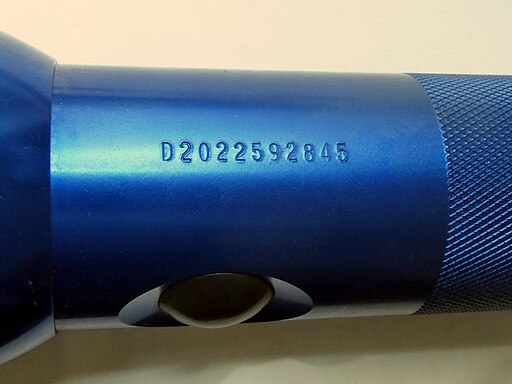 For many years, Maglite brand flashlights have been the “go-to” choice as the starting points for making registered suppressors. These high-quality machined aluminum alloy flashlights have several advantages: They have standardized dimensions and are precision threaded at both ends. They also come uniquely serialized, right from the factory. They have external knurling. They have also been produced in large numbers, so used ones are also relatively inexpensive. “Dead” Maglites with no-longer-functional switches. broken reflectors, or some minor internal corrosion (from leaking batteries) can often be found very inexpensively at thrift stores, junk shops, flea markets, or on eBay. The only drawback is the standard 0.50-inch switch hole on all large Maglites. But that hole can be filled with a short Allen head cap screw, a lock washer, a nut, and a dab of Permatex sealant.
Just about any early (pre-LED) C-cell or D-cell Maglite is a good candidate for conversion. But beware that many of the later LED varieties have focus ring slots cut in the tube body, and that makes them unsuitable, since they won’t hold pressure. (Any unintended gas release before the suppressor’s muzzle is noisy. and likely will also have a lot of flash.)
The only tricky part of converting a Maglite is finding or creating a thread adapter that will transition from typical gun muzzle threads (such as 1/2×28 or 3/4×24, or .578×28) to the large thread pattern used to connect a MagLite head to a Maglite body. (Typically, the butt end of a Maglite becomes the muzzle end of a suppressor.) Your local machine shop can probably help you create that adapter, after you get an approved Form 1. There are also several online companies that sell precision-made thread adapters, such as www.FreedomGear.org.
Two important data points:
- A C-cell Maglite has a +/- 1.03″ inside diameter.
- A D-cell Maglite has a +/- 1.344″ inside diameter.
There is a lot of useful information available online and on YouTube about converting Maglites. Among other things, you’ll learn that the C-Cell tube diameter Maglite tube is best for .17 to .25 caliber, and the D-Cell diameter can work up to .45 ACP. But, again: Be sure to obtain an approved Form 1 before you even initially disassemble a Maglite to begin conversion to a suppressor.
As for baffles, there are several online companies that sell precision-made un-drilled baffles, such as www.FreedomGear.org. You can also search eBay with phrases such as “C-Cell Spacer”.
(To be concluded tomorrow, in Part 2.)