Some SurvivalBlog readers may be familiar with “Grandmother’s Song” [1] by Steve Martin. I heard that song for the very first time back in 1979. It was part of Martin’s album “Let’s Get Small”, played from a vinyl LP on a stereo belonging to one of my college roommates.
One of the lines of the song is, “Live in a swamp and be three dimensional.” I never dreamed that one day I would be living that line. But now, almost 50 years later, I find myself living in a home surrounded by wetland.
One facet of wetland life is the need to keep encroaching vegetation at bay. Along the driveway in particular, nutrient rich soil and plentiful water fuel almost explosive plant growth. It is a constant battle to keep the marshland from reclaiming it former domain.
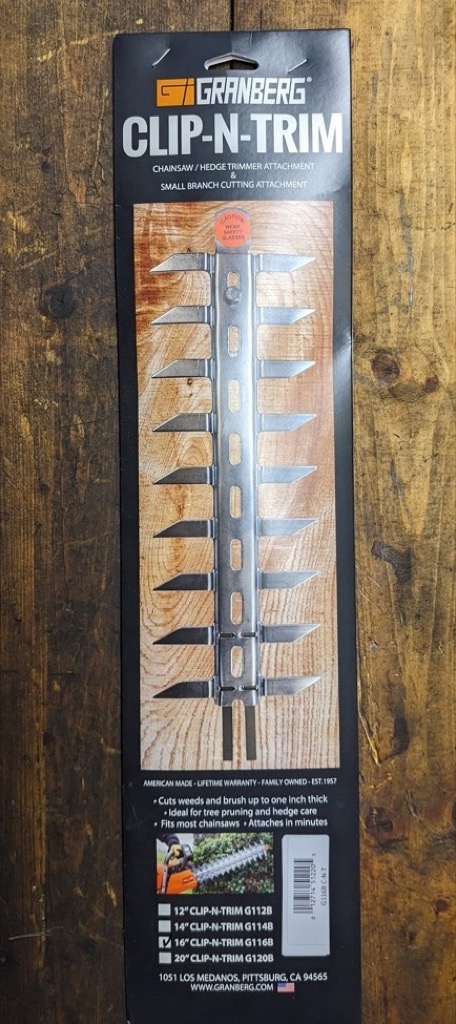
I am happy to report that I have a new weapon in my ongoing campaign to keep the Christianson-Croft-Moor-Monster at bay. It is the Granberg 16 Inch Clip-N-Trim.
 [2]
[2]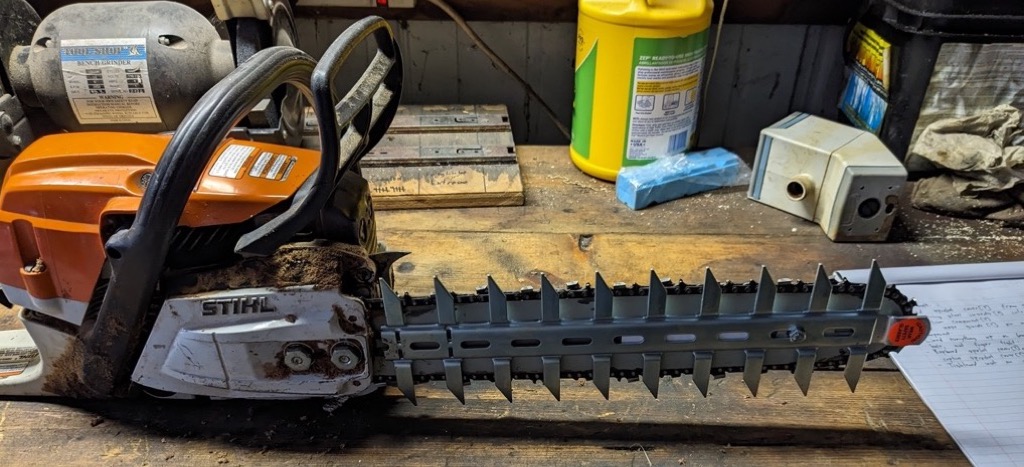 [3]The Clip-N-Trim attaches to most commonly-used chainsaw bars. It transforms the chainsaw to which it is attached into a more effective hedge-trimming and small-branch-cutting machine. It does this by guiding branches toward the chain and stabilizing them there to be cut rather than allowing them to bounce away from the moving chain.
I was impressed with how much the Clip-N-Trim enhanced the effectiveness of my Stihl MS261 [4] for brush trimming work.
The Clip-N-Trim comes in 12, 14, 16 and 20 inch lengths. It is made in the USA. At the time of this writing, it ranged in cost at granberg.com from $45.50 for the 12 inch version to $58.50 for the 20 inch version. The 16 inch version that I tested was priced at $52.00.
If cutting back brush and small branches or trimming hedges is a job that you often find on your to-do list, then I highly recommend the Clip-N-Trim.
Background
Back in February of 2025, SurvivalBlog published my review of the Granberg G-1012XT 12-Volt Chain Grinder [5]. I was impressed with the effectiveness of that tool for sharpening chainsaw chains. The experience of testing that tool made me aware of the many other highly effective forestry tools manufactured by Granberg International.
I revisited the Granberg website recently to examine their current product offerings. In view of my brush clearing challenges, the Clip-N-Trim immediately caught my attention. I contacted Granberg to see if they could provide me with a sample for testing and evaluation. They were kind enough to agree. Shortly afterward, a 24 x 14.75 x 4.5 inch shipping box was delivered to my home from Granberg International, 1051 Los Medanos, Pittsburg, CA 94565.
First Impressions
Inside of the shipping box, there was an ample supply of packing peanuts, a Granberg decal, and a 22 x 5.25 inch paperboard sleeve containing the Clip-N-Trim.
The paperboard sleeve was imprinted with a many items of helpful information:
–”Chainsaw/Hedge Trimmer Attachment & Small Branch Cutting Attachment”.
–”Caution: Wear Safety Glasses”.
–”American Made. Lifetime Warranty”.
–”Cuts weeds and brush up to one inch thick”.
–”Ideal for tree pruning and hedge care”.
–”Fits most chainsaws. Attaches in minutes”.
–Installation instructions were illustrated on the back of the sleeve. There was also a QR code on the back with the URL for a YouTube-hosted installation video [6]. If a suitable hole is not already present in the guide bar, it will be necessary to drill a 0.25-inch hole in order to install the Clip-N-Trim. The hole was already present in the OEM guide bar of my Stihl MS261.
–The sleeve included a Proposition 65 warning that use of the product may expose one to sawdust, “which is known to the State of California to cause cancer.” I wish that California voters were as rigorous about the potential dangers caused by the laws passed by the politicians that they elect as they are about the potentials dangers caused by the products that they buy. Many laws are dangerous. Those adopted by the State of California are more hazardous than most.
The sleeve contained the Clip-N-Trim main component and a plastic bag containing two small and thin stainless steel fingers, the nose guard, and a 0.25 inch bolt.
The Clip-N-Trim main component consists of a central bar that runs along the side of the guide bar of the chainsaw. Arms run out perpendicularly from the central bar. These arms capture the branches being cut, direct them onto the chain, and stabilize them against the chain for more effective pruning.
Installation
Installing the Clip-N-Trim on the chainsaw involved the following steps:
1. Removing the sprocket cover from the saw.
2. Sliding the spring steel fingers into slots in the Clip-N-Trim main component.
3. Placing the nose guard on the Clip-N-Trim main component with the offset of the guard facing away from the chain.
4. Lining the parts up on the guide bar and inserting the 0.25 inch bolt through the hole on the guide bar.
5. Placing the nut on the bolt and fastening it finger tight.
6. Replacing the sprocket cover on the saw and tightening the sprocket cover nuts.
7. Tightening the nut on the nose guard.
Testing
 [7]
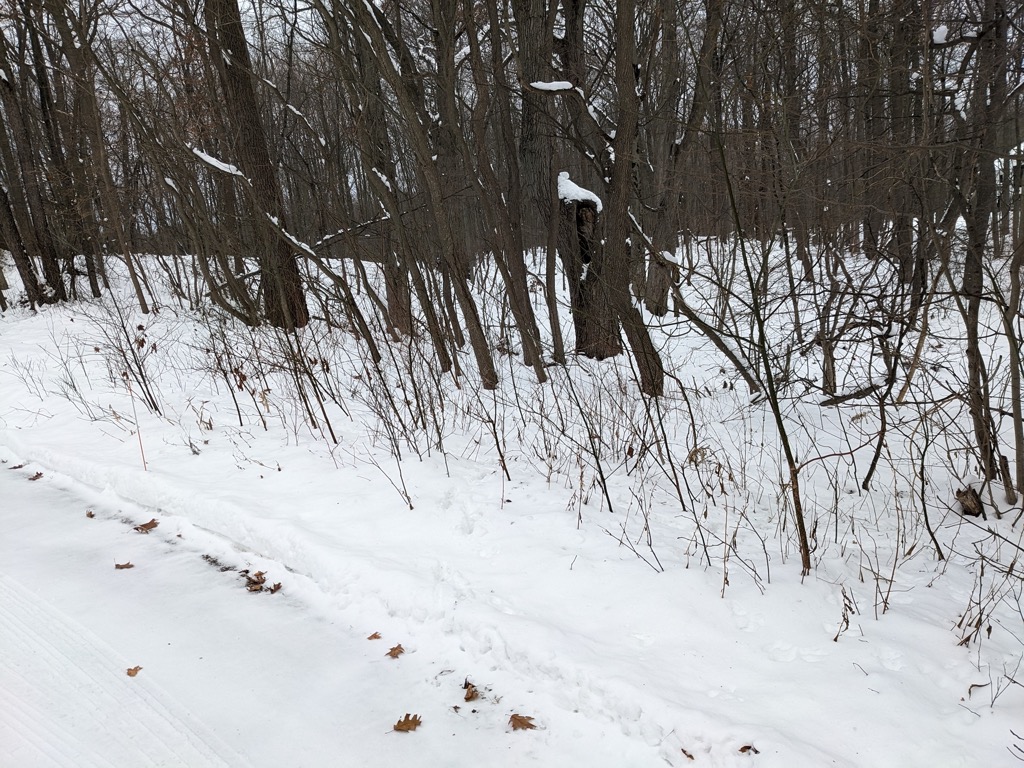
[7]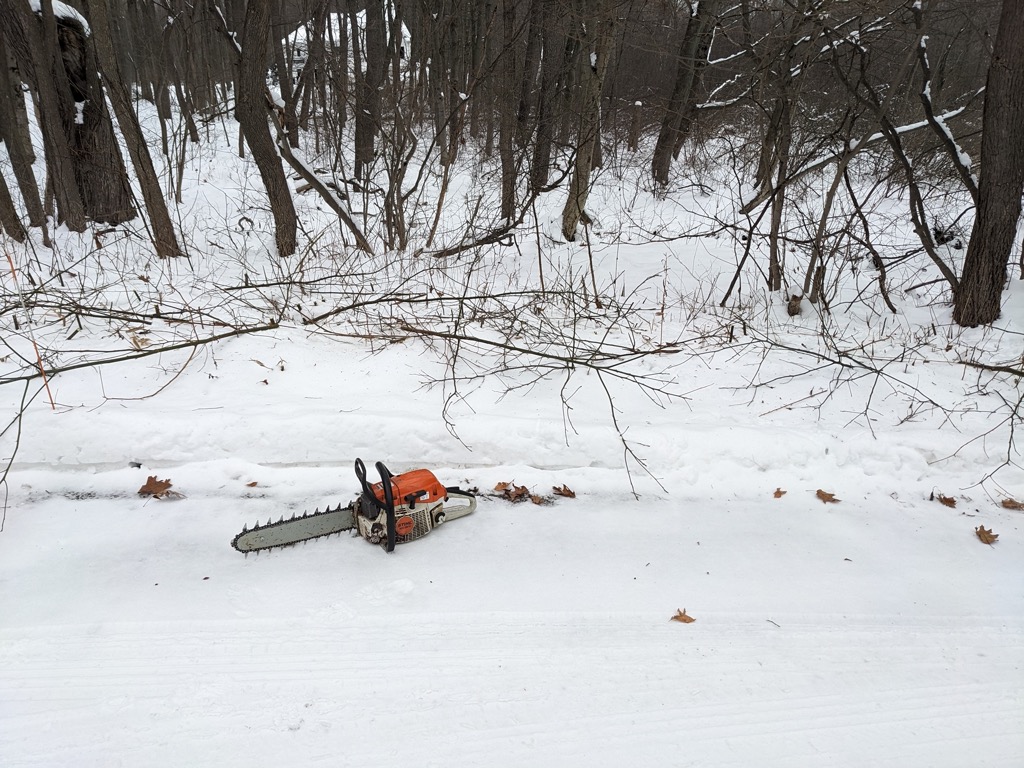 [8]It was a snowy December morning with temperatures in the 20s Fahrenheit. I took the saw out to a brushy area along the driveway and started it up. I then proceeded to trim the brush along the driveway with the Clip-N-Trim equipped saw.
The saw made quick work of the brush, cutting more in 10 minutes than I could typically have cut in half an hour.
I’m writing this review in January. I will need to return to this section along the driveway sometime when there is no snow on the ground. The bottom six inches or so of the brush stumps will need to be trimmed closer to the ground after they are exposed by melting snow.
Chainsaw History
There is evidence from prehistoric times of the use of serrated stone tools to cut wood. Copper saws have been found among Egyptian grave goods dating back to 3100 BC. The use of saws by carpenters was also portrayed on the walls of ancient Egyptian tombs.
In verse 37 of chapter 11 of the biblical book of Hebrews, reference is made to some of the great heros of the Old Testament being martyred for their faith by being sawn asunder. The Jerusalem Talmud relates that the Prophet Isaiah met his death in this way.
Historically, axes were preferred for felling and limbing timber while saws were better suited for cutting logs into planks. The preference for axes was partly due to the fact that the typical two-man saw cost six times as much as the typical axe.
The first chainsaws were designed in the late 1700s to cut the pelvic bone to assist with childbirth [9]. These manually operated saws were used as surgical tools until the late 1800s, when they were replaced by twisted wire saws. The twisted wire saws left a smaller wound channel, and were less likely to leave bone fragments in the incision.
In 1883, a saw was developed that used teeth on a continuous chain stretched between two grooved drums. This saw was developed for the purpose of milling boards.
Later, in 1897, naturalist John Muir developed a chain saw for the purpose of felling of large redwood trees. Since the saw weighed several hundred pounds and was dependent upon a crane for movement, it was not a commercial success.
In 1918, a Canadian millwright developed a truly portable design. After his patent expired, the idea was taken up and developed further by Germany companies in the 1930s.
Andreas Stihl developed an electric powered chainsaw for bucking in 1926. That saw weighed 116 pounds. A year later, in 1927, Emil Lerp, the founder of Dolmar, developed the first gasoline powered chainsaw.
Early gasoline powered chainsaws were designed to be operated by two men. They had handles on both ends of the bar. The saws were so heavy that most of them had wheels.
The onset of World War II interrupted the shipment of German chainsaws to the United States. Domestic production was initiated to overcome this shortage.
The first one-man chainsaw was introduced in 1950. As late as 1959, a typical chainsaw still weighed approximately 26 pounds.
The automatic chain brake was patented by Husqvarna in 1973.
I was surprised to see how radically chainsaw design had changed just during the course of my own lifetime. I was especially interested to see pictures of some of the saws included near the end of a Swiss article about the history of the use of saws for cutting timber [10].
Conclusions
The Granberg Clip-N-Trim does an outstanding job of improving the performance of a chainsaw when it is used for clipping hedges or trimming branches less than one inch in diameter. I highly recommend it.
Disclaimer
Granberg International provided me with a sample of their 16 inch Clip-N-Trim attachment for testing and evaluation. I tried not to allow their kindness to interfere with my objectivity in this review, and I believe that I have succeeded. I did not receive any other financial or other inducement to mention any vendor, product, or service in this article.