Author’s Introductory Note: I am not a medical professional. This article does not constitute medical advice. It merely represents the observations and opinions of an average layperson. Please consult a medical professional about the best training, equipment, and supplies that you should obtain in order to be better prepared for possible emergencies. SurvivalBlog readers who are also medical professionals are strongly encouraged to contribute articles within their areas of expertise to SurvivalBlog. You may provide the vital public service of rescuing SurvivalBlog readers from the simplistic ideas of people like me).
Many first-aid kits are really boo-boo kits. They are designed for the minor cuts, slivers, and scrapes of life.
Other first-aid kits are designed to treat truly life-threatening injuries. These kits are designed for accidents involving things like chainsaws, firearms, or heavy equipment. These accidents can lead to major hemorrhage and death. The JaseAid Trauma Kit from Jase Medical [1] is intended for these types of serious accidents. It contains items that are made to address serious injuries: things like a tourniquet, hemostatic gauze, a chest seal, or a nasopharyngeal airway.
The kit also includes helpful field education cards to explain the use of the various components of the kit. I highly recommend thoroughly studying the cards prior to using the kit in any actual emergency. If you try to read the cards for the first time during an emergency situation, it will already be too late.
Comprehensive training in the use of the various components of the kit would be even more helpful than just studying the cards. If any SurvivalBlog readers have advice about good sources of training to accompany the components of the JaseAid Trauma Kit, please send your comments to the Snippets column or e-mail ThomasKChristianson at gmail dot com.
At the time of this writing, the JaseAid Trauma Kit cost $199.95 at jase.com. I am glad to have the kit. I plan to brush up my skills in using the various components of the kit by participating in the next training session organized by our church’s Safety and Security Team.
Full disclosure: Jase Medical [1] is one of our affiliate advertisers, so we get a small commission if you place an order after following our link.
Background
Back in August of 2025, my review of the Jase Medical Antiobiotic Kit [2] was published on SurvivalBlog. I found that kit to be a potential source of vital medications to have as a part of a disaster preparedness plan.
Over the course of time, I have become painfully aware that most of the first-aid supplies that I have gathered as a part of my disaster preparedness plan are on the “Boo-Boo kit” level. So when I heard about the JaseAid Trauma Kit, I was immediately interested. I contacted Jase Medical [1] to see if they would be willing to provide me with a sample for evaluation. They were kind enough to agree.
Before long, a package arrived via FedEx from Jase Medical [1], 13648 S 200 West, Draper, UT 84020.
Description
 [3]
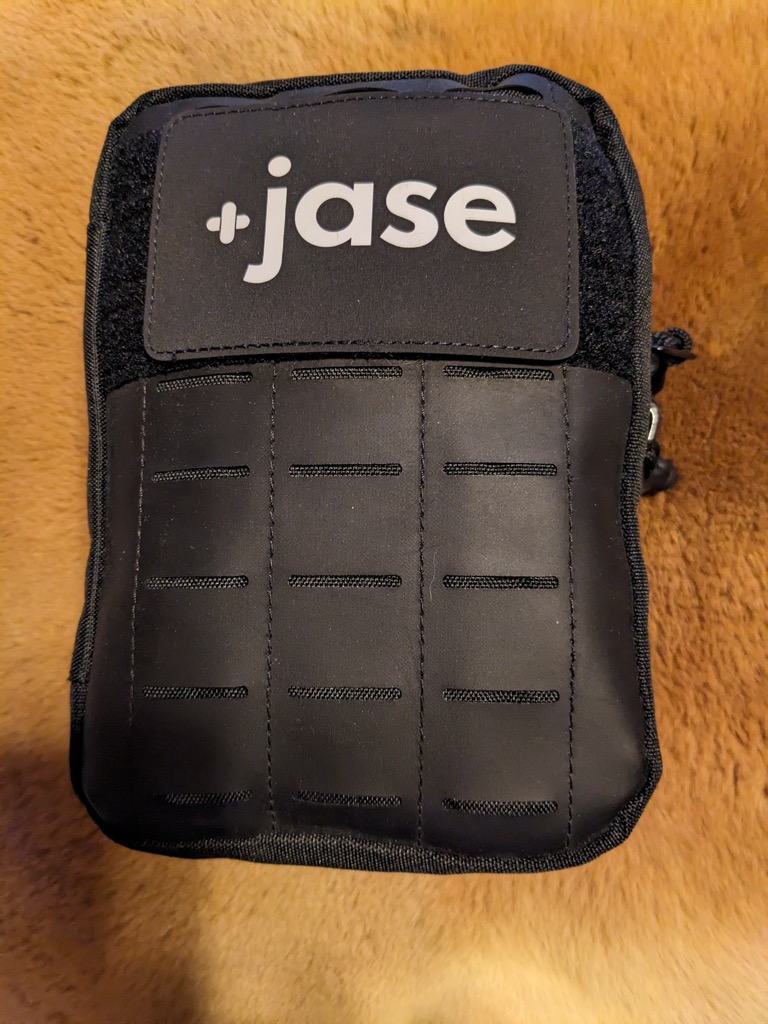
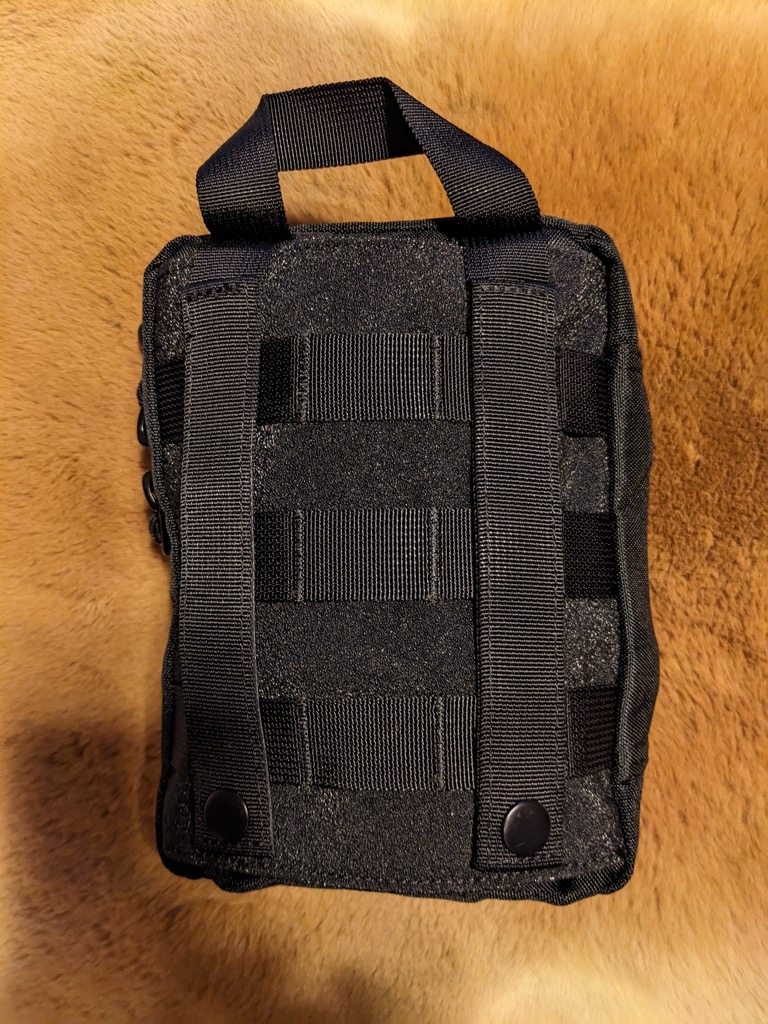
[3]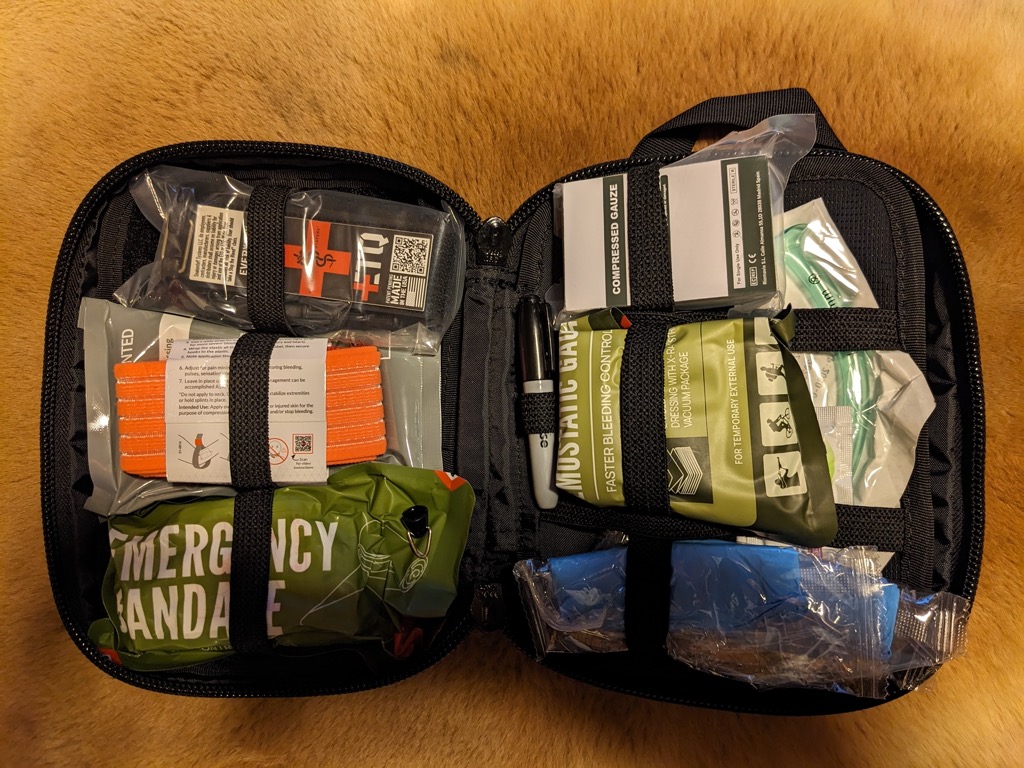 [4]The JaseAid Trauma Kit arrived in an 8.88 x 7.13 x 4.5 inch box which was sealed inside a plastic FedEx envelope. The box contained the Trauma Kit in a black nylon MOLLE-compatible case that was just slightly smaller than the shipping box. It also contained a letter-sized information sheet about the ky. The focus of the trauma kit is to “Stop the Bleed.”
The case is divided into four main compartments. It contains the following items:
1. An ETQ Everyday Carry Tourniquet. The tourniquet is made in the USA by Snakestaff Systems and is compact for easy carry. It is highly rated in online reviews. I estimate its value to be about $31.99 .
2. A Slishman Pressure Wrap. The wrap is made in the USA by Rescue Essentials. I estimate its value to be about $12.95 .
3. Two vented chest seals. They are made by an unspecified manufacturer, probably in China. I estimate the value of the two seals to be about $1.68 total.
4. A four-inch, Israeli-style emergency bandage. It is made in China by an unspecified manufacturer. I estimate its value to be about $6.99 .
5. Compressed gauze. It is 4.5 inches by 4.1 yards, Z-folded, 12 ply, white cotton, and sterile. It is made in Spain by Riomovix S.L. I estimate its value to be about $2.99 .
6. Kaolin Hemostatic Gauze. It is 3 inches by 4 yards, Z-folded, and has an x-ray strip. It is made in China by an unspecified manufacturer. I estimate its value to be about $7.07 .
7. A pair of nitrile gloves of unspecified origin. I estimate their total value to be about $0.94 .
8. A small Sharpie. Place of manufacture uncertain. I estimate its value to be about $0.42 .
9. A 5 gram foil or plastic packet of lubricating jelly. I estimate its value to be about $0.13 .
10. A Nasopharyngeal Airway. Origin unspecified. I estimate its value to be about $3.99 .
11. A good, basic set of instructions for how to use the major components of the kit. I estimate its value to be about $10.00 .
12. A tiny LED light. Useful for making sure that pupils are even and reactive to light. Origin uncertain, likely China. Estimated value about $1.00 .
13. The nylon case itself. Made in Vietnam. Estimated value about $15.00 .
14. Large trauma shears. Origin uncertain. Estimated value about $10.00 .
15. Aluminum eye shield. Origin uncertain. Estimated value about $9.99 .
16. Abdominal pad. It is 5 by 9 inches. Origin uncertain. Estimated value about $0.40 .
17. Emergency blanket. Measures 63 by 83 inches. Made in China. Estimated value about $1.75 .
18. Burn dressing. Measures 4 by 4 inches. Made by Roosin in China. Estimated value about $5.00 .
The various components appeared to be of good quality and are well0selected. I estimate that the total value of the components comes to about $125 . But the whole is more than the sum of the parts. The value added by selecting, ordering, and assembling the components easily brings the value of the kit to an amount that is in excess of its $199.95 price tag.
In Defense of Boo-Boo Kits
By the way, the use of the term “Boo-Boo Kits” to describe typical first-aid kits is not intended to be derogatory. I was reminded of the importance of Boo-Boo kits on the very day that the JaseAid Trauma Kit was delivered. I was taking the dog for a walk. Near the beginning of the walk, I noticed some minor discomfort on the little toe of my right foot. By the end of the walk, the discomfort was significant enough that it was becoming difficult to walk. A blister had developed, burst, and begun to bleed in record time.
In the field, an untreated blister can become crippling. There can be the risk of infection in addition to the reality of significant discomfort.
Some triple antibiotic ointment and a bandaid did a great deal to increase my sense of comfort and well-being. When I got tired of changing bandaids, I adopted an even more effective course of treatment. (Reminder: this is not medical advice). The “dollar” store in our community sells packs of four 0.01 ounce tubes of superglue for $1.25 (Inflation has destroyed the accuracy of the “dollar” store label, just as it destroyed the accuracy of the “dime” store label of yesteryear.)
I thoroughly cleaned the wound and the surrounding area with rubbing alcohol. After the alcohol dried thoroughly, I applied a thin layer of superglue to the wound and the area immediately around it. I allowed that layer to dry thoroughly. I then applied a second layer of glue to a slightly larger area, and allowed it to dry thoroughly as well. For the next week or so, the wound was so well protected that it caused virtually no discomfort.
This is not the first time in my experience that superglue has given more effective performance than a bandaid. In my non-professional opinion, two or three small tubes of superglue make a great addition to a Boo-Boo kit. Medical professionals are invited to contribute more helpful and reliable advice to this discussion.
JaseAid makes a couple of kits that are intended to supplement the Trauma Kit. The Mini Kit is designed for everyday use. It is much like the Boo Boo kits that I have described above. The Medic Kit is designed to be a comprehensive home medical solution. I hope to be able to evaluate both of these kits at some point in the future.
Conclusions
 [5]
[5]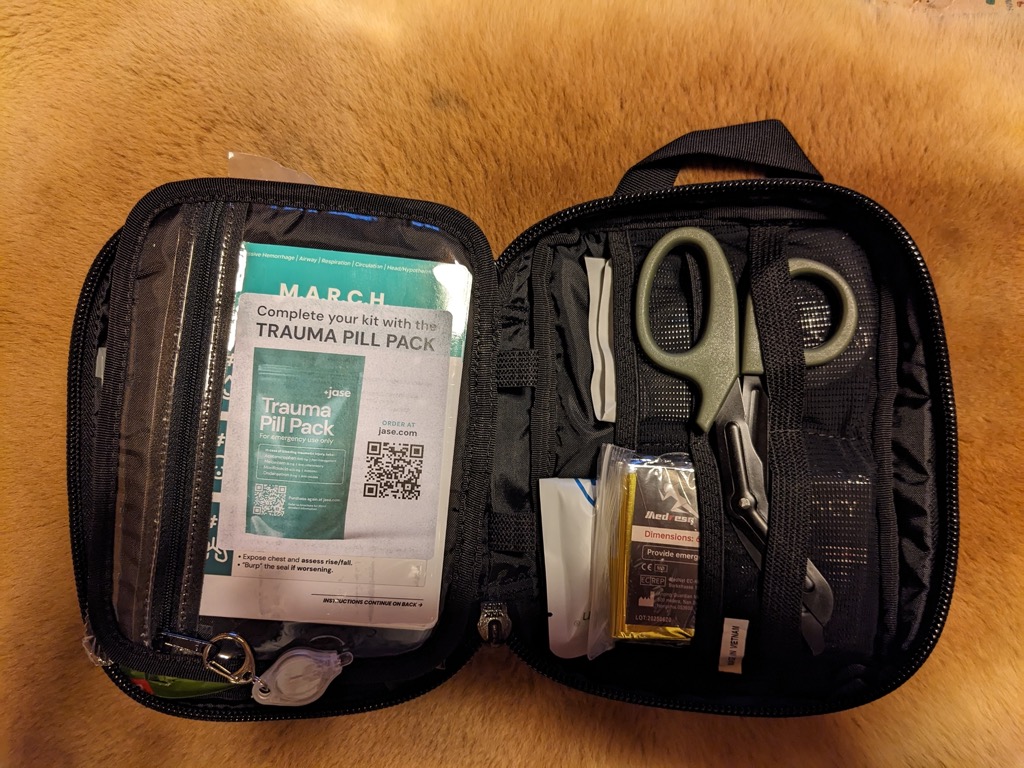 [6]The JaseAid Trauma kit from Jase Medical [1] seems well-designed for the initial treatment of significant injuries which may otherwise lead to a major loss of blood. The kit should be paired with appropriate training in order to provide the most helpful results. At $199.95 I believe the kit to be reasonable priced in light of its contents and organization.
Disclaimer
Jase Medical [1] provided me with a sample of their JaseAid Trauma Kit for testing and evaluation. They had also provided me with a sample of their Medical Antiobiotic Kit for a previous review. I tried not to let their kindness interfere with the objectivity of this review, and I believe that I have succeeded. I did not receive any other financial or other inducement to mention any vendor, product, or service in this article.