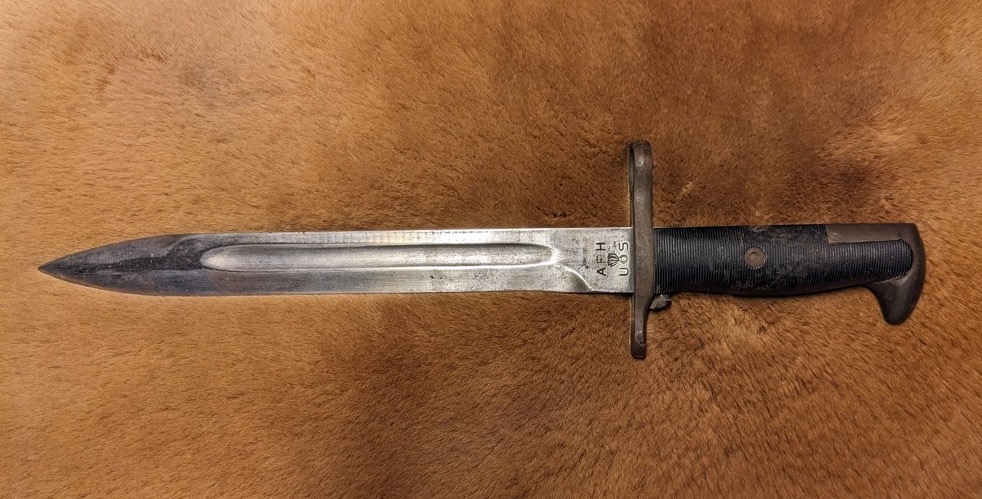
The U.S. M1 bayonet is designed to fit the M1 Garand rifle which was the standard issue American infantry rifle during World War II and the Korean conflict. The M1 bayonet has a 10-inch spear-point blade that is 1 inch wide and has a tang that is around 0.25 inches thick. The blade is made of 1080 carbon steel. The grip panels are made out of black Durez or a similar plastic. The bayonet measures 14.25 inches overall.
The 10-inch blade is long enough to make the bayonet somewhat awkward for everyday tasks like opening cans, prying open crates, or batoning firewood. On the other hand, the blade of the bayonet is rugged enough to hold up under such utility use.
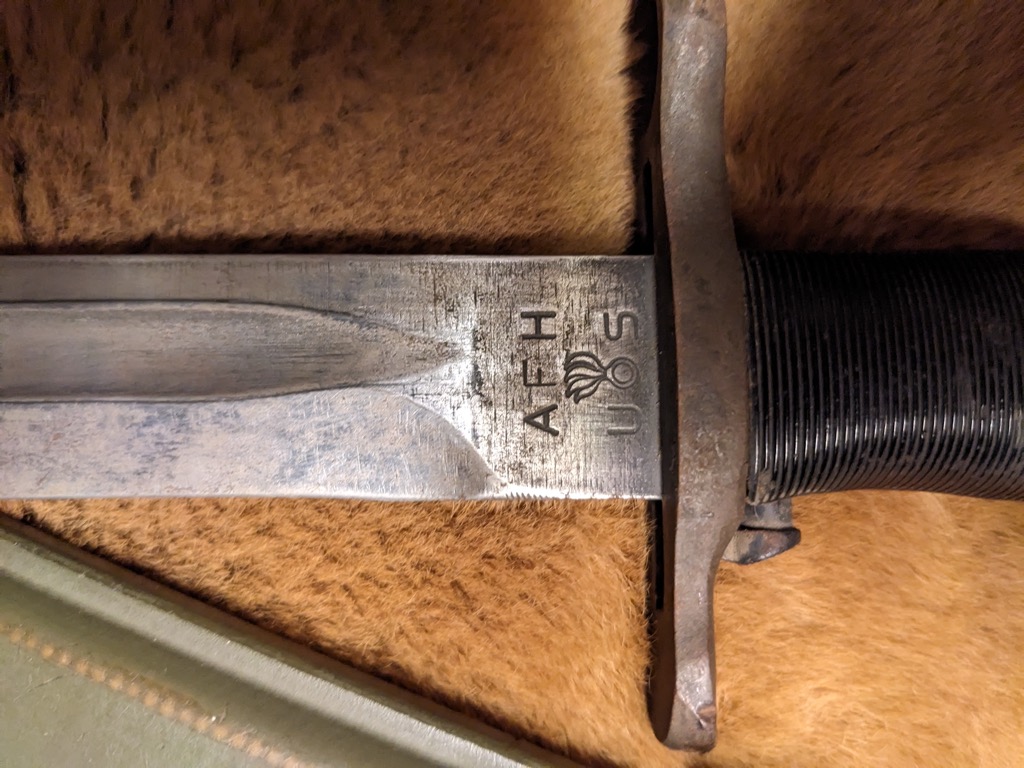 [1]The particular M1 bayonet that is the focus of this review is stamped with the letters “AFH.” This indicates that it was manufactured by American Fork and Hoe. Of the approximately 2.7 million new M1 bayonets manufactured from 1943 to 1945, only about 350 thousand (about 13%) were manufactured by American Fork and Hoe. That makes this particular sample somewhat rare.
If you are looking for a field knife suitable for both combat and utility use, I would recommend something like the OKC-3S or M9 bayonets. Genuine new examples of those bayonets generally cost about $250 at the time of this writing. Used examples typically cost about half that.
If, on the other hand, you are armed with a Garand, then I recommend the M1 bayonet. Replicas of M1 bayonets typically cost about $60 on eBay at the time of this writing. Original bayonets typically cost about $150 (depending upon condition) with especially nice examples running as high as $449.
Deep Background
One dark winter night, a small American patrol moved through a frozen forest. Their mission was to capture some prisoners in order to gather intelligence.
In the frigid darkness ahead, a tiny light appeared. As the patrol crept closer to the light, it revealed itself to be a dying campfire. A small group of German soldiers lay wrapped in their blankets close to the embers, trying to keep warm as they slept.
The American patrol took up firing positions around the German bivouac. The lieutenant leading the patrol had ordered his BAR man to fire a burst from his Browning Automatic Rifle into the air once everyone was in position. He was hoping that this evidence of overwhelming firepower would intimidate the Germans soldiers into immediate surrender.
The BAR man pulled the trigger. Nothing happened. The action of the BAR was frozen and inoperable. One by one, the other members of the patrol attempted to fire their rifles. One by one, they also found their weapons to be frozen and inoperable.
Finally in desperation, the lieutenant reached under his field jacket and pulled a his 1911 out of a shoulder holster. Kept warm by his body heat, the .45 fired when he pulled the trigger.
Awaking with a start, the German soldiers found themselves staring into the barrels of the American patrol. Unaware that the rifles were frozen, the Germans quickly surrendered. The patrol led the captured Germans back to the relative safety of American lines. They then expended fervent efforts to get their rifles back into operating condition.
Fast Forward Almost 82 Years
It was Thanksgiving Day 2025. My youngest daughter, “Rivkah”, was at our house for dinner. During the course of the meal, she mentioned that she had somehow ended up with my father-in-law’s bayonet and compass from World War II. She wondered if she should entrust those items to a different family member. I recommended that she keep the items, but asked if I could borrow the bayonet for examination. Rivkah agreed to my request, and brought the bayonet over the next day.
The most intriguing thing about the bayonet is that my father-in-law should have a bayonet at all. Dad was the BAR man in the story above, which took place during the Battle of the Bulge. As a BAR man, he would not have been issued a bayonet. He would have been issued an M3 fighting knife, instead.
The M1 Family
The M1 bayonet is a direct descendant of the M1905 bayonet. The M1905 was designed for use with the M1903 Springfield rifle. When the M1 Garand was adopted as the US Army’s new service rifle, it was designed to fit the M1905 bayonet, since large stocks of the M1905 were available in storage, left over from World War I.
The M1905 bayonet has a 16-inch spear-point blade that is 1 inch wide and has a tang that is around 0.25 inches thick. The blade is made of 1080 carbon steel. With the addition of its handle, the bayonet is 20 inches overall. The handles of the World War I era M1905s were made of walnut wood.
As war clouds gathered on the horizon in the early 1940s, it was decided to resume production of the M1905. The handles of these World War II era M1905s were made of Durez or a similar plastic.
 [2]
[2]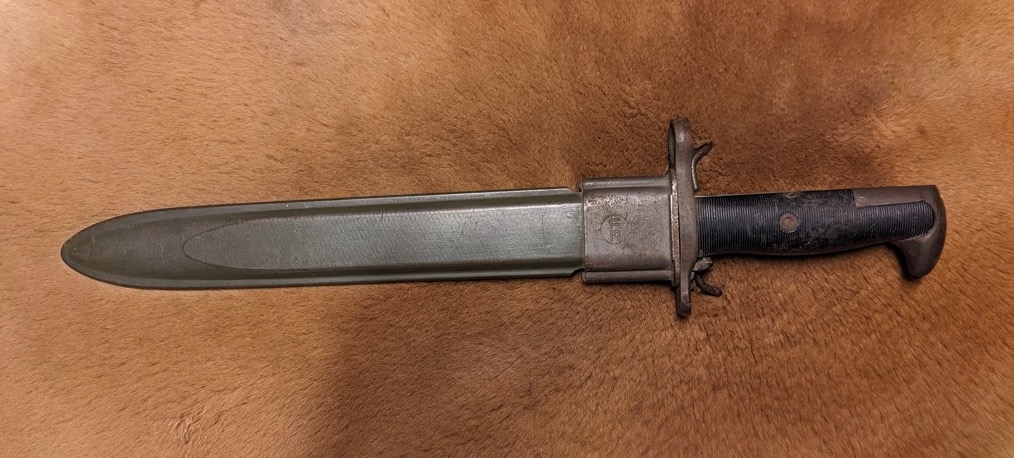 [3]After due consideration and testing, the Army decided in 1943 that a 16-inch bayonet was just too long. A shorter bayonet would still be long enough to penetrate the vital organs of an enemy while being easier to manage. They decided to shorten the blade of the M1905 to 10 inches. In its new length, the bayonet was designated as the M1.
Approximately one million M1905 bayonets were recalled, cut down in length, and reissued. As the supply of surplus M1905 bayonets began to dry up, the focus turned to the manufacture of new M1 bayonets.
The M3 Family
The M3 fighting knife has a 6.75-inch blade that is 0.94 inches wide and has a tang that is around 0.13 inches thick. The blade is made carbon steel, and the handle is made of wood or of stacked leather washers.
The M3 was adopted by civilian planners over the objections of the US military. The civilians liked it because it could be quickly and economically produced by small businesses, thus allowing private industry to more smoothly reconvert to peacetime goods production after the war. More than two-and-one-half-million were manufactured in 1943 and 1944.
The thin tang and spine of the M3 made it too fragile for utility use. As a result, they were broken or abandoned in large numbers in the field.
When a bayonet was sought for the M1 Carbine, a bayonet ring was added to the hilt of the M3 and a locking mechanism was added to the pommel. This modification was designated at the M4 bayonet. In a way it was somewhat appropriate that a smallish rifle should be equipped with a smallish bayonet.
In Korea, soldiers found it difficult to fix M1 bayonets on their Garands while wearing gloves. The basic M3 family design was modified with a stud on the cross guard, a larger push button release, and a plastic rather than a wooden or leather-washer handle. This was the M5 bayonet.
When the Army transitioned from the Garand to the M14, the basic M3 family design was adapted to the M14 and became the M6 bayonet. Then, when the M14 was quickly supplanted by the M16, the basic M3 family design was adapted to the M16 and became the M7 bayonet.
This perpetuated a design that was effective for penetrating vital organs but poor for the more utilitarian tasks for which knives and bayonets are most often used. About the only advantages of the M3 family over the M1 bayonet are weight (about 9.6 vs. 14 ounces) and length (about 11.75 vs. 14 inches). The shorter blade was still long enough for combat use while being less awkward for utility use.
Dad’s M1 Bayonet
I did not talk to Dad about his bayonet before he passed away, but I have a theory about why he carried an M1 bayonet instead of an M3 fighting knife. My theory is that he recognized the M3 as being too flimsy for practical use. So he discarded the M3 and carried an M1 instead.
If my theory is correct, it was a decision that demanded a certain amount of personal commitment. The BAR that Dad carried weighed about 16 pounds unloaded. In contrast, the M1 Garand rifles which were issued to most of the rest of his squad weighed “only” about 10 pounds each unloaded. The M3 fighting knife that he would have been issued weighed about 8 ounces. In contrast, the M1 bayonet weighed about 14 ounces. It appears that Dad was willing to carry some extra weight in order to pack some extra punch.
American Fork and Hoe
As I mentioned above, Dad’s bayonet was manufactured by American Fork and Hoe.
From ancient times there has always been a certain overlap between agricultural implements and weapons. For example, the Old Testament prophets saw a coming time of God’s wrath when the world would be plunged into war. During that time the nations would beat their plowshares into swords and their pruning hooks into spears (Joel 3:10). But eventually, God would establish His kingdom of peace. During that time, the nations would be able to beat their swords into plowshares and their spears into pruning hooks (Isaiah 2:4, Micah 4:3).
So it should not be too surprising that during World War II, companies associated with domestic tranquility should manufacture M1 bayonets. These companies were the Union Fork and Hoe Company, the Utica Cutlery Company, Pal Blade and Tool Company, the American Fork and Hoe Company, and Oneida Ltd.
American Fork and Hoe made about 350,000 M1 bayonets by shortening longer (16 inch) M1905 bayonets. They also made about 350,000 new M1 bayonets. The shortened bayonets can be distinguished from the new production bayonets by the length of the fuller on the side of the blade. On the shortened bayonets, the fuller extends all the way to the end of the blade. On the new production bayonets, the fuller begins about 3 inches from the tip of the blade and extends about 6 inches toward the handle. The fuller on Dad’s bayonet indicates that it was one of the new production units.
American Fork and Hoe manufactured the new-production bayonets from 1943 to 1945.
Dad’s M1 Bayonet
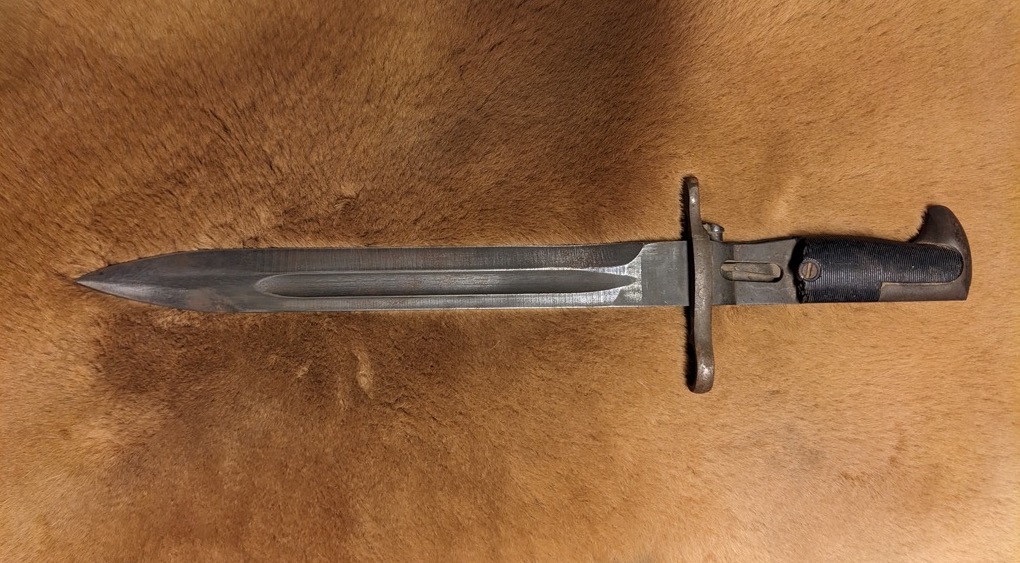 [4]The black plastic scale on the right side of the handle of Dad’s bayonet is broken in half at the retaining screw. The blade is not Parkerized, unlike many other M1s. There is a significant patina on the hilt and pommel of the bayonet, but the blade is surprisingly shiny.
The 11.13-inch scabbard is made of resin-impregnated canvas. It was manufactured by Victory Plastics Company of Hudson, Massachusetts.
I was not eager to meddle with an historical artifact by removing the patina from the hilt, pommel, and the throat of the scabbard or by polishing the blade. I did, however, take the liberty of trying to sharpen the blade at Rivkah’s request. I have a sense that blades ought to be shaving sharp, even if they are historical artifacts.
In the past I have often found 1080 carbon steel to be challenging to sharpen. The blade of the M1 was no exception. Four long sessions with the AccuSharp Diamond Pro 2 Step Knife Sharpener were not sufficient to bring the knife to shaving sharpness. I was hesitant to undertake more extensive sharpening, so I finally reconciled myself to a blade that was less than shaving sharp.
Some Bayonet History
The first bayonets were simply knives with handles designed to fit inside the barrels of firearms. These are called plug bayonets. Because they were inserted into the barrel, the firearms could not be fired while the bayonets were fixed.
During the battle of Killiecrankie in 1689, Jacobite forces attacked so quickly that supporters of William of Orange did not have time to insert their plug bayonets into the barrels of their muskets in order to repel the attack. This motivated the invention of the socket bayonet, which fit around the end of the barrel so that the weapon could be fired while the bayonet was fixed.
Spike bayonets were commonly used with muzzle-loading weapons. When repeating weapons were developed, bladed bayonets became more commonly used. This was a tacit acknowledgement that the bayonet was now somewhat less likely to be used in combat, and thus needed to be better suited to more utilitarian tasks in order to justify its continued existence.
As the standard service rifle transitioned from bolt action to semi-automatic and then to selective fire, bayonets tended to become progressively shorter. As combat use continued to become less likely, utility use became an increasingly more important facet of the bayonet’s existence.
The development of the M4 bayonet from the M3 fighting knife bucked this trend. It left American soldiers with a bayonet that was not practically useful due to the fragility of its blade. Its heritage in the M5, M6, and M7 bayonets left American soldiers poorly equipped until the introduction of the M9 bayonet in 1986.
Conclusions
The M1 bayonet is well-designed for use as both a tool and as a weapon. The blade is sturdy enough to withstand practical use and abuse. The blade is long enough to penetrate deeply into an opponent’s vital organs in order to release large amounts of blood and so quickly render the opponent combat ineffective.
In my opinion, the M1 bayonet is infinitely superior to the M4, M5, M6, and M7 bayonets that were descendants of the M3 fighting knife. I find the blade of the M3 and its offspring to be just too flimsy for practical field use. Realistically speaking, a bayonet will often be used as a tool to open crates and cans, strip wires, cut shavings for kindling and similar tasks. On certain rare occasions, it will also be used as a weapon. A good bayonet should be designed with both uses in mind.
About the only change that I would make to the design of the M1 bayonet would be to shorten the blade by about three inches. That would leave the blade long enough for effective use as a weapon while making it a little more handy for use as a tool.
I hope that I never need to engage in hand-to-hand combat. But I am glad that my family owns an M1 bayonet. It is a reminder of the courage of my father-in-law as he engaged in the dirty and horrifying work of defending our freedom. May America never lack for rough men ready to do violence on our behalf upon those who wish to harm us. And may America never lack the decency to show mercy to those who do not wish to harm us.
Disclaimer
I did not receive any financial or other inducement to mention any vendor, product, or service in this article.