A lot of mundane people have workshops, and a lot of preparedness-minded people have workshops, but not all of those preppers have a workshop that is properly prepared for many of the scenarios that they are concerned about. Perhaps this is because they do not see the role a workshop plays in preparedness. What distinguishes the prepared workshop from others is that the owner has:
- Learned key skills
- Acquired apropos tools, and has,
- Stocked hardware on a “just in case” footing.
This approach differs from the ordinary workshop that is inadequately prepared and hopefully will never going to be needed for anything out of the ordinary. The prepared workshop warehouses tools, hardware and supplies, which is not to be confused with hoarding anymore than what a hardware store does. This logistical base is planned to be able to deal with most foreseeable repairs, maintenance tasks, or calamity that may occur without any outside help; no service call, no trip to the hardware store, no Internet. As if it were an island.
This approach is not concerned frugality but with having plenty. The risk involved maintaining this workshop is never having a need for the skills, tools or hardware that it is equipped with. It is prepared for the foreseeable as well as the unforeseen. If we stocked our pantry like I stock the shop we would have food products that we never have had but maybe someday might need, just in case. It is easy to stock our pantry because we can easily forecast what we will be eating in the foreseeable future in any kind of normal or emergency situation. Preparing the workshop requires research and planning in making a forecast — a calculated guess –based on what is probable. That means that it isn’t stocked with every single thing imaginable, but with practicality and probability in mind.
The typical unprepared workshop relies heavily on service calls, trips to the hardware store and Internet searches when a situation requiring repair or maintenance occurs. I frequently see posts on social media asking for suggestions for a good appliance/washing machine repair person in the area. I don’t want to ever have to do that if I can do the work myself. Since good reliable home repair contractors don’t have the time or need to search social media for work, the most likely responses might be home service scam artists, who have found easy prey in the home service repair market. Learning how to do routine maintenance and basic repairs can eliminate the need to depend on expensive or questionable service.
Distance from supplies and service is a big influence on how well people feel they need to be prepared. Someone living in an apartment in an urban setting with hardware stores within minutes of walking distance is in a different situation than someone in a remote rural location that is hours from any resources.
An unprepared workshops is also subject to supply chain disruptions, inflation and obsolescence of good long-lasting products being replaced with throw-away versions.
How can you transition an ordinary workshop into a prepared workshop? Starting with acquiring skills and know how, a library needs to come together. This will consist of manuals of all tools and appliances for the household as well as anything structural in the house, like doors and windows. Manuals, however, need some work to make them more practical. The first thing I do is to cut out all the pages printed in foreign languages. I also cut out all the pages of common sense warnings, most of which are electrical shock warnings, but if you need to read them you should read them. Removing this detrius can reduce the volume of manuals by up to 90%. If you have any intention of selling those items someday, then you might want to keep those manuals as-is and find and print an online copy for your own use. I keep all my “cropped” manuals in a filebox in my workshop library. I search for and store a digital version of every printed manual to print if the hard copy is lost or destroyed.
Books, magazines and videos relating to any potential incident should be acquired from bookstores, used goods outlets, garage sales, auctions. Libraries often will have annual book sales in which one can find books and DVDs for this purpose. One can take notes from online videos now while they are available. As for example, the “Ask This Old House” television series can be purchased in DVD format. That show is the most basic encyclopedia for the prepared homeowner to have. By far, the best “how-to” reference resource is the SurvivalBlog archive USB stick. I consider it a “must have”. I can think of numerous articles in the SurvivalBlog archives that are the best anywhere for thoroughness and relevance to their respective topics.
JWR Adds: There are also online video capture software tools [1] that can allow you to save “how-to” videos that you find on YouTube of elsewhere on the Internet. Doing this is generally legal with public domain videos, or as long as the archive is for your personal use, and you do not sell or otherwise distribute copies. Keep you archive copy on either a USB stick or a compact backup hard drive that is USB-powered. Mine is an “armored” 1 Terabyte drive, made by Silicon Power (SP).
 [2]
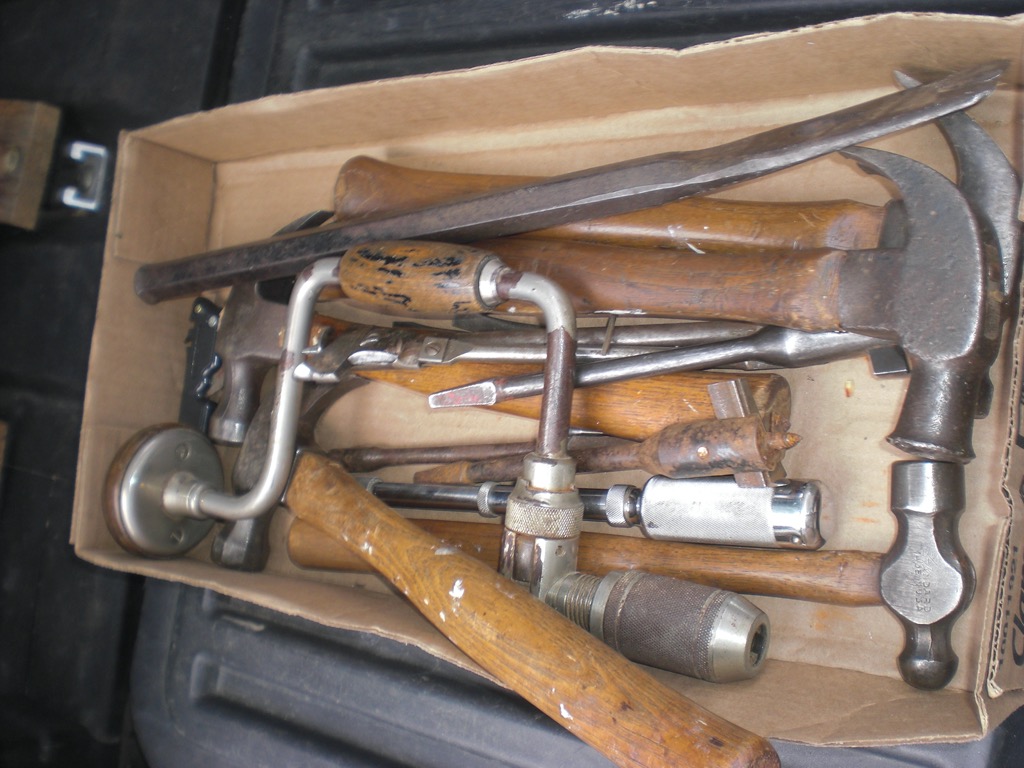
[2] [3]Besides the reference resources in your library, a way to learn what you might need is to simply browse the sections in a hardware store; plumbing, electrical, tools, hardware, garden, appliances, garage, pets, kitchen and so on. It is a good way to familiarize yourself with whatever might be needed in your particular household systems. However, the real treasure chest of information can be had by visiting estate sales of long term homeowners as well as garage sales to see what others have needed for their household. (The photo at the top of this article shows the assortment of tools that I inexpensively bought at an estate sale.) Here, you cannot only acquire knowledge but some great deals in hand tools, hardware and barely-used cans of paint. Garden tools, wheelbarrows, lawnmowers, snowblowers can often be picked up for giveaway prices. Online auctions will always have very thorough photos and is a good place to look for ideas even if you have no intention of bidding. An easy way now to get an idea of what kind of homeowner tools and hardware people use would be to do an online image search for “homeowner tools”.
Your location and housing and belongings are the biggest factors determining how your workshop is to be prepared. Every workshop is unique and evolves as circumstances change. One must continuously adapt. There is no one single perfect workshop for everyone or even the same person. Apartment life has vastly different needs from that in the country, small town or big city. What remains the same in all situations is being stocked and ready for any foreseeable need according to what works in each specific scenario.
The prepared workshop isn’t a gloomy doomsday bunker nor is it a man’s cave party hangout. It can be either one of those as long as it is at least serves the function of a prepared workshop. The shop can also be outfitted as your disaster headquarters where you have an emergency radio and other communication equipment. There are a good number of books on workshop and workbench designs that explore shops in closets, pantries, attics, garages, basements and warehouses. My favorite books on those subjects are about woodworking shops and workbenches that were published by Taunton Press and are informative for planning any kind of shop.
Every workshop should be prepared to work without electrical power for tools, lights and climate control. No air compressor, no table saw, no arc welder, no dust control. For me a generator is not a solution as it just wouldn’t make sense for me to put out the kind of money that would be requird to operate the equipment I have. For me a generator is to preserve household concerns, not power tools. Besides that, I have adapted to the possibility of a long term power outage by developing my hand skills and senses. I once visited an Amish workshop with a foot-pedal powered grinder in a dim workshop with the only light coming from windows across the shop. From that experience I have practiced working in unlit work spaces by allowing my eyes to adjust and using my hearing, for example, to fill up water containers by the sound it makes as it reaches the top. I once had my right arm in a bandage and a sling so I had to learn how to use my left hand to hammer, write, and use all other tools as best I could. In any case, don’t do anything risky and always have a first aid kit ready to use.
After employing all of the typical security lights, cameras and motion detectors as well as taking common sense measures concerning windows and garage door vulnerabilities, it helps to be discreet. Neighbors are going to know that you have power tools if you operate them, that’s okay. What I don’t want is for passers-by to know that. This can be a problem on Saturdays when an open garage door can slow down traffic for those who are cruising for garage sales. When it is not favorable to have the doors closed on a nice sunny warm Saturday an easy way to defer curiosity is to leave your vehicle in the driveway with the hood up. That way it looks like you’re working on the car and not having a garage sale.
In some neighborhoods there seems to be an unwritten rule that if you are doing work in your driveway it is an invitation for nosy neighbors to visit, (but rarely if ever do they offer to help). Once they’re in your driveway they are only steps away from your workshop. Usually that is okay, but if it isn’t okay with you, keep your work out of the driveway or your doors closed. One of my neighbors that frequently visited would point to some oddball item I had and would ask what I had that for. I have learned to always have an answer ready, which is that I had it ‘just in case” I might need it someday. Depending upon the oddity of the item their response will either be a head nod indicating approval or rolling eyes for “you got to be kidding”. Either way, I get by with it..
A preparedness-minded workshop will have all the common shop features of any shop, but it has one significant requirement unique to all preparedness topics: storage. Clutter and disorganization will make any inventory useless. Remember the old adage: “If you can’t find it, then you don’t have it”. Storage of inventory requires space, containers, shelving and a record of what it is, and where it is. As you browse all the offerings of toolboxes, toolchests, and storage systems, consider building your own. Cardboard boxes of all sizes can be had for free and can make good storage containers. Do not forget to safeguard your treasure where not only thieves but also rust can destroy. Rust is a hidden thief and there is scant information on how to deal with it. On a hot and humid day when the temperature drops overnight a layer of rust can be everywhere. I use plastic sheets and bags to cover tools and hardware.
Lastly, can every prepared homeowner have a prepared workshop? Yes, size doesn’t matter, it can be a kitchen drawer with a hammer, screwdriver and a pair of pliers and a kitchen table for a workbench plus a little know-how to do things around the place. My daughter got a start with the stocked toolbox I gave her when she got her apartment, and when she needs a service call, she knows who to call.