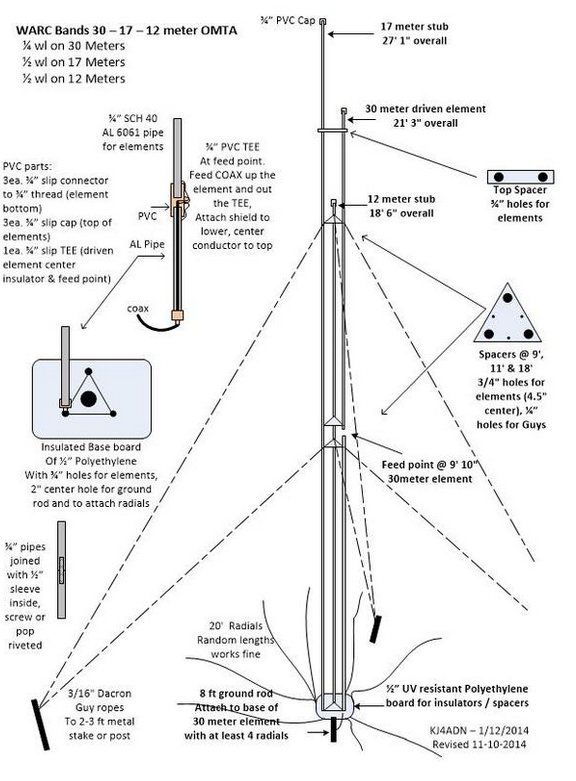
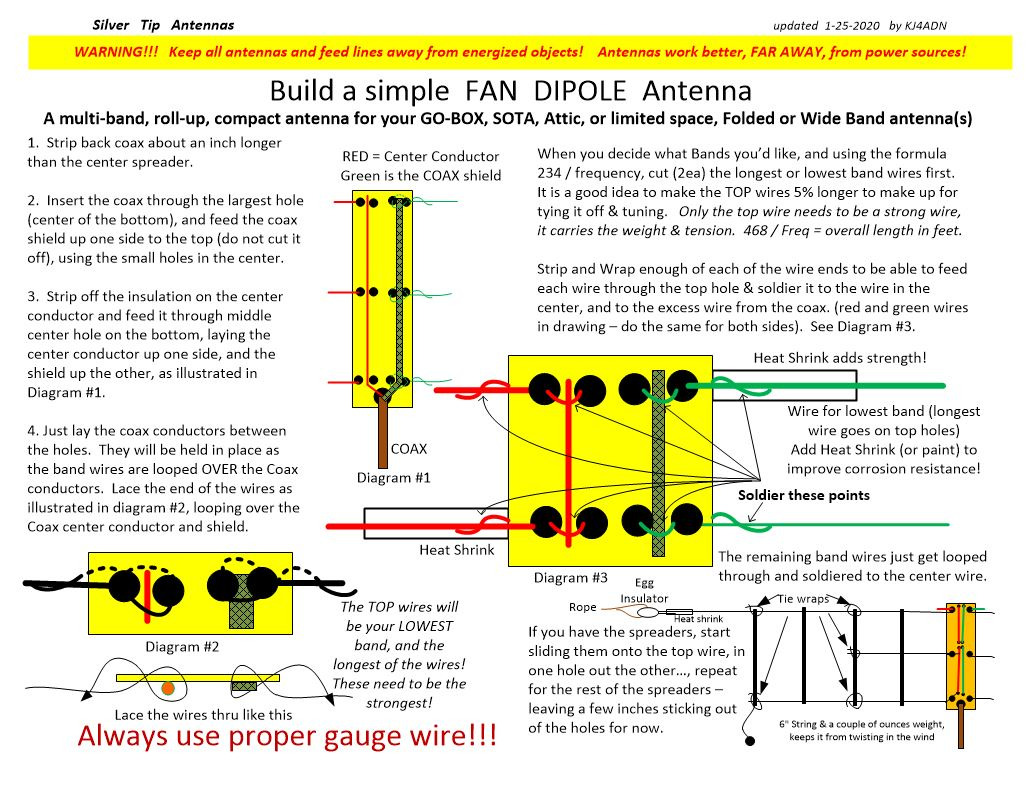
As a public service, I’d like to share my ham radio antenna designs with SurvivalBlog readers. We handed out these antenna-building diagrams, free of charge, at Hamfests. We sell laminated copies of wall charts and pocket band charts.
Below, I am including drawings for Fan Dipoles and OMTA Verticals. (The original idea was Robert Wilson, a nice guy, we shared several ideas, but, after improving on his “math-inspired idea”, we designed and built many iterations of a more practical design.) For the Fan Dipoles we sell a kit without wire, or a complete build. Please note that the Fan Dipole drawings represent years of testing and learning ‘the hard way’, what works and lasts, and what fails in performance and longevity
As I mention at my web page: Nothing special in the ever-changing Shack, the Antenna farm consists of Open Stub J-poles for 2m & 70cm (KJ4AMU design & build). 6m turnstyle, 3 OMTA verticals for 40-20-17/15m (AK7KK design [1], but modified) -and- 1 OMTA 30-17-12m. A pair of 80m 1/4 wave co-phased verticals, TRI-vertical arrays for 40m & 20m. All these are tuner-less, trap-less, etc., band-resonant antennas. I am hesitant to talk about radio brands and models – because it’s the antenna that makes or breaks the receiving ability of the best or worst radio.
We’re like most hams: We started with multi-band, wire antennas, and moved to mono-band antennas & resonators – because the performance and usable bandwidth is greater. My idea of “tuning” is in building the antenna for Resonance, not to “tune” it while I operate it. Improving the Match (SWR) gets far too much emphasis – even ladder line is affected by rain and wind.
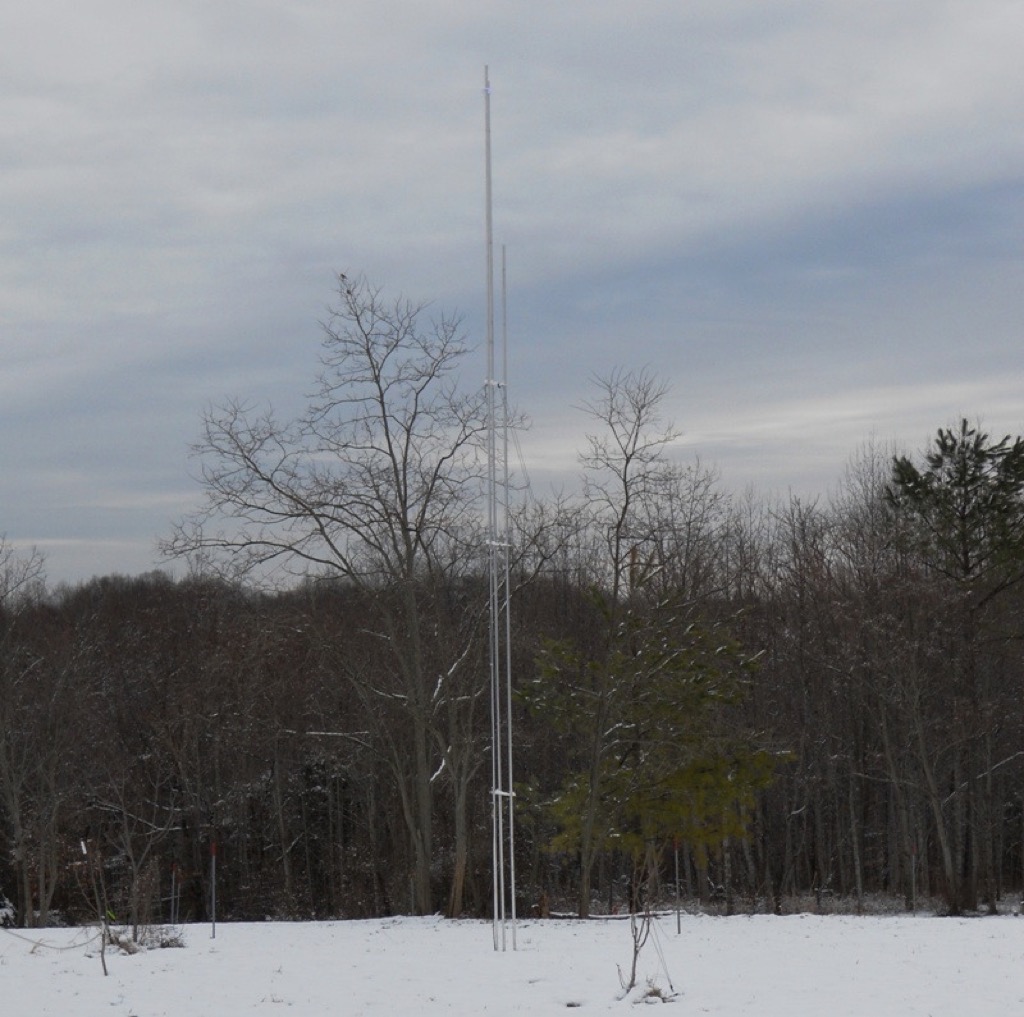 [2]The picture on the left in the snow is 1 of 3 OMTA 40-20-15/17 antennas at the QTH. It is my “Workhorse” antenna that we kept “modding” to get the components right to withstand wind, UV radiation, guying, et cetera. The actual resonator lengths haven’t changed in nine years, and it’s been struck by lightning at least once – the RG-214 buried feed line had a hole blown through it, part of the center conductor was vaporized… But the heavy Aluminum pipe is a “build-once” item.
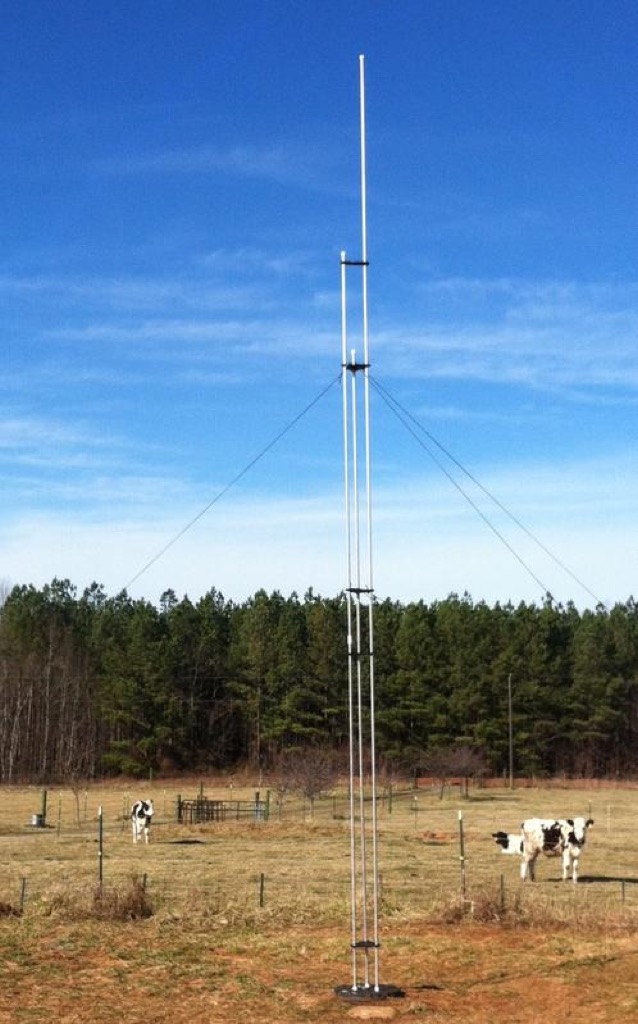 [3]We have three of these 40-20-15 OMTAs on the farm, one for me, 2 for the kids. A 30-17-12 OMTA (photo at right and at the top of this article — with cows, viewed from the front yard) and a roof-mounted 2m/70cm for the ‘house radio’ – wall mounted, in the living room for ‘NETS’ and emergency use, and for use with a shortwave listening (SWL) radio — an ICOM IC-7000.
Here are the two antenna construction handouts: